Bau.Salz
Basic information
Project Title
Full project title
Category
Project Description
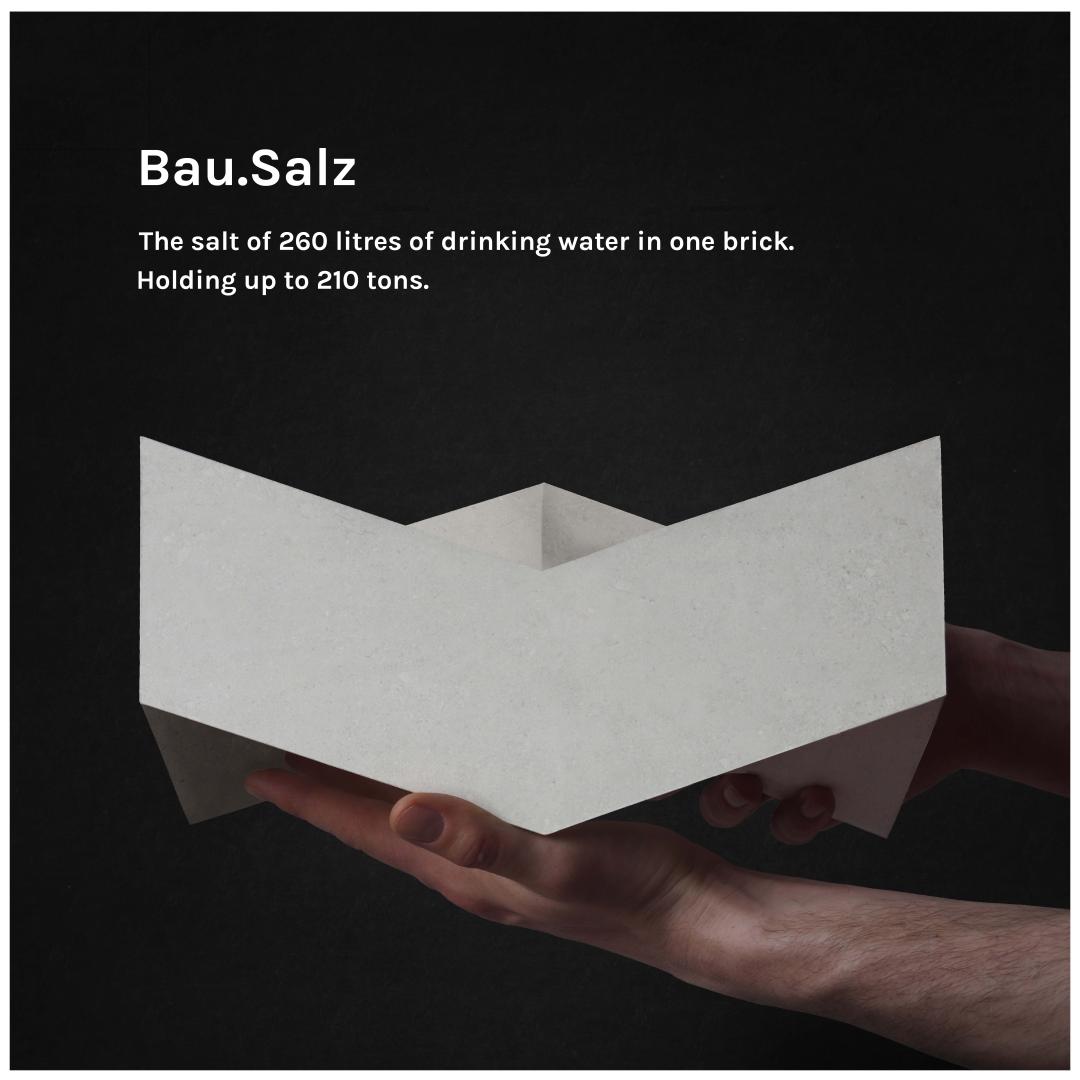
Imagine an affordable building material that shines like porcelain, has a positive impact on your health and safes maritime ecosystems.
When drinking water is produced by desalination, a highly concentrated salt brine is produced as a waste product. Until now, being dumped back into the sea, Salt has dramatic consequences for the environment. Bau.Salz demonstrates the potential of an unused resource: an environmentally harmful waste product is transformed into a high-quality building brick.
Project Region
EU Programme or fund
Description of the project
Summary
Imagine an affordable building material that shines like porcelain, has a positive impact on your health and safes maritime ecosystems.
When drinking water is produced by desalination, a highly concentrated salt brine is produced as a waste product. Until now, being dumped back into the sea, Salt has dramatic consequences for the environment. Bau.Salz demonstrates the potential of an unused resource: an environmentally harmful waste product is transformed into a high-quality building brick.
Not only the utilization of salt itself has a good impact on our environment, but every processing step from the raw material to the final product follows the principle of sustainability and considers the whole buildings life cycle.
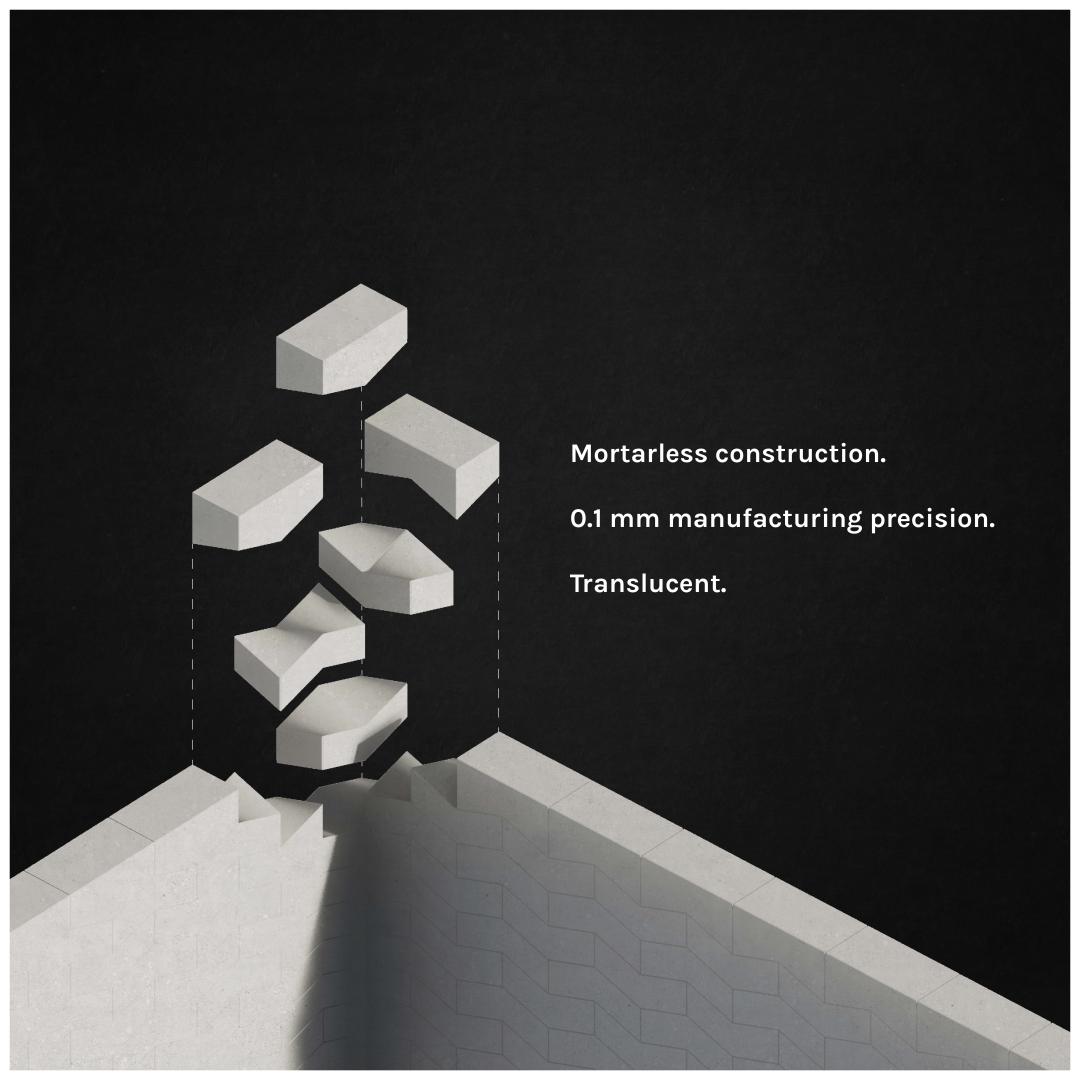
By means of a smart, elaborated design the masonry blocks interlock with each other. This enables an omission of cement mortar and creates seamless, translucent bonds. The result is a brick that can barry just as much as the conventional ones- but without being burned or the use of emmision-intensive materials.
Despite its good impact on the health and climatic properties, Salt still is an underestimated material in the construction industry. Bau.Salz changes that, to make a contribution to a more sustainable desalination process and by that means counteract the fact that 2.2 billion people do not have regular access to drinking water.
As students from the Bauhaus-University we adapted the radical way of breaking conventional patterns looking for holistic solutions to the problems of our generation.
Key objectives for sustainability
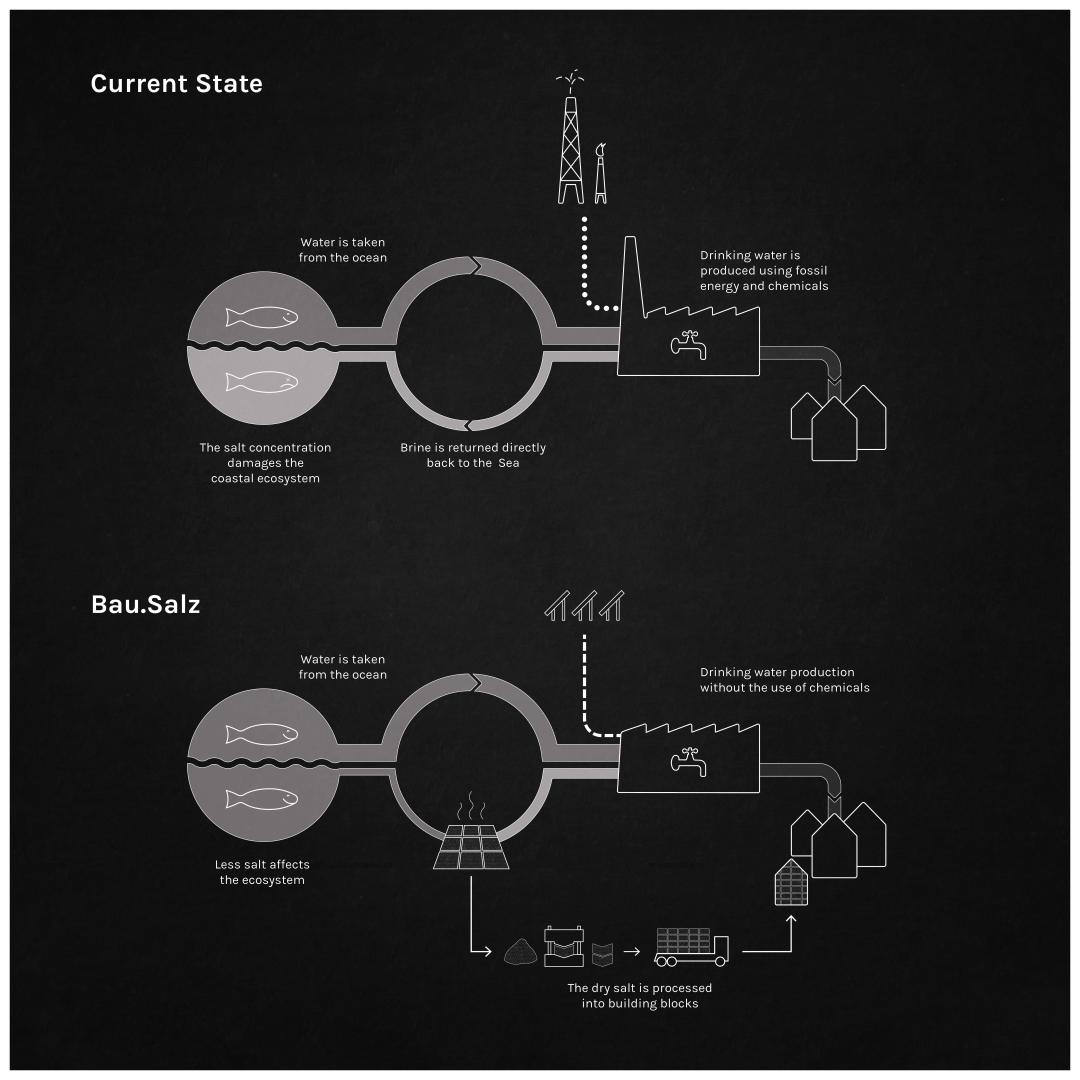
For every litre of produced drinking water, about 1.5 times as much brine is produced, which until now is led back into the sea or seeped into the ground. The consequences for the environment are dramatic: groundwater, which already is a rare resource, becomes saline and unusable. In the sea, the increased salt content leads to a lack of oxygen, thus depriving fauna and flora of the basis of life. Bau.Salz aims to prevent this punctual recirculation and therefore reduce the burden on the environment.
To prevent as much salt as possible from being returned, the sodium chloride is compressed under mechanical pressure. The result is a load-bearing brick that, compared to other claybased bricks, is produced in an energy-efficient way and without the use of fossil fuels.
The shape of the mansory is designed in such a way that each stone interlocks with another by means of double-curved surfaces in two directions. This not only eliminates the need for CO2-intensive cement mortar, but also allows the structure to be easily disassembled into its individual segments. In the long term, this increases the service life of the building, as it is easy to replace or repair individual stones. By using purely natural substances, the building material is 100% recyclable.
Protection against moisture is ensured by the greatly reduced surface of the building block and an additional, biodegradable coating, so that Bau.Salz can also be used for exterior facades.
In order to pursue the idea of sustainability consequently, architecture made of Bau.Salz should only be built locally in the vicinity of the more than 16.000 desalination plants that already exist worldwide.
The result is a load-bearing brick that, compared to other bricks, is produced in an energy-efficient way and without the use of fossil fuels.
Key objectives for aesthetics and quality
Sodium chloride is pressed into a masonry block that is similar to porcelain in its glossy and smooth surface texture. The crystalline structure of the salt is no longer visible.
The special form of a double hyperbolic surface means that there is no need for a cement mortar between the individual bricks. This is not only attractive from a constructional and ecological point of view, but also has an aesthetic value:
The surface, which at first glance appears plain and smooth, reveals ornamentation on closer inspection due to the precise joint pattern. This effect can be achieved by a pressing accuracy of tenths of a millimetre opening up new design possibilities for the architecture by means of a two-dimensional interlocking masonry.
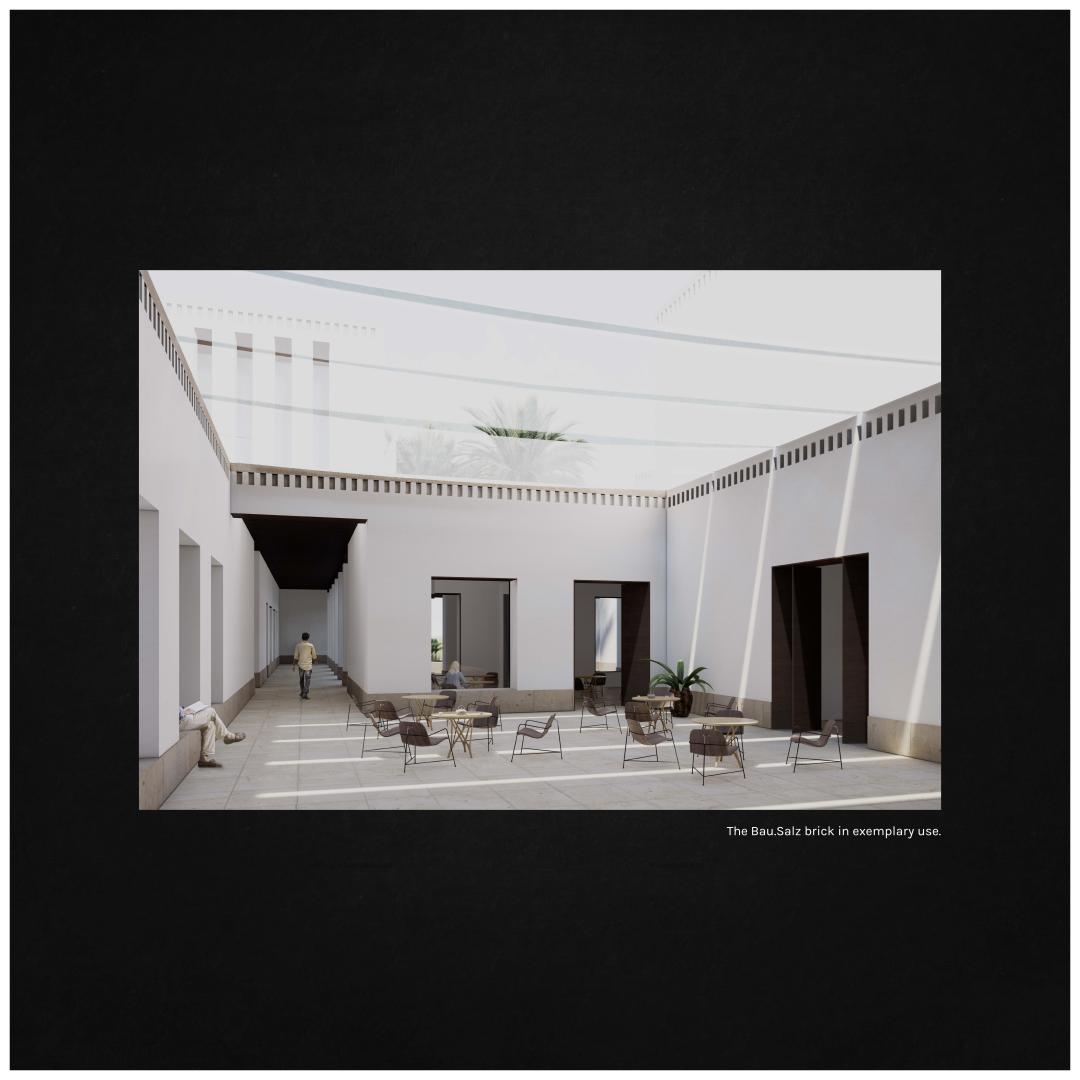
The translucency of salt is retained even after the pressing process and brings further aesthetic advantages compared to conventional materials. Depending on the wall thickness, translucent walls could also replace windows, but still guarantee sufficient illumination. A building made of Bau.Salz, which stands as a monolithic structure in the urban space during the day, visually dissolves at night as a filigree, luminous structure.
The demands placed on a building have changed in recent years. In addition to the aesthetics and functionality of buildings, room-climatic properties and health aspects are playing an increasingly important role. The return to "simple", natural materials and construction techniques are essential components of climate-friendly and healthy building. The positive properties of sodium chloride have been known for centuries: Salt particles in the air are considered beneficial to health, especially for the skin and lungs. The positive properties can also be extended to potential composite materials such as wood, on which salt has a preservative effect.
Another technical added value of salt is a high storage thermal capacity. Adequate facade thickness can ensure a constantly pleasant climate for the interior.
Key objectives for inclusion
Bau.Salz designs its entire production process to be particularly low-threshold.
Only simple hydraulic machines and a low energy input are needed to process the sodium chloride. Even when processing the stones on the construction site, architecture can be created without the need for costly laying techniques.
Local people in coastal areas can therefore participate in a change to sustainable architecture without a large investment risk.
The dual use of brine from drinking water production can also open up a new utilisation cycle and thus give other regions access to affordable drinking water. The reuse of salt as a building material can make it cheaper and more affordable than other building materials.
Innovative character
Every day 100 million m3 of drinking water is produced by desalination - few people think about the 150 million m3 of brine. The accumulated salt is still seen as a waste product. Bau.Salz sees the potential in this natural material, which in its raw form has enormous aesthetic, climatic and health qualities. By making use of the resource a financial value is being attached to salt. This can be understood as an incentive for the drinking water industry to invest more in the future in those kinds of processes that do not chemically pollute the salt.
The water crisis is one of the greatest challenges of our time. Already every third person has no regular access to fresh drinking water. This situation is worsened by a growing world population and effects of climate change. Given the increasing need to produce drinking water technically, a change in the desalination industry towards more sustainable, low-tech methods is essential. Bau.Salz is a big step in this direction. The new material is innovative not only because of its pioneer-role in sustainability. Until now, salt has not been considered as a building material, despite its good indoor climatic, health and conservation properties. The challenge of the climate crisis requires a rethinking of conventional building practices, making room for natural materials in new combinations.
Beyond the positive properties of the raw material, sustainability and efficiency are also top priorities in the design. The special design combines the advantages of masonry construction with the appearance of modern architecture. The Bau.Salz stone is designed in a way that it achieves a maximum degree of economic production and allows it to be handled easily. Despite the small size of the component, uniform surfaces can be created through manufacturing precision and the elimination of mortar. The salt stone can carry more weight than a conventional masonry block and that without having to undergo an emission-intensive firing process.