DigiMooD for CCI
Basic information
Project Title
Full project title
Category
Project Description
DigiMooD, a 28-months project co-funded by the European Commission under the pilot call "Creative Europe - Modules for Masters in Art and Science". It aimed to develop and test the offer of a set of innovative and interdisciplinary educational modules in "Digital Entrepreneurship for the Creative Industries", with a specific application to the Fashion industry, its companies' branding and narrative strategies, and the digital service models.
Project Region
EU Programme or fund
Which funds
Other Funds
Programme: Creative Europe Programme – Audiovisual Industry and Media Support
Call for Proposal: Connect/2017/3346110
Project Grant Agreement: LC 00793005
Description of the project
Summary
DigiMooD, a 28-months project co-funded by the European Commission under the pilot call "Creative Europe - Modules for Masters in Art and Science" run from April 2018 to January 2021, was aimed at providing solutions to address the lack of multidisciplinary educational approaches capable of supporting Cultural and Creative Industries (CCIs) in exploiting the opportunities offered by the digital transformation. Although the creative sector is recognised to be "among the most entrepreneurial sectors, developing transferable skills such as creative thinking, problem-solving, teamwork and entrepreneurship" (European Commission, 2018), it is clear how the absence of technical and digital skills constitutes an obstacle to its potential for growth, especially for young graduates in Arts and Humanities.
While developing the project, these possibilities have also been exponentially increased by the outbreak of Covid-19, during which the lockdown has forced educators and researchers to explore distance learning more urgently.
Through DigiMood, the consortium prepared for the next Digital Decade even before the pandemic crisis, identifying a set of new interdisciplinary competencies essential to fill the digital skill gap, to be developed through the design and test of a set of Massive Open Online Courses (MOOCs), dealing with topics related to the fashion field, from companies' branding and lifecycle assessment to narrative strategies and digital service models.
The consortium achieved the outcomes through direct field experimentation and a co-design approach that involved a multidisciplinary team of experts from academia and the fashion industry.
The project provided students with the necessary knowledge to design and operate across disciplines within the fashion system while also testing and experiencing innovative learning environments through blended learning experiences, including the combination of MOOCs, Field Projects and internship experiences.
Key objectives for sustainability
Identifying the existing gap of digital competence in Fashion companies required the consortium to understand and formulate the needs and obstacles of the sector. To conduct this analysis, DigiMooD consortium combined desk research, the study of existing literature and relevant reports, with field research, collecting data first-hand by conducting a quantitative survey (aimed at traditional companies having difficulties to enter the digital world) and a qualitative set of interviews and focus groups (performed with selected companies in Italy and France that had been able to innovate digitally). Both the survey and the interviews were aimed at verifying companies' digital awareness in terms of potential opportunities for new digital and sustainable strategies, referring to the main drivers for innovation in this sector:
- Sustainability issues, attempting to reduce the environmental, economic and socio-cultural impacts that fashion has on our planet,
- The effects of the digital transformation on the whole supply chain, from product development to retail and communication,
- New production and consumption dynamics (i.e., from products to services, sharing economy, social interaction & social innovation).
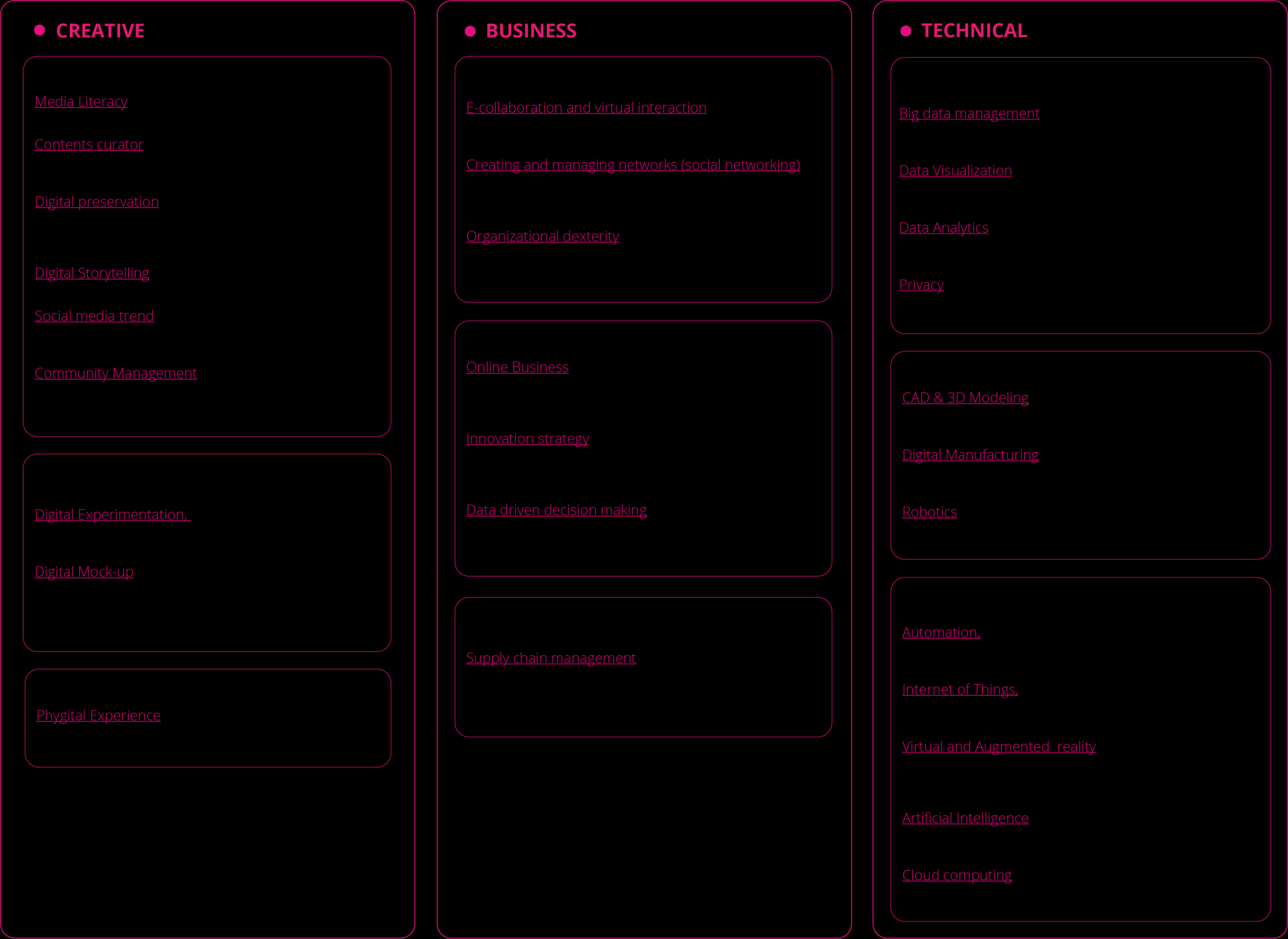
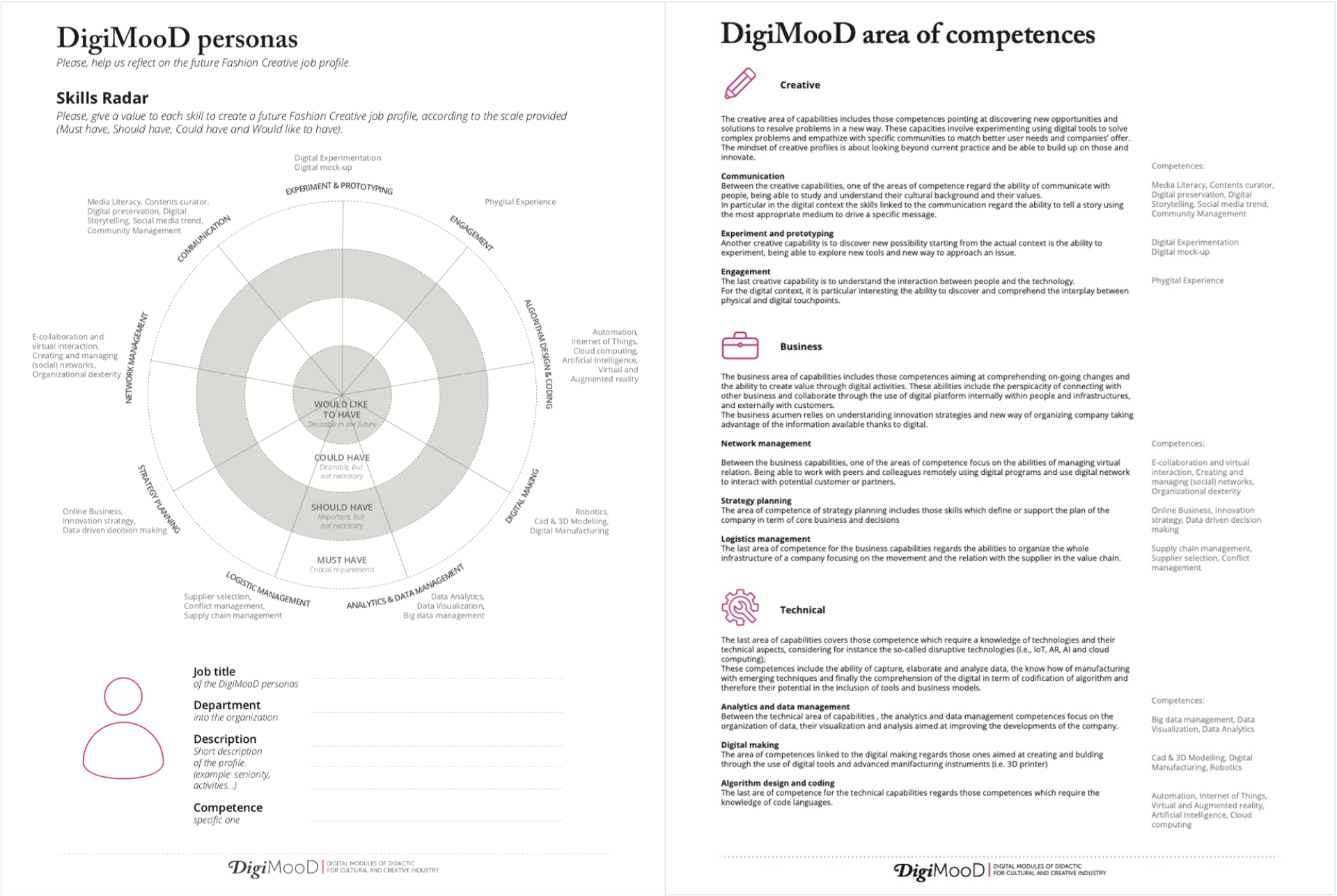
The framework developed (Fig.01) identifies a set of competencies that can be mixed to offer guidance to industries and to train institutions: in the first case, it helps them select the competencies they are looking for in the profile of new employees; in the second case, it guides the establishment of innovative educational paths or the modification of existing ones towards the creation of professionals ready for the jobs of the future.
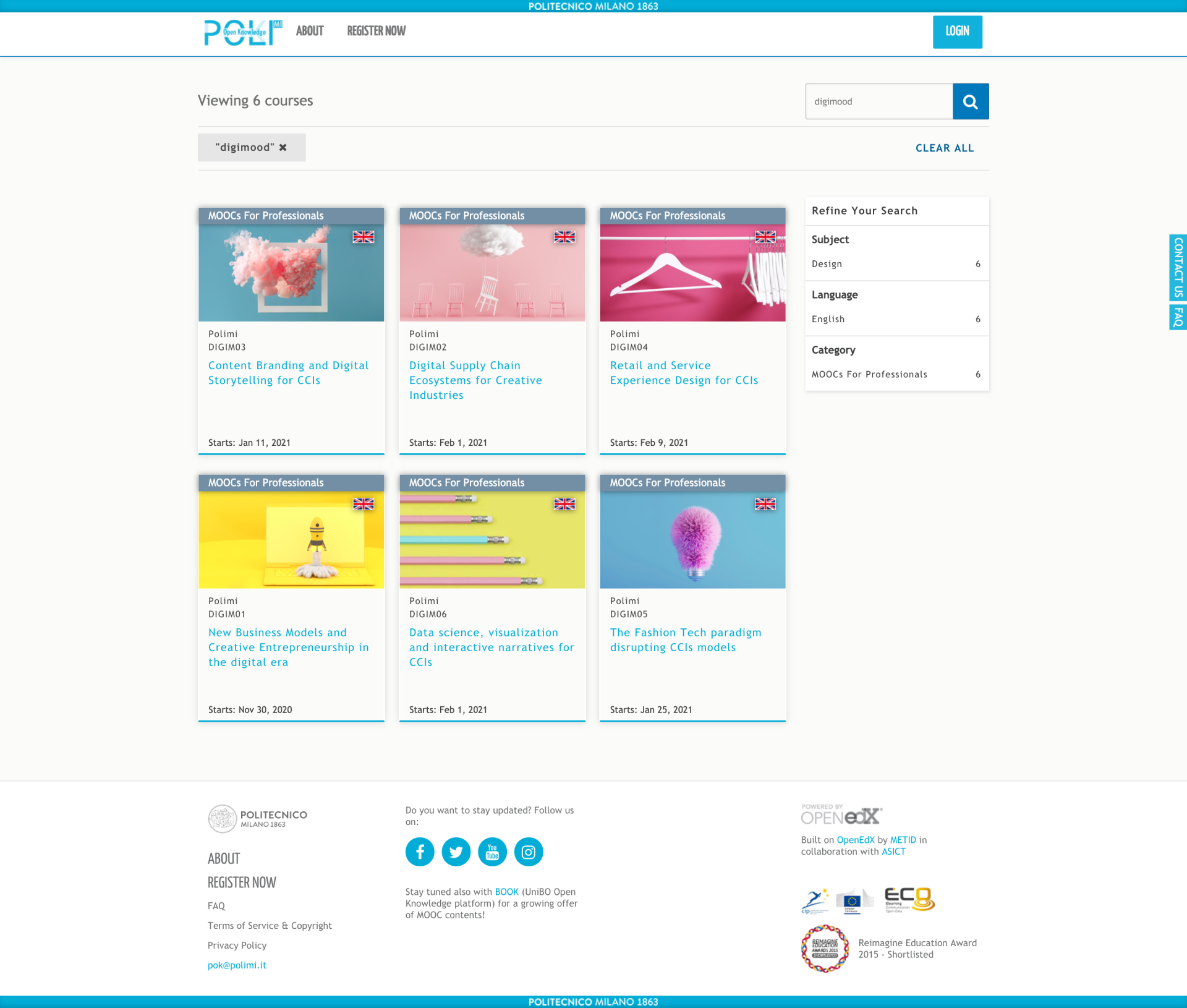
Looking at the competence identified as essential from the analysis and at the educational offer of MOOCs (Fig.02), designed from the framework, it is evident how sustainability should not be considered an option anymore but as an unavoidable asset that drives each business production and consumption dynamics.
Key objectives for aesthetics and quality
One of the most consistent actions of DigiMooD has concerned the development of MOOCs not only as integration to the current educational offer but also as an opportunity to experiment with new formats and approaches in the educational path for Fashion designers.
To consistently develop MOOCs in terms of aesthetics and quality of fruition throughout the curriculum, three toolkits with a series of guidelines have been elaborated for educators and professionals:
• the first toolkit supports the development of the structure of the MOOCs (macro development) by illustrating the main theoretical aspects of MOOCs and describing in detail the project format to coordinate the output of the different modules;
• the second one guides the production of the storyboard for the MOOCs (micro development) by providing practical tips and rules linked to the length and number of slides and showing the result of other necessary aspects related for example to quizzes and other class activities,
• the third one helps setting the recordings of the videos (operative execution) to maintain the same style and ensure high quality.
Furthermore, the DigiMood consortium offered a template for lecturers to create their slides in order to achieve aesthetic consistency throughout all the modules.
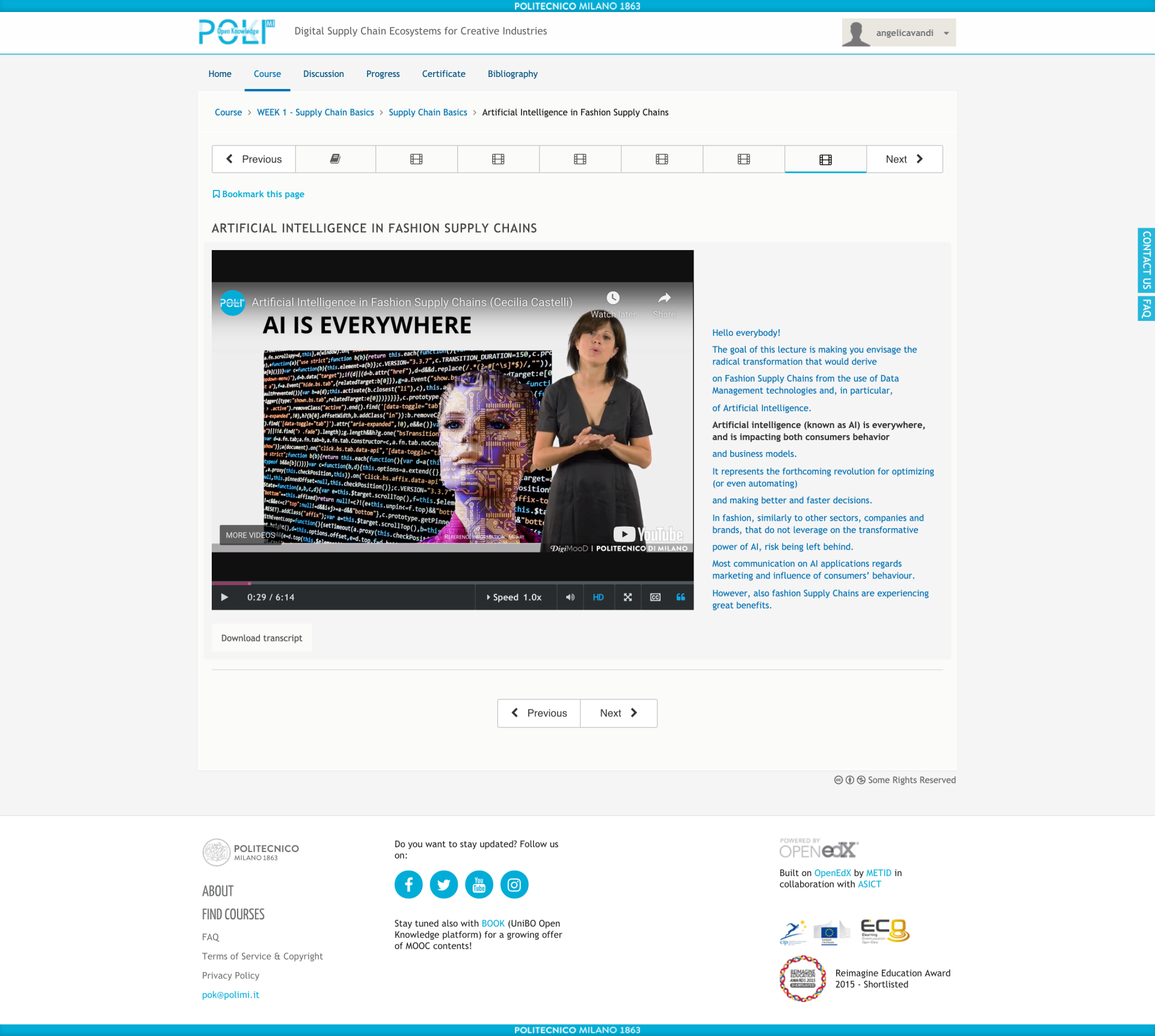
Each MOOC is open-access on the Polimi Open Knowledge Platform (https://www.pok.polimi.it/courses?search_query=digimood) and composed of different elements as video lectures, texts and subtitles, quizzes to assess knowledge, a forum for discussions and optional materials.
Each MOOC is introduced by a Case Study video narrative selected as best practice. The educational path is sequenced in 5 weeks, which are composed of 4/5 lectures each.
Generally, the introduction of the MOOC is called week 0, and it contains a video teaser presenting the DigiMood Project and a short introduction to the topics which will be explored in the course.
Key objectives for inclusion
Building on the scenario described, the project achieved objectives in terms of inclusion have been:
a. Equipping students in arts, creativity, business and technology with the knowledge and core transferable competencies they need to think and work across cultural and creative sectors and disciplines.
The project has aimed at filling this gap through:
- experimenting, testing, and validating teaching modules allowing students to work hands-on on real-world challenges;
- involving professors and researchers directly from different disciplines to create a virtuous cycle of exchange of knowledge across the academic community
- including soft skills in the curriculum offered and contributing to institutionalise their teaching through problem-solving and collaboration.
b. Improving the quality and relevance of teaching and learning in arts and culture disciplines by linking creativity, business and technology. As an open system that looks to the open-source paradigm as a frontier for open innovation in education, digital modules have been made available open access through the Polimi Open Knowledge platform (POK).
Moreover, the content has been delivered in academic courses through a hybrid methodology, including the combination of MOOCs and field projects, internships, and challenges co-developed with actual companies.
c. Developing an entrepreneurial culture among the students and the teaching staff by opening new learning opportunities that have allowed the configuration of classes as multidisciplinary and international teams, while teachers aim to lead projects to potential commercialisation of new services, products, and prototypes.
d. Stimulating innovative learning environments through a constant flow and exchange of knowledge between higher education institutions and enterprises.
Results in relation to category
As the "Interdisciplinary Education Models" category stands for, the DigiMooD consortium answered the need of filling the skill gap identified by equipping design students in arts and creativity, business and technology through the offer of a set of open, digital, interdisciplinary modules.
As part of the project field-test, Politecnico di Milano—the academic coordinator of the project— selected two MOOCs (MOOC 2 "Digital supply chain Ecosystems for Creative Industries" and MOOC 6 "Data Science, Visualization and Interactive Narratives for CCIs") to test within the Final Synthesis Design Studio, the final project-based course of the second year of the MSc in Design for the Fashion System. At the moment of writing and after a semester from the field test, five out of six modules have been integrated through blended-learning approaches throughout many MSc courses.
Institut Français de la Mode, the second academic partner of DigiMooD– tested MOOC 1 "New Business Models and Creative Entrepreneurship in the digital era" with students enrolled in the MA in Fashion Design, MSc in International Fashion and Luxury Management, in the Global Fashion Management Executive MBA, and in the Specialized Master Degree in Fashion and Luxury Management.
Those two tests have allowed the project to reflect on the possible variations of pace and types of activities that MOOCs can bring to the in-presence teaching, improving the link between the MOOC and the physical class.
Thanks to a questionnaire sent to students and teachers at the end of blended teaching activities, the most-mentioned strengths concerned the efficiency and time to dedicate to in-class practice, the possibility of having more accessible contents, and more professors and experts involved in the course. The most mentioned weaknesses mainly concerned the absence of a learning atmosphere and the possibility of getting bored quickly.
How Citizens benefit
Looking into numbers at the end of the project, we realised the substantial impact DigiMood has on communities of fashion professionals, academic educators and students.
- 50 French and Italian companies engaged in the Survey activity
- 12 French and Italian start-ups interviewed
- 10 companies involved in the Focus Group
- 6 MOOCs (18 ECTS) realised
- For a total of 130 video lessons recorded
- 6 Case Studies Video Narratives produced
- 100+ students engaged in the Field Test
- Creation of a network between students and companies for job offers
- 4 conference articles and 1 open-access book published
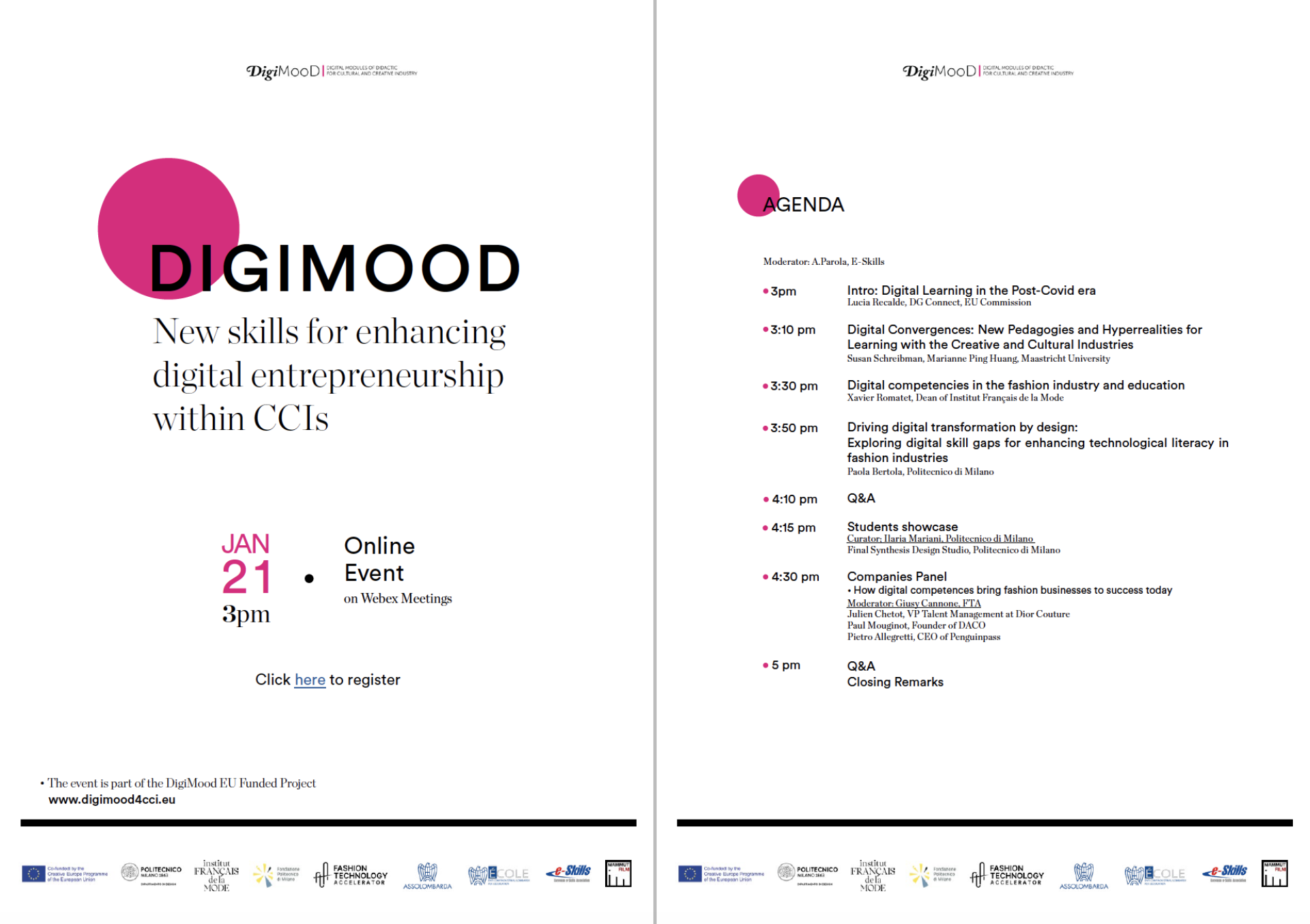
- 1 Final Event organised and delivered
Innovative character
In little more than two years, the project has designed, implemented, delivered six interdisciplinary modules involving 50 academic and industry professionals, recording 130 video lessons.
The innovative and digital teaching/learning methods, after this first experimentation, have been integrating with the permanent offer of POLIMI and IFM MOOCs, being open access even to a broader public. Modules are offered in a hybrid modality that combines MOOCs delivered through the Polimi Open Knowledge Platform (POK) with Field Projects and internships to provide students with the opportunity of hands-on experience to apply and verify acquired knowledge and skills. This has provided the existing curriculum with the possibility for personalised learning, transforming students into active learners responsible for their education, scheduling their activities, pausing and rewinding video lessons when necessary, and personalising the fruition. Furthermore, leveraging cross-sector innovative practices and transdisciplinary scholarships for creating added value in the Fashion Industry, during the Field test, the MOOC served as an entry point to new topics so far distant from students' domain of study.
Since concepts, terminology, and practices were shared in advance, the in-class time could be effectively spent for informed and critical discussion on more advanced theoretical aspects. This favours a sort of flipped-classroom approach, where students actively participate in debates and are allowed to spend most of the time on hands-on activities and project reviews. This aspect is especially relevant for a design-driven school where the curriculum relies heavily on project-based learning and studio-based courses.