NYE – community through architecture
Basic information
Project Title
Full project title
Category
Project Description
The name of the city says it all – “Nye” is the Danish word for “new”. A new city built from scratch with one overall mission: to design a beautiful and sustainable city with a strong social purpose. A city that in its mindset and functionality inspires a local commitment and sense of community, with a deep awareness of sustainability. AART has contributed to this city with 30 innovative wooden terraced houses that nudge a new way of living – based on sharing, co-creating and socializing.
Project Region
EU Programme or fund
Description of the project
Summary
An emerging city
A sustainable city is emerging north of Denmark's second largest city, Aarhus. What makes the city unique is that it stems from af collaboration between the client Tækker Gruop and nine of Denmark's leadning architectural firms and is basen on the idea of creating variation and richness in detail concerning the buildings as well as the urban space. Each architectural firm is responsible for developing their own part of the city.
The Danish architectural firm AART has designed 30 single-family terraced houses 135 m² each. AART teamed up with Tækker Rådgivende Ingeniører, JCN Bolig and LOOP on this project. All of Nye will contain 650 newly built residential units distributed on 220 acres. This application will focus only on the 30 houses designed by AART and their near surroundings.
Uniting the city with the landscape
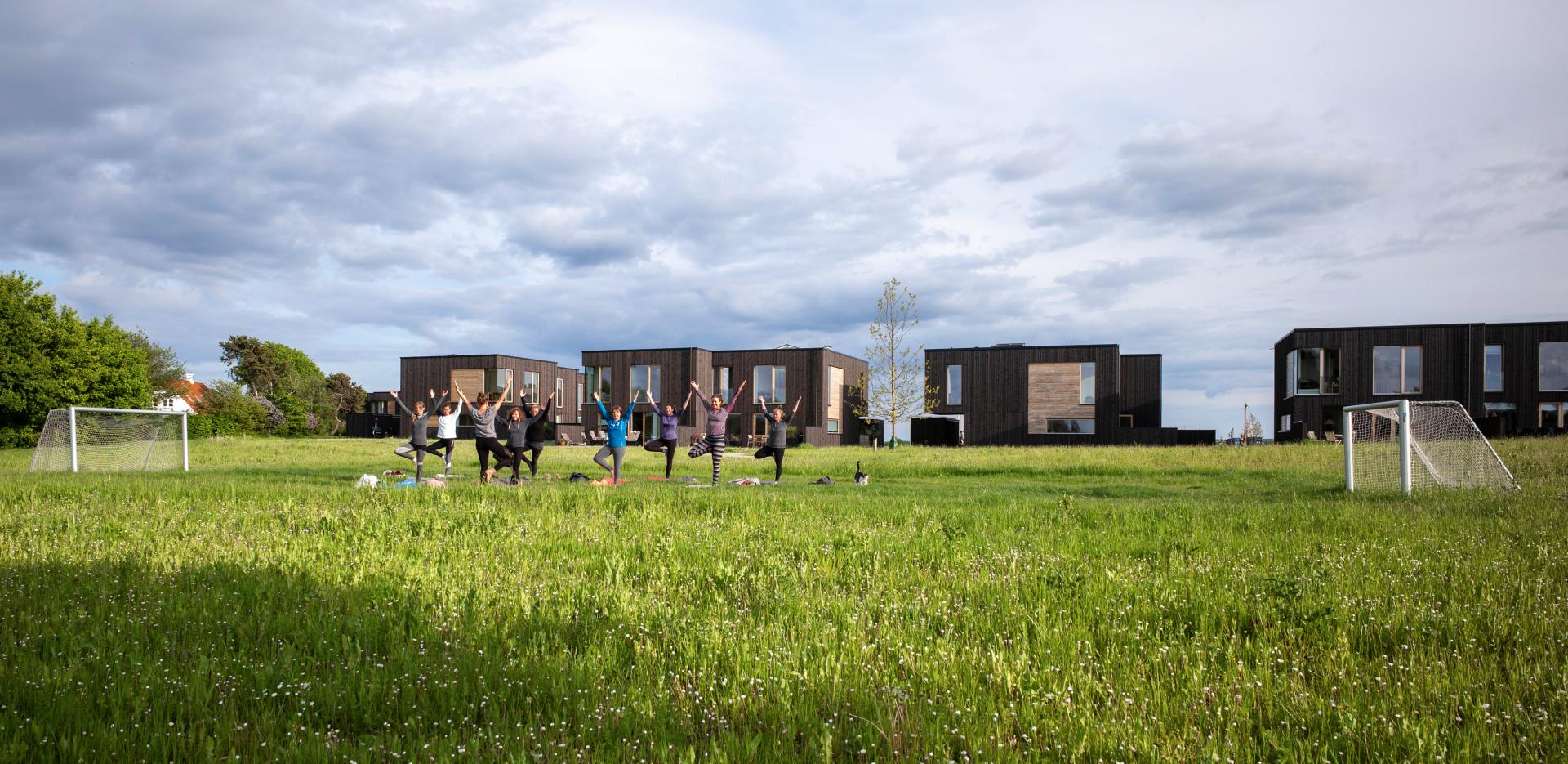
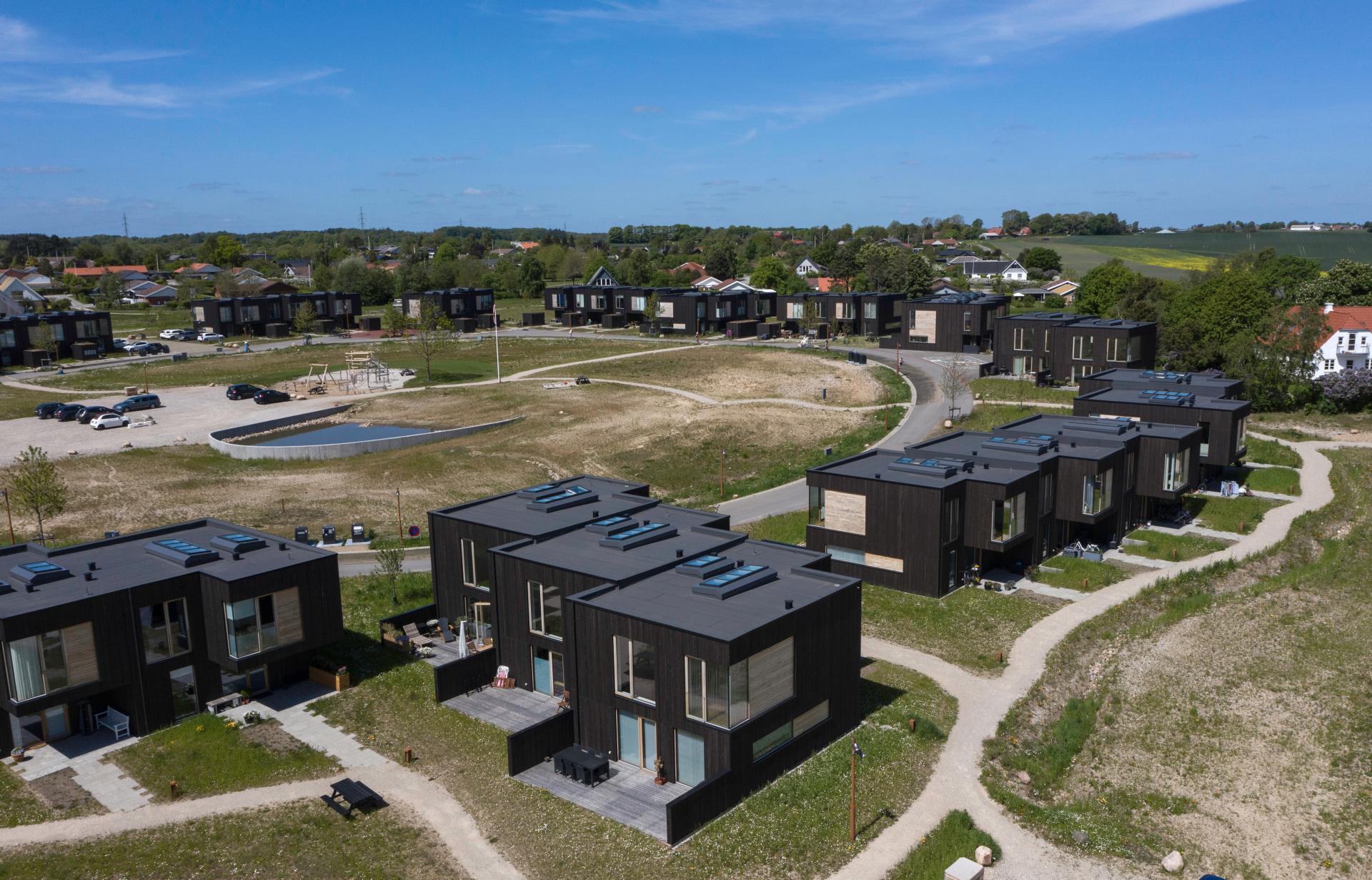
AART’s contribution consists of a ring of 30 diverse residential units that unite the city with the landscape to the north. In a topographic grid, the dwellings are distributed across the construction area, bringing together the qualities from the ordered and more organic city. To the south, the homes stretch in a relatively tight formation into the grid with rectangular building volumes, while the ones to the north dissolve the compact geometry in a staggered formation, opening the city up to the countryside.
Different degrees of community
The residences not only create different degrees of links to the landscape, but also different degrees of privacy and community. For instance, the variation of flats, terraced houses, and cluster houses create a wide range of private outdoor spaces ranging from the balconies of the flats to the gardens of the terraced and cluster houses. Community is the main element in our contribution to Nye, where the great common area, the green wedges between the residences, and the numerous social areas along the residential streets provide ample room for different types of community.
Key objectives for sustainability
Nye equals sustainability
The overall key objective of Nye is sustainability understood as both social, environmental, and economical sustainability.
Social sustainability
Strong communities are characterized by several positive traits such as a high level of trust and less loneliness. The main objective of social sustainability has therefore been to build a sense of community amongst the homeowners. On a conceptual level, this is partly achieved e.g. through applying the gaining by a sharing philosophy to nudge homeowners into engaging with other homeowners in the shared spaces and through using shared functions.
Environmental sustainability
Building on the insight that 23% of the Danish CO2 emissions derives from heating and operating buildings, the houses in Nye have been designed with the end-user in mind and one of the main objectives regarding environmental sustainability is to nudge environmentally sustainable behaviour in the end-user through well-designed solutions like vast amounts of daylight reducing the need for artificial light and heating in winter, strategically placed doors and windows to naturally ventilate and cool the house in the summer. Another objective has been reducing material carbon footprint by using wood throughout as façade material, and as the primary part of the construction.
Economical sustainability
Like in most cities of a certain size, housing prices in Aarhus and its suburbs have risen to a level that makes it difficult for the mid-income families to enter the housing market and buy their own homes. The main impact goal regarding economical sustainability has therefore been to ensure affordable and attractive quality housing close to Aarhus for this segment. This has been ensured by e. g. applying a “gaining by sharing” philosophy, where each family only owns the actual building but has shared access to all the surrounding area and the facilities there owned and operated by Tækker Group.
Key objectives for aesthetics and quality
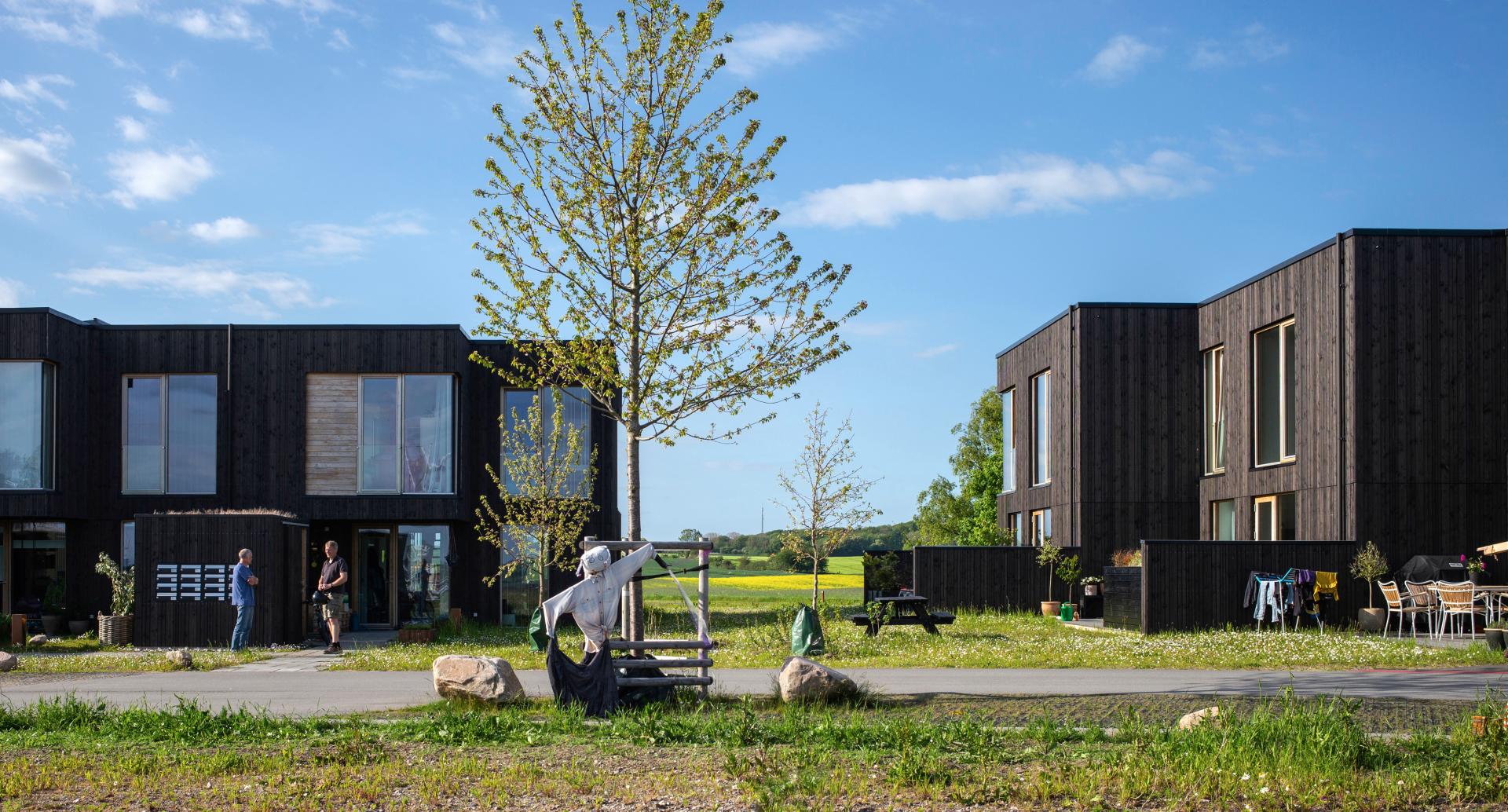
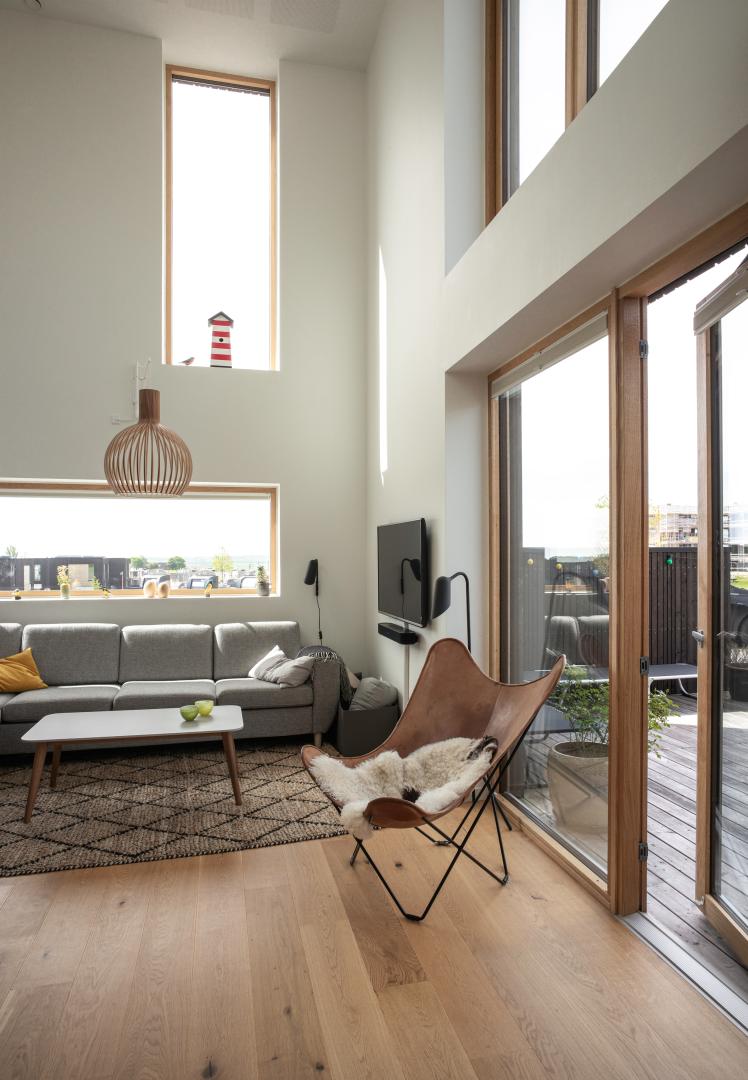
The terraced houses in Nye have been designed with great attention to aesthetics and high quality in the chosen materials. Moreover, they gently adapt to the landscape by paring in small clusters of respectively two and three dwellings and by staggering each dwelling from the next creating both private areas and a dynamic expression. The overall material is wood – in both cladding and construction leaving a low C02 footprint. The façades are made in the black AART designed Superwood cladding with a vertical orientation, while the window sections are underlined by a cladding in oak that has a horizontal orientation, resulting in both expressive and calm expression.
When asked in post-occupancy-surveys and interviews performed by AART’s impact team, residents mention the aesthetics of the wood-clad houses and the choice of high-end aesthetic materials like oak window ceilings as one the things that they appreciate the most about their house, and also an important reason for buying this exact type of house in Nye.
“The big windows, oak framings, and the double-height [in the living room]. We love it! It gives the house a certain edge and extremely nice daylight” (Resident, Nye. Post-occupancy study 2019/2020)
The large windows create an excellent view of both the surrounding landscape and the street – securing visual contact between interior and exterior. The dwellings are both compact and yet very functional and spacious.
Key objectives for inclusion
As mentioned earlier the main objective when it comes to social sustainability is community building and inclusion.
On a conceptual level, this is partly achieved through applying the gaining by sharing philosophy to nudge homeowners into engaging with other homeowners in the shared spaces and through using shared functions.
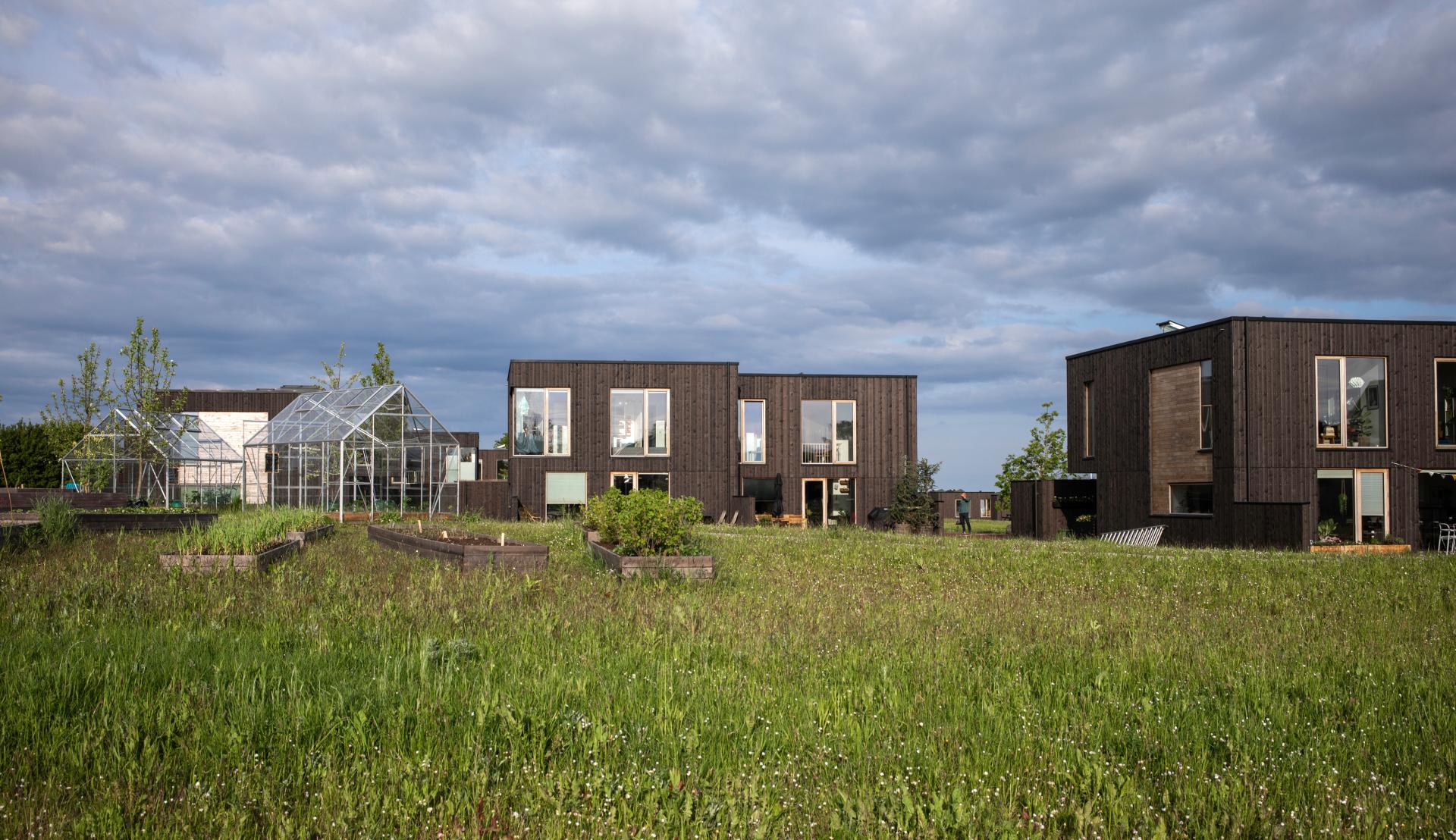
On a landscape level, this has been achieved through e.g. grouping everyday functions usually distributed to each home such as letterbox, garbage and recycling, and parking and strategically placing them to ensure everyday spontaneous friction between homeowners. Furthermore, the wild grass fields of the landscape stretching all the way up to the houses and in between clusters of houses, thus creating differentiated spaces for different types of activities and communities. Common greenhouses offer space for the type of community that is based on shared interests co-creating small gardens and green communities.
On a building level design choice such as big windows facing the common spaces enables residents to connect with the outside community and for residents to keep an eye out on each other.
Our post-occupancy interviews and survey with residents clearly showed how privacy is an essential prerequisite for the community in Nye. The residents need to be able to tap in and out of the community as they want. Private spaces are provided by e.g. the staggered buildings that ensure natural lighting from every direction and create private niches in the front yards and back yards. Furthermore, the fact that the house is two storages also provides residents with a strong sense of privacy on the second floor.
An important point to stress is that community in Nye is not just a community amongst people who are alike. The community goes across the age from young families with children and without, middle-aged couples and elderly couples and as such the community includes segments that may otherwise be prone to loneliness
Results in relation to category
The following description of impacts is derived from a post-occupancy study carried out in 2019/2020 comprising of observations, semi-structured interviews with 10 residents in their homes and a survey with 38 respondents from the 30 AART designed residential units. All research was done by anthropologists from AART’s research team.
Residents feel that the built environment through the architectural instruments actively support and nudge interaction between residents and thus positively contribute to two different types of community: communities of interest and everyday communities.
“No doubt, the architecture and outdoor spaces are the reason why we bump into each other. It feels safe. We come across each other; - Do they need help? - Do they need a lift? The children benefit from some of the elderly bringing them to the greenhouses or walking the dogs” (Resident, Nye)
Residents highlight shared space and functionalities as a contributing factor to a strong and shared sense of community. They report that this positive sense of community means that they: see more people, have more social engagements, help each other, interact across generations, talk when they meet, participate in common dining and activities, dine together, borrow things from each other, watch each other’s pets, plants and children, and keep an eye on each other.
When we benchmark survey results from Nye against a national survey (Kantor Gallup 2019), we find that the houses in Nye perform better in terms of both community and quality of life. 66% percent of the residents report that they “socialize a lot with their neighbours and we have a good neighbourhood-feeling” compared to the national average of 26%.
Last but not least residents in Nye report that their house contributes positively to their quality of life. In Nye the percentage of residents who answered “very much so” and “much so” combined was as high as 82%, whereas the national average was around 66%.
How Citizens benefit
The residents of Nye were not known by Tækker Group or AART prior to them buying and moving in. This means that residents have not been involved in the initial part of the development of AART’s houses.
After moving into their house residents are encouraged to contribute to the development of the future common house and to common activities. They have been invited to meetings held and facilitated by Tækker with the ambition to involve and co-create with the residents. This has given the residents a chance to influence some of the common and shared functions and spaces.
Last but not least the residents in Nye have been actively involved in the post occupancy study performed by AART. This study has given voice to residents shared and different experiences of what works and what could be better both regarding the houses that AART has designed, but also Nye as a whole new city.
Innovative character
Strategically using architecture as a catalyst for community building is innovative in the sense, that architecture is often reduced to aesthetic and form – what architecture is - instead of focusing on what architecture does and the impact it creates for users, organisations and society. AART’s main competence is to design impact through architecture, and taking this approach to architecture seriously means that AART has gone beyond the “normal” realm of the architects and has not just turned over the keys and gone on to the next project, but has followed the Nye houses closely and initiated an anthropological post occupancy study. The purpose of the post occupancy study has been to learn from the Nye houses and apply these insights in AARTs future projects. This has successfully been achieved in several new projects that shared characteristics with Nye. This systematic approach to architecture and impact is innovative and rarely seen in the business.
The Gaining by Sharing philosophy underlying the project is an innovative approach to reducing both the CO2 footprint of the individual buildings and at the same time creating added value through community building. In this way, the reduction of CO2 footprint becomes something positive and something that adds value to the end-user instead of leaving the end-user with a feeling of having to choose between doing what is “right” environmentally and doing what feels good.
Lastly the overall starting point and setup was quite innovative with the development of Nye by the client Tækker Group in collaboration with no less than nine of Denmark's leading architectural firms responsible for developing their own part of the city.