La Loza
Basic information
Project Title
Full project title
Category
Project Description
The structure is re-used.
The interior is occupied or vacated by removable parts.
The resulting architecture, more than geometric, is algebraic.
The existing structure, conserved for environmental reasons, remains as a matrix onto which specific elements are added. These are arranged using an algebraic arrangement as in a musical score, punctuating but not dividing the space. Through its design the whole project achieves maximum sustainability and attention.
Geographical Scope
Project Region
Urban or rural issues
Physical or other transformations
EU Programme or fund
Which funds
Description of the project
Summary
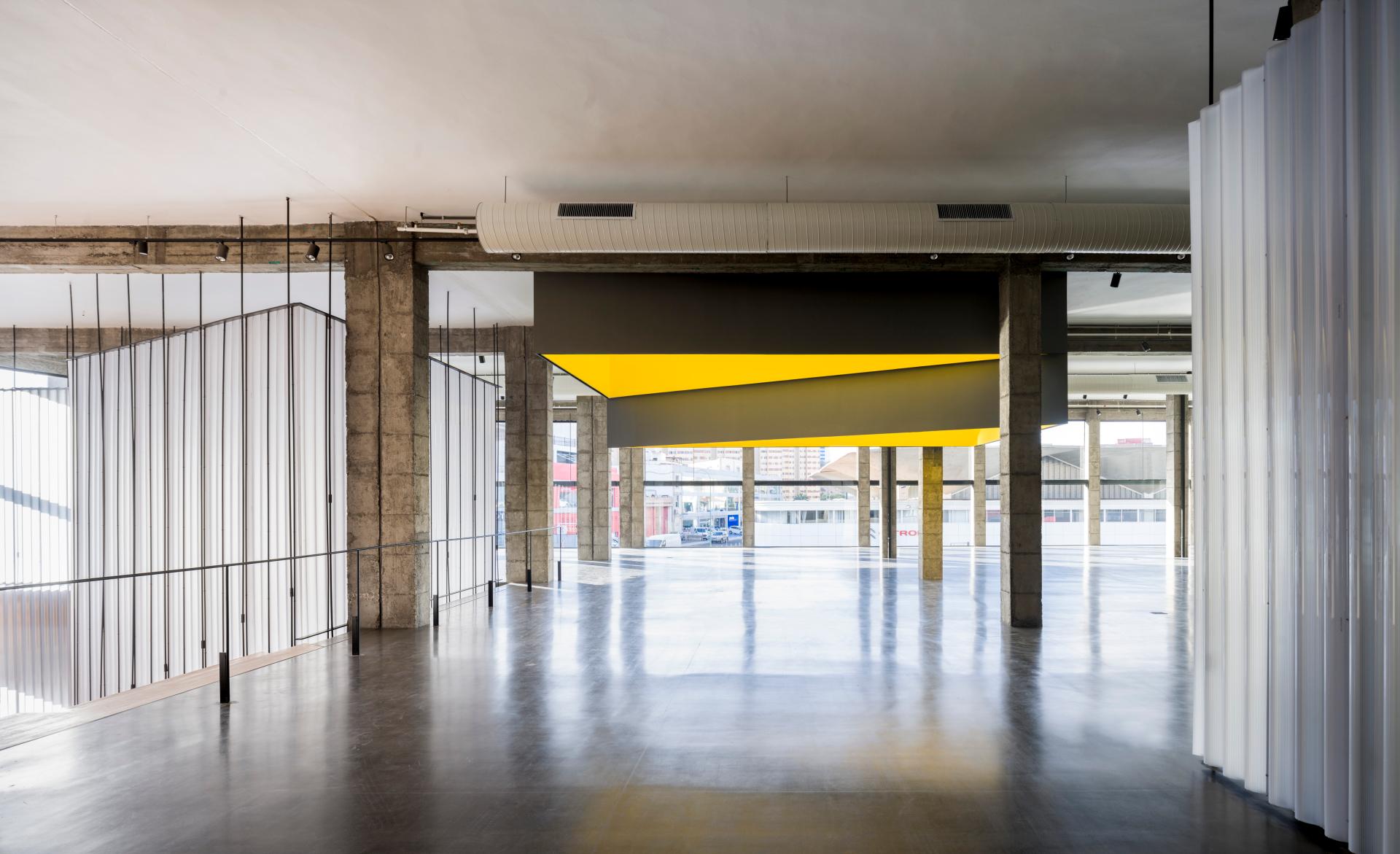
Dismantling, cleaning and stripping old plaster (except in some points) led the old building to a new zero point from which to start the occupation process; this was done by avoiding divisions, freeing the grid of bare pillars to generate an ordered indeterminate space.The aim was to achieve an open, non-occlusive, simply ‘occupied’ organisation with a certain provisionality, hence the references to the inevitable Branzi and typewriter art and the drawing of the plans with an old Olivetti found in the studio, resolving the organisational arrangement with an architecture more algebraic than geometric.
In an algebraic organisation, the elements occupy a neutral matrix. The grid of pillars, cleaned and ‘perfected’ (reinforced, extended, purged), becomes a kind of blank score, an ordered space on which to write the elements that organise the programme, punctuating the space as the notes on the staff do. With this strategy the various objects (curtains, boxes, and also the cases around the entrances) were placed in the reticulated or hypostyle space of the building. Working with numbers has the advantage of checking any erroneous attempt to ‘compose’ based on closed geometries that might hierarchise or divide the spatial continuum.
This algebraic interpretation of space requires maximum transparency and visual elongation. The organisation of the space is limited or indicated (not divided) by translucent corrugated polycarbonate curtains, attached without horizontal elements to avoid any shadow that would lend them consistency. These contrast with the existing concrete structure to give a friendly flexible touch. The aim was to achieve a perception of the space in all its totality.
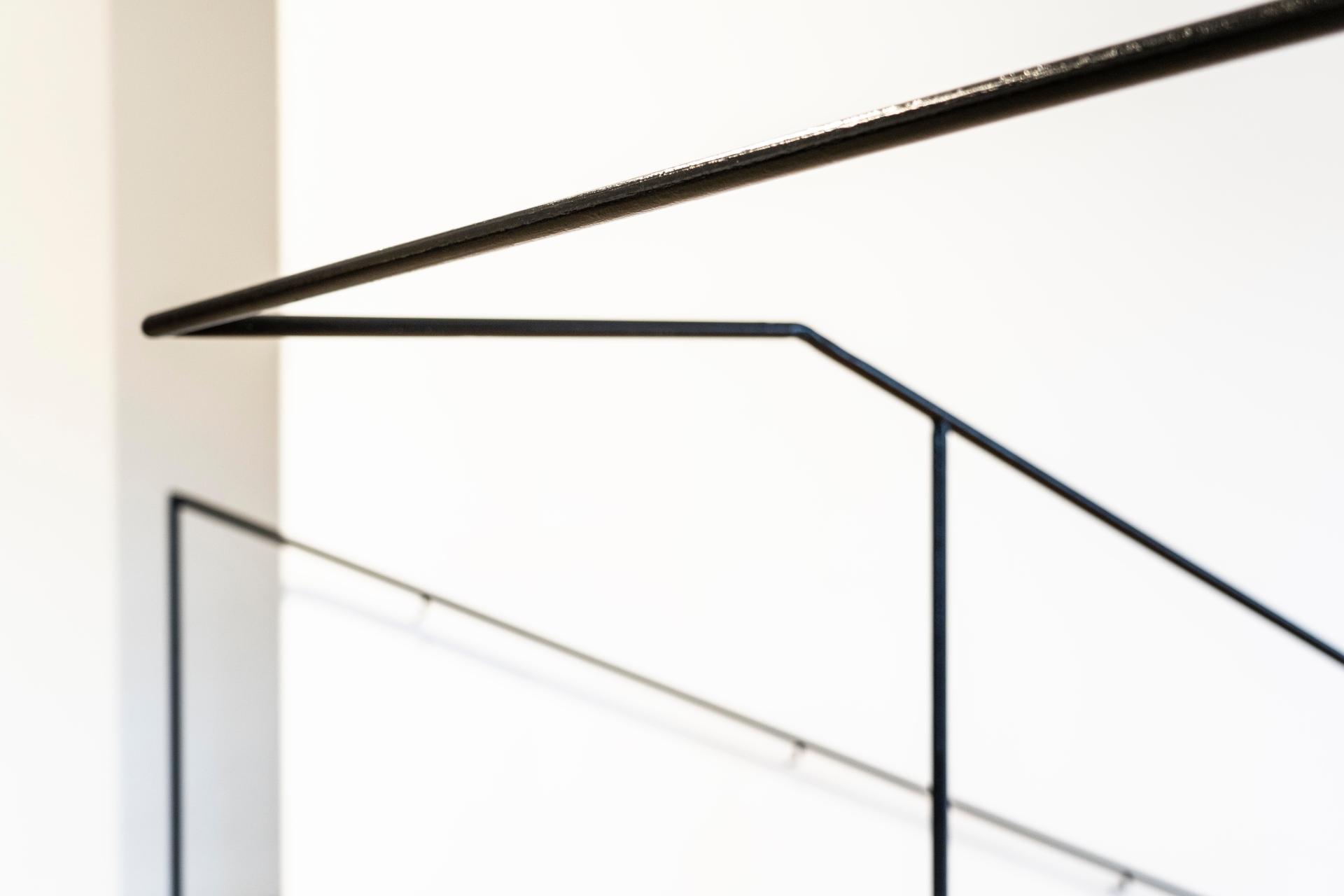
To do this it was important to define the construction details and reduce the elements to their most essential condition. Understanding the grid as the project matrix also conditioned the resolution of its limits, clearly affecting the treatment of the façade.
Key objectives for sustainability
Circularity must be the next paradigm of sustainability. With this re-use strategy, the existing structure is not demolished but recovered and readapted. The structure’s new elements simply punctuate the space, allowing the free circulation of space and air between pieces which can be relocated without having to discard anything. Everything in this modular system is dismountable and can be remounted at any other point. This meant defining the construction details to reduce every element to its essential minimum condition. Light v. quantity: the polycarbonate curtains suspended, weightless; the large glass façade without trim, suspended; the skylights hung from the roof, the fencing of the entrances resolved as a fold–as if of cardboard–resolved with a 20mm steel sheet… all pursue economy of means with little weight, facilitating sustainability as well as coherence with the global structure of the project.
Maximum transparency of the façade is combined with energy efficiency. The large floor-to-ceiling windows let the light in further, aided by the polished unjointed terrazzo floor. Taking advantage of three existing patios for moving goods up and down, three large ‘diagonalised’ skylights were designed, treated internally with reflective paint.
But a window without metal fittings does not meet the challenge of efficient ventilation (one goal was to have no air conditioning) so each opening has 2 huge panes set 40cm apart and suspended like giant guillotine blades, together forming a great adjustable aerator by means of a pivoting slat. The air naturally drawn in at a height of 2 metres and expelled by a powerful extractor at the opposite end sweeps the upper part of the space, which remains free and continuous thanks to the polycarbonate curtains. The year-round comfort of the workers is ensured simply by manually opening or closing the system. On the roof there are enough photovoltaic panels for all the building's needs. There are also chargers for electric cars.
Key objectives for aesthetics and quality
This project was a chance to explore the organisation of a complex floor plan as a continuous space, which is why it shunned the conventional tools of geometry, which would have fragmented the spatial organization or conditioned it by formal structures. The formulation of less closed solutions was thus researched in order to ensure the interest of the continuous space while retaining the option of organising it into specific areas. This new strategy–more algebraic than geometric–is achieved through the design of minimal elements that provisionally ‘occupy’ the space and, like the notes of a score, maintain a changing order of punctuation or notation.
Special care was taken in the design of each of the pieces that resolve this free occupation of the space (boxes, curtains, skylights) to guarantee efficiency and lightness of design, consciously pursuing the contrast between its minimal design and the massiveness of the concrete.
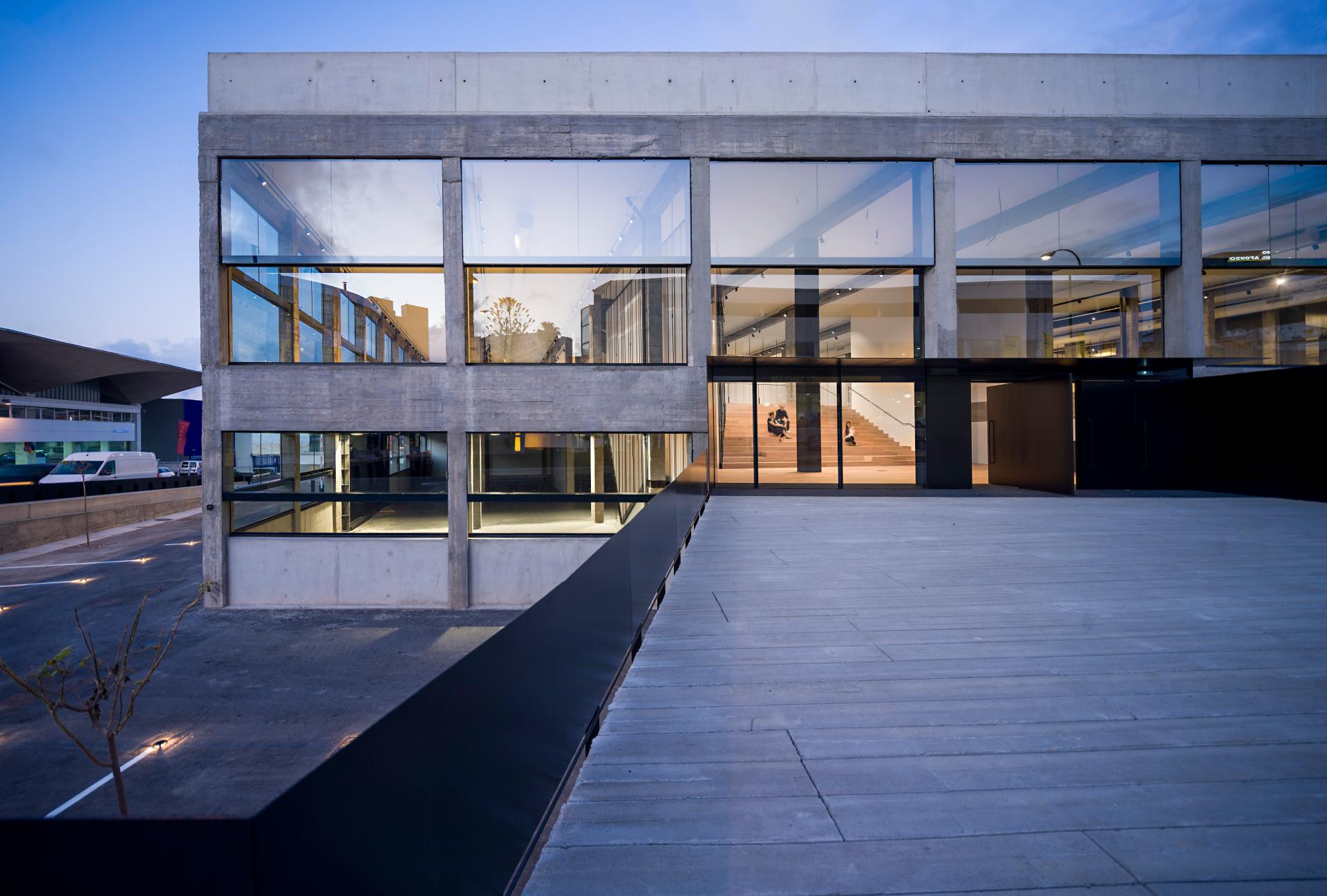
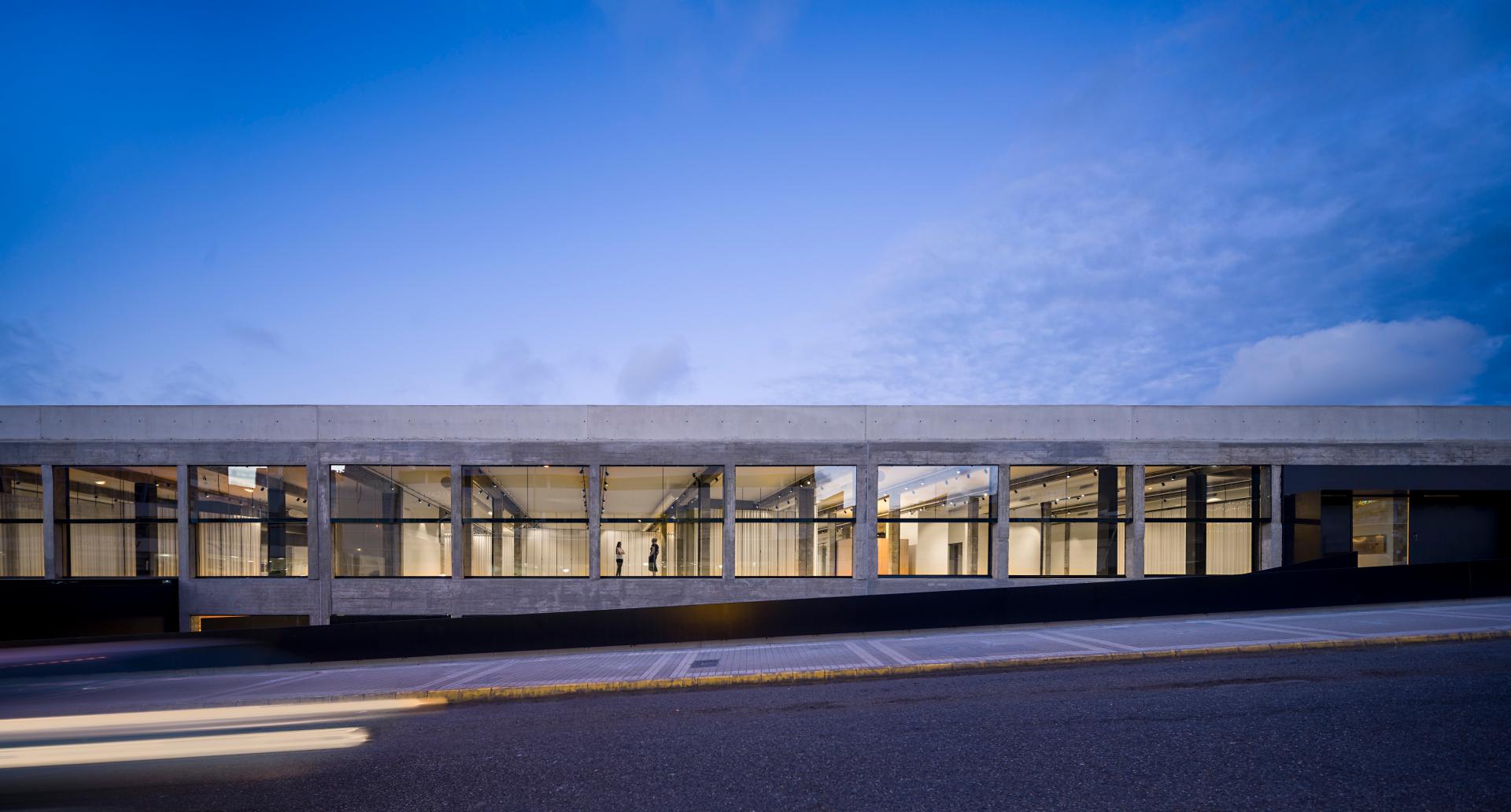
The exterior of the building reflects the project goal of preserving the recycled structure, which acts as the main framework of the project. The enclosing elements added to this structure are of transparent glass without visible fittings, hung from the ceiling and separated from each other to allow air to pass through.
The idea of minimum material is also used for the entrance doors and canopies, of steel plate. The interplay between the 1960s reinforced concrete structure, irregular and massive, and the very thin and shiny new elements, parallel panes of glass and black sheet metal 2cm thick, greatly reinforces the contrast between the recycled and the new. To recycle is in some way to play with time: here the time lag is made visible by pointing up that contrast.
Key objectives for inclusion
One of the objectives of the project is the search for an open distribution that would not be defined by the project but could be defined by the users themselves at any time. The definition of the project starts from the users and should never be permanent.
This being a privately financed building for private use, citizen engagement is enhanced by means of transparency and the contribution made by the vegetation on the plot, as the only building with trees in the entire neighborhood and also the most transparent. The internal streets are open to passers-by at any time, and anyone who wants to can use the entrance plaza as a little public park.
The need for a different interaction is signalled right from the entrance with its tiered area for more or less public events: soccer matches, training (including Vocational Training for children from local schools) or other firms’ work meetings. This kind of organisation is one of the merits of the company: the project simply supplies an open and flexible reception space.
All of the building’s accesses are designed to avoid any kind of discrimination. Every change in level has an elevator right next to it to ensure the equal opportunities of all users, including those with reduced mobility, the elderly and people with young children.
Results in relation to category
Shaping a circular industrial ecosystem and supporting life-cycle thinking have been achieved in several ways:
The building expresses the advantages of preserving what already exists (when its preservation has a considerably lower environmental cost). It can be seen as exemplifying the architectural possibilities afforded by this commitment to recycling.
It achieves programmatic functionality and great flexibility and possibilities of use through an alternative approach to distribution, avoiding the fixed, the ‘transcendent’ or the showy to settle instead in the everyday, the weak and the ‘normal’.
It achieves maximum sustainability and comfort by means of the architectural design itself, providing adjustable ventilation between its glass façade and powerful mechanical extractor, dispensing entirely with air conditioning. It lets natural light into the whole space by means of the large glazed surface of the façade, reflective flooring that brings daylight deeper into the interior, and the skylights that occupy existing voids in the structure.
The project has made the building’s users, visitors and owners more aware of the need to engage in this kind of interevention. Rather than demolish the existing building and maximise cost they have managed to find solutions that optimise the space and reduce costs in every way.
How Citizens benefit
It is a private project, and the dialogue was primarily with future users, who expressed their desire for open spaces, natural lighting and ventilation without air conditioning. Achieving these desiderata has resulted in great comfort and great satisfaction for the users, who were coming from artificially lit air-conditioned buildings. They feel happy and proud to be working there and this is very important to us.
Good communication throughout the drawing up of the brief was key to achieving the objectives and arrive at the desired architectural response. Also, being able to posit quite radical proposals seems to have given something to users who at times put forward more conservative ideas
Physical or other transformations
Innovative character
The work is on an old industrial estate where many buildings from the 1960s have been demolished and replaced with brand new ‘shiny’ buildings with aluminum cladding, standard framing elements and air conditioning. This is standard practice in both industrial and non-industrial areas here. An anodyne universal architecture that poses no challenges. The objectives this project embraced were: to salvage as much as possible of the existing building and not demolish it; to design and manufacture everything locally, and to do this with recyclable and environmentally friendly materials; to keep the whole space open and continuous, enabling its fragmented use while providing good natural ventilation, and introduce natural light all the way into every floor. But above all it set out to design a project based on new concepts which without breaking with the environment would become a benchmark for a different way of acting.
The life of this building is not conceived from a specific industrial use but with an open structure of uses, with the idea that it could become housing, offices, a museum or anything else. It is not fixed in time. The use of the neighbourhood is not taken as fixed. It is an industrial area that is becoming less industrial all the time.
Learning transferred to other parties
The possible examples set by this project or transfers from it start with the initial attitude adopted in designing it:
To show it is possible to rescue an old concrete structure and not demolish it without relinquishing architectural value, which obviously leads to a certain modesty or humility in undertaking it. Ultimately, the old structure became an expressive opportunity.
To establish an alternative compositional pattern different from the usual one (using an algebraic composition rather than a geometric one) in occupying the reticulated or ‘hypostyle’ space created by this structure.
To make the effort to locally design and produce all the elements of the project (fittings, boxes, curtains) to achieve the necessary coherence with the overall concept and reduce CO2 emissions from transport.
To use recyclable materials wherever possible.
To emphasise in the design of the framing elements the effort to achieve a high ventilation system (two metres) for the (adjustable) natural ventilation of the building.
The many visitors the building receives and the large number of people work there have in one way or another come to align themselves with that vision. We constantly disseminate our approach to this building in academic settings, in conferences and lectures in Europe and beyond and also to our students at the university.