Co-neighbouring
Basic information
Project Title
Full project title
Category
Project Description
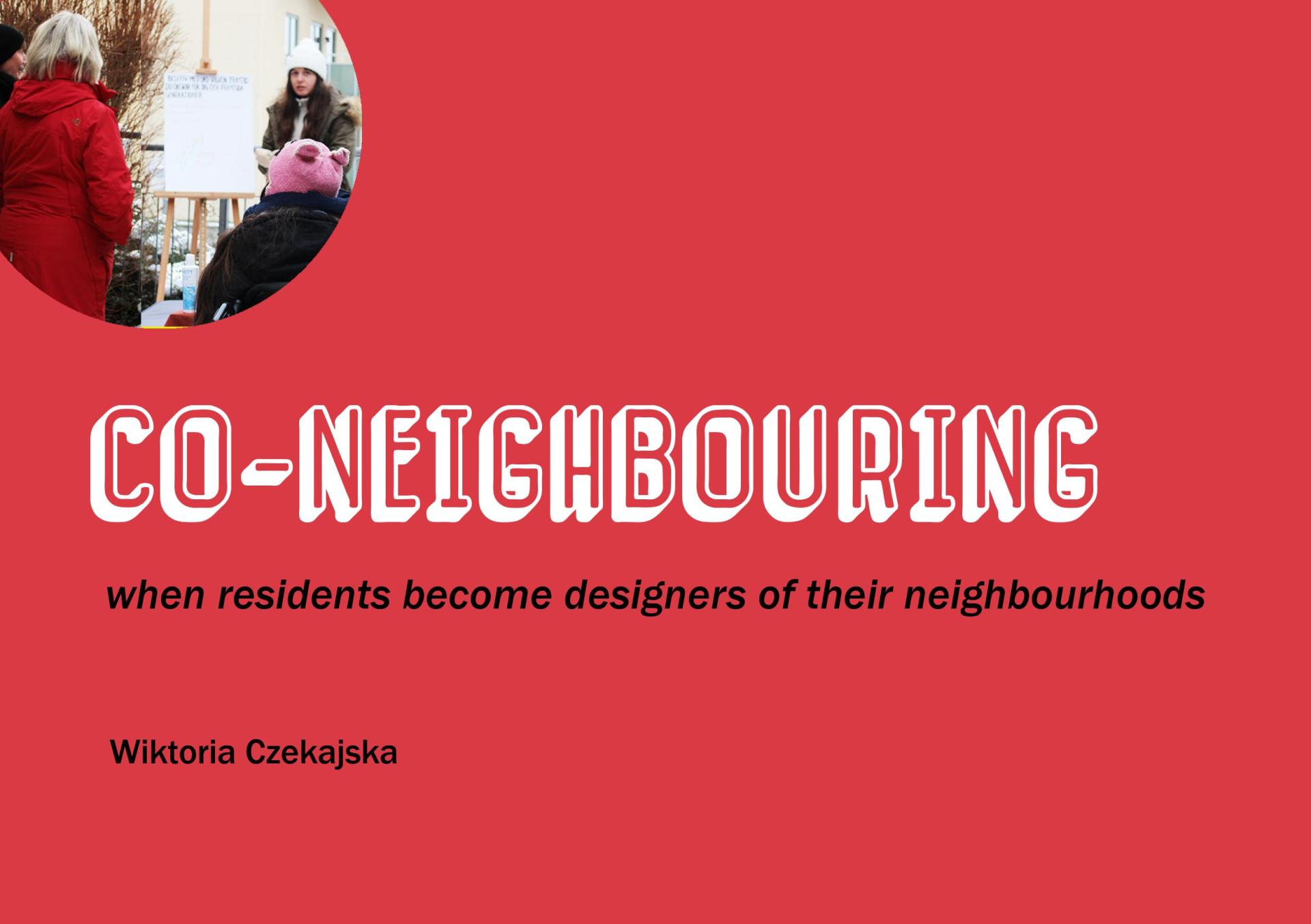
Co-neighbouring is a design exploration that aims to examine the possibilities of resident’s engagement and collaboration. In an apartment building for rent, where resident’s agency is limited to their private apartment, I invited my neighbors to become active designers of our closest environment together. This project explores what kind of innovations become possible when residents get the chance to contribute to the development of the building they live in.
Geographical Scope
Project Region
Urban or rural issues
Physical or other transformations
EU Programme or fund
Which funds
Description of the project
Summary
Co-neighbouring is a design exploration that aims to examine the possibilities of resident’s engagement and collaboration in a rented apartment building in Sweden. In an apartment building for rent, where resident’s agency is limited to their private apartment, I invited my neighbors to become active designers of our closest environment together. This project uncovers the power relation visible between the landlord and tenants and some tensions that arise from this project’s will to give residents more agency. It also aims to highlight the importance of collaborative processes in apartment buildings and explores what kind of innovations become possible when residents get the chance to contribute to the development of the building they live in.
The project resulted in strengthened relationships between neighbours, physical adjustments we co-created for our buidling in order to make it and our community more resilient and the collaborator journey map that could serve as a framework for designing more participatory projects around housing. Putting the ‘collaborator’ as opposed to a ‘user’, commonly used in service design, is a suggestion for other designers to rethink their position and relationships with those, who are affected by their work.
All the insights from the project are put together in a form of a booklet, a publication that is aimed towards a broader audience like urban developers, landlords and the society as a whole.
Key objectives for sustainability
The project explores resiliency in a context of apartment buildings for rent, which I argue is crucial for creating sustainability. “Urban resilience literature frames social and ecological systems as inseparably coupled, and understands adaptive capacity and inclusivity as critical aspects of resilience planning. A resilient city would be one that plans collectively for and responds well to disaster, but is also powered by renewable energy, including nature, food production, and cooperative economies.”(Brown Wilson, 2018, p.6)
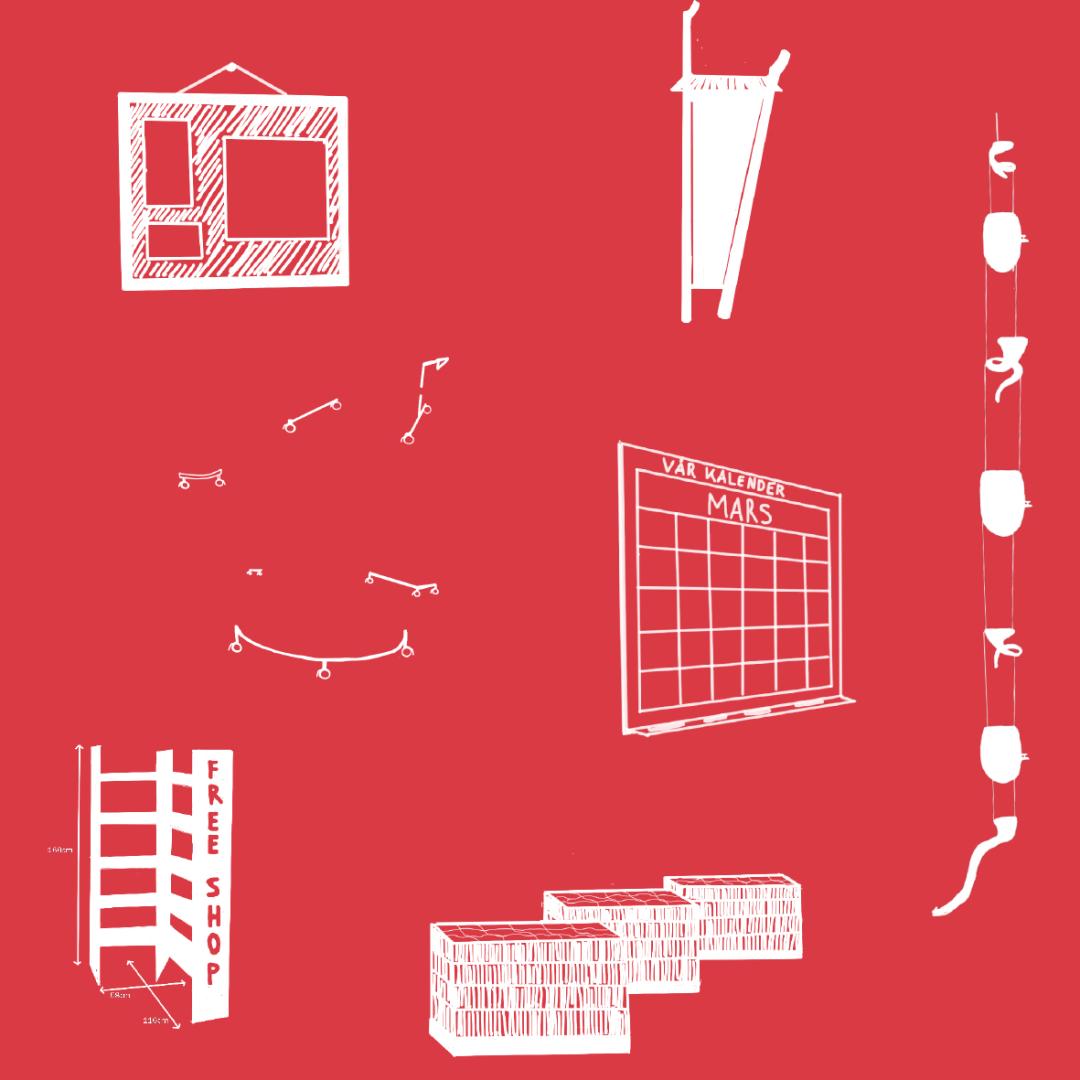
Moreover the physical adjustments that were co-created during the project are aimed to introduce circularity into this local community. Suggestions to build a free shop that reduces waste and decreases mass consumption and a rain water collection system are just some examples of what would be possible in apartment buidlings, that would increase local resilience and therefore contribute to sustainability.
In this project I also look at the concept of smart cities and digitalizaion with a critical perspective, arguing that low-tech, bottom-up solutions can be a simplier and more efficient way to reach sustainability.
Brow Wilson. (2018). Resilience For All. Washington, Covelo, London: Island Press
Key objectives for aesthetics and quality
Since it is a design exploration, I put a lot of attention to the aesthetics of my final products which were the sketches of adjustments, the journey map and the booklet. When it comes to the sketches of physical adjustments, the forms I suggested were simple and aimed to symbiotically blend with our buidling and the local environment. Since the idea was to make the adjustments from recycled materials, perhaps not so polished and a bit rough look is predicted. The collaborator journey maps and the booklet are telling a complex story, therefore the visuals had to be simplified as much as possible in order not to confuse the reader. Overall the choice of red is showing that the project is a radical statement and it touches on the emotions of frustration, since it could not be completely implemented at the end. Sketching was a medium that I used a lot to communicate with my neighbours and it became an important tool, to imagine a different future together.
Key objectives for inclusion
The steps I took during this journey can be used as a design method for connecting to and forming bonds between those living in close proximity (people, species, infrastructure). I don’t think the process should be repeated in exactly the same way somewhere else because the point is to adapt your next action to the insights you got from your previous actions and that will vary depending on who participates and where. I would also argue for implementation of the co-neighbouring process in housing in general as a way to experiment with collaborative processes in neighbourhoods for sustainable development. For example, a discussion about allowing residents to transform their building to some extent, following appropriate rules and guidelines would be worth having. There could be new kinds of contracts emerging from such discussion that for example, allow and guide residents in what is possible to change in the common spaces, without limiting their rights to their private apartments. It would also open possibilities for figuring out how to maintain common spaces, how to make decisions together in such micro-communities, and how to manage responsibility in a group. Looking at how weak our social muscles are right now and the fact that living in active communities allows for more resilient lifestyles, it seems like a good path to take on for making our spaces and cities more sustainable. These experiments would require support at least from the landlords and for them to change their priority from economic growth to sustainable development or even Earth Logic.
Results in relation to category
I think this project applies to all the categories but I decided to apply for "Regaining a sense of belonging" one, because at the core of co-neighbouring is strengthening our local relationships. I mentioned the outcomes of my project before and they show the practical outcomes of trying to build such relationships. There is another level of building a sense of belonging which in this case was the process we went through together with my neighbours. The physical infrastructure is important for supporting building relationships with others but it is the initiatives from people and their motivation to belong that needs to happen in order to achieve a sense of community. I think it is interesting how the design practice is capable of creating these experiences and processes. Therefore another outcome was the time and methods developed in order to design the process of building relationships between each other and the places we live in.
How Citizens benefit
Some of the inhabitants of the building that the project took place in were the co-creators of it's outcomes. Once invited to events and given surveys, they contributed with their thoughts on community building in their building.
Physical or other transformations
Innovative character
The innovative part in co-neighbouring is a new perspective on what it means to design and be a designer. I challenge the idea of the ownership of designs and design processes and instead of making decisions that will influence others by myself, I involve the community that will be influenced by my actions.
I find this empowering research approach to be extremely important in times of the overwhelming crisis that we are in right now, since it gives space and guidance to the bottom-up, grassroots initiatives that have proved to bring long-term, deeply sustainable solutions.Redistributing power in that way opens doors for more democratic and bottom-up actions to emerge. Providing us with diverse solutions, it also contributes to resilience building
Another innovative aspect concerns the very popular investments in making our city "smarter" and therefore more sustainable. In my project, I question what does 'smart' mean? “Perhaps soft city can be considered a counterpoint or even a complement to “smart” city. Rather than looking to complex new technologies to solve the challenges of increasing urbanization, we can instead look to simple, small-scale, low-tech, low-cost, human-centered, gentle solutions that help make urban life easier, more attractive, and more comfortable. Softer may be smarter.” (Sim, 2019, p.4) It is Sim’s idea of smartness that I argue for with my project. Additionally, I’d like to challenge who is in charge of proposing changes and innovations in our cities and housing complexes. Instead of it being those well economically established corporations I suggest we give space to local residents since they are the experts of the areas they live in.
Sim. (2019). Soft City: building density for everyday life. Washington, Covelo, London: Island Press
Learning transferred to other parties
The steps I took during this journey can be used as a design method for connecting to and forming bonds between those living in close proximity (people, species, infrastructure). I don’t think the process should be repeated in exactly the same way somewhere else because the point is to adapt your next action to the insights you got from your previous actions and that will vary depending on who participates and where. I would also argue for implementation of the co-neighbouring process in housing in general as a way to experiment with collaborative processes in neighbourhoods for sustainable development. For example, a discussion about allowing residents to transform their building to some extent, following appropriate rules and guidelines would be worth having. There could be new kinds of contracts emerging from such discussion that for example, allow and guide residents in what is possible to change in the common spaces, without limiting their rights to their private apartments. It would also open possibilities for figuring out how to maintain common spaces, how to make decisions together in such micro-communities, and how to manage responsibility in a group. Looking at how weak our social muscles are right now and the fact that living in active communities allows for more resilient lifestyles, it seems like a good path to take on for making our spaces and cities more sustainable. These experiments would require support at least from the landlords and for them to change their priority from economic growth to sustainable development or even Earth Logic.
The process I designed can serve as an inspiration with practical examples for others to apply elsewhere. Such participatory processes could be applied also outside of residential spaces, in urban development in general. I transfer my knowledge in a form of a small booklet, directed to urban developers and architects to showcase a different perspective on urban development.