ProModSe - Modular Refugee Settlement
Basic information
Project Title
ProModSe - Modular Refugee Settlement
Full project title
ProModSe - Modular Refugee Settlement
Category
Prioritising the places and people that need it the most
Project Description
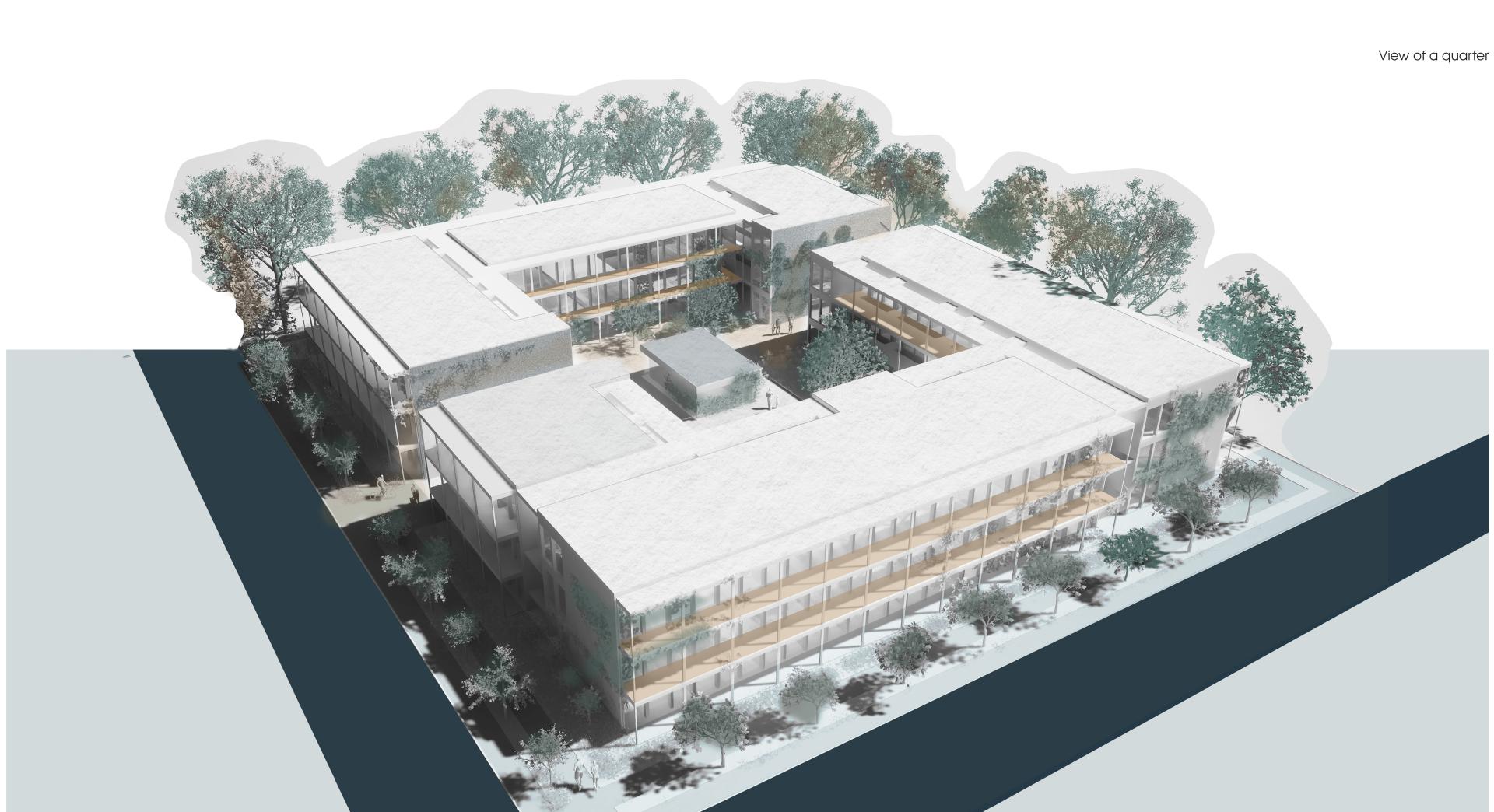
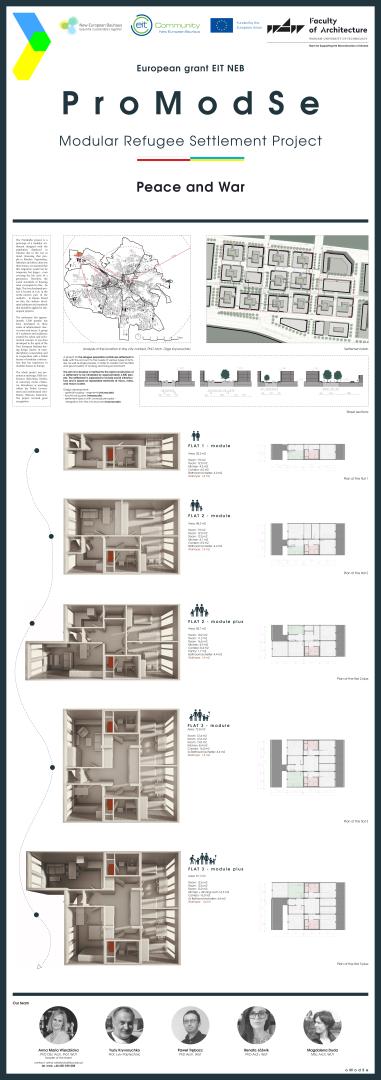
The design of a modular settlement in Lviv for a Ukrainian community displaced by the war was developed at three scales: macro, mezzo and micro. The urban-architectural concept was created by academic architects and developed in design classes in the European Bauhaus spirit. Students were involved in a collaborative process with a modular building factory. The project resulted from a grant awarded by the European Institute of Innovation and Technology (EIT) Community New European Bauhaus.
Geographical Scope
Cross-border/international
Project Region
CROSS-BORDER/INTERNATIONAL: Poland, Other
Urban or rural issues
Mainly urban
Physical or other transformations
It refers to a physical transformation of the built environment (hard investment)
EU Programme or fund
Yes
Which funds
Horizon2020 / Horizon Europe
Description of the project
Summary
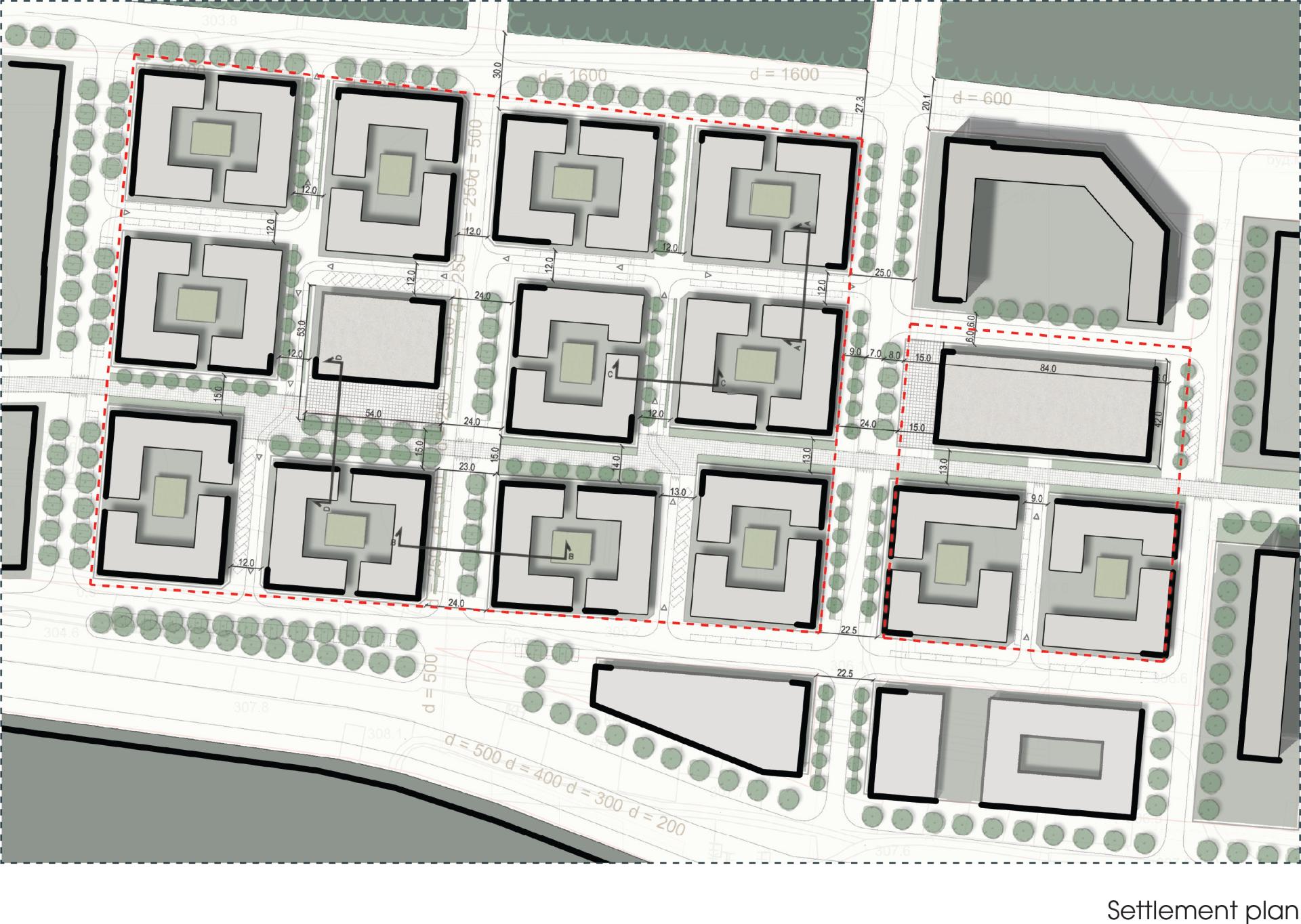
The ProModSe project is a prototype of a modular settlement designed with the population displaced in Ukraine due to the war in mind. Knowing that people in Kharkiv, Zaporozhye, Mykolaiv and other cities lost their homes, we assumed that this migration would not be temporary but longer - even covering the life cycle of a generation. Therefore, the social standards of housing must correspond to this - be high. The first developed project is located in Lviv, in the north-western part of the outskirts - in Riasne. Based on this, the authors developed solutions and standards that should be applied in subsequent projects.
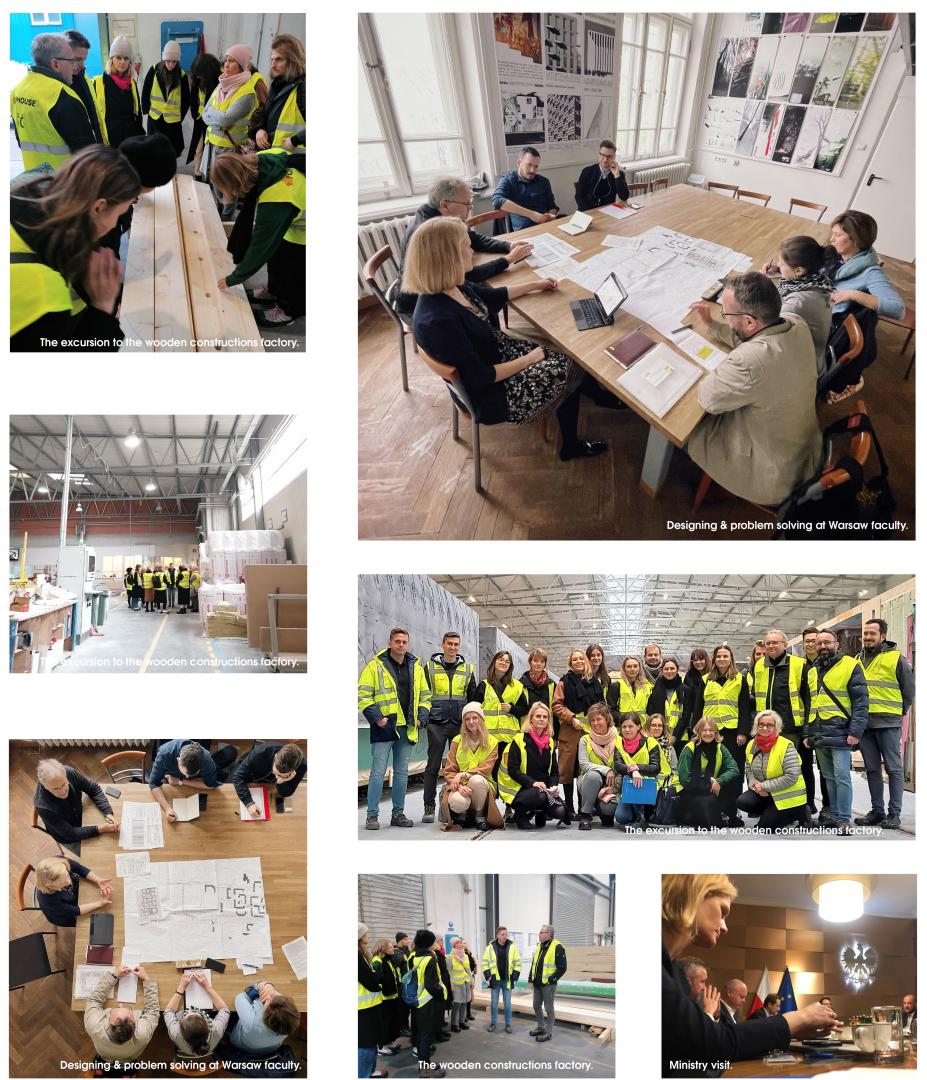
The settlement (for approximately 3,500 people) has been developed in three scales of advancement: macro, meso and micro. A group of 5 architects and academics created the urban and architectural concept - Prof. Anna Maria Wierzbicka, Prof. Yuriy Kryvoruchko (Lviv), PhD Paweł Trębacz, PhD Renata Jóźwik, and M.Sc. Magdalena Duda. It was then developed in the spirit of the New European Bauhaus during design classes, in interdisciplinary cooperation, and in cooperation with a Polish factory of modular construction that has experience in modular houses in Europe. Students in the last year of studies (just before graduation) developed the concept through the projects of two centres - a social centre (kindergarten for children) and a commercial - multifunctional one. We organised a factory visit where students could show their work's effects at architectural meetings. The whole project was presented at meetings, NEB conferences (Barcelona, Berlin), in university circles (Valencia, Barcelona), at meetings within the Polish Government and architectural exhibitions (Warsaw, Katowice).
The project resulted from a grant from the European Institute of Innovation and Technology (EIT) Community New European Bauhaus. The project was presented at meetings in Europe and received great recognition.
The settlement (for approximately 3,500 people) has been developed in three scales of advancement: macro, meso and micro. A group of 5 architects and academics created the urban and architectural concept - Prof. Anna Maria Wierzbicka, Prof. Yuriy Kryvoruchko (Lviv), PhD Paweł Trębacz, PhD Renata Jóźwik, and M.Sc. Magdalena Duda. It was then developed in the spirit of the New European Bauhaus during design classes, in interdisciplinary cooperation, and in cooperation with a Polish factory of modular construction that has experience in modular houses in Europe. Students in the last year of studies (just before graduation) developed the concept through the projects of two centres - a social centre (kindergarten for children) and a commercial - multifunctional one. We organised a factory visit where students could show their work's effects at architectural meetings. The whole project was presented at meetings, NEB conferences (Barcelona, Berlin), in university circles (Valencia, Barcelona), at meetings within the Polish Government and architectural exhibitions (Warsaw, Katowice).
The project resulted from a grant from the European Institute of Innovation and Technology (EIT) Community New European Bauhaus. The project was presented at meetings in Europe and received great recognition.
Key objectives for sustainability
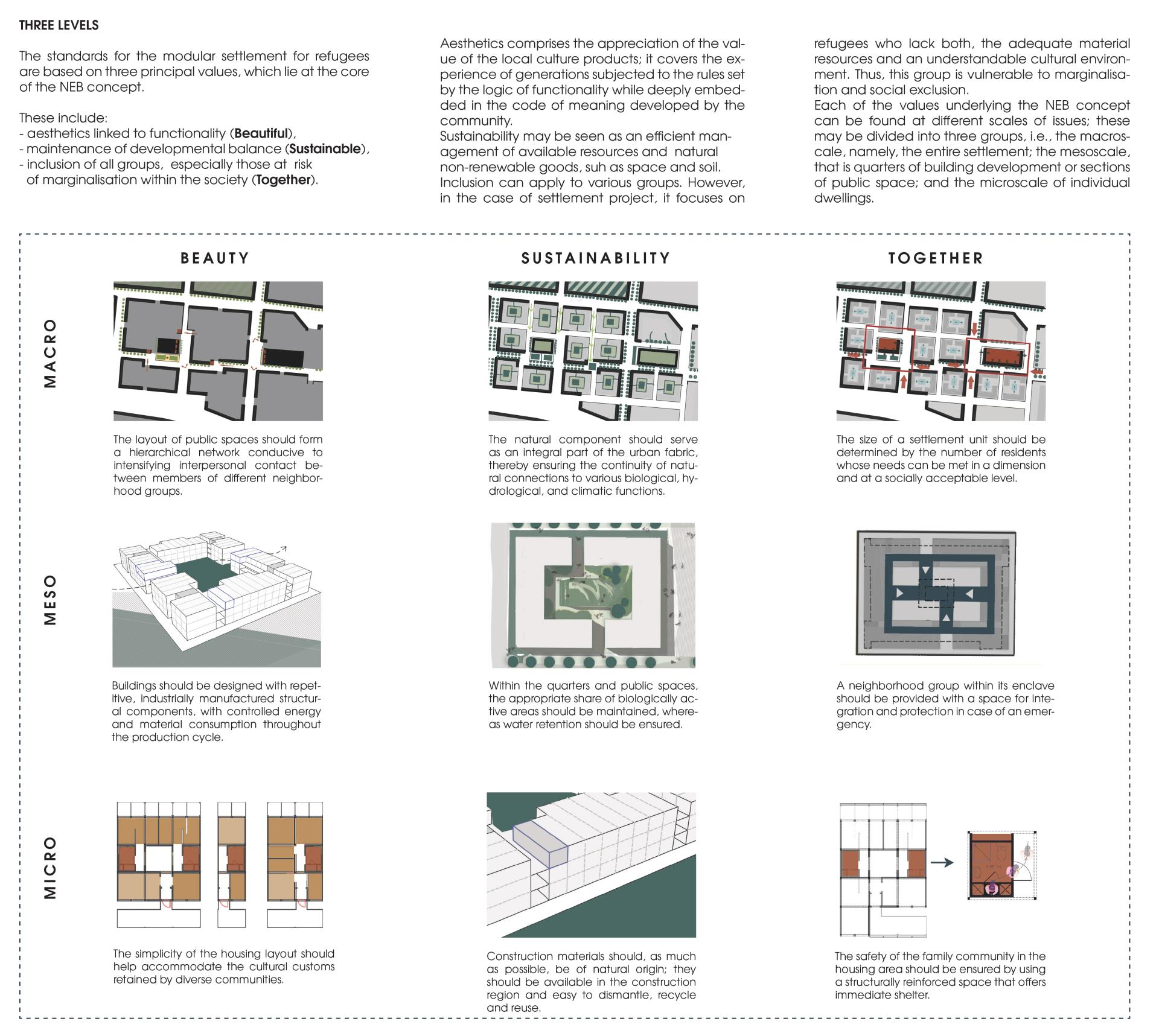
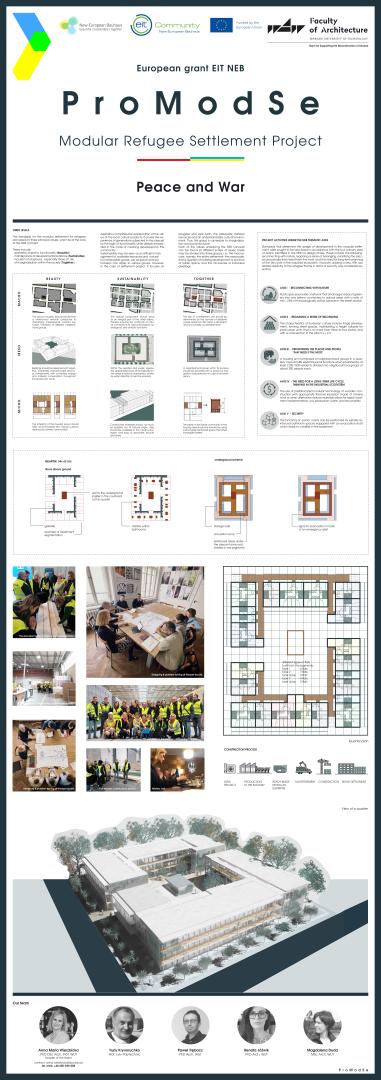
The authors have developed standards for modular buildings. The standards for the modular settlement for refugees are based on three principal values, which lie at the core of the NEB concept. These include aesthetics linked to functionality (Beautiful); maintenance of developmental balance (Sustainable); inclusion of all groups, especially those at risk of marginalisation within the society (Together).
Sustainability may be seen as the efficient management of available resources and non-renewable natural goods, such as space and soil.
Macroscale: The natural component should serve as an integral part of the urban fabric, ensuring the continuity of natural connections to various biological, hydrological, and climatic functions.
Mesoscale: Within the quarters and public spaces, the appropriate share of biologically active areas should be maintained, whereas water retention should be ensured
Microscale: Construction materials should, as much as possible, be of natural origin; they should be available in the construction region and easy to dismantle, recycle and reuse.
We integrated these principles into the course programme. The students were very active in proposing different sustainable solutions
Sustainability may be seen as the efficient management of available resources and non-renewable natural goods, such as space and soil.
Macroscale: The natural component should serve as an integral part of the urban fabric, ensuring the continuity of natural connections to various biological, hydrological, and climatic functions.
Mesoscale: Within the quarters and public spaces, the appropriate share of biologically active areas should be maintained, whereas water retention should be ensured
Microscale: Construction materials should, as much as possible, be of natural origin; they should be available in the construction region and easy to dismantle, recycle and reuse.
We integrated these principles into the course programme. The students were very active in proposing different sustainable solutions
Key objectives for aesthetics and quality
Aesthetics comprises the appreciation of the value of the local cultural products; it covers the experience of generations subjected to the rules set by the logic of functionality while deeply embedded in the code of meaning developed by the community.
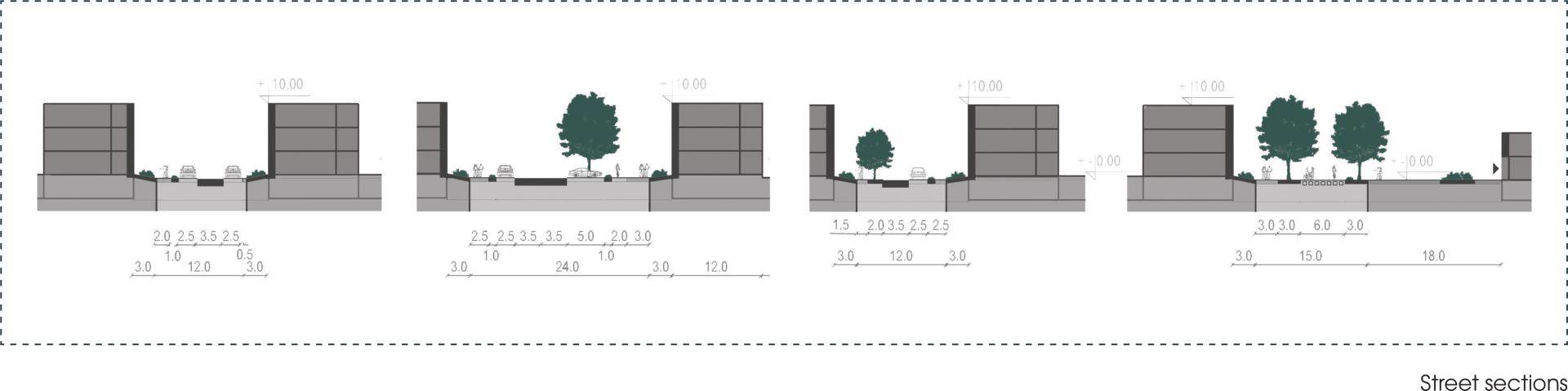
Macroscale: The layout of public spaces should form a hierarchical network conducive to intensifying interpersonal contacts between members of different neighbourhood groups.
Mesoscale: Within the quarters and public spaces, the appropriate share of biologically active areas should be maintained, whereas water retention should be ensured.
Microscale: Construction materials should, as much as possible, be of natural origin; they should be available in the construction region and easy to dismantle, recycle and reuse.
Macroscale: The layout of public spaces should form a hierarchical network conducive to intensifying interpersonal contacts between members of different neighbourhood groups.
Mesoscale: Within the quarters and public spaces, the appropriate share of biologically active areas should be maintained, whereas water retention should be ensured.
Microscale: Construction materials should, as much as possible, be of natural origin; they should be available in the construction region and easy to dismantle, recycle and reuse.
Key objectives for inclusion
Inclusion can apply to various groups. However, in the case of the settlement project, it focuses on refugees who lack both adequate material resources and an understandable cultural environment. Thus, this group is vulnerable to marginalisation and social exclusion.
Macroscale: The size of a settlement unit should be determined by the number of residents whose needs can be met in a dimension and at a socially acceptable level.
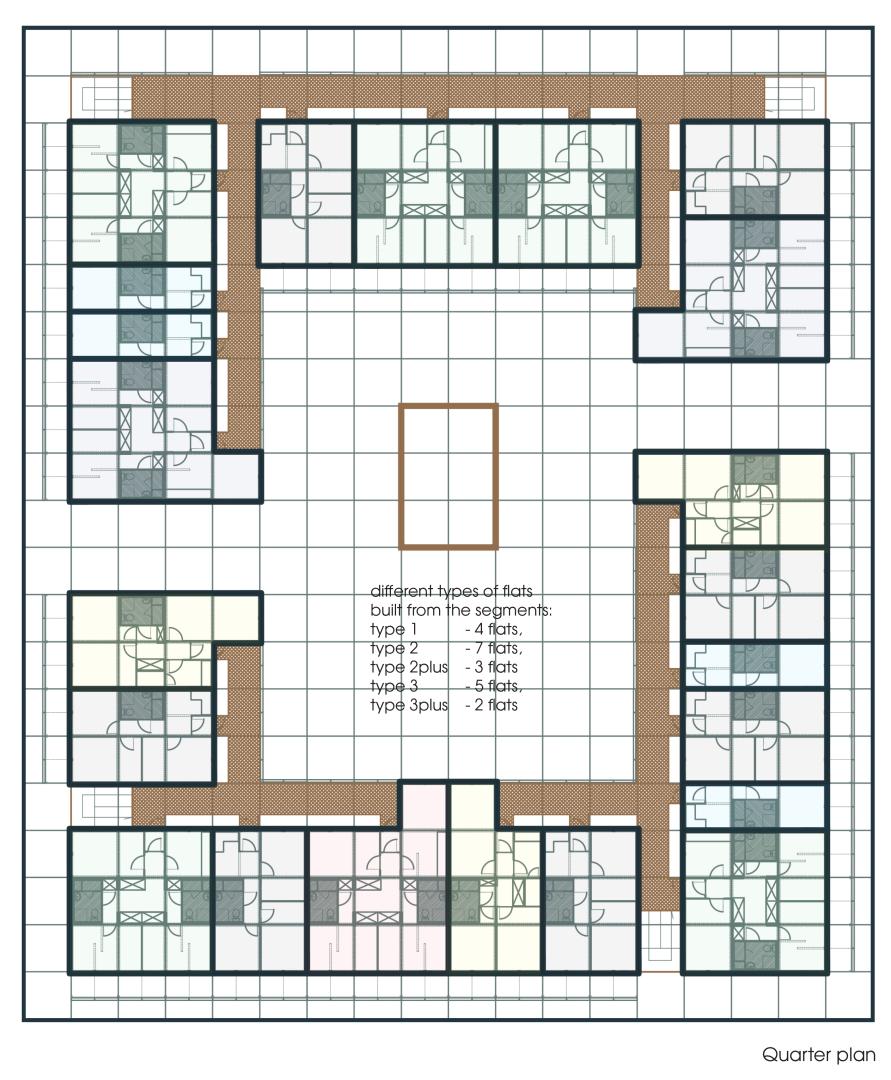
Mesoscale: A neighbourhood group within its enclave should be provided with a space for integration and protection in an emergency.
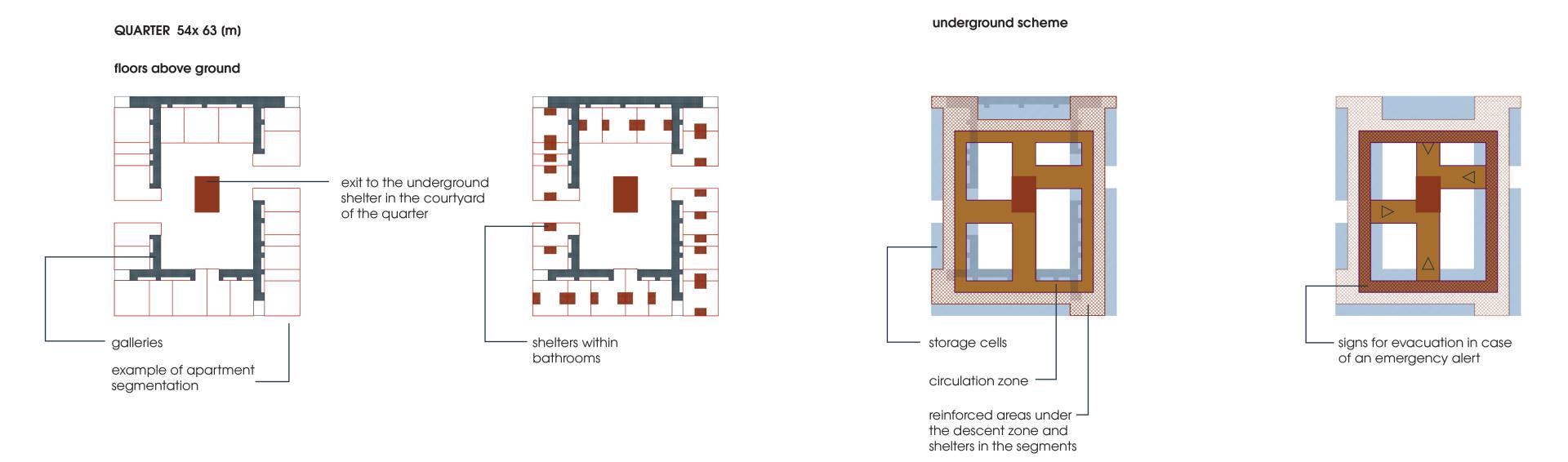
Microscale: The safety of the family community in the housing area should be ensured by using a structurally reinforced space that offers immediate shelter.
Macroscale: The size of a settlement unit should be determined by the number of residents whose needs can be met in a dimension and at a socially acceptable level.
Mesoscale: A neighbourhood group within its enclave should be provided with a space for integration and protection in an emergency.
Microscale: The safety of the family community in the housing area should be ensured by using a structurally reinforced space that offers immediate shelter.
Results in relation to category
Project development can involve different scales of involvement (this also depends on the project's funding capacity):
1. Design and development RESEARCH for the ProModSe concept
2. Development of DOCUMENTATION conceptual, patent and construction documents
3. INTERDISCIPLINARY Study research confrontation with other groups
4. Popularisation and PARTICIPATION activities
5. Creation of a lab EQUIPMENT website
It would be most effective to realise a unit - even 1 module - to test and further develop solutions (on a prototype basis). To this end, we are planning further applications for international grants and attending meetings to establish collaborations with contractors. The ProModSe concept we developed involved a short timeframe and limited funding. Despite this, a project with great development potential was created.
1. Design and development RESEARCH for the ProModSe concept
2. Development of DOCUMENTATION conceptual, patent and construction documents
3. INTERDISCIPLINARY Study research confrontation with other groups
4. Popularisation and PARTICIPATION activities
5. Creation of a lab EQUIPMENT website
It would be most effective to realise a unit - even 1 module - to test and further develop solutions (on a prototype basis). To this end, we are planning further applications for international grants and attending meetings to establish collaborations with contractors. The ProModSe concept we developed involved a short timeframe and limited funding. Despite this, a project with great development potential was created.
How Citizens benefit
The collaboration with local stakeholders was multidimensional, depending on the scope and type of work/activities. During the project:
- conducted surveys with groups of Ukrainians resettled in Lviv (400 people surveyed) - this scope of work was carried out by Municipal Institution City Institute, a company existing under the laws of Ukraine with offices located Rynok Square 1, office 111, Lviv, Ukraine;
- conducted surveys with groups of Ukrainians who came to Poland during the war (more than 60 survey responses) - this scope of work was carried out in several local Ukrainian groups (a group of refugees under the care of a religious community and a group under the care of ORG people from the reception points);
- the group directly collaborating on the project were the authors of the concept and experts from various communities (Architecture Department of the Warsaw University of Technology, Unihouse BP S.A. factory ) - dzięki temu mogliśmy profesjonalnie rozwiązywać zagadnienia NEB – estetyki i funkcjonalności, zrównoważoności, wspólnotowości
- a group of final-year students (master's degree) of the Faculty of Architecture of the Warsaw University of Technology was entrusted with the workshop task;
- thanks to the partnership with the Lviv authorities, we have received baseline data and an indicated location for future project implementation.
- in the course of the project's work, several official meetings and informal discussions took place to highlight the housing problem of internally displaced persons in Ukraine and sensitise the audience to this problem.
- the project was presented to the academic community (teachers and students) at the Polytechnic University of Valencia (Universitat Politècnica de València) and the Polytechnic University of Catalonia (Barcelone). As a result, we have established scientific contacts and are planning further joint activities.
- conducted surveys with groups of Ukrainians resettled in Lviv (400 people surveyed) - this scope of work was carried out by Municipal Institution City Institute, a company existing under the laws of Ukraine with offices located Rynok Square 1, office 111, Lviv, Ukraine;
- conducted surveys with groups of Ukrainians who came to Poland during the war (more than 60 survey responses) - this scope of work was carried out in several local Ukrainian groups (a group of refugees under the care of a religious community and a group under the care of ORG people from the reception points);
- the group directly collaborating on the project were the authors of the concept and experts from various communities (Architecture Department of the Warsaw University of Technology, Unihouse BP S.A. factory ) - dzięki temu mogliśmy profesjonalnie rozwiązywać zagadnienia NEB – estetyki i funkcjonalności, zrównoważoności, wspólnotowości
- a group of final-year students (master's degree) of the Faculty of Architecture of the Warsaw University of Technology was entrusted with the workshop task;
- thanks to the partnership with the Lviv authorities, we have received baseline data and an indicated location for future project implementation.
- in the course of the project's work, several official meetings and informal discussions took place to highlight the housing problem of internally displaced persons in Ukraine and sensitise the audience to this problem.
- the project was presented to the academic community (teachers and students) at the Polytechnic University of Valencia (Universitat Politècnica de València) and the Polytechnic University of Catalonia (Barcelone). As a result, we have established scientific contacts and are planning further joint activities.
Physical or other transformations
It refers to a physical transformation of the built environment (hard investment)
Innovative character
The project is based on the idea of NEB, which was introduced and tested in a war crisis. Only now has such an approach been widely developed. We noticed that in addition to the three cores of NEB - Beautiful, Sustainable and Together - a SAFETY aspect was necessary.
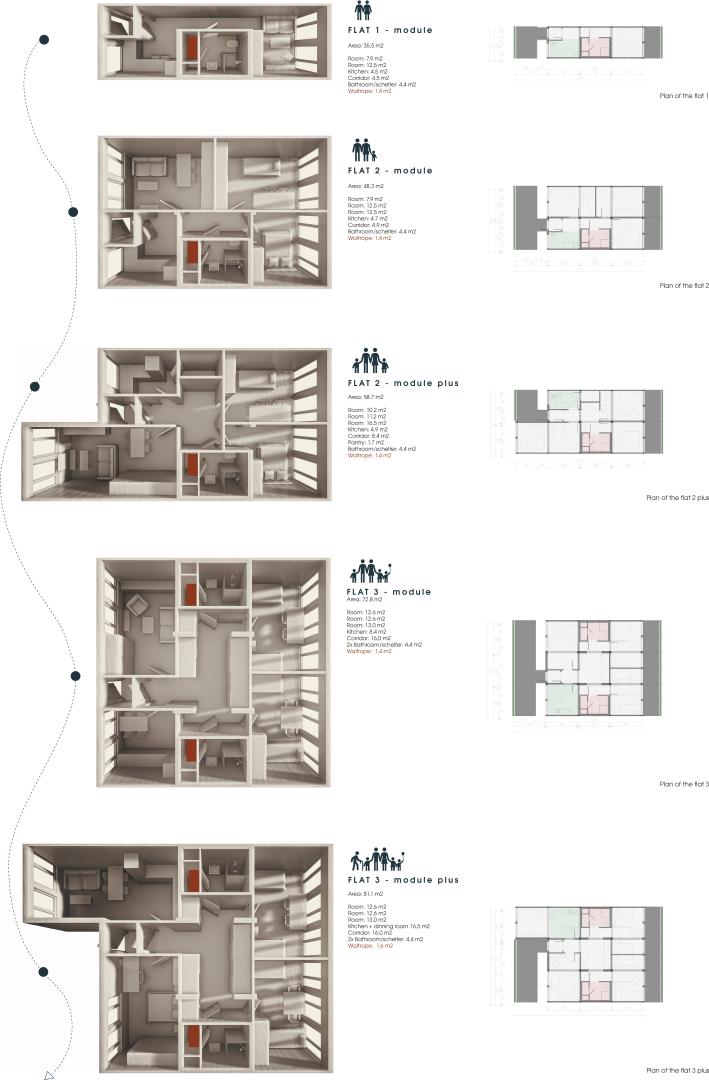
This led us to develop a reinforced bathroom/shelter within the modular housing and a basement descent system in case of emergency. These elements should be integrated into the flats to provide psychological comfort.
The regeneration issue after the war experience was also crucial in our deliberations. The community aspect was, therefore, a priority.
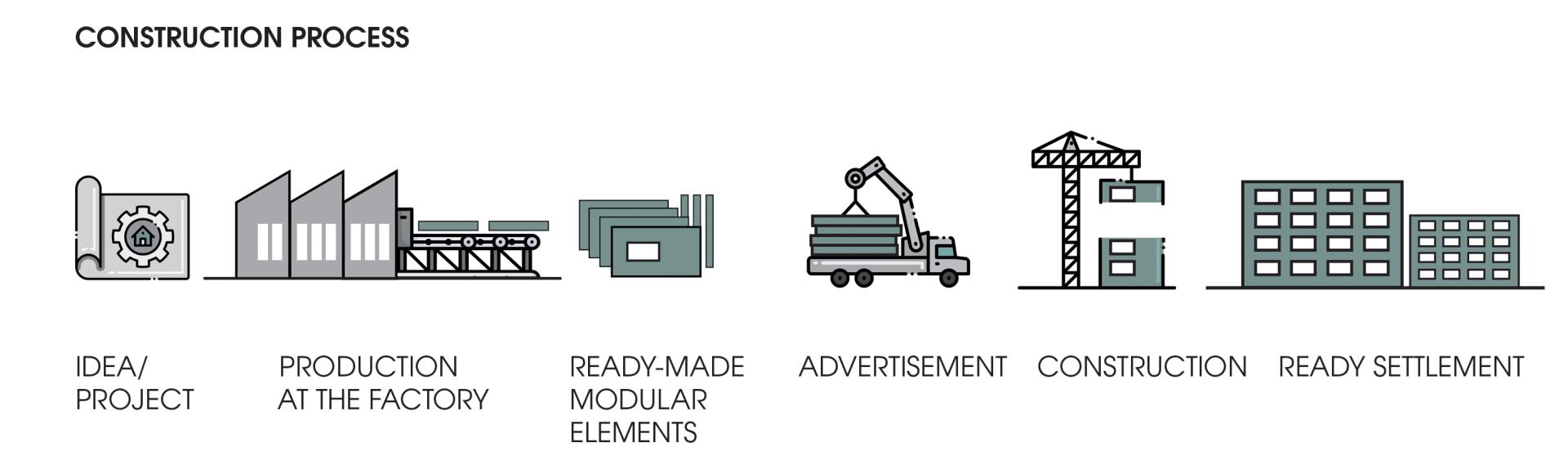
We chose modular construction because it guarantees rapid assembly in a production line start-up environment.
The possibility of flexible housing programming according to the changing family structure.
This led us to develop a reinforced bathroom/shelter within the modular housing and a basement descent system in case of emergency. These elements should be integrated into the flats to provide psychological comfort.
The regeneration issue after the war experience was also crucial in our deliberations. The community aspect was, therefore, a priority.
We chose modular construction because it guarantees rapid assembly in a production line start-up environment.
The possibility of flexible housing programming according to the changing family structure.
Disciplines/knowledge reflected
Architecture - general concept, identification of opportunities for sustainable construction, rapid implementation in an emergency of housing needs. Design of safety-related elements - shelter system. Adaptation of the design to local regulations.
Urban design - a creation of a sustainable housing estate in terms of size and form, including social functions. The project included a functional and spatial structure designed based on analyses of the site and surroundings.
Construction - integration of technical knowledge, building construction.
Materials science - use of sustainable materials for construction - renewable materials, use of post-war materials - e.g. rubble.
Sociology - surveying the needs of war-affected populations - large-scale research.
Landscape architecture - introduction of pro-environmental elements.
Urban design - a creation of a sustainable housing estate in terms of size and form, including social functions. The project included a functional and spatial structure designed based on analyses of the site and surroundings.
Construction - integration of technical knowledge, building construction.
Materials science - use of sustainable materials for construction - renewable materials, use of post-war materials - e.g. rubble.
Sociology - surveying the needs of war-affected populations - large-scale research.
Landscape architecture - introduction of pro-environmental elements.
Methodology used
We acted according to a framework schedule (what we were doing and why):
1. Inventing and identifying the elements necessary in this type of place and program - we conducted surveys and interviews in terms of needs; In these 2 phases we established cooperation with colleagues from Lviv Polytechnic on a subcontracting basis, which we have in our financial plan.
2. Applying results to spatial forms; designing individual components - a task for the design team; We got material for the seminar in October - answers: what modules should be, what design, what settlement programme - guidelines for seminar tasks
3. Mid-report
4. Design workshops during which various configurations and settings of individual components of the settlement were tested; preparation of a brochure and research article - the task of the project team; get an answer to an assignment from the various seminar teams, which was provided with an opportunity for a panel discussion; accumulation of engagement - planned seminars with: students, academic teachers, Ukrainians, experts.
5. Realisation planning, dissemination - expert panel. Final report. To share the results with a wider audience.
1. Inventing and identifying the elements necessary in this type of place and program - we conducted surveys and interviews in terms of needs; In these 2 phases we established cooperation with colleagues from Lviv Polytechnic on a subcontracting basis, which we have in our financial plan.
2. Applying results to spatial forms; designing individual components - a task for the design team; We got material for the seminar in October - answers: what modules should be, what design, what settlement programme - guidelines for seminar tasks
3. Mid-report
4. Design workshops during which various configurations and settings of individual components of the settlement were tested; preparation of a brochure and research article - the task of the project team; get an answer to an assignment from the various seminar teams, which was provided with an opportunity for a panel discussion; accumulation of engagement - planned seminars with: students, academic teachers, Ukrainians, experts.
5. Realisation planning, dissemination - expert panel. Final report. To share the results with a wider audience.
How stakeholders are engaged
Local
Local involvement includes the community of the Faculty of Architecture at the Warsaw University of Technology - teacher-architects and a group of students involved in the centre's design workshops.
Regional
The regional impact was realised through active cooperation with a modular house factory in Bielsk Podlaski (Unibep S.A.), which the students visited. This was a new and valuable experience for both parties. The students were able to learn about the implementation aspect of modular architecture
National
The international aspect is the basic scale of impact, as we worked with partners from Ukraine. Thanks to Prof. Yuriy Kryvoruchko in the author's team, we had contact with the leading representatives of the city, the architects' Association of Ukraine Etc.
The aspect of contact with the stakeholders themselves, i.e. the displaced population, was also important. Therefore, needs surveys were essential. This contact yielded many positive relationships in a humanitarian crisis.
European
The dissemination of the project (media, institutional and personal) was on a European scale. It resulted in the broadcast of more than 20 activities - see the attached report for a list.
Local involvement includes the community of the Faculty of Architecture at the Warsaw University of Technology - teacher-architects and a group of students involved in the centre's design workshops.
Regional
The regional impact was realised through active cooperation with a modular house factory in Bielsk Podlaski (Unibep S.A.), which the students visited. This was a new and valuable experience for both parties. The students were able to learn about the implementation aspect of modular architecture
National
The international aspect is the basic scale of impact, as we worked with partners from Ukraine. Thanks to Prof. Yuriy Kryvoruchko in the author's team, we had contact with the leading representatives of the city, the architects' Association of Ukraine Etc.
The aspect of contact with the stakeholders themselves, i.e. the displaced population, was also important. Therefore, needs surveys were essential. This contact yielded many positive relationships in a humanitarian crisis.
European
The dissemination of the project (media, institutional and personal) was on a European scale. It resulted in the broadcast of more than 20 activities - see the attached report for a list.
Global challenges
We have experienced that project collaboration can result in positive interactions on a transnational level.
Designing with citizen participation is much more effective and draws attention to irrelevant aspects.
Integration and interdisciplinarity broaden knowledge.
The design of modular settlement was designed from the outset with the possibility of universal implementation but was also given security-related elements. The layout of the dwellings assumes different family structures without issues of exclusion.
Designing with citizen participation is much more effective and draws attention to irrelevant aspects.
Integration and interdisciplinarity broaden knowledge.
The design of modular settlement was designed from the outset with the possibility of universal implementation but was also given security-related elements. The layout of the dwellings assumes different family structures without issues of exclusion.
Learning transferred to other parties
Modular construction, the creation of sustainable community settlements, is a universal idea that can be implemented wherever there is access to basic material - i.e. it does not need to be exported from distant places.
Security elements are dedicated to places that are in some way vulnerable to armed conflict. Trusting that they will not take place in a normal situation, they will fulfil essential functions - bathroom, community room, etc.
Design in the spirit of NEB and oriented towards psychological comfort is also to be implemented everywhere. It is necessary to develop the technical aspects, which are a matter of optimising the solutions presented.
Security elements are dedicated to places that are in some way vulnerable to armed conflict. Trusting that they will not take place in a normal situation, they will fulfil essential functions - bathroom, community room, etc.
Design in the spirit of NEB and oriented towards psychological comfort is also to be implemented everywhere. It is necessary to develop the technical aspects, which are a matter of optimising the solutions presented.