Enhancing Circularity, Sustainability, and Innovation
Pedalando Juntas (Cycling Together)
Pedalando Juntas (Cycling Together): Bike sharing system
Pedalando Juntas (Cycling Together) offers free shared bicycles in São Paulo favelas, improving park access for women and children. Piloted in Peinha with 4,000 residents, partners included Metrópole Um pra Um, Tembici, Farah Services, Ameciclo, Aromeizero Institute, and Associação dos Moradores Jardim Santo Antônio. Awarded Prêmio Bicicleta Brasil. Key results: co-created bike-sharing system, donation campaign, and report, improving park access, public space use, and women’s empowerment.
Brazil
Local
São Paulo
Mainly urban
It involves other types of transformations (soft investment)
Yes
2025-01-17
No
No
No
Organisation
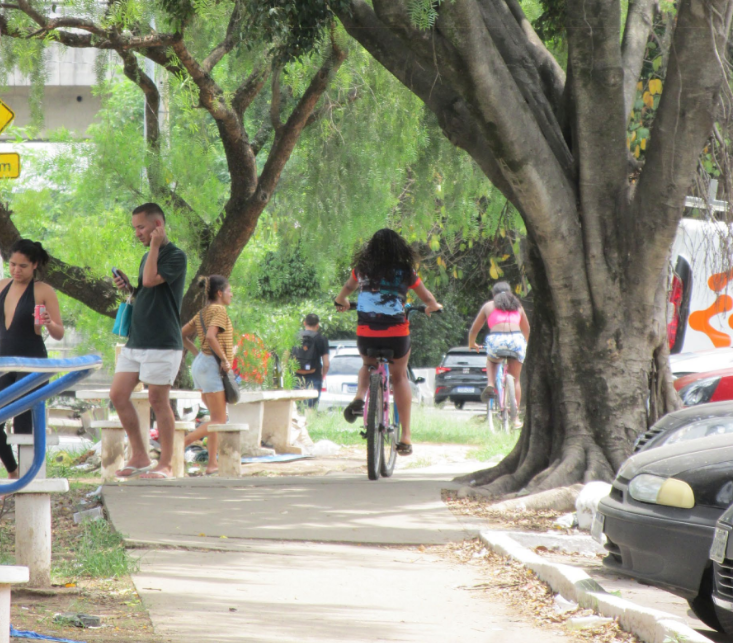
Pedalando Juntas Cycling Together is a community based initiative that provides free shared bicycles in favelas in São Paulo, aimed at increasing access to the Rio Pinheiros linear park especially for women and children living in nearby communities.
The project has already been successfully implemented as a pilot in the Peinha community, home to approximately 4,000 residents facing high social vulnerability, developed in partnership with Metrópole Um pra Um, with financial support from Tembici through a public call and from Farah Services via Lab Rio Pinheiros. The initiative also counted on the technical partnership of Ameciclo and Aromeizero Institute, and was locally implemented with the Associação dos Moradores Jardim Santo Antônio, led by Fabiola da Silva. The project was awarded the Prêmio Bicicleta Brasil, an initiative by the Ministry of Cities recognizing leading cycling initiatives in the country.
Building on the pilot’s success, the project is currently expanding to two additional communities with support from The Healthy Cycling Challenge organized by Cities for Better Health by Novo Nordisk and the European Cyclists’ Federation ECF.
Key results achieved so far include the co-creation and implementation of a community bike sharing system, the development of its operational structure, and a bicycle donation campaign to support the initiative. The project has also conducted a structured evaluation of the lending system, consolidating findings in a report that informs its ongoing expansion.
The initiative has strengthened connections between communities and the Rio Pinheiros linear park, increased safe and democratic access to public spaces, and empowered local women through active participation and mobility autonomy.
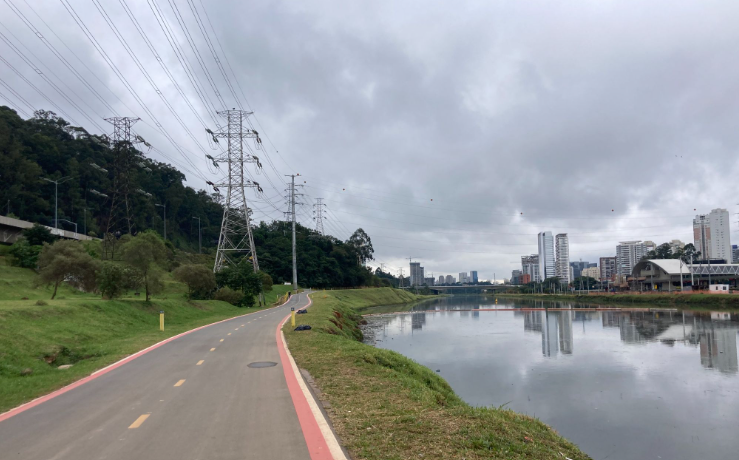
The Peinha community is located just 300 meters from Parque Linear Bruno Covas, which features a cycling path along the Pinheiros River. Despite this proximity, access to the park is extremely difficult, with narrow sidewalks, lack of pedestrian crossings, and no safe cycling infrastructure. To reach it, residents often have to risk crossing high speed traffic on the João Dias bridge. This situation is even more challenging for women, who often have less time available for leisure because they are primarily responsible for care and household duties, in addition to facing greater safety concerns in public spaces.
In response to these challenges, the Walking Together project was developed to better understand local mobility barriers. Through participatory workshops with women and children from the community, an access analysis was conducted to identify the main difficulties in reaching the park and moving safely through the neighborhood.
Based on these findings, a set of proposals was co created with residents to improve access conditions and presented to municipal departments. One of these proposals was Pedalando Juntas, a community based bicycle sharing system designed to enable safer and more autonomous access to the park.
The project emerged directly from the needs and experiences of the community and was developed with and for local residents. Its implementation involved close collaboration with community members, ensuring that the system responds to everyday realities while strengthening local ownership and engagement.
Active mobility
Women empowerment
Access to public spaces
Social inclusion
Community engagement
Pedalando Juntas addresses environmental, social, and economic challenges through a community led, low cost, and replicable active mobility solution. The project is structured in four stages articulation, system development, launch, and monitoring and analysis ensuring long term sustainability through local ownership, continuous learning, and adaptation.
During articulation, local networks are strengthened and community leadership is central to decision making. In the system development phase, the bicycle sharing model is co created with residents, including bike customization, maintenance training, and the organization of a locally managed lending system. The launch phase activates the system through bike lending, communication, and cycling activities, while ongoing monitoring ensures data driven improvements and long term viability.
Environmentally, the project promotes cycling as an alternative to motorized transport, contributing to emission reduction and reconnecting residents with green public spaces such as the Rio Pinheiros linear park. Socially, it expands safe and inclusive mobility for women and children in underserved areas, addressing gender inequalities and barriers to leisure, health, and urban access. The initiative also strengthens community ties and builds local capacity through direct participation and management.
Economically, Pedalando Juntas operates as a low cost system based on donated bicycles and shared resources, making it adaptable to contexts where conventional bike sharing systems are not viable. Its community managed model ensures efficient use of resources and long term maintenance.
The project exemplifies sustainability by integrating environmental impact, social inclusion, and local empowerment into a single solution. Recognized by the Bicicleta Brasil Award, it demonstrates how bottom up approaches can create resilient, inclusive, and scalable urban mobility systems, advancing socio spatial and environmental justice.
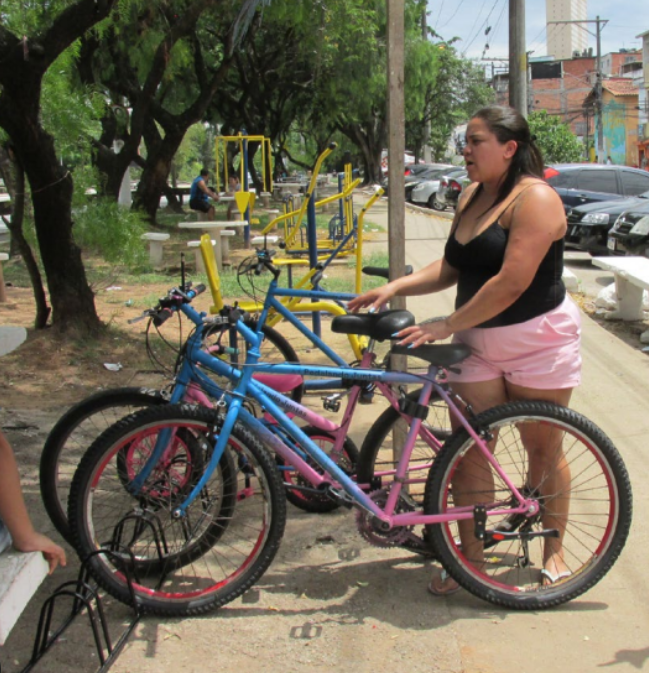
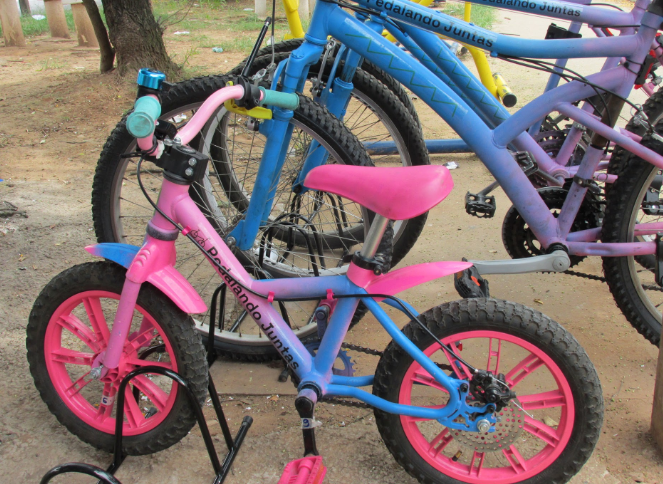
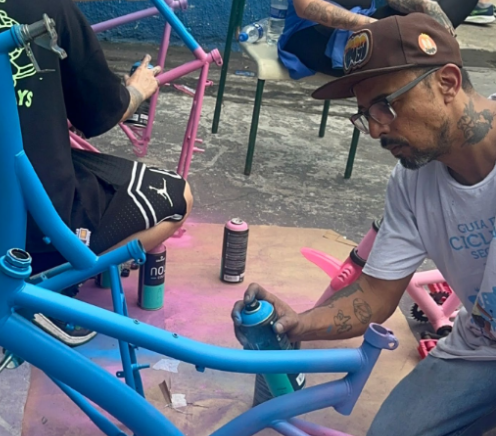
The project contributes to the aesthetics of the community both visually and socially by integrating artistic expression, participatory design, and local ownership into the bike-sharing system. To make the project more appealing and culturally resonant, artists were hired to customize the bicycles with unique designs that reflect the identity, creativity, and stories of the local communities. These visually engaging bikes not only enhance the streetscape but also transform the act of cycling into a joyful and expressive experience, connecting residents to the public space in a meaningful way.
Beyond visual impact, the project fosters a strong sense of belonging and care for the neighborhood through active community participation, particularly by women, in every stage of the initiative. Local leaders and facilitators are involved in decision making, system management, bike maintenance, and operational planning. This hands-on engagement empowers residents to take ownership of the project, reinforcing pride in their environment and encouraging ongoing stewardship of public spaces.
By combining art, participation, and local management, Pedalando Juntas creates everyday moments of beauty and care, turning simple rides into culturally rich and socially meaningful experiences. Over the longer term, the project strengthens community identity and promotes an aesthetic of inclusivity, safety, and shared responsibility. Its replicable, participatory approach makes it exemplary in terms of aesthetics, demonstrating how thoughtful design and community leadership can transform urban mobility infrastructure into a vibrant, welcoming, and inspiring element of the neighborhood.
In underserved neighborhoods where safe and active mobility is limited, Pedalando Juntas ensures that everyone, especially women and children, can access public spaces through a free, community-managed bicycle system. By removing economic and infrastructural barriers, the project guarantees affordable and safe mobility for those who would otherwise face exclusion.
Inclusive governance is central to the initiative. Women and local leaders actively participate in decision making, guiding the design of the lending system, operational procedures, and community activities. This participatory approach empowers residents, strengthens local leadership, and ensures the system reflects the community’s needs.
The project also embraces design-for-all principles. Bicycles and lending procedures are adapted to the local context, prioritizing safety, accessibility, and usability for different ages and abilities. Training sessions, cycling lessons, and community rides encourage broad participation, building confidence among users who may have little prior experience with cycling.
Pedalando Juntas exemplifies inclusion by combining accessibility, social empowerment, and community-led governance in a replicable model. Its focus on gender equity, local ownership, and participatory decision making advances social justice, fosters equitable access to public spaces, and strengthens a sense of belonging, serving as a model for inclusive urban mobility solutions.
The entire project was developed jointly with the community, and its success depended on the active engagement of residents during and after implementation. Community members participated in workshops to define system rules, customize the bicycles, and adapt the model to the specific needs of their territory. Local leaders were trained to manage the bike-sharing system, taking responsibility for operations and maintenance, which strengthened skills and autonomy.
Partner organizations also played a key role. Bike Anjo conducted cycling workshops to teach residents how to ride, while Pedal na Quebrada organized cultural bike rides aimed at women, particularly Black and peripheral women, promoting safe use of bicycles for leisure and access to the park.
To support implementation, local community coordinators were hired in each territory to facilitate communication, organize workshops, build local relationships, and monitor the system. A community member was hired to manage bike lending, and local services, such as bicycle repair and workshop snacks, were contracted from within the community.
The community’s prior engagement in the Ameciclo community bike-sharing training course during the pilot ensured readiness and motivation for the project’s expansion. The active participation of residents made Pedalando Juntas sustainable and culturally relevant, strengthened local leadership, fostered pride and a sense of belonging, ensured inclusion of women and peripheral groups, and created a self-managed, replicable system that directly reflects the community’s needs and priorities.
For the pilot project in the Peinha community, the project was developed in close collaboration with the local community and the Associação dos Moradores Jardim Santo Antônio (Residents’ Association), mainly represented by its leader Fabiola da Silva. Local residents were central to the design, implementation, and management of the bike-sharing system, ensuring that the project responded directly to community needs.
At the organizational level, the project partnered with Metrópole Um pra Um, and with expert organizations in bike systems and projects, Ameciclo and Aromeizero Institute. Ameciclo provided technical training in community bike-sharing systems, while the other partners contributed knowledge for system development, operational planning, and participatory engagement.
At the regional and national level, the project received financial support from Tembici through a public call and Farah Services via Lab Rio Pinheiros, which was critical for scaling and sustaining the pilot. The initiative also gained national recognition through the Prêmio Bicicleta Brasil, awarded by the Ministry of Cities, which highlighted its innovation in promoting cycling in underserved communities.
The current expansion phase of the project is supported by the Healthy Cycling Challenge, organized by Cities for Better Health (Novo Nordisk) and the European Cyclists’ Federation (ECF), bringing additional resources and knowledge for replication in new communities.
The engagement of stakeholders across these multiple levels added significant value: local involvement ensured relevance, ownership, and social impact; organizational expertise provided technical robustness and replicability; and national support offered financial stability and recognition. This multilevel governance approach made Pedalando Juntas a resilient, inclusive, and exemplary community-led urban mobility project.
Pedalando Juntas combined practical, technical, and cultural knowledge to create a community-centered mobility solution. Understanding the social context of the Peinha community required expertise in social sciences and urban studies to map barriers to park access, analyze mobility patterns, and ensure the system addressed real needs. Architecture and urban planning informed the placement of bike stations and integration of the sharing system into the local public space.
Creativity and visual arts contributed to the project through the customization of bicycles, making them recognizable and engaging for the community and encouraging participation. Mechanical expertise from the community ensured the bikes were safe, durable, and properly maintained, while environmental principles guided the project’s promotion of cycling as a sustainable alternative to motorized transport.
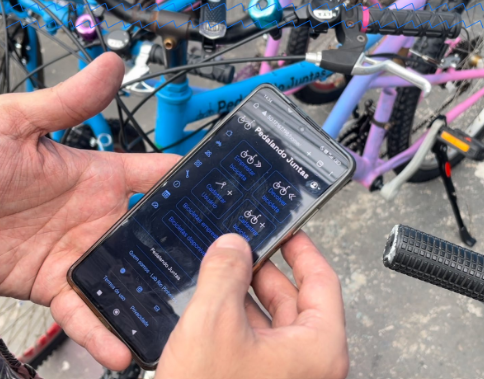
Education and capacity-building were embedded in the project through workshops and training: local leaders learned system management and maintenance, and cycling workshops taught practical skills while fostering confidence, especially among women and children. Digital tools supported operational monitoring, data collection, and communication with community members and partners.
By combining these fields—social sciences, urban design, arts, mechanical knowledge, environmental studies, education, and digital technologies—Pedalando Juntas created a practical and socially relevant solution. This transdisciplinary approach ensured the project addressed mobility, inclusion, sustainability, and community engagement in an integrated and replicable way.
Pedalando Juntas is based on a community-driven, low-cost business model that ensures financial sustainability while remaining accessible and free for users. The core of the model relies on the organization and participation of local residents, who manage the bike-sharing system and contribute to its operation, including lending, maintenance, and basic repairs. By leveraging community labor and local coordination, operational costs are kept low while empowering residents and strengthening local ownership.
The project was initially funded through a combination of public calls, NGO support, and private sponsorships. For the pilot in the Peinha community, financial support came from Tembici through a public call and Farah Services via Lab Rio Pinheiros, which covered equipment, workshops, training, and local coordination. Partnerships with organizations like Ameciclo and Aromeizero Institute provided technical expertise, training, and guidance without additional cost.
Ongoing sustainability is supported through community-managed systems that minimize operational expenses, as well as through local partnerships for bicycle repair and supply of consumables.
The business model is highly transferable and replicable to other neighborhoods and urban contexts. Its low-cost, participatory approach allows adaptation to different community sizes and resources, while maintaining social, environmental, and gender-focused objectives. By combining local engagement, low operating costs, and scalable partnerships, Pedalando Juntas demonstrates a sustainable, inclusive, and replicable framework for community-based mobility solutions.
The Pedalando Juntas model has proven adaptable and scalable for community‑led bike‑sharing systems. Several elements can be transferred to other neighbourhoods, cities, or social contexts while maintaining its core principles of community engagement, inclusivity, and sustainability.
The participatory methodology is a key element of scalability. Engaging local residents through workshops to define system rules, customise bicycles, and manage operations ensures the system reflects the specific needs of each community. This approach can be adapted to different social, cultural, and geographic settings, strengthening ownership and local leadership wherever implemented.
The community‑managed operational model is also highly transferable. By hiring local coordinators and technicians, leveraging community knowledge for bicycle maintenance, and organising peer‑led management, the system maintains low operational costs while building capacity within the community. Other scalable aspects include training programmes, cycling workshops, and cultural rides, which empower women, children, and marginalised groups to use bicycles safely and confidently. The tools for monitoring and managing the system, as well as partnerships with NGOs and technical experts, can also be adapted to new communities.
Finally, the project’s focus on social inclusion, gender equity, and environmental sustainability guides similar initiatives in other urban settings. The model is being replicated in two additional communities, Jardim Ibirapuera and Jardim Panorama, with support from the Healthy Cycling Challenge, an initiative by Cities for Better Health by Novo Nordisk and the European Cyclists’ Federation (ECF). By combining participatory design, low‑cost operations, and culturally sensitive practices, Pedalando Juntas provides a flexible and replicable framework that promotes active mobility and equitable access to public spaces.