Enhancing Circularity, Sustainability, and Innovation
Oichuy: Governance Ecosystem for Nature
Oichuy: An Integrated Governance Ecosystem for Sustainable Tourism Transformation in Brazilian
Oichuy integrates governance diagnostics (43 municipalities, 17 states), data intelligence (5,274
municipalities, 78 variables), and a conservation-first platform (5,259 places, 7 biomes) to transform how
Brazil governs sustainable tourism.
municipalities, 78 variables), and a conservation-first platform (5,259 places, 7 biomes) to transform how
Brazil governs sustainable tourism.
Brazil
National
It addresses urban-rural linkages
It involves other types of transformations (soft investment)
Yes
2026-03-14
No
No
No
Organisation
Brazil has 5,570 municipalities, over 3,000 conservation units, and tens of thousands of natural attractions across 7 biomes. Yet most municipalities — especially emerging destinations — lack the tools to govern tourism sustainably. Public managers often lack the expertise or resources to fulfill their missions. Heritage degrades before governance catches up. Oichuy exists to break this cycle.
Oichuy combines Data, AI, Field Insights, and International Benchmarks into an integrated ecosystem that enables municipalities to develop tourism sustainably from day one. Built through academic research at the Universidade de Brasilia and validated through extensive fieldwork, it addresses the governance gap at its root.
Three pillars work together:
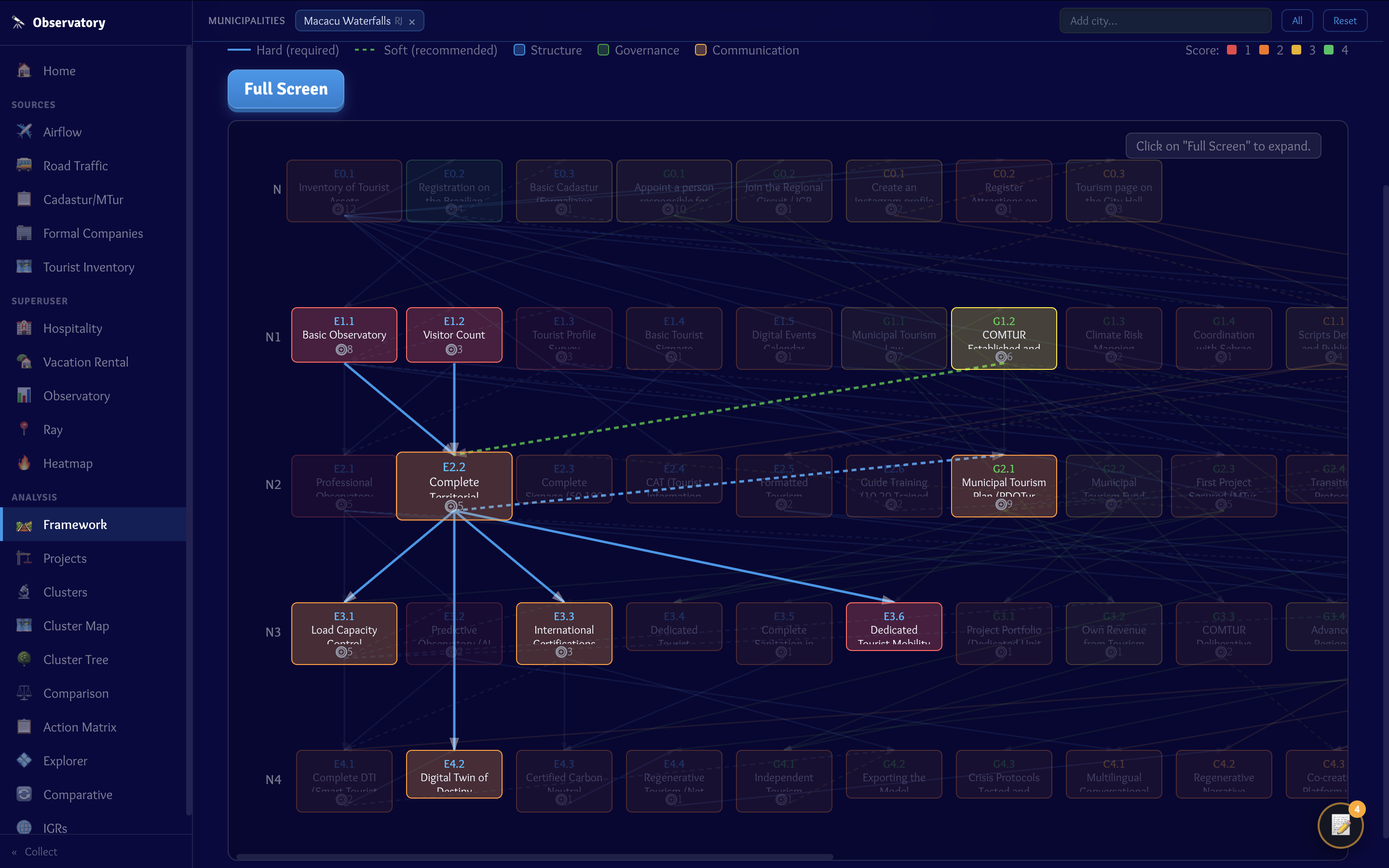
1. An AI-powered governance diagnostic framework applied across 43 municipalities in 17 states — 8 dimensions, 90 scenario-based questions, 123 academic criteria — currently in validation conversations with local authorities to refine results and drive implementation.
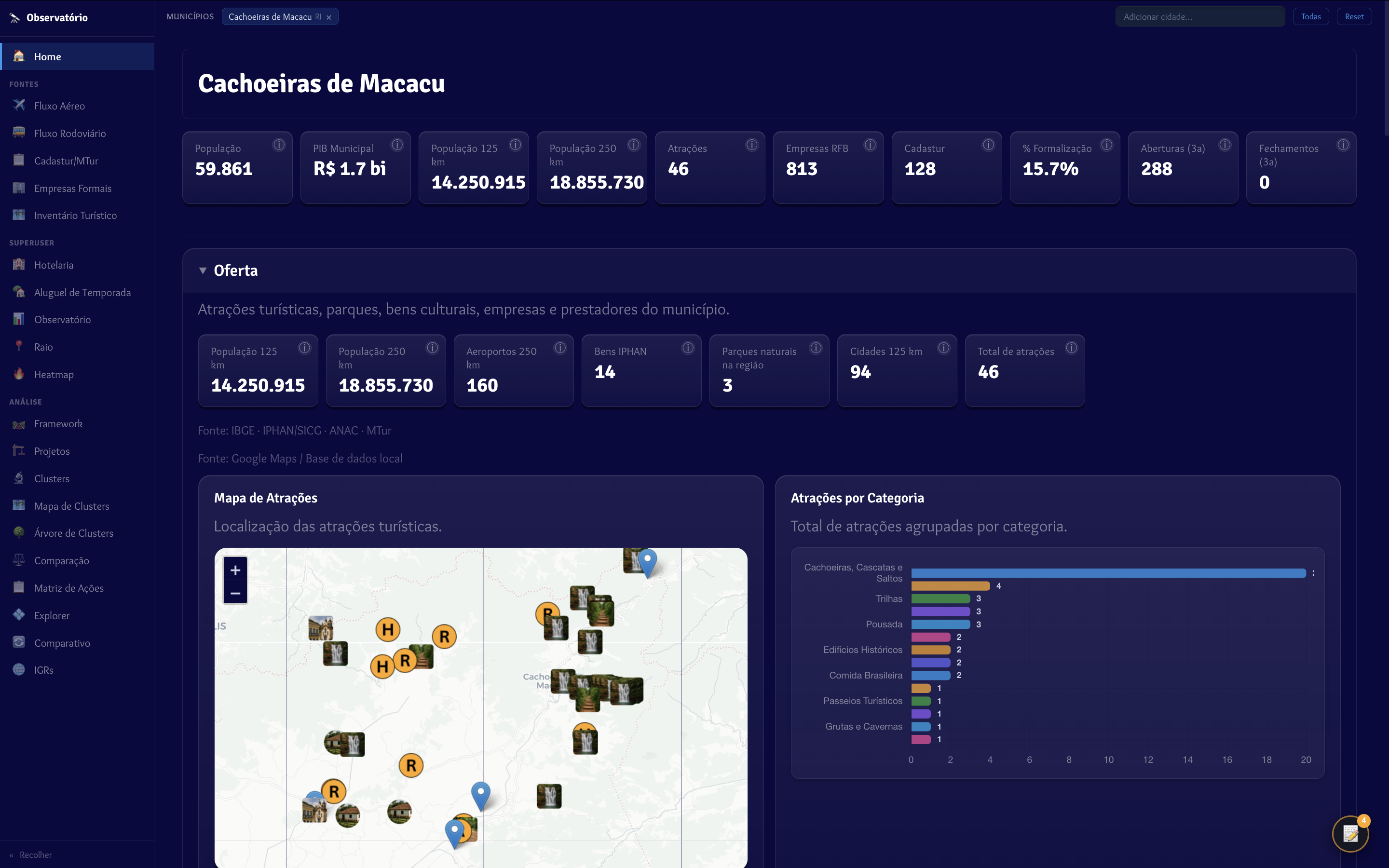
2. A data intelligence observatory analyzing 78 variables across 5,274 municipalities via PCA and clustering, integrating 13 federal data sources into 35+ dashboards — analytical infrastructure for evidence-based governance at national scale.
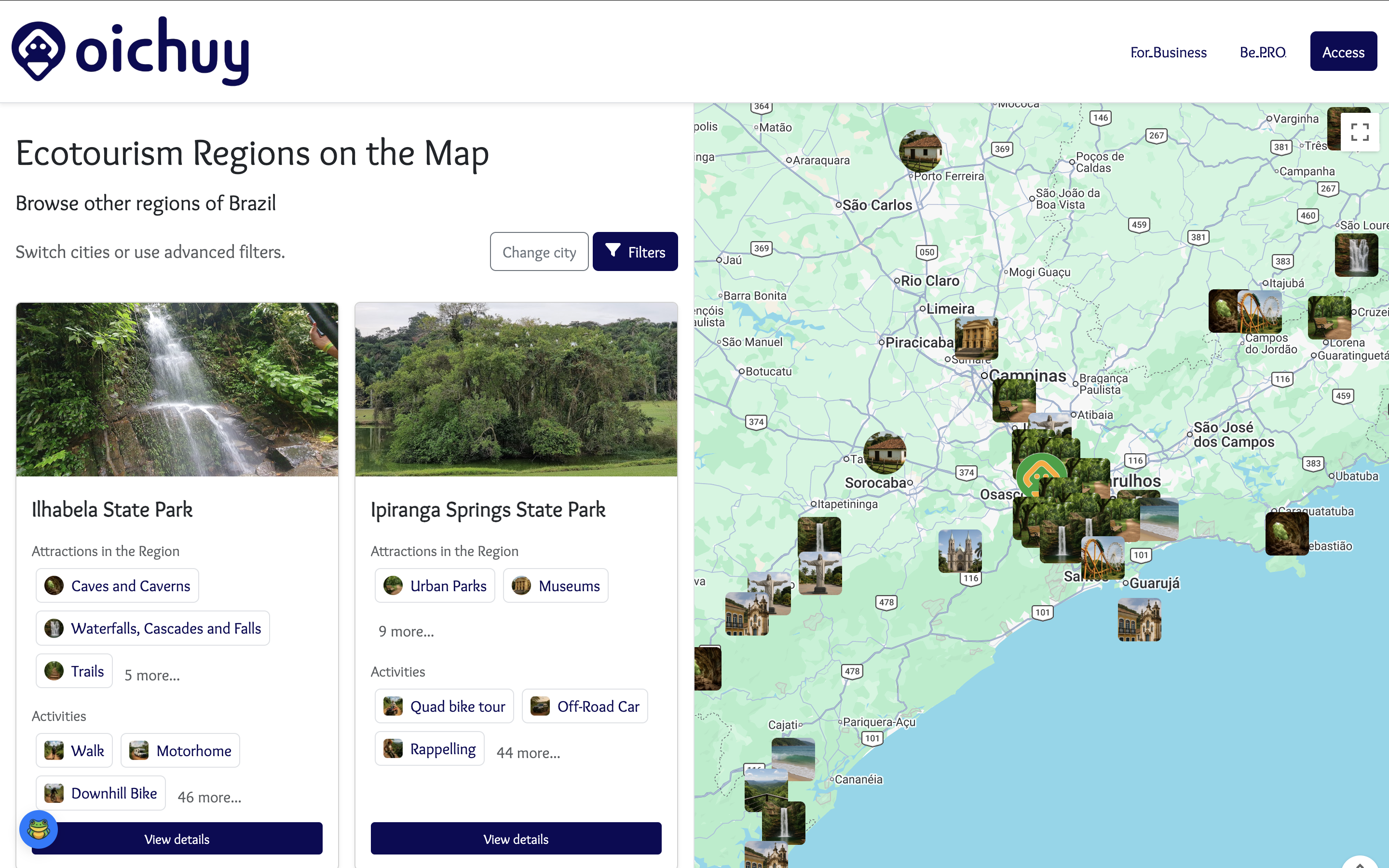
3. A conservation-first platform cataloguing over 5,200 places across 7 biomes and 525 tourism regions — digital infrastructure connecting sustainable supply with responsible demand.
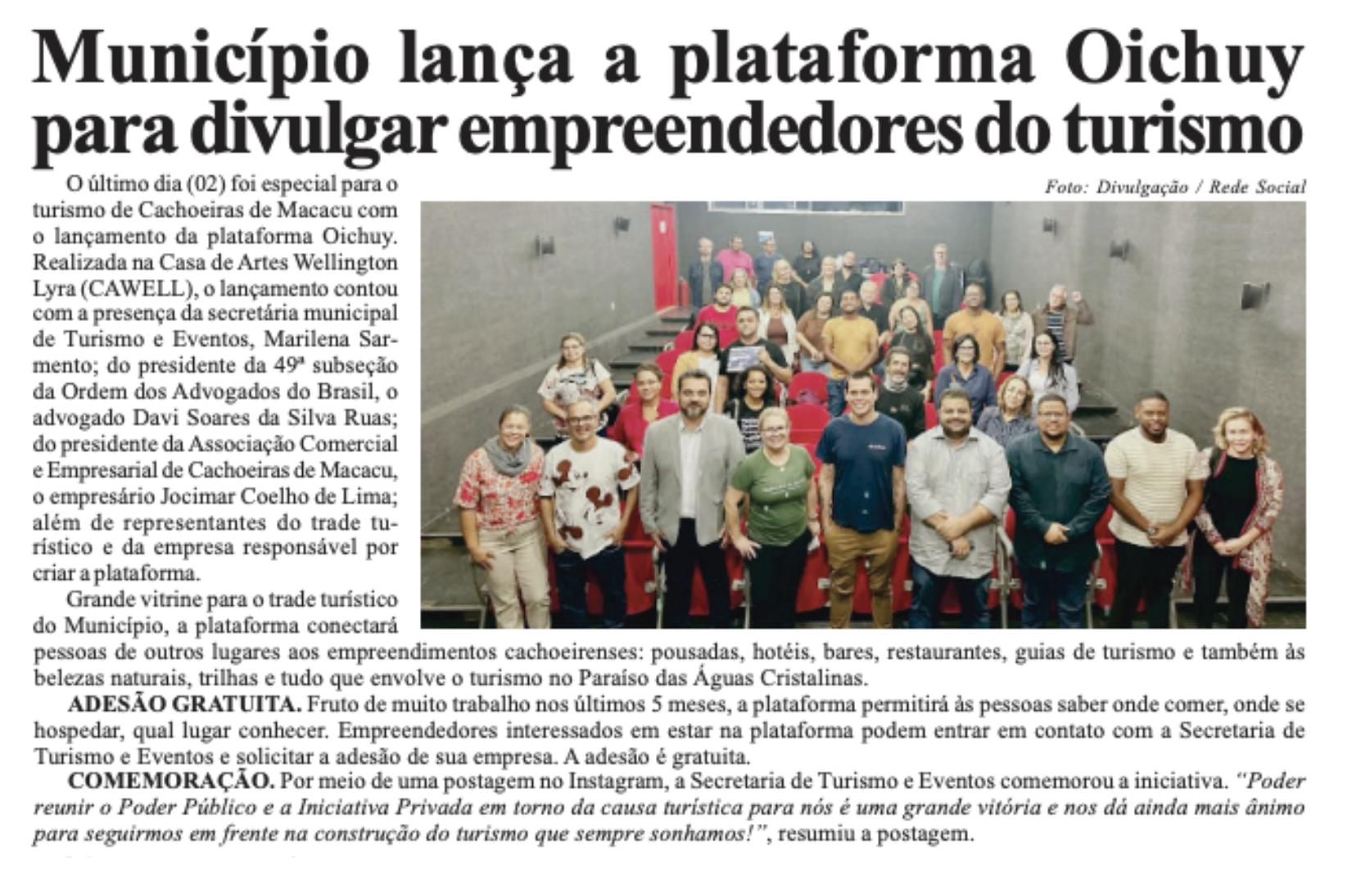
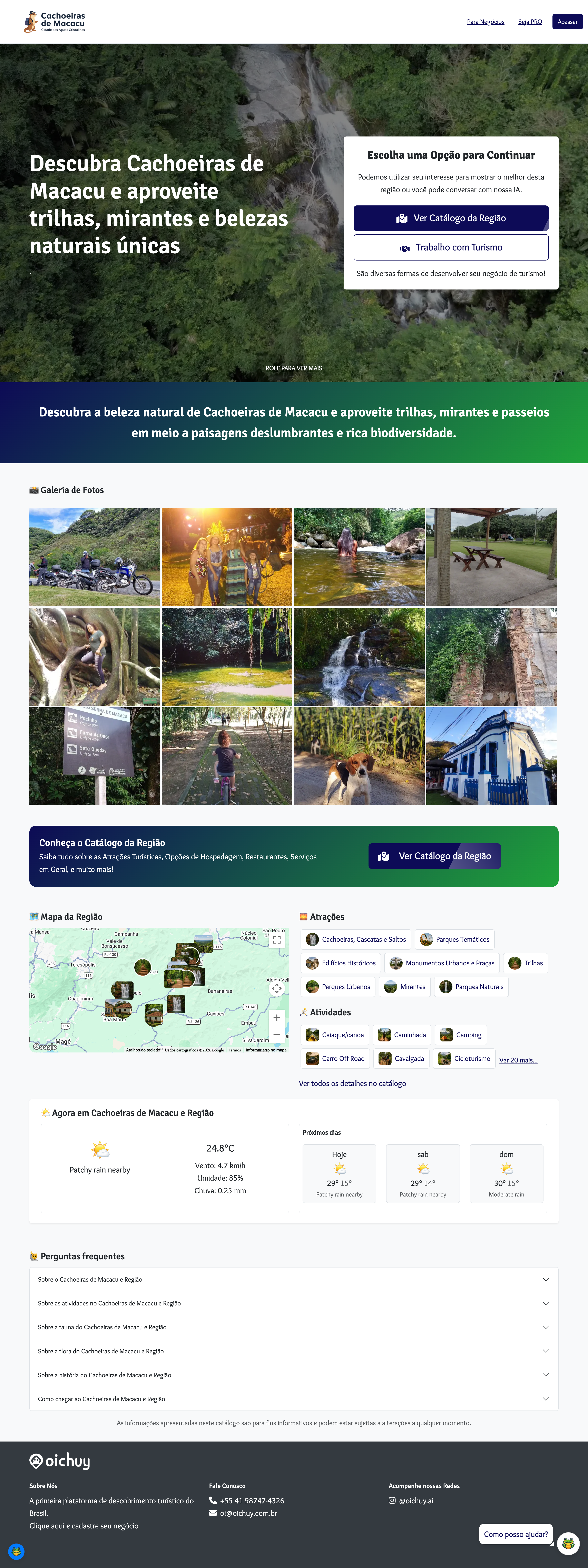
Key results: As technology partner for "Um Dia no Parque," a national campaign by WWF, Imaflora, and SOS Mata Atlantica, Oichuy consolidated 450 conservation units and 700+ activities, reaching 135,000+ visitors. In Cachoeiras de Macacu, municipal partnership onboarded 90+ businesses via WhatsApp, many gaining digital presence for the first time.
Oichuy was born on the road. While backpacking across Brazil, visiting over 90 destinations across all 7 biomes, the founder witnessed a recurring pattern: municipalities with extraordinary attractions facing two opposite crises — either emptiness, with no visitors despite remarkable heritage, or ecosystem degradation from overtourism and unmanaged practices. The problem was not a lack of heritage — it was a lack of information management about that heritage.
This insight is being formalized during a postgraduate specialization in Municipal Tourism Management at UnB's Centro de Excelencia em Turismo. The founder synthesized 12 academic modules into an operational diagnostic framework — 90 scenario-based questions across 8 governance dimensions, grounded in 123 criteria.
The AI-powered diagnostic was then applied across 43 municipalities in 17 states, from Arraias/TO (4,091 inhabitants) to Sao Paulo (11.9M), cross-referencing official data with field evidence. Results are currently in validation conversations with local authorities to drive implementation. Simultaneously, 424 international benchmarks were compiled from 215 cities across 30 countries.
To scale beyond diagnostics, the observatory was built — integrating 13 federal sources (statistics bureau IBGE, tourism registry Cadastur, aviation agency ANAC, heritage institute IPHAN, biodiversity institute ICMBio) into a unified AI pipeline. PCA on 78 variables across 5,274 municipalities revealed governance patterns invisible to qualitative observation.
Then came impact: Oichuy became technology partner for "Um Dia no Parque" (WWF, Imaflora, SOS Mata Atlantica) — 450 conservation units, 135,000+ visitors. In Cachoeiras de Macacu, municipal partnership onboarded 90+ businesses via WhatsApp, many online for the first time.
sustainable tourism governance
nature-based solutions
AI-powered data intelligence
community empowerment
territorial development
Sustainability objectives: Over 200,000 tourism businesses in Brazil depend directly on preserved nature for their livelihood. Oichuy addresses biodiversity loss by aligning these businesses' economic interest with environmental protection — when communities have governance tools, digital visibility, and access to responsible visitors, they become stewards of their ecosystems rather than being forced into extractive practices. Social development is the most effective upstream mechanism for preventing the destruction of nature.
Implementation: As technology partner for "Um Dia no Parque" — a nationwide campaign by WWF, Imaflora, SOS Mata Atlantica — Oichuy consolidated 450 conservation units and 700+ activities, mobilizing 135,000+ people to visit protected areas across all biomes. This is nature-based tourism at national scale: creating economic incentives for conservation so communities near parks can attract responsible visitors instead of resorting to extractive land use.
Our AI-powered diagnostics across 43 municipalities revealed that sewage treatment below 40% blocks tourism maturity — a direct link between environmental infrastructure and economic viability, giving governments concrete targets where investment prevents ecological damage.
The observatory integrates conservation unit boundaries and protected area data across 5,274 municipalities, identifying which governance approaches preserve biodiversity versus those leading to degradation — enabling action before damage occurs.
Our benchmarks include Bonito's 30-year carbon-neutral voucher system protecting river ecosystems and Barcelona's overtourism mitigation. Emerging destinations can adopt regenerative approaches from the start.
Exemplary character: Oichuy treats environmental preservation and social development as inseparable — empowered communities are the most effective force for protecting ecosystems.
Aesthetic objectives: Oichuy makes life more beautiful for both communities and visitors. For communities near conservation units, sustainable tourism raises living standards — creating jobs, improving infrastructure, and fostering pride in local heritage and landscapes. For the millions who visit Brazil's parks and natural areas, ecotourism delivers proven health and wellbeing benefits: reduced stress, physical activity, mental restoration, and meaningful connection with nature.
Implementation: The marketplace organizes over 5,200 places by biome and conservation unit — Mata Atlantica, Cerrado, Amazonia, Caatinga, Pantanal, Pampas, and Marine. Visitors encounter destinations through landscape and living culture, not commercial rankings. This architecture channels people toward experiences that are inherently beautiful and restorative — crystalline rivers, tabletop mountains, wetlands, forest trails.
The diagnostic framework makes aesthetic quality a governance indicator through its Hospitality & Experience dimension (D4) — assessing how municipalities activate heritage, develop cultural signage, promote gastronomy, and create meaningful encounters. Public space quality in heritage sites is explicitly evaluated.
"Um Dia no Parque" — 135,000+ visitors across 450 conservation units — demonstrated this at national scale: connecting people with the beauty of protected areas while creating a sense of care and belonging for those places.
Cultural benefits: The project documents local identity, traditional knowledge, gastronomy, and artisanal practices as integral to destination value. When a community sees its culture and landscape valued by visitors, it develops deeper care for its own place — beauty generates belonging.
Exemplary character: Oichuy connects community development with natural beauty — tourism that raises living standards while restoring visitors' connection with nature.
Inclusion objectives: Oichuy promotes inclusion across three dimensions: governance access for under-resourced municipalities, digital visibility for small businesses, and affordable nature experiences for visitors.
First: municipalities with no budget or technical expertise access cutting-edge AI technology. The diagnostic works identically for Arraias/TO (4,091 inhabitants) and Sao Paulo (11.9 million), requiring no technical knowledge. The observatory gives any municipality 78-variable analysis and benchmarking across 5,274 municipalities — intelligence that wealthy cities built over decades, now digitally accessible. "Size does not determine score — intentionality does."
Second: small tourism businesses gain online visibility for the first time. In Cachoeiras de Macacu, municipal partnership onboarded 90+ operators via WhatsApp — guides, family lodges, artisanal restaurants who had never had digital presence. The platform bridges the digital divide keeping remote communities economically isolated.
Third: most natural attractions in Brazil — waterfalls, trails, beaches, lookouts, conservation units — are free or low-priced, making nature-based tourism inherently accessible regardless of income. By organizing the marketplace around these public natural assets rather than expensive commercial destinations, Oichuy ensures affordability is built into the model. "Um Dia no Parque" proved this: 135,000+ people visiting 450 conservation units in a single mobilization.
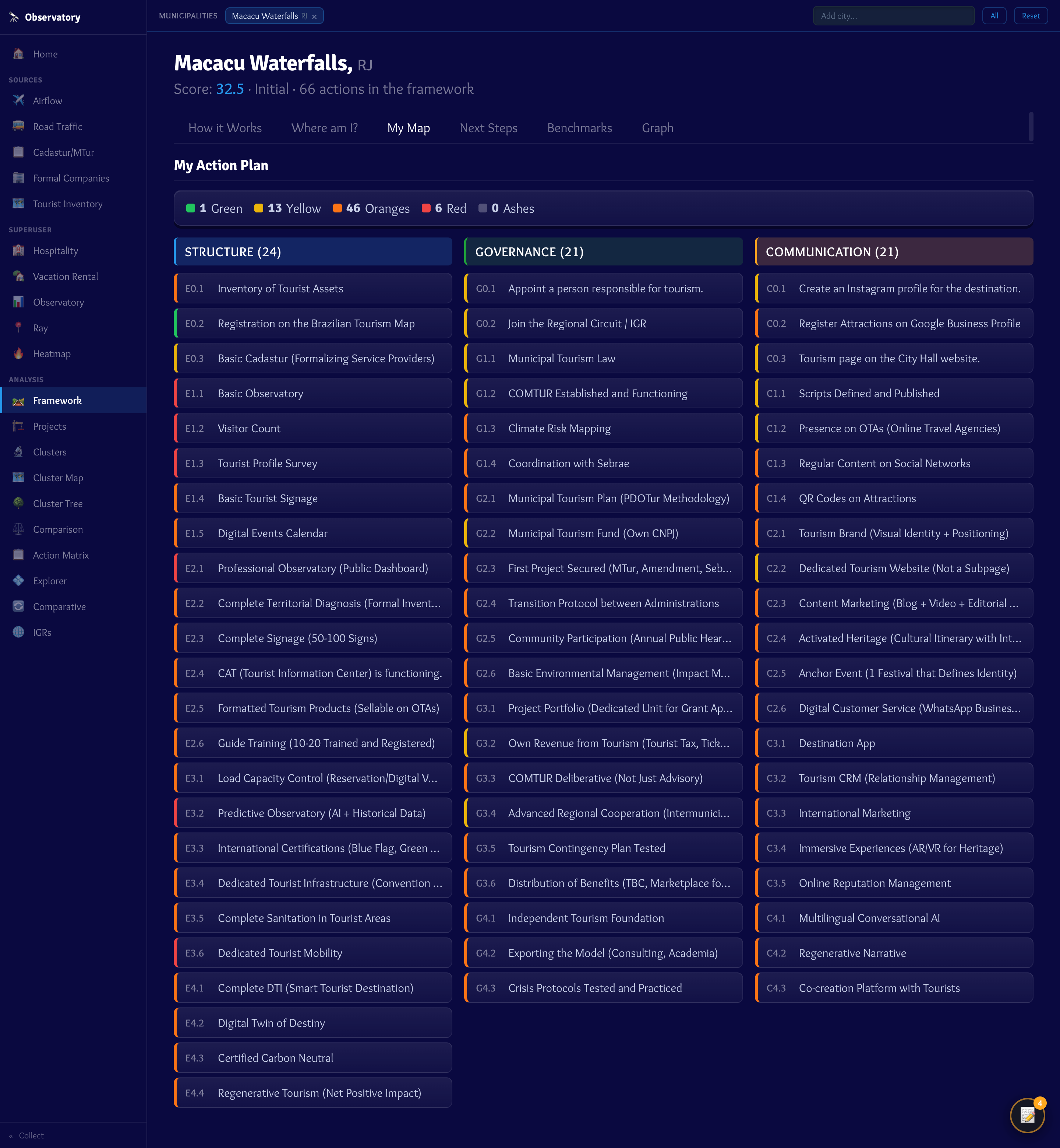
The prescriptive module generates 66 graduated actions from zero-cost to full investment — budget is never a barrier at any level.
Exemplary character: Oichuy's inclusion operates at every layer — governance tools for municipalities, digital presence for businesses, affordable access for visitors.
Oichuy's participatory dimension goes beyond consultation — it empowers communities to monitor, learn, and demand better governance from their authorities.
Who was involved: Municipal tourism managers across 43 cities in 17 states in process for validating in AI-powered diagnostics, with results currently in validation conversations with local authorities to drive implementation. Faculty from 12 disciplines at UnB co-developed the methodology. Local associations and cooperatives near conservation units contributed ground-level knowledge.
How participation shapes the project: The observatory dashboards will be available to all local SMBs in each destination — not just authorities. Business owners can monitor tourism data, understand seasonal patterns, and benchmark their destination's performance. Combined with education on best practices from our 424-benchmark international library, this empowers local operators to hold authorities accountable and demand implementation of proven governance practices.
How they participated: The 90-question scenario methodology is itself participatory — managers identify their reality from narrative descriptions, making the diagnostic a self-assessment rather than external evaluation. The framework incorporates the DRPE (Diagnostico Rapido Participativo Emancipador), a co-diagnosis methodology from UnB.
Level of influence: Community feedback shaped the framework, it was based on deep connections with the community — adding the Resilience & Crisis Management dimension and refining scenarios across all 8 dimensions.
Impact: "Um Dia no Parque" mobilized 135,000+ people across 450 conservation units. In Cachoeiras de Macacu, 90+ businesses registered via WhatsApp — many online for the first time. When SMBs have data and knowledge, participation shifts from passive consultation to active civic engagement.
Oichuy delivers the same analytical intelligence to every governance level simultaneously — federation, states, municipalities, local conservation unit managers, and community tourism councils (COMTURs) — enabling shared understanding and collective problem-solving with aligned data.
Federal level: 13 sources integrated — Statistics Bureau/IBGE (5,274 municipalities), Federal Revenue Service (209,478 tourism enterprises), Tourism Registry/Cadastur (175,327 providers), Civil Aviation Agency/ANAC, Land Transport Agency/ANTT, Heritage Institute/IPHAN, and Biodiversity Institute/ICMBio.
State level: State tourism agency data and state park systems integrated. The marketplace maps state-managed conservation units alongside federal ones across 525 tourism regions.
Municipal level: 43 municipalities diagnosed with AI-powered diagnostics, results in active validation conversations with local authorities. Over 2,100 municipal tourism secretariats mapped. Conservation unit managers and COMTURs access the same dashboards as federal authorities.
Horizontal integration: The observatory clusters destinations based on data criteria — grouping municipalities with similar profiles, challenges, and opportunities. This enables peer benchmarking and collective problem-solving between municipalities that share characteristics but may never have connected otherwise. A small ecotourism destination in Tocantins can learn directly from a peer cluster in Minas Gerais.
As tech partner for "Um Dia no Parque," Oichuy worked with NGOs (WWF, Imaflora, SOS Mata Atlantica) to mobilize 135,000+ visitors across 450 conservation units — vertical integration from national policy to local community engagement.
Added value: When all levels access shared intelligence, coordination shifts from top-down directives to collaborative, evidence-based decision-making.
Oichuy integrates data science, artificial intelligence, public policy, ecology, tourism studies, cultural heritage, economics, digital technology, and territorial planning.
Data science and AI: PCA on 78 variables, K-Means clustering, and hierarchical classification across 5,274 municipalities. AI powers every layer — the diagnostic methodology uses AI for rapid municipal assessment, the observatory applies machine learning for pattern recognition and clustering, and the platform uses AI for content generation and data enrichment, making the ecosystem scalable beyond manual analysis.
Public policy: The diagnostic draws on governance theory, institutional analysis, and public administration from UnB's specialization, assessing structures, participatory mechanisms, and policy instruments across 43 municipalities.
Environmental science: Over 3,000 conservation units, tens of thousands of heritage records, biome classification, and protected area analysis structure the ecosystem around ecological integrity.
Tourism studies: 12 academic modules covering ecosystem analysis, hospitality, experience quality, sustainability ethics, and crisis resilience — grounding 123 operational criteria.
Digital technology and big data: Full-stack development (Laravel, FastAPI, Next.js, PostgreSQL, scikit-learn) processes large-scale federal datasets and transforms methodology into accessible tools — dashboards, diagnostics, and marketplace across 7 biomes.
Economics: Over 200,000 registered tourism businesses analyzed for patterns (survival rates, growth, formalization), plus marketplace models connecting operators near conservation units to responsible demand.
How organized: UnB/CET's specialization is transdisciplinary by design — 12 modules from geography, economics, public administration, ecology, and tourism, synthesized into one AI-enhanced instrument.
Oichuy has been self-financed, with academic infrastructure from UnB. The model is validated through two partnership channels:
Proven partnerships: As technology partner for "Um Dia no Parque" (WWF, Imaflora, SOS Mata Atlantica coalition), Oichuy demonstrated value to major environmental organizations at national scale. In Cachoeiras de Macacu, municipal partnership proved the local deployment model — 90+ businesses onboarded via WhatsApp, a low-barrier channel meeting operators where they already are.
Revenue channels:
1. Municipal diagnostic services: AI-powered governance assessment as consulting. With 5,570 municipalities and 43 diagnosed, the addressable market is vast. The prescriptive module generates 66 graduated actions with cost estimates, creating follow-on consulting.
2. NGO and institutional partnerships: Technology platform services for conservation campaigns — proven by Um Dia no Parque across 450 conservation units.
3. Business platform services: Brazil has over 200,000 registered tourism businesses and approximately 40,000 tour guides in Cadastur — all dependent on preserved nature for their livelihood. The marketplace connects this supply with responsible demand across 525 regions via commission-based revenue, while giving operators digital visibility.
4. Data intelligence: Municipal profiles, cluster analysis, and benchmarking for state agencies, development banks, and international organizations.
The addressable market — 200,000+ businesses, 40,000 guides, 5,570 municipalities, major environmental NGOs — ensures long-term financial viability with minimal continuation costs (servers, data pipelines).
Disruptive potential: Oichuy replaces expensive consulting with systematic, AI-enhanced governance intelligence. No comparable system integrates diagnostics, national-scale data, and conservation-first market activation.
Oichuy was designed for replicability. Every component transfers:
The AI-powered diagnostic framework's 8-dimension, 90-question methodology adapts to any country with municipal governance. The scenario-based approach (narratives rather than scales) is culturally adaptable. Already validated across extreme diversity: Arraias/TO (4,091 inhabitants) to Sao Paulo (11.9M), proving the method works regardless of context.
The observatory transfers to any context with open government data. The PCA + clustering pipeline requires only substitution of data sources — European municipalities could replicate using Eurostat, OECD, and national statistics. Our 78-variable framework provides a template, and the AI layer accelerates adaptation to new datasets.
The marketplace architecture — organizing tourism by ecosystem and conservation area rather than commercial category — applies to any form of territorial tourism: nature-based, rural, cultural, historic, or gastronomic. The conservation-first model adapts to EU contexts: Natura 2000 sites, national parks, UNESCO biosphere reserves, rural heritage routes, and cultural landscapes.
Why it serves as a model: Most governance tools are either theoretical (academic without implementation) or commercial (consulting without transparency). Oichuy bridges this with an open, AI-enhanced, evidence-based system validated across 43 municipalities and 5,274 data profiles.
Replication requirements: Data science capacity for observatory adaptation; local academic partnership for framework calibration; tourism governance knowledge. No proprietary technology required.
Adaptation: Variable selection reflects local data; diagnostic scenarios rewritten for local governance; ecosystem categories matched to regional context. The methodology transfers; content requires localization.