Arts, Culture, and Heritage as Drivers of Change
Guardiã do Rio: E-Game do Jequitinhonha
Guardian of the River: The first digital game about women's crafts and legends of the Jequitinhonha
Guardiã do Rio is the first digital game about the Vale do Jequitinhonha heritage. Players control Gena, a fisherwoman chosen by the Sereia do Rio to recover clay pots with the river’s soul, stolen by the cursed werewolf.All characters and scenes are inspired by clay dolls made by women artisans. The game mixes folklore, female empowerment and river protection to engage youth. Prototype after talks with local women. With the NEB Prize I'll finish the game and release it free for schools in Vale.
Brazil
Regional
Jequitinhonha's Valley (Minas Gerais - Vale do Jequitinhonha)
Mainly rural
It refers to other types of transformations (soft investment)
Prototype level
No
No
No
Individual
Guardiã do Rio is the first digital game dedicated to the living heritage of Brazil's Jequitinhonha Valley. Players control Gena, a fisherwoman chosen by the Sereia do Rio Jequitinhonha, the river's guardian, to recover sacred clay pots containing the river's soul, stolen by the cursed Bicho de Pedra Azul, the Valley's own werewolf legend.
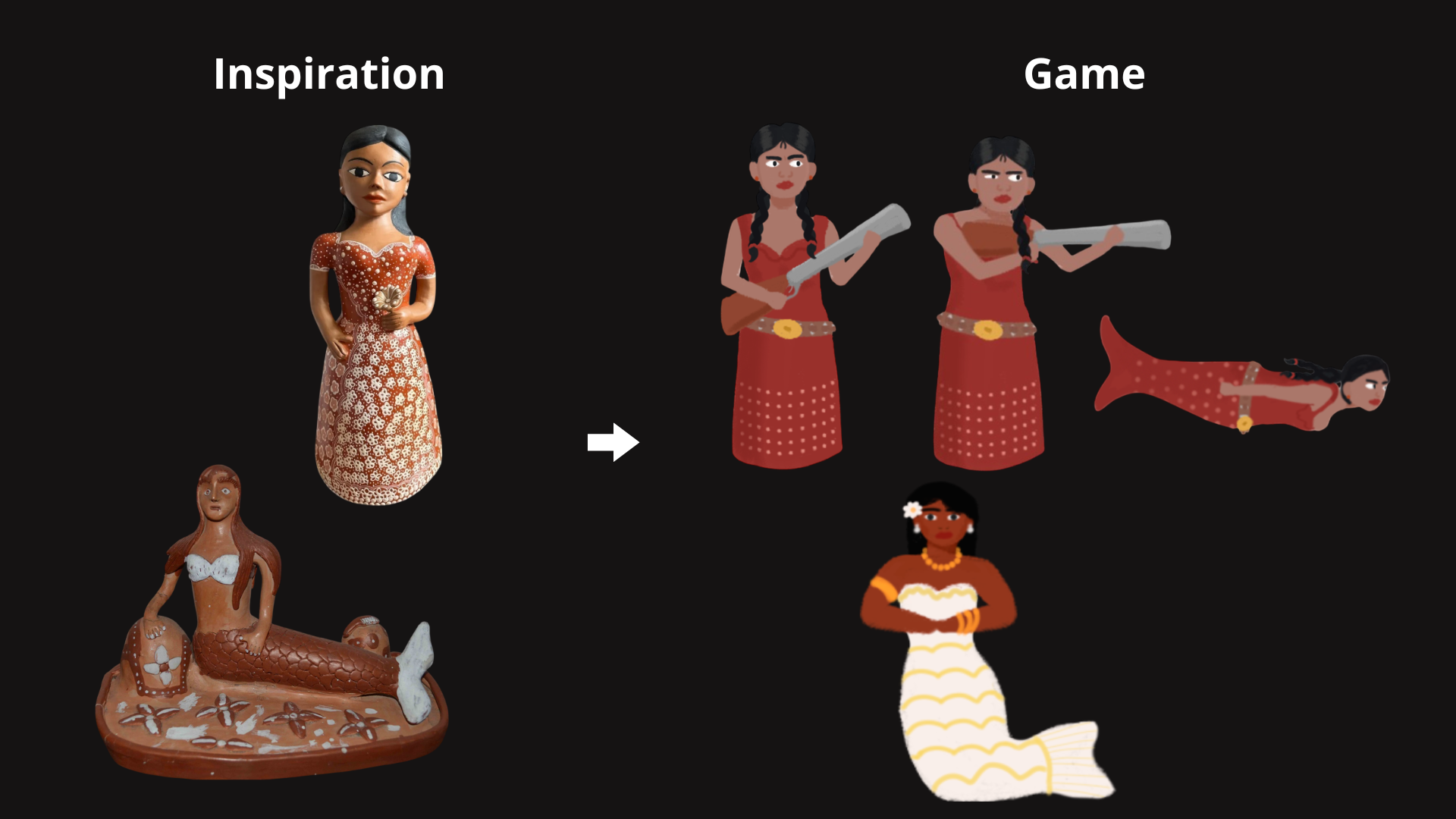
Every character is directly modelled on the clay dolls handcrafted by generations of women artisans. Gena wears a red dress and carries silver bullets — a deliberate design choice drawing on the cultural meaning of red as leadership and power. Grandmother Lourdes, a healer (benzedeira), and the Sereia Stella complete a cast of female figures rooted in real Jequitinhonha everyday life.
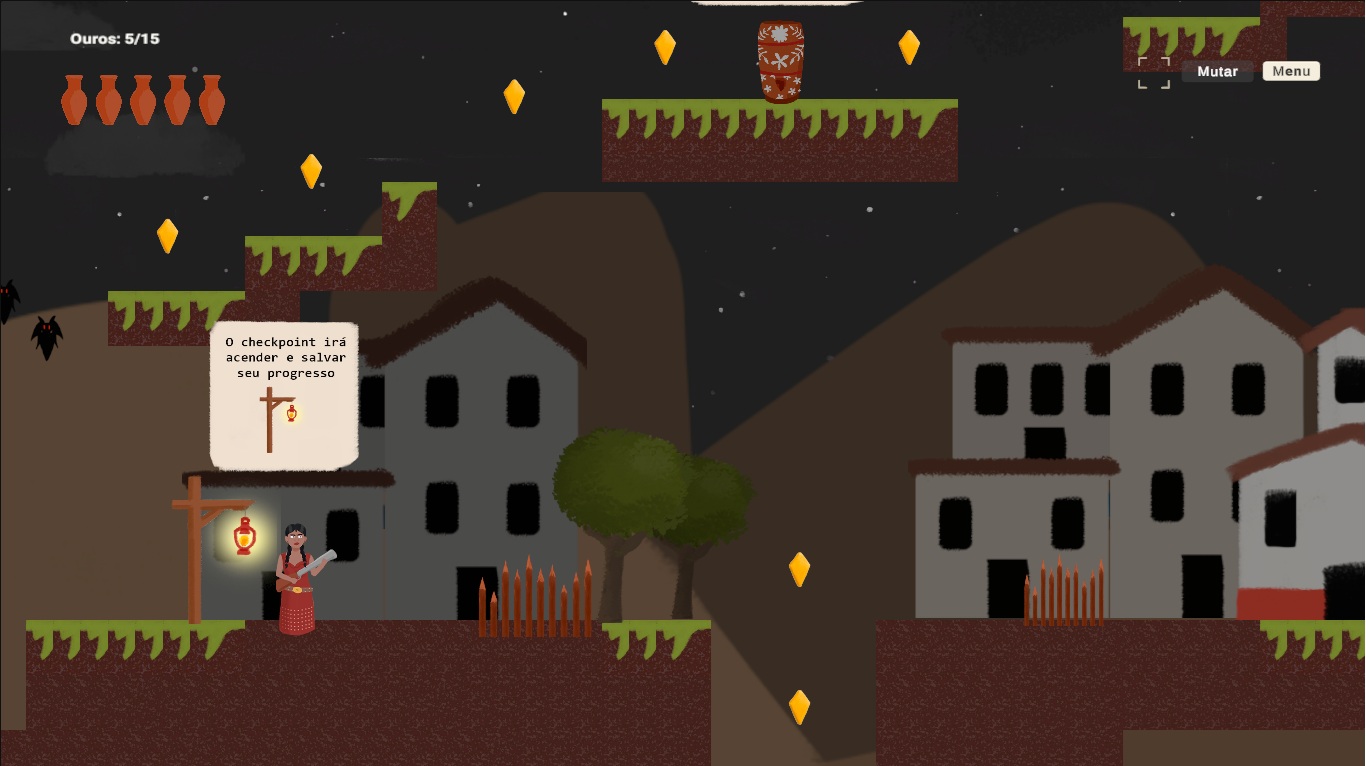
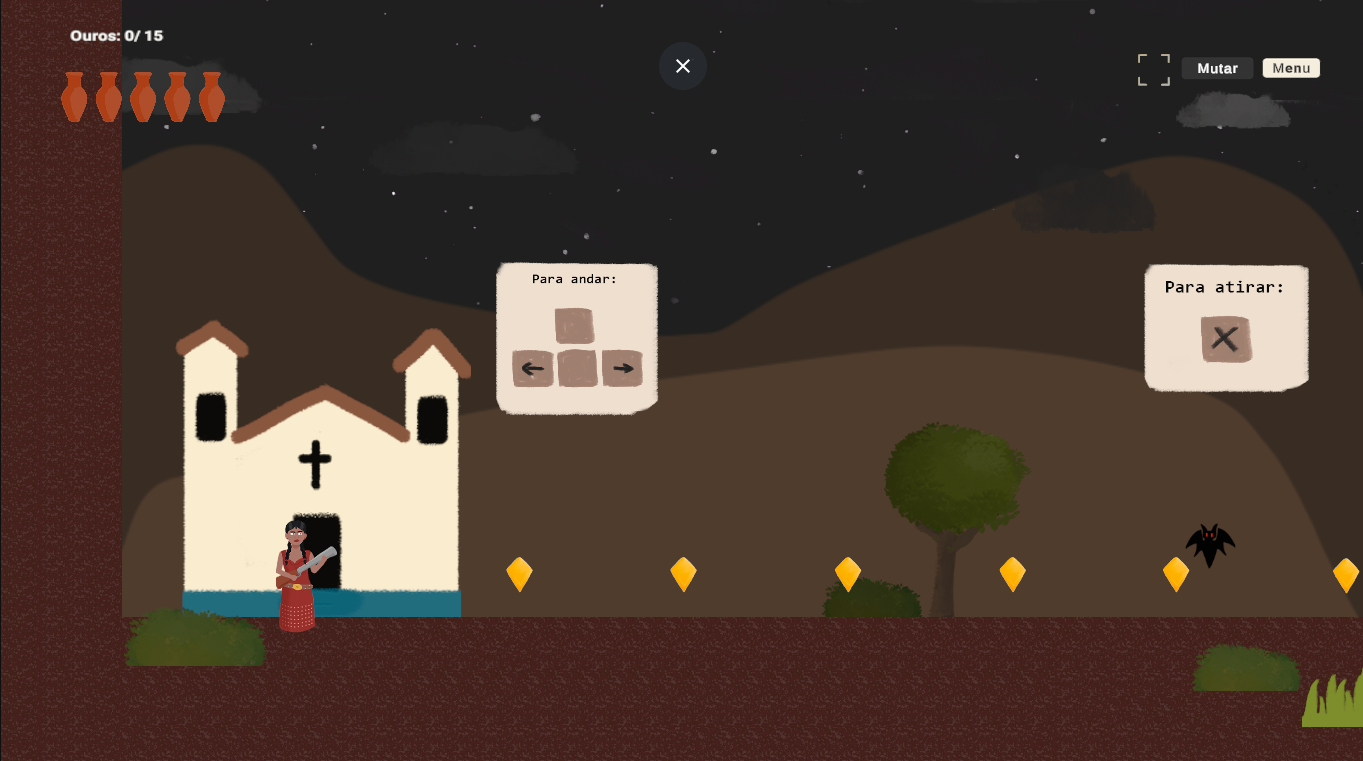
The game was developed solo as a university Design thesis at UFMG, using the Double Diamond methodology, semi-structured interviews with local artisans and community members, and a quantitative survey with 38 gamers. A fully playable first level — with complete mechanics, animations, scoring, checkpoints, and an original soundtrack — is publicly available online.
Expected results: a complete 10-level game, free for schools in the Valley, that strengthens cultural belonging, challenges the poverty stigma historically attached to the region, and puts women's craft knowledge at the centre of a new digital narrative.
The idea was born during my Design degree at UFMG in Belo Horizonte. While researching Brazilian cultural heritage for my thesis, I discovered how absent the extraordinary craft tradition of the Jequitinhonha Valley is from digital games — despite being one of Brazil's most recognised intangible heritage practices, generating income for women across a region historically reduced to its poverty index.
I travelled to the Valley, conducted semi-structured interviews with five local residents — including a weaver, a Portuguese teacher, the president of an artisan cooperative, and a sustainability project director — and ran a survey with 38 gamers to understand the market. Their stories shaped everything: the river's centrality to local identity, the Bicho de Pedra Azul legend as distinctly local folklore, the benzedeira figure, the importance of the "prosas" storytelling tradition.
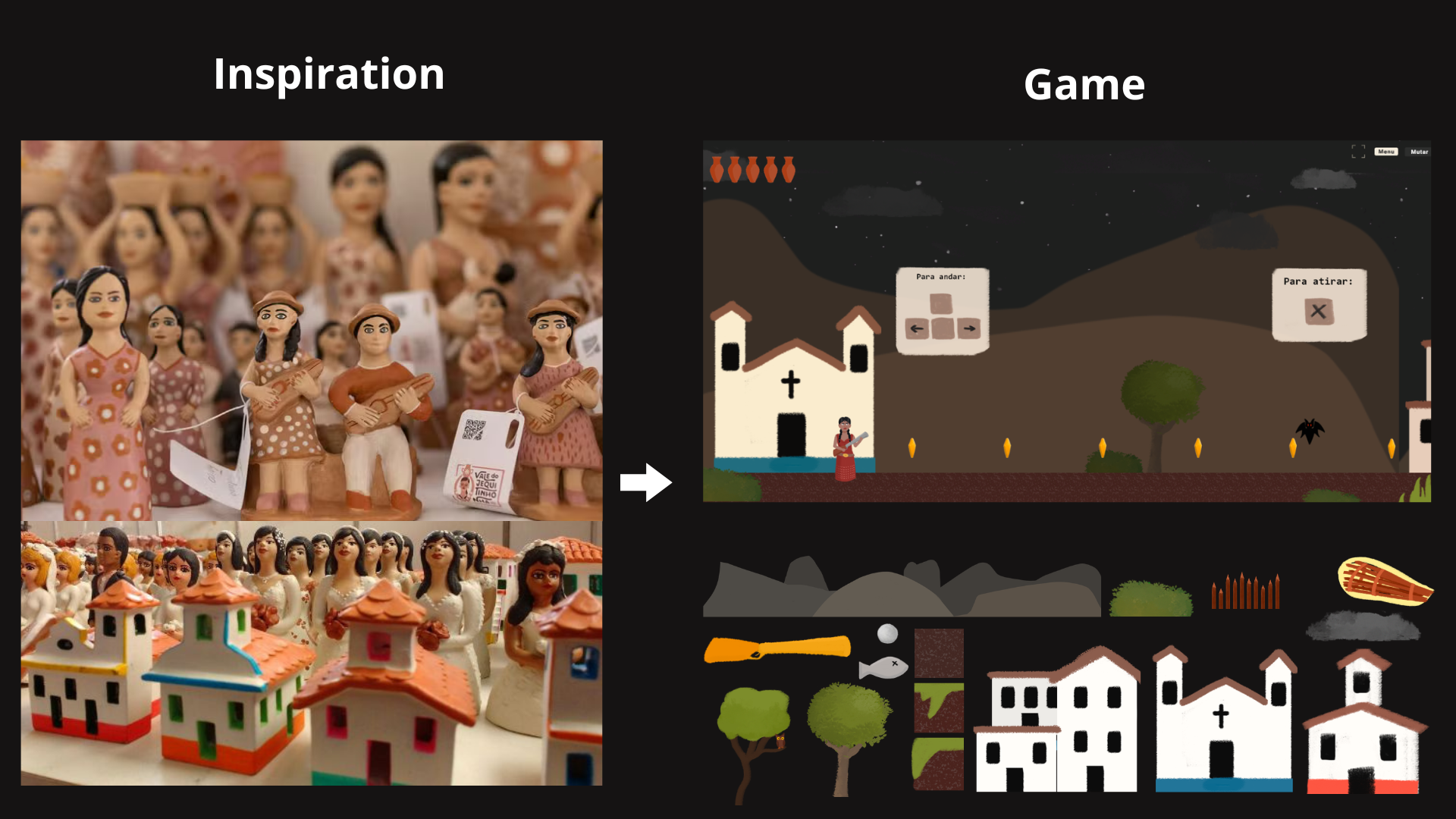
I then designed and built the entire game alone: narrative script, character design inspired by real clay dolls, level design following academic game design patterns, all visual assets drawn frame by frame in Photoshop with a charcoal brush to evoke handmade craft, and programmed in Unity. A playable first level is live online as proof of concept.
Cultural heritage
Female empowerment
Traditional crafts
River preservation
Pioneering theme in the digital games
The project addresses cultural, environmental and economic sustainability simultaneously, and the connection between these three dimensions is not incidental — it is structural to the game's design.
Culturally, it preserves and disseminates a generational craft tradition practised by women in one of Brazil's lowest HDI regions. The Jequitinhonha Valley represents less than 2% of Minas Gerais' GDP, yet holds extraordinary intangible heritage. The game directly challenges the poverty stigma historically attached to the region by centring its cultural richness.
Environmentally, the Jequitinhonha River (declared a natural monument in the late 1980s) is the game's narrative engine. Protecting the river is the player's central mission, embedding environmental awareness into gameplay rather than treating it as a secondary message.
Economically, by making local craft aesthetics visible and desirable to new digital audiences, the game creates potential demand for the artisans' physical work, connecting cultural preservation to income generation for the women who inspired it.
The entire visual identity of Guardiã do Rio was built as a direct translation of Jequitinhonha clay craft aesthetics into a digital language. Every character, Gena, Grandmother Lourdes, the Sereia Stella, the werewolf, Bicho de Pedra Azul, is designed as a ceramic doll, referencing the specific formal vocabulary of the Valley's artisans: rounded forms, terracotta skin tones, expressive faces, handmade textures.
All visual assets were drawn frame by frame in Photoshop using a dry charcoal brush, deliberately evoking the tactile quality of handmade objects. The colour palette: night black, clay brown, terracotta red, white paint — was built to reference the barro (clay) tradition directly. Even the typography (Courier Prime) was chosen to evoke handwritten lettering.
This design approach creates a strong sense of belonging: players from the Valley see their own cultural landscape rendered beautiful and heroic in a digital medium for the first time. For players unfamiliar with the region, it introduces an aesthetic world of extraordinary originality, one that could only come from this specific place and its women.
Guardiã do Rio places women artisans and their knowledge at the absolute centre, as the visual inspiration for every character, as direct contributors to the narrative through community interviews, and as the cultural authority the game is built to honour.
The development process was itself participatory: five community members (a weaver, a teacher, a sustainability director, an artisan cooperative president, and a student) were interviewed using semi-structured methods to ensure the game reflects authentic local knowledge and avoids stereotyping the region.
The game is designed to be free for all public schools in the Jequitinhonha Valley, a region where young people have little access to digital representations of their own culture. A quantitative survey of 38 gamers informed design decisions to ensure accessibility and ease of play. All female characters are represented as strong, non-sexualised protagonists, directly countering the hypersexualisation documented in game design literature.
The project's deeper inclusion goal: to make young girls from the Valley see themselves as heroes in a digital world, and to make their grandmothers' art the aesthetic language of that world.
Participation was not a gesture, it was the methodological foundation of this project. Before a single character was designed or a line of code written, five semi-structured interviews were conducted with Jequitinhonha Valley residents across different ages and roles: a weaver, a Portuguese language teacher, a sustainability project director, the president of an artisan cooperative, and a student.
These conversations shaped every core decision. The centrality of the river to local identity came directly from interviewees — one described the Valley entirely through its riverbanks. The Bicho de Pedra Azul was confirmed as the region's most distinctly local legend, separate from national folklore. The benzedeira figure emerged as a key cultural archetype. The importance of oral storytelling ("prosas") informed the narrative structure.
The result is a game whose narrative, characters and world would not exist without the community's voice. The next phase will deepen this: artisans will be invited as cultural advisors during the remaining level development, and playtesting sessions in local schools will feed directly into iteration.
The project currently operates at three levels. At the community level, local artisans and residents contributed directly to the game's development through interviews and cultural consultation. At the academic level, the project was developed as a Design thesis at the Federal University of Minas Gerais (UFMG), Brazil's leading public university, with institutional supervision and academic research rigour.
In the next phase, engagement will expand to: municipal governments of Jequitinhonha Valley cities (for school distribution partnerships); UFVJM (Federal University of the Jequitinhonha Valley), which has direct ties to regional communities; state-level cultural bodies in Minas Gerais; and national heritage institutions such as IPHAN (National Institute of Historic and Artistic Heritage), which recognises the Valley's craft as intangible cultural heritage.
At the international level, the NEB Prize represents the project's first formal entry into European cultural and educational networks, opening pathways for co-production, methodology exchange, and connections with institutions working on heritage and digital culture across the EU.
Guardiã do Rio is structurally transdisciplinary, not by design choice, but by necessity. To make the game, it was impossible to operate within a single field.
The project integrates: Design (Double Diamond methodology, user-centred research, visual identity, character and level design); Digital game development (Unity Engine, C# programming, frame-by-frame animation, game mechanics); Anthropology and ethnography (semi-structured community interviews, cultural immersion); Folklore studies (research into the Sereia do Jequitinhonha and Bicho de Pedra Azul legends, oral tradition); Gender studies (critical analysis of female representation in games, countering hypersexualisation); Environmental education (river as cultural and ecological heritage); and Traditional crafts (clay doll aesthetics as the game's visual language).
This convergence is what makes the project's output impossible to achieve through any single discipline — and what gives it its originality.
Guardiã do Rio (Guardian of the River) is a fully playable digital game, developed as a Design undergraduate thesis, set in the Jequitinhonha Valley, Brazil. It is the first digital game rooted in the visual and narrative heritage of the Jequitinhonha Valley craft tradition, where generations of women have shaped an internationally recognized clay doll culture. The game is designed to be free for public schools, ensuring access for communities that have never seen themselves represented in digital media.
Financial sustainability rests on a hybrid model:
1. Public cultural grants: Brazilian mechanisms such as Lei Paulo Gustavo, Fundo Nacional de Cultura, and FAPEMIG provide direct funding for cultural-educational digital projects. EU-Brazil bilateral cooperation programs in culture and digital education are a secondary target.
2. Institutional licensing: While free for public schools, the game can be licensed to museums, cultural centers, universities, and NGOs as an educational and cultural mediation tool — generating stable recurring revenue without compromising the social mission.
3. Craft economy integration: Physical products co-designed with Jequitinhonha artisans — illustrated booklets, prints, clay figurines inspired by the game's characters — create a direct revenue loop for the women who inspired the game, linking digital visibility to tangible craft sales.
4. Workshops and methodology licensing: The process of translating living craft heritage into game design can be packaged as an open methodology, offered as paid workshops for educators, designers, and cultural institutions in Brazil and internationally.
5. ESG-aligned sponsorships: Companies with sustainability and social impact commitments in Brazil's underserved regions represent a natural sponsorship audience.
The NEB Prize is a strategic entry point into European cultural funding networks and potential co-production partnerships.
Guardiã do Rio was built by a solo designer from within the community it represents. That origin is itself the proof of the model's scalability: it does not require large teams, institutional infrastructure, or external expertise to work. It requires a creator with cultural roots, a methodology, and accessible tools.
The following elements are directly transferable:
Methodology: The process — researching intangible heritage, conducting community listening with artisans, extracting visual and narrative language from craft objects, and translating them into game systems — is documented through the academic thesis underpinning this project. This can become an open toolkit for educators, designers, and cultural institutions globally.
Technology: Built in Unity, one of the world's most accessible game engines, with a playable build already publicly available. The architecture can be adapted to other cultural contexts by small teams or even individual creators.
Narrative and visual framework: A female protagonist protecting a river's living soul against extraction and erasure resonates far beyond the Jequitinhonha Valley. The same framework applies to quilombola communities in Bahia, indigenous territories in the Amazon, or folk craft traditions in Portugal, Sardinia, or Romania — anywhere heritage faces erasure by economic pressure.
Educational framework: The pedagogical model connecting gameplay to local history, environmental education, and gender protagonism is replicable in any context where local identity is absent from digital media.
Long-term vision: A network of community-rooted games — each unique in content, unified in method — co-created with artisans, elders, and young people from territories whose stories have never been told in interactive media.
Guardiã do Rio — Year 1 Implementation Plan:
The project enters this phase with a strong foundation: a fully playable first level published on Unity Play, complete character design system inspired by Jequitinhonha clay dolls, full narrative script, game mechanics, and an academic research base from a Design undergraduate thesis.
Months 1–3 — Funding and partnerships:
Submit applications to Lei Paulo Gustavo and FAPEMIG. Open formal dialogue with UFVJM (Federal University of Jequitinhonha Valley) for institutional partnership. Begin conversations with local artisan cooperatives to formalize their role as cultural advisors and future craft co-producers.
Months 3–6 — Full game development:
Expand team (one developer, one illustrator) using initial funding. Complete remaining levels, cutscenes, and narrative arcs. Commission original soundtrack drawing from traditional Jequitinhonha musical forms.
Months 6–9 — Community testing:
Playtesting sessions in 3–5 public schools in the Jequitinhonha Valley. Artisans participate directly in feedback sessions — their responses become part of the project's cultural record and documentation.
Months 9–11 — Accessibility and localization:
Finalize full Portuguese version. Develop accessibility features. Prepare English version for international reach and festival submissions.
Month 12 — Public launch:
Free release for all public schools. Launch event in the Jequitinhonha Valley, co-hosted with artisan cooperatives. Submit to international indie game festivals and cultural heritage digital media showcases.
Throughout: actively leverage NEB network for European partnerships and co-production opportunities.