Strengthening Local Democracy and Inclusion
The Flowerpot - Small World Social Media
Social media app that connects neighbours and encourages residents to engage with their community
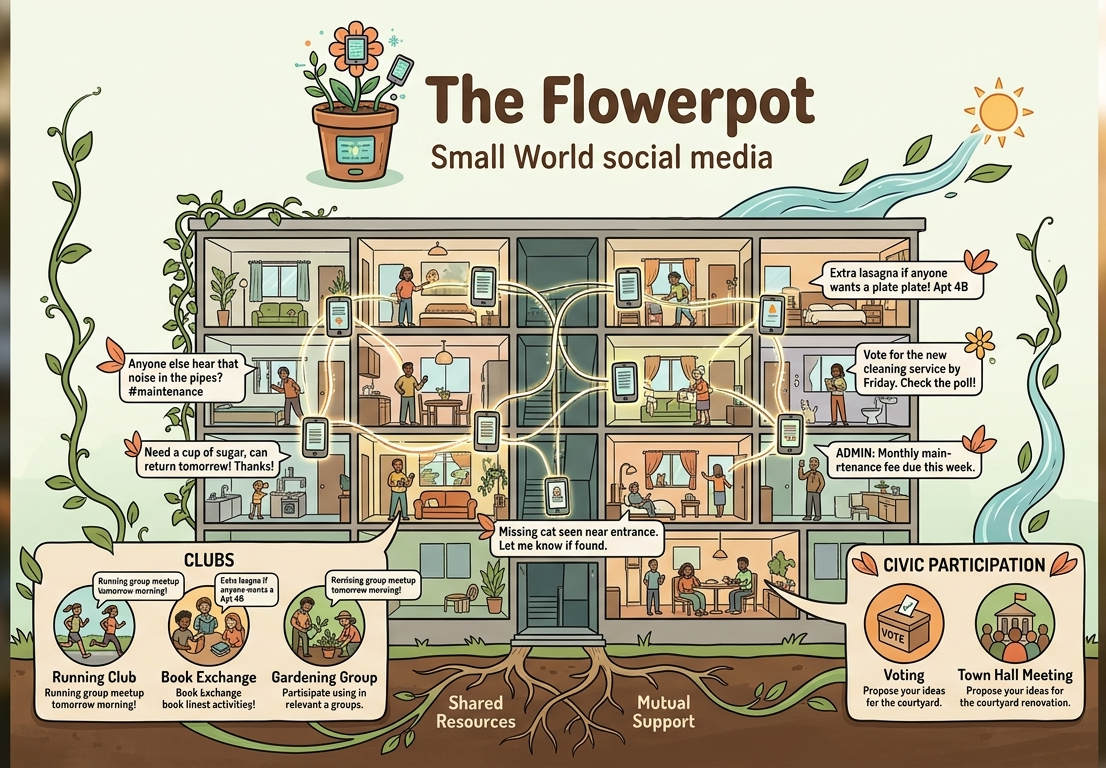
The Flowerpot is a "Small World" social network designed to bring community back to your doorstep. Unlike global platforms filled with bots and noise, we focus on real connections with the people who matter most: your neighbors.
Built for the apartment blocks of Bucharest and beyond, our app replaces messy flyers and chaotic group chats with a sleek hub for private messaging, local updates, and digital voting. Grow your community, manage your home, and keep it real.
Built for the apartment blocks of Bucharest and beyond, our app replaces messy flyers and chaotic group chats with a sleek hub for private messaging, local updates, and digital voting. Grow your community, manage your home, and keep it real.
Romania
Local
Bucharest
Mainly urban
It refers to other types of transformations (soft investment)
Early concept
No
No
Yes
Individual
The “Flowerpot” will be a digital communication platform for local residential areas. It will consist of a web and mobile application for people living in the same housing “group”. The application will allow users who live in the same “neighbourhood” to message each other, organize votes, decide meetings and post to a public space about their day to day life. The primary goal of the app is to allow more agency in the way their homes are taken care of. The primary target of the app at first will be the association run apartment blocks of Bucharest (Romania), locally known as “commie blocks”. Many building administrators’ only way of communicating bills and announcements to other tenants is physical flyers. Some use Whatsapp groups, others use Email chains, but these methods do not properly satisfy the needs of the residents of such blocks. A common complaint we heard in our stakeholder interviews, from both the sides of administrator and resident, is that due to the inflexibility of these methods, miscommunication and loss of information occur frequently. The Flowerpot will solve this issue by providing a specially made app that allows for easy access to bills and announcements. However, there already exist such solutions on the market. Where our app will differ from others will be from the social aspect of our app. We wish to build a feature that is akin to contemporary “Social Media” but at a scale which is far smaller. For this we have coined the term “Small World Social Network". This will include the basic functionalities of social media, such as private messaging, public posts and customizable profiles, but will not include features such as “followers” (or anything similar) , short-form video scrolling or anything that we feel might turn the space into a parasocial environment. With this, we wish to provide an alternative to apps such as Instagram, Facebook, Twitter and Tiktok, which seek to maximize user retention and competition over real social connection
The idea of the Flowerpot came from a number of casual, but frequent interactions and conversations in regular social settings/ that highlighted a common local sense of separation and the desire to socialize and integrate. Conversations among team members and their peers, family members, relatives and acquaintances served as one of the drivers as a recurring issue appeared: the challenge of sustaining meaningful contact within local communities. These conversations showed that many people lack efficient ways or engage and maintain conversations with their neighbors, even when they live in close physical proximity. Communication in residential environments, such as apartment complexes, is frequently disjointed and dependent on old techniques like printed notices or erratic digital technologies. Misunderstandings decreased involvement in group decision-making, and overall feeling of disengagement from one’s immediate surroundings results from this.
Other structures groups, especially educational environments, showed a similar pattern. While kids themselves frequently encounter obstacles in making connections, finding common interests, or even participating in extracurricular activities, parents have indicated a need for easier, more accessible means to stay updated about their children’s activities and school life. These gaps highlight a larger systemic problem, the lack of user-friendly, integrated platforms that enable meaningful, localized engagement.
As a result, the concept was developed as an answer to these intersecting needs. These discussions gave rise to the idea of ‘’small world’ social network, which reflects a desire to replicate the familiarity and immediacy of real life groups in a digital setting. In this way, the initiative is based on observable social dynamics, and lived experiences rather than theoretical presumptions. We will build a social media where only real, verified people could see and contact us.
social cohesion
engage local community
residential democracy
provide a neighbourhood digital hub
integrate emerging technology in day to day life
he app focuses on the social foundations that help communities remain secure and resilient. It addresses sustainability and the growing sense of alienation among people who live near each other, but rarely interact. Informal support networks weaken, trust declines, and mental health suffers from this disconnection. The app helps rebuild these ties by creating a localized digital space that encourages everyday interactions. Social sustainability enables people to know their neighborhood, build connections, communicate directly, and share information, reducing loneliness. It fosters a sense of belonging instead of isolation. When people feel connected, they are more likely to care for one another and their shared environment, supporting long-term community well-being. The Flowerpot limits its content to local events and shared experiences, making interactions more positive and meaningful. It also supports direct exchange of resources like tools, food, skills, information, and time within a defined area. Local exchange brings environmental benefits by reducing the need for transport, leading to fewer emissions and shorter travel distances. These small-scale changes can compound when adopted widely. The platform’s ‘’small world’’ design limits content geographically keeping the system manageable, focused, and less overwhelming. Smaller networks are easier to maintain and better reflect real human interactions.
Trust is essential for sustainability. Many online spaces suffer from anonymous or automated accounts that weaken communication. The app addresses this with strong authentication linked to the living unit (house/apartment), ensuring users are real people tied to a location. This promotes safer, more respectful interactions. Clear communication makes it easier to rely on neighbors for small acts of support, strengthening the community's resilience. Over time, the app can also support local initiatives by helping events, coordinate tasks, and address shared needs.
Trust is essential for sustainability. Many online spaces suffer from anonymous or automated accounts that weaken communication. The app addresses this with strong authentication linked to the living unit (house/apartment), ensuring users are real people tied to a location. This promotes safer, more respectful interactions. Clear communication makes it easier to rely on neighbors for small acts of support, strengthening the community's resilience. Over time, the app can also support local initiatives by helping events, coordinate tasks, and address shared needs.
By creating a digital space that is calm, transparent, more rooted in reality, The Flowerpot enhances aesthetics, viewing beauty as a quality of experience, with the intention of creating an environment that encourages concentration, lowers stress, makes people feel comfortable, and fosters relationships with others in the community. Instead of using advertisements, endless scrolling, features that encourage users to stay online for extended periods of time, the platform facilitates brief, meaningful interactions. It is simpler to monitor local activity without feeling pressured to keep up because content appears in a constrained and organized manner. The ads frequently interrupt the user's attention and present irrelevant content, eliminating them, the area remains clear and concentrated. Likewise, the platform steers clear of "doomscrolling,", allowing users to check what is new in their region and then exit the app without feeling drawn back in. The Flowerpot is a local platform, so members are more likely to know one another, have common interests, which contributes to its aesthetic appeal. People talk to people they may meet in real life, which promotes caring in their interactions. This is supported by the design, which keeps profiles straightforward and uncomplicated, allowing people to express themselves honestly without feeling compelled to perform well or gain a sizable fan base, not concentrating on status because there are no complicated measures that rank visibility or popularity. People feel more grounded in their surroundings as a result of this link between digital content and real location. The bond between people and location may eventually be strengthened as a result and users become more conscious of their surroundings when they observe and participate in local activities, going to events, answer inquiries, or talk about their personal experiences contributing to creating a mutually reinforcing feedback loop between the digital and real worlds.
By removing common barriers to digital participation, The Flowerpot ensures accessibility.The financial obstacles are eliminated by providing The Flowerpot as a free (for the user) software. This supports equal access across income levels and helps create a shared space that reflects the diversity of a neighborhood. The platform prioritizes simplicity and clarity. Unlike many digital tools with complex interfaces, it focuses on basic actions like posting, reading, and responsibility. Its clear structure makes features easy to find and understand, allowing users of all ages, including seniors, to participate comfortably. Familiar design patterns, clear tables, and consistent layout reduce the learning curve, enabling users to start without training or prior experience.
The Flowerpot also supports users with varying digital skills. It avoids technical language and minimizes steps needed to perform actions. For example, posting or replying requires only a few simple steps, allowing even users with limited technical experience to engage easily and without frustration. It also considers those excluded by traditional social media. Large platforms often emphasize followers, speed, and visibility, creating pressure and comparison. The app removes metrics like followers counts and popularity rankings, shifting focus to communication rather than status. This allows users to participate without feeling judged.
Its local focus further supports inclusivity. Users interact with people in the same area, creating shared context through common places, events and issues. This makes communication easier and helps individuals feel a part of an active local network rather than isolated. Consistency in design also improves accessibility. Predictable behavior builds trust, especially for users less comfortable with technology. Actions have clear outcomes, and the system remains stable, allowing users to engage confidently over time.
The Flowerpot has been developed through participatory, user-centered opinion polls, involving residents, building administration, and local community members from the earliest stages of the project.
The primary stakeholders of this project are the residents themselves, building associations and the larger communities surrounding them. From the moment the project was conceived, we have talked with residents from various backgrounds in order to understand their issues with current ways of communication and to ask for features which they think could be implemented in an app such as The Flowerpot.
These conversations brought to light persistent problems like disjointed communication, a lack of transparency, and a few more chances for group decisions made in groups. Users actively provided suggestions for solutions in addition to being advertised on issues, thereby influencing important aspects of the site. Local voting mechanisms, streamlined communication and daily movement are all examples of this. This participatory manner gave rise to the idea of ‘’small world’’ social network, which reflected a clear need for more meaningful, localized digital engagement. Because of this, the platform is more relevant and useful because it is based on actual need, rather than conjecture.
The platform’s design clearly reflects the influence of stakeholders participation, with a significant emphasis on accessibility for all age groups, user friendly interfaces, encouragement for strengthening community, elimination of distracting competitive features that are frequently used in social media. This creates an atmosphere that ensures long-term engagement and acceptance, participation will continue to be crucial throughout the deployment, especially during pilot testing phases, where ongoing user feedback will direct additional development.
Including stakeholders at a local, regional, and European levels in both design and implementations, The Flowerpot employs a multilevel governance strategy. Residents, housing associations, and building administrators are the main stakeholders at the local level. Their participation is crucial to co-design the platform’s features so that it directly addresses community dynamics , decision making procedures, and daily communication demands. Their involvement fosters long-term adoption, ownership, trust.
Local governments and city administrations are anticipated to be crucial at the municipality and regional levels. They can assist local initiatives, disseminate public information, and promote participatory governance using the platform. Their engagement improves responsiveness and transparency by fortifying the bond between citizens and institutions. The project can get finance, regulatory alignment, and integration with more comprehensive digital and social policies from governmental institutions and innovation agencies at the national level. Their involvement guarantees standardization, scalability, integration with national agenda including cohesion and digitization.
At a European level the project is in line with principles and goals of the New European Bauhaus as well as more general EU programs including digital innovation, inclusivity and community resilience. By facilitating information sharing, international implementation, financing programme access, European stakeholders can help the idea grow and adapt to a variety of situations. The combination of top-down institutional support and bottom-up community knowledge is what makes this multilevel involvement valuable. This guarantees the platform’s sustainability, scalability and alignment with broader policy frameworks while maintaining local relevance.
The computer and software engineering that is required to build a robust system capable of handling all the tasks proposed in the concept is a crucial discipline that is only enabled by recent advancements into digital technologies and an easy of access to new technology. From a sociological standpoint, the application is intended to be taken in use by the entire body of residents of a building or complex, in the context of which to encourage communication and establishing relationships. As a result, the platform gains a considerable advantage in the form of its diverse userbase, since individuals in the local community are likely to be distributed in different professional fields, and the focus on collective involvement means the entire local area becomes a creative outlet where one can express any talent useful to its development.
The various themed branches of the app allow, for example, for an engineer and architect to collaborate for the development of an arranged space meant for silent relaxation in the green space surrounding the residential building. At the same time, a passionate teacher can post an announcement inviting parents to bring their children to after-school practice. In the same vein, the application encourages other such activities promoting development of individuals in fields like arts, sciences, environmental awareness, that knowledgeable residents can arrange.
The various themed branches of the app allow, for example, for an engineer and architect to collaborate for the development of an arranged space meant for silent relaxation in the green space surrounding the residential building. At the same time, a passionate teacher can post an announcement inviting parents to bring their children to after-school practice. In the same vein, the application encourages other such activities promoting development of individuals in fields like arts, sciences, environmental awareness, that knowledgeable residents can arrange.
The Flowerpot is built on a hybrid economic strategy that keeps the core platform free and open to all users while combining institutional partnership, public backing and service-based profits. In order to guarantee inclusivity and broad acceptance at the neighborhood level, free access is important. This platform can create local networks which are essential to its long term profitability and social value, by reducing financial obstacles.
Early on, public funds such as municipal budgets, national innovation programs, European funding and other instruments in line with digitalization, social cohesion, and civic engagement will assist development and pilot deployment. The platform is a great contender for institutional support since it directly advises public policy objectives like citizen involvement, mental health, and community adaptability. Partnership with housing groups and municipalities will eventually become a significant source of income. Improved administrative tools including data dashboards, communication modules, elements for participatory decision-making are available to these stakeholders. By increasing effectiveness and citizen engagement, this adds value.
Extra income could come from optional premium services like enhanced customisation, payment system connections, or maintenance management tools that are provided to businesses, such as cooperatives and property managers. To protect user confidence and uphold a peaceful, non-exploitative online environment, the platform stays away from advertising-based business methods. By combining steady institutional funding with scalable service-based revenue, this hybrid strategy guarantees financial sustainability while preserving the platform’s primary goal of blistering local communities.
The Flowerpot scales easily because it is a digital application. It requires no special hardware or physical accessories. Any resident with a smartphone can download and use the platform.
The app addresses universal challenges in residential living. It streamlines communication and simplifies shared decision-making. These needs exist in apartment blocks, housing cooperatives, and gated communities worldwide. Because the social structure of a "neighborhood" is a global concept, the app requires little adaptation for different cultures or regions.
The low cost of the platform removes financial barriers. It creates a shared space for both low-income and high-income households. This accessibility helps neighbors interact and care for their surroundings. The model is also transferable to other settings. Educational campuses, nursing homes, and professional hubs can use the same "Small World" framework to build local trust.
We provide a stable technical core. Local groups then provide the content. This balance makes the project easy to replicate in any community that values transparency and social cohesion.
A planned and scalable development approach will be used to build the app, with a major emphasis on real-world testing and iterative improvements in the first year. Developing a workable space code prototype with an emphasis on the essential features, local user authentication, messaging, notifications, and participatory tools, such as voting and decision making, being the first step. Data security, usability, accessibility are some of the few aspects to be given top priority during this period.
After that, a pilot test will be carried out in a single residential building, enabling direct user behavior monitoring and feedback gathering from administrators and tenants. This stage is crucial for verifying the idea in an actual setting and determining what needs to be improved. The platform will be improved and extended to more buildings and neighborhoods based on the pilot results, expanding the quantity and variety of users. The stage will assess the system’s stability, scalability, and the ability to adapt to various community structures.
Additionally, the project will develop into a prototype that is ready for commercial usage, complete with enhanced technical infrastructure, user support system, governmental elements, designed for collaborations with housing organizations and governments.
Lastly, the idea will be expanded to include various kinds of communities and establishments, including educational institutions like schools, high schools, universities, nursing homes, police academies, military bases, ex-convict groups etc. or employment settings. This will show how adaptable the small ‘’small world’’ idea is in many social settings. This methodical approach guarantees user driven development, ongoing validation, and feasible route from concept large-scale implementations.