Strengthening Local Democracy and Inclusion
shortl.ee
shortl.ee - Bridging Europe's Language-Divided Media to Strengthen Democratic Participation
In Estonia, Estonian and Russian speakers live side by side but read different news. Expats miss most local information. Communities sharing the same streets lack shared understanding of what happens around them. shortl.ee gives every community equal access to local news in the language they speak. Free, open to all, no registration. Already helping people in 10+ countries understand their neighbours. We started this experiment in Estonia and want to bring it to communities across Europe.
Estonia
National
It addresses urban-rural linkages
It involves other types of transformations (soft investment)
Yes
2026-02-01
No
No
No
Individual
You cannot participate in democracy if you do not know what is being decided. In Estonia, that is the reality for a quarter of the population. 25% of Estonian residents are Russian-speaking. Local Russian-language media is limited. Many turn to sources from Russia instead, where disinformation is a documented risk. Estonian speakers read Estonian outlets. Expats cannot follow local news at all. Communities sharing the same streets form views based on different facts. During elections, this becomes a direct threat to democratic life.
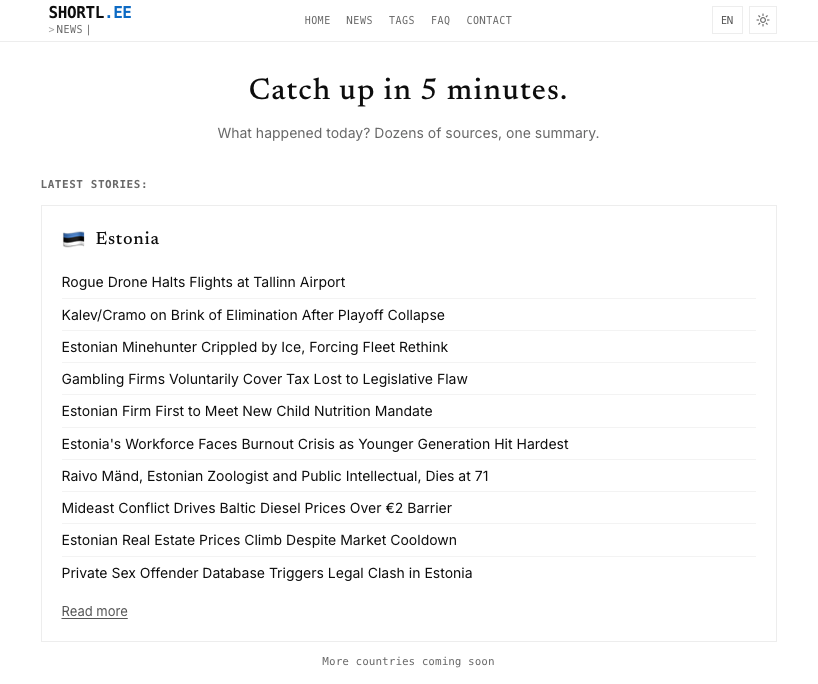
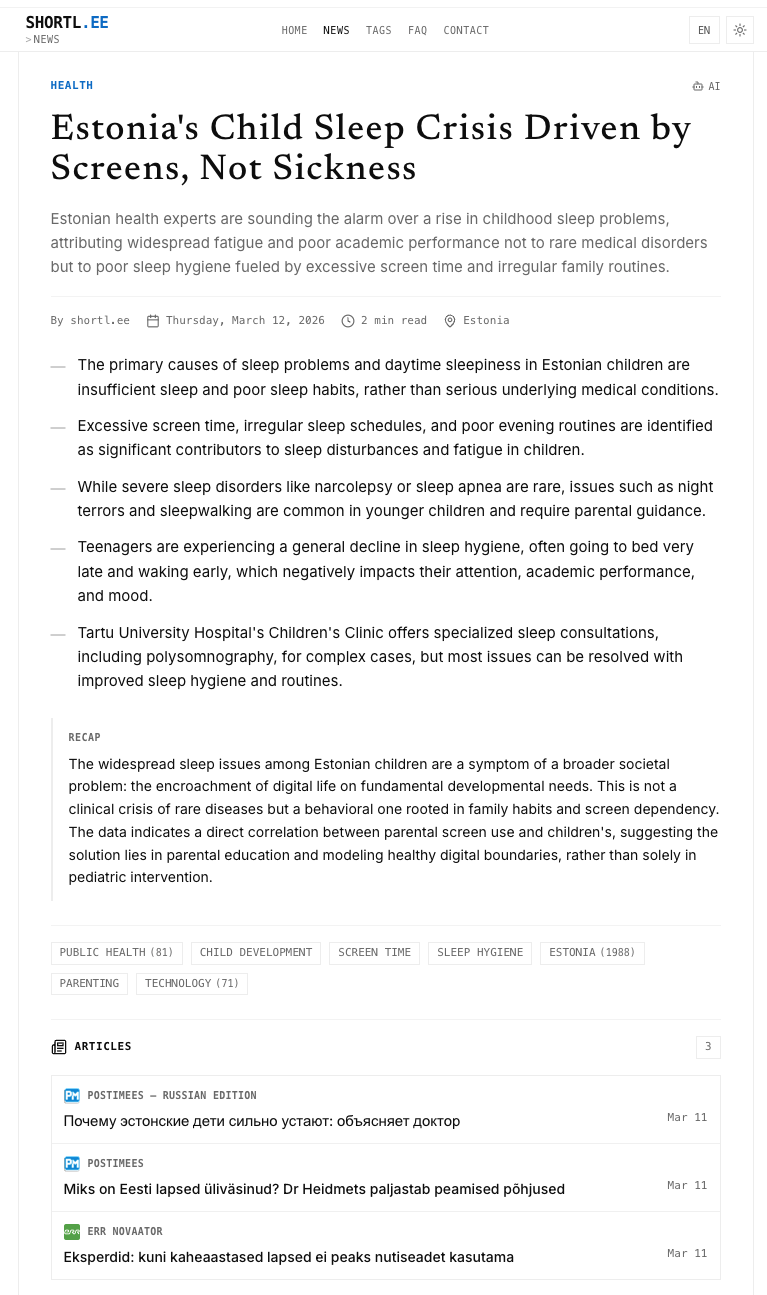
shortl.ee is a free platform built to give every community a neutral alternative. It aggregates 50+ news sources, including government announcements, public broadcaster ERR, and independent media, and publishes the same stories simultaneously in Estonian, Russian, and English. Every summary links to original reporting. Readers see how different outlets cover the same event and make up their own minds. The goal: every resident should be able to participate in democratic life regardless of language. A Russian speaker in Narva should not have to choose between thin local coverage and outlets from Moscow. An expat in Tallinn should know what the city council decided.
Results (28-day Google Search Console data):
- 1,235 organic clicks, 99,660 impressions, +12.5% week-over-week
- 48% of clicks from outside Estonia: Finland, Latvia, Lithuania, Germany, Netherlands, Poland
- Baltic neighbors have the highest engagement: Lithuania 4.94% CTR, Finland 4.18%
- 8,216 indexed pages across three language versions
Long-term impact: Estonia is the starting point, not the destination. Europe has 24 official languages and almost no way for ordinary citizens to follow what happens in neighboring countries. We want to build the same bridge across EU media ecosystems, country by country. The cross-border usage is already there: half our readers are from other EU countries.
I am an Estonian resident and former Staff Engineer at Veriff, an identity verification company. For years I watched how Estonia's information landscape splits along language lines. Estonian speakers read Estonian outlets. Russian speakers face a harder choice: local Russian-language media is limited, and many turn to sources from Russia, where disinformation is a real risk. Expats have ERR English, but that is about it. One source, limited coverage, no way to compare or go deeper. During elections this becomes a democratic problem. Three communities sharing the same country, forming views based on completely different information.
I wanted to build something neutral. Not pro-Estonian, not pro-Russian. A source that covers the same local events for everyone, in every language that matters here: Estonian, Russian, English. So that a Russian speaker in Narva has an alternative to choosing between thin local coverage and outlets from Moscow. So that an expat in Tallinn can follow what the government decided. So that everyone starts from the same facts before they form an opinion.
I mapped 50+ sources across all three languages. Built an AI pipeline that clusters coverage of the same event, generates summaries, and links every claim to its source. The hardest part was neutrality. How to show framing differences without editorializing. I got this wrong a few times before settling on a rule: show everything, link everything, let the reader decide. The platform should not tell anyone what to think. It should make sure no one is stuck with only one perspective because of the language they speak.
We never spent a cent on marketing. Users in 10+ countries found us through search. One said: "Summaries are short and on point. I liked the tags. And the fact that it's free."
multilingual democratic participation
civic information inclusion
cross-border community understanding
digital platform for local democracy
language equality in public information
The standard approach to multilingual civic information is expensive. State-funded multilingual broadcasters. Translation agencies. Parallel newsrooms. These work, but they cost millions and only large countries can afford them.
shortl.ee proves there is a lighter path.
The entire platform costs under 200 EUR per month to run. Three languages, 50+ sources, scales to thousands of users without increasing the bill.
There is no physical distribution. No printed copies in three languages. No delivery trucks. Citizens access Estonian, Russian, and English versions from one URL. The environmental footprint is minimal by design.
AI summarization also reduces information waste. Instead of reading dozens of articles across multiple outlets to piece together what happened, readers get one concise summary with links to the originals. Less screen time. Less data transfer. Less redundant content production.
And by linking to original journalism rather than replacing it, shortl.ee extends the useful life of reporting that already exists. Local journalists get more readers, not fewer. The platform drives traffic to sources rather than capturing it.
The result is a model where sustainability and inclusion are not in tension. The cheapest way to deliver civic information across languages turns out to also be the most inclusive. Under 200 EUR/month for a service that would cost a traditional institution millions. That matters for small countries and regions across Europe that need multilingual information infrastructure but cannot fund large programs.
Most news platforms are built to capture attention. Clickbait. Outrage sorting. Algorithmic feeds that optimize for engagement over understanding. shortl.ee is built for the opposite: help people understand what happened and get on with their day.
The design is deliberately calm. One event, multiple sources, clear language choice. No algorithmic ranking. No engagement tricks. The interface treats readers as adults who want to be informed citizens, not stimulated consumers.
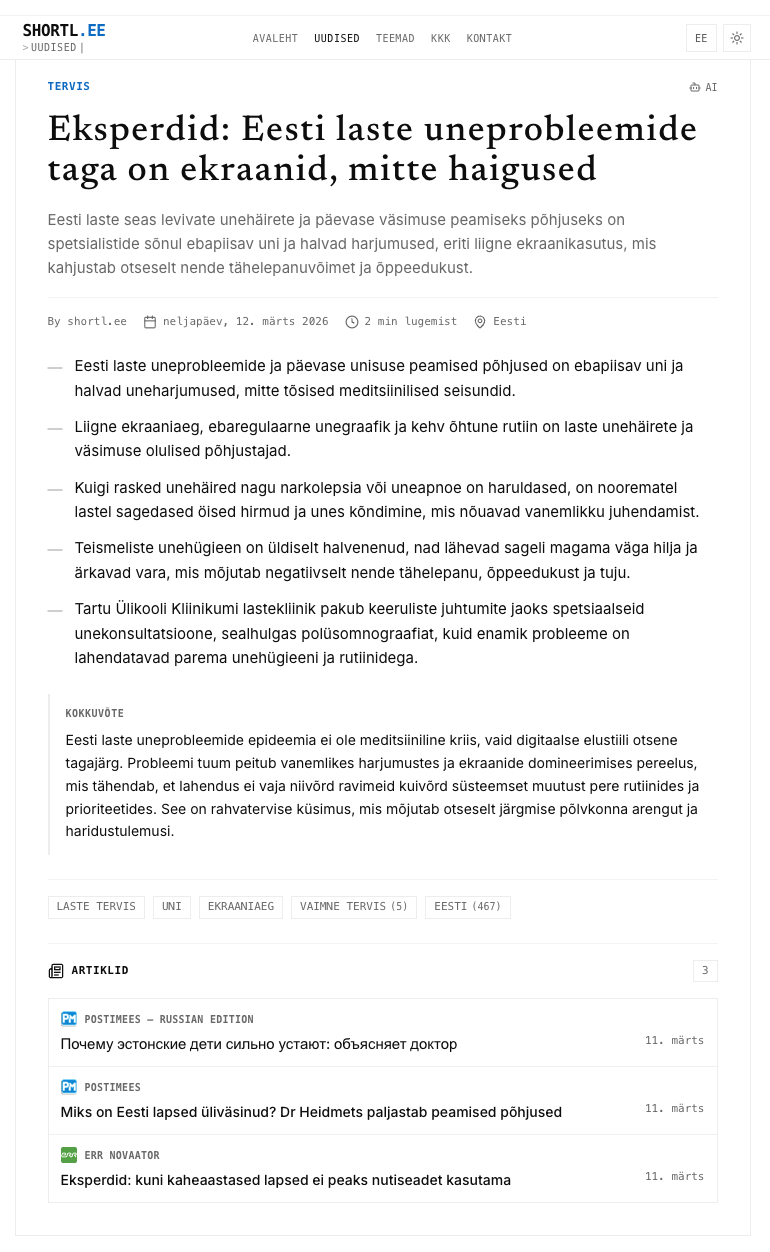
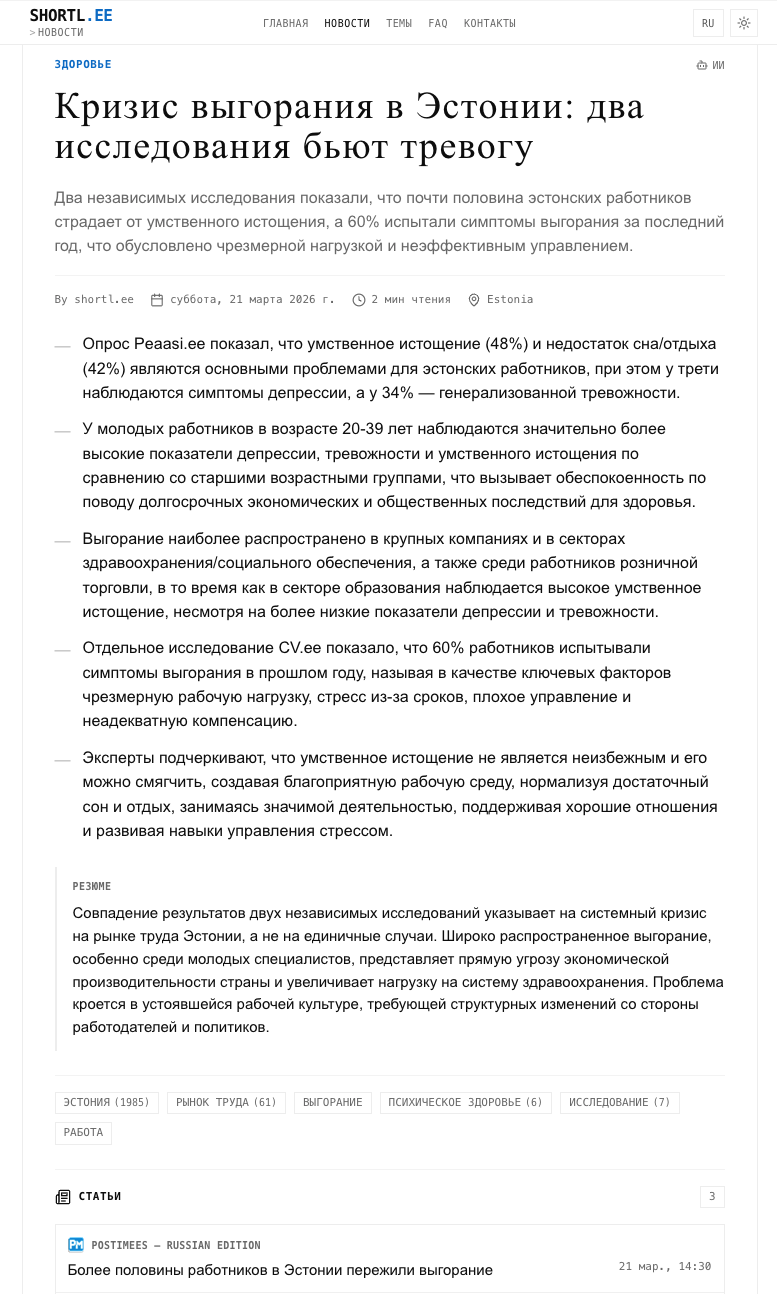
Every language version gets equal design care. The Russian pages are not an afterthought. They have the same typography, navigation depth, and content priority as Estonian and English. That is a deliberate message: every community in this country deserves the same quality of democratic information.
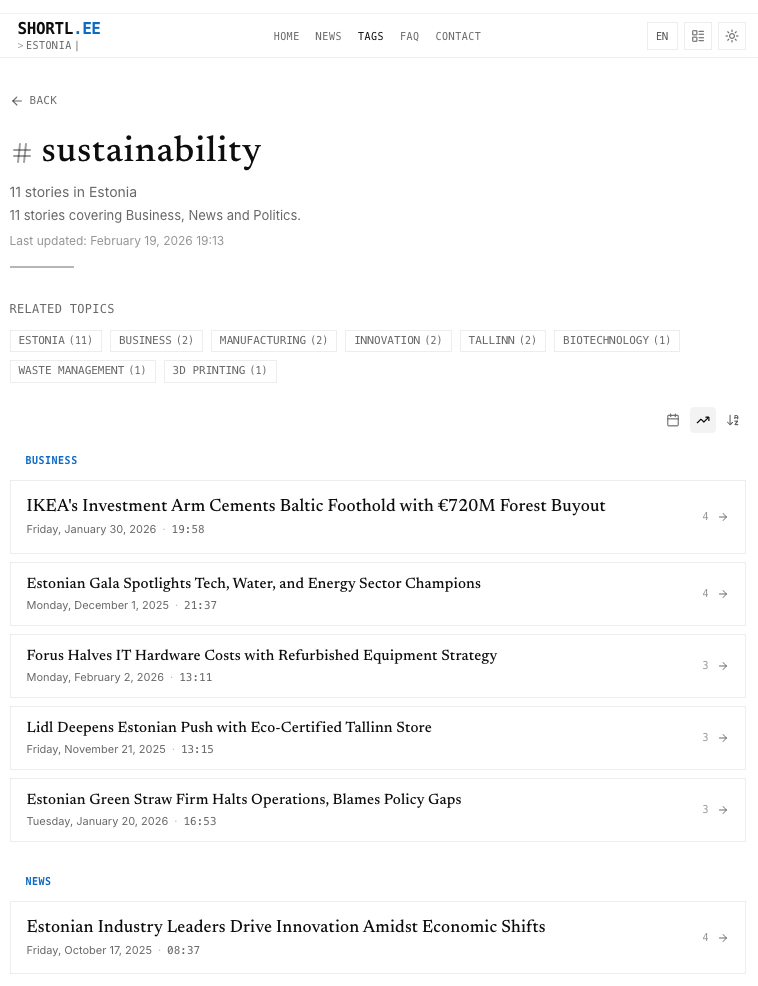
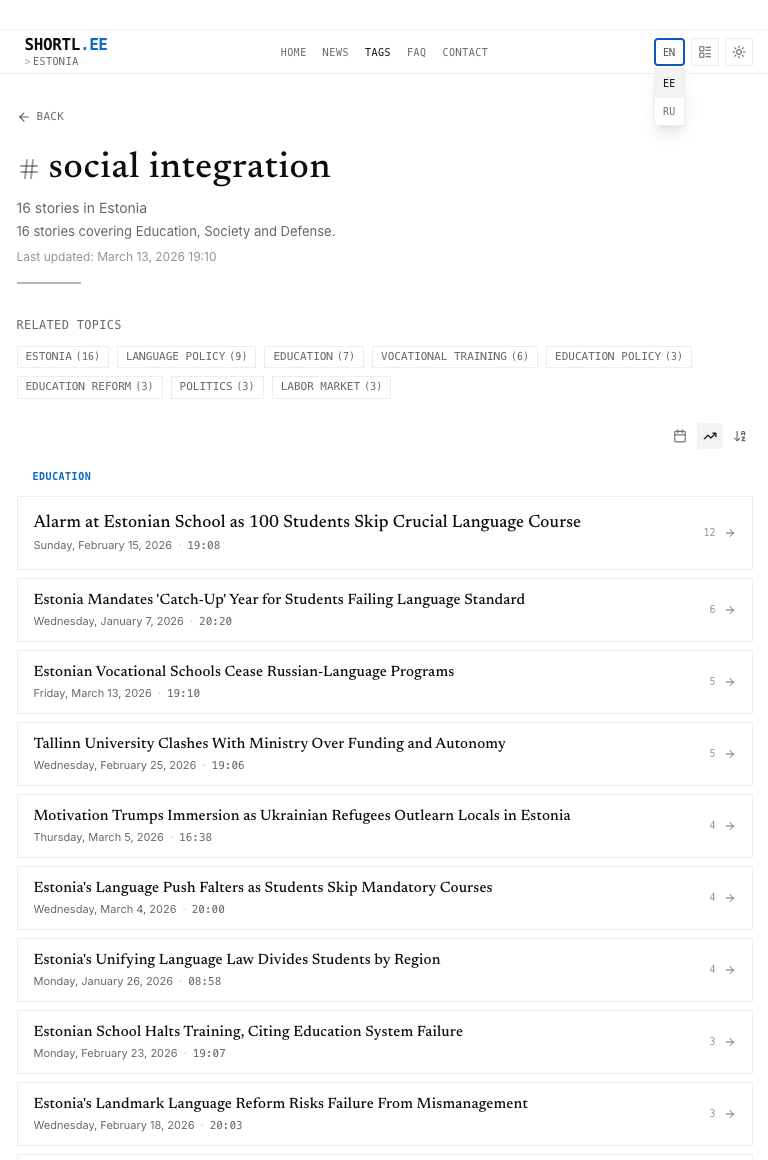
300+ topic tags organize the country's civic landscape into something navigable. Instead of scrolling a feed hoping to find what matters, residents orient by topic, by source, by language. Local elections, city council decisions, government policy, all findable in two clicks.
But the real contribution is emotional. Russian-speaking residents and expats who could never easily follow Estonian civic life now can. Estonian speakers can see how Russian media frames the same event. For the first time, there is one place where all communities are reading about the same country.
That shared reference point creates belonging. When you see your neighbor's media covered the same event you read about, just from a different angle, the country starts to feel like one place instead of parallel realities. That feeling matters for democracy. People who feel they belong to the same place are more likely to participate in shaping it together. shortl.ee makes Estonia's multilingual identity visible and navigable, not a barrier to civic life.
In Estonia, if you speak Russian, you consume Russian media. If you speak Estonian, Estonian media. If you are an expat, you are mostly in the dark. These are not overlapping circles. They are separate worlds. The same government decision, the same local crisis, framed differently or sometimes not covered at all in the other language.
shortl.ee makes language irrelevant for accessing civic information. All three versions publish the same stories at the same time with equal depth.
The numbers tell the story. 48% of our clicks come from outside Estonia (Google Search Console, 28 days). Finland: 57 clicks, 4.18% CTR. Latvia: 38, 3.66%. Lithuania: 24, 4.94%. Germany: 33. Netherlands: 26. Poland: 23. These are people actively looking for what is happening in Estonia and finding us through search. No marketing. No ads.
In-country, English and Russian paths dominate traffic. The people who need this most are the ones using it most: non-Estonian speakers who had no good way to follow local civic life.
The platform is free. No registration. No paywall. Mobile-first, with 55% of traffic from phones. Source-linked summaries show not just what happened but how different outlets frame it. A language switcher lets you see the same story in another language instantly.
We expanded the Russian-language section after analytics showed real demand from underserved users. That is inclusion driven by evidence, not assumptions.
An intelligence analyst wrote us unprompted: "I am really impressed and see a lot of potential. I want to build my own similar project." A user said: "Summaries are short and on point. I liked the tags. And the fact that it's free."
Democratic participation starts before the vote. It starts with knowing what is being discussed. In Estonia, language barriers cut entire communities out of that first step. shortl.ee puts them back in.
The platform does not have a community board or a workshop series. Participation here means something different. It means a Russian-speaking resident in Narva can now follow the same policy debate an Estonian speaker in Tallinn reads about. It means an expat in Tartu finally knows what the city council decided. These people were not absent from civic life by choice. They were absent because the information was not in their language.
The platform also changes how people engage with information. Traditional media gives you one editorial view. shortl.ee shows multiple sources covering the same event side by side. The reader compares angles, spots what one outlet emphasizes and another ignores, forms their own view. That is not passive reading. That is citizens doing the democratic work of making sense of public life.
Language switching is participation too. When someone goes from the English to the Russian version of the same story, they are choosing to see how another community frames a shared event. In a country where language communities rarely see each other's media, that is a civic act.
Development follows users. Russian-language coverage expanded because analytics showed demand, not because we assumed it. Users vote with their behavior. We listen.
The evidence: non-Estonian speakers are the primary users. English and Russian paths dominate. The communities previously excluded from civic information are now the core audience.
Democracy works at multiple levels. shortl.ee connects levels that normally do not talk to each other in Estonia's information landscape.
Horizontally, across language communities: Estonian, Russian, and English speakers have separate media ecosystems. When a government decision affects everyone, these communities learn about it from different sources with different framing. shortl.ee creates a shared democratic information space. Same stories, all communities, equal priority. When a city council vote is covered by ERR in Estonian and Delfi in Russian, both appear together, clustered around the same event.
Horizontally, across media types: government communications, public broadcaster, commercial outlets, and independent media sit in one view. A citizen can compare how the government announced a policy versus how ERR reported it versus how an independent outlet covered it. That transparency is democratic accountability made practical.
Vertically, from institutions to citizens: government announcements are published in Estonian. If you do not read Estonian, you do not get them. Or you get them late, reframed through a second outlet. shortl.ee makes institutional information accessible in all three languages simultaneously. This closes a real democratic gap: residents who do not speak the state language should still know what the state decides.
From local to European: 48% of traffic comes from other EU countries already. Finland, Latvia, Lithuania, Germany, Netherlands, Poland. Citizens of neighboring countries follow Estonian civic decisions because they affect the region. The platform was built as the Estonian pilot of a European model. Cross-border democratic understanding is not a future plan. It is already happening through organic usage.
Building shortl.ee required solving problems from very different fields at the same time.
The core technical challenge is an NLP problem: 50+ sources in three languages publish stories every day, and the system needs to figure out which articles are about the same event, summarize them, and flag contradictions. I spent 15 years as an engineer, the last at Veriff doing identity verification at scale. That background is why the pipeline works.
But the technology created an editorial question I did not expect. When you summarize multiple sources, you are making choices. What to include, what to leave out, how to phrase things. I had to learn from journalism: always link to the original, never add claims the sources did not make, never editorialize. The rule became simple: aggregate, attribute, stay out of the way.
Then there is the democratic design question. Why did I refuse ads, algorithmic feeds, engagement optimization? Because I read enough about how attention-driven platforms erode civic discourse. Every design choice came from asking: what does someone need to participate in their community's democratic life? That question came from political science and civic design thinking, and it shaped the entire product.
And finally, you cannot build this without understanding the local media landscape from the inside. Estonian, Russian, and English outlets do not just use different languages. They cover different events, quote different officials, frame things for different audiences. I know this because I live here and read all three. That knowledge is not something you can hire for or find in a paper.
shortl.ee runs on personal savings. No investors, no institutional funding, no advertising. I chose this deliberately. Civic information should not depend on whoever is paying for it.
The operating costs are remarkably low. Cloud hosting plus AI API costs: under 200 EUR per month. To put that in perspective: a state-funded multilingual broadcaster serving the same function would cost millions annually. shortl.ee does it for 2,400 EUR per year. The proof that multilingual civic infrastructure can be cheap enough for any community to sustain.
shortl.ee is free and will stay free. On the same infrastructure, we are building https://ultimate.news, a commercial platform for global news awareness aimed at professionals and researchers. Once that launches, revenue from the commercial product funds the free civic layer permanently. The public surface never needs to charge anyone.
Prize funding would go directly toward expanding shortl.ee to other EU countries and getting ultimate.news to market. Once both are running, the model sustains itself.
The replication case does not need to be argued. It is already visible in the data.
Half our traffic comes from outside Estonia. Lithuania, Finland, Latvia have the highest engagement rates. These are people trying to understand what happens next door and finding no other way to do it.
Latvia has almost the same situation as Estonia: large Russian-speaking minority, split media, same democratic risks. Lithuania too. Belgium has been living with a Dutch-French media divide for decades. The Western Balkans have multiple languages and are navigating EU integration with fragmented information. Ukraine and Moldova, now NEB-eligible, face even more urgent versions of the same problem.
What would it take to launch shortl.ee in any of these places? Plug in local news sources. Adjust the AI for the target languages. Calibrate which sources to include. The core platform, the clustering logic, the design, the cost structure, all of that transfers without changes. Adding a new country is configuration, not development.
The cost structure is what makes replication realistic. Under 200 EUR per month means a civic organization, a small municipality, or a single motivated person can run this. It does not require ministry-level budgets or EU programme funding to keep the lights on.
The most important thing that transfers is the idea itself: that language-based information fragmentation is not something communities just have to live with. It is a gap, and it can be closed with tools that already exist. We proved it works in Estonia. The same proof can happen anywhere in Europe where people sharing the same democratic space do not share the same information.