Enhancing Circularity, Sustainability, and Innovation
Computador Circular
Computador Circular — Circular Platform for Digital Inclusion Through Technology Lifecycle Managemen
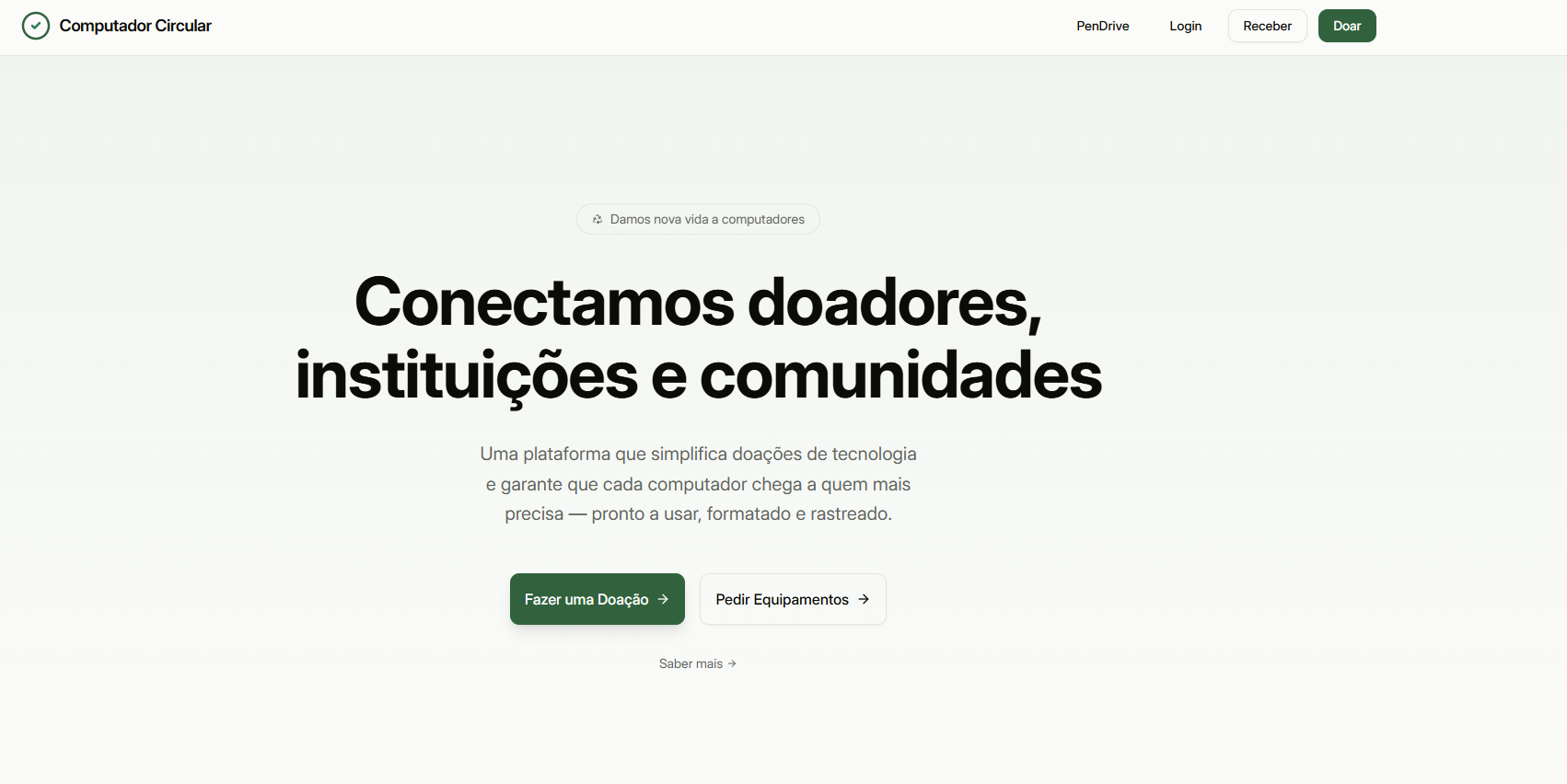
Computador Circular is a digital platform that connects companies with surplus technology to communities in need, managing the full lifecycle of each device - from donation to refurbishment, redistribution, and end-of-life reuse. A smart USB tool automates device setup, eliminating technical barriers. Unlike linear donation models, every device circulates multiple times, maximising social and environmental impact.
Portugal
National
It addresses urban-rural linkages
It refers to other types of transformations (soft investment)
Prototype level
Yes
Horizon2020 / Horizon Europe
No
No
Individual
Computador Circular is a digital platform that creates a fully circular ecosystem for the redistribution and lifecycle management of technological equipment. Large volumes of functional devices exist in companies, yet communities in need — schools, libraries, social organisations — lack structured access to them.
Existing donation models are linear and opaque: a device is assigned once, without tracking, without criteria. Resources are wasted. Impact is unmeasured.
Computador Circular introduces a circular model where every device is registered, tracked, redistributed, and — at end of life — disassembled for component reuse. A smart USB tool automates refurbishment by installing a lightweight OS and registering each device in the platform, eliminating technical barriers.
Target groups include digitally excluded individuals, educational institutions, municipalities, and companies seeking ESG impact. The concept won the CDI Portugal challenge at the LX Circular Hackathon (EIT Ignite NEB event, October 2025) and is being incubated by IES Social Business School and Impact Hub Lisbon through EIT Grow NEB. A prototype is live at computadorcircular.pt.
One device, managed circularly, benefits multiple people over time. We are building the infrastructure for digital inclusion at scale.
Computador Circular was born in two days. In October 2025, five people who had never worked together were brought into the LX Circular Hackathon — an EIT Ignite NEB event organised by Impact Hub Lisbon, IES Social Business School, and Unicorn Factory Lisboa, funded by Portugal Inovação Social. Our team was assigned a challenge proposed directly by CDI Portugal (Centre for Digital Inclusion): design a solution for the fair, efficient, and traceable distribution of donated computers to communities in need.
CDI had the equipment and the goodwill — but no system. Devices arrived without tracking, were assigned without criteria, and disappeared without any record of impact. Our two days of intense work, guided by CDI representatives and expert mentors, produced the core concept: a circular platform where devices are not donated once but managed across their entire lifecycle.
We won the challenge. The jury — which included CDI Portugal directly — selected our concept as the winning solution. This was not a coincidence: the concept was built with the problem owner, not just for them.
Since October 2025, we have been supported by IES Social Business School and Impact Hub Lisbon through the EIT Grow NEB incubation programme — receiving business mentorship, prototyping support, and access to a network of sustainability and innovation professionals. One team member represented the project at Slush 2025 in Helsinki, connecting with the European startup and impact ecosystem. We have since built a functional platform prototype, publicly accessible at computadorcircular.pt, which demonstrates the core user flows and value proposition.
The next step is operational: formalising the partnership with CDI, completing the USB smart tool, and running the first tracked distribution pilot.
circular economy
digital inclusion
e-waste reduction
lifecycle tracking
social innovation
Computador Circular is built on circular economy principles applied to the technology sector — one of the fastest-growing sources of electronic waste globally. The concept directly addresses the environmental, social, and economic dimensions of sustainability.
Environmental sustainability: The platform extends the active life of technological devices that would otherwise be discarded prematurely. By automating refurbishment through the USB smart tool (which installs a lightweight OS optimised for older hardware), devices that companies consider obsolete are made functional again for years. Each device diverted from waste reduces the demand for new manufacturing and its associated carbon footprint. The circular redistribution model — where devices are returned, reprocessed, and reallocated rather than permanently assigned — multiplies the environmental benefit of each unit.
At end of life, the platform facilitates structured disassembly and component reuse, ensuring zero-waste closure of the cycle.
Social sustainability: The model is designed to be financially self-sustaining without depending on continuous donations or public subsidies. Revenue streams (USB tool sales, SaaS subscriptions, component resale) create a viable long-term operation, meaning the social impact is not contingent on external goodwill.
Economic sustainability: By giving companies a structured, traceable, ESG-certified channel for equipment donation, Computador Circular creates economic value for donors (reporting, reputation, tax benefits) while reducing costs for recipient institutions that would otherwise need to purchase equipment.
What makes this approach exemplary is the integration of all three dimensions in a single operational system — sustainability is not a feature of the platform, it is its architecture.
In the context of Computador Circular, aesthetics is understood not as visual decoration but as the quality of human experience that the platform enables. The concept contributes to making life better — more dignified, more connected, more full of possibility — for people who have been structurally excluded from the digital world.
Access to a working computer changes how a child experiences learning. It changes how a job-seeker navigates the labour market. It changes how an elderly person in a rural municipality connects with family and services. These are not abstract outcomes — they are concrete transformations in the daily quality of life of real people. The platform is designed to deliver that transformation in the most frictionless, dignified way possible: recipient institutions register a need, the platform manages the rest.
The design philosophy of the platform itself reflects a commitment to clarity and accessibility. The interface is built to serve users with low digital literacy — simple flows, plain language, no unnecessary complexity. The USB tool embodies the same principle: one click, one formatted device, ready to use. The aesthetic of the tool is functional beauty — something that works so well it disappears.
At a community level, equipping a school or a social association with working technology has a visible, felt impact on the space and on the people in it. It signals care. It signals that the community is not forgotten. This sense of belonging — of being included in the digital society — is a core cultural benefit of the concept.
The concept also contributes to a broader cultural narrative: that circular economy is not a sacrifice but an upgrade, that reused technology can be beautiful, reliable, and meaningful.
Digital exclusion is one of the most consequential forms of exclusion in contemporary Europe. Access to a working device and connectivity determines access to education, employment, healthcare, civic participation, and social connection. Computador Circular is, at its core, an inclusion infrastructure.
Inclusion objectives: The platform targets individuals and communities who are structurally excluded from digital participation — students in under-resourced schools, elderly populations, people experiencing poverty or social vulnerability, residents of rural or peripheral areas with limited access to services.
Implementation: The platform removes the three main barriers to equipment access: (1) lack of transparent matching between supply and demand — solved by the platform's demand registration and algorithmic prioritisation based on eligibility and impact criteria; (2) lack of technical capacity to set up donated devices — solved by the USB smart tool, which formats and configures each device automatically; (3) lack of visibility and accountability in donation processes — solved by full lifecycle tracking and ESG-certified impact reporting.
The model is explicitly designed so that recipient institutions pay nothing. The costs are borne by operational partners and donor organisations, who receive value in return (efficiency, reporting, certification). Inclusion is structural, not charitable.
Governance inclusion: The platform also includes mechanisms for recipient institutions to register needs and participate in prioritisation — giving communities a voice in how resources are distributed rather than being passive recipients.
What makes this approach exemplary is that inclusion is built into the operational model, not added as a feature. Every device that moves through the platform is moving specifically because someone who needs it has asked for it.
Computador Circular was not designed about its stakeholders — it was designed with them. This is not a retrospective claim; it is the structural reality of how the concept was built.
The challenge that originated the concept was proposed by CDI Portugal (Centre for Digital Inclusion) — an organisation that has been operating equipment donation programmes for years and knows the problem from the inside. Our team worked directly with CDI representatives throughout the LX Circular Hackathon: understanding their operational pain points, validating our proposed solutions in real time, and iterating on the concept based on their feedback. CDI sat on the jury that selected our concept as the winning solution. Their endorsement is therefore not a letter of support — it is an act of co-authorship.
The hackathon structure itself was participatory: four preparatory sessions brought together teams, challenge owners, and mentors from the social impact ecosystem before the two-day event. The session dedicated to the CDI challenge (7 October 2025) provided direct exposure to the problem context, the communities served, and the operational constraints that any solution would need to navigate.
Since October 2025, the EIT Grow NEB incubation programme — delivered by IES Social Business School and Impact Hub Lisbon — has included structured sessions with potential consumers and beneficiaries to validate the concept's assumptions. The programme formally requires facilitated testing with at least 20 potential consumers, ensuring that development continues to be grounded in real user feedback rather than internal assumptions.
The demand-registration model at the core of the platform is itself participatory by design: recipient institutions express their needs, and the platform responds. Communities are not passive recipients — they are active participants in the allocation process.
Computador Circular already operates within a multi-level ecosystem — this is not a future aspiration but a present reality.
Local level: CDI Portugal is the primary operational anchor. Their existing network of recipient institutions — schools, libraries, social associations, and IPSS across Portugal — represents the immediate deployment context for the platform. At this level, the platform creates traceable, accountable relationships between donor companies and local communities. Municipalities and juntas de freguesia are also identified as key recipient partners.
National level: The concept was developed within the LX Circular programme — a national initiative funded by Portugal Inovação Social, a Portuguese government agency. The programme brought together Impact Hub Lisbon, IES Social Business School, and Unicorn Factory Lisboa as co-organisers, each with national networks in the impact entrepreneurship and circular economy space. IES has been providing ongoing business mentorship and incubation support since October 2025, connecting the team to national-level practitioners, policymakers, and institutional stakeholders.
European level: The LX Circular Hackathon was an official EIT Ignite NEB event, co-funded by the European Institute of Innovation and Technology. Our entry into the EIT Grow NEB programme directly connects the project to the European NEB ecosystem. One team member attended Slush 2025 in Helsinki as part of the prize, gaining exposure to European and international innovation networks. The concept is explicitly aligned with EU policy priorities: the Circular Economy Action Plan, the Digital Decade 2030 targets, and the CSRD reporting framework.
Each level reinforces the others: local operational credibility (CDI), national institutional legitimacy (IES, Portugal Inovação Social), and European policy alignment (EIT, NEB). The platform is the infrastructure that makes these levels work together.
Computador Circular was built by a team that spans five distinct knowledge domains, and this diversity is not incidental — it is what makes the concept work.
The team brings together expertise in: marketing and communications (platform design, stakeholder engagement, narrative); technology and software development (platform architecture, automation, USB tool engineering); business innovation and circular economy (model design, revenue streams, ESG frameworks); design and user experience (interface design, accessibility); and social impact (inclusion criteria, community engagement, institutional partnerships).
These disciplines do not operate in parallel — they are integrated. The USB smart tool, for example, was not designed by engineers alone: the simplicity of its operation (one click, zero technical knowledge required) was shaped by social impact considerations about the digital literacy levels of operational partners. The prioritisation algorithm was not designed by data scientists alone: it was shaped by conversations with social workers and institutional representatives about what fairness means in practice.
The incubation at Impact Hub Lisbon has reinforced this approach, connecting the team to a broader ecosystem of entrepreneurs, sustainability experts, designers, and policy professionals who contribute to the ongoing development of the concept.
The transdisciplinary character of the project is also reflected in the concept itself: it sits at the intersection of the circular economy, digital inclusion, social innovation, and public-private partnership — a space that cannot be navigated from within a single discipline.
Computador Circular is designed for financial sustainability from the outset. The model avoids dependency on donations or public subsidies by creating multiple interlocked revenue streams tied to the core operational cycle.
Revenue stream 1 — USB Smart Tool (hardware): The physical tool that automates device refurbishment and registration is sold to operational partners (organisations that collect, refurbish, and distribute equipment). This creates a direct, scalable revenue source that grows with the number of operational partners onboarded.
Revenue stream 2 — Platform SaaS subscription: Operational partners and donor organisations pay a subscription for access to the platform's management, tracking, and reporting features. This includes ESG impact dashboards, donation certificates, and lifecycle documentation — features with clear value for companies with sustainability reporting obligations under CSRD and similar frameworks.
Revenue stream 3 — Component resale (end-of-life): When devices reach the end of their useful life, the platform facilitates structured disassembly and resale of components. This creates a third revenue layer that closes the circular loop economically.
Cost structure: Primary costs are platform development and maintenance, USB tool production, and operational coordination. The model is asset-light on the platform side and scales with partner growth.
Potential for disruption: As CSRD reporting obligations expand across European companies, the demand for traceable, certified ESG impact actions will grow significantly. Computador Circular is positioned to become the standard infrastructure for technology donation compliance — a high-value, recurring revenue opportunity.
The NEB Prize funding (€15,000) would be allocated to: completing the USB tool hardware development, funding the first operational pilot, and formalising the first partner agreements.
Computador Circular is designed for replication from the ground up. The model does not depend on specific local conditions, unique partnerships, or non-transferable resources. Its core components are all portable.
Most transferable elements:
1. The platform itself is geography-agnostic. Any country with a combination of corporate equipment surplus and communities experiencing digital exclusion — which describes virtually every EU Member State — can deploy the same system with minimal adaptation.
2. The USB smart tool is a physical product that can be manufactured and distributed independently. Operational partners in any location can use it without technical expertise, making local replication straightforward.
3. The circular redistribution model — demand registration, algorithmic matching, lifecycle tracking, end-of-life processing — is a methodology that can be applied to other categories of equipment beyond computers (tablets, phones, medical devices, tools).
4. The ESG certification and reporting framework is directly aligned with EU-wide CSRD obligations, making it immediately relevant to any European company.
Requirements for replication: Local operational partners (NGOs, refurbishment organisations, municipalities) are the primary requirement for expansion into new geographies. The platform provides the coordination infrastructure; local partners provide the physical logistics. This model — platform as infrastructure, partners as operators — is designed for rapid horizontal scaling.
Sectors beyond technology: The circular redistribution model is applicable to any durable goods sector. The learnings from Computador Circular could inform circular platforms in furniture, medical equipment, or educational materials.
The project can serve as a replicable model for EU-wide digital inclusion infrastructure, and the NEB Prize would provide the visibility and credibility needed to accelerate that replication.
Computador Circular is actively being developed — not a concept on paper. A functional prototype is live at computadorcircular.pt, built since winning the LX Circular Hackathon in October 2025.
We are currently in the EIT Grow NEB incubation programme (IES Social Business School and Impact Hub Lisbon), concluding mid-late 2026. The programme includes mandatory consumer testing sessions and structured business development milestones we are actively completing.
In the year following this application: we will finalise the USB smart tool, run the first operational pilot with CDI Portugal (our founding challenge partner), onboard the first donor companies under a SaaS model, and enter the market by Q3-Q4 2026. The NEB Prize would directly fund this transition from prototype to operational platform.