Enhancing Circularity, Sustainability, and Innovation
Waste to Value with Black Soldier Fly
From Waste to Value: A Black Soldier Fly Hub for Circular Skills and Youth Education
From Waste to Value turns organic waste into value through Black Soldier Fly rearing, practical learning, and community action. A central rearing and education hub, together with school-based activities, helps young people gain circular skills, understand waste transformation, and explore green opportunities. The concept is low-cost, visible, and replicable across communities in North Macedonia and beyond.
North Macedonia
Regional
Vardar Region, Skopje Region, Pelagonia Region, Southeastern Region.
It addresses urban-rural linkages
It refers to other types of transformations (soft investment)
Prototype level
No
No
Yes
Organisation
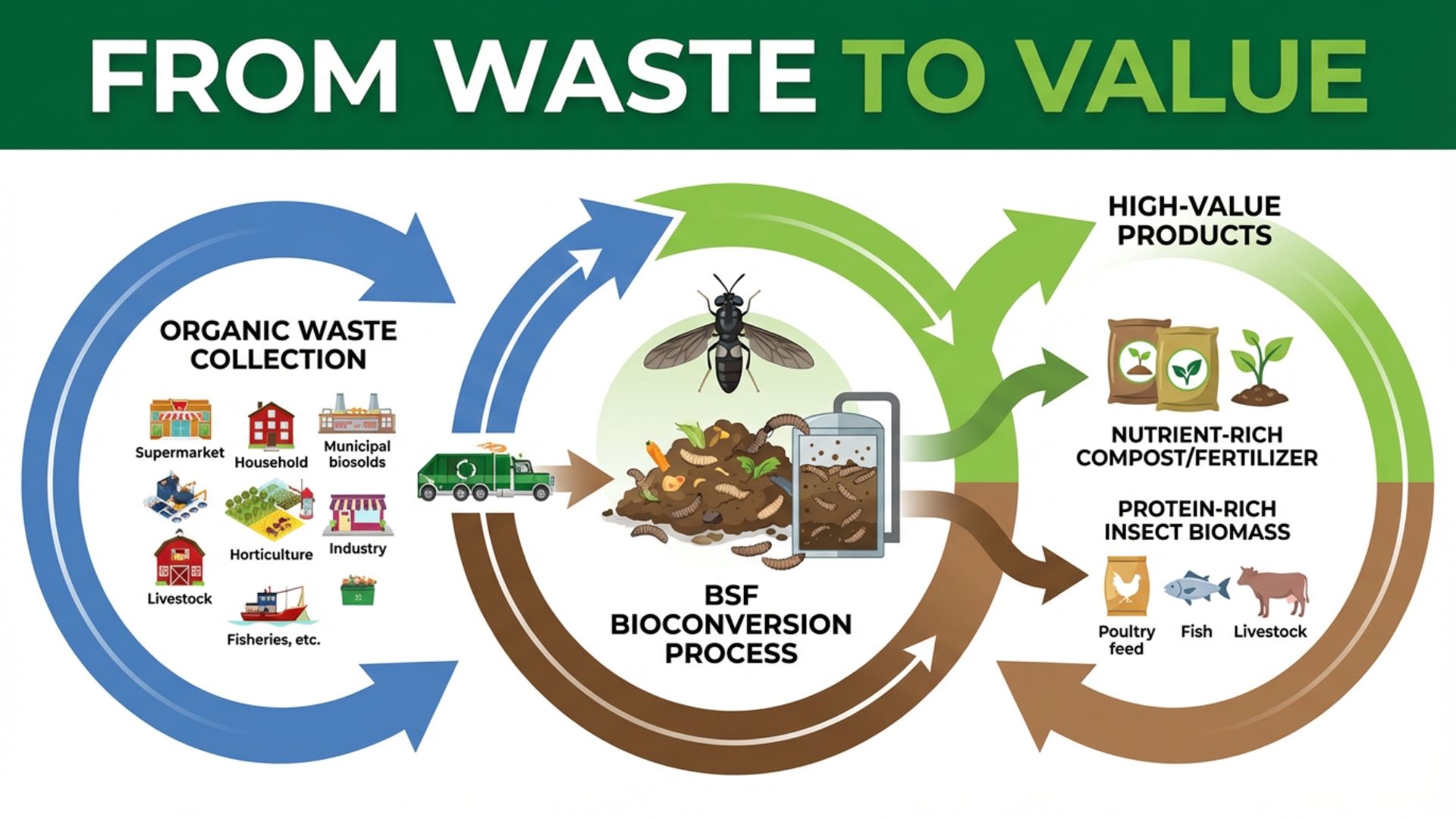
From Waste to Value: Circular Skills with Black Soldier Fly is a youth-driven, community-based concept that transforms organic waste into valuable resources through small-scale, accessible circular systems. By combining hands-on learning with practical application, the project aims to establish a central circular learning hub for Black Soldier Fly rearing, where young people can directly observe, follow, and understand the full process of converting organic waste into insect-based outputs and organic fertilizer.
This hub will serve as a local centre for knowledge, experimentation, and engagement, making circular economy practices visible and practical in everyday life. In parallel, the concept foresees educational activities in 3 to 4 schools, introducing students to circular resource use, sustainable food systems, and organic waste transformation. In 2 of these schools, small demonstration rearing units will be introduced, allowing students to gain direct hands-on experience with the system.
The concept addresses environmental, social, and economic challenges at the same time. It reduces organic waste and associated emissions, promotes sustainable resource use, and strengthens local resilience by keeping value within communities. Through inclusive, low-cost systems and participatory learning, it empowers youth, educators, households, and small farmers with practical green skills and opportunities for collaboration and micro-entrepreneurship.
Expected results include measurable reductions in organic waste, production of organic fertilizer for local use, increased awareness of circular economy practices, and the creation of an engaging pilot model that can be replicated in other communities. By combining education, local action, and simple innovation, the project demonstrates how circular solutions can be inclusive, practical, and transformative at the grassroots level.
The idea behind the concept grew from both prior knowledge and direct hands-on experimentation. We had known about the Black Soldier Fly for some time as an insect with remarkable potential in circular systems. However, the turning point came when we attended a fair in Larissa, Greece, where we made our first direct contact with experts from the Faculty of Agriculture in Thessaloniki, Department of Entomology. That exchange transformed our curiosity into a concrete direction for action.
From there, we began our own process of rearing Black Soldier Fly larvae. This was not immediate or simple. We had to learn through trial and adjustment how to create the right conditions, especially the temperature and humidity levels the insect requires. Finding the optimal balance was demanding, but that process gave us practical knowledge and confidence in the feasibility of the system.
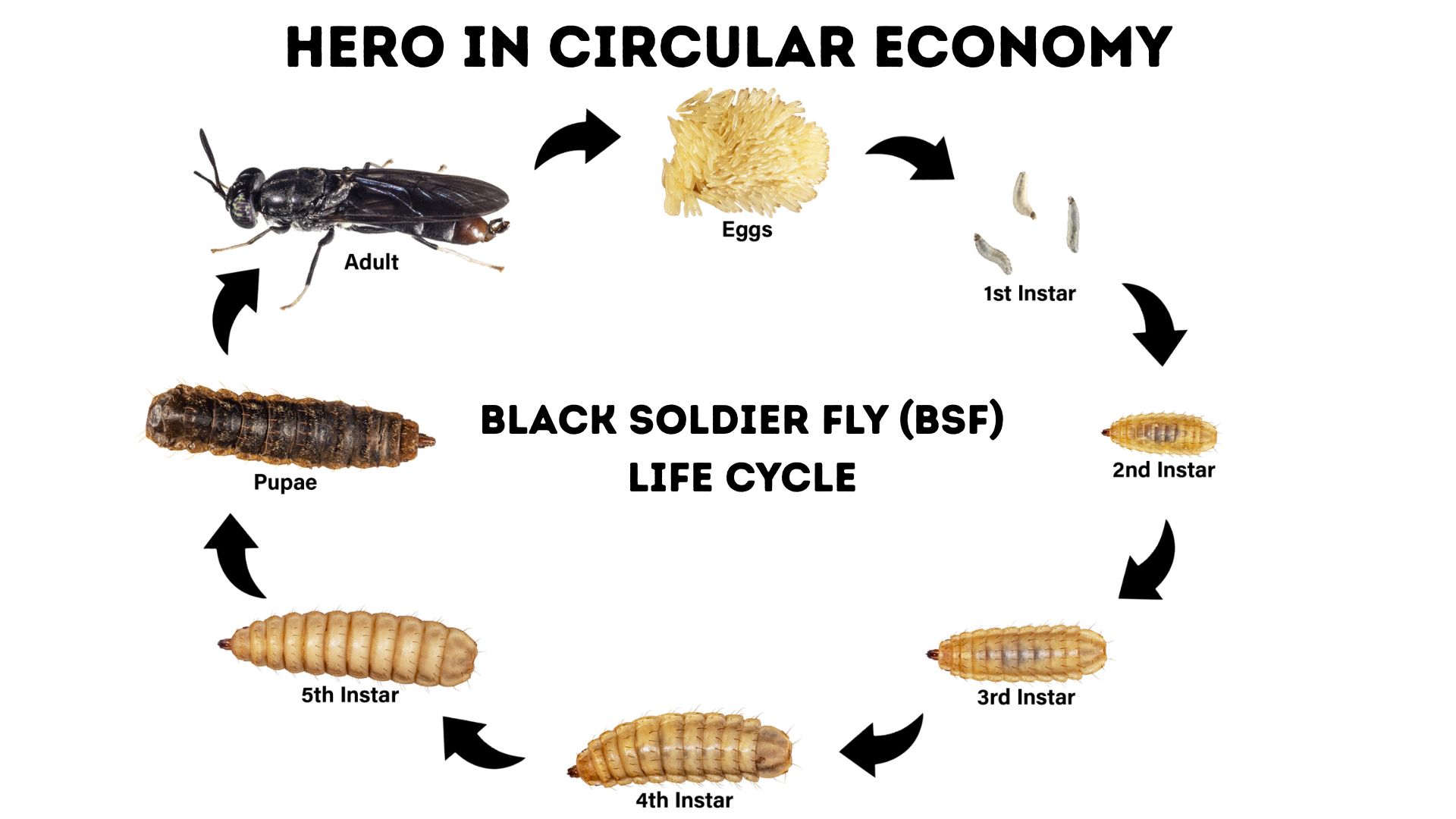
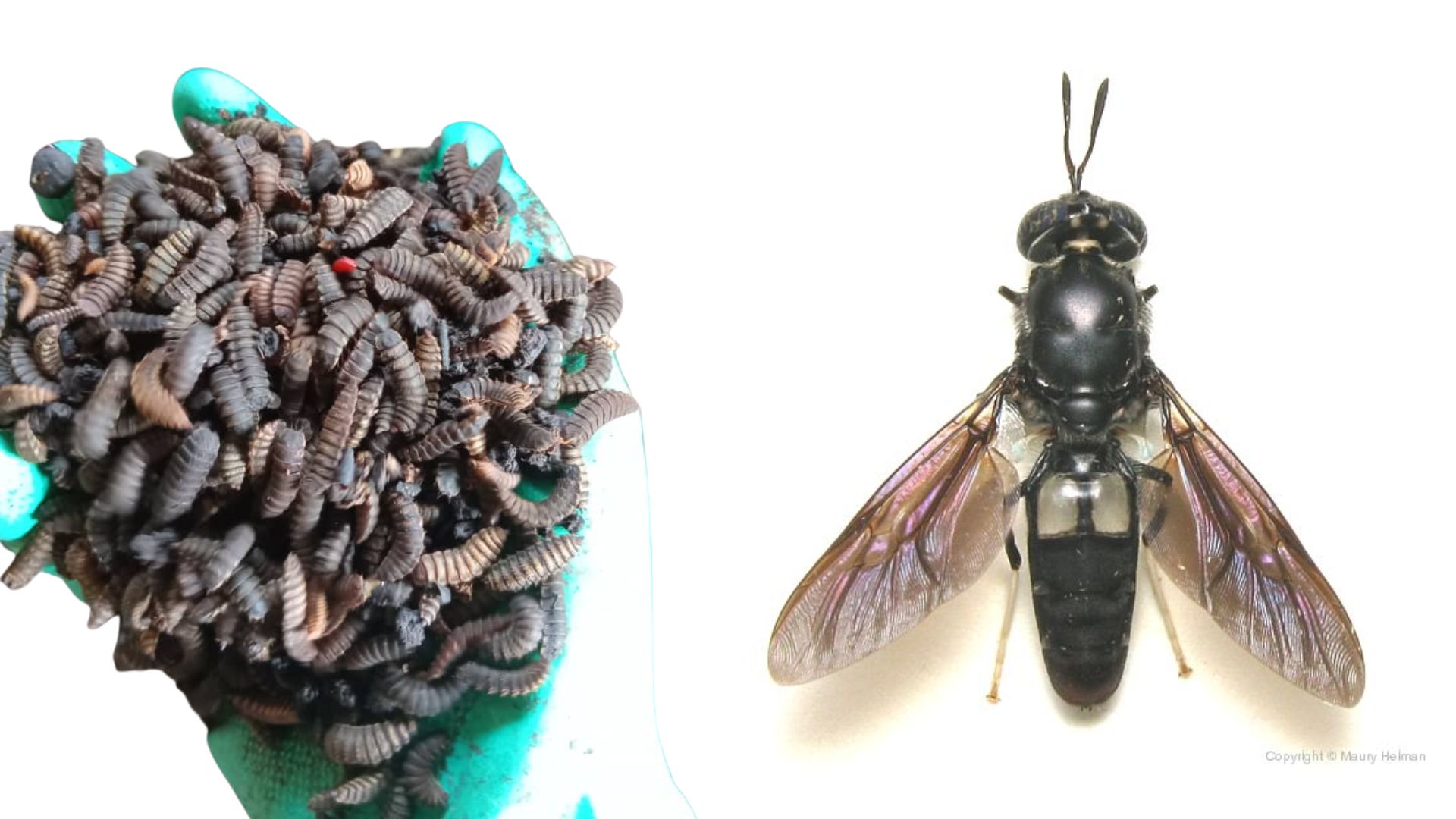
At the same time, we were already aware that Black Soldier Fly larvae are among the fastest natural decomposers of organic waste. Through our own practice, we confirmed this directly: the larvae consume large quantities of organic waste and process it quickly and efficiently. Today, we raise quails, and their waste is processed with Black Soldier Fly larvae. This real-life application showed us how the insect can close nutrient loops, reduce waste, and generate useful outputs. For us, the Black Soldier Fly is not only a hero of our own story, but also a hero of the circular economy. The concept developed from this lived experience: from observation, experimentation, and local practice to a broader vision of a central rearing and education hub, where waste becomes value, knowledge becomes skill, and sustainability becomes visible in everyday community life.
Circular economy
Waste transformation
Sustainable food systems
Youth empowerment
Community innovation
The concept addresses environmental challenges by reducing organic waste through a circular system that converts it into valuable outputs, including organic fertilizer and insect-based resources. This lowers landfill use, greenhouse gas emissions, and reliance on synthetic inputs, while promoting regenerative, low-impact production methods.
Socially, the project empowers youth and local communities through hands-on learning and skills development in circular economy practices. It fosters inclusion by engaging schools, households, and small farmers, creating accessible opportunities for participation, knowledge-sharing, and local ownership.
Economically, the concept introduces low-cost, small-scale production systems that can reduce waste management costs and generate value through fertilizer use or local distribution. It supports micro-entrepreneurial thinking and strengthens local resilience by keeping resources within the community.
Culturally, the project encourages a shift in mindset—from waste as a problem to waste as a resource—while building a culture of sustainability, responsibility, and innovation among younger generations.
The concept is exemplary in its simplicity, accessibility, and replicability. It translates complex sustainability principles into practical, community-driven solutions that can be easily adopted across different contexts. By combining education, local action, and circular design, it demonstrates how sustainable living can be both achievable and impactful at the grassroots level.
The concept contributes to making life more beautiful by turning an invisible and often unpleasant problem—organic waste—into a visible, clean, and educational experience. Instead of being associated with disorder, smell, and neglect, waste is reimagined as part of a well-organised rearing and education process that is understandable, safe, and inspiring for young people and the wider community.
At the centre of the concept is a rearing and education hub where young people can observe and follow the full Black Soldier Fly process, from organic waste input to the production of useful outputs such as organic fertilizer. This central space is not designed only as a technical site, but as an engaging and well-maintained place for learning, curiosity, and community interaction. In parallel, educational activities in schools and small demonstration rearing units help extend this experience into everyday learning environments.
The concept improves the visual and ecological quality of spaces by transforming overlooked corners of community areas and school environments into purposeful, attractive, and living places. The use of organic fertilizer can support greener surroundings, healthier plants, and more vibrant schoolyards and gardens, reinforcing the connection between circular practice and visible improvement of the local environment.
Beauty in this concept also comes from participation and meaning. Young people and community members are not passive observers; they become part of a living transformation process. This creates a sense of belonging, shared responsibility, and pride in a place that reflects local care, learning, and sustainable action. In this way, the concept shows that circular systems can be functional, educational, and aesthetically inspiring at the same time.
The concept promotes inclusion by making circular economy knowledge, tools, and opportunities accessible to a broad range of users, including students, teachers, young people, households, small farmers, and community groups. It is intentionally designed as a low-cost, locally adaptable model that can operate even in resource-constrained settings, reducing both financial and technical barriers to participation.
Inclusion is built into the structure of the concept itself. A central rearing and education hub will serve as an open learning space where young people and other community members can observe, understand, and engage with the full process of Black Soldier Fly rearing and organic waste transformation. In parallel, educational activities in 3 to 4 schools will extend this knowledge more widely, while 2 schools will also host small demonstration rearing units, allowing students to gain direct hands-on experience.
Accessibility is embedded in both the learning process and the system design. The training is practical, visual, and easy to understand, so participants do not need previous technical knowledge to take part meaningfully. This makes the concept suitable for different age groups, educational backgrounds, and local contexts, both in formal school settings and in community-based learning environments.
Inclusion is also reflected in governance. The concept encourages shared responsibility through the involvement of youth, educators, and community members in the organisation, use, and development of the hub and school-based activities. Rather than delivering sustainability as an external service, it gives local people an active role in shaping and improving the system. In this way, the concept democratizes access to green knowledge, practical skills, and future micro-enterprise opportunities, making the circular transition more inclusive and locally rooted.
The concept has been developed through a participatory, community-based approach, shaped by direct engagement with local stakeholders, including young people, teachers, community members, and small farmers. Early discussions and informal consultations helped identify key local challenges, especially the need for better organic waste management, more practical environmental education, and affordable circular solutions that people can understand and apply in their daily lives.
Young people have played a particularly important role in shaping the concept. Their interest in hands-on, real-life learning helped define the idea of creating a central rearing and education hub where they can directly observe and follow the Black Soldier Fly process. Rather than learning only through theory, they are given the opportunity to engage with a living circular system and understand how waste can be transformed into value.
Educators also contributed to the development of the concept by highlighting how such activities can be introduced into school settings in accessible and meaningful ways. This influenced the plan to extend the concept through educational activities in 3 to 4 schools, while 2 schools will also host small demonstration rearing units that allow students to gain practical experience.
Community members and small-scale farmers contributed by emphasizing the importance of low-cost, locally relevant solutions and the value of organic fertilizer and waste-to-resource practices. Their input helped shape the concept as a simple, adaptable, and community-rooted model based on local ownership and shared responsibility.
Participation has therefore influenced not only the content of the concept, but also its structure. The result is a model that grows from real local needs and capacities, strengthens trust and ownership, and encourages collective learning and long-term engagement.
This concept applies a multilevel governance approach by connecting local action with institutional, educational, and potentially regional support. At the local level, the main actors include young people, teachers, schools, community groups, households, and small farmers. They are the core users and participants of the concept, engaging directly in the central rearing and education hub, in school-based educational activities, and in the use of small demonstration rearing units. Their involvement ensures that the concept remains practical, relevant, and rooted in real community needs.
At the municipal level, local authorities and public services can play an important enabling role by supporting access to organic waste streams, encouraging cooperation with schools and community actors, and aligning the project with local environmental, educational, and youth priorities. Their engagement adds institutional legitimacy and helps embed the concept in existing local systems.
At the educational and technical level, schools, educators, eco-clubs, and academic experts can contribute to the quality of the learning process, the safe development of the rearing model, and the adaptation of activities to different age groups and settings. In this regard, cooperation with technical and academic partners can strengthen the scientific basis and credibility of the concept.
At broader regional or national level, NGOs, educational networks, and relevant institutions can support knowledge sharing, visibility, capacity building, and future replication in other communities. Their role is especially important for dissemination, partnerships, and scaling.
The added value of this multilevel governance model lies in combining grassroots ownership with wider institutional and technical support. Local actors ensure day-to-day relevance and participation, while higher-level stakeholders provide coordination, expertise, legitimacy, and opportunities for growth.
The concept From Waste to Value: A Black Soldier Fly Hub for Circular Skills and Youth Education
is inherently transdisciplinary, combining knowledge and practices from multiple fields to create an integrated, community-based solution.
Environmental science and circular economy principles form the foundation of the concept, guiding the transformation of organic waste into valuable resources and promoting sustainable resource management. Biology and entomology are central to understanding the Black Soldier Fly life cycle and applying it in a safe, effective, and locally relevant way.
Education and pedagogy play a major role through the creation of hands-on learning experiences linked to the central rearing and education hub, as well as school-based educational activities. These elements make complex sustainability concepts understandable and practical, especially for young people. Vocational learning and skills development are also embedded in the concept, helping participants gain practical knowledge that can support future green jobs and entrepreneurship.
The concept also draws on agriculture and soil science through the use of frass as organic fertilizer, supporting healthier soils, greener spaces, and local food systems. In parallel, basic business and entrepreneurship knowledge is included to explore small-scale circular production and community-based income opportunities.
In addition, the concept incorporates social innovation and community development by emphasizing participation, local ownership, and inclusive governance. Elements of design and spatial thinking are reflected in the creation of an accessible and engaging rearing and education space, as well as in the adaptation of small demonstration units within school environments.
By connecting environmental action, scientific knowledge, education, agriculture, entrepreneurship, and community participation, the concept moves beyond a single-sector approach.
The business model behind From Waste to Value: Circular Skills with Black Soldier Fly is a hybrid, community-centred approach that combines low operational costs, local value creation, education, and small-scale revenue generation.
The concept is designed to remain affordable by using simple, modular systems built from locally available materials and by treating organic waste as a low-cost or free input. This reduces implementation costs for schools and communities and makes the model accessible even in resource-constrained settings.
Financial sustainability can be supported through several complementary value streams. One of the most immediate is the production of frass, which can be used as an organic fertilizer and soil improver for local gardens, plants, and small-scale agriculture, reducing the need for purchased inputs. Over time, surplus may also be shared or sold locally as a plant nutrition product. In addition, the concept can reduce organic waste disposal needs, creating practical savings and opening opportunities for cooperation with municipalities and local service providers.
In the longer term, the model can also create small-scale market opportunities through Black Soldier Fly biomass. Dried larvae may become a valuable product for use as feed for pets and other animals, depending on the scale of development and the applicable regulatory framework. This creates an additional pathway for local value generation and strengthens the economic potential of the system.
The concept also creates opportunities for youth-led micro-enterprises. Trained participants can replicate small-scale systems, provide waste-to-resource services, produce organic fertilizer, or support community-based circular activities. At the same time, the educational component can be supported through schools, NGOs, municipalities, public funding, or project-based partnerships.
The concept From Waste to Value: Circular Skills with Black Soldier Fly is designed for high scalability and transferability due to its simplicity, low cost, and modular structure.
A key element that can be replicated is the central rearing and education hub model, which combines practical Black Soldier Fly rearing with hands-on learning and community engagement. This model can be adapted to different local contexts using locally available materials and organic waste streams, making it relevant for both urban and rural environments.
Another highly transferable element is the educational approach. The training modules are designed to be practical, visual, and easy to adapt for different age groups, schools, youth groups, and community settings. Educational activities can be introduced in multiple schools, while small demonstration rearing units can be established where appropriate, allowing the concept to expand step by step without requiring large investments.
The concept is also scalable because it is community-based and does not depend on complex infrastructure. Local teams such as teachers, eco-clubs, youth groups, community organisations, or small farmers can adopt and manage the system according to their own needs and capacities. This supports local ownership while making replication easier in different regions.
Transferable elements also include the operational model, the use of organic waste as an input, the production of frass as organic fertilizer, and the development of practical green skills linked to circular economy and local entrepreneurship.
Overall, the concept offers a replicable framework that connects low-cost circular technology, education, and community participation. Its strength lies not only in the Black soldier fly system itself, but also in its transferability as a locally adaptable model for learning, environmental action, and future circular micro-enterprise development.
In the year following the application, From Waste to Value: Circular Skills with Black Soldier Fly (BSF) will move from concept development to practical pilot implementation and validation.
The first step will be the establishment of a central rearing and education hub, which will serve as the main place for observing the Black Soldier Fly process, testing the model in practice, and delivering hands-on learning activities for young people and the wider community. This will include setting up the rearing system, preparing the basic infrastructure, and organising the process in a safe, practical, and educational way.
In parallel, the concept will be extended through educational activities in 3 to 4 secondary schools, with 2 schools expected to host small demonstration rearing units adapted for learning purposes. These school-based activities will introduce students to circular economy principles, organic waste transformation, BSF rearing, hygiene and safety, and basic entrepreneurial thinking.
The concept already builds on an existing basis for implementation. Our association has been and remains in communication with 10 secondary schools, including 3 food-processing schools and 7 agricultural schools, which creates a strong foundation for outreach, testing, and future collaboration. The team also includes expertise in biology and agronomy, which strengthens the technical and educational development of the concept.
During the pilot phase, the project will monitor key indicators such as waste processed, frass produced, participant engagement, and learning outcomes. Feedback from students, educators, and community participants will be used to improve both the rearing model and the educational approach.
At the same time, communication with schools, local actors, and potential municipal partners will continue to support long-term integration and future scaling. By the end of the year, the aim is to have a tested and documented model.