Arts, Culture, and Heritage as Drivers of Change
Casa da Azenha
Casa da Azenha: A Social Impact and Sustainable Enotourism Ecosystem
Casa da Azenha transforms a tradicional family olive mill into a vibrant "Living Lab" in Santa Cruz do Douro. We blend five generations of heritage with social innovation, using sustainable enotourism to revive ancestral traditions and combat rural depopulation. By empowering local producers and sharing our oral history through podcasts, we prove that rural roots are the foundation for a beautiful, inclusive, and sustainable European future.
Portugal
Local
Baião
Mainly rural
It involves a physical transformation of the built environment (hard investment)
Prototype level
Yes
StartUP Voucher - Innovate 2025-2026 (IAPMEI - Agência para a Competitividade e Inovação), Ano: 2025.
No
No
Individual
Casa da Azenha is a social, cultural and enotourism innovation project based on the rehabilitation of a century-old family watermill estate in Santa Cruz do Douro (Baião, Portugal). In the same family for five generations, the site was once a local economic hub, producing olive oil and creating employment until its closure in 1999. It is now being reactivated as a “living museum” where heritage is preserved through practice and shared with others.
The project responds to rural depopulation, ageing, and the loss of traditional knowledge by placing the community at its core. It proposes a cooperative model: reactivating the olive mill for community production with fair pricing, developing small-scale sustainable wine production (Avesso grape), and creating authentic enotourism experiences connecting visitors with local culture and people.
The concept includes cultural programming, intergenerational knowledge exchange, and, in a later phase, digital tools such as augmented reality to document memory without losing authenticity.
Casa da Azenha follows a sustainable model where tourism revenues (tastings, visits, cultural activities) finance heritage preservation, community engagement and operations.
Recently, the project has been structured through the StartUP Voucher (IAPMEI). An MVP is being developed, and a pilot visit has already been tested with a small group, with positive feedback. Partnerships are in development with local institutions and Quinta da Lavandeira. Community involvement has begun through meetings, events and diaspora engagement.
Expected results include stronger social cohesion, complementary income for locals, preservation of intangible heritage, and a model for sustainable rural development.
The project responds to rural depopulation, ageing, and the loss of traditional knowledge by placing the community at its core. It proposes a cooperative model: reactivating the olive mill for community production with fair pricing, developing small-scale sustainable wine production (Avesso grape), and creating authentic enotourism experiences connecting visitors with local culture and people.
The concept includes cultural programming, intergenerational knowledge exchange, and, in a later phase, digital tools such as augmented reality to document memory without losing authenticity.
Casa da Azenha follows a sustainable model where tourism revenues (tastings, visits, cultural activities) finance heritage preservation, community engagement and operations.
Recently, the project has been structured through the StartUP Voucher (IAPMEI). An MVP is being developed, and a pilot visit has already been tested with a small group, with positive feedback. Partnerships are in development with local institutions and Quinta da Lavandeira. Community involvement has begun through meetings, events and diaspora engagement.
Expected results include stronger social cohesion, complementary income for locals, preservation of intangible heritage, and a model for sustainable rural development.
Casa da Azenha is a five-generation legacy rooted in the memory and community of Santa Cruz do Douro. The story began with my great-great-grandfather, who built the property’s olive mill—a vital social heart that provided local employment and production until its closure in 1999. A decade ago, my father began restoring our agricultural roots by replanting two hectare of vineyards, restarting small-scale, traditional winemaking. I have followed this rebirth from the start, forging a deep connection with the land.
This personal heritage, combined with my academic background in Sociology and professional experience in Enotourism, allowed me to identify a critical disconnect in the sector: the rise of "fast tourism" and standardized experiences that lack a true bond with people and territory. Recognizing that modern visitors crave authenticity and meaningful cultural contact, I envisioned Casa da Azenha as a bridge between the past and a sustainable future.
The concept was shaped through a bottom-up approach, involving continuous dialogue with the local community and the diaspora. Our location adds a profound layer of cultural significance; Santa Cruz do Douro is the setting of "The City and the Mountains" by Eça de Queirós. Like the character Jacinto, our project advocates for a "return to the mountains"—a simpler, dignified rural life. This literary heritage, combined with the presence of the Fundação Eça de Queiroz, positions our project at the intersection of history and innovation.
Supported by the StartUP Voucher (IAPMEI), the project has moved from vision to implementation. We have applied a structured strategy: establishing local partnerships, conducting fieldwork to map community memories, and currently testing an MVP (Minimum Viable Product) through pilot visits. Casa da Azenha is not just a restoration project; it is a response to a global need to reconnect tourism with authenticity, territory, and the people who inhabit it.
This personal heritage, combined with my academic background in Sociology and professional experience in Enotourism, allowed me to identify a critical disconnect in the sector: the rise of "fast tourism" and standardized experiences that lack a true bond with people and territory. Recognizing that modern visitors crave authenticity and meaningful cultural contact, I envisioned Casa da Azenha as a bridge between the past and a sustainable future.
The concept was shaped through a bottom-up approach, involving continuous dialogue with the local community and the diaspora. Our location adds a profound layer of cultural significance; Santa Cruz do Douro is the setting of "The City and the Mountains" by Eça de Queirós. Like the character Jacinto, our project advocates for a "return to the mountains"—a simpler, dignified rural life. This literary heritage, combined with the presence of the Fundação Eça de Queiroz, positions our project at the intersection of history and innovation.
Supported by the StartUP Voucher (IAPMEI), the project has moved from vision to implementation. We have applied a structured strategy: establishing local partnerships, conducting fieldwork to map community memories, and currently testing an MVP (Minimum Viable Product) through pilot visits. Casa da Azenha is not just a restoration project; it is a response to a global need to reconnect tourism with authenticity, territory, and the people who inhabit it.
Heritage Regeneration
Social Inclusion
Sustainable Enotourism
Community Co-creation
Rural Revitalization
Casa da Azenha addresses sustainability through an integrated environmental, social, cultural and economic approach, rooted in the specific challenges of a rural territory facing depopulation and loss of identity.
Environmentally, the project promotes low-impact practices by valuing existing resources rather than building new infrastructure. The rehabilitation of the watermill preserves the built heritage, while agricultural practices follow a small-scale, conscious approach. Wine production (Avesso grape) and olive cultivation are developed with respect for local ecosystems, seasonality and biodiversity.
Socially, the project places the community at its centre. It creates opportunities for local participation through cooperative olive oil production, ensuring fair compensation and reinforcing local networks. It also promotes intergenerational knowledge exchange, combating isolation and valuing elderly knowledge holders.
Culturally, Casa da Azenha acts as a living archive. It preserves and activates intangible heritage—stories, practices, and ways of life—by integrating them into daily activities and visitor experiences. Culture is not staged but lived, ensuring continuity rather than replication.
Economically, the project proposes a regenerative model where tourism revenues directly support cultural activities, local production and the maintenance of the space. By creating complementary income for residents and attracting conscious visitors, it contributes to local resilience.
The concept is exemplary in its holistic approach: it does not treat sustainability as a single dimension, but as a balance between people, place and economy. By combining heritage preservation, community participation and responsible tourism, Casa da Azenha offers a replicable model for small-scale, community-driven rural development aligned with long-term sustainability.
Environmentally, the project promotes low-impact practices by valuing existing resources rather than building new infrastructure. The rehabilitation of the watermill preserves the built heritage, while agricultural practices follow a small-scale, conscious approach. Wine production (Avesso grape) and olive cultivation are developed with respect for local ecosystems, seasonality and biodiversity.
Socially, the project places the community at its centre. It creates opportunities for local participation through cooperative olive oil production, ensuring fair compensation and reinforcing local networks. It also promotes intergenerational knowledge exchange, combating isolation and valuing elderly knowledge holders.
Culturally, Casa da Azenha acts as a living archive. It preserves and activates intangible heritage—stories, practices, and ways of life—by integrating them into daily activities and visitor experiences. Culture is not staged but lived, ensuring continuity rather than replication.
Economically, the project proposes a regenerative model where tourism revenues directly support cultural activities, local production and the maintenance of the space. By creating complementary income for residents and attracting conscious visitors, it contributes to local resilience.
The concept is exemplary in its holistic approach: it does not treat sustainability as a single dimension, but as a balance between people, place and economy. By combining heritage preservation, community participation and responsible tourism, Casa da Azenha offers a replicable model for small-scale, community-driven rural development aligned with long-term sustainability.
Casa da Azenha redefines aesthetics through the "Aesthetics of Authenticity," valuing the raw, everyday beauty of rural life over staged or artificial tourism. We believe that true beauty is found in the harmony between a community and its landscape, and in the dignity of lived traditions.
Sensory and Material Beauty: Our project enhances the Genius Loci (spirit of the place) by rehabilitating the watermill’s original character. We prioritize local materials and the preservation of the architectural identity of the Douro. The experience is deeply sensory: the tactile grain of centennial granite, the rhythmic sound of the river, and the seasonal colors of the vineyard. Visitors are not passive observers; they are participants in a "living environment," engaging in the poetic rhythms of harvesting and traditional production.
Relational and Human Beauty: For us, aesthetics is inherently relational. It is found in the human connection established through shared meals, storytelling, and the transmission of ancestral knowledge from local residents. This creates a profound "Quality of Experience" that fosters a sense of belonging. When the community sees their heritage recognized and valued in such a refined way, it restores collective pride and encourages a "culture of care" for the territory.
Innovative Storytelling: In the long term, we strengthen these emotional ties by integrating subtle digital tools, such as Augmented Reality (AR). This allows us to bridge the gap between historical memory and contemporary experience, enhancing the narrative without compromising the physical authenticity of the site.
Exemplary Character: Casa da Azenha is exemplary because it demonstrates that beauty is not merely visual; it is cultural and emotional. It lies in preserving identity, creating meaningful encounters, and nurturing a deep, lasting connection between people, heritage, and the landscape.
Sensory and Material Beauty: Our project enhances the Genius Loci (spirit of the place) by rehabilitating the watermill’s original character. We prioritize local materials and the preservation of the architectural identity of the Douro. The experience is deeply sensory: the tactile grain of centennial granite, the rhythmic sound of the river, and the seasonal colors of the vineyard. Visitors are not passive observers; they are participants in a "living environment," engaging in the poetic rhythms of harvesting and traditional production.
Relational and Human Beauty: For us, aesthetics is inherently relational. It is found in the human connection established through shared meals, storytelling, and the transmission of ancestral knowledge from local residents. This creates a profound "Quality of Experience" that fosters a sense of belonging. When the community sees their heritage recognized and valued in such a refined way, it restores collective pride and encourages a "culture of care" for the territory.
Innovative Storytelling: In the long term, we strengthen these emotional ties by integrating subtle digital tools, such as Augmented Reality (AR). This allows us to bridge the gap between historical memory and contemporary experience, enhancing the narrative without compromising the physical authenticity of the site.
Exemplary Character: Casa da Azenha is exemplary because it demonstrates that beauty is not merely visual; it is cultural and emotional. It lies in preserving identity, creating meaningful encounters, and nurturing a deep, lasting connection between people, heritage, and the landscape.
Casa da Azenha addresses inclusion as a core sociological strategy to combat rural isolation and promote territorial equity. We believe that a space is truly inclusive only when the local community feels a sense of ownership over it, transitioning from passive beneficiaries to active protagonists.
Accessibility and Affordability: Our commitment to accessibility transcends physical barriers. While the rehabilitation of the centennial structure follows "Design for All" principles—ensuring the site is navigable for the elderly and those with reduced mobility—we prioritize "Social Accessibility." By creating cooperative models for olive oil and wine production, we guarantee fair access to income-generating opportunities for local micro-producers. Casa da Azenha remains an affordable, open ecosystem, intentionally avoiding the gentrification often associated with exclusive tourism to ensure the local population remains at the heart of the experience.
Inclusive Governance and Societal Models: Inclusive governance is embedded in our structure through a "bottom-up" approach. Decisions are co-created with a network of local stakeholders, including residents, cultural associations, and municipal representatives. This collaborative stewardship ensures the project evolves in harmony with the territory’s needs. By bridging generations—connecting the ancestral wisdom of elderly "knowledge holders" with the youth and the diaspora—we foster intergenerational synergy, transforming marginalized traditional practices into modern tools for social and economic empowerment.
Casa da Azenha is exemplary because it integrates social, cultural, and economic dimensions into a single participative model. It strengthens community cohesion by valuing local identity and providing equitable access to both heritage and livelihood. It is a model for socially sustainable rural development, where collective stewardship ensures that no one is left behind in the revitalization of the Douro’s heart.
Accessibility and Affordability: Our commitment to accessibility transcends physical barriers. While the rehabilitation of the centennial structure follows "Design for All" principles—ensuring the site is navigable for the elderly and those with reduced mobility—we prioritize "Social Accessibility." By creating cooperative models for olive oil and wine production, we guarantee fair access to income-generating opportunities for local micro-producers. Casa da Azenha remains an affordable, open ecosystem, intentionally avoiding the gentrification often associated with exclusive tourism to ensure the local population remains at the heart of the experience.
Inclusive Governance and Societal Models: Inclusive governance is embedded in our structure through a "bottom-up" approach. Decisions are co-created with a network of local stakeholders, including residents, cultural associations, and municipal representatives. This collaborative stewardship ensures the project evolves in harmony with the territory’s needs. By bridging generations—connecting the ancestral wisdom of elderly "knowledge holders" with the youth and the diaspora—we foster intergenerational synergy, transforming marginalized traditional practices into modern tools for social and economic empowerment.
Casa da Azenha is exemplary because it integrates social, cultural, and economic dimensions into a single participative model. It strengthens community cohesion by valuing local identity and providing equitable access to both heritage and livelihood. It is a model for socially sustainable rural development, where collective stewardship ensures that no one is left behind in the revitalization of the Douro’s heart.
Casa da Azenha is built on the belief that a private family legacy only becomes a meaningful project when it is co-authored by its territory. Our participatory methodology is rooted in a sociology-driven bottom-up approach, ensuring that every development phase reflects the community’s identity and needs.
Stakeholder Involvement:
Local Residents and Elders: Through ethnographic fieldwork and informal "memory mapping," we involved the primary "knowledge holders" of Santa Cruz do Douro. Their oral histories and technical memories of the traditional olive mill were essential in ensuring that the restoration honors intangible heritage (the "saber-fazer") that only the community possesses.
The Diaspora: We actively engaged with those who moved away from the region, understanding their emotional ties to Baião. Their feedback helped us design an experience focused on "meaningful return" and authentic roots, ensuring the project resonates with the wider regional identity.
Institutional and Pilot Users:We established partnerships with local associations and conducted MVP (Minimum Viable Product) pilot visits. These sessions allowed potential users and local producers to test the concept in real-time, providing feedback that was immediately integrated into our implementation plan.
Participation fundamentally transformed the concept from a static museum into a "Living Lab." Early feedback revealed that the community did not want a "dead" monument; they wanted a functional space where tradition is practiced. This led us to prioritize participatory production and workshops over passive observation.
Furthermore, involving residents as co-creators has shifted the narrative from "tourism development" to "collective stewardship." This participatory process is already mitigating social isolation, as elderly residents see themselves as vital contributors to a shared, regenerative future, restoring collective pride in the territory.
Stakeholder Involvement:
Local Residents and Elders: Through ethnographic fieldwork and informal "memory mapping," we involved the primary "knowledge holders" of Santa Cruz do Douro. Their oral histories and technical memories of the traditional olive mill were essential in ensuring that the restoration honors intangible heritage (the "saber-fazer") that only the community possesses.
The Diaspora: We actively engaged with those who moved away from the region, understanding their emotional ties to Baião. Their feedback helped us design an experience focused on "meaningful return" and authentic roots, ensuring the project resonates with the wider regional identity.
Institutional and Pilot Users:We established partnerships with local associations and conducted MVP (Minimum Viable Product) pilot visits. These sessions allowed potential users and local producers to test the concept in real-time, providing feedback that was immediately integrated into our implementation plan.
Participation fundamentally transformed the concept from a static museum into a "Living Lab." Early feedback revealed that the community did not want a "dead" monument; they wanted a functional space where tradition is practiced. This led us to prioritize participatory production and workshops over passive observation.
Furthermore, involving residents as co-creators has shifted the narrative from "tourism development" to "collective stewardship." This participatory process is already mitigating social isolation, as elderly residents see themselves as vital contributors to a shared, regenerative future, restoring collective pride in the territory.
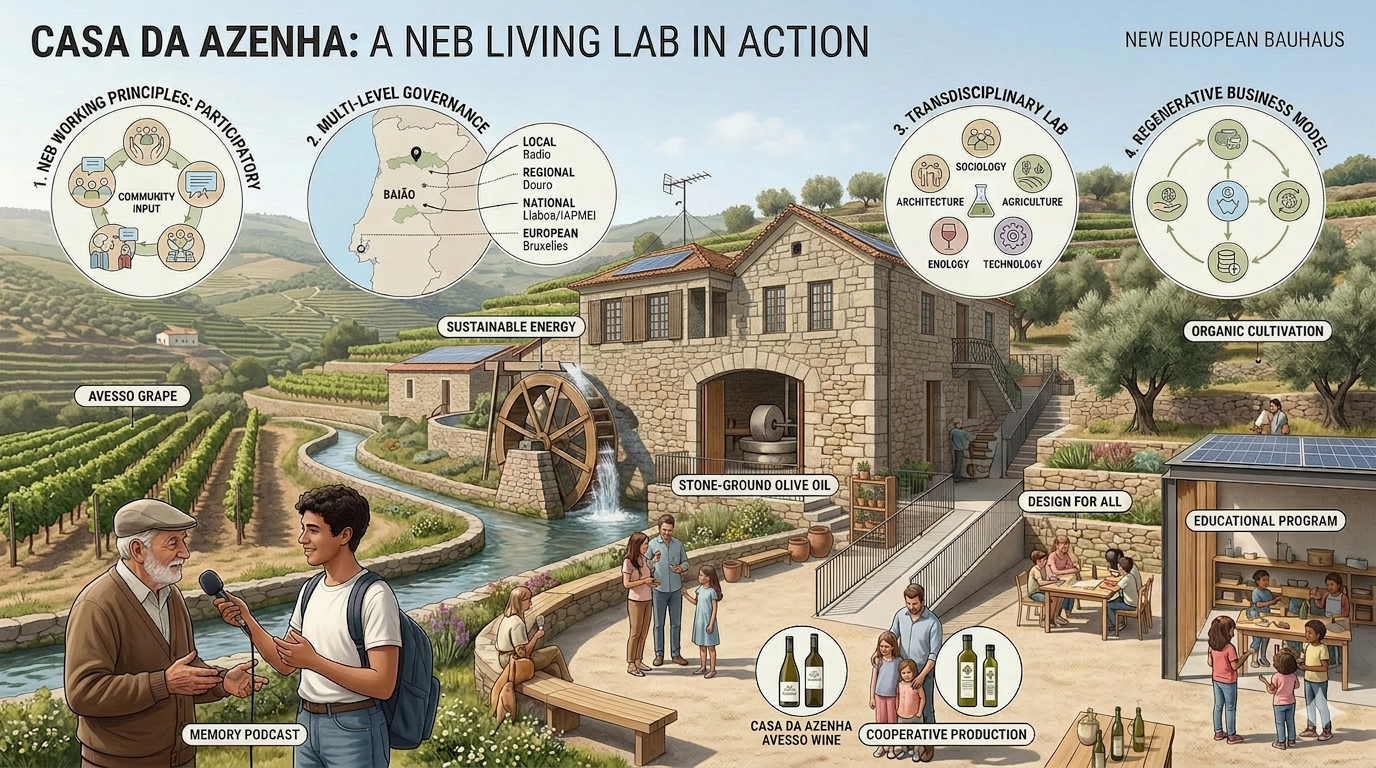
Casa da Azenha operates as a cross-sectoral ecosystem, bridging hyper-local heritage with European strategic goals. Its governance model integrates stakeholders across four levels to ensure legitimacy, sustainability, and scaling potential.
1. Local Level: Community and Micro-producers
Stakeholders: Residents of Santa Cruz do Douro, elderly “knowledge holders,” local farmers.
Added Value: They provide the project’s “intangible architecture.” Their engagement ensures social cohesion and authenticity, transforming the olive mill into a shared, living asset rather than a private venture.
2. Regional Level: Municipality and Cultural Landmarks
Stakeholders: Municipality of Baião, Fundação Eça de Queiroz.
Added Value: Cooperation aligns the project with regional tourism and cultural strategies. It situates Casa da Azenha within a broader narrative of territorial valorization, leveraging literary and cultural heritage to attract conscious visitors and preserve local identity.
3. National Level: Innovation and Economic Frameworks
Stakeholders: IAPMEI (StartUP Voucher Innovate 2025-2026), national tourism boards.
Added Value: This level provides technical and financial validation for a regenerative business model, ensuring the project meets national standards for social innovation while turning a traditional site into a viable economic driver.
4. European Level: NEB Community and EU Networks
Stakeholders: New European Bauhaus network, European rural development programs.
Added Value: Alignment with the European Green Deal and NEB values offers visibility and a framework for replicability, positioning Casa da Azenha as a pilot model for small-scale European rural communities revitalizing heritage through sustainable innovation.
By synchronizing these levels, Casa da Azenha ensures that a 100-year-old local mill contributes directly to the European mission of creating a more beautiful, sustainable, and inclusive future.
1. Local Level: Community and Micro-producers
Stakeholders: Residents of Santa Cruz do Douro, elderly “knowledge holders,” local farmers.
Added Value: They provide the project’s “intangible architecture.” Their engagement ensures social cohesion and authenticity, transforming the olive mill into a shared, living asset rather than a private venture.
2. Regional Level: Municipality and Cultural Landmarks
Stakeholders: Municipality of Baião, Fundação Eça de Queiroz.
Added Value: Cooperation aligns the project with regional tourism and cultural strategies. It situates Casa da Azenha within a broader narrative of territorial valorization, leveraging literary and cultural heritage to attract conscious visitors and preserve local identity.
3. National Level: Innovation and Economic Frameworks
Stakeholders: IAPMEI (StartUP Voucher Innovate 2025-2026), national tourism boards.
Added Value: This level provides technical and financial validation for a regenerative business model, ensuring the project meets national standards for social innovation while turning a traditional site into a viable economic driver.
4. European Level: NEB Community and EU Networks
Stakeholders: New European Bauhaus network, European rural development programs.
Added Value: Alignment with the European Green Deal and NEB values offers visibility and a framework for replicability, positioning Casa da Azenha as a pilot model for small-scale European rural communities revitalizing heritage through sustainable innovation.
By synchronizing these levels, Casa da Azenha ensures that a 100-year-old local mill contributes directly to the European mission of creating a more beautiful, sustainable, and inclusive future.
Casa da Azenha is inherently transdisciplinary, merging diverse knowledge fields to create a holistic, community-centered project where social, environmental, and cultural objectives are interwoven.
Social Sciences & Community Development: My background in Sociology guides our participatory model. Ethnographic mapping ensures intergenerational knowledge transfer and cooperative production, transforming residents from passive observers into active co-authors.
Architecture & Heritage Conservation: The rehabilitation of the centennial watermill preserves historical structures while integrating “Design for All” principles. Structural functionality is blended with aesthetic and cultural authenticity, respecting the Douro’s vernacular engineering.
Agriculture & Environmental Sciences: Sustainable viticulture (Avesso grape) and olive cultivation follow ecological principles. We promote biodiversity and climate-conscious practices, treating the estate as a living laboratory for low-impact, seasonal production.
Enology & Food Sciences: Technical expertise in wine and olive oil production ensures quality and a deep connection to the local terroir, bridging ancestral “saber-fazer” with modern standards.
Arts, Culture & Humanities: The literary heritage of Eça de Queirós and Camilo Castelo Branco shapes immersive storytelling. Narratives are translated into cultural programming connecting visitors to the region’s poetic and historical identity.
Digital Technologies & Tourism Design: Tools like Augmented Reality enhance engagement without compromising authenticity. Integrated into enotourism experiences, they create meaningful, memorable visitor interactions.
Added Value: By merging these disciplines, Casa da Azenha creates a cross-sectoral ecosystem. This transdisciplinary approach ensures the project is more than a restoration of walls—it is a replicable model for sustainable rural development, innovative yet deeply rooted in place.
Social Sciences & Community Development: My background in Sociology guides our participatory model. Ethnographic mapping ensures intergenerational knowledge transfer and cooperative production, transforming residents from passive observers into active co-authors.
Architecture & Heritage Conservation: The rehabilitation of the centennial watermill preserves historical structures while integrating “Design for All” principles. Structural functionality is blended with aesthetic and cultural authenticity, respecting the Douro’s vernacular engineering.
Agriculture & Environmental Sciences: Sustainable viticulture (Avesso grape) and olive cultivation follow ecological principles. We promote biodiversity and climate-conscious practices, treating the estate as a living laboratory for low-impact, seasonal production.
Enology & Food Sciences: Technical expertise in wine and olive oil production ensures quality and a deep connection to the local terroir, bridging ancestral “saber-fazer” with modern standards.
Arts, Culture & Humanities: The literary heritage of Eça de Queirós and Camilo Castelo Branco shapes immersive storytelling. Narratives are translated into cultural programming connecting visitors to the region’s poetic and historical identity.
Digital Technologies & Tourism Design: Tools like Augmented Reality enhance engagement without compromising authenticity. Integrated into enotourism experiences, they create meaningful, memorable visitor interactions.
Added Value: By merging these disciplines, Casa da Azenha creates a cross-sectoral ecosystem. This transdisciplinary approach ensures the project is more than a restoration of walls—it is a replicable model for sustainable rural development, innovative yet deeply rooted in place.
Casa da Azenha operates as a self-sustaining, community-centered ecosystem where economic viability and societal value reinforce each other. Our business model is designed to move away from extractive tourism toward a regenerative cycle: tourism finances culture, culture strengthens community engagement, and community participation ensures authenticity.
Diversified Revenue Streams:
Experiential Enotourism: High-value, low-impact guided visits, tastings, and immersive cultural experiences (literary and historical) that connect visitors to the Douro’s heritage.
Agricultural Production: Cooperative production and direct-to-consumer sales of artisanal, stone-ground olive oil and Avesso wine. This ensures fair pricing for local micro-producers while capturing the "story-driven" premium market.
Cultural & Educational Workshops: Monetized programs for schools, researchers, and visitors focused on traditional milling, sustainable agriculture, and oral storytelling.
Strategic Partnerships: Collaborations with regional festivals to generate seasonal revenue and visibility.
Financial Instruments & Funding Strategy:
Public Grants & Seed Capital: Integration with the StartUP Voucher (IAPMEI) for initial validation.
Capital Investment (Rehabilitation): We are targeting the NEB Prize and national/European public grants (Portugal 2030, Rural Development/GAL, and Tourism lines) to finance the physical restoration of the mill. This ensures a solid strategic foundation before major construction.
Reinvestment Model: A circular financial structure where a percentage of profits is reinvested into building maintenance, community programming, and digital heritage integration.
Sustainability & Scalability: By reducing dependence on a single income source, Casa da Azenha ensures long-term resilience. This hybrid model demonstrates how small-scale heritage can thrive as a viable economic driver while fulfilling a vital social and environmental mission in low-density territories.
Diversified Revenue Streams:
Experiential Enotourism: High-value, low-impact guided visits, tastings, and immersive cultural experiences (literary and historical) that connect visitors to the Douro’s heritage.
Agricultural Production: Cooperative production and direct-to-consumer sales of artisanal, stone-ground olive oil and Avesso wine. This ensures fair pricing for local micro-producers while capturing the "story-driven" premium market.
Cultural & Educational Workshops: Monetized programs for schools, researchers, and visitors focused on traditional milling, sustainable agriculture, and oral storytelling.
Strategic Partnerships: Collaborations with regional festivals to generate seasonal revenue and visibility.
Financial Instruments & Funding Strategy:
Public Grants & Seed Capital: Integration with the StartUP Voucher (IAPMEI) for initial validation.
Capital Investment (Rehabilitation): We are targeting the NEB Prize and national/European public grants (Portugal 2030, Rural Development/GAL, and Tourism lines) to finance the physical restoration of the mill. This ensures a solid strategic foundation before major construction.
Reinvestment Model: A circular financial structure where a percentage of profits is reinvested into building maintenance, community programming, and digital heritage integration.
Sustainability & Scalability: By reducing dependence on a single income source, Casa da Azenha ensures long-term resilience. This hybrid model demonstrates how small-scale heritage can thrive as a viable economic driver while fulfilling a vital social and environmental mission in low-density territories.
Casa da Azenha is a modular blueprint for rural regeneration. While rooted in Santa Cruz do Douro, its core elements can be replicated in other European territories facing depopulation, heritage loss, and social isolation.
1. Methodological Replicability – “Sociology of Place”: Our bottom-up ethnographic mapping identifies “intangible architecture”—oral histories, traditional know-how, and community narratives. This tool can transform abandoned or decaying structures into living community assets anywhere, turning heritage into social and economic opportunity.
2. The “Living Lab” Model: By integrating traditional industry (milling), sustainable agriculture, and experiential tourism, we create a resilient, diversified economic model. This hybrid hub can be applied to other heritage sites—old granaries, forges, or tanneries—showing that preserving heritage can generate income and strengthen local identity.
3. Technological and Cultural Transfer: Subtle digital storytelling, including Augmented Reality (AR) to capture and share oral histories, is fully scalable. It allows heritage preservation without altering physical authenticity, offering adaptable solutions for schools, museums, cultural organizations, and tourism boards across Europe.
4. Intergenerational Governance: Our cooperative model engages elders as “knowledge holders” and diaspora members as active stakeholders. This participatory approach fosters inclusion, restores territorial dignity, and provides a replicable framework for community-led rural development in diverse contexts.
Key Learning: Casa da Azenha shows that authenticity is a competitive advantage. Small-scale, community-driven interventions can be both financially sustainable and culturally regenerative. The project offers a replicable path toward the New European Bauhaus vision, combining beauty, social cohesion, and heritage preservation to revitalize Europe’s rural heart.
1. Methodological Replicability – “Sociology of Place”: Our bottom-up ethnographic mapping identifies “intangible architecture”—oral histories, traditional know-how, and community narratives. This tool can transform abandoned or decaying structures into living community assets anywhere, turning heritage into social and economic opportunity.
2. The “Living Lab” Model: By integrating traditional industry (milling), sustainable agriculture, and experiential tourism, we create a resilient, diversified economic model. This hybrid hub can be applied to other heritage sites—old granaries, forges, or tanneries—showing that preserving heritage can generate income and strengthen local identity.
3. Technological and Cultural Transfer: Subtle digital storytelling, including Augmented Reality (AR) to capture and share oral histories, is fully scalable. It allows heritage preservation without altering physical authenticity, offering adaptable solutions for schools, museums, cultural organizations, and tourism boards across Europe.
4. Intergenerational Governance: Our cooperative model engages elders as “knowledge holders” and diaspora members as active stakeholders. This participatory approach fosters inclusion, restores territorial dignity, and provides a replicable framework for community-led rural development in diverse contexts.
Key Learning: Casa da Azenha shows that authenticity is a competitive advantage. Small-scale, community-driven interventions can be both financially sustainable and culturally regenerative. The project offers a replicable path toward the New European Bauhaus vision, combining beauty, social cohesion, and heritage preservation to revitalize Europe’s rural heart.
Months 1-3: Strategic Team Building via European Networks Our priority is to build a transdisciplinary team using European Exchange Programs (such as the European Solidarity Corps and Erasmus+). We will host two international collaborators with backgrounds in Cultural Management and Sustainable Tourism. This strategy fosters a unique cross-border knowledge exchange: while the collaborators bring fresh global perspectives and digital skills, they will learn traditional "saber-fazer" from our local community. This phase also includes launching our digital presence and social media strategy.
Months 4-6: MVP Launch and the "Memory Podcast" We will launch our MVP, featuring pilot "Living Museum" visits. A key promotional milestone is the launch of our "Podcast of Memories." Involving our international exchange collaborators and local elders, we will record the oral histories of the mill. This creates a digital archive of intangible heritage, boosting visibility and fostering intergenerational and international inclusion.
Months 7-9: Institutional Partnerships and Cooperative Networks - We will formalize partnerships with the Fundação Eça de Queiroz and ARCSCD. Simultaneously, we will establish the first cooperative agreements with local micro-producers for stone-ground olive oil, testing our shared-revenue model and reinforcing the local economy with the support of our European exchange team.
Months 10-12: Scaling and Funding for Physical Rehabilitation Using the visibility and data gathered during the first year, we will apply for national and EU grants (Portugal 2030 / Rural Development) to finance the full physical restoration of the mill. This marks the transition from a validated pilot to a permanent landmark for rural regeneration, proving that local roots and European collaboration are the keys to a sustainable future.
Months 4-6: MVP Launch and the "Memory Podcast" We will launch our MVP, featuring pilot "Living Museum" visits. A key promotional milestone is the launch of our "Podcast of Memories." Involving our international exchange collaborators and local elders, we will record the oral histories of the mill. This creates a digital archive of intangible heritage, boosting visibility and fostering intergenerational and international inclusion.
Months 7-9: Institutional Partnerships and Cooperative Networks - We will formalize partnerships with the Fundação Eça de Queiroz and ARCSCD. Simultaneously, we will establish the first cooperative agreements with local micro-producers for stone-ground olive oil, testing our shared-revenue model and reinforcing the local economy with the support of our European exchange team.
Months 10-12: Scaling and Funding for Physical Rehabilitation Using the visibility and data gathered during the first year, we will apply for national and EU grants (Portugal 2030 / Rural Development) to finance the full physical restoration of the mill. This marks the transition from a validated pilot to a permanent landmark for rural regeneration, proving that local roots and European collaboration are the keys to a sustainable future.