Arts, Culture, and Heritage as Drivers of Change
K67: Re:Activate
K67 : The Smallest Unit of Public Life / Reclaiming the Everyday
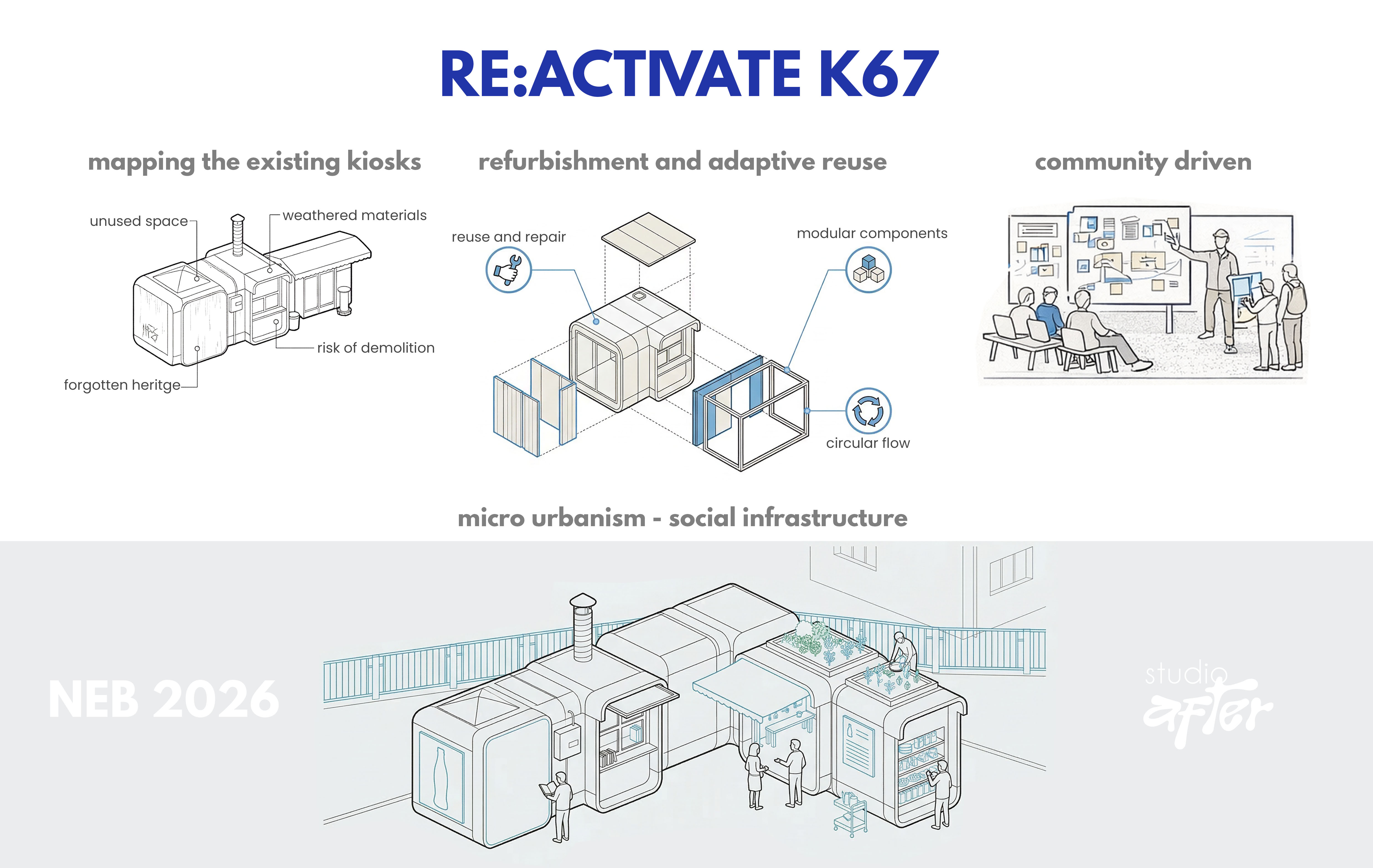
K67 Re:Activate brings back to life the iconic K67 kiosk by restoring and reactivating it as a new form of social infrastructure through a socially-inclusive and culturally-aware framework. Once embedded in everyday urban life, these small structures are reimagined through circular reuse as the smallest unit of public life. The project tackles contemporary urban challenges by transforming abandoned kiosks into spaces for local exchange, culture, and community.
Serbia
Local
Right now the project is being developed in Novi Sad region, with talks under way for implementation in other cities in the region such as Belgrade and Zrenjanin, with aim to become transnational, having raised interest within potential partners in Sarajevo, Ljubljana and Zagreb.
Mainly urban
It involves a physical transformation of the built environment (hard investment)
Prototype level
No
No
No
Organisation
K67 Re:Activate is a design-research project focused on documenting, collecting and restoring K67 kiosks as a network of small-scale social infrastructure through circular reuse. The K-67 Kiosk, designed by Saša Mächtig in 1966, is a design icon recognized by renowned institutions (such as MoMA) for its material and immaterial values. These micro structures once stood on streets of former Yugoslavia, serving as food stalls, newspaper stands, and even police posts. Most of them today are either abandoned or left at junk yards, reflecting the loss of human-centered infrastructure. As modern societies grow, a need for communal infrastructure is growing by day, and we believe that the answer to new urban challenges can be found in the solutions of the past.
The project tackles these challenges by transforming existing kiosks into contemporary micro civic spaces, enabling local exchange, cultural activity, and community interaction. With structures themselves being versatile and universal, the possibilities of their use are almost infinite. Instead of new construction, the concept extends the lifecycle of existing structures through low-impact restoration, significantly reducing material use and environmental footprint.
There are three main stages to the project: mapping existing kiosks, developing a sustainable restoration methodology, and implementing a pilot reactivation through community-defined programs. Expected results for the year 2026 include at least one restored kiosk, activation of local users in Novi Sad and developing community initiatives. Another product of the project is development of an open-access restoration toolkit, giving anyone the possibility to apply the same ideas and methodologies.
Another focal point of the project is the making of a short documentary film, which would serve to raise awareness of the projects potential. The concept demonstrates how minimal interventions can generate significant environmental, social, and cultural impact.
The story of the K67 starts long before this projects. We grew up with kiosks as part of everyday life. They were small but constant elements of the city — places where daily routines occured, where you would stop briefly. Over time, many of these structures remained present, but lost their role in the life of the city. Today, these integral parts of urban and collective identity, are no more to be seen. Besides the cultural impact that the erasure of the kiosks had in our societies, it left a hole in the urban infrastructure of everyday needs, being sometimes replaced by new but low quality and commercially driven structures.
Through our work in architecture and research at Studio After, we developed a research and film project, which included revisiting kiosks across different cities. Through field visits, mapping, and visual documentation, as well as conversations with local residents, small business owners, and community leaders, we recognized a recurring pattern: a lack of socially aware urban infrastructure.
These insights revealed a gap between heritage preservation and everyday urban reality. While large architectural landmarks are often protected, small infrastructures that once supported daily social interaction are being abandoned. At the same time, communities expressed a clear need for accessible, affordable, and visible spaces within their neighbourhoods, which would speak to their everyday needs.
The concept was developed as a response to this gap. It reframes the K67 kiosk as an active and reusable micro-urban space. Rather than a central point, the concept proposes a socio-cultural network of spaces oriented towards local communities. We developed these ideas through field research, spatial analysis, visual storytelling, and community engagement. The concept is intended to be implemented through a pilot restoration, which will test the methodology in practice.
social infrastructure
adaptive reuse
micro urbanism
community co-design
circular economy
In terms of sustainability, the concept addresses the issues of everyday life in cities from an environmental and socio-cultural standpoint. The process of kiosk reactivation itself is based on a circular methodology, by collecting existing abandoned structures and restoring them in a sustainable manner.This is achieved by prioritising low-impact interventions, durable materials and saving parts the parts of structures which are in good condition. The future programme of structures is community driven, answering real needs of modern societies. The K67 sytem, originally designed as a modular network, allows for targeted solutions, removing the need for full reconstructions or new developments, thus reducing the needs for potential new construction in cities. In this way the project reduces waste and pollution and cuts carbon emissions significatly.
By adapting the concepts of adaptive reuse the project is aimed at extending the lifespan of existing structures, thus promoting a shift towards a regenerative and circular approach to solving everyday problems in urban environments.
Beyond environmental aspects, the project speaks to cultural sustainability by preserving and reactivating an important element of shared urban identity. K67 kiosks are part of the collective memory of cities across the region. Rather than treating heritage as static, the project keeps it alive through use, allowing cultural value to evolve and remain relevant. The project has received major positive feedback from the local communities in Novi Sad, Belgrade and Sarajevo.
The concept also addresses economic challenges and opportunities by enabling low-cost spatial infrastructure for local initiatives and businesses. Restored kiosks can support small businesses, informal economies, and community-led programs, reducing barriers to entry and creating new opportunities for local entrepreneurship.
The projects contributes to the betterment of everyday life in urban environments, by introducing human-scale spaces, which are community driven and invite interaction. The kiosk form and its iconic red color are well known elements of urban identity, especially among older generations. By reinventing them in contemporary terms, with new use-cases and possibilities for a more inclusive visual identity (community led repaintings, mural developments, workshops etc.) the kiosk network would appeal to younger generations aswell. The project could bring back the sense of belonging to urban environments, thus making them more human friendly and enhancing the everyday life of societies.
Aesthetic values of the project are approached through care rather than transformation. Being already a globally recognized designed icon (presented in 2018 as part of a MoMA exhibition), the original design language, proportions, and material character of the kiosk are maintained and reintroduced to new urban contexts. In a way, this creates a dialogue between the present and the past, teaching us how to look at heritage as an integral part of everyday life.
In the long term, the project proposes a shift towards a more humane look at the idea of beauty in our cities. Instead of large, megalithic architectural gestures it promotes qualities which can emerge from small, carefully crafted interventions, which are embedded in everyday life. In this way the project sets an example in how design can become a tool for fostering care, identity and sense of belonging in urban contexts.
K67:ReActivate directly promotes social inclusion by creating a network of accessible, small-scale structures, embedded directly within local communities and their needs, removing the economic and spatial barriers needed for participation in public life of cities. The projects is driven by real-life needs and problems of local stakeholders, having been envisioned originally as a solution to problems people have at the micro-local level, such as the lack of open inclusive spaces or locally owned businesses. Unlike large, centralised institutions, K67 kiosks operate at a human scale and are distributed across the city, serving rather as a distributed network than a centralized institution.
Affordability is addressed through the reuse of existing structures, which significantly lowers the cost of space compared to new construction. This enables access for small entrepreneurs, local initiatives, and community groups who are often excluded from conventional commercial or cultural spaces. Reactivated kiosks provide low-threshold opportunities for engagement, supporting diverse forms of use, from local services to cultural and social activities.
The project promotes inclusive governance through participatory reprogramming, where local communities are directly involved in defining the future use of each kiosk. This ensures that spaces respond to real needs and reflect the diversity of users, rather than imposing predefined functions. In this way, decision-making is shared and grounded in local context.
Participation has been a crucial part of the concept from its earliest stages. The idea itself did not emerge from design and architecture speculation, but from conversations with people from local communities in Novi Sad and Belgrade. These included young entrepreneurs, local leader and older people. During the development of our research project on K67 kiosks, we engaged with local residents through informal interviews, site visits, and ongoing dialogues. In this way we gained important insight into both the past and present role of these structures in peoples everyday life. Many of the people we spoke with expressed a clear need for accessible, affordable, and visible spaces within their neighbourhoods. Besides this, especially withing members of older generations, there was a clear nostalgic stance towards the once integral parts of urban environments of the region, which were the K67 kiosks. These conversations directly shaped the direction of the project, shifting the focus from preservation alone to reactivation and community regeneration.
This input influenced key decisions in the concept, including the emphasis on circular reuse, low-cost interventions, and flexible programming. It also highlighted the importance of keeping the kiosks embedded in everyday life of local communities, rather than transforming them into isolated or purely symbolic objects.
In the long term, participation will continue through structured workshops and local collaborations, where users and stakeholders will co-define the future use of each kiosk, giving people opportunities to either develop their own needs and ideas or choose from ones agreed upon through previously held collaborative talks and sessions. The impact of this participatory approach is reflected in a concept that is grounded in real needs, locally relevant, and more likely to achieve long-term use and care.
At its start the concept was introduced to local residents, which are integral to its development. As the project began to grow and the ideas evolved, more people became interested in participating. To date, at the local level, people engaged include not only residents but also student organisations, micro businesses, cultural initiatives, and independent creatives. The engagement of the people ensures the project remains grounded in real-life needs and that all the planned activities reflect the local socio-cultural context.
At the broader level the project aims at collaborating with city authorities and institutions. Their involvement is crucial to obtaining permits, identifying long-term potential and integrating the kiosks into urban development. As the project originated in Novi Sad, the mentioned initiatives and ideas will be developed there in terms of a pilot project, and later on used in other urban contexts (so far the project is planned to be developed in Belgrade, Zrenjanin, Sarajevo, Split and Ljubljana). The municipal level ensures that the project isn’t just an experimental intervention, but a recognized part of the urban system.
Looking at the regional level it is planned to connect with cultural organisations, as well as academic institutions, contributing to discussions on heritage, adaptive reuse, and sustainable urban development. These actors support knowledge exchange and research validation. Initial communication has begun with universities in Novi Sad, Belgrade and Sarajevo, the MAO museum in Ljubljana and multiple architectural practices across the region. At the broader European level, the concept aligns with values such as circular economy and cultural sustainability. Although originally produced in Yugoslavia, research shows that many kiosks exist across different european countries, including Germany, Austria and Poland, thus creating space for sustainable implementation of the project outside of the Balkan region.
The concept is transdisciplinary in its nature, relying heavily on knowledge and methods from architecture, urban design, material sciences, heritage and social studies and visual arts. Architectural and engineering expertise is needed in developing restoration methodologies and ensuring the structural and material integrity of the kiosks, while ensuring the whole process remains sustainable. Other spatial practices, such as urban design and planning, are crucial their positioning within the city and their role as distributed micro-infrastructure.
Social sciences play a key role in understanding everyday use, community needs, and patterns of interaction, directly informing the reprogramming of the kiosks. Cultural studies and heritage research contribute to interpreting the historical and symbolic value of the K67 system, ensuring that restoration goes beyond technical repair and addresses its broader meaning.
Artistic and visual practices, including film and visual storytelling, are used as tools for research, communication, and public engagement, making the project accessible to both professional audiences and the wider public. Educational aspects are also present through the development of an open-access toolkit and the potential for workshops and knowledge-sharing activities.
Importantly, the project integrates not only expert knowledge but also the experiential knowledge of local communities, small business owners, and everyday users. This combination of professional and non-academic perspectives ensures that the concept is both technically grounded and socially relevant.
By bridging these different fields, the project creates a holistic approach to urban transformation, where design, research, culture, and community are interconnected.
The projects and its implementation are based on a hybrid model which combines, in a broader sense, public funding, local partnerships and self-sustaining activities. At the current phase the concept is being developed fully through the authors (ours) private funding, with plans to develop the pilot project through cultural funding programs and possible local sponsorships. These sources enable the development and testing of the concept without placing financial pressure on end users.
The plan after the pilot project, once the initial kiosks restored and activated and the concept is proven to be sustainable, is to develop the model which operates through low-cost, flexible principles including affordable rental agreements for micro businesses, local services, and community initiatives, as well as program-based use for cultural and social activities, which could be funded by the local governments and institutions. This generates a continuous but accessible revenue stream, ensuring that the spaces remain financially viable while maintaining their inclusive character. One important aspect of the business model is learning on the way, since such a concept hasn’t yet been implemented in the region. This would require extensive documentation and planning.
In the long term, the model is designed to be low-cost, adaptable, and resilient, relying on a combination of local economic activity, public support, and knowledge transfer. By activating existing structures rather than investing in new construction, this concept significantly reduces initial investment costs, making it financially sustainable and easier to implement in different urban contexts.
The concept is highly scalable due to its focus on methodology and universality rather than a site-specific solution. The core elements that can be replicated include the mapping process of existing kiosks, the restoration methodology based on circular reuse, and the participatory reprogramming approach used to define new functions.
The K67 system itself, as a modular and standardised structure, allows for relatively straightforward adaptation across different locations. However, the project is not limited to this specific typology. Its approach can be transferred to other forms of small-scale, underused urban infrastructure, according to different cities and contexts.
Key transferable outputs include an open-access and ongoing restoration toolkit, which documents technical guidelines, processes, and lessons learned, as well as a framework for community engagement and activation. These tools enable municipalities, organisations, and local actors to implement similar interventions independently. The concept is adaptable to different groups of beneficiaries, including local communities, small businesses, cultural organisations, and public institutions. Its flexibility allows it to respond to a wide range of local needs, from economic activation to social and cultural use.
By combining a clear methodology with adaptable application, the project demonstrates strong potential for replication across different geographies, contributing to a broader shift toward circular, inclusive, and small-scale urban development models.
In the year following the application, the project will focus on transitioning from research to implementation through a clearly defined sequence of actions.
The first phase involves mapping and documentation of existing K67 kiosks in selected cities, including condition assessment, ownership mapping, and identification of feasible pilot locations. This phase builds on existing research and will result in a structured database of potential intervention sites.
The second phase focuses on the development and testing of a restoration methodology and model. This includes technical detailing, material assessment, and preparation for on-site intervention. During this stage, partnerships with local stakeholders, including municipalities and community actors, will be formalised to support implementation.
The third phase is the pilot restoration and activation of at least one kiosk. This step will test the concept in practice, combining physical restoration with a community-defined program. The pilot will generate measurable outputs such as number of users, local partnerships, and activities hosted within the space.
In parallel, the project will be actively promoted through digital platforms, public presentations, and collaborations with cultural and professional networks. This includes documenting the process through visual media and sharing results with a wider audience, with focus on the development of a short film.
The final step is the development and publication of an open-access restoration toolkit, which will consolidate the methodology, technical guidelines, and lessons learned. This will enable replication and support further implementation in other contexts.
Through this structured approach, the project demonstrates a clear and realistic commitment to moving from concept to implementation, while ensuring long-term impact and scalability.