Enhancing Circularity, Sustainability, and Innovation
ReUseChain.ba
ReUseChain.ba - B&H’s First B2B Reuse Platform for Multiple Waste Streams
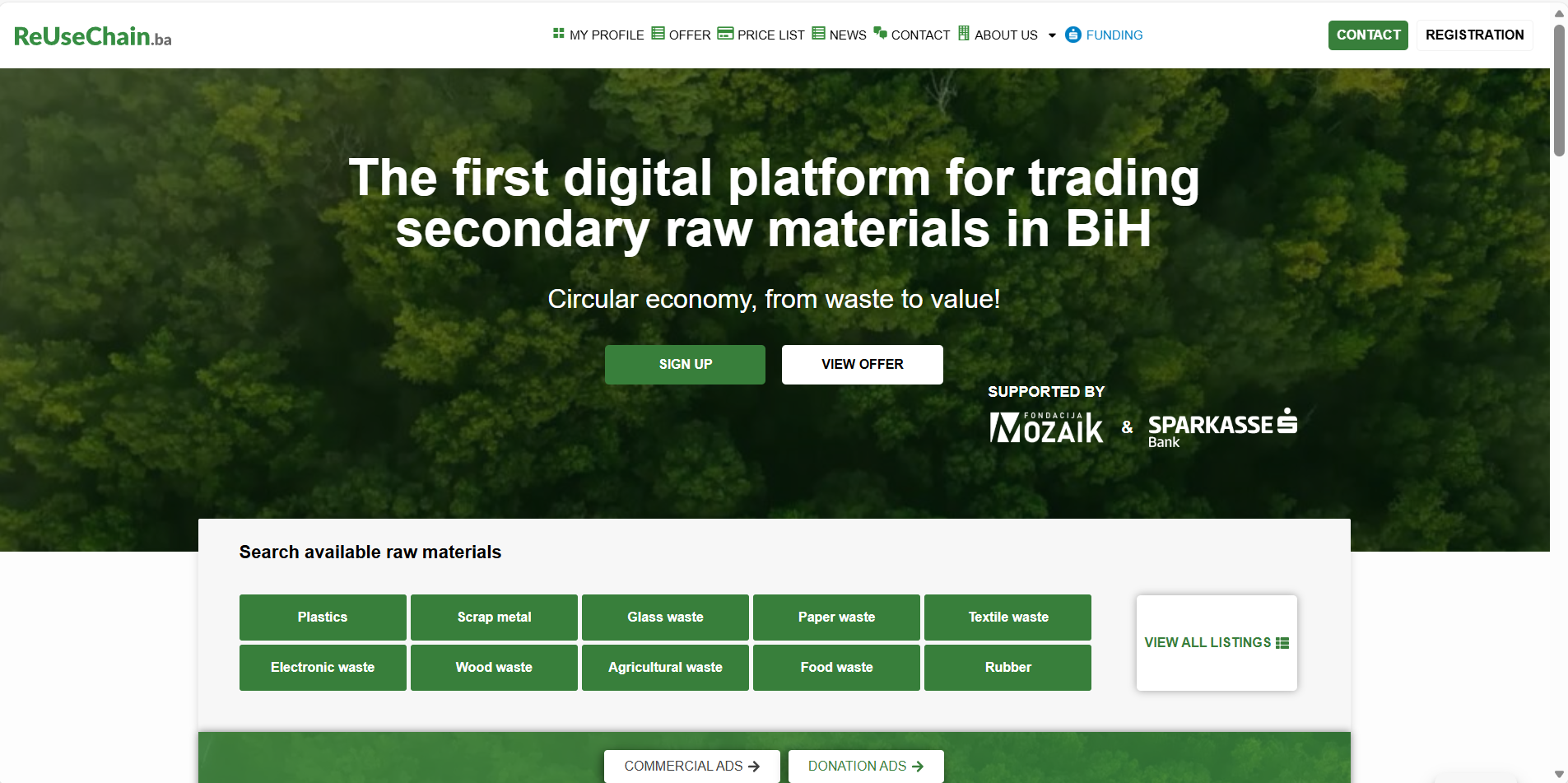
ReUseChain.ba is the first digital platform in Bosnia and Herzegovina dedicated to the exchange of secondary raw materials, connecting companies that generate industrial by-products with those that can reuse them. By turning waste into resources, the platform reduces environmental impact, supports circular business models, and creates new economic value through smarter material use.
Bosnia and Herzegovina
National
It addresses urban-rural linkages
It involves other types of transformations (soft investment)
Yes
2025-06-25
No
No
No
Organisation
ReUseChain.ba is the first digital B2B platform in Bosnia and Herzegovina dedicated to the exchange of secondary raw materials and industrial surplus streams. It addresses a critical systemic challenge: low recycling rates, lack of structured material reuse systems, and limited access to circular economy practices for businesses.
The platform connects companies that generate surplus materials with those that can reuse them, transforming waste into valuable resources and enabling more efficient material flows. By introducing a digital, market-based approach, ReUseChain.ba supports the transition from a linear to a circular economy model.
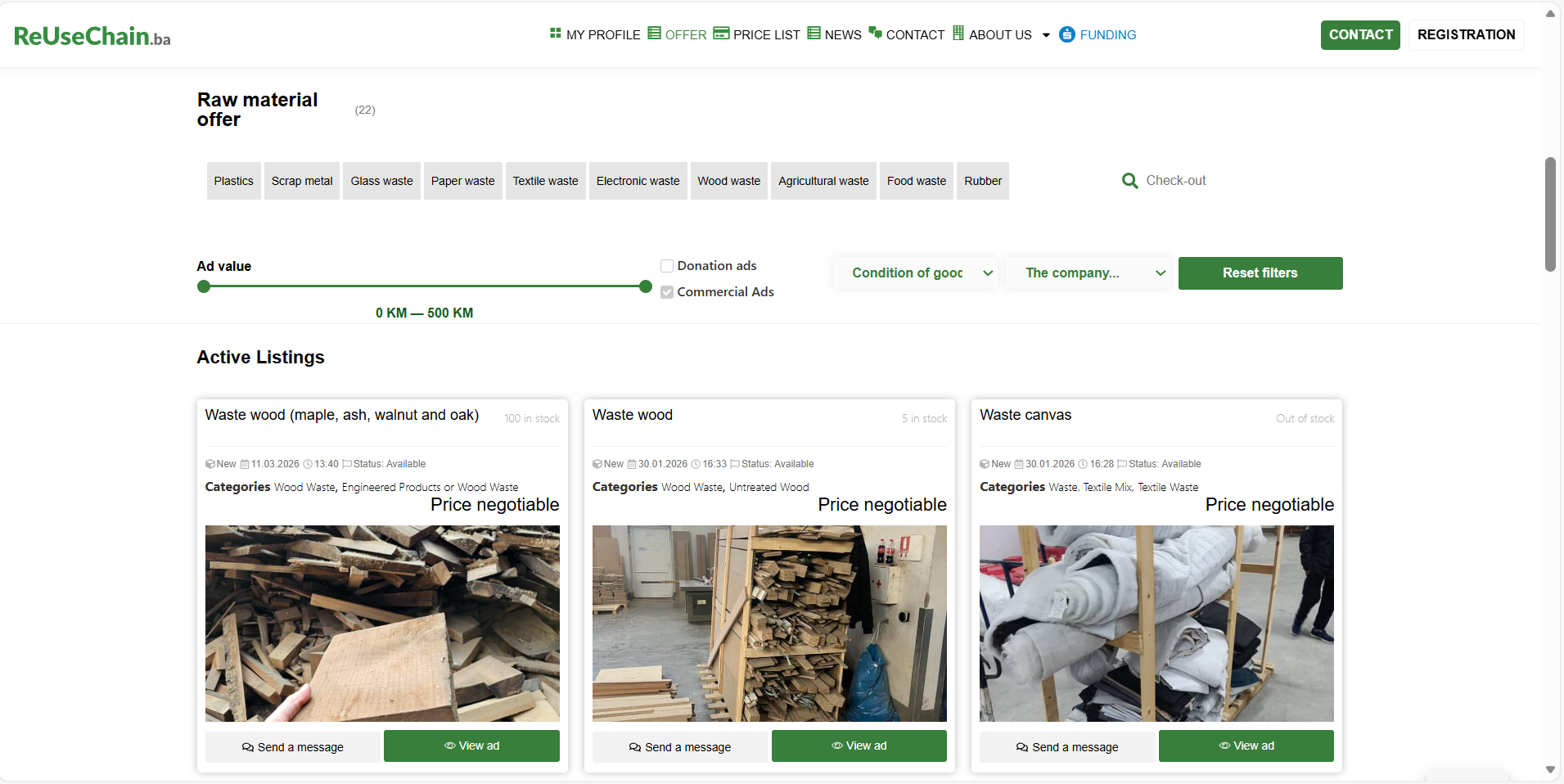
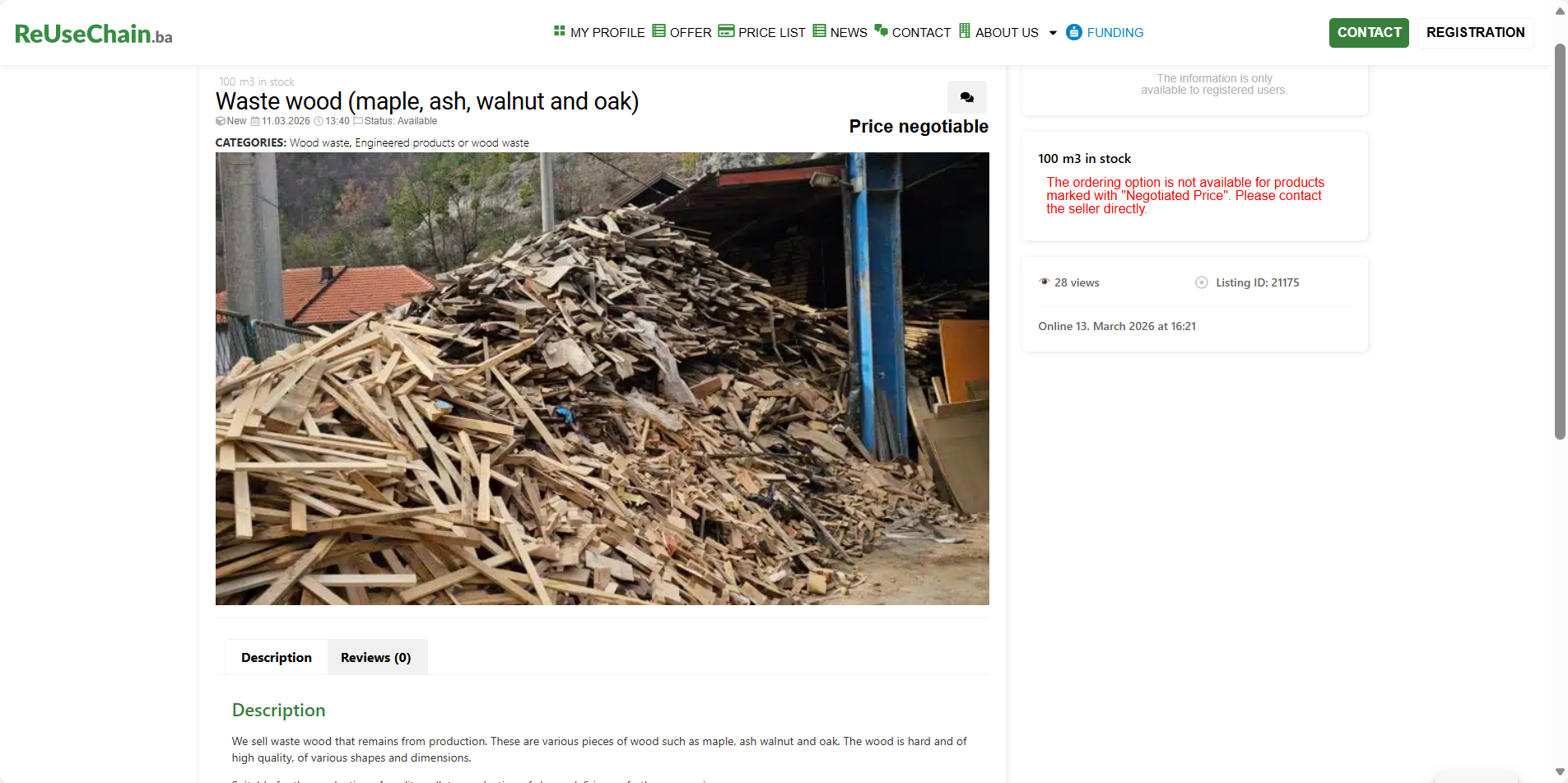
Since its launch in June 2025, the platform has attracted over 120 registered companies across Bosnia and Herzegovina and enabled more than 20 material listings, with the first successful transaction completed. These early results confirm both the functionality of the platform and the relevance of the solution for the market.
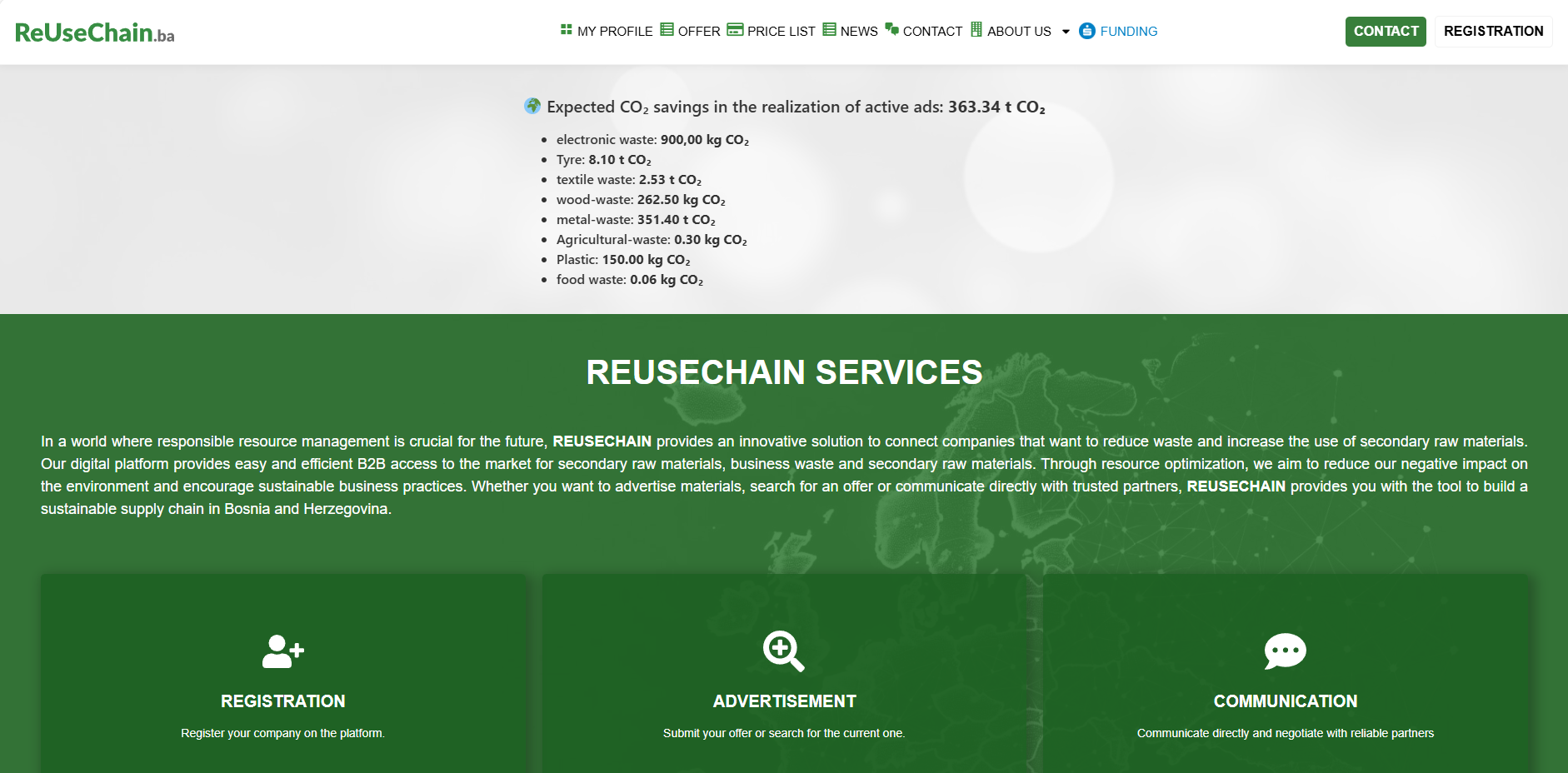
Beyond direct transactions, ReUseChain.ba contributes to raising awareness among companies about the value of material reuse, promoting a shift from waste as a cost to waste as a resource. The platform also provides tools for tracking CO₂ savings and supports companies in understanding and improving their environmental performance.
As the first solution of its kind operating at the national level, ReUseChain.ba establishes the foundation for a more efficient and connected system of material exchange. In the long term, the project aims to expand to the Western Balkans, strengthening cross-border circular value chains and contributing to a more sustainable and resilient regional economy.
ReUseChain.ba emerged from a clear gap observed in Bosnia and Herzegovina: companies were generating significant amounts of material surplus, while at the same time other businesses were purchasing new raw materials, with no structured system to connect the two. Materials that could be reused were often treated as waste and disposed of, creating both environmental and economic losses.
Through its work with businesses and communities, Mozaik Foundation identified this disconnect as a key barrier to circular economy development. Companies lacked both the tools and the knowledge to recognise and utilise secondary raw materials.
In response, the idea of ReUseChain.ba was developed as a practical, scalable solution that would bridge this gap through a digital platform. The goal was not only to create a marketplace, but to introduce a new way of thinking about materials—as resources rather than waste.
The platform was designed and developed as a user-friendly, self-service system, allowing companies to easily register, publish listings, and connect directly with potential partners. Special attention was given to structuring material categories and ensuring transparency to make the process efficient and accessible.
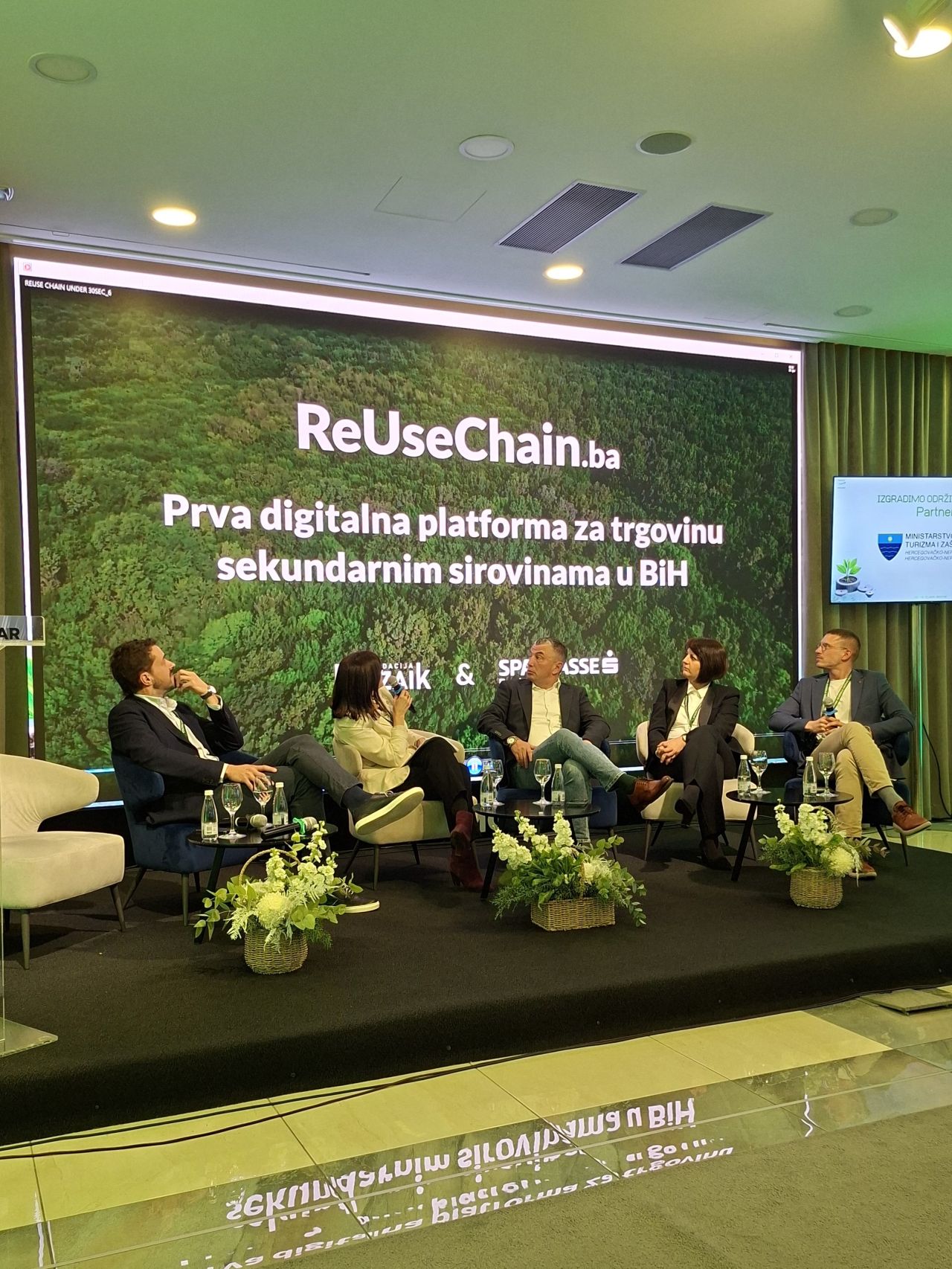
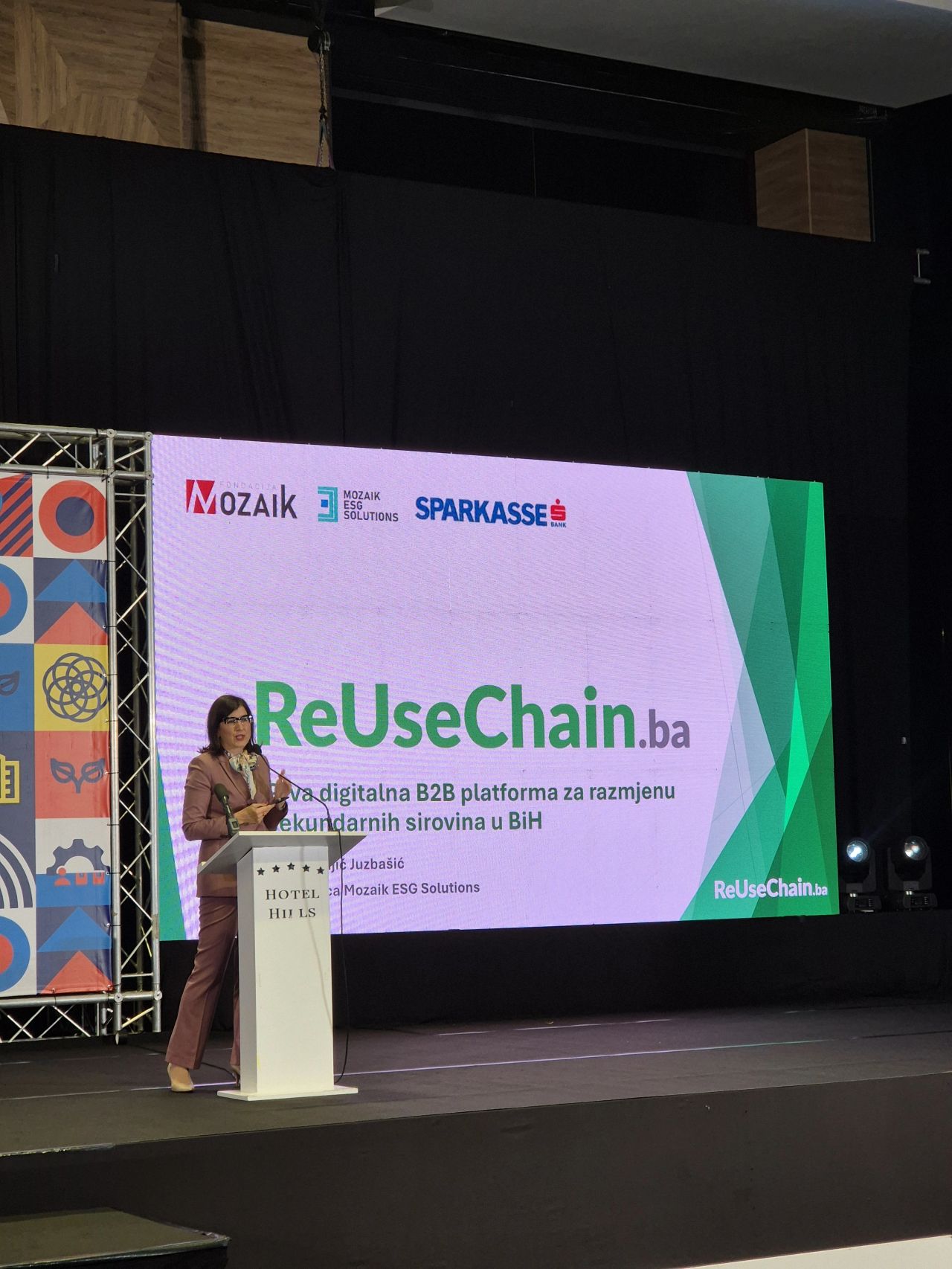
Implementation on the ground has been supported through collaboration with Sparkasse Bank dd BiH, a partner operating across the country with a strong focus on ESG. Through this partnership, the platform was introduced to a wide network of companies, enabling initial user engagement and adoption.
Since its launch, ReUseChain.ba has begun to demonstrate its practical value, enabling real exchanges between companies and gradually building a community of users who are adopting more sustainable practices. The project continues to grow as both a digital solution and a catalyst for change in how materials are managed and valued.
Circular economy
Secondary raw materials
Industrial symbiosis
Digital platform
Resource efficiency
ReUseChain.ba addresses multiple environmental, economic, and social challenges by introducing a practical system for the reuse of materials that would otherwise be treated as waste. In Bosnia and Herzegovina, where recycling rates remain low and material flows are largely unstructured, valuable industrial surplus is often disposed of instead of being reused.
The platform tackles this challenge by enabling companies to exchange secondary raw materials through a digital marketplace, reducing the need for virgin resource extraction and decreasing the volume of waste sent to landfills. This contributes directly to lowering environmental impact and supporting more efficient use of resources.
At the same time, ReUseChain.ba creates economic value by helping companies reduce disposal costs, access more affordable materials, and generate additional revenue from surplus resources. This strengthens business resilience and supports the transition towards more sustainable and circular business models.
The project also addresses social and knowledge-related challenges by raising awareness about circular economy principles and promoting a shift in perception—from waste as a burden to waste as a resource. Through its platform and communication activities, it supports companies in adopting more responsible practices and understanding their environmental impact.
ReUseChain.ba is exemplary in demonstrating how a digital, market-based solution can enable circular economy practices in a context where infrastructure and systems are still underdeveloped. By combining transaction facilitation, data-driven impact tracking, and knowledge-sharing, the project creates a scalable and replicable model that contributes to long-term environmental sustainability and systemic change.
ReUseChain.ba contributes to aesthetics by transforming how materials are perceived and experienced in everyday business practices. Instead of being seen as waste, materials are presented as valuable resources with continued use and potential. This shift in perception contributes to a more thoughtful, responsible, and meaningful relationship with resources.
The platform enhances the quality of experience through a clear, intuitive, and user-friendly digital design that simplifies the process of finding, offering, and reusing materials. By organising complex material flows into a structured and accessible system, it makes circular practices easier to understand and adopt, improving the everyday experience of its users.
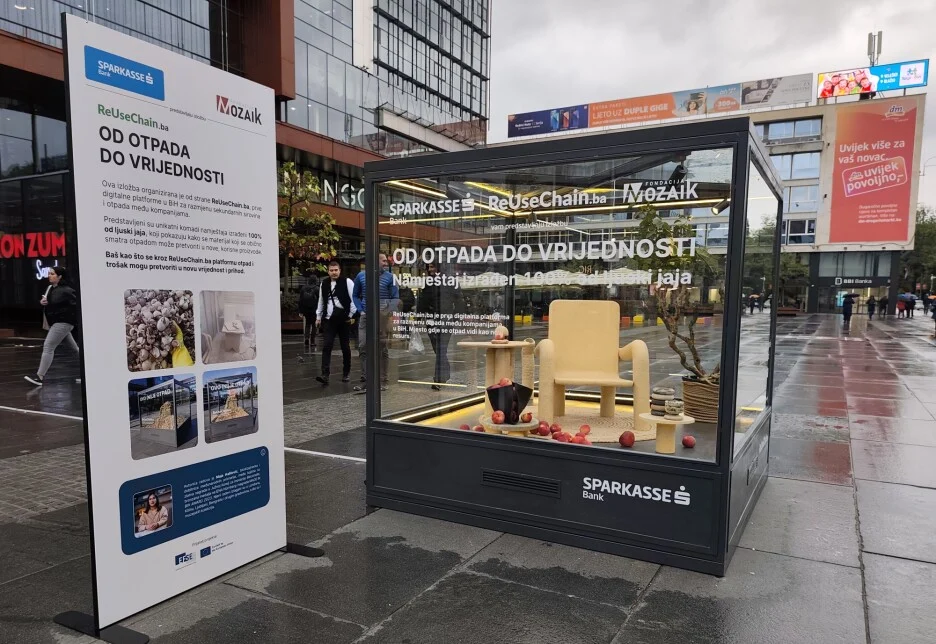
Beyond functionality, ReUseChain.ba contributes to a broader cultural shift by promoting examples of reuse and circular innovation. By highlighting how materials can be repurposed and reimagined, the project supports new ways of thinking about production, design, and value creation.
In the long term, this contributes to creating a sense of responsibility and care for resources and the environment, which directly impacts communities and the spaces in which people live and work. Reduced waste, cleaner environments, and more efficient use of materials all contribute to improving the quality of life.
ReUseChain.ba is exemplary in demonstrating that aesthetics is not limited to physical spaces, but can also be embedded in systems and processes. By combining clarity of design, accessibility, and a redefinition of material value, the project creates a more conscious and engaging experience, contributing to a more sustainable and beautiful way of using resources.
ReUseChain.ba addresses inclusion by making circular economy practices accessible and affordable to a wide range of businesses, regardless of their size, resources, or prior experience. In a context where such opportunities are often limited to larger or more advanced companies, the platform lowers barriers to entry and enables broader participation.
This is achieved through an open and tiered model, including a free (freemium) package that allows companies to access the platform and engage in material exchange without upfront costs. This approach is particularly important for small and medium-sized enterprises, which often lack the financial and technical capacity to participate in circular economy systems.
The platform also promotes inclusion by creating a transparent and accessible marketplace that connects companies across sectors, enabling them to participate in circular value chains that would otherwise remain out of reach. By facilitating collaboration and exchange, it supports a more connected and balanced economic ecosystem.
In addition, ReUseChain.ba addresses knowledge barriers by providing educational content and practical guidance on circular economy and sustainability. This ensures that participation is not limited to experts, but open to all interested businesses, regardless of their starting point.
The project contributes to a new societal model in which waste is recognised as a shared resource and value is created through cooperation rather than linear consumption. By combining affordability, accessibility, and knowledge-sharing, ReUseChain.ba enables a more inclusive transition towards sustainability.
ReUseChain.ba is exemplary in demonstrating how digital platforms can democratise access to circular economy opportunities, creating a system in which businesses of all sizes can participate, benefit, and contribute to a more sustainable and inclusive economy.
ReUseChain.ba is primarily designed as a B2B platform; however, it incorporates participatory elements through the involvement of civil society and the broader ecosystem in which it operates.
The project was developed by Mozaik Foundation, a civil society organisation with extensive experience in working with communities and businesses. Through its existing networks and engagement with local actors, the Foundation ensured that the platform responds to real needs and challenges identified on the ground.
Participation is reflected in the way businesses engage with the platform as active contributors rather than passive users. Companies are both providers and users of materials, shaping the platform’s value through their listings, interactions, and exchanges. This creates a collaborative system where value is co-created through participation.
The project also engages the business community through its partnership with Sparkasse Bank dd BiH, which has enabled outreach to a wide network of companies. Through this engagement, companies are encouraged to adopt circular practices and actively participate in building a more sustainable system of material use.
In addition, ReUseChain.ba promotes awareness and knowledge-sharing beyond its direct users, contributing to a wider societal dialogue on circular economy and responsible resource use. While citizens are not direct users of the platform due to regulatory constraints, they benefit from reduced waste, cleaner environments, and more sustainable local economies.
The impact of this participatory approach is reflected in the gradual creation of a community of businesses that actively engage in circular practices. ReUseChain.ba demonstrates how participation can be embedded in market-based systems, enabling collective action and shared responsibility in the transition towards sustainability.
ReUseChain.ba has been developed and implemented through collaboration across different governance levels, combining national coordination with local engagement and future regional potential.
At the national level, the project is led by Mozaik Foundation, which is responsible for the overall design, development, and implementation of the platform. The Foundation ensures alignment with local socio-economic and environmental priorities, while integrating circular economy and ESG principles into the project.
Sparkasse Bank dd BiH has been involved as a strategic partner operating at the national level, contributing to the project’s visibility, credibility, and access to a broad network of companies. This partnership has played a key role in engaging the business sector and supporting initial adoption of the platform.
At the local level, the project is implemented through outreach, awareness-raising, and engagement with companies across different regions of Bosnia and Herzegovina. This enables the platform to respond to diverse local contexts and supports the practical application of circular economy principles.
While currently operating at the national level, ReUseChain.ba is designed with a regional perspective, with plans to expand to the Western Balkans. This creates the basis for future multilevel collaboration across countries, strengthening cross-border material flows and circular value chains.
The added value of this multilevel approach lies in the combination of strategic coordination, strong business engagement, and local-level adoption. It enables both top-down and bottom-up dynamics, ensuring that the platform is relevant, scalable, and capable of driving systemic change.
ReUseChain.ba is exemplary in demonstrating how effective collaboration across governance levels can support the development and implementation of innovative solutions in contexts where formal circular economy systems are still evolving.
ReUseChain.ba is based on a transdisciplinary approach that integrates knowledge and expertise from multiple fields, including digital technologies, environmental sciences, circular economy, business development, and social innovation.
The platform combines technical expertise in digital product development with an understanding of material flows and resource efficiency, enabling the creation of a functional and scalable system for the exchange of secondary raw materials. Environmental knowledge is embedded in the platform through its focus on waste reduction, reuse, and CO₂ impact tracking.
In parallel, business and economic perspectives have shaped the platform as a viable marketplace, ensuring that it responds to real needs of companies and enables practical, financially sustainable exchanges. This is complemented by ESG-related knowledge, supporting companies in understanding and improving their sustainability performance.
The project also draws on social innovation and community development expertise through the work of Mozaik Foundation, ensuring that the solution is accessible, relevant, and aligned with broader societal needs.
The interaction of these different disciplines has enabled the development of a solution that goes beyond a purely technical platform. It combines technology, environmental impact, and market logic into a single system that is both practical and transformative.
ReUseChain.ba is exemplary in demonstrating how integrating diverse fields of knowledge can lead to more effective and scalable solutions for complex challenges such as waste management and resource efficiency.
ReUseChain.ba has been developed as an internal initiative of Mozaik Foundation, with initial funding provided by the Foundation and supported by Sparkasse Bank dd BiH. This early-stage support enabled the development and launch of the platform, as well as initial market validation.
At its current stage, the platform is focused on user adoption and behavioural change, as circular economy practices and secondary raw materials exchange are still emerging in Bosnia and Herzegovina. Therefore, access to the platform is currently supported through a freemium model, allowing companies to test and adopt this new way of doing business without financial barriers.
Significant efforts are being invested in awareness-raising and capacity-building, including educational activities, presentations, and collaboration with business associations and chambers of commerce. These activities are essential to support companies in understanding the value of material reuse and integrating circular practices into their operations.
In the next phase, the business model is designed to generate revenue through subscription-based service packages (Standard and Premium), which offer additional functionalities and support to companies with more advanced needs. This model ensures scalability while maintaining accessibility for a broad range of users.
The long-term financial sustainability of the project is based on a combination of recurring subscription revenues, continued growth of the user base, and potential partnerships with financial institutions and ecosystem actors interested in supporting circular economy solutions.
ReUseChain.ba demonstrates a sustainable business model that balances initial support for market creation with a clear pathway towards financial self-sufficiency, aligned with the gradual adoption of circular economy practices in the region.
ReUseChain.ba is designed as a scalable and transferable solution, with a business model and technological structure that can be adapted to different geographical and economic contexts.
The core element of the project—a digital marketplace for the exchange of secondary raw materials—can be replicated in other countries facing similar challenges, such as low recycling rates, limited circular economy infrastructure, and unstructured material flows. The platform’s technology, including its user interface, listing system, categorisation of materials, and matching functionalities, can be adapted to local regulatory frameworks and market needs.
The methodology based on a self-service model, combined with structured data and targeted facilitation of connections between companies, is also transferable. This approach enables efficient matching of supply and demand while remaining flexible and easy to adopt.
In addition, the integration of CO₂ tracking provides a scalable tool for measuring environmental impact, supporting companies in different contexts to align with ESG requirements and sustainability reporting.
The project is particularly relevant for replication in the Western Balkans, where similar structural challenges exist and where there is increasing pressure to align with EU circular economy and sustainability standards. At the same time, the model can be applied across different sectors, as it is not limited to a specific industry but supports multiple material streams.
ReUseChain.ba offers a modular and adaptable solution that combines technology, market mechanisms, and knowledge-sharing. This enables its transfer across geographies and sectors, supporting the development of more efficient, transparent, and sustainable circular economy systems.