Enhancing Circularity, Sustainability, and Innovation
Entraide
Entraide: Towards a circular and interspecies territorial park
Entraide imagines a new future for the Nive Valley through a territorial river park conceived as a living, regenerative system rooted in mutual aid between humans and non-humans. Through soft infrastructures, reactivated waste streams, and micro-architectures made from local materials, the project fosters coexistence. Risk zones become spaces for learning and resilience, fostering empathy and initiating a long-term process toward a shared future rather than offering fixed solutions.
France
Local
Ustaritz, Saint-Jean-Piet-de-Port, Villefranque
It addresses urban-rural linkages
It involves a physical transformation of the built environment (hard investment)
Prototype level
No
No
Yes
Individual
Entraide proposes a vision for the Nive territory through the creation of a Territorial River Park based on circular resource systems and interspecies coexistence. The project aims to transform a fragmented territory into a living organism by reconnecting landscapes, communities and ecosystems, while responding to floods and the climate crisis. Natural areas, urban spaces, industrial heritage and productive landscapes are linked through a networked vision in which the river becomes the main ecological and spatial backbone, finding space to expand without increasing danger.
Inspired by theory of Mutual Aid (Kropotkine, 1890) the project explores cooperation between humans, ecosystems, non-human species and water. Flood-risk areas and river edges are reimagined as spaces of socio-ecological value, where risk becomes an opportunity for learning, exchange and resilience. The project addresses residents at different life stages, pilgrims walking the Camino de Santiago, and other living species, recognizing the river itself as a living entity.
The concept relies on a circular territorial supply chain transforming local waste streams into building resources while supporting ecological regeneration and social cohesion.
Entraide develops a network of soft-mobility paths along the river from source to mouth, reconnecting fragmented territories and enabling people to rediscover the valley as a shared ecological system. Pilot interventions show how the strategy can be applied locally through accessibility improvements, ecological restoration, reuse of industrial heritage and biodiversity protection in some Natura2000 areas.
By combining circular material reuse, ecological infrastructure and community engagement, Entraide proposes a new regenerative territorial model strengthening environmental awareness and long-term resilience, with EU climate change targets in mind. Reconnecting people with the territories they inhabit, shape and care for is key to enabling future change.
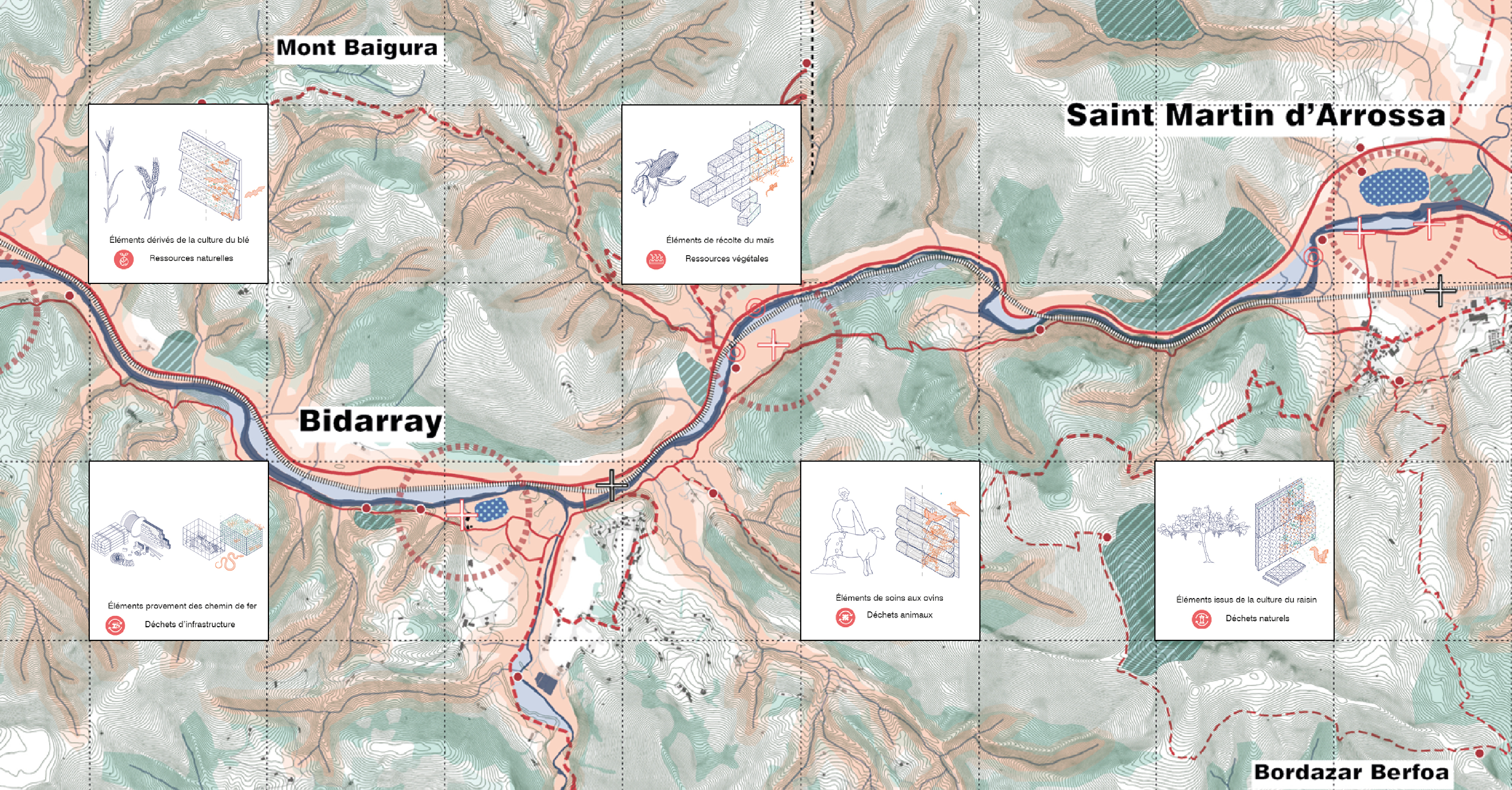
The approach emerged from living experiences in which adapting to natural rhythms and recurring crises shapes daily life. Our places of origin serve as references for environmental risks that shape future challenges and our understanding of long-term resilience: Venice - with its high tides, the Dolomites - with high-altitude complexities, and Sicily - with volcanic and open-sea risks. These experiences have taught us to seek a different balance with nature and its composing elements. This insight led to broader reflections on water, redefining coexistence zones as opportunities for shared understanding while ensuring safe environments for both humans and aquatic ecosystems, choosing specific areas in which the river can expand without becoming a risk.Entraide was developed through a walking exploration of the Nive area. Territorial analysis revealed fragmented mobility networks, ecological degradation along certain river sections, local materials and waste streams, and unused industrial infrastructures. Mapping, on site observation, interviews with residents, species identification, and waste assessment helped to design a method to reach an abacus useful to design in areas of a specific territory.
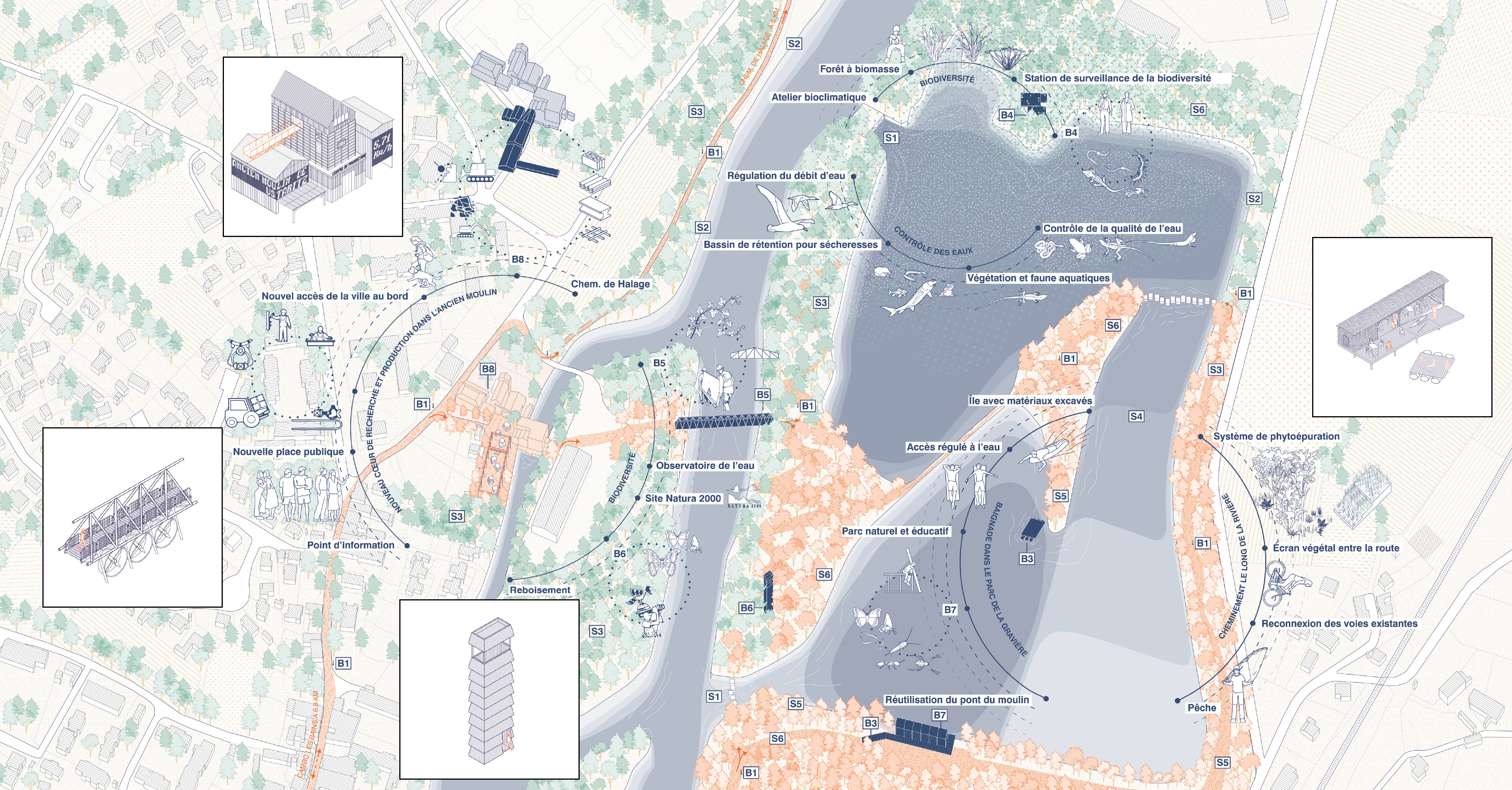
Three pilot sites - Villefranque, Ustaritz, and Saint-Jean-Pied-de-Port - tested strategies to improve river access, transform industrial heritage into circular production spaces, and restore ecological balance in highly frequented areas. Future developments aim to foster community participation and encourage a shift in mindset through workshops, while exploring new ecological and circular material practices across the valley. Micro-architectures using local and reused materials will be implemented participatively, starting in Ustaritz. Entraide is conceived as a process-oriented project fostering community participation, ecological and circular material practices, and a shift in mindset. It aims to reconnect people with the territories they inhabit, shape, and care for.
Three pilot sites - Villefranque, Ustaritz, and Saint-Jean-Pied-de-Port - tested strategies to improve river access, transform industrial heritage into circular production spaces, and restore ecological balance in highly frequented areas. Future developments aim to foster community participation and encourage a shift in mindset through workshops, while exploring new ecological and circular material practices across the valley. Micro-architectures using local and reused materials will be implemented participatively, starting in Ustaritz. Entraide is conceived as a process-oriented project fostering community participation, ecological and circular material practices, and a shift in mindset. It aims to reconnect people with the territories they inhabit, shape, and care for.
Mutual Aid
Micro-architectures
Circular supply-chain
Local resources
Room for the river
Sustainability lies at the heart of Entraide’s territorial strategy, grounded in a shift of mindset that helps communities live within an emerging climate and ecological crisis. By minimizing new construction, avoiding virgin materials, and transforming waste into building resources within a circular supply chain, the project emphasizes coexistence between water and the diverse species it sustains. This approach is profoundly ecologically and economically sustainable, as it reduces resource consumption, regenerates ecosystems, and fosters long-term resilience in both human and non-human communities. The project tackles environmental challenges such as biodiversity loss, flood risks, resource waste, and territorial fragmentation through integrated ecological design. Controlled flooding zones, reinforced riverbanks, and water management basins regulate extreme events while restoring natural river dynamics. In other areas, spatial and environmental justice guide the design, ensuring equitable access to water and its social value, especially in isolated alpine or productive landscapes. Ecological restoration measures protect sensitive habitats and limit human presence in vulnerable zones, while other areas promote responsible interaction between people and ecosystems. The Territorial River Park becomes a necessity for residents and a tool for ecological education for visitors. A network of paths linked to the Camino de Santiago spreads the message of mutual aid and sustainability approach to a broader audience. By combining landscape restoration, circular material systems, and climate adaptation strategies, Entraide demonstrates how river territories can evolve and continue existing into resilient socio-ecological systems, reinforcing the conviction that no approach to deep sustainability is possible without rethinking how we produce and inhabit space.
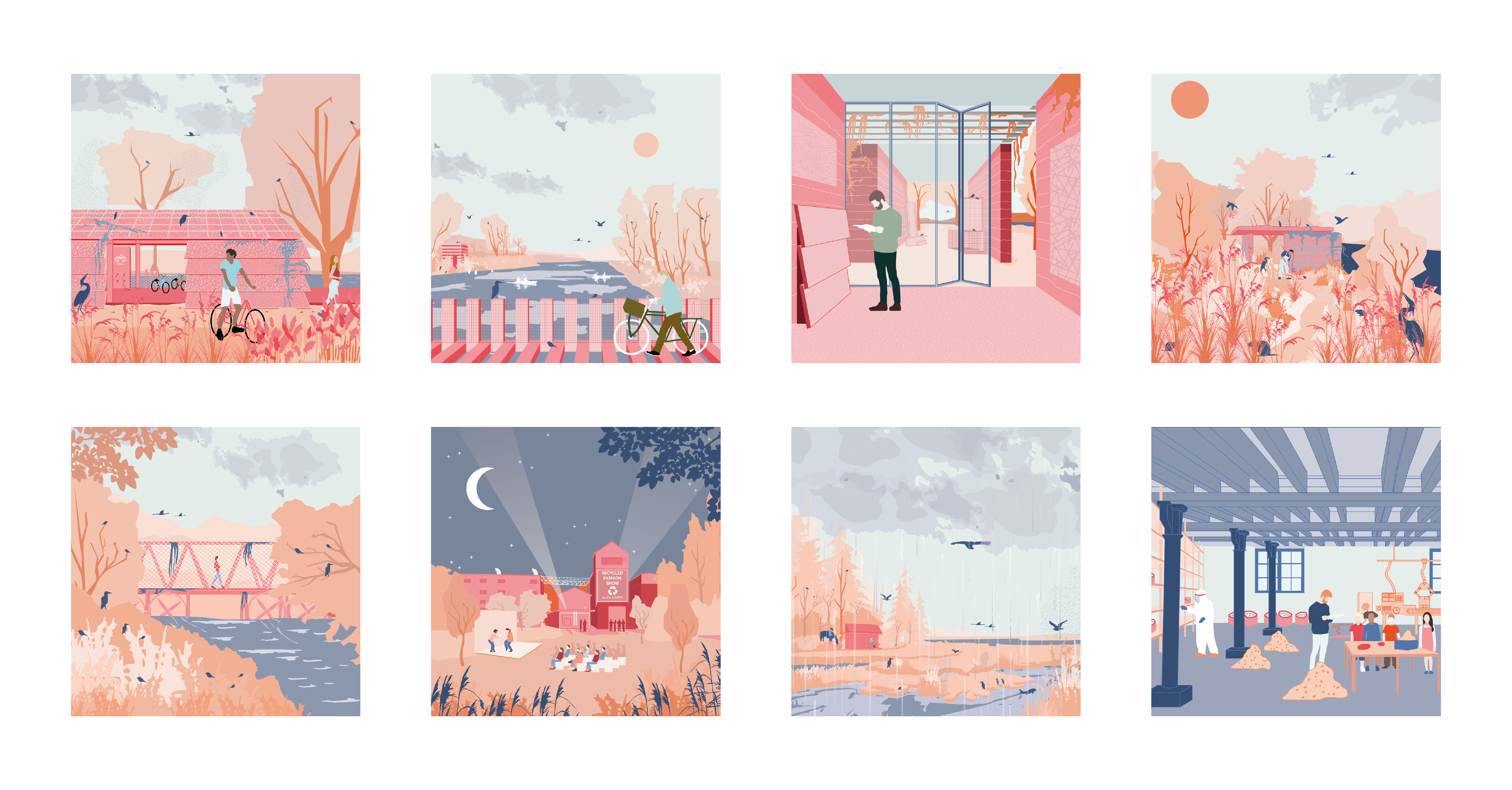
Through careful design and minimal interventions, Entraide enhances the landscape’s beauty while strengthening people’s emotional connection to the valley and fostering a profound sense of belonging. In this context, aesthetic qualities and form are not our primary objectives but emerge from a long process of understanding how people inhabit a place, through the chosen local materials, construction methods, and typological considerations. Entraide fosters a renewed aesthetic experience of the river landscape by transforming the Nive area into a continuous sequence of ecological and cultural spaces linked to a direct experience with local resources. In each site, interventions are proposed that respond to its specific craftsmanship, materials, and spatial characteristics, fostering local identity and a sense of belonging.All interventions begin with co-design workshops, where inhabitants participate in decisions about architectural aspects they relate to. Students are actively involved in design process and construction phase through workshops, festivals, and events. Areas once dominated by water exploitation are transformed into spaces for flood risk management, water resilience, education on coexistence, and encounters with the water element. Structures reinterpret the genius loci while remaining lightweight, adaptable, and open to non-human life, using local techniques to restore spatial quality and social value of underused and abandoned locations. A network of pedestrian and cycling paths allows visitors to experience the river gradually, from urban zones to natural and mountain landscapes, connecting previously isolated areas and promoting spatial justice. Educational spaces, observation platforms, and cultural hubs provide sensory journeys to learn about ecological processes, local culture, and territorial resources. Small-scale architectures enrich experiences for humans and non-humans, combining local materials with a territorial aesthetic and coherence.
Entraide promotes inclusion by improving river access, water resilience, and coexistence among all landscape inhabitants. Many areas of the Nive are currently difficult to reach due to private ownership, steep topography, railways or roads that interrupt connectivity, flood risks, or fragmented infrastructure. The project reconnects these spaces through new paths and multimodal slow-mobility nodes, ensuring that the river becomes a common good accessible to all while working in harmony with the existing railway line as an economical accessibility tool. Entraide applies spatial and environmental justice at both local and territorial scales, improving access and connectivity, protecting vulnerable communities in flood-prone areas, and enhancing ecological resilience and natural river functions. Public spaces along the river host educational programs, water access for sports and recreation, community workshops, and intergenerational activities that promote environmental awareness and collective care, strengthening social cohesion while anticipating upcoming socio-ecological crises. The reuse of abandoned industrial buildings creates inclusive social hubs where communities can gather, learn, and collaborate in circular production processes. By recognizing both human and non-human actors as participants in the territorial ecosystem, the project proposes a new model of coexistence that expands traditional notions of inclusion to embrace broader ecological relationships. Entraide advances inclusion across species, moving beyond conventional anthropocentric approaches: the river and other ecological systems are recognized as having rights equal to those of humans, becoming full participants in the stewardship of the landscape and fostering the conditions for a lasting, sustainable coexistence. Integrating care into everyday life, rather than confining it to formal civic duties, allows the natural system to foster new forms of social organization across the territory.
Entraide began as an entry for Europan18, winning second prize. The competition proposal represents the first step in a process to be developed with local actors, met during the award ceremony in Paris (2025). Site visits combined observation of the natural environment with discussions with local residents to understand real needs, thanks to whom Entraide is conceived as a collective territorial project engaging communities, visitors, institutions, and ecological actors. Starting from one pilot case, consultation and co-design sessions are progressively expanded to other cities, gradually fostering territorial cohesion and shared objectives at a larger scale, recognising a current state of social fragmentation at the territorial scale. At the territorial level, this approach could demonstrate how targeted, community-driven actions can serve as a first crucial step toward shifting sensitivities around mutual aid - both among humans and across species - in a valley where communities currently remain disconnected or in conflict. The project aims to create effective communication and collaboration while respecting the unique characteristics of each locality. In Ustaritz, an old quarry is transformed, after a co-design process with local population, into a multifunctional space for social interaction, water retention, recreation. A former mill becomes a collaborative hub for citizens, artisans, and researchers to explore sustainable materials and micro-architectures. These active devices – such as bridges, mobility hubs, water-level monitoring, water filtration and treatment, signage - are adaptable by the community, fostering long-term stewardship and collective care.
Participatory mechanisms strengthen local ownership, ecological awareness, and ensure that both human and non-human actors actively contribute to the valley’s transformation.Co-design and participatory workshops have been already held by the group, as parts of professional and academic research in Italy.
Participatory mechanisms strengthen local ownership, ecological awareness, and ensure that both human and non-human actors actively contribute to the valley’s transformation.Co-design and participatory workshops have been already held by the group, as parts of professional and academic research in Italy.
The implementation of Entraide requires collaboration among stakeholders operating at multiple governance levels. The process began during Europan18 France, serving as a European platform for research, dialogue and experimentation in spatial design. At the European level, the project aligns with initiatives such as the New European Bauhaus, climate adaptation strategies, biodiversity restoration policies, and EU climate targets. Currently, the project is engaging in dialogue with individual municipalities through its participation in the territorial initiative Projet Petites Villes de Demain (http://anct.gouv.fr/programmes-dispositifs/petites-villes-de-demain). Coordination is led by the Communauté d’Agglomération Pays Basque, with a dedicated representative managing the political-administrative strategy across the municipalities, in a role largely financed by the French state. Entraide has been recognized for its innovative approach, offering a new model for water resilience, spatial justice, and mutual aid as a pilot strategy to help Europe confront emerging socio-ecological crises. The project team is responsible for co-coordinating community workshops and implementation processes in partnership with local authorities and the coordinators of Projet Petites Villes de Demain. Local associations, environmental groups, farmers, and cultural organizations actively contribute to the development of educational, ecological, and social activities within the Territorial River Park and participate in the co-design process.
This multilevel collaboration combines local knowledge with institutional expertise, ensuring legitimacy, technical capacity, and financial support. This collaboration is necessary in dealing with territorial-scale innovative approaches. Simultaneously, the territorial model developed in the Nive territory has the potential to inspire similar river-based regeneration strategies in other European regions.
This multilevel collaboration combines local knowledge with institutional expertise, ensuring legitimacy, technical capacity, and financial support. This collaboration is necessary in dealing with territorial-scale innovative approaches. Simultaneously, the territorial model developed in the Nive territory has the potential to inspire similar river-based regeneration strategies in other European regions.
Entraide is founded on a strong transdisciplinary approach that brings together architecture, landscape design, ecology, urbanism, and territorial planning, working closely with local administrations and citizens. The project was proposed by a group of young architects with diverse backgrounds and expertise, including architecture, local materials and construction, landscape design, and the management of local wood supply chains, initially specialized in the Dolomites (IT) but also testing other materials and contexts. Architects and landscape designers define spatial strategies to reconnect fragmented territories and design micro-architectural interventions, collaborating with landscape professionals to recognize and integrate other species into the planning process. The team’s expertise is to be combined with participatory processes (ongoing) in which local administrations play a strategic role in facilitating dialogue with citizens and aligning with local policies. This collaborative framework allows multiple perspectives and knowledge systems to interact through workshops, shared research activities, and pilot projects.
The result is a holistic territorial strategy that integrates ecological, social, cultural, and technical dimensions into a coherent regenerative vision. Collaboration is organized through the partnership between the young architects’ team - with architecture students - and the coordinators of the Projet Petites Villes de Demain, part of the French government’s operational programs. The team will also collaborate with other multidisciplinary groups awarded in Europan18 for the same territorial area, whose expertise deepens different, complementary approaches for the Nive area. Decision-making will be conducted within open workshops involving professionals, local communities, and administrative representatives, ensuring that interventions are collectively shaped and responsive to local needs, following the usual steps of Europan France.
The result is a holistic territorial strategy that integrates ecological, social, cultural, and technical dimensions into a coherent regenerative vision. Collaboration is organized through the partnership between the young architects’ team - with architecture students - and the coordinators of the Projet Petites Villes de Demain, part of the French government’s operational programs. The team will also collaborate with other multidisciplinary groups awarded in Europan18 for the same territorial area, whose expertise deepens different, complementary approaches for the Nive area. Decision-making will be conducted within open workshops involving professionals, local communities, and administrative representatives, ensuring that interventions are collectively shaped and responsive to local needs, following the usual steps of Europan France.
Funding for Entraide is linked to French government programs, specifically in the French Basque Country through the Projet Petites Villes de Demain. The economic sustainability relies on a hybrid model that combines public funding, local economic activities and private entities as spokespersons for change, alongside universities research hubs.
Entraide also generates new economic opportunities through circular material reuse and by promoting slow, responsible tourism. Interest in the network of paths within the Territorial River Park is amplified by the proximity of the starting point of the Camino de Santiago, in Saint-Jean-Piet-de-Port, which already attracts a significant number of visitors. Within this context, the mutual aid approach becomes essential in managing the growing presence of visitors while preserving the ecological and social integrity of areas with high natural and cultural value. Former industrial buildings are repurposed as research and production hubs, where local waste streams are transformed into construction materials for the park’s micro-architectures. This fosters a sustainable local economy while providing educational and cultural activities. Such initiatives can support employment in craftsmanship, ecological construction, and cultural production. Educational programs, workshops, cultural events, and ecological tourism along the river network can generate additional revenue for local communities and institutions. Soft mobility infrastructure and landscape regeneration further enhance the valley’s appeal for sustainable tourism, benefiting local businesses such as hospitality services, cultural organizations, and agricultural producers.
By combining ecological regeneration, circular production, and cultural activities, Entraide proposes a financially sustainable model that strengthens local economies while minimizing environmental impact, through an implementable territorial project.
The Entraide model is designed to be adaptable and transferable to other territories facing ecological and social challenges. Operating at both territorial scale and local scale, it places scalability and phased implementation at its core. Several elements of the concept can be replicated in different contexts where socio-ecological transition requires a shift in mindset and in conventional design tools. The territorial approach can inspire regeneration strategies in other critical environments, while the system of micro-architectures built from reused local materials - from agricultural, pastoralism and production waste - offers a flexible methodology adaptable to different ecosystems and cultural contexts. The small-scale interventions can act as catalysts for broader territorial transformations while requiring relatively limited material and economic resources, thanks to the circular supply chain approach that can also be reproduced elsewhere.
Successful implementation relies on collaboration among municipalities, environmental organizations, designers and local communities, fostering more just and inclusive design approaches and initiating processes of care and consequent maintenance at various scales. Adaptations may be required depending on local ecological conditions, available waste materials, governance structures, communities, and resources. Entraide provides a replicable framework for sustainable territorial and local regeneration, enabling coordinated multiscalar and coherent interventions. In new contexts, strong communication and mediation skills are essential to engage local communities, alongside expertise in specific climatic and environmental conditions and designers’ sensitivity to non-anthropocentric, collaborative approaches. The role of the coordinator of the Projet Petites Villes de Demain proves essential, to guarantee a territorial coherence, while guiding a stronger local participation.
Successful implementation relies on collaboration among municipalities, environmental organizations, designers and local communities, fostering more just and inclusive design approaches and initiating processes of care and consequent maintenance at various scales. Adaptations may be required depending on local ecological conditions, available waste materials, governance structures, communities, and resources. Entraide provides a replicable framework for sustainable territorial and local regeneration, enabling coordinated multiscalar and coherent interventions. In new contexts, strong communication and mediation skills are essential to engage local communities, alongside expertise in specific climatic and environmental conditions and designers’ sensitivity to non-anthropocentric, collaborative approaches. The role of the coordinator of the Projet Petites Villes de Demain proves essential, to guarantee a territorial coherence, while guiding a stronger local participation.
Following the usual steps of Europan, Entraide is structured into several phases unfolding throughout spring and summer 2026. In January 2026, representatives of the French administrative framework initiated a dialogue with local authorities and communities to better coordinate the next stages. All selected teams will contribute to a broader territorial strategy, bringing their specific approaches into a coherent and unified action.The process will then develop through a sequence of closely connected steps. It begins with an intermediate phase centered on workshops and meetings, where national structures facilitate exchanges between the winning teams and local stakeholders. This stage is crucial for exploring operational perspectives, testing ideas, and deepening them through preliminary studies, on-site workshops, and urban analyses. Building on this groundwork, the process moves toward a contractual phase, in which the most promising proposals are progressively translated into concrete projects. At this stage, collaborations with municipalities or developers may be formalized, defining the conditions for planning, development, and potential implementation.Finally, the process evolves into an operational phase, where initial concepts are transformed into detailed designs and, eventually, into built interventions. This transition from strategy to realization may occur incrementally, with construction and implementation unfolding over multiple phases. According to discussions with the coordinator of Projet Petites Villes de Demain, the initial focus is likely to be on the area of Ustaritz, identified as a priority due to its strong spatial and social challenges.Co-creation workshops are expected to begin in spring, initiating a process based on the reuse of local and waste materials. This will lay the foundation for a broader strategy along the territory, also addressing the development of slow-mobility networks to strengthen territorial coherence and accessibility.