Enhancing Circularity, Sustainability, and Innovation
Zero-Bio-Waste at Schools
Introducing the Benchmark for Biowaste Audit in Transnistria and Its Pilot in Tiraspol
Zero-Bio-Waste at Schools transformed 20 schools in Transnistria, Moldova into the first local model of circular biowaste action. Led by Kokoza and AO Vitality, the project helped children and staff measure, sort and compost waste on site, showing that 75–80% of school organics can return to the soil. The tested model, including a handbook, videos and templates, is now ready to scale across Moldova.
Moldova
Regional
Transnistria
Mainly rural
It involves other types of transformations (soft investment)
Yes
2025-12-23
No
No
No
Organisation
The project closes the loop between organic waste and soil across 20 school environments in Transnistria, where no structured school biowaste intervention had previously existed. It introduced the first circular biowaste audit benchmark for schools in the country and used it as a practical tool for local transformation: making invisible waste streams visible, reorganising daily routines, and turning discarded organics into a resource for compost, soil health and care for place.
In Moldova, nearly 50% of municipal waste is organic and typically ends up in landfill. Schools reflected this linear pattern: no measurement, no separation, no local processing. Our project broke that cycle by combining structured audits with low-cost composting solutions, multilingual learning materials, and hands-on activities that reshaped both school practices and parts of the school environment. All 20 schools completed audits, using either a full bin-sorting model or a lighter basket-based format adapted to local capacity. Together they measured around 170 kg of waste and confirmed that approximately 133 kg, or 75–80%, was compostable, creating the first quantitative school biowaste baseline in the region.
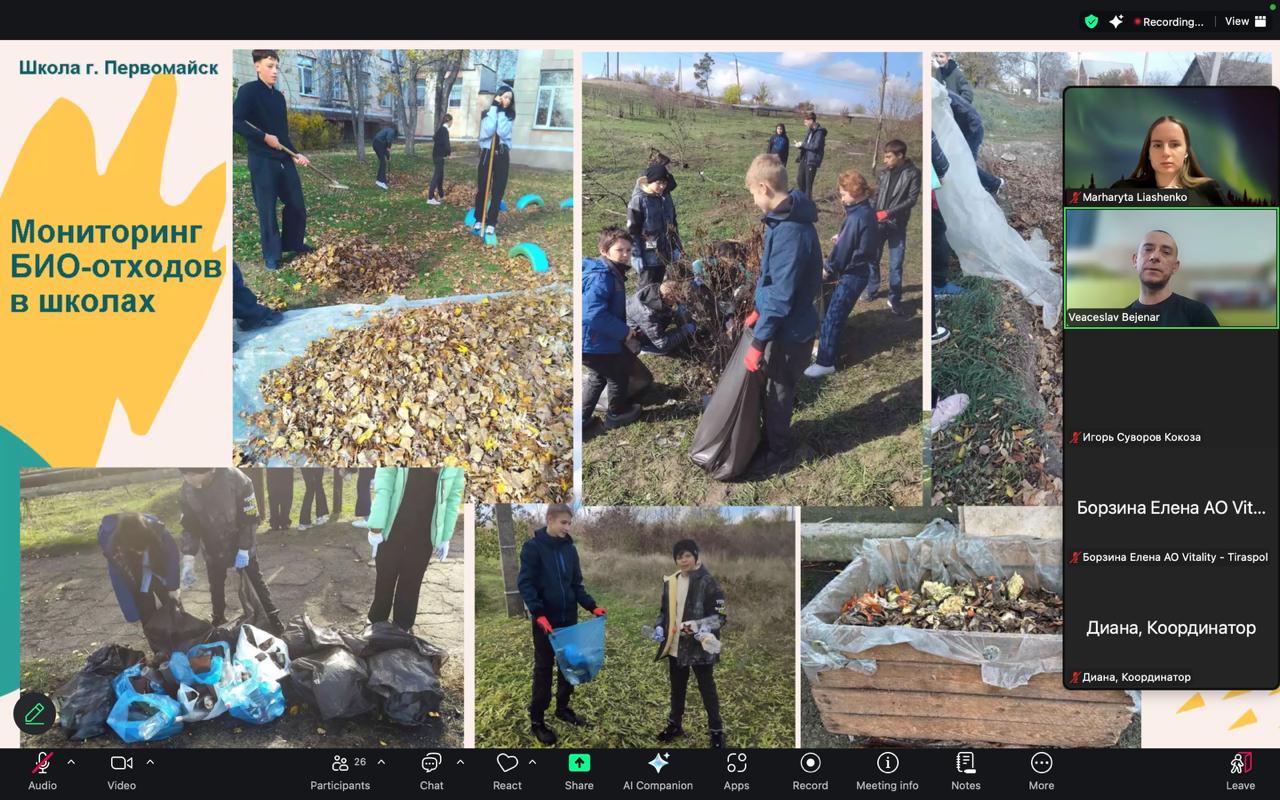
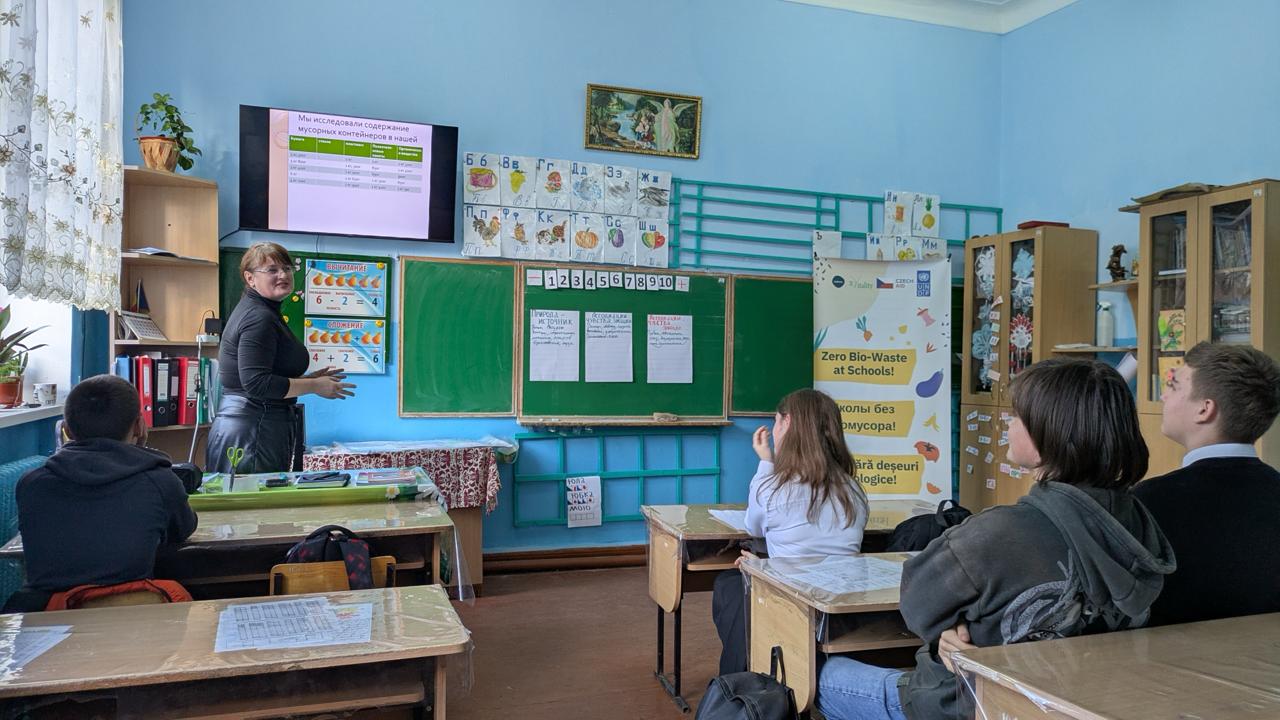
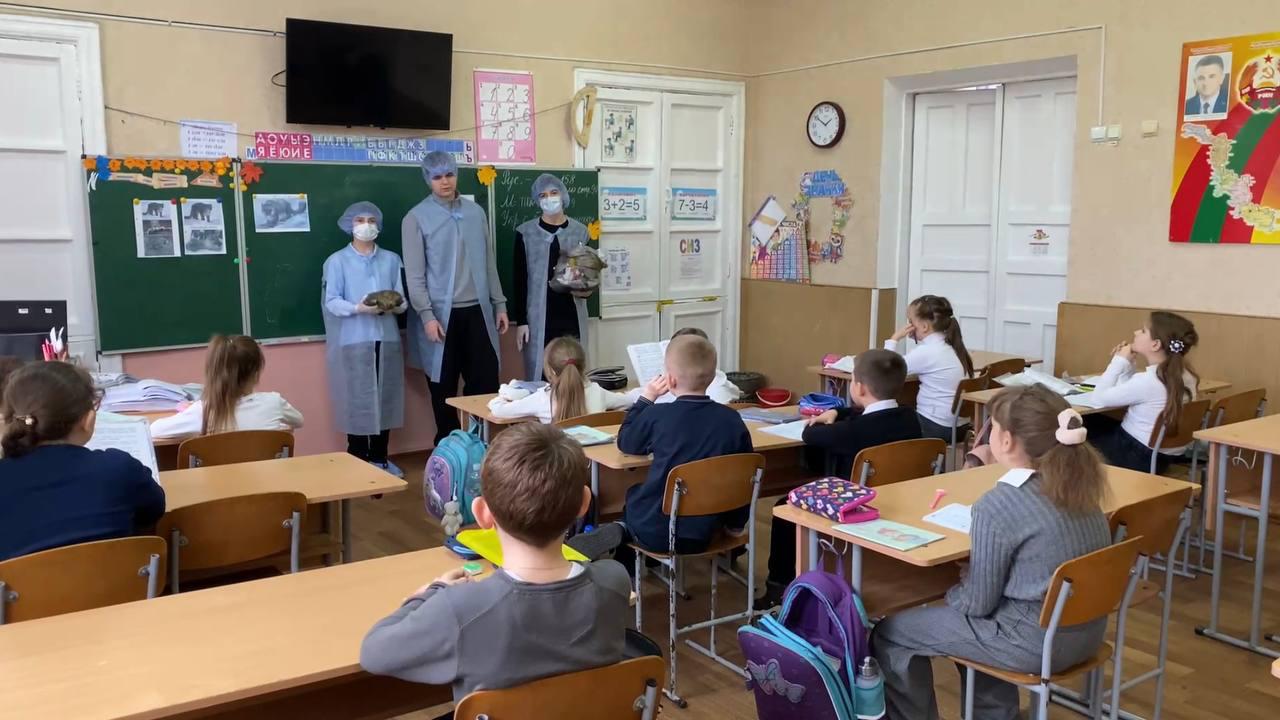
The transformation went beyond data. Schools set up or expanded compost pits and leaf-collection systems, turning neglected corners into green infrastructure and replacing disposal with local circular use. In most schools, audits led to practical composting lessons, poster campaigns and student-made videos.
The project worked across school communities of about 8,000 students and 1,000 staff, with particular value for rural schools with limited extracurricular opportunities. Final satisfaction reached 4.91/5, while awareness of the biowaste problem increased by +0.91 points. Its long-term impact lies in a tested, low-cost and multilingual replication package: handbook, videos, audit templates, case studies and mentoring logic that make this model ready to scale across Moldova.
The project originated from strategic alignment between two organisations with complementary strengths. Kokoza had already built a strong track record in composting, closed-loop food systems and circular education in Czechia. AO Vitality had years of operational experience in Moldova and Transnistria, including environmental education in schools, organic agriculture and local stakeholder engagement. When AO Vitality approached Kokoza, both sides quickly recognised a shared opportunity: combine proven circular know-how with deep local implementation capacity and create a model that could work in a context where waste separation, recycling and circular practices were still far from standard.
The project was therefore designed as a joint venture, not a transfer of a ready-made Czech solution. AO Vitality brought critical added value in methodology adaptation, school outreach, translation, local coordination and an understanding of how schools in Moldova actually operate. This was decisive, because the audit model had to function in an environment with uneven infrastructure, low institutional readiness and limited everyday exposure to circular systems. Kokoza contributed the audit framework, technical composting expertise, monitoring logic and overall project coordination. Together, both partners developed a two-format model: a full bin-sorting audit and a lighter basket-based version, making the methodology workable across very different school conditions.
Implementation reflected that structure. AO Vitality led localisation and day-to-day work with schools and stakeholders, while Kokoza provided mentoring, technical guidance and on-site support in Tiraspol. This allowed the project to move from concept to execution in real school environments. What emerged was not only a pilot in 20 schools, but a cross-border model for how circular practice can be translated into places where circularity is not yet part of the system.
bio-waste management
nature-based solutions
community co-design
closed food loop
soil regeneration
The project targets the root cause of biowaste mismanagement — not by improving disposal, but by removing the need for it. In Moldova, organic waste accounts for nearly 50% of the municipal stream and goes to landfill, producing methane (25x more potent than CO2), contaminating groundwater, and depleting soil. Schools are major institutional producers of this waste, yet none had tools to measure, separate, or process it. Our intervention replaced the linear discard model with a closed-loop system: biowaste is audited, sorted, composted on site, and returned to soil in the place of its origin.
The causal logic is deliberate. At the output level, the project delivered 20 documented audits, a dual-format benchmark, composting infrastructure, and a multilingual toolkit. These outputs produced short-term results: schools now understand the closed food cycle and recognise compost as part of it; organic material can be sorted and processed locally; teachers and students have the knowledge and tools to act. The data confirms this — biowaste awareness grew by +0.91 points, 100% of surveyed teachers reported new skills, and 75–80% of measured school waste was confirmed compostable.
The medium-term trajectory is already visible. Schools built compost pits and leaf-collection systems, converting disposal costs into productive assets. Children participate in sorting and composting as embedded daily routine, not a one-off lesson. Several schools expanded composting independently. These are behavioural changes — habits forming around a new relationship with organic material.
The long-term objective aligns with regenerative sustainability: organic material is perceived and used as a valuable resource. Compost enriches soil, supports biodiversity, and sequesters carbon. The model requires no advanced technology, runs on local materials, and is designed to function where formal waste infrastructure does not exist — making it replicable precisely where it is needed most.
Before the project, biowaste in participating schools was largely invisible: it went into mixed bins, had no dedicated place, and created no visible link between food, waste and soil. The project changed that by making the cycle visible in everyday school life.
Across 20 schools, audits were linked to dedicated biowaste baskets, compost pits or leaf-collection zones, poster campaigns and student videos. Neglected corners gained a clear function. Collection points and compost areas gave organic waste a visible place in the school environment. The biowaste basket design competition added a creative layer: pupils helped shape the tools they used, instead of receiving anonymous infrastructure.
This improved everyday school experience in three concrete ways. First, it replaced hidden and disordered waste handling with clear, understandable routines. Second, it created activities that pupils could join, see and present to others. Third, it turned maintenance into a source of pride: teachers reported “positive emotions,” “eyes shining,” and growing engagement; in at least one school, all pupils joined biowaste-related routines.
The project also strengthened belonging and care for place. In rural schools with few extracurricular options, composting and related creative activities gave pupils something useful and visible to do for their own school. That matters aesthetically in NEB terms: not as decoration, but as a better relationship between people, everyday practices and the spaces they share.
The project is exemplary because it shows that aesthetics can emerge from function, participation and care. It made an ignored waste stream visible, gave it form in the school environment, and turned routine maintenance into a shared culture of care for place.
Our project addressed inclusion by starting from a simple reality. Schools in Transnistria do not operate under equal conditions. They differ in infrastructure, staff capacity, language environment and access to extracurricular opportunities, especially in rural areas. That meant a standard circular model would have included only the schools that were already more prepared and would have excluded the rest.
We therefore built inclusion into the project design itself. Instead of one rigid methodology, schools could work with two audit formats, a full bin-sorting model or a lighter basket-based model. This made participation possible under different levels of readiness and allowed schools to join on realistic terms. The same logic guided the rest of the implementation. Materials were translated into Russian and Romanian, local lecturers were trained, and AO Vitality adapted the tools to the everyday functioning of Moldovan schools. As a result, participation did not depend on prior expertise, language advantage or advanced technical conditions.
This also shaped the affordability of the model. Because many schools cannot sustain resource-intensive solutions, the project relied on low-cost tools, reusable materials and simple routines that could continue after the pilot phase. Inclusion therefore meant more than temporary access. It meant creating a model that schools could actually maintain.
That same principle carried into governance. Pupils, teachers and staff were not treated as passive recipients of expert instruction. They tested the model in practice, adjusted routines, documented results and helped shape the next steps. In rural schools with few opportunities beyond formal teaching, this gave pupils a visible and meaningful role in school life. In at least one school, all pupils became involved in biowaste routines. In that sense was the condition that made circular transition possible, not a mandatory add-on feature.
Our project was participatory from the design stage: Kokoza and AO Vitality did not impose a fixed audit model on schools. The methodology was developed through joint adaptation to Moldovan school realities, and then refined again through teacher feedback gathered after the introductory webinars, mentoring sessions and final evaluation. That led to concrete corrections such as simplified forms, additional support materials, stronger monitoring guidance, and the consolidation of a two-level audit model.
Participation then continued at school level through co-implementation. Schools were invited to shape how the method would work in practice, while still contributing to one shared dataset. On teachers’ request and based on uneven readiness, the project worked with two audit pathways, a full bin-sorting audit and a lighter basket-based audit. As a result, the 20 completed audits were not identical copies of one template. Some focused mainly on classrooms, some included canteens, school grounds and home waste, some built eco teams, and others created collaboration across age groups and staff roles. In most schools, audits also triggered follow-up lessons, poster campaigns, student videos and composting activities. Participation therefore shaped both the method and the form of implementation on the ground.
Because schools could co-shape the process, all 20 stayed in the programme until the end, the data remained usable across very different conditions, and teachers developed real ownership of the model. They asked for more live meetings, more materials, more consultations and a community space, while the final conference helped incorporate their feedback into the handbook and next iteration of the approach. This is why the project is exemplary in participatory terms. It proves that a circular model becomes stronger when users help design it, test it, and adapt it to their own context.
Our project used multilevel governance because the challenge could not be solved at one level only. We therefore built the project as a chain of connected responsibilities rather than a single delivery structure.
At local level, schools, teachers, pupils, school leaders and staff were not only implementers. They generated the evidence base, tested the methodology in real conditions, and showed what was workable in classrooms, canteens, school grounds and home-related routines. Their role was decisive because they turned the model from a concept into a functioning practice.
At regional level, AO Vitality provided the governance bridge that made local implementation possible. It maintained direct relations with schools, translated and localised the tools, coordinated communication in Russian and Romanian, liaised with local authorities and partner structures, and ensured that the methodology worked in the specific conditions of Transnistria. This regional anchoring gave the project trust, access and operational realism.
At national level, the pilot was connected to wider uptake from the start. Audit results, the policy paper, the round table, translated dissemination materials and links to municipal and education stakeholders created a pathway from school evidence to broader institutional relevance. This gave the project legitimacy beyond the pilot and positioned it for replication within Moldova.
At European and international level, Kokoza brought methodological leadership, technical oversight, monitoring logic and tested Czech experience in closed-loop biowaste systems, while the UNDP Challenge Fund created the framework for accountable cross-border cooperation and transfer. The added value of this governance model was clear. Local actors made the approach real, regional coordination made it workable, national engagement made it scalable, and cross-border expertise made it robust and transferable.
Our project was transdisciplinary because the problem could not be solved by waste expertise alone. To move schools from mixed disposal of organics to local closed-loop practice, the project had to connect composting science, soil and organic agriculture, pedagogy, behaviour change, monitoring, communication, and local school know-how in one method. The audit benchmark worked only because these fields were designed to reinforce each other rather than operate in parallel.
Kokoza contributed the technical backbone. It brought expertise in biowaste audits, composting systems, closed-loop food cycles, and monitoring logic, then translated this into practical school tools, worksheets, videos and a teacher handbook. AO Vitality brought the second backbone. It contributed long-term work with schools, environmental education, organic agriculture, localisation, and direct knowledge of how Moldovan and Transnistrian schools function in practice. This made it possible to adapt the method to real teaching conditions, local capacities, and a context where circular systems are still weak.
The integration of disciplines was visible in implementation. Environmental and composting knowledge defined what to measure and how to process organics safely. Educational practice turned that into lessons, webinars and school routines. Monitoring converted 20 different school implementations into one comparable dataset. Communication and visual design helped schools explain the process through posters, student videos and basket design. Local pedagogical feedback then improved the method again, including the consolidation of the full and light audit formats.
The project is exemplary in transdisciplinary terms because no single discipline could have produced this outcome alone. Technical knowledge made the model credible, educational design made it usable, local school practice made it workable, and monitoring made it transferable. That is what turned one pilot into a scalable method.
The project was financed as a pilot through a mixed model combining the UNDP Challenge Fund with co-funding from Kokoza. That financing was appropriate for the first phase, because the main task was to develop, test and document a model that had not existed in Moldova before. Financial sustainability over time does not depend on repeating the same grant. It depends on turning the pilot into a low-cost replication offer with clear users, clear services and falling marginal costs.
The first continuation route is institutional uptake. The project has already produced the core assets needed for expansion, including a tested two-format audit benchmark, bilingual materials, videos, templates, case studies, a handbook and a policy paper. This means future adopters do not pay for redesign. Schools, municipalities and education networks would mainly finance training, mentoring and light composting equipment.
The second route is paid methodology transfer. Kokoza already works with municipalities, businesses and educational institutions in Czechia on composting, urban agriculture and closed-loop food systems, while AO Vitality has implementation capacity in Moldovan schools and regions. Together, they can offer defined services such as training of trainers, school audit packages, mentoring for new cohorts, and adaptation support for universities, vocational institutions and selected SMEs with biowaste streams.
The third route is partnership finance for scale. Because the model delivers measurable value in waste reduction, climate mitigation, soil improvement and education, it fits municipal programmes, donor funding and CSR support. Its financial logic is strong because the know-how is already developed, the tools are reusable, and each next cohort is cheaper to deliver. In that sense, the business model is not based on one revenue source, but on a replicable platform that can be financed through institutional budgets, service contracts and targeted expansion funding.
Our project was designed from the start as a transferable model rather than a one-off school pilot. The core element that can be replicated is the two-format biowaste audit benchmark, which combines one shared dataset with flexible delivery. This allows different institutions to adapt the process to their own readiness, while still producing comparable evidence for decision-making. That is why the model worked across 20 schools with different conditions and why it can travel further.
Several parts are directly transferable. These include the audit methodology, the full and light audit formats, bilingual materials in Russian and Romanian, three training videos, worksheets, presentations, the teacher handbook, documented case studies, and the mentoring logic that supported schools through implementation. Together, these tools reduce the cost and difficulty of adoption, because new users do not need to invent a method from zero. They can start from a tested package and adapt it to their own setting.
The model is also transferable across beneficiary groups. It was piloted in schools, but the same logic can be applied to universities, vocational institutions, municipalities and selected SMEs that generate organic waste and need affordable local processing solutions. The policy paper was developed precisely to support this next step and to connect pilot evidence with wider institutional uptake in Moldova.
What makes the project especially scalable is that it has already moved beyond proof of concept. Kokoza had tested related composting and closed-loop education models in Czechia, while the Moldova pilot proved that the method can be adapted to places where circularity and recycling are still weak. This makes the project not only replicable, but transferable across contexts with different levels of infrastructure, capacity and institutional readiness.