Enhancing Circularity, Sustainability, and Innovation
FurniSave
FurniSave, A Circular Furniture Rescue System
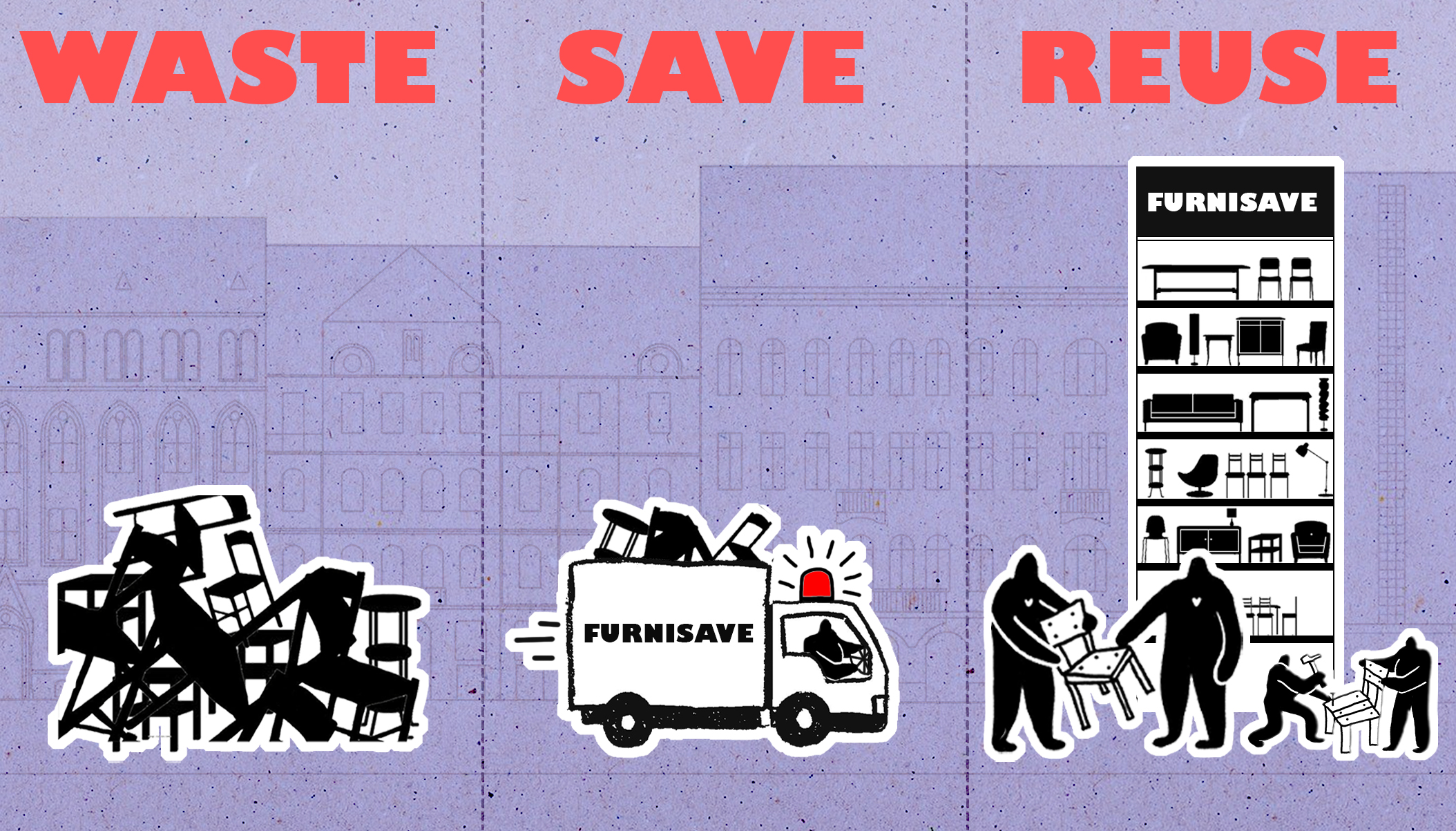
FurniSave is a circular urban system that saves furniture from becoming waste and returns it to use through repair. It offers an alternative to Budapest’s bulky waste system by redirecting items to new users through donations and sales. Through workshops and community programs, it makes repair part of everyday culture again.
Hungary
Local
Budapest
Mainly urban
It refers to other types of transformations (soft investment)
Early concept
No
No
No
Individual
FurniSave is a circular urban system that rescues furniture from disposal and returns it to use through repair. The project responds to the Hungarian “bulk waste collection” practice, where every year residents place large household items on the street. Around 40–50 thousand tons of waste appear annually, most of which goes directly to landfills.
A significant portion of this waste is still functional and could be reused. Informal “treasure hunts” already occur, where people try to salvage valuable items. FurniSave organizes this spontaneous activity into a safe, accessible, and structured system: residents can responsibly part with unwanted furniture any day of the year.
FurniSave extends the life of furniture through sale or donation. It is not a conventional furniture store, but an urban exchange and reuse platform that turns disposal into circulation. The project also promotes repair culture, which has declined due to consumption-driven practices. Workshops and community programs make repair skills accessible and teachable.
The project strengthens community connections across generations. Older craftsmen share their skills with younger people, creating learning opportunities and reducing social isolation.
FurniSave is currently in the pilot preparation phase. A local Budapest district partnership supports site selection and operational fine-tuning. The small-scale launch allows testing the quality of incoming furniture, establishing repair processes, and setting up a stable operational foundation.
In the long term, FurniSave aims to become a scalable urban network. The system could transform bulk waste collection practices, turning waste into resources and consumption into a circular process.
FurniSave originated from Borbála Véghelyi’s 2025 master’s thesis at Moholy-Nagy University of Art and Design. The thesis proposed a city-scale circular system and designed a model station, earning a diploma award. The project continues in collaboration with the Budapest district that granted the award.
After graduation, development continued in the Design and Art Incubator program. With guidance from professional mentors, the team explored practical implementation. In October 2025, the core team formed: Lilla Drahota Szabó (cultural community organizer), Réka Márkus (economist), and Barnabás Bessenyei (carpenter). This diverse team ensures multiple perspectives shape the project.
Research and international learning informed the concept. The team visited Vienna’s Carla reuse center and Paris’s La Collecterie, gaining insights into circular practices and operational processes. These examples helped refine the concept and operational model.
The project progressed through research, concept development, expert consultations, and continuous iteration. Case studies, expert feedback, and international examples guided decision-making.
Currently, FurniSave is in the pilot preparation phase. A local district collaboration supports site selection and finalizing the operational model. The small-scale launch allows testing and refining the system in a real environment.
The core team is supported by a growing volunteer community who will assist with collection, repair, and logistics. The next step is launching a pilot location, laying the foundation for long-term, scalable operations.
Circular economy
Urban reuse systems
Repair culture
Community engagement
Material reuse
FurniSave aims to save as much furniture as possible from disposal, reducing waste and promoting circularity. All incoming items are measured and documented, making it easy to track exactly how much material is returned to the circular system. Items that cannot be reused as furniture are repurposed as raw materials, ensuring that every piece contributes maximally to the circular economy.
The project collaborates with DIY stores to use materials that would otherwise be discarded, such as slightly damaged or broken wood, in the repair process. FurniSave integrates city and commercial resources while applying transparent and measurable processes.
The strength of FurniSave lies in creating a transparent, scalable urban circular model that delivers environmental, economic, and social sustainability. It encourages community participation, conscious consumption, and fosters a culture of sustainable urban practices. The project demonstrates that reuse and repair-based circular systems can be both eco-friendly and innovative long-term urban solutions.
FurniSave gives used furniture aesthetic value while promoting reuse and repair. Instead of hiding flaws, cracks, or repairs, we highlight them, inspired by the Japanese kintsugi principle. This approach, similar to wabi-sabi, celebrates imperfection and emphasizes the value of use, helping people form a stronger attachment to the objects and care for them longer.
The project collaborates with designers, visual artists, and craftsmen to communicate the repair and transformation process to the community. This ensures that the added value is not only functional but also visual and cultural.
Each piece is consciously transformed in shape, material, and color to improve usability and comfort. Community participation gives every object a unique story, strengthening local identity, creativity, and a sense of belonging.
FurniSave exemplifies how sustainability and creative aesthetics can combine. By integrating reuse and repair into design, the project adds historical and emotional value to objects, enhancing the connection between people and their surroundings.
FurniSave aims to make furniture accessible and affordable for everyone, especially for communities in need, supporting social and economic inclusion. The project focuses on use rather than high-priced sales, and a credit system allows anyone to purchase items at a reduced cost. The price of each piece is based on the energy invested in its repair. Donations and municipal partnerships ensure that support reaches social housing and disadvantaged families.
The project creates jobs and builds community. It engages senior craftsmen, who pass on their skills to younger generations, and provides work and reintegration opportunities for people in disadvantaged situations. We also plan to collaborate with civil organizations, such as the “From Street to Home Association,” which renovates social housing for people experiencing homelessness.
FurniSave is exemplary because it combines affordability, social participation, and community knowledge sharing. The process of repair, transformation, and reuse is sustainable and creates long-term social value.
Our concept is an open and continuously evolving system that actively involves stakeholders from the early stages of development. Beneficiaries and stakeholders include households in need, residents of social housing, senior craftsmen, young volunteers, as well as civil society and municipal actors.
During the concept development, we consulted with local family support organizations and municipal staff. In addition, multiple professional consultations helped shape the model, especially regarding business operations and social engagement. These inputs ensured that the project is built on a practical and responsive foundation.
FurniSave plans a pilot phase to test and further refine the system. Participants are engaged through community workshops, collaborative activities, and feedback platforms, ensuring they are not only users but active shapers of the process. Feedback directly influences decisions, such as pricing, services, and operational structure.
FurniSave offers not a fixed system, but a community-shaped, adaptive model. Participation allows the concept to flexibly respond to local needs, which is essential for its social relevance and long-term sustainability.
FurniSave is built on multi-level collaborations, with a focus on the local, district level. During development, we have already consulted with a Budapest district municipality (District XII) and its affiliated family support organization, which help us reach those in need and local residents.
Key partners also include civil organizations and the private sector. Civil groups, especially those addressing housing issues, and companies such as hardware store chains (e.g., Praktiker) provide materials that are no longer sellable but still usable. This benefits both sides: partners reduce waste, while FurniSave gains access to the resources needed for repair.
The concept follows the principles of a circular economy and reuse. It promotes the re-use of waste and can align with national and European initiatives in the long term, as the system is easily adaptable to other cities.
Multi-level collaboration adds expertise, resources, and credibility to the project. It also supports growth and long-term sustainability. FurniSave thus creates a flexible, scalable model that builds local connections while fitting into larger systems.
FurniSave builds on collaboration across multiple disciplines to create complex, sustainable, and community-focused solutions. The project integrates architecture, economics, community organization, craftsmanship, and education, ensuring that every decision considers multiple perspectives. Architectural and strategic thinking, community engagement, economic sustainability, and hands-on craft knowledge continuously inform one another.
This approach extends to the community. Open repair workshops allow local residents to learn different repair skills. For children, workshops using old furniture parts to make wooden toys foster creative reuse and environmental awareness from an early age.
Collaboration with designers and artists adds creative and aesthetic value to the repair and reuse process. By combining different fields of knowledge, FurniSave is more than a service—it is an innovative, community-driven, and long-term system. The interdisciplinary approach connects theory and practice, professional and non-professional experience, enabling everyone to learn, contribute, and support the project’s success.
FurniSave operates as a self-sustaining non-profit association, supported by a diversified revenue model that ensures long-term financial stability. The primary source of income comes from the resale of collected furniture, complemented by limited design collections that are sold at higher price points to help cover operational costs.
In the future, the model aims to expand its revenue streams through repair and creative workshops, interior design services, and the rental of community spaces. These activities not only strengthen financial resilience but also reinforce the project’s social and community-oriented mission.
Public funding and municipal support provide additional security, particularly during the pilot phase. Through donations and community contributions, the project is also able to reach vulnerable groups, while engaging local craftsmen, artisans, and young people who gain employment opportunities, skills development, and knowledge transfer. In this way, the initiative generates both economic and social value at the district level.
The project’s cost structure is defined as follows:
Initial costs: establishment of a small repair workshop (equipment acquisition), rental of premises, and marketing expenses
Operational costs: rent and utilities, material costs for repairs, wages, transportation, storage, and communication (marketing)
The innovative impact of FurniSave lies in creating a local, scalable reuse network that simultaneously reduces waste, supports communities in need, and fosters social cohesion.
The FurniSave project offers a flexible, scalable model that can be adapted to other locations.
The most easily transferable elements of the system are the depot network, small-scale repair functions, and community workshops, which can operate independently but together form a complex circular model.
The project starts on a small scale with a pilot depot in collaboration with a district, allowing the system to be fine-tuned and adapted to local needs. In the future, the model can be expanded to other districts and eventually evolve into a city-wide reuse network, where materials and knowledge flow between nodes.
Implementation does not require specialized technology, but establishing local partnerships with municipalities, civil organizations, and market actors is crucial to ensure resources and social embeddedness.
Adapting to local conditions mainly requires adjustments in logistics and partnership structures, while the core principles – reuse + repair, community participation, and circular operation – remain unchanged.
FurniSave is exemplary because it offers a bottom-up, flexible model that works locally while being expandable into a larger network and applicable in other urban contexts.
The FurniSave development follows a year-long, phased pilot process, focusing on testing, refining, and establishing a locally scalable circular system.
Months 1–3: preparation and setup. A suitable site is selected and prepared, with emphasis on storage capacity. The space primarily functions as a logistical base; direct public drop-off is not yet available. The team participates in municipal bulky waste collection events, rescues furniture, and initiates material assessment and repair testing. Communication channels (website, social media) are launched to build visibility.
Months 4–10: full pilot operation. Residents can bring in furniture, completing the cycle of collection, transport, repair, and reuse. The system is continuously refined using data and user feedback. Foundations for community engagement are laid: workshop formats are developed and categorized, and partnerships with local institutions (schools, kindergartens) are initiated, including educational activities for children.
Months 11–12: evaluation and consolidation. The first community-oriented activities are introduced, while environmental, social, and economic impacts are measured. Results form the basis for a robust, adaptable model applicable in other urban contexts.