Enhancing Circularity, Sustainability, and Innovation
REESTRENA: Circular Parenting Hub
REESTRENA: A Premium Circular Economy Hub for Sustainable Parenting and Community Ceremonies
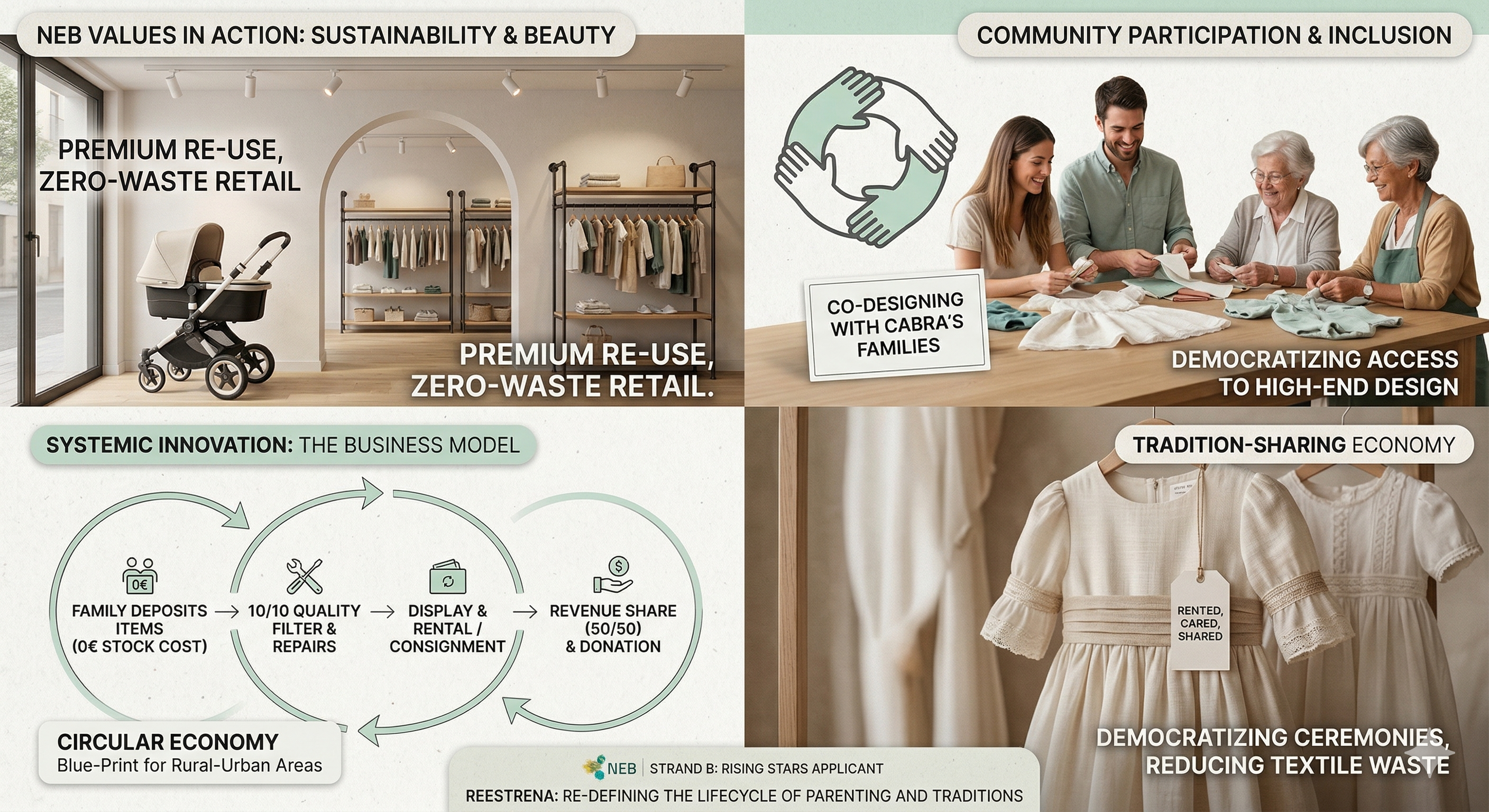
REESTRENA transforms the "fast-parenting" culture into a premium circular experience. Located in rural Spain, this boutique-hub elevates pre-loved baby gear and ceremonial wear through a "Low-Cost Premium" aesthetic. We prove that sustainability is not just about recycling, but about beauty and shared quality. By combining a zero-waste consignment model with high-end rentals, we democratize access to top-tier design, reducing the carbon footprint of one-time-use traditions.
Spain
Local
CABRA
Mainly urban
It involves a physical transformation of the built environment (hard investment)
Early concept
No
No
No
Individual
REESTRENA is an innovative circular economy boutique in Cabra (Spain) that transforms "second-hand" into a "Premium Re-use" experience. We tackle the environmental impact of the "fast-parenting" and ceremonial industries by extending the lifecycle of high-quality goods through an innovative, zero-waste business model. Our goal is to prove that sustainable consumption can be aspirational, elegant, and economically resilient.Core Pillars (NEB Alignment)Sustainability & Innovation: We operate a zero-inventory-cost consignment system for premium baby gear and a high-yield rental model for ceremony attire (Communion, Baptisms). By recirculating top-tier brands, we prevent landfill waste and significantly reduce the carbon footprint and water consumption associated with new textile and plastic production.Aesthetics: We break the "thrift shop" stigma with a minimalist, Bauhaus-inspired interior. Using neutral LED lighting, modular industrial design, and a curated sensory experience, we ensure that the space reflects the quality of the products. We prove that the circular economy can be beautiful and desirable.Inclusion: We democratize access to high-quality design. Our model allows families from all socio-economic backgrounds to access safe, premium, and beautiful products at 40-60% of their retail price, fostering social cohesion and supporting young families in a rural-urban setting.Expected ResultsEnvironmental: Recirculation of +1,500 premium items per year, saving an estimated 12 tons of CO2 and promoting a "zero-waste" lifestyle.Economic: A highly scalable and resilient business model for young entrepreneurs in non-metropolitan areas, achieving 100% ROI on rental items by their second use.Social: Revitalizing local commerce in the Subbética region and creating a community hub for conscious parenting.
The idea for REESTRENA was born from observing a paradoxical reality in my local community of Cabra: while young families faced increasing economic pressure, their homes were overflowing with premium baby goods and ceremonial outfits used only for a few months—or even hours. In the "fast-parenting" era, high-quality products like Bugaboo strollers or handcrafted Communion dresses were being treated as disposable. I saw an opportunity to bridge this gap by creating a space where sustainability meets aspiration, transforming "second-hand" into a "premium re-use" experience.
Development & Strategy
The concept was developed through a "Lean Startup" approach combined with NEB design principles. I identified three main barriers to circularity in rural-urban settings: stigma, quality perception, and accessibility. To overcome these, I designed a three-step implementation strategy:
Systemic Innovation (The Business Model): I chose a zero-inventory-cost consignment model. This allows the business to scale without heavy initial capital while turning the local community into "partners" rather than just customers. By offering a 50/50 profit split, we incentivize the recirculation of high-end goods.
Aesthetic Transformation (The Space): I applied a "Low-Cost Premium" interior design strategy. Instead of expensive renovations, I focused on high-efficiency LED lighting (4000K) and modular industrial aesthetics. This ensures that the product—not the price tag—is the protagonist, breaking the "cluttered" stigma of traditional thrift shops.
Digital & Legal Framework: To ensure transparency, I integrated specific REBU (Special Regime for Used Goods) tax software and digital inventory tracking. This provides a professional, trustworthy bridge between depositors and new owners.
Circular Economy
Premium Re-use
Social Inclusion
Rural-Urban Revitalization
Resource Efficiency
REESTRENA is an exemplary concept of sustainability because it addresses the entire lifecycle of high-impact consumer goods, focusing on Resource Efficiency and Waste Prevention in a sector—parenting—characterized by short-term product utility.1. Environmental Sustainability (Decarbonization & Circularity)The production of a single high-end stroller or a ceremonial silk dress involves significant CO2 emissions and water consumption. By implementing a rigorous "10/10 quality filter" and a professional maintenance system, REESTRENA extends the functional life of these goods by 3 to 4 times.Concrete Impact: We estimate that recirculating 1,500 items annually prevents the emission of approximately 12 tons of $CO_2$ and saves thousands of liters of water by offsetting the need for new manufacturing.Zero-Waste Packaging: We eliminate single-use plastics in-store, utilizing recycled paper or reusable textile bags, fostering a "zero-waste" mindset in the local community.2. Economic Sustainability (Resilience & Local Growth)Our model is exemplary in its financial ingenuity. By using a zero-inventory-cost consignment system, we create a business that is resilient to market fluctuations and requires minimal capital. This "Low-Cost/High-Impact" strategy is a scalable blueprint for young entrepreneurs in rural-urban areas like Cabra, proving that the Green Transition can be a driver of local economic revitalization and youth employment.3. Social & Cultural SustainabilityWe challenge the "throwaway culture" associated with family traditions. By offering high-quality rentals for religious and social ceremonies, we preserve cultural heritage while removing the environmental guilt and financial burden of single-use luxury. REESTRENA transforms the act of "buying used" from a financial necessity into a conscious, prestigious choice, aligning local traditions with 21st-century environmental values.
REESTRENA is an exemplary project of "Aspirational Sustainability." We believe that for the circular economy to succeed in rural-urban settings like Cabra, it must be more beautiful and desirable than the traditional "linear" shopping experience. Our aesthetic strategy is built on three pillars:
1. The "Low-Cost Premium" Visual Language
We break the cluttered, chaotic stigma of second-hand shops by applying a minimalist Bauhaus-inspired interior. By using neutral color palettes (pure whites and light oaks), modular industrial furniture (matte black metal), and a "less is more" layout, we allow the design of the products—Bugaboo strollers or handcrafted silk dresses—to become the protagonists. The store is designed so that the customer perceives luxury, cleanliness, and order from the moment they step in, proving that "pre-loved" can feel "brand new."
2. Sensory & Emotional Well-being
Aesthetics in the NEB is about how a place feels. REESTRENA employs Sensory Marketing to create a sanctuary for busy families. High-efficiency neutral LED lighting (4000K) ensures products look vibrant and fresh, while a curated olfactory identity (notes of white tea and cotton) creates a calming atmosphere. This creates an "everyday beauty" that dignifies the act of sustainable shopping, turning a chore into a rewarding emotional experience.
3. Cultivating a Sense of Belonging and Care
Located in a key commercial hub of Cabra, our storefront acts as a "Circular Gallery." By showcasing a single, high-quality, restored item in a curated window display, we educate the community on the value of preservation. We foster a "culture of care" where objects are not just commodities but stories to be passed on. In the long term, REESTRENA strengthens the neighborhood’s identity as a leader in conscious living, creating a space where the community feels proud to participate in a more elegant and responsible future.
REESTRENA is an exemplary model of Socio-Economic Inclusion, designed to ensure that sustainability and high-quality design are not elite privileges, but accessible rights for all families in the Subbética region.
1. Affordability and Financial Dignity
Our core mission is to bridge the "opportunity gap" for young families. By offering premium, certified-safe baby gear and ceremonial attire at 40-60% below retail prices, we allow families from diverse socio-economic backgrounds to access the best tools for their children’s development. Furthermore, our consignment model acts as a circular micro-economy: it allows local families to recover part of their investment in childcare, providing them with extra liquidity and turning "consumers" into "active economic partners."
2. Design for All & Accessibility
Inclusion starts at the door. Our boutique is designed following "Design for All" principles, featuring a 100% barrier-free layout that exceeds local accessibility regulations. The space is specifically engineered for wide strollers and wheelchairs, with low-level displays and resting areas for pregnant women and the elderly. This ensures a dignified, stress-free shopping experience for every member of the community, regardless of their physical needs.
3. A New Societal Model: The Circular Commons
REESTRENA promotes a shift from "ownership" to "stewardship and sharing." Our rental system for Communion and ceremony wear (Baptisms, Weddings) is inherently inclusive; it prevents social exclusion based on appearance in traditional events, allowing every child to participate in community traditions with high-end attire without a prohibitive financial burden.
4. Inclusive Governance & Solidarity
Items that remain unsold after 90 days and are not reclaimed by owners enter our "Social Solidarity Line." These goods are donated to local NGOs or offered at symbolic prices to families in vulnerable situations, ensuring a 100% circular and inclusive loop.
REESTRENA is not a traditional retail project; it is a bottom-up initiative shaped by the active participation of the families and local ecosystem of Cabra (Subbética region). Our participatory approach has been fundamental in transforming a business idea into a community-driven circular hub.
1. Identifying Needs through Local Dialogue
The concept was developed through active listening and informal focus groups with young parents and grandparents in the neighborhood. These dialogues revealed two critical pain points: the financial burden of rapid infant growth and the "clutter anxiety" caused by high-quality items that families were reluctant to discard but had no easy way to recirculate. This direct feedback led to the creation of our "Zero-Inventory Consignment Model," where the citizens are not just customers, but the primary suppliers and beneficiaries of the economic loop.
2. Stakeholder Engagement and Co-Creation
We have involved key local actors to ensure the project’s integration into the social fabric:
Local Educators & Nurseries: Consultations with early childhood professionals helped define our "Safety and Quality Filter," ensuring that the items recirculated meet the highest developmental standards for children.
Artisans & Event Professionals: Collaboration with local photographers and ceremony organizers led to the "Sharing Economy for Traditions" line, ensuring our rental offerings align with local cultural heritage and family needs.
3. Impact of Participation on the Concept
The community’s input radically changed our spatial design. Originally conceived as a warehouse-style shop, participant feedback emphasized the need for a "dignified and beautiful" environment to overcome the social stigma of second-hand goods. This resulted in our "Low-Cost Premium" aesthetic, prioritizing light, scent, and order.
Our governance strategy involves stakeholders at four distinct levels:
1. Local Level (Cabra & Subbética Region): Proximity and Trust
The heart of our project lies in direct engagement with the Cabra City Council (Ayuntamiento) and local commerce associations. We aim to integrate REESTRENA into local "Green Commerce" circuits, revitalizing the town center. By partnering with local nurseries and "AMPA" (Parent-Teacher Associations), we ensure a constant feedback loop that keeps the project rooted in the community’s evolving needs.
Added Value: Ensures social acceptance and provides a grassroots database for the circular economy.
2. Regional Level (Junta de Andalucía): Policy Alignment
We align our implementation with the Andalusia Circular Economy Law (LECA). We expect to engage with regional entrepreneurship agencies (such as Andalucía Emprende) to use REESTRENA as a pilot "Good Practice" for young entrepreneurs in non-metropolitan areas.
Added Value: Access to specialized mentoring and regional visibility for scaling the business model to other Andalusian towns.
3. National Level (Spain): Legal and Fiscal Standards
Our project strictly follows the Spanish Circular Economy Strategy (España Circular 2030). By operating under the REBU (Special Tax Regime for Used Goods), we demonstrate how national fiscal frameworks can be used to promote sustainable retail. We also expect to collaborate with national consumer protection agencies to certify the safety and quality of recirculated childcare products.
Added Value: Guarantees legal transparency and consumer trust in "pre-loved" goods.
4. European Level: The NEB Vision
REESTRENA acts as a local ambassador for the European Green Deal. By presenting this concept to the New European Bauhaus, we connect a small-town initiative with the EU’s vision of a sustainable, beautiful, and inclusive future.
Added Value: Provides a scalable, "Made in Europe" blueprint for circular retail that can be replicated
1. Sustainable Design & Interior Architecture
We apply "Lean Design" principles to create a "Low-Cost Premium" space. By focusing on lighting engineering (4000K neutral LEDs for product fidelity) and modular industrial furniture, we use architecture as a tool to remove the social stigma of second-hand goods. Our aesthetic is not decorative; it is a functional strategy to dignify the circular economy.
2. Environmental Science & Life-Cycle Analysis
Our operations are informed by Circular Economy principles. We don't just "resell"; we manage the lifecycle of complex goods (strollers, car seats). We apply knowledge of materials and durability to establish our "10/10 quality filter," ensuring that the environmental benefit of recirculation is maximized by preventing the carbon-intensive manufacturing of new plastic and textile products.
3. Economic & Legal Innovation (FinTech)
The implementation of the REBU (Special Tax Regime for Used Goods) and the use of specialized TPV/ERP digital inventory software reflect a deep intersection between fiscal law and digital technology. This allows for total transparency in a "zero-inventory" business model, turning a complex legal framework into a seamless, automated operational system.
4. Social Sciences & Community Psychology
We use Behavioral Economics to shift consumer habits. By using "Sensory Marketing" (olfactory and acoustic identity), we influence how the community perceives "pre-loved" items, moving the narrative from "buying out of necessity" to "buying out of environmental pride and style."
5. Education & Local Heritage
Our "Sharing Economy for Traditions" line (ceremonial wear) integrates Cultural Heritage with modern sustainability. We work as educators, teaching the community that preserving traditions does not require over-consumption, but rather a respect for the craft and the longevity of ceremonial garments.
1. Revenue Streams (Diversified Income)
Consignment Fees (Core Revenue): We operate on a 50/50 profit-sharing model for premium nursery items. By not purchasing stock upfront, we eliminate "frozen capital" and inventory risk. Revenue is generated at the point of sale, covering operational costs with zero cost of goods sold (COGS).
High-Yield Rental Service: Our "Ceremony & Events" line follows a sharing economy model. Items like Communion dresses, purchased strategically at low cost or consigned, are amortized by the second or third rental. This generates a recurring high-margin revenue stream with minimal maintenance (cleaning fees included in the service).
Value-Added Services: Future revenue includes specialized cleaning/restoration of premium strollers and "Circular Consulting" for families, providing a holistic service ecosystem.
2. Cost Optimization (Competitiveness)
Low-Asset Intensity: By utilizing a "Low-Cost Premium" design strategy, we minimize initial CAPEX. We invest in high-impact elements (lighting and branding) rather than structural renovations.
Digital Efficiency: Automated inventory and fiscal management (REBU tax regime) reduces administrative hours, allowing a lean team to manage high volumes of stock.
3. Financial Sustainability & Scalability
Self-Sufficiency: Unlike many social projects, REESTRENA is designed to be cash-flow positive from Year 1. The high demand for affordable premium goods in rural-urban areas ensures a steady "supply-demand" loop.
Scalability: This model is a "Plug & Play" blueprint. Its financial structure is easily replicable in other municipalities, making it an attractive concept for social franchising or regional expansion.
REESTRENA is designed as a highly replicable "Plug & Play" model for the circular economy. Its success lies not in its location, but in a systematic methodology that can be transferred to diverse geographical and socio-economic contexts. The following elements are specifically designed for scalability:
1. The "Zero-Inventory" Methodology
The core of our scalability is the Consignment Business Process. By eliminating the need for initial capital to purchase stock, the model can be replicated by young entrepreneurs with limited financial resources. This methodology is transferable to any sector involving high-value, short-lifecycle goods (e.g., sports equipment, specialized tools, or high-end electronics), providing a universal template for risk-free circular entrepreneurship.
2. The "Low-Cost Premium" Aesthetic Toolkit
We have developed a standardized Visual Identity and Spatial Manual. This toolkit uses "Lean Design" principles—modular furniture, specific lighting temperatures, and sensory branding—that can be implemented in any empty commercial space with minimal renovation. This ensures that the "Premium Re-use" brand experience remains consistent and aspirational, regardless of the city or country.
3. Digital and Legal Interoperability
Our use of specialized Inventory Management Software and the adaptation to the REBU (Special Tax Regime) provides a technical framework that is easily transferable. As European circular economy regulations (such as the Digital Product Passport) become more standardized, REESTRENA’s digital tracking system serves as a ready-made tool for compliance and transparency across the EU.
4. The "Tradition-Sharing" Social Model
The rental of ceremonial attire is a culturally adaptable module. While in Spain it focuses on Communions, in other European contexts it can be adapted to local traditions (weddings, graduations, or folklore festivals), proving that circularity can coexist with—and even protect—local cultural heritage.
Phase 1: Setup & Aesthetic Prototyping (Months 1-3)
Space Finalization: Securing the physical location in Cabra’s commercial district and executing the "Low-Cost Premium" interior design. This includes installing high-efficiency LED systems and modular furniture.
Legal & Fiscal Setup: Finalizing the integration of the REBU tax software and establishing the data protection protocols for the consignment registry.
Curated Inventory Acquisition: Launching the "Acquisition Campaign" (Month 2) to stock the rental line (Communion and event wear) through strategic purchases from private sellers.
Phase 2: Community Engagement & Launch (Months 4-6)
The "Founding Families" Campaign: Launching a local marketing drive to attract the first 50 depositors. This phase focuses on building trust through transparency in the 50/50 profit-sharing model.
Grand Opening & "Circular Gallery": A launch event designed as a NEB workshop, inviting local stakeholders (nurseries, city council, and press) to experience the space and understand the environmental impact of their participation.
Phase 3: Operational Growth & Digital Presence (Months 7-9)
Strategic Partnerships: Formalizing agreements with local photographers and event planners to cross-promote the "Ceremony Rental" service.
E-Catalog Launch: Developing a real-time digital catalog where families can browse available premium gear, optimizing the "Search & Reserve" process before visiting the physical store.
Phase 4: Impact Assessment & Scalability Review (Months 10-12)
CO2 Savings Audit: Publishing the first "Circular Impact Report," measuring the number of items recirculated and the estimated carbon emissions avoided.
Scalability Blueprint: Documenting the operational processes to create a "Manual of Good Practices," preparing the model for potential replication in other municipalities of the Subbética region.