Strengthening Local Democracy and Inclusion
Reclaiming Spaces of Exclusion
A Conceptual Design for Inclusive Juvenile Educational Institution
This project focuses on the Juvenile Educational Institution SC Logatec, examining how spaces of care affect the community’s perception of those within them. By exploring new forms of collective living and integrated services, the design fosters active participation in community life. The transformation positions public space at the heart of the institution, shifting it from a symbol of exclusion to a catalyst for public life, becoming not an isolated facility, but a place in its own right.
Slovenia
Local
Logatec
Mainly rural
It involves a physical transformation of the built environment (hard investment)
Early concept
No
No
No
Individual
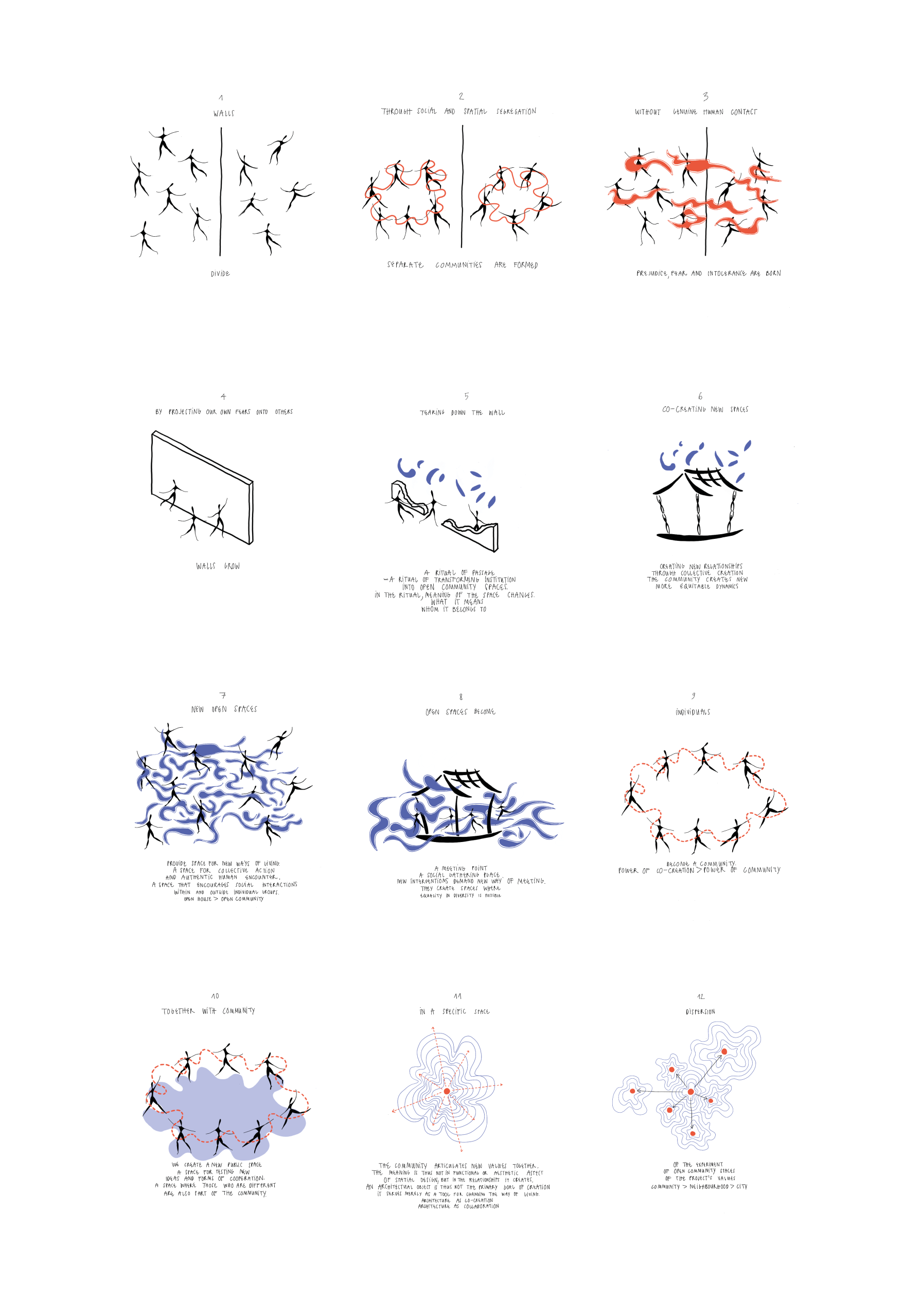
The concept addresses the social stigma of institutionalizing youth with emotional and behavioral disorders. Historically these facilities functioned as "spaces of exclusion," using rigid structures that isolate individuals. This project proposes a transformation of the Juvenile Educational Institution Logatec, evolving from a closed institution into a decentralized community-integrated infrastructure of care. By reinterpreting the "invisible boundary" between institution and town, architecture becomes an agent in producing solidary social dynamics.
The framework prioritizes de-institutionalization. Instead of a singular complex, residential units are integrated into the urban fabric. These domestic, family-scale environments replace clinicalism with the architecture of shared daily life, fostering belonging. This shift facilitates authentic social contact, the most effective catalyst for reducing public stigma.
The primary complex is reimagined as an open infrastructure of care. Existing structures are re-functionalized as autonomous community services, including specialized therapies, counseling, and an integrated school. This ensures support is delivered within a natural social context, where new behavioral patterns are internalized through authentic interaction.
The site becomes a social catalyst by introducing public programs and reimagining the "place of care" as a public space. By merging specialized services with a public canteen and community functions, the project redefines public infrastructure. The space of care is no longer a destination for punishment, but a vibrant part of the town’s social life. Architecture does not just house a program; it actively dismantles the logic of exclusion by creating a shared environment where diversity is normalized. Through this metamorphosis, the once-closed institution is reborn as a permeable urban node, proving that the built environment can foster belonging and agency for those society too often chooses to hide.
The framework prioritizes de-institutionalization. Instead of a singular complex, residential units are integrated into the urban fabric. These domestic, family-scale environments replace clinicalism with the architecture of shared daily life, fostering belonging. This shift facilitates authentic social contact, the most effective catalyst for reducing public stigma.
The primary complex is reimagined as an open infrastructure of care. Existing structures are re-functionalized as autonomous community services, including specialized therapies, counseling, and an integrated school. This ensures support is delivered within a natural social context, where new behavioral patterns are internalized through authentic interaction.
The site becomes a social catalyst by introducing public programs and reimagining the "place of care" as a public space. By merging specialized services with a public canteen and community functions, the project redefines public infrastructure. The space of care is no longer a destination for punishment, but a vibrant part of the town’s social life. Architecture does not just house a program; it actively dismantles the logic of exclusion by creating a shared environment where diversity is normalized. Through this metamorphosis, the once-closed institution is reborn as a permeable urban node, proving that the built environment can foster belonging and agency for those society too often chooses to hide.
The idea originated from a critical observation of the SC Logatec, established when care was synonymous with confinement. My research revealed how the "total institution" model utilizes architecture to surveil rather than support. The project breaks this cycle by asking: Can architecture repair the social bonds it once helped sever?
I approached this transformation not as a renovation of objects, but as a strategic redefinition of the relationship between the individual and the community. Implementation focuses on architecture as a process of co-creation, where existing buildings are stripped of their internal barriers to become open, adaptable frameworks. These structures function as an invitation to inhabit, intended to be claimed and completed by the residents and the local public through shared workshops. By working side-by-side with local masters and neighbours, the construction site becomes a neutral ground where social ties are woven. In this shared creative process, participants meet not as representatives of a group or a stigma, but simply as individuals, fostering authentic human connection through collective labour.
By co-authoring their space, the youth gain agency, transforming the institution into a site of shared belonging. They move from being passive subjects of a rigid system to active protagonists of their own environment. This shift is facilitated by structural scaffolding, which becomes an integral, permanent part of the building’s fabric. Serving as a system of elevated walkways and shared terraces, this secondary structure enables visual and spatial continuity, creating an open sequence of movement that naturally interweaves different programs. By dissolving the boundary between the institution and the street, the architecture becomes a living extension of the city, replacing the logic of exclusion with a new, shared urban reality.
I approached this transformation not as a renovation of objects, but as a strategic redefinition of the relationship between the individual and the community. Implementation focuses on architecture as a process of co-creation, where existing buildings are stripped of their internal barriers to become open, adaptable frameworks. These structures function as an invitation to inhabit, intended to be claimed and completed by the residents and the local public through shared workshops. By working side-by-side with local masters and neighbours, the construction site becomes a neutral ground where social ties are woven. In this shared creative process, participants meet not as representatives of a group or a stigma, but simply as individuals, fostering authentic human connection through collective labour.
By co-authoring their space, the youth gain agency, transforming the institution into a site of shared belonging. They move from being passive subjects of a rigid system to active protagonists of their own environment. This shift is facilitated by structural scaffolding, which becomes an integral, permanent part of the building’s fabric. Serving as a system of elevated walkways and shared terraces, this secondary structure enables visual and spatial continuity, creating an open sequence of movement that naturally interweaves different programs. By dissolving the boundary between the institution and the street, the architecture becomes a living extension of the city, replacing the logic of exclusion with a new, shared urban reality.
deinstitutionalisation
social inclusion
adaptive reuse
participatory design
social infrastructure
The project’s sustainability is rooted in the circularity of both material and social structures. Rather than a total rebuild, the design prioritizes the adaptive reuse of the original complex, maintaining the structural integrity of the existing buildings where viable. This is augmented by a reusable, modular scaffolding system that provides a flexible framework for future growth. Because this system is adaptable, the architecture remains a living organism that evolves with the centre, allowing the community to physically reshape their environment as needs change. This "architecture of process" ensures long-term utility and reduces the waste associated with static, inflexible institutional buildings.
Socially, the project creates a sustainable model of care by lowering the threshold for support. By transforming the centre’s services—such as workshops and counselling—into public-facing community assets, the intervention actively de-stigmatizes the act of seeking help. When services are public, they are integrated into daily life, encouraging families to engage with support systems much earlier. This preventative approach reduces the need for intensive, long-term residential care. For those who do require housing, the project breaks down the institutional scale into domestic groups of only six people, fostering a more "normal" living environment that accelerates social reintegration and ensures that communal living is a brief, effective transition rather than a permanent exclusion.
Socially, the project creates a sustainable model of care by lowering the threshold for support. By transforming the centre’s services—such as workshops and counselling—into public-facing community assets, the intervention actively de-stigmatizes the act of seeking help. When services are public, they are integrated into daily life, encouraging families to engage with support systems much earlier. This preventative approach reduces the need for intensive, long-term residential care. For those who do require housing, the project breaks down the institutional scale into domestic groups of only six people, fostering a more "normal" living environment that accelerates social reintegration and ensures that communal living is a brief, effective transition rather than a permanent exclusion.
The quality of the built environment sends a direct message of worth to marginalized communities. This project rejects the sterile, static language of traditional institutions in favour of an "architecture of process." Here, beauty is not found in a final, untouchable form, but in the potential of the incomplete, a design philosophy that treats buildings as evolving frameworks for collective creation.
The design strategically renovates the existing complex, clearing rigid original structures to reveal open volumes. These voids act as the primary architectural feature: intentional "empty" spaces that provide the infrastructure for inhabitants to actively shape and finish their own environment. This physical agency transforms the resident from a passive user into a co-creator, fostering a deep sense of belonging.
In this model, the child's room and communal areas become sanctuaries of identity—spaces that remain "unfinished" by the architect so they can be personalized and adapted as the individual grows. By leaving these volumes open for reclamation, the architecture remains as dynamic as the lives within it.
The design strategically renovates the existing complex, clearing rigid original structures to reveal open volumes. These voids act as the primary architectural feature: intentional "empty" spaces that provide the infrastructure for inhabitants to actively shape and finish their own environment. This physical agency transforms the resident from a passive user into a co-creator, fostering a deep sense of belonging.
In this model, the child's room and communal areas become sanctuaries of identity—spaces that remain "unfinished" by the architect so they can be personalized and adapted as the individual grows. By leaving these volumes open for reclamation, the architecture remains as dynamic as the lives within it.
The project addresses the social stigma of youth with emotional and behavioural disorders by transforming the SC Logatec from a closed facility into a new type of inclusive public space. It replaces the "total institution" model with a decentralized network of domestic units integrated into the urban fabric. This shift allows residents to live within the existing community structure, offering a more affordable and dignified alternative to traditional institutional isolation.
Inclusion is concretely realized by opening institutionalized support systems to the wider community and refunctionalizing them as autonomous services. By strategically clustering clinical interventions with community learning hubs, open vocational workshops, a public canteen, a coffee shop, and a neighbourhood playground, the project creates a seamless interface for social interaction. Merging specialized support with these everyday programs lowers the threshold for assistance and normalizes diversity. This ensures that professional help is delivered within a natural social context, allowing for de-stigmatized access that serves both the residents and the local population.
The project proposes a new model by redefining the "place of care" as a vibrant public commons. This approach shifts the burden of integration away from the individual and onto the environment, transforming the town into a space of mutual care and collective responsibility. By dismantling the physical and symbolic barriers of the institution, the architecture proves that a once-marginalized site can become a shared reality, where the facility is no longer a destination for "the other," but a resilient civic anchor.
Inclusion is concretely realized by opening institutionalized support systems to the wider community and refunctionalizing them as autonomous services. By strategically clustering clinical interventions with community learning hubs, open vocational workshops, a public canteen, a coffee shop, and a neighbourhood playground, the project creates a seamless interface for social interaction. Merging specialized support with these everyday programs lowers the threshold for assistance and normalizes diversity. This ensures that professional help is delivered within a natural social context, allowing for de-stigmatized access that serves both the residents and the local population.
The project proposes a new model by redefining the "place of care" as a vibrant public commons. This approach shifts the burden of integration away from the individual and onto the environment, transforming the town into a space of mutual care and collective responsibility. By dismantling the physical and symbolic barriers of the institution, the architecture proves that a once-marginalized site can become a shared reality, where the facility is no longer a destination for "the other," but a resilient civic anchor.
The development of the concept was rooted in a multi-layered engagement with residents, professional staff, and the local community of Logatec. By conducting site-specific observations and workshops, the project moved beyond a top-down architectural intervention toward a co-designed social infrastructure. This process identified a critical need for shared spaces that serve both the institution and the town, ensuring that the new model was not imposed on the neighbourhood, but grew out of its existing urban gaps.
The impact of this participation was transformative for the spatial program. The decision to cluster clinical interventions with high-demand public services—such as the community learning hub and the open vocational workshops—was a direct response to local needs for accessible, non-institutional support. This dialogue shifted the project's focus from "housing for a specific group" to a "public commons" that provides value to all citizens. By incorporating local feedback, the design ensures that the canteen, coffee shop, and neighbourhood playground function as genuine social anchors, fostering a sense of collective ownership and responsibility for the shared space.
The architectural proposal is intentionally open-ended, moving away from a rigid, finished aesthetic toward a flexible framework. By providing a "base" structure rather than a completed monument, the design invites residents and the community to shape the space through their own use and creative expression. This ensures the environment can adapt to shifting social needs over time. The architecture remains a work in progress, where the community’s ongoing presence and agency are the primary forces in defining the site’s identity.
The impact of this participation was transformative for the spatial program. The decision to cluster clinical interventions with high-demand public services—such as the community learning hub and the open vocational workshops—was a direct response to local needs for accessible, non-institutional support. This dialogue shifted the project's focus from "housing for a specific group" to a "public commons" that provides value to all citizens. By incorporating local feedback, the design ensures that the canteen, coffee shop, and neighbourhood playground function as genuine social anchors, fostering a sense of collective ownership and responsibility for the shared space.
The architectural proposal is intentionally open-ended, moving away from a rigid, finished aesthetic toward a flexible framework. By providing a "base" structure rather than a completed monument, the design invites residents and the community to shape the space through their own use and creative expression. This ensures the environment can adapt to shifting social needs over time. The architecture remains a work in progress, where the community’s ongoing presence and agency are the primary forces in defining the site’s identity.
The project is designed as a cross-scalar collaboration that bridges the gap between individual care and national policy. At the local level, the primary stakeholders are the Municipality of Logatec, the local residents, and the professional staff of SC Logatec. By engaging with the educators and practitioners who operate the facility, the project’s vision was developed from the bottom-up rather than being a top-down architectural imposition. The added value of their involvement is a design that is deeply rooted in operational reality, ensuring that the decentralized "domestic units" and shared public programs are functional, safe, and supportive of the staff's pedagogical goals.
At the national and regional levels, the project involves the Ministry of Education and the Ministry of Solidarity Future, alongside the Center for Deinstitutionalization. While the ministries provide the funding and legal framework, the Institute acts as a strategic consultant to ensure the spatial transition aligns with international human rights standards. The added value is the transformation of the site into a monitored pilot case for national reform, shifting the focus from confinement to community-based support.
At the European level, the project aligns with the EU Strategy on the Rights of the Child. By participating in the New European Bauhaus framework, it contributes to a growing body of knowledge on how to design "spaces of care" that are beautiful and inclusive.
At the national and regional levels, the project involves the Ministry of Education and the Ministry of Solidarity Future, alongside the Center for Deinstitutionalization. While the ministries provide the funding and legal framework, the Institute acts as a strategic consultant to ensure the spatial transition aligns with international human rights standards. The added value is the transformation of the site into a monitored pilot case for national reform, shifting the focus from confinement to community-based support.
At the European level, the project aligns with the EU Strategy on the Rights of the Child. By participating in the New European Bauhaus framework, it contributes to a growing body of knowledge on how to design "spaces of care" that are beautiful and inclusive.
The project is a spatial manifestation of social pedagogy, where the building process and organizational structure are the primary drivers of the design, rather than a finished architectural object. By merging architectural design with pedagogical theory and organizational sociology, the site is transformed from a static institution into a dynamic framework for co-creation. Here, the "architecture" is a continuous pedagogical activity, a "raw" infrastructure for ongoing vocational workshops and collective production. This approach moves beyond a simple construction task to become a resilient system of mutual exchange, where diversity is normalized through the repetitive, shared acts of daily life and collective organization.
The project’s financial sustainability is rooted in a systemic shift from high-cost institutional confinement to a more efficient community-based residential model. By moving away from the "total institution" characterized by high overheads for isolated maintenance and 24-hour surveillance, the project utilizes a multi-level funding structure that supports the residents within a decentralized, integrated environment.
The core operational budget remains provided by the Ministry of Education, covering the housing, care, and education of the residents. This public foundation is optimized through local municipal partnerships, where the Municipality of Logatec co-finances the maintenance of the shared public infrastructure that both the residents and the townspeople use. By removing the physical walls and integrating the site into the town’s daily life, the project reduces the long-term drain on public budgets through preventative social care. The return on investment is measured by the successful social autonomy of the residents, which lowers future state expenditures on social dependency and creates a resilient, shared system of communal organization.
The core operational budget remains provided by the Ministry of Education, covering the housing, care, and education of the residents. This public foundation is optimized through local municipal partnerships, where the Municipality of Logatec co-finances the maintenance of the shared public infrastructure that both the residents and the townspeople use. By removing the physical walls and integrating the site into the town’s daily life, the project reduces the long-term drain on public budgets through preventative social care. The return on investment is measured by the successful social autonomy of the residents, which lowers future state expenditures on social dependency and creates a resilient, shared system of communal organization.
The project is designed as a transferable pilot model for the Slovenian context, specifically targeting the de-institutionalization of "total institutions" through local urban integration. The most replicable element is the spatial methodology of proximity. My research indicates that social relations between the neighbourhood and the residents improve significantly when they live in close, domestic proximity. By breaking down the large institution into a decentralized network of smaller units, the residents are encountered as individual people rather than anonymous "group members." This shifts the site of destigmatization to the local level, where daily, informal interactions normalize the presence of the youth within the town’s fabric.
This methodology is highly scalable because it provides a blueprint for how destigmatization can happen locally across multiple sites simultaneously. Rather than one large-scale national campaign, the project proposes a network of small-scale architectural interventions that can be adapted to other Slovenian towns.
This methodology is highly scalable because it provides a blueprint for how destigmatization can happen locally across multiple sites simultaneously. Rather than one large-scale national campaign, the project proposes a network of small-scale architectural interventions that can be adapted to other Slovenian towns.
The year following this application will focus on transitioning the concept from an academic thesis into a tangible framework for social integration. The primary step is the initiation of participatory design workshops in collaboration with the existing staff of SC Logatec, the Faculty of Education (Department of Social Pedagogy), and the Centre for Deinstitutionalization. By building upon the expertise of the current staff who are already providing care within the constraints of the existing facility, this collaborative process will function as a neutral ground where residents and the local neighbourhood meet as individuals to co-create shared public spaces.
By building functional elements such as outdoor seating, community gardens, or open workshop structures, the project will physically demonstrate how the institutional grounds can be reclaimed as a public commons. This visible progress is essential for proving to the government and the public that the model works, which makes it much easier to secure the next round of investment. These early successes will serve as a pilot study to engage the Ministry of Education and the Municipality of Logatec in a formal dialogue. By showing that the community actually supports these changes, the project aims to leverage EU structural funds such as the ESF+ to begin a broader reform aligned with Slovenia's national de-institutionalization strategy.
By building functional elements such as outdoor seating, community gardens, or open workshop structures, the project will physically demonstrate how the institutional grounds can be reclaimed as a public commons. This visible progress is essential for proving to the government and the public that the model works, which makes it much easier to secure the next round of investment. These early successes will serve as a pilot study to engage the Ministry of Education and the Municipality of Logatec in a formal dialogue. By showing that the community actually supports these changes, the project aims to leverage EU structural funds such as the ESF+ to begin a broader reform aligned with Slovenia's national de-institutionalization strategy.