Strengthening Local Democracy and Inclusion
HouseEurope! Power to Renovation
HouseEurope! – Connecting Practice, Democracy and Public Discourse for Europe’s Buildings
HouseEurope! is a community-driven non-profit for the built environment, translating practical competency into policy and advocacy. Through formats including European Citizens’ Initiatives, films, research, and a network of 250+ organisations across 27 EU member states, it connects practice, democracy, and public discourse to create frameworks and awareness for the social and ecological transformation of the built environment.
Germany
National
It addresses urban-rural linkages
It involves other types of transformations (soft investment)
Yes
2026-01-31
No
No
No
Organisation
HouseEurope! is a community-driven non-profit that advocates for affordable homes on a liveable planet. Founded in 2023 by practicing architects, the organisation operates across all 27 EU member states through a network of 250+ partner organisations, translating practical competency into policy and advocacy.
HouseEurope! is rooted in a complex reality: the building sector consumes 40% of household income, produces 38% of CO2, generates 36% of waste, and holds 68% of global real capital. As such, buildings are the biggest problem, but at the same time, the biggest opportunity. The EU has legislated the necessary transformation, yet, speculative demolition for new construction remains the default. Why? Because the barrier is not technical, it is cultural and political: people cannot demand change, if they cannot imagine it.
HouseEurope! develops different formats to break this cycle: European Citizens' Initiatives as democratic tools for legislative change; applied research including an 8-country survey with 8,000 respondents; the Renovation Atlas mapping transformation projects across Europe; documentary films and exhibitions; and educational programmes such as the Holcim Foundation Fellowship at ETH Zurich.
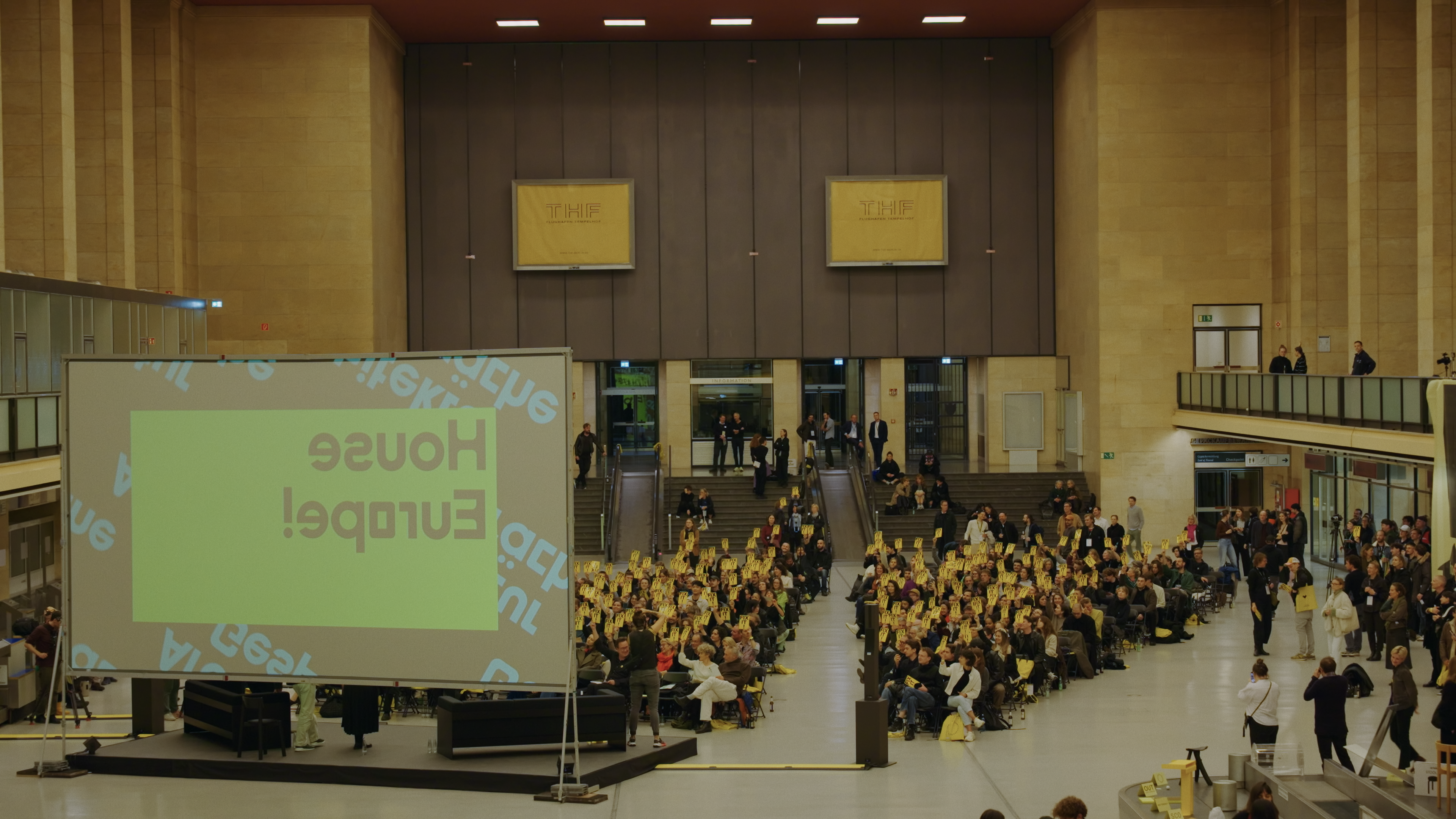
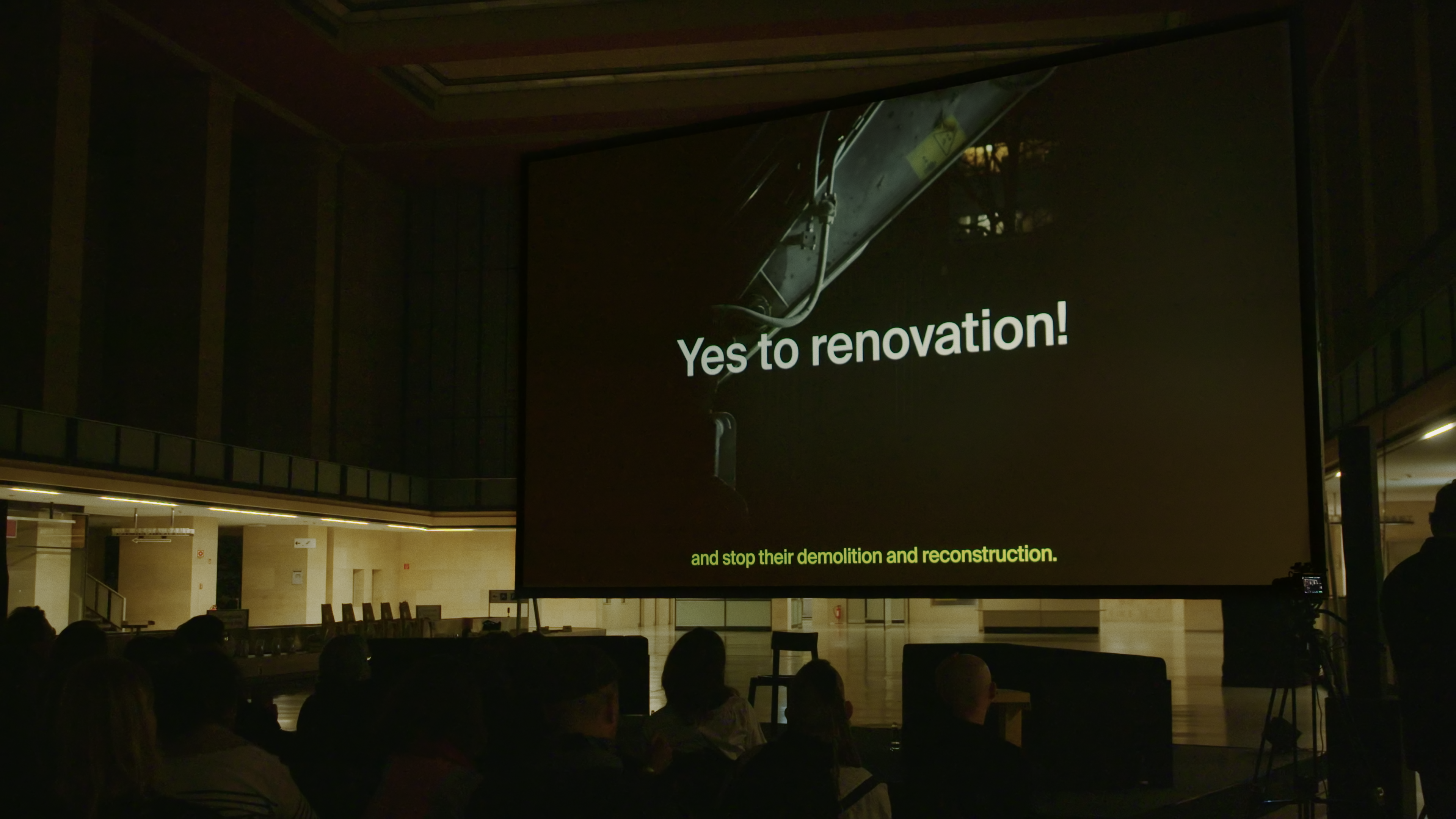
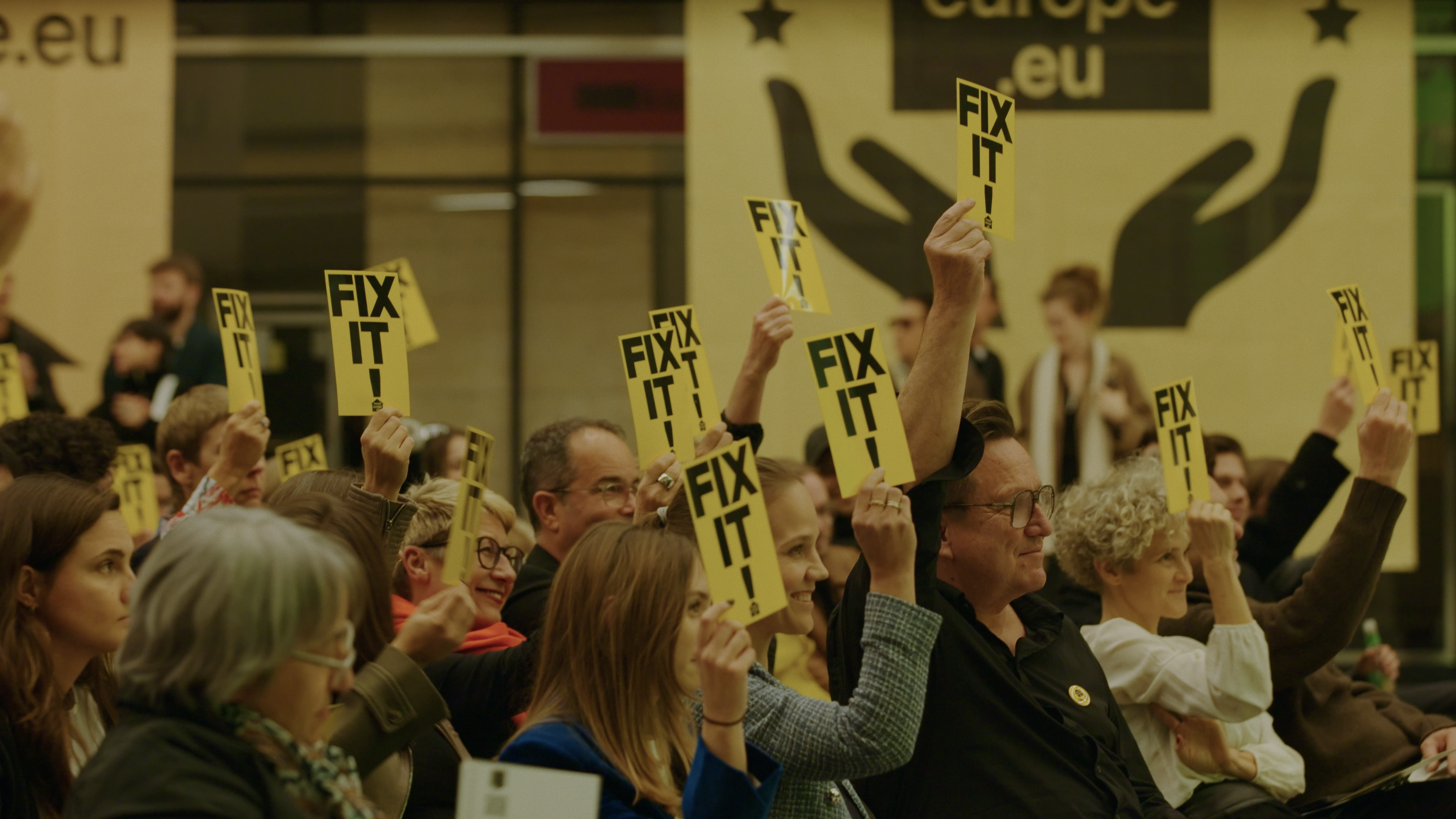
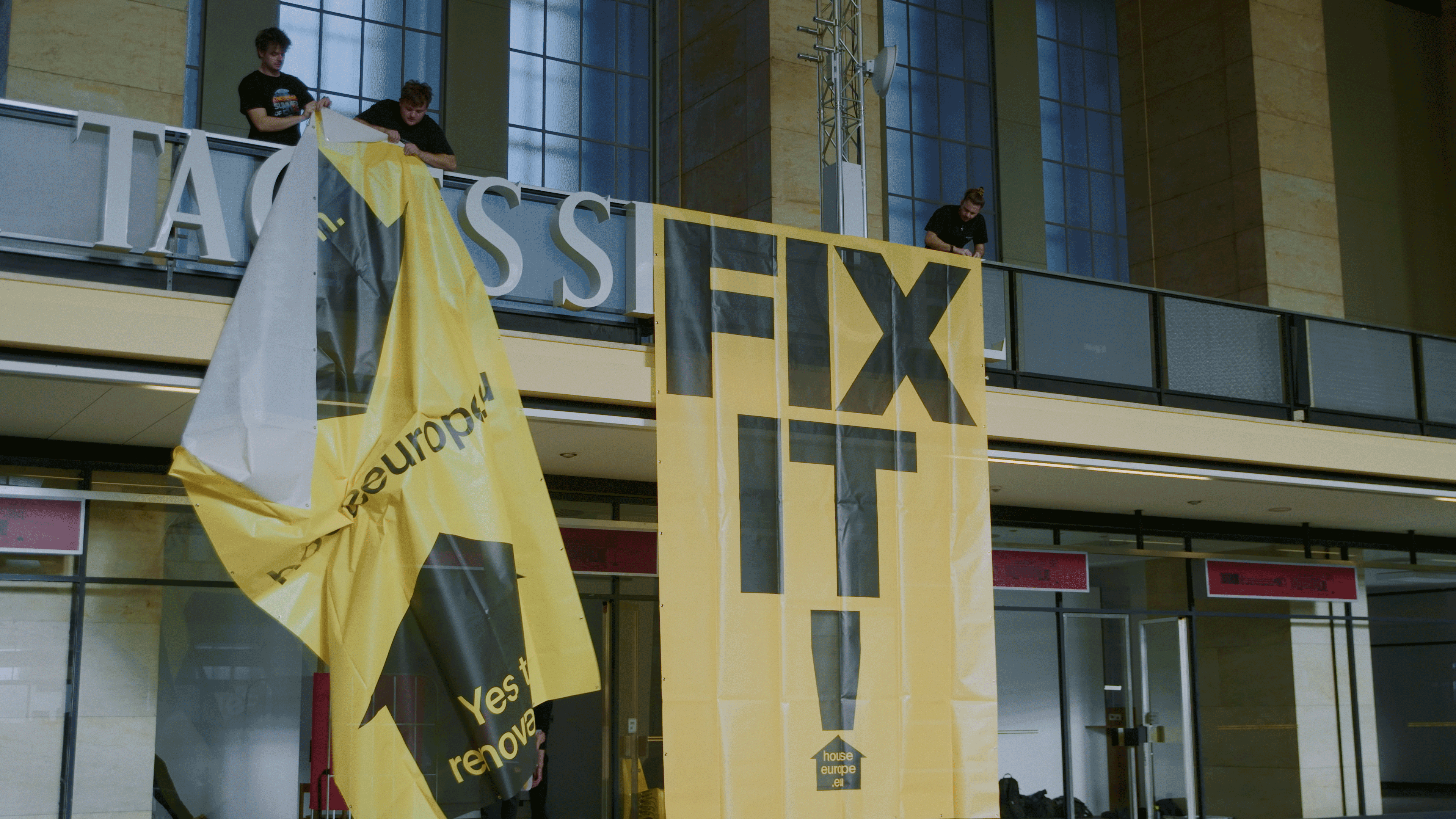
The first completed European Citizens’ Initiative – "Power to Renovation" concluded in January 2026 and mobilised over 85.000 registered supporters, 800 volunteers, and 250+ partner organisations across the EU. It generated 3 million reach, 10 million views, 100+ public events, 65 exhibitions, and 50+ international press features.
Furthermore, HouseEurope! has been awarded the 2025 OBEL Award and counts among its ambassadors Pritzker Prize winners and a former UN Special Rapporteur on Housing.
HouseEurope! was born from a contradiction its founders live every day. As practicing architects who build, teach, and work with existing buildings, they saw the same pattern: the knowledge exists, legislation demands transformation, yet the industry demolishes and rebuilds for profit. No organisation connected practice to policy to public opinion in a loop that could break this cycle.
In 2023, they founded HouseEurope! as a platform that moves between all three. The first vehicle was the ECI "Power to Renovation": a legal proposal that requires citizens to actively support it, forcing the organisation to build across all 27 member states simultaneously.
Phase 1 – Network: Connecting practitioners, housing associations, developers, and architects who already work with existing buildings. Partners in every EU country – from professional chambers to individual volunteers.
Phase 2 – Evidence: An 8-country survey with 8,000 respondents on attitudes toward existing buildings. Case studies of exemplary projects, from Lacaton & Vassal's 530 Dwellings to bauburo insitu's K118.
Phase 3 – Democratic mobilisation: over 85.000 registered supporters, 250+ partner organisations, 800 volunteers, 100+ public events.
Phase 4 – Communication: Doc films including "Power to Renovation: A Question of Values" and the CCA-produced "To Build Law" documenting the ECI journey; the "Renovation Stories" series (with ETH Zurich); a TEDxBerlin talk; 65 exhibitions; reaching 3 million people. The ECI's legal demands are generating political uptake in Germany. A second ECI on housing rights launches in 2026. What started as an initiative became a community; that community is now becoming a permanent non-profit.
Team: Arno Brandlhuber (DE), Ludwig Engel (DE), Olaf Grawert (AT), Jonas Janke (DE), Maximilian Lewark (DE), Roberta Jurčić (HR), Anastasiia Kalyta (UA), Alina Kolar (AT), Jackie Orner (US), Hannah Rettl (AT), Josiane Schmidt (DE), Rosa Schuster (DE), Alexander Throm (DE).
built environment
practice of building
awareness
policy lab
social and ecological transformation
The building sector produces 38% of Europe's CO2 emissions and 36% of its waste – the single largest contributor to both. Yet the dominant practice treats embodied energy, materials, and cultural value as disposable by defaulting to demolition and new construction.
HouseEurope! addresses sustainability at the systemic level: the cultural assumption that progress requires demolition, the political absence of mandates for preservation, and the market structures that make new construction more profitable than renovation.
Concrete actions: Our 8-country survey provides large-scale evidence on public attitudes toward existing buildings – data policymakers can use to shift demand. Our ECI "Power to Renovation" proposed EU legislation to improve conditions for renovation. Our network documents proven approaches: Lacaton & Vassal transforming 530 social housing units without displacing residents; bauburo insitu's K118 demonstrating circular reuse of building components at scale.
Results: The OBEL Award recognised our systemic approach. The ECI's legal demands – the "Right to Reuse" – are being prepared for submission to the German parliament at state level, showing how European-level advocacy translates into national legislative action. Our coalition of 250+ organisations represents cross-sectoral commitment to stock transformation connecting environmental and social sustainability.
Exemplary character: Most sustainability initiatives focus on individual buildings or technologies. HouseEurope! targets the system – connecting evidence, democracy, and public opinion to make sustainable building practice the norm. The renovation market is one of Europe's largest growth sectors; we work to ensure this growth serves people and planet.
Working with existing buildings produces a fundamentally different aesthetic. The dominant model – the polished rendering, the predetermined image implemented through new products – is replaced by a process of discovery. When you renovate, you encounter what is already there: materials, structures, traces of use, spatial qualities no one planned. Design becomes reading and responding rather than imposing.
This is not nostalgia but a pragmatic aesthetic emerging from the encounter between what exists and what is needed. It requires different skills: improvisation, working with constraints, finding beauty in the already-built.
HouseEurope! makes this aesthetic visible. The Renovation Atlas – a growing archive mapping successful transformation projects across Europe – collects built evidence. Our network includes practices defining this approach: Lacaton & Vassal's transformation of social housing that preserves while adding; &bogdan's Cosmopolitan converting offices to housing in Brussels; Esch Sintzel's dwellings in a former wine warehouse; NL Architects' deFlat reimagining mass housing; AMUNT's Haus Schreber; bauburo insitu's K118 built from reused components.
The "Renovation Stories" film series, produced with ETH Zurich's chair for Architecture and Storytelling, documents these practices across countries – making visible how transformation produces spaces that carry history, show layers of time, and connect people to place.
Exemplary character: HouseEurope! shifts the cultural framework within which beauty is understood – from the new and pristine to the adapted and layered. Through 65 exhibitions, films, and 3 million people reached, we create a new desire for what already exists.
HouseEurope! addresses inclusion in governance, in access to housing, and in who shapes EU building policy.
Democratic inclusion: The ECI is the only instrument allowing citizens to directly propose EU legislation. "Power to Renovation" mobilised over 85.000 registered supporters, 250+ organisations, and 800 volunteers – giving citizens a direct voice in building policy otherwise dominated by industry. Our upcoming ECI "A Right to Housing" (July 2026) frames access to adequate housing as a fundamental right, developed with Housing Europe, The Shift, and actors across the housing justice sector.
Economic inclusion: 40% of European household income goes to housing. By advocating for renovation over demolition, we support approaches delivering affordable housing without the cost structures of new construction. Projects in our network – from Lacaton & Vassal's 530 dwellings transformed without displacing residents to cooperative models across Europe – demonstrate that existing buildings serve communities priced out by new development.
Governance inclusion: ECI legal proposals are developed through open processes. The "A Right to Housing" text is being co-written with hundreds of representatives from housing associations, tenant unions, professional chambers, and advocacy groups – co-creation of legislation, not consultation after the fact.
Pan-European inclusion: Our network spans all 27 member states, including countries where discourse on building stock transformation is less developed. 60,000+ followers ensure the conversation reaches beyond expert circles.
Exemplary character: HouseEurope! practises inclusion through the most direct democratic instrument the EU offers, involving the widest possible range of actors in shaping legislation.
Participation is the mechanism through which HouseEurope! operates.
Scale: "Power to Renovation" engaged over 85.000 registered supporters, 800 volunteers, 250+ partners, and generated 100+ public events across Europe. The coalition spans institutional partners (ACE, Deutsche Umwelthilfe, NABU, DGNB), educational partners (ETH Zurich, Politecnico di Milano), supporting practices (Herzog & de Meuron, Lacaton & Vassal, OMA), and ambassadors including Pritzker Prize winners and a former UN Special Rapporteur on Housing.
Co-creation of legislation: The ECI text has being co-written with individuals representing organisations across housing, architecture, climate, and social justice. Contributors shape the legislative language through direct co-authorship – not through a feedback form.
Local-to-European participation: Partners in each EU member state are contributors and multipliers – from established institutions to individual volunteers. This breadth is deliberate: transforming the building sector requires voices from every part of society.
Public participation through communication: 3 million people reached, 10 million views, 60,000+ followers. The "Renovation Stories" film series makes participation possible through storytelling – allowing people to engage with transformation without requiring expert knowledge.
Impact: The coalition spans the full value chain from architects to developers to tenants – so proposals are grounded in real constraints. This has produced political uptake: the ECI's legal demands are being prepared for submission to the German parliament. The upcoming Berlin event (March 2026, with Heinrich-Boll-Foundation) brings MEPs, Bundestag members, architects, and tenant associations into direct exchange with citizens.
HouseEurope! operates at the intersection of European, national, and local governance – because building policy does. Energy standards are increasingly European, building codes national, planning permissions local. No single level can drive transformation alone.
European level: The ECI directly addresses EU institutions. "Power to Renovation" proposed legislation to the European Commission. "A Right to Housing" continues this, supported by Housing Europe, The Shift, and MEPs across political groups.
National level: In Germany, the legal demands from "Power to Renovation" – the "Right to Reuse" – are being prepared for parliamentary submission at state level, taken up by a political party. National events like with the Heinrich-Boll-Foundatio bring together members of the European Parliament, the German Bundestag, and a state parliament, alongside the Federal Chamber of Architects and Berlin's largest tenant association – deliberately bridging governance levels and political parties from left to conservative.
Local level: Building transformation happens locally. Our practitioner network documents concrete projects across Europe. When European evidence enters local contexts, local actors gain arguments and legitimacy, while the European level gains grounded examples.
Cross-level feedback: Most organisations operate at one level. HouseEurope! creates a loop: local practice informs European proposals, European strategy provides frameworks for local action. The Berlin event exemplifies this – one evening, four governance levels, one shared question: how existing buildings can address the housing and climate crisis simultaneously.
HouseEurope! is transdisciplinary by necessity. Transforming existing buildings requires architecture, engineering, economics, law, social science, communication, and political science working together.
This is reflected in the core team: co-founded by architects Olaf Grawert and Arno Brandlhuber, it includes ECI campaign managers, a European policy officer, social media and community managers (Instagram, TikTok, LinkedIn), and content creators for exhibitions and digital media. Beyond the core, the network brings together practicing architects, developers, housing associations, researchers, and legal experts drafting ECI proposals that must meet EU legislative standards.
How collaboration works: The legal text is developed with hundreds of contributors across disciplines – housing law experts, architects, tenant advocates, economists. Each contributes domain knowledge while engaging perspectives outside their field. The result must be simultaneously legally precise, technically grounded, politically viable, and publicly communicable.
The "Renovation Stories" film series and the documentary "Power to Renovation" (both produced with ETH Zurich) combine architectural expertise with storytelling. The Holcim Foundation Fellowship, hosted by HouseEurope!/s+ at ETH Zurich, brings international students to Brussels to engage with stakeholders across the building value chain – from architects and developers to investors and policymakers – learning to design arguments for systemic change through direct encounter.
Benefits: Policy proposals are technically grounded because practitioners contribute, legally sound because legal experts draft them, democratically legitimate because citizens sign them, and publicly visible because communication professionals translate them.
HouseEurope! is a non-profit organisation registered in Germany (gemeinnützige GmbH).
Funding: Grants, prize money (including the OBEL Award), and private donations. A significant share of capacity comes from non-monetary contributions by partners: knowledge, research, event hosting, travel support, and professional expertise in-kind. This distributes costs across the coalition rather than concentrating them centrally.
Cost structure: The core team combines leadership, campaign management, EU policy expertise, communications, and content creation – covering the full practice-policy-public loop. Major activities are co-produced with partners: 800 volunteers contributed to the first ECI. 250+ partner organisations co-host events, share research, and extend reach.
Value creation: While HouseEurope! does not generate direct revenue, it creates value by advancing the renovation market – one of Europe's largest growth sectors. Political uptake of ECI demands demonstrates that platform outputs translate into regulatory change. Strategic partnerships with institutions like the Holcim Foundation (educational fellowship programme), the Canadian Centre for Architecture (documentary co-production), and ETH Zurich extend impact beyond the organisation's own capacity.
Scalability: Each new partner extends reach without proportionally increasing costs. The ECI framework is replicable – a second is launching. The model has been validated: from zero to 250+ partners, 82,631 supporters, and the OBEL Award in under three years.
Disruptive potential: HouseEurope! demonstrates that systemic policy change does not require large institutional budgets – it requires connecting practice, democracy, and communication through a strategic platform.
HouseEurope! was designed for replicability. Its core components – evidence from practice, democratic participation, and public communication – are each independently transferable.
The ECI as replicable tool: A standardised EU instrument. Our experience – coalition building, legal drafting, signature collection across 27 countries – is documented methodology applicable to other policy domains. We are already replicating it: "A Right to Housing" builds on lessons from "Power to Renovation."
The survey methodology: The 8-country, 8,000-respondent survey can be replicated in additional countries or adapted to other questions. It serves as a template for evidence on public attitudes toward sustainability transitions in any sector.
The network model: Pan-European presence built by identifying existing actors, not creating new structures. Directly replicable: find people already doing the work, connect local action to European impact.
The practice-policy-public loop: The most transferable element. Other sectors where technical solutions exist but cultural and political barriers prevent adoption can apply the same logic: energy, food systems, mobility, circular economy all face the same gap between knowledge and action.
Proven at scale: From zero to 250+ partners, over 85.000 supporters, 800 volunteers, 3 million people reached, the OBEL Award, and political uptake in national parliaments – in under three years. The model works and the results are documented.
Adaptation: Content changes by sector and geography. ECIs require EU procedural knowledge. But the structural approach – evidence, democratic instruments, public communication in a reinforcing loop – is sector-agnostic.