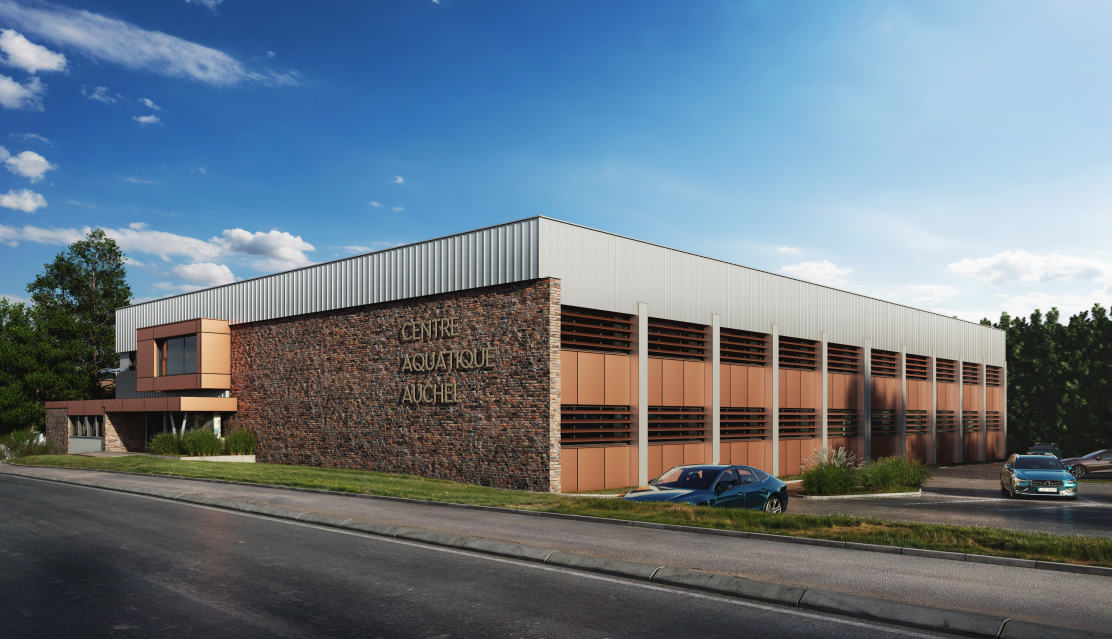
Enhancing Circularity, Sustainability, and Innovation
Auchel pool: From energy waste to value
Auchel public pool renovation: turning energy waste into low-carbon value through circular energy
The Auchel public pool renovation transforms one of the most energy-intensive public buildings into a low-carbon facility. By recovering heat from humid air (Terrao), greywater (Greenheat), and using geothermal energy from the parking area (PowerRoad), the project turns wasted energy into a valuable resource. It cuts energy use by 52% (1,140 MWh/year) and 308 tons of CO₂ annually, while improving comfort and reducing costs.
France
Local
Auchel, France
Mainly urban
It involves a physical transformation of the built environment (hard investment)
Prototype level
No
No
No
Organisation
The renovation of the Auchel public pool aims to transform one of the most energy-intensive public buildings into a low-carbon, efficient and sustainable facility. Based on a comprehensive energy audit, the project combines a set of innovative and complementary solutions to drastically reduce energy consumption while improving user comfort and operational efficiency.
The concept relies on a circular energy approach. Heat is recovered from humid air in the pool hall through the Terrao system, from greywater using Greenheat technology, and from the ground beneath the parking area via geothermal energy (PowerRoad). These systems convert unavoidable energy losses into valuable resources. They are complemented by a building management system (GTC), optimized water renewal, and targeted improvements to the building envelope.
Expected results are significant, with a 52% reduction in total energy consumption (around 1,140 MWh/year) and a decrease of approximately 308 tons of CO₂ emissions annually. The project will also improve indoor air quality, thermal comfort, and the overall experience for users, including schools and local associations.
Beyond its technical performance, the project demonstrates how existing public infrastructure can be transformed into sustainable assets. As public pools are among the most energy-intensive facilities, this project is designed as a replicable model for the decarbonization of public pools across the territory and at a wider European scale, supporting the transition towards low-carbon public services.
The concept emerged from a clear and urgent reality: public buildings, especially swimming pools, are among the most energy-intensive infrastructures, and their environmental impact is becoming increasingly unsustainable in the context of climate change. Rising energy costs and the need to reduce greenhouse gas emissions made it essential to rethink how such facilities operate.
In this context, the Auchel public pool was identified as a priority site. An in-depth energy audit was carried out to better understand consumption patterns, identify major energy losses, and define realistic improvement scenarios. This analysis highlighted significant heat losses from building thermal envelope, humid air, water renewal, and building systems.
The project was then developed through a systemic approach, aiming not only to reduce energy consumption but to transform losses into resources. Several innovative solutions were combined: renovate the building's thermal envelope, heat recovery from humid air (Terrao), greywater energy recovery (Greenheat), and geothermal energy from the parking area (PowerRoad). These technologies were selected and dimensioned based on technical feasibility, energy performance, and integration into the existing infrastructure.
The concept also integrates smart energy management (GTC), optimization of water use, and targeted improvements to the building envelope. The process involved close collaboration between engineers, technical partners, and the local authority to ensure a coherent and efficient strategy.
Ultimately, the project reflects a broader ambition: to actively contribute to the ecological transition by transforming a highly energy-consuming public facility into a resilient, low-carbon and sustainable asset.
Low-carbon renovation
Circular energy
Energy recovery
Public infrastructure
Energy management (GTC)
The Auchel public pool renovation directly addresses major environmental and economic challenges by significantly reducing the energy consumption and carbon footprint of one of the most energy-intensive public facilities. In the context of climate change and rising energy costs, the project provides a concrete and scalable response to the need for sustainable public infrastructure.
The concept is based on a circular energy approach, transforming energy losses into usable resources. Heat is recovered from humid air (Terrao), greywater (Greenheat), and the ground beneath the parking area (PowerRoad), reducing reliance on fossil fuels. Combined with smart energy management (GTC) and optimized water use, this approach leads to a 52% reduction in energy consumption (1,140 MWh/year) and avoids approximately 308 tons of CO₂ emissions annually.
Beyond environmental impact, the project also addresses economic challenges by lowering operating costs, helping ensure the long-term viability of the facility for the local authority. Socially, it improves indoor comfort, air quality, and user experience, benefiting schools, associations, and residents.
This project can be considered exemplary in terms of sustainability because it demonstrates how existing public infrastructure can be transformed through an integrated, innovative and replicable approach. It offers a practical model for the decarbonization of public pools, supporting the transition towards more resilient and sustainable communities.
The Auchel public pool renovation contributes to making everyday life more pleasant by improving the quality, comfort and atmosphere of a key public space used by the local community. Beyond its technical performance, the project enhances the sensory experience of users through better thermal comfort, improved air quality and a more stable indoor climate, making the space healthier and more enjoyable.
By reducing humidity levels and optimizing ventilation, the project creates a more comfortable and welcoming environment for swimmers, schools and associations. The modernization of technical systems also contributes to a quieter and more balanced indoor atmosphere, improving overall well-being.
In the longer term, the project strengthens the relationship between people and their public infrastructure. By preserving and upgrading an existing facility rather than replacing it, it reinforces a sense of continuity, local identity and care for shared spaces. It demonstrates that sustainability and technical innovation can directly contribute to the quality of everyday life.
The project can be considered exemplary in terms of aesthetics as it shows that “beauty” is not only visual, but also experiential: a comfortable, healthy and sustainable environment where people feel good, and which reflects a collective commitment to a better future.
The Auchel public pool renovation promotes inclusion by ensuring long-term access to a key public service for all users, regardless of age, income or physical ability. Swimming pools play a crucial role in public health, education and social cohesion, especially for schools, families and local associations. By reducing operating costs through significant energy savings, the project helps maintain affordable access and prevents potential closure due to rising energy expenses.
The project also improves accessibility and user experience by enhancing indoor comfort, air quality and thermal stability. A healthier and more pleasant environment benefits all users, including children, elderly people and more vulnerable groups who are particularly sensitive to temperature and humidity conditions.
In addition, the project is developed through a collaborative approach involving technical experts, public stakeholders and the local authority, ensuring that decisions are aligned with public needs and long-term community benefits. It reflects a governance model based on responsible resource management and public interest.
Finally, by proposing a replicable model for the sustainable renovation of public pools, the project contributes to a broader societal transition where essential services remain accessible while reducing environmental impact. It demonstrates that ecological transition and social inclusion can go hand in hand, making public infrastructure both sustainable and equitable.
The concept has been developed through a collaborative and iterative process involving technical experts, local authority representatives, facility operators and end users. From the early stages, the energy audit played a key role not only as a technical tool but also as a means to better understand real usage patterns, operational constraints and user expectations.
Users such as schools, sports associations and regular visitors were indirectly involved through feedback on comfort conditions, including air quality, temperature stability and overall usability of the facility. These insights helped identify key issues such as excessive humidity, thermal discomfort and the need to maintain affordable access.
This participatory approach directly influenced the design of the project. For instance, improving indoor climate stability, reducing noise from technical systems and ensuring long-term affordability became central objectives. Facility managers and technical staff also contributed by sharing their operational experience, ensuring that proposed solutions remain practical and maintainable.
As a result, the project goes beyond a purely technical renovation. It reflects a shared vision between stakeholders and users, improving both performance and everyday experience. This inclusive process strengthens user acceptance, fosters a sense of ownership and ensures that the renovated facility truly responds to the needs of the community.
The project is structured around a multilevel governance approach, involving stakeholders from local to European levels in order to ensure coherence, efficiency and scalability.
At the local level, the agglomeration authority (CABBALR) leads the project, working closely with facility managers, technical services and users. Their involvement ensures that the project responds to local needs and operational realities.
At the regional level, the project aligns with the REV3 dynamic, which promotes sustainable and innovative development. Regional support mechanisms provide both financial leverage and strategic guidance, reinforcing the project’s ambition.
At the national level, the project contributes to France’s energy transition objectives, particularly in reducing greenhouse gas emissions and improving the energy performance of public buildings. It complies with regulatory frameworks and supports national climate commitments.
At the European level, the project directly contributes to the objectives of the New European Bauhaus by combining sustainability, inclusion and quality of life. Its design as a replicable model increases its relevance for other European territories.
This multilevel governance ensures access to diverse expertise, facilitates funding opportunities and enhances the project’s visibility and impact. It also strengthens its potential to be replicated and adapted across different contexts.
The project is inherently transdisciplinary, combining multiple fields of expertise to deliver a comprehensive and integrated solution.
Engineering and energy systems play a central role, with detailed energy audits and the implementation of innovative solutions such as heat recovery from humid air, greywater energy recovery and geothermal systems. These are complemented by environmental sciences, focusing on decarbonization, energy efficiency and resource optimization.
Digital technologies are also essential, particularly through the integration of a building management system (GTC/GTB), enabling real-time monitoring and optimization of energy consumption. This smart approach ensures long-term performance and adaptability.
At the same time, the project incorporates public service management considerations, ensuring that the facility remains functional, accessible and economically viable. Social aspects are equally important, with a strong focus on user comfort, health conditions and accessibility for all.
By combining these disciplines, the project moves beyond a purely technical intervention. It creates a holistic transformation that integrates environmental performance, operational efficiency and human experience. This approach reflects the NEB ambition to bridge technical innovation with cultural, social and experiential dimensions.
The project is based on a hybrid and resilient financial model designed to ensure long-term sustainability.
It relies primarily on public investment from the local authority, reflecting the importance of maintaining essential public services. This investment is complemented by regional and European funding opportunities, including REV3 and the New European Bauhaus, which support innovative and sustainable projects.
A key component of the model is the energy savings generated by the project. With an expected reduction of around 52% in energy consumption, operational costs will significantly decrease. These savings contribute directly to the financial balance of the facility, allowing the local authority to reinvest in maintenance, improvements or other public services.
In addition, the project opens the possibility for third-party financing mechanisms, particularly for energy recovery systems, where investment costs can be partially offset by future energy savings.
This model ensures that the project is not only environmentally sustainable but also economically viable. By reducing dependency on volatile energy prices and stabilizing operating costs, it helps maintain affordable access for users while securing the long-term operation of the facility.
The concept has been designed from the outset as a replicable and scalable model for other public infrastructures.
Its strength lies in a clear and transferable methodological approach: starting with a detailed energy audit, identifying major sources of energy loss, and implementing circular energy solutions adapted to the building. This structured process can be applied to many similar facilities.
The technological solutions used—such as heat recovery from humid air, greywater energy recovery, geothermal systems and smart energy management—are modular and adaptable to different contexts, sizes and budgets.
In addition, the project includes operational strategies, such as energy monitoring, optimization of water use and improved maintenance practices, which can easily be transferred to other sites.
Public swimming pools are among the most energy-intensive buildings across Europe, making this project particularly relevant. By demonstrating how such facilities can be transformed into low-carbon assets, the project provides a concrete and scalable pathway for the decarbonization of public infrastructure.
Over the next 12 months, the project will move from design to implementation through several key steps.
First, technical studies will be finalized to validate the selected solutions and ensure their integration into the existing infrastructure. This phase will include detailed engineering, cost optimization and risk assessment.
Second, the project will focus on securing funding and launching procurement procedures. This includes mobilizing public investment, applying for regional and European funding, and engaging with technical partners.
Third, the implementation of priority measures will begin, particularly those related to energy management systems (GTC/GTB) and initial energy recovery solutions. These early actions will generate the first measurable impacts.
At the same time, monitoring tools will be deployed to track energy performance, emissions reduction and user comfort. This data will be essential for evaluating the project and demonstrating its effectiveness.
Finally, the project will include communication and knowledge-sharing actions, such as presentations, technical feedback and dissemination of results, in order to support replication.
Expected outcomes within the first year include initial energy savings, improved indoor conditions and the establishment of a robust, replicable framework for other facilities.