Enhancing Circularity, Sustainability, and Innovation
LoopCorner
Transforming near-expiry food into a measurable circular consumption experience
LoopCorner transforms near-expiry food into a smart, desirable choice. Through a vibrant in-store corner and a rewarding digital experience, we help supermarkets reduce waste while shoppers discover affordable meals, save food, and track their impact — turning everyday purchases into a more circular way of living.
Portugal
Regional
Lisbon, Portugal
Mainly urban
It refers to other types of transformations (soft investment)
Early concept
Yes
Grow NEB (EIT)
No
No
Individual
Every day, European supermarkets discard thousands of tonnes of food, not because it is unsafe, but because consumers perceive near-expiry products as undesirable. This perception, reinforced by discount stickers and bottom-shelf placement, turns perfectly good food into waste.
Born from the LX Circular Hackathon in Lisbon, LoopCorner is a phygital concept that transforms near-expiry food from a hidden retail loss into a visible, desirable, and measurable circular consumption experience.
We do this through two integrated dimensions:
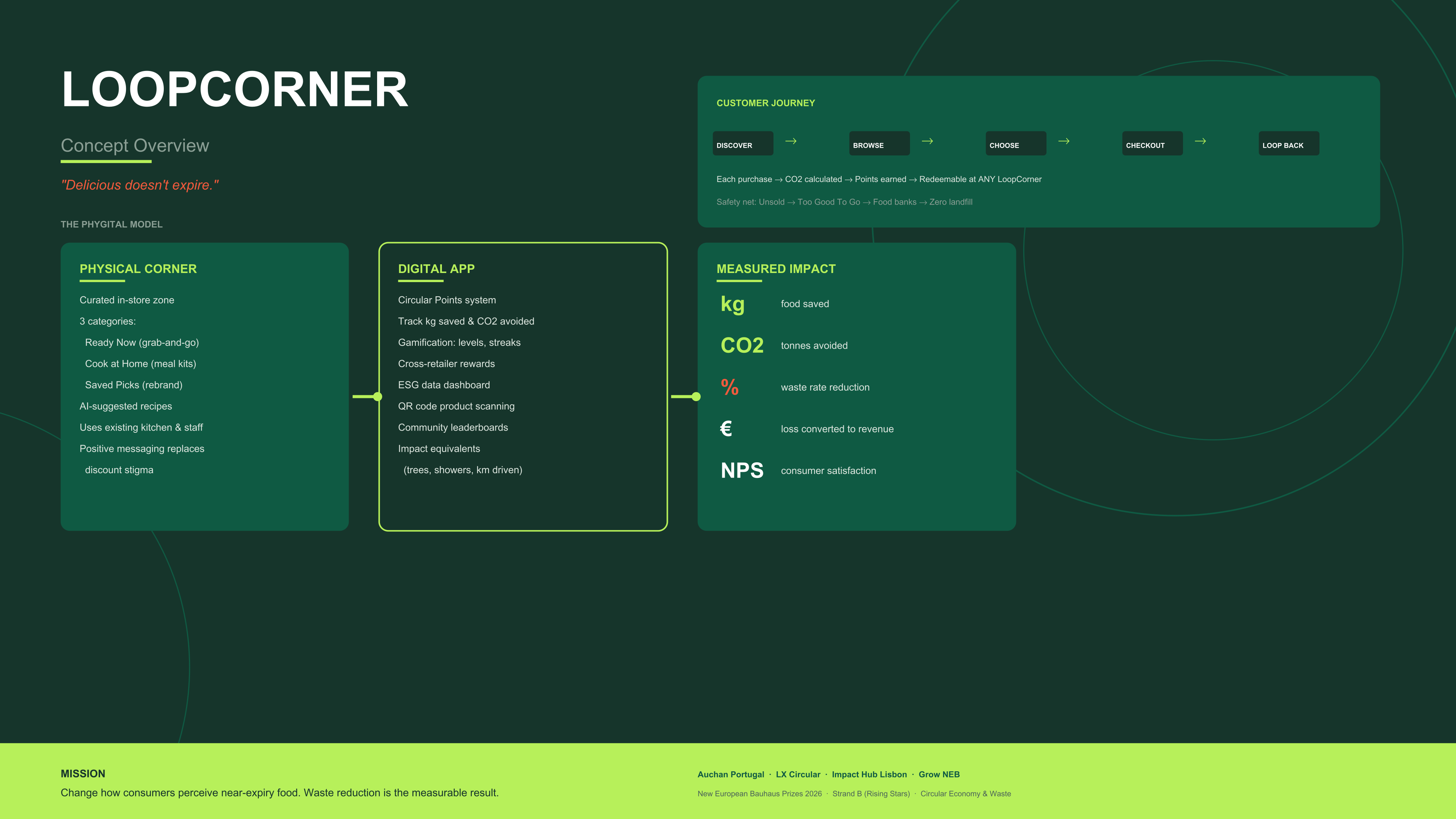
- A physical LoopCorner inside the supermarket: a curated and visually appealing area offering ready-to-eat meals, meal kits for home cooking, and near-expiry products. All branded with positive messaging that replaces discount stigma with conscious choice.
- A digital platform that tracks each consumer’s impact (kg of food saved, CO₂ avoided), rewards participation through points and badges, and builds a community of conscious consumers.
Together, these physical and digital streams close the loop: every purchase made in the LoopCorner is reflected in the app as points that can be converted into benefits, such as vouchers and discounts, encouraging consumers to return and continue purchasing within the LoopCorner. Within this dynamic, our target groups are everyday supermarket shoppers, sustainability-minded consumers, and budget-conscious families seeking quality meals at accessible prices.
Achieved so far: we won the LX Circular Hackathon responding to Auchan’s food waste challenge, were selected for the Grow NEB program, participated in Slush to sharpen our product and scaling strategy, conducted consumer interviews validating the perception barrier, and are now designing a pilot with Auchan in Lisbon.
LoopCorner began in October 2025 at the LX Circular hackathon, organised by Impact Hub Lisbon. Auchan, one of Portugal’s largest food retailers, posed the challenge: how can we reduce food waste in stores?
Our team of five, spanning innovation & entrepreneurship, business consulting, environmental science, and architecture/urbanism, four women and one man, came together around a shared conviction: the real problem is not the food, but how people perceive it. During the hackathon weekend, we conducted informal interviews with consumers and quickly confirmed that near-expiry products carry a stigma. People associate them with decline, not opportunity.
That insight shaped everything. Instead of building another discount or redistribution tool, we designed a concept that intervenes at the perception level: a dedicated, curated in-store space paired with a digital experience that makes choosing near-expiry food feel smart and rewarding.
We pitched the concept to a jury that included Auchan’s operational team. They selected LoopCorner as the winning project and committed to co-designing a pilot. Mentors from Impact Hub and food industry experts challenged our assumptions on food safety, pricing, and scalability throughout the hackathon.
After the hackathon, we were selected for the Grow NEB accelerator and participated in mentoring sessions and workshops with IES (Social Business School), which helped us sharpen our solution, define the startup model, and structure our value proposition. At Slush, we explored product strategy, AI integration for stock-based recipe suggestions and dynamic pricing, and white-label scaling potential.
We are now designing a pilot with Auchan in Lisbon, structured to validate three hypotheses: sufficient daily product volume, operational viability within existing store processes, and consumer acceptance of the reframed near-expiry proposition.
circular economy
food waste prevention
behavioural change
conscious consumption
retail inclusion
Every year, the EU generates over 58 million tonnes of food waste, valued at €132 billion, while over 42 million people cannot afford a quality meal every second day. Portugal ranks among the highest in Europe at 185 kg per capita. Food waste accounts for about 16% of greenhouse gas emissions from the EU food system. LoopCorner addresses this at its root cause: instead of spoilage, perception.
Our objective is to prevent food waste at the retail level by intercepting near-expiry products and transforming them into desirable propositions. Products 1 to 3 days from expiry are screened daily using existing inventory systems. An AI-assisted tool suggests uses, as ingredients for ready-to-eat meals, meal kits for home cooking, or individually sold items with positive branding. These are placed in the LoopCorner, a dedicated in-store area. Unsold items flow to redistribution partners such as Too Good To Go, creating a layered system where prevention comes first.
This embodies circularity and lifecycle thinking: LoopCorner intervenes upstream, extending the useful life of food and capturing its value before it exits the consumption cycle.
Through our pilot with Auchan, we will measure kg of food saved per month, waste reduction by category, and estimated CO₂ avoided. These metrics form the basis of our impact-based business model, linking financial sustainability directly to environmental outcomes.
LoopCorner aligns with Portugal’s ENCDA 2025+ strategy targeting 50% retail food waste reduction by 2030, and with EU Farm to Fork objectives. What makes our approach exemplary is that it does not devalue food through discounting, it adds value through design, experience, and behavioural change.
The greatest obstacle to near-expiry food is not its quality, but the way it is perceived. Discount stickers, bottom-shelf placement, and clearance bins turn perfectly good food into something visually and emotionally undesirable. LoopCorner responds to this through design: it transforms the act of choosing near-expiry food into a positive, attractive, and conscious experience.
Our concept combines two complementary dimensions: a physical in-store space and a digital journey. In the supermarket, LoopCorner is conceived as a distinct and inviting corner with its own visual identity, warm materials, and a market-like atmosphere. Rather than signalling compromise, it creates a sense of care, dignity, and discovery. Positive labels such as “Salva este alimento” and “Feito com consciência” replace the language of discount with a language of purpose.
The experience is also sensory. Ready-to-eat meals and meal kits, prepared from near-expiry ingredients, appeal through taste, smell, and presentation, making sustainable choice easy, immediate, and desirable. In this way, convenience and beauty work together to support new habits.
The digital platform extends this experience over time. Through impact tracking, badges, shared progress, and redeemable points, consumers can see the value of their choices and feel part of something larger than a single purchase. The platform builds continuity, engagement, and a sense of belonging around conscious consumption.
Rooted in Portuguese food culture, LoopCorner gives the value of not wasting food a new, contemporary, and desirable form, making conscious consumption a shared identity people are proud to adopt.
Near-expiry food carries a double exclusion. For lower-income consumers, it is often the only affordable option, yet choosing it feels stigmatizing. For higher-income consumers, it is invisible. LoopCorner addresses both barriers by removing the stigma and making near-expiry food a desirable choice for everyone, regardless of income.
Affordability is our most direct inclusion lever. LoopCorner products are priced below standard alternatives, making quality food accessible to budget-constrained households. But unlike traditional discounting, the experience does not mark the buyer. There is no “reduced” label, no clearance shelf. Everyone who shops at the LoopCorner is making the same choice: a conscious one. This removes the psychological barrier that disproportionately affects people who feel judged for buying cheaper food. Buying from Loop Corner becomes a conscious and desirable choice, aligned with sustainability and purpose, and driven by convenience and loyalty, where price is an added benefit, not the primary motivation.
The physical format is inherently inclusive: no app download, no registration, no digital literacy required to browse and buy. The digital layer is additive and optional, not a gateway. This ensures that older shoppers, people with limited digital access, and anyone unfamiliar with apps can participate fully.
The concept works across generations. Meal kits encourage shared cooking at home, bringing families together. Gamification engages younger, digitally native consumers. The physical corner speaks to older generations who value not wasting food as a cultural practice.
We are exploring partnerships with food banks and social organisations: food not sold through the LoopCorner can be redirected to communities in need, extending inclusion beyond the store. Our team, four women and one man from diverse disciplinary backgrounds, reflects our commitment to inclusive perspectives in the design process.
LoopCorner was not designed in isolation. From its first hours, the concept was shaped through interaction with the people it aims to serve and the stakeholders needed to make it work.
During the LX Circular Hackathon, we conducted informal interviews with consumers. These confirmed our central hypothesis: near-expiry products are avoided not because of quality concerns, but because of stigma. Shoppers described feeling uncomfortable choosing visibly discounted food. This insight became the foundation of the concept: the decision to design around perception change came directly from listening to how people experience near-expiry food.
Auchan’s operational team played a decisive role as jury members during the hackathon pitch, evaluating the concept against practical retail realities. Their selection of LoopCorner validated that it was not only innovative but operationally credible. We are now co-designing the pilot with Auchan, where their knowledge of product flows, expiry management, and in-store logistics directly informs the workflow.
Mentors from Impact Hub Lisbon and food industry experts provided structured feedback throughout the hackathon, challenging assumptions on food safety, preparation, and pricing. After the hackathon, workshops with IES (Social Business School) helped us refine the startup model and structure the business logic.
We also engaged with local community organisations and NGOs, exploring how unsold LoopCorner products could be redirected to food banks, extending impact beyond commercial consumers to vulnerable communities.
The pilot is designed to deepen participation: we plan to collect structured feedback from at least 20 users, using their input to iterate on product selection, pricing, the physical space, and the digital experience.
LoopCorner connects stakeholders across multiple levels: from a single supermarket in Lisbon to EU-wide policy frameworks.
At the private sector level, Auchan is our primary partner. As a multinational retailer, Auchan brings operational scale and a strategic interest in ESG performance. LoopCorner offers a way to monetise near-expiry products that currently generate losses, while producing quantifiable sustainability data for corporate reporting. The pilot is being co-designed with their team.
At the civic and innovation ecosystem level, Impact Hub Lisbon and the LX Circular Hackathon provided the launchpad. IES (Social Business School) supported post-hackathon development. The Grow NEB accelerator connected us to European circular economy networks and the New European Bauhaus community.
At the national level, LoopCorner aligns with Portugal’s ENCDA 2025+ strategy, which targets a 50% reduction in retail food waste by 2030 and calls for consumer-centred solutions developed in collaboration between retailers, municipalities, and civil society.
At the municipal level, Lisbon’s circular economy strategy and the Food Transition Strategy for the Metropolitan Area, approved in February 2025, both emphasise reducing food waste and building sustainable local food systems. LoopCorner contributes from within existing commercial infrastructure, the supermarket, rather than requiring new public investment.
At the EU level, the concept supports the Farm to Fork Strategy and the binding food waste reduction targets adopted in 2025, requiring a 30% reduction in retail and household food waste by 2030. As LoopCorner scales, potential stakeholders include other retail chains, municipal waste authorities, and EU food policy networks.
LoopCorner required knowledge from fields that do not typically converge around food waste. Our team of five spans architecture and urbanism, biology and environmental management, international business, sustainability research, and collaborative strategy. The team is multicultural, with members from Portugal, Brazil, and Switzerland.
Marina Sung, trained in architecture, urbanism, and entrepreneurship, shapes the spatial design of the LoopCorner and has worked on circular economy projects in packaging waste. Sofia Firmino and Janete João, biologists specialising in ecology and environmental management, ground the concept in scientific rigour, from lifecycle thinking to the impact framework. Diogo Afonso brings international business and sustainability research, with prior circular economy experience. Gabriella Kagueyama contributes innovation strategy and structures how the team collaborates with external stakeholders.
In practice, these fields interact constantly, as spatial design decisions are tested against environmental logic, and business model assumptions are questioned through a sustainability lens. The phygital format, a physical retail corner paired with a digital platform, could not have emerged from any single discipline.
The hackathon and post-hackathon process widened this further. Food industry experts raised practical questions about food safety that reshaped our workflow. Mentors from Impact Hub challenged assumptions about scalability. IES (Social Business School) helped us think through startup structure and impact business logic. Auchan’s retail team brought operational knowledge about inventory management and consumer behaviour. At Slush, conversations on AI and product strategy introduced a technology perspective we are now incorporating.
We continue to work this way as we move into the pilot with Auchan, bringing in new expertise as the project demands it.
LoopCorner’s business model is designed around a principle: revenue should come from impact. We are developing two complementary revenue streams, both being validated through our pilot with Auchan.
The first is impact-based pricing. Retailers pay a fee linked to measurable outcomes, per kilogram of food saved or per tonne of CO₂ avoided. This ties cost to environmental value, giving retailers a transparent, results-based relationship with LoopCorner. It also produces data needed for ESG reporting and compliance with EU food waste targets.
The second is a royalty on products sold through the LoopCorner section. Each meal, kit, or rebranded near-expiry item generates a shared margin. This creates a conventional revenue floor alongside the impact-based stream.
For the retailer, the logic is straightforward. Near-expiry products that currently generate total losses become a source of positive margin and brand value. The LoopCorner uses existing store space, kitchens, and inventory systems. Main costs are corner setup, branding, and digital platform development.
For LoopCorner, the model is asset-light. We provide the concept, brand, digital platform, impact measurement framework, and a playbook with training for internal implementation by the retailer’s staff. This means replication across stores and chains without heavy capital investment or ongoing dependency on our team.
The pilot will test both revenue hypotheses and establish unit economics: cost per corner, revenue per kg saved, margin per product sold, and break-even per store. These numbers will determine which stream leads as we scale, or whether both operate together.
The European grocery retail market exceeds €3 trillion, and EU food waste carries an estimated value of €132 billion annually. LoopCorner addresses a problem that exists wherever supermarkets sell perishable goods, therefore our addressable market spans every retailer handling near-expiry products.
In TAM/SAM/SOM terms: the total addressable market is the European grocery sector and its embedded food waste. Our serviceable market is the near-expiry segment across supermarkets, hypermarkets, and local food stores. Our initial obtainable market is Auchan in Portugal, starting with one pilot store in Lisbon.
The most transferable elements are the LoopCorner format, the positive reframing methodology, the implementation playbook with staff training, and the impact measurement framework, a turnkey package any retailer can adopt.
A key scaling element is the digital platform, as the app belongs to the consumer, not the retailer. Circular points earned at one retailer’s LoopCorner can be redeemed as vouchers in the LoopCorner section of any participating store. This creates a loop: consumers keep coming back, and as more retailers join, the network becomes more valuable for everyone.
Our path begins with Auchan in Lisbon, expanding to more Auchan stores, then to other leading European chains. We also plan to work with local, independent food stores, as the model adapts to smaller formats, and the cross-retailer platform makes small stores part of the same ecosystem.
What adapts locally: meal recipes follow regional food cultures, branding language is translated. What stays constant: intercept near-expiry products, transform them through design, sell through a curated experience, measure impact, and reward consumers with circular points across the network.
In the year following this application, our priority is to move LoopCorner from a validated concept into a real pilot in partnership with Auchan in Lisbon. Our implementation pathway is structured in four stages.
First, we will finalise pilot design and operational alignment with Auchan, including product selection criteria, in-store workflow, food safety procedures, pricing logic, staff roles, and the physical setup of the LoopCorner space. In parallel, we will refine the brand identity, customer journey, and communication materials needed to test the concept in a real retail environment.
Second, we will develop and test the core digital layer: impact tracking, points and rewards logic, and the basic user interface needed to connect in-store purchases with measurable consumer engagement. This phase will also include internal testing of data collection and KPI tracking.
Third, we will launch a pilot in one Auchan store in Lisbon to validate three key hypotheses: that sufficient daily near-expiry volume exists, that the concept can operate within existing retail processes, and that consumers respond positively to a reframed near-expiry offer. During this phase, we will monitor food saved, product performance, customer uptake, and user feedback.
Fourth, we will evaluate results and iterate. Based on pilot evidence, we will improve product categories, spatial design, messaging, pricing, and the digital experience. The goal is to produce a replicable implementation model, including an operational playbook, impact framework, and business model assumptions for future rollout.
This next year is therefore not only about testing LoopCorner in practice, but about building the foundations for a scalable, evidence-based model that can help supermarkets reduce food waste by changing behaviour at the moment of choice.
- https://claude.ai/public/artifacts/308d7fb8-9e5d-40c6-8811-23c59cbc349a
- https://claude.ai/public/artifacts/dece84b7-6a1d-4304-9110-0cadc3ac9466
- https://www.linkedin.com/posts/impacthub-lisbon_hackathon-lx-circular-jovens-a-tornar-activity-7389254572441067520-O26N?utm_source=share&utm_medium=member_desktop&rcm=ACoAAD5BiV4BEQcWbclYVdm-WWDhFHQSBPQe5F8