Arts, Culture, and Heritage as Drivers of Change
La Maison des Médias Libres
{Empty}
La Maison des Médias Libres is a project to reinvent the way public information is produced and disseminated. It is a workspace for dozens of media outlets and their ecosystem, a meeting place for the press and citizens. Open to the public, the space will host exhibitions, workshops, conferences, screenings, and training sessions.
France
Local
Paris
Mainly urban
It involves a physical transformation of the built environment (hard investment)
Completed
No
No
No
Individual
The Maison des Médias Libres is a pioneering cultural and civic infrastructure dedicated to reinventing how information is produced, shared and experienced in Europe. Located in Paris, it will bring together dozens of independent media organisations under one roof, offering affordable workspaces to support media pluralism and economic sustainability.
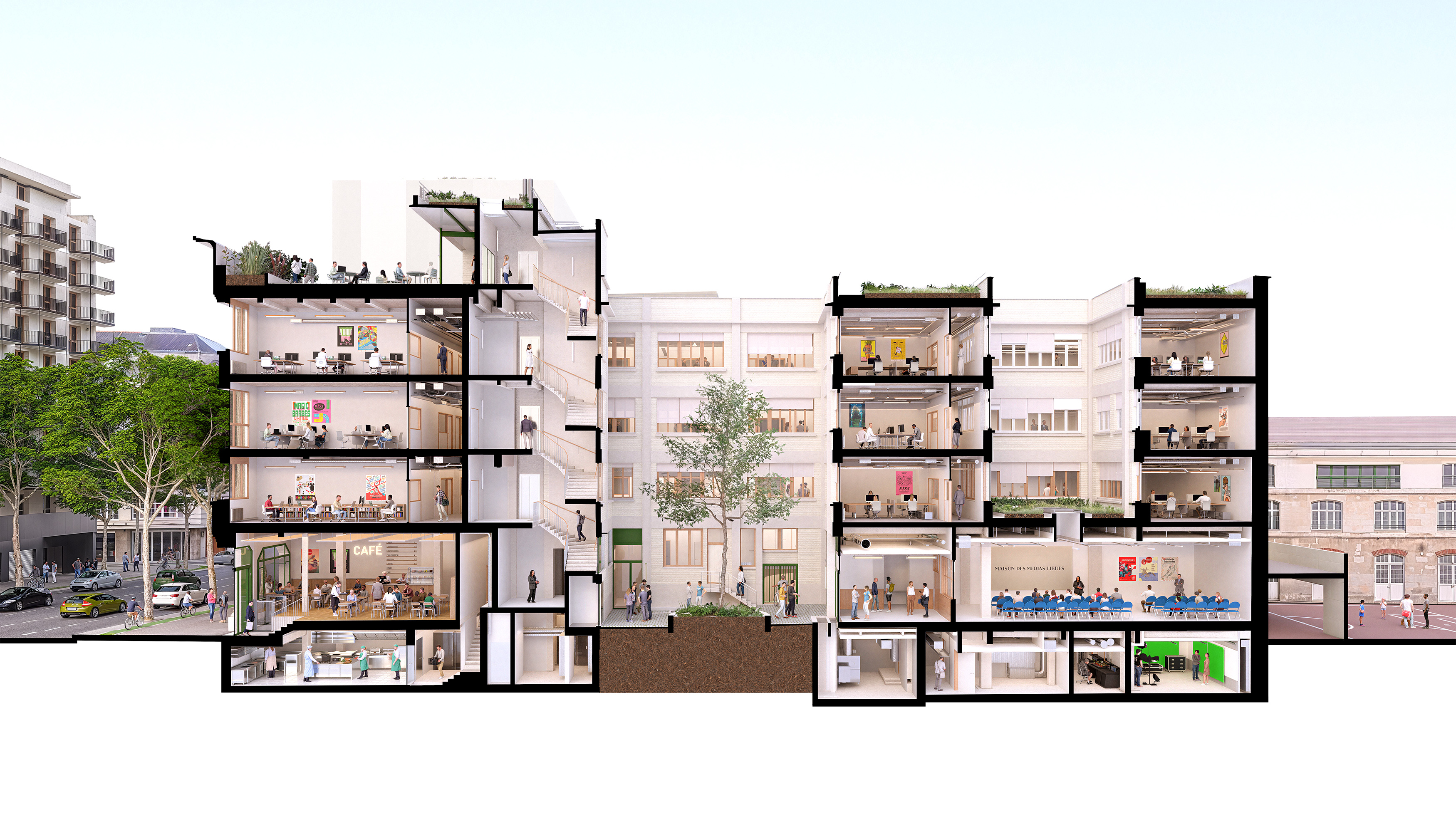
Beyond a workspace, the project is conceived as a public-facing cultural venue. It will host exhibitions, debates, workshops, screenings and training programmes, creating direct interactions between journalists and citizens. A 200-seat agora, podcast and video studios, and a street-level café will make the building an accessible and vibrant place for public engagement.
The project responds to a clear demand: over 80 media organisations have expressed interest, exceeding the building’s capacity by 150%.
By combining media production, cultural programming and civic dialogue, the Maison des Médias Libres acts as a “democratic infrastructure” — strengthening freedom of expression while reconnecting citizens with trustworthy information.
Expected results include:
improved economic conditions for independent media (through solidarity-based rents),
increased public access to media literacy and critical thinking,
the creation of a new hybrid cultural venue rooted in its neighbourhood and open to all.
The concept emerged from a shared observation: the economic fragility of independent media threatens media pluralism and, ultimately, democracy itself.
Over the past decade, a collective of independent media organisations came together to imagine a common space that could provide both economic support and public visibility. This collective, supported by philanthropist Olivier Legrain, gradually structured the vision and defined shared values through a common charter.
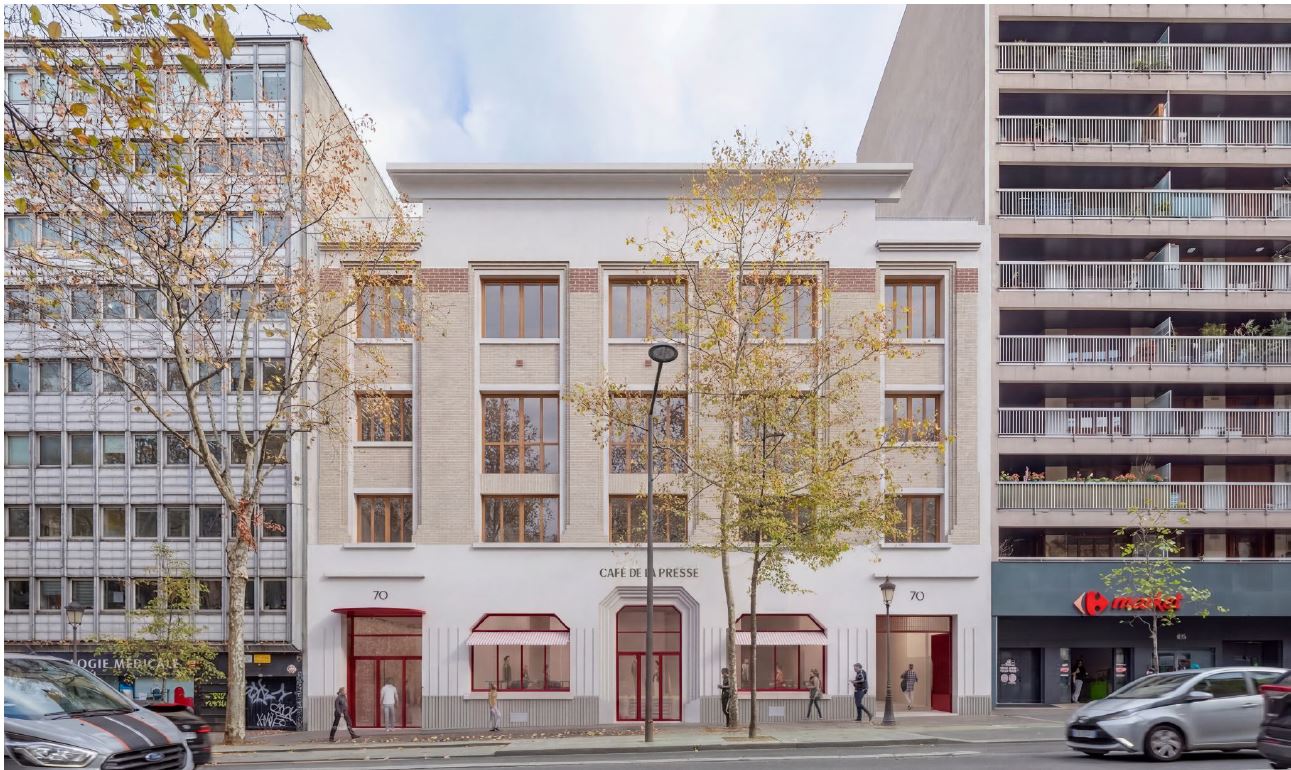
In 2022, Bellevilles joined the initiative as co-investor and project developer, enabling the transition from vision to implementation. In 2024, the City of Paris approved the sale of a former office building at 70 boulevard Barbès to host the project, marking a key milestone in its realisation.
The development process combines real estate transformation and collective governance. It includes: participatory programming with future users (media organisations), architectural rehabilitation of an existing building with strong environmental ambitions (30% material reuse, bioclimatic design), and the creation of an independent operating structure responsible for animation and public outreach.
The project is now entering its operational phase, with the rehabilitation of the building in progress since november 2025 and opening planned for 2027.
Media pluralism
Lively democracy
Civic engagement
Hybrid cultural space
Inclusive urban regeneration
The Maison des Médias Libres addresses sustainability through an integrated environmental, social and economic approach.
Environmentally, the project is based on the adaptive reuse of an existing building, significantly reducing its carbon footprint. The renovation includes 30% material reuse, bioclimatic design, improved insulation, natural ventilation, and the reduction of urban heat island effects through green roofs and permeable surfaces.
Socially, the project tackles a major democratic challenge: the fragility of independent media. By offering below-market rents (around 30% lower), it provides stable economic conditions for media organisations that contribute to pluralism and public debate.
Economically, the hybrid model (workspaces, studios, events, café) ensures long-term financial viability while maintaining affordability.
Finally, the project contributes to sustainable urban development by introducing new economic and cultural uses in a predominantly residential and socially diverse neighbourhood, strengthening its vitality without displacing existing communities.
The project aims to create a place where democracy is not only practiced, but also experienced through space, design and atmosphere.
The rehabilitation preserves and enhances the building’s architectural heritage, restoring its original Art Deco façade while introducing transparency and openness at street level. This physical openness reflects the project’s core value: making media accessible to all.
The ground floor is designed as a welcoming interface with the city, combining a café, public spaces and an agora. These spaces are conceived to be flexible, inclusive and lively, supporting a wide range of uses — from debates to informal encounters.
Particular attention is paid to comfort, light, and spatial quality, creating an environment that encourages dialogue, learning and collective experiences.
By transforming a former office building into a vibrant cultural hub, the project contributes to making everyday urban life more meaningful, fostering a sense of belonging and shared ownership among users and local communities.
Inclusion is at the core of the Maison des Médias Libres, both in its social mission and its operational model.
The project improves access to media production by offering affordable workspaces to independent media organisations, many of which operate with limited resources.
It also opens media practices to the public through workshops, training sessions and events, targeting diverse audiences including young people, residents of underserved neighbourhoods and individuals with limited access to information.
Located next to the Goutte d’Or, a historically working-class and multicultural area, the project actively seeks to engage local communities through partnerships with schools, associations and social organisations.
Accessibility is addressed through inclusive pricing policies, open programming, and physical accessibility of the building.
Governance is also designed to be inclusive: media organisations are involved in shaping the project and may participate in its operation, fostering a cooperative and participatory model.
The Maison des Médias Libres is rooted in a strongly participatory approach, initiated by a collective of independent media organisations that have co-designed the project over more than a decade.
Future users have been involved at every stage: defining the vision, expressing spatial and functional needs, and shaping the governance principles. A large-scale consultation conducted in 2024 confirmed both the relevance and demand for the project, with interest exceeding capacity by 150%.
Participation will continue during operation through a dedicated Association of resident media. This body will play a central role in designing and implementing the cultural and editorial programme of the venue, ensuring that content reflects the diversity of voices and practices within independent media.
The operating company will complement this participatory dynamic by managing the venue and opening it to broader audiences, while guaranteeing that the Association has priority access to spaces under solidarity-based conditions.
This dual structure ensures a balance between professional management and collective governance, enabling both efficiency and democratic ownership.
The project mobilises stakeholders across multiple levels, creating strong alignment between local impact and broader European challenges.
At the local level, the Maison des Médias Libres is deeply anchored in the neighbourhood of La Goutte d’Or, through partnerships with schools, associations and community organisations. The project aims to foster access to media practices and cultural activities for diverse and often underserved populations.
At the metropolitan and national levels, the initiative involves public authorities such as the City of Paris, which has supported the project through the sale of the building, as well as potential public co-investment mechanisms linked to urban regeneration policies.
At the European level, the project addresses key issues such as media pluralism, freedom of expression and democratic resilience — challenges that transcend national borders.
Private actors, including impact investors and philanthropic support, are also engaged, ensuring financial robustness.
This multi-level ecosystem strengthens the project’s legitimacy, scalability and long-term impact.
The Maison des Médias Libres is inherently transdisciplinary, combining expertise from media, architecture, urban development, social sciences and cultural programming.
The project brings together journalists, editors, media producers and educators with architects, engineers and sustainability experts involved in the building’s rehabilitation.
It also integrates economic and operational expertise through the development of an innovative hybrid business model, bridging real estate, cultural production and social impact.
The future operation will further expand this transdisciplinary dimension by hosting a wide range of activities: media production, public debates, artistic events, educational workshops and digital content creation.
By creating a shared space for these diverse practices, the project fosters new forms of collaboration and knowledge exchange, contributing to the emergence of innovative cultural and democratic ecosystems.
-I am leading the creation of the operating company, for which I have developed a detailed and balanced business model ensuring long-term financial sustainability.
The model is based on a hybrid revenue structure combining stable income and activity-based revenues. Total annual revenues are projected at €1.8 million, including €900k from office rents and service charges paid by resident media, €550k from media studios (podcast, video), €250k from the Agora (events and conferences), and €100k from the café-restaurant.
Operating costs are also estimated at €1.8 million, including €1 million in rent paid to the property owner, €230k in building-related expenses, €420k in staffing, and €150k in operational costs. This ensures a balanced and resilient economic model.
The operating company will manage the building, collect rents, and optimise the use of spaces. While the Association of resident media will benefit from priority access under solidarity conditions, the company will generate additional revenue by opening unused spaces to external clients.
A call for proposals will be launched to select an independent operator for the café-restaurant, based on alignment with the project’s values, economic viability, and integration within the local community.
Partnerships with experienced organisations such as Plateau Urbain are also envisaged to strengthen the management and programming model.
The Maison des Médias Libres is designed as a replicable model for democratic and cultural infrastructure.
Its core components — affordable workspaces for independent media, hybrid cultural programming, and a dual governance structure combining an operating entity and a user-led association — can be adapted to other urban contexts.
The methodology developed (user-driven design, hybrid economic model, integration of public-facing activities) is transferable to other cities facing similar challenges related to media sustainability, access to information and social cohesion.
The project also relies on widely available building typologies (vacant office buildings) that can be transformed into multi-use civic hubs through adaptive reuse strategies.
Beyond the physical model, the project contributes to a broader vision: the creation of a European network of “media houses” acting as local anchors for independent journalism and democratic engagement.
By combining economic viability, social impact and cultural relevance, the Maison des Médias Libres offers a scalable and inspiring blueprint for other territories.
Foreseen steps
- from now to summer 2027 : rehabilitation works
- April 2026 : partnership with Plateau Urbain and media residency in la Goutte d'Or with
- June 2026 : selection of an operator for the café-restaurant
- Summer 2026 : lease contracting with every single media
- October 2026 : foreshadowing of the project with the anticipated opening of the café-restaurant
- from November 2026 to July 2027 : preparation of the opening of la Maison des Médias Libres & reflexions on the non-speculative aspect of the project.
- July 2027 : public opening and festive inauguration