Enablers for New European Bauhaus Transformation
PLANTS ERA
PLANTS ERA – A Participatory Design System for Transforming Human–Nature Relationships
PLANTS ERA is a participatory design system that reshapes people’s relationship with nature through music as a shared, non-verbal interface. By engaging users in music-based interaction with plants, it shifts perception from passive observation to active participation, making it accessible across ages, cultures and abilities. Plants are experienced as active participants people can relate to and care for, creating shared experiences that foster environmental sensitivity and eco-empathy.
Poland
National
It addresses urban-rural linkages
It refers to other types of transformations (soft investment)
Prototype level
No
No
No
Individual
PLANTS ERA is a participatory design system that transforms everyday relationships between people and plants through sound-based interaction, technology, and shared experience. The concept has been developed through prototypes, installations, and workshops presented across Europe, Asia, and the Middle East, including events such as Vienna and Dubai Design Weeks. It is currently being implemented in Silesia, a post-industrial region shaped by coal mining traditions, where workshops create new forms of engagement with nature and support environmental awareness and care. To date, the system has engaged over 2,500 participants.
The core of the project is an interactive environment where users generate sound through interaction with plants, shifting from passive observation to active participation. This leads to observable behavioural changes: participants spend more time with plants, return to them, and demonstrate increased attention and care. In workshops, children who initially ignore plants begin to seek contact with them, showing signs of attachment such as repeated interaction, gentle touch, and sustained presence.
PLANTS ERA operates as a modular system rather than a single installation, translating ecological knowledge into direct, embodied experience and supporting everyday ecological awareness in public and educational contexts. By enabling institutions to adopt this system independently, PLANTS ERA shifts environmental engagement from isolated experiences to repeatable and scalable practices embedded in everyday settings.
PLANTS ERA originated from my early experience with music as a universal language. As a violinist trained in the Suzuki method, I learned how sound can connect people beyond language and culture, which later shaped my approach to design.
During academic research on ecological awareness, this perspective led me to a key question: how can interaction, rather than information, shape relationships with the natural environment? This initiated a series of experiments exploring whether music could become a medium of connection between humans and plants. Early prototypes investigated how sound can structure attention, engagement, and perception.
The first object, Fasola si do, combined simple, accessible technology and sound interaction to support plant care and shift user perception from passive observation towards active engagement. The project developed through iterative prototyping and direct user interaction. Exhibitions became key development environments, where observation of participant behaviour informed design decisions. Patterns such as extended interaction, repeated visits, and physical contact with plants led to a transition from isolated objects to a system of interactions.
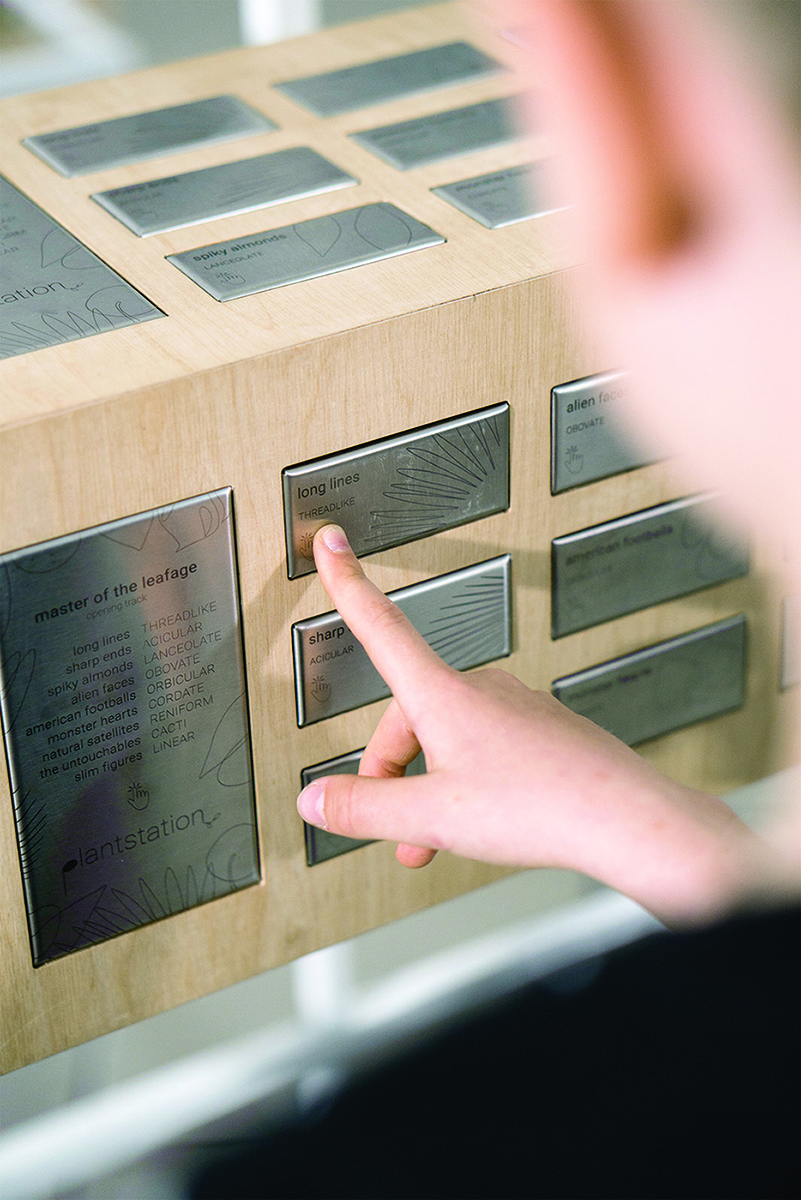
This approach evolved into Plantstation, a modular installation integrating sound, plants, and user input. Over time, the project expanded into a broader system combining design, technology, and participatory methods, implemented through workshops engaging diverse groups, including children, adults, and seniors. These workshops became a core tool for testing, learning, and scaling the approach in real-world contexts.
Today, I develop PLANTS ERA as an evolving design system based on research-by-design, prototyping, and real-world testing, where participation remains the central method. It is being transformed into a structured and transferable system that enables institutions to independently implement and scale this approach across educational and public settings.
environmental empathy
human–plant relationships
participatory design
sound interaction
behavioural change
I address sustainability at the level where environmental behaviour is formed — through everyday, music-based interaction.
Behavioural change as a sustainability driver
Through direct interaction with plants, participants shift from passive care to active engagement. Observations show consistent patterns such as returning to plants, spending more time with them, and increased attentiveness. These interactions support the development of long-term habits and more conscious relationships with the natural environment. Research in environmental psychology shows that emotional and sensory engagement with nature is a strong driver of pro-environmental behaviour, particularly in children.
From perception to environmental responsibility
By changing how plants are perceived — from passive background elements to responsive living systems — the project fosters environmental empathy and strengthens a sense of responsibility in everyday interaction. This shift directly influences everyday ecological decisions.
Low-impact, durable system
The installations are modular, repairable, and designed for long-term use. They are built from durable materials and operate with low-energy systems, including renewable sources such as solar energy. Their adaptability to local plant species enables context-specific implementation without additional environmental burden.
Scalable environmental education
PLANTS ERA translates scientific knowledge into direct, embodied experience. Instead of abstract learning, users engage physically and emotionally, making environmental awareness actionable and enabling its long-term integration into educational systems and public institutions.
I approach aesthetics as an experiential and relational quality emerging through perception, interaction, and presence.
Perception shift as aesthetic value
The key moment occurs when users realise that plants are not passive, but responsive living systems. This shift transforms everyday environments into spaces of attention, awareness, and emotional engagement.
Reframing everyday environments
The installations introduce moments of focus, stillness, and interaction into spaces that are usually fast-paced or purely functional. This redefines how people experience familiar environments such as schools, institutions, and public spaces, turning them into places of encounter rather than transit.
Shared aesthetic experience
Installations such as Plantstation create situations where people of different ages interact together. The aesthetic experience is collective — it emerges through shared action, sound, and presence, fostering connection between participants and their surroundings.
Living and dynamic environments
The aesthetic quality evolves over time through plant growth, user interaction, and sound. These environments are not fixed but continuously changing, reinforcing a sense of care, attachment, and ongoing relationship.
Context-sensitive implementation
Each installation adapts to its location through a modular system, incorporating local plant species and spatial conditions. This creates a direct and situated relationship between people, place, and living systems.
PLANTS ERA is an inclusive system enabling participation across diverse groups and abilities.
Accessible interaction
Participation is based on simple, intuitive actions — generating sound and engaging with plants — requiring no prior knowledge, language, or technical skills. This lowers barriers to entry and enables participation regardless of age, background, or ability level.
Design for all abilities
The system engages multiple senses — sound, touch, and presence — making it accessible to people with different cognitive and physical abilities. It does not rely on verbal communication or abstract knowledge, allowing inclusive participation across diverse user groups.
Spatial accessibility and multi-level interaction
The physical design of installations such as Plantstation enables interaction at multiple heights and positions. Side panels allow access for children and users with reduced mobility, while upper interfaces engage standing adult users. This is achieved through ergonomic, inclusive, and multi-level design, ensuring that the same experience is accessible to diverse bodies and abilities without separating users into different systems.
Intergenerational engagement
The system naturally brings together children, adults, and seniors in shared activities, strengthening social connection and knowledge exchange across generations.
Access to nature in restricted environments
PLANTS ERA can be implemented in schools, care homes, hospitals, and correctional facilities, providing meaningful contact with nature where it is often limited or unavailable. In these contexts, it supports well-being, reduces isolation, and creates opportunities for shared experience.
Adaptable formats and affordability
The system can be implemented at different scales — from compact objects to larger installations — allowing adaptation to different budgets and institutional conditions. Its modular structure enables gradual implementation and long-term use.
PLANTS ERA is developed through direct interaction with users, where participation is not an addition but the core method shaping the project.
Co-creation through interaction
Users act as co-creators of the experience. By generating sound for plants, they actively shape the outcome, making each interaction unique, situated, and responsive to context.
Participation as a development method
Workshops and exhibitions function as iterative development environments, where observation of user behaviour directly informs the evolution of the system. Participation is embedded in the design process as a continuous feedback loop between users and the system.
Behaviour as feedback
User behaviour functions as a primary source of feedback. For example, children extending interaction time, returning to plants, and demonstrating care led to the development of more open, long-duration interaction formats and modular systems. These patterns directly influenced design decisions and system structure.
Collective participation and social dynamics
Participation extends beyond individual experience into collective engagement. Installations create shared environments where users influence each other’s behaviour, forming social dynamics around care, attention, and interaction with living systems.
From facilitation to distributed participation
PLANTS ERA is evolving into an enabling framework in which participation shifts from artist-led facilitation to educator- and institution-led implementation. This transition allows participatory practice to be embedded in everyday educational and social environments.
Engaging institutions as co-implementers
Educators and institutions are not only hosts but active participants in adapting and implementing the system. This supports long-term integration and allows the project to evolve across different social and cultural contexts.
PLANTS ERA operates across multiple levels — from local workshops to international exhibitions — engaging stakeholders across educational, cultural, and public sectors.
Local level
The project has been implemented through workshops in schools, libraries, and cultural institutions in Poland, engaging children, educators, and local communities. At this level, participants directly influence the development of the system through interaction and feedback.
Regional and national level
Through collaboration with educational and cultural institutions, the project contributes to the development of new formats of environmental education and participatory practice within institutional settings.
International level
Installations have been presented across Europe, Asia, and the Middle East (2,500+ participants), demonstrating the adaptability of the system across diverse cultural contexts and enabling knowledge exchange between different environments.
Cross-sector collaboration
The concept connects design, education, and cultural institutions, with growing potential for integration into public systems such as schools, care homes, hospitals, and correctional facilities.
Institutional integration and governance
The project is designed to be embedded in institutional frameworks (education, health, social care), enabling collaboration between designers, educators, and public stakeholders. This supports the transition from artist-led initiatives to distributed, system-level implementation.
Added value
The added value lies in linking local, experience-based engagement with a scalable and transferable model. This enables the project to operate across different governance levels, supporting long-term implementation within public and institutional systems.
PLANTS ERA is developed at the intersection of multiple disciplines, integrating scientific knowledge, design, and artistic practice into a single experiential system.
Design and interaction
The project is based on designing objects and systems that structure user interaction, perception, and behaviour in real-time environments.
Music and sound
Music functions as the main interface, where plant-related data and user interaction are translated into sound, enabling communication and engagement beyond language barriers.
Biology and plant science
The concept draws on research related to plant responses to sound and environmental stimuli, translating biological processes into interactive and perceptible experiences.
Technology and engineering
Sensors, microcontrollers, and sound systems are used to detect input and generate responsive environments, linking biological signals, user interaction, and sound output.
Education and social practice
Workshops and participatory formats connect the system with learning environments, allowing users to engage directly with the system and contribute to its development.
Environmental psychology and cognitive sciences
The project is informed by research on attention, emotional engagement, and memory, applying these principles to design experiences that foster deeper engagement with the natural environment.
PLANTS ERA integrates these fields into a coherent system in which biological processes, technological systems, and human interaction are interconnected, turning scientific knowledge into direct experience and design into a tool for behavioural and perceptual change.
I develop PLANTS ERA as a hybrid model combining product design, educational services, and institutional implementation. The model is based on multiple complementary revenue streams ensuring long-term financial sustainability.
1. Product-based system
Core elements such as Fasola si do and Plantstation function as modular, durable products designed for long-term use in schools, cultural institutions, and public spaces. These can be distributed through direct sales or institutional procurement.
2. Educational services
Workshops and facilitated programmes generate revenue while supporting implementation. These formats are being developed into scalable toolkits and training programmes that can be licensed or delivered to educators and institutions.
3. Institutional partnerships and public funding
The project aligns with priorities in education, environmental awareness, and well-being, enabling access to public funding, cultural programmes, and educational budgets. These partnerships support implementation at larger scale.
4. Social impact implementation
Targeted implementations in care environments (e.g. children’s hospices) are supported through partnerships, grants, and social funding mechanisms, ensuring accessibility in non-commercial contexts.
5. Distributed model
In the next phase, PLANTS ERA will function as a distributed system, where institutions implement it independently through toolkits, guidelines, and training. This model enables revenue through licensing, training, and support services while reducing dependence on the author.
6. Long-term sustainability
Financial sustainability is based on combining product distribution, educational services, licensing, and institutional funding streams, creating a balanced model that supports both impact and economic viability over time.
PLANTS ERA is designed as a scalable and transferable system that can be adapted across different contexts, user groups, and institutional environments.
1. Replicable objects
The modular design enables production in multiple units and adaptation to different spatial, environmental, and institutional conditions.
2. Transferable methodology
The core method — engaging with plants through sound-based interaction — structures attention, perception, and care. It is independent of language, culture, and age, enabling implementation across diverse contexts.
3. Cross-sector application
The system can be implemented in:
education (schools, kindergartens)
healthcare (hospitals, care homes)
social systems (correctional facilities)
public and urban spaces
4. Proven adaptability
The project has been tested with over 2,500 participants across Europe, Asia, and the Middle East, demonstrating consistent patterns of engagement, including extended interaction time, repeated participation, and increased attentiveness.
5. Integration into existing systems
PLANTS ERA can be integrated into existing educational curricula, well-being programmes, and cultural activities, enabling long-term use without the need for new infrastructure.
6. Toolkit-based scaling
Future development includes implementation toolkits, guidelines, and training formats, enabling institutions to adopt and implement the system independently.
This enables the project to scale both as a product and as a method embedded within institutional frameworks, supporting long-term behavioural and organisational change.
PLANTS ERA is transitioning from project-based implementation to a scalable system embedded in institutional contexts. This process is already underway, with 10 workshops scheduled and growing institutional interest.
Planned steps for the following year:
Pilot implementation (months 1–6) – delivery of 10–20 workshops in schools and kindergartens – testing the system in real institutional conditions – collecting feedback from users and educators
Development of implementation toolkit (months 3–9) – creation of toolkits, guidelines, and training materials – enabling educators and institutions to implement the system independently
Product refinement and small-scale production (months 3–12) – improving modular objects in terms of durability, usability, and scalability – preparing for small-scale production and distribution
Institutional partnerships (ongoing) – building collaborations with educational, cultural, and public institutions – expanding implementation into healthcare, social care, and other institutional contexts
Communication and dissemination (months 6–12) – development of a dedicated website and publication – sharing results and methodologies with a broader audience
Research and knowledge development (months 6–12) – collaboration with academic or institutional partners on a research-based publication – analysis of user interaction, behavioural patterns, and long-term engagement – documentation of results to support further development and dissemination of the system
The pilot phase is used to test long-term use in real environments, build user and institutional capacity, and refine the system based on sustained interaction rather than short-term engagement.
These steps are designed to transform PLANTS ERA into a repeatable and transferable system that can be implemented independently by institutions, supporting long-term behavioural and organisational change.