Arts, Culture, and Heritage as Drivers of Change
De Aderton
De Aderton: public art & placemaking as tools for social sustainability in urban development
This project focusses on the correlation
between public art and placemaking in urban public spaces and the level of social sustainability in cities in Northern Europe during wintertime. De Aderton is also the name of an architectural light art installation that was designed and built by architect and artist Elise Cervin. It was first exhibited during the light art festival Nobel Week Lights 2024 and was during the spring of 2025 presented at two other places in the region of Stockholm.
between public art and placemaking in urban public spaces and the level of social sustainability in cities in Northern Europe during wintertime. De Aderton is also the name of an architectural light art installation that was designed and built by architect and artist Elise Cervin. It was first exhibited during the light art festival Nobel Week Lights 2024 and was during the spring of 2025 presented at two other places in the region of Stockholm.
Sweden
Regional
Region Stockholm
Mainly urban
It involves a physical transformation of the built environment (hard investment)
Yes
2025-03-31
No
No
No
Organisation
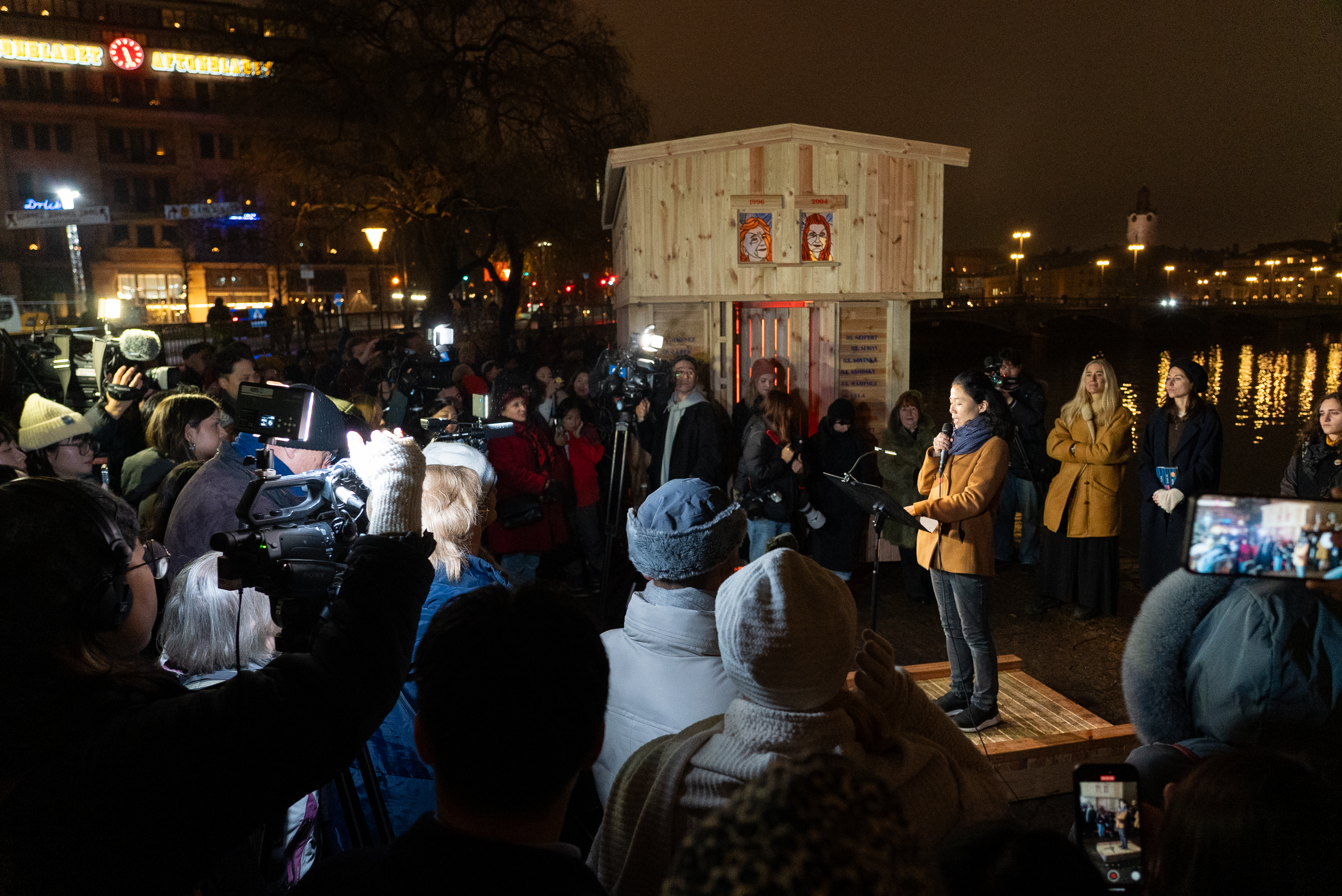
The project De Aderton focussed on the correlation between art in urban public space and the level of social sustainability in cities. Even though De Aderton was a summary of the various cultural activities it had given rise to, the core of the project consisted of an illuminated wooden pavilion that was first exhibited in December 2024 during the festival Nobel Week Lights in Stockholm.
This art pavilion was dedicated to the female Nobel Prize laureates in literature. The title, meaning the eighteen in Swedish, referred to the eighteen women who have received the Nobel Prize in Literature so far (March 2026). The title also alluded to the 18 members of the Swedish Academy, responsible for selecting the literature laureates. De Aderton celebrated female writers while recognising the historical gender imbalance among the laureates. Since 1901 the literature prize has been awarded to eighteen women and 104 men.
With inspiration from the organisation PPP and their Power of 10-method, the pavilion was designed according to at least ten types of activations. By introducing a variety of programs in urban space, places become accessible and relevant for a broader group of people with different backgrounds and interests. The pavilion also served as a hub for other cultural activations such as read-aloud sessions, where books written by the female laureates were read in their original language.
The project was initiated and produced by architect Elise Cervin and implemented in cooperation with two lighting designers and one sound artist. De Aderton also involved collaboration with a range of different stakeholders such as The City of Stockholm, Nobel Week Lights, KTH Royal Institute of Technology, Institute Français de Suède and OrganoWood. De Aderton succeeded to reach the project’s goal of highlighting the importance of living urban spaces that promote social interaction, artistic values, variation and a sense of well-being among people in the city.
The project was initiated and produced by architect Elise Cervin and implemented in cooperation with two lighting designers and one sound artist. De Aderton also involved collaboration with a range of different stakeholders such as The City of Stockholm, Nobel Week Lights, KTH Royal Institute of Technology, Institute Français de Suède and OrganoWood. De Aderton succeeded to reach the project’s goal of highlighting the importance of living urban spaces that promote social interaction, artistic values, variation and a sense of well-being among people in the city.
Public life in the city of Stockholm is dependent on seasonal weather variations. One consequence of the cold and dark Scandinavian winter is the lack of public life in urban spaces during the months when the sun reaches far below its zenith. The idea of creating De Aderton arose from a wish to make these abandoned public spaces in Stockholm come alive also during the winter months. By addressing the need for another way to work with urban development during the dark season of the year, De Aderton introduced art and cultural city activations. These were implemented as tools to make the public spaces of Stockholm more engaging, aesthetically appealing, relevant and interesting for people to inhabit despite darkness and cold weather.
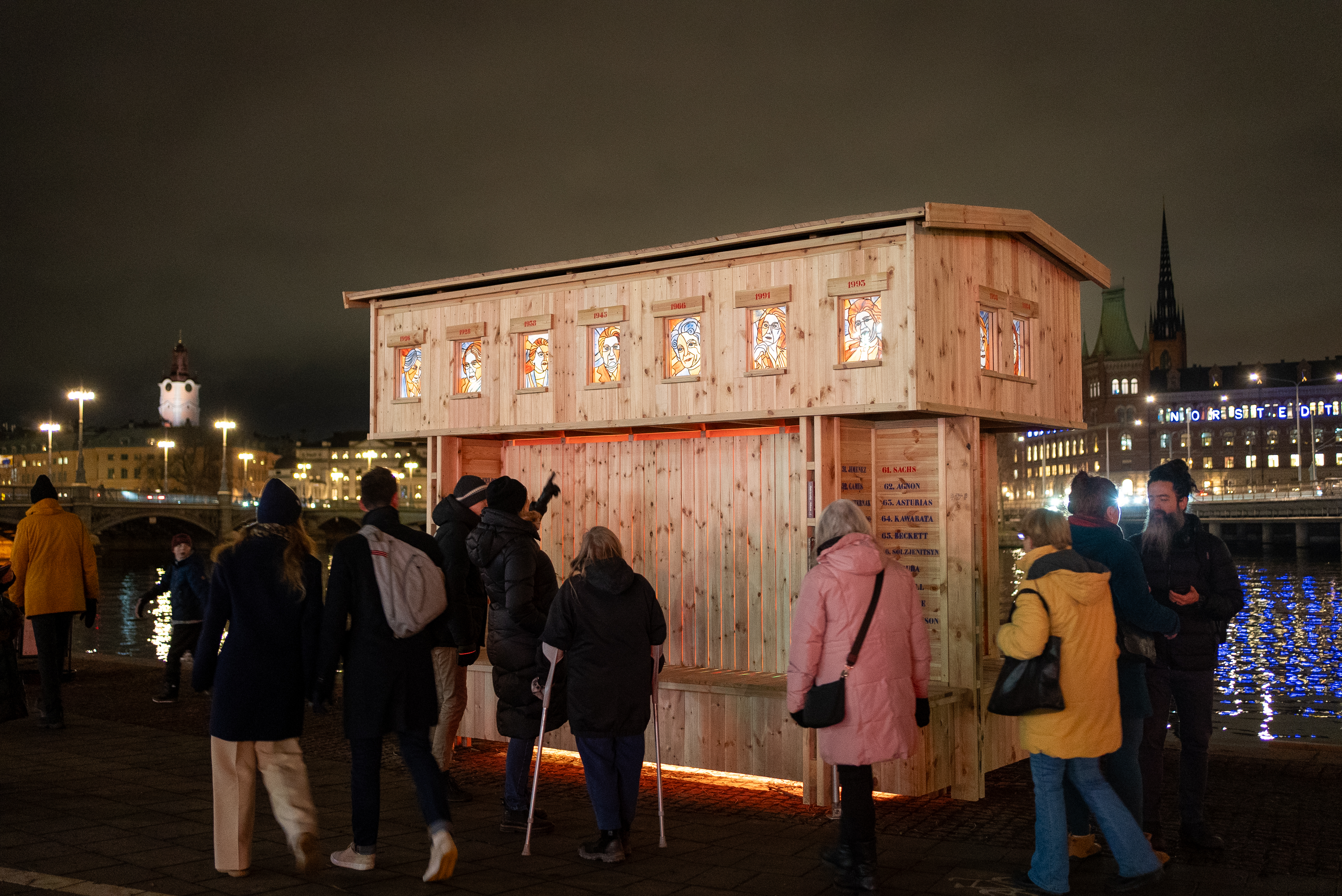
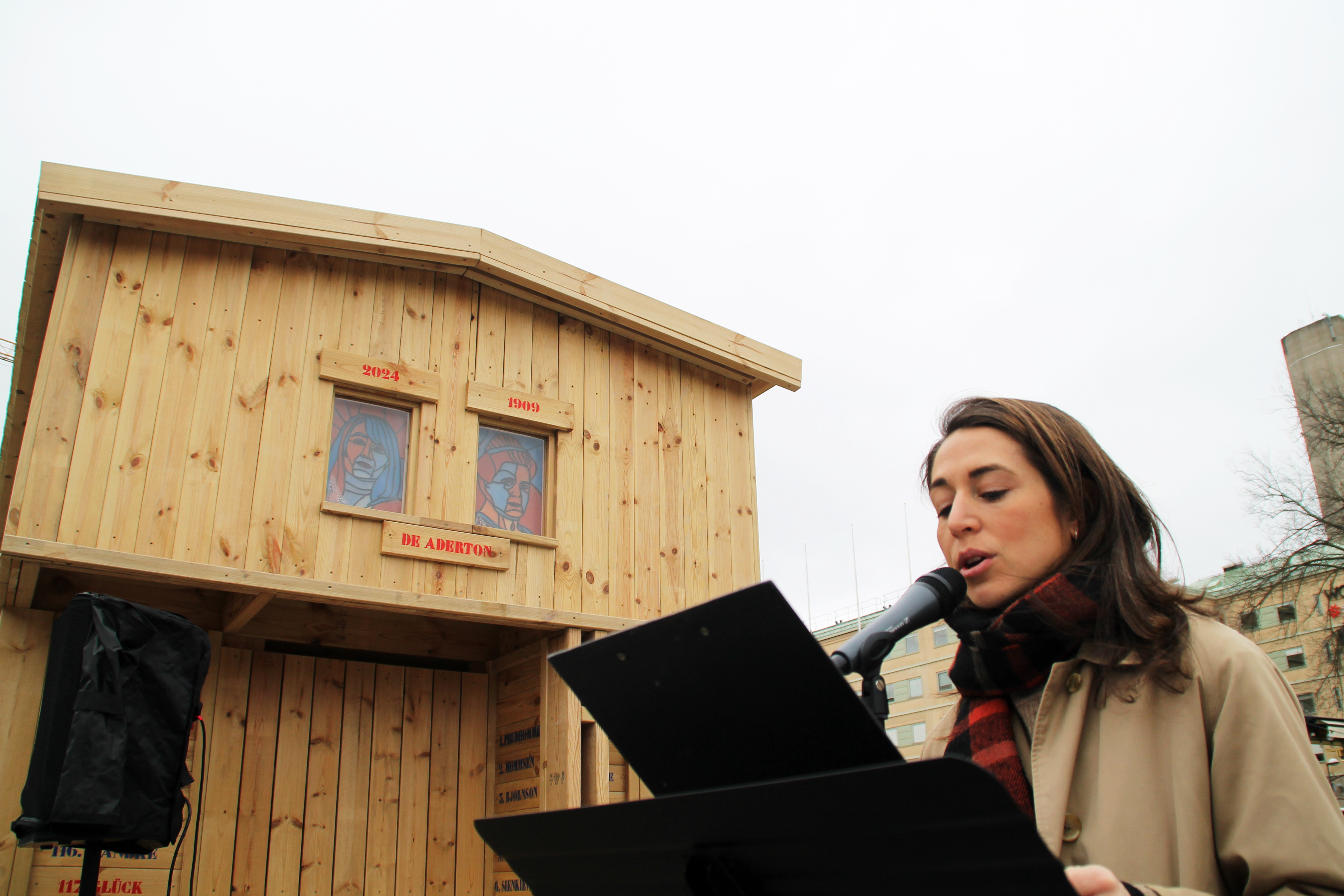
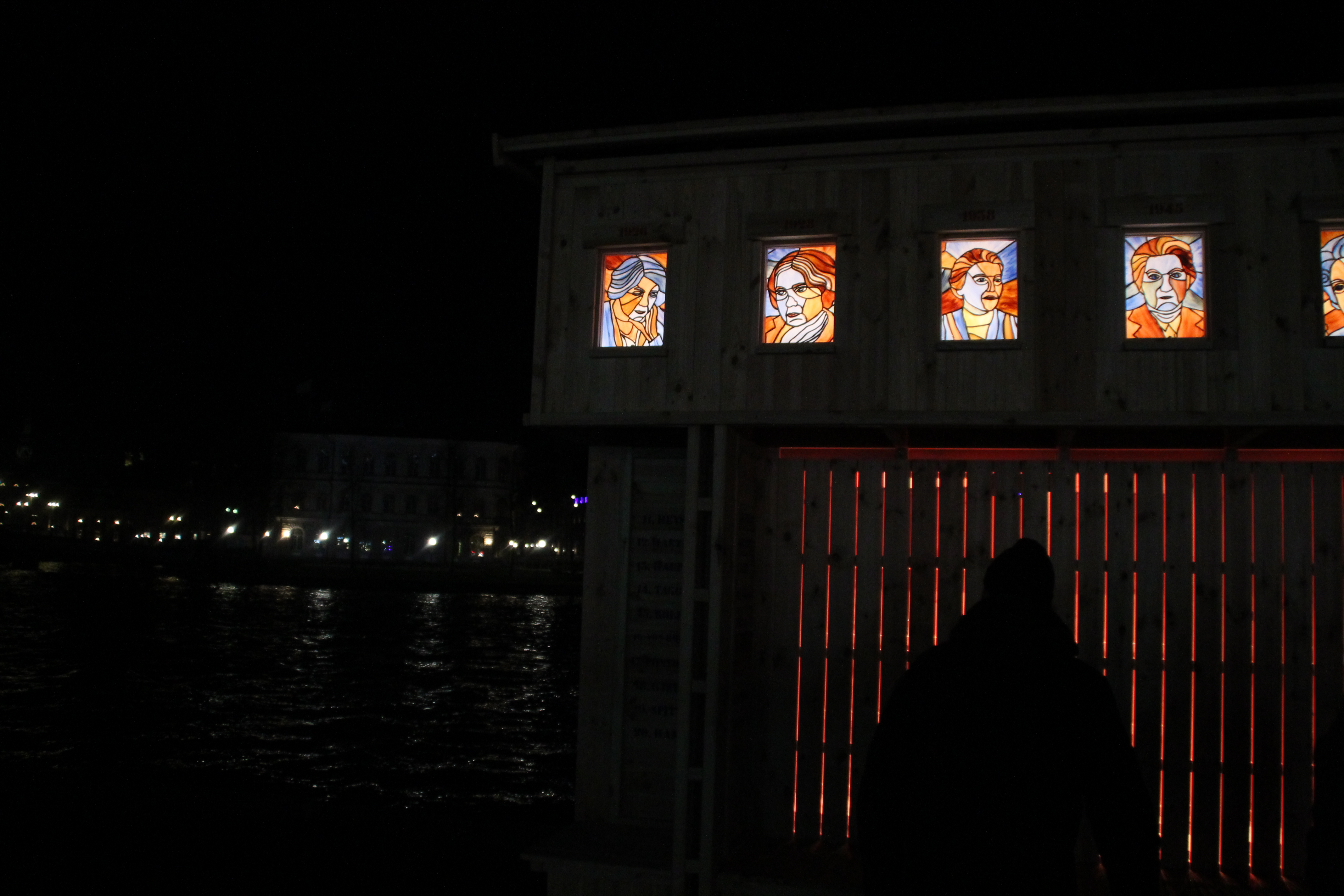
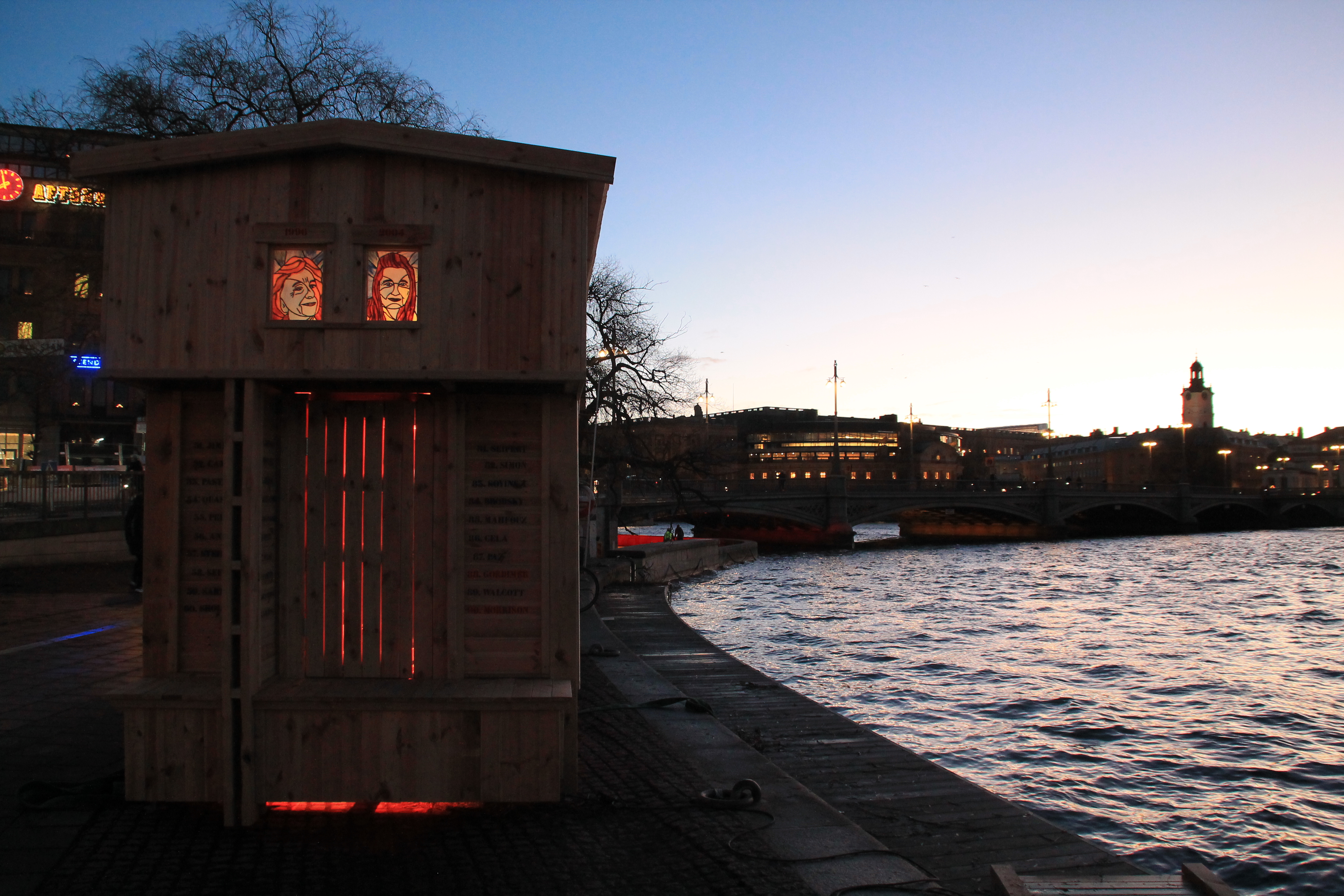
The activations that took place next to the artwork engaged cultural institutions, the local library and citizens in the co-creation of read aloud-sessions. The pavilion, that served as a node for these activities, was designed and built by Elise Cervin, who also painted the stained glass portraits of the female laureates. These portraits and the walls of the pavilion were illuminated by the project’s lighting designers. From the walls one could also hear a musical soundscape inspired by the female laureates’ oeuvre that was composed by the project’s sound artist. The structure included benches and bookshelves which invited the audience to engage with the artwork rather than only watching it.
After De Aderton had had its premiere at Nobel Week Lights in December 2024, the illuminated art pavilion was, during the spring of 2025, located in a public square at Södermalm, a district of Stockholm. In June the same year the pavilion was a part of the program of Järvaveckan which is a democratic platform for political and cultural engagement in the north-eastern suburbs of Stockholm.
De Aderton contributed to a sense of community and well-being during times when people have a tendency to stay in their private zone at home.
De Aderton contributed to a sense of community and well-being during times when people have a tendency to stay in their private zone at home.
Public art
Social interaction
Urban variation
Living cities
Winter conditions
De Aderton is exemplary in terms of sustainability because of its involvement of organic and nature based building materials, its positive impact on human health and transportation, its contribution to social interaction and cultural engagement as well as the vision for re-use of the future version of the artwork.
In collaboration with the project partner OrganoWood, the art pavilion was built out of organically impregnated wood. This solution was important since it created opportunities to build the structure in a wooden material that was suited for the wet winter conditions that yet did not involve poisonous treatments of the material. The paint of the stained glass portraits was manufactured by Toniton. Their products does not include any plastic ingredients which makes it a sustainable option in the paint industry.
Being a part of the art network of Nobel Week Lights, which is a light art festival taking place in Stockholm's urban space, De Aderton promoted non-motorised transportation in the city. In order to be able to interact with De Aderton people needed to get there either by foot, bike, wheels, pram etc. This did not only affect the emission levels but also did it have a positive effect on peoples’s health since physical activities is crucial for maintaining a sustainable lifestyle. People roaming the streets also have a positive impact on increased levels of social interaction, which contributes to decreased stress levels and peoples’ sense of belonging. Engaging in cultural activities also influences an increased sense of meaning.
Since the theme of De Aderton one day will be outdated due to changed numbers of female Nobel Prize laureates in literature, the project shall evolve into another type of artistic experience. The pavilion will be kept but its appearance will change. This is not a part of the current artwork but an explanation for a vision of letting it develop and become reused in the future.
De Aderton contributed to public life in Stockholm during a time when many people usually avoid roaming the city due to weather conditions. The secret behind this accomplishment was the cultural approach which made people become engaged in public space through art. The squares where De Aderton was located, were transformed from being under-used and dark into becoming illuminated and dynamic. The project showcased that climate conditions is not necessarily an obstacle in the process of making a city feel welcoming and aesthetically interesting. By implementing art, placemaking and other citizen engaging activities adjusted to the environmental circumstances, De Aderton succeeded to create meaningful experiences in urban public space that brought people together in a shared art experience which served as a bond between them, each other and the city itself.
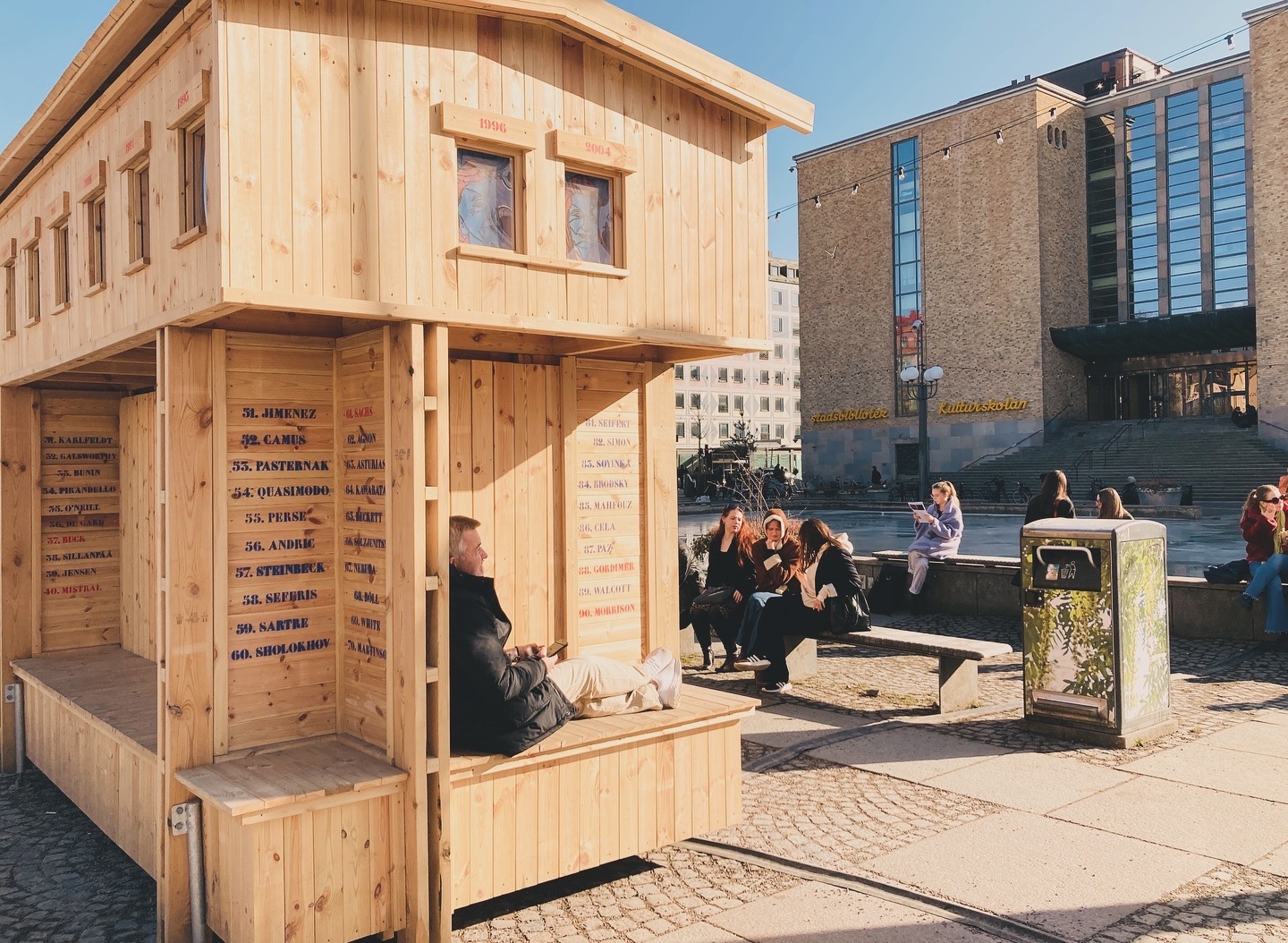
The parts of the aesthetic vision: 1. Architecture: benches & bookshelves invited people to engage with the structure which erased the distance between them and the artwork.
2. Light art: glowing light leaking through the planks of the walls. This was a metaphor for the importance of reading between the lines which alludes to the deeper understanding of a literary work but that also could be applied to life in general.
3. Faux-stained glass portraits of the female laureates. Besides tributing the female writers, this was also an attempt to encourage women to claim space in the city.
4. Sound art: a soundscape dedicated to the female writers combining music and the writer’s recorded voices, which is another example of giving women space in the public sphere.
5. Names of all laureates; the walls of the pavilion was cladded in stenciled letters, partly as an hommage to the street art scene but also as an educational way to show the gender imbalance between the laureates in literature.
6. Read-aloud sessions made the artwork come alive which created another possibility for people to engage with it.
De Aderton addresses gender inequality as an important topic in the discussions of urban development since women tend to feel more unsafe in public space compared to men. In order to develop a sustainable city that is accessible for different people it is important to take gender-related realities into consideration when designing cities. De Aderton is implementing these perspectives both in the project’s artistic theme focusing on female writers as well as in the design of the pavilion itself. Using the metod of the power of 10 as a starting point, the project contributed to a varied urban experience. By programming the pavilion with several activities such as sitting, reading, listening to music, experience light art and learn about the Nobel Prize laureates, people of various backgrounds regardless of age, gender and sociodemographic situation were engaged in a common experience. The pavilion design also took the result from a survey of teenage girls’ feelings of safety in public space into account (survey by White Architects). One wish that the girls expressed was opportunities to be able to ”sit but not be seen”, therefore side walls were installed along the benches which contributed to the experience of a semi-enclosed safe space.
The project made people become socially and personally involved in the urban space. It also made art accessible to new audiences that usually not encounter Art in galleries. It also offered qualities to the urban context that met several of psychologist Ingrid Gehl’s criteria for social sustainability, since it stimulated orientation possibilities, playfulness, a varied experience and aesthetics. The artwork created relevance for people to inhabit an urban space that otherwise would have been dark and empty. This resulted in an increased level of social interaction between people which accordingly stimulated their sense of belonging in the community. De Aderton made its urban sites evolve into meaningful places for people.
People roaming the streets of Stockholm were regarded as co-creators of the artwork. The goal with De Aderton was to contribute to people’s experience of public space with an increased level of variation, safety and sense of belonging. Simultaneously, the people engaging with De Aderton contributed to the whole artistic outcome. By someone sitting on the bench reading a book from one of the bookshelves, or looking at the stained glass portraits, listening to the soundscape, taking pictures or having spontaneous discussions about the names on the walls, the artwork were brought to life. De Aderton is a good evidence for William H. Whyte’s famous quote referring to that people are drawn to places where other people are. Therefore, the most important part of De Aderton was the spectators engaging with it.
Through the collaboration with KTH, a group of master students in architecture were engaged in an extension of the project. In a university course led by lecturers Per Franson and Fredrik Stenberg, the students were assigned to build wooden structures inspired by nine of the eighteen female writers. The involvement of the student group contributed to variation and playfulness in the final installation. The main De Aderton-pavilion was exhibited together with the nine student pavilions during the exhibition at Nobel Week Lights.
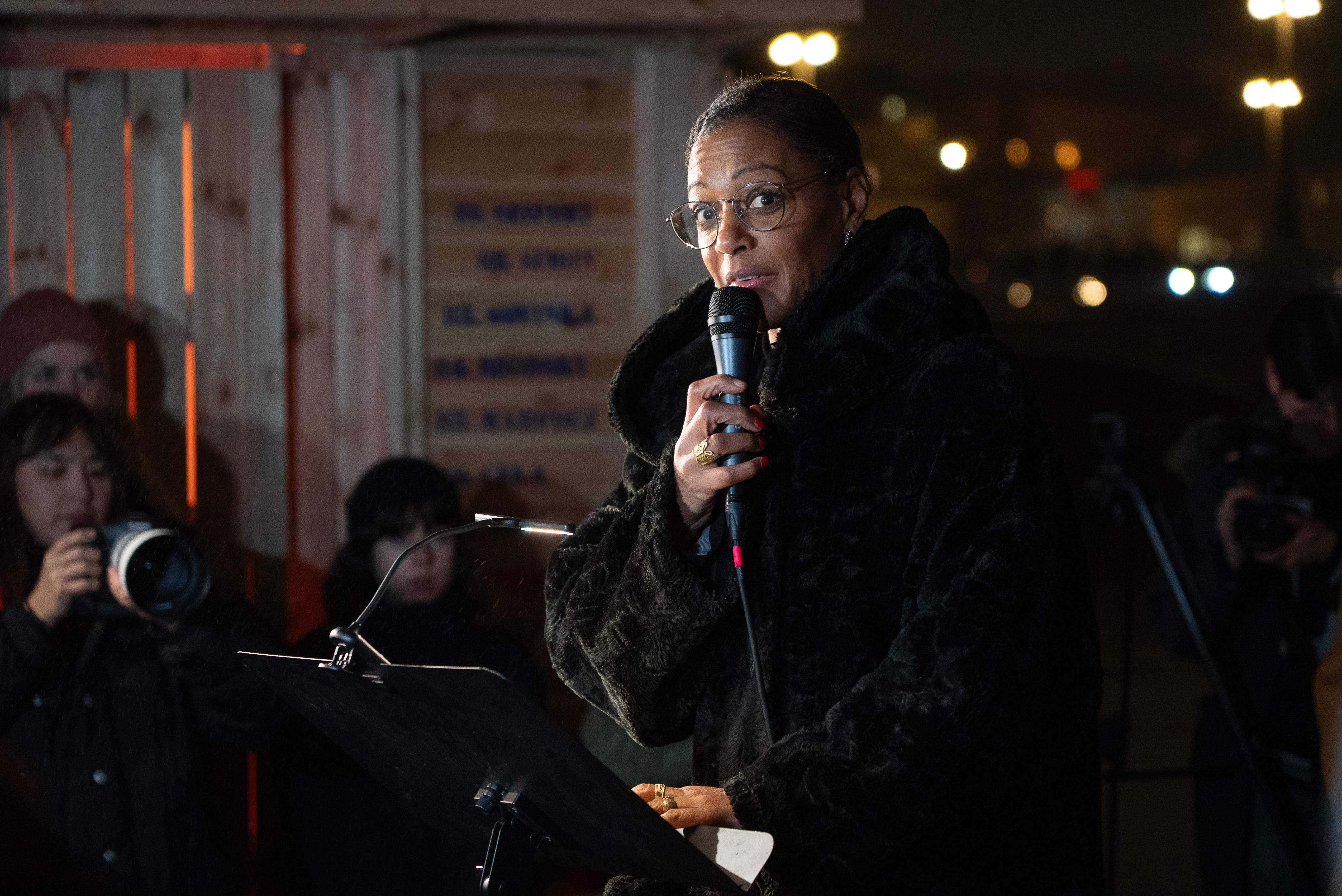
People visiting De Aderton were also invited to take part of the read aloud sessions that were carried through in collaboration with the local library and cultural institutions. This event made the artwork and its concept come alive by including excerpts from literary works by a selection of the eighteen female writers. The read-aloud session covered recitals in both Swedish and the original languages (French, Italian, Polish, Korean) in order to make it accessible to people from different backgrounds. The curation of the texts were carried out together with the librarians, the cultural institutes and in some cases even the translators.
People visiting De Aderton were also invited to take part of the read aloud sessions that were carried through in collaboration with the local library and cultural institutions. This event made the artwork and its concept come alive by including excerpts from literary works by a selection of the eighteen female writers. The read-aloud session covered recitals in both Swedish and the original languages (French, Italian, Polish, Korean) in order to make it accessible to people from different backgrounds. The curation of the texts were carried out together with the librarians, the cultural institutes and in some cases even the translators.
The working process behind urban development demands a multi-disciplinary approach not only focusing on the design and its aesthetics. In order to cover the vast perspectives of society and the city, the De Aderton-project involved a broad collaboration with different stakeholders:
Nobel Week Lights offered an invaluable artistic basis which made the implementation of De Aderton less complicated since NWL already had established a framework for public light art in the urban environment of Stockholm wintertime.
The City of Stockholm was involved as the main sponsor and partner of the pavilion’s second location at Södermlam. Their funding and cooperation was a prime condition for the implementation of the project.
KTH Royal Institute of Technology offered space and tools for the building process. The collaboration with master students in architecture contributed to a sense of community and playfulness in the building phase of the artwork.
OrganoWood sponsored De Aderton with organically impregnated construction material. Without their participation the project would not have been able to be as comprehensive regarding size of the pavilion.
Institut Français de Suède, The Polish institute, The Italian Cultural Institute and the Korean Cultural Center were sponsoring and involved in the read aloud-sessions arranged next to the pavilion. Without their cooperation it would not have been possible to cover different languages during the events. The companies
Anell ljus & form & Farula Lighting Design sponsored the project with the pavilion’s lighting fixtures.
Toniton sponsored the project with organic plastic free paint for the making of the stained glass portraits.
Audiorama were responsible for installing the sound equipment for the musical soundscape in the pavilion.
Fredrika Bremer förbundets stipendiestiftelse sponsored the project monetarily which, combined with the financial support from the City of Stockholm, covered salaries for the team.
De Aderton was strongly influenced by a transdisciplinary approach. First of all, the team members that were responsible for the creation of the art pavilion contributed to the project with their different fields:
Architecture, production: Elise Cervin. Lighting design: Iris Molendijk & Razan Albunayah . Soundscape: Johan Stohne. The collaboration with KTH contributed to an academical approach. This connects to another transdisciplinary part which included field observations for research. In order to better understand the impact that De Aderton had on usage of the urban space it was located in, an anthropological working approach was implemented by Elise Cervin through field observations. The aim was to give knowledge about how people behaved on the site when it was activated by De Aderton compared to after the festival. While keeping the risk of bias into account, the results of the field study showed a correlation between an increased level of public life and the presence of De Aderton. The group of project sponsors and partners also represented transdisciplinarity, ranging from the company OrganoWood that supported the project with building materials to the cultural institutions cooperating in the reading-activations taking place next to the pavilion. Through the collaboration with several international cultural institutions based in Stockholm, these read-aloud sessions engaged actresses who read excerpts written by four of the female writers represented in the artwork. The readings were carried through in Swedish and the original languages including French, Polish, Italian and Korean. The collaboration with Nobel Week Lights and its connection to the Nobel Prize also shed light on the ground breaking science and peace actions that have been awarded the prestigious prize. In that sense, the artwork did not only tell the story about female laureates in literature, but also did it become an invitation for further exploration of the universe of Alfred Nobel
Architecture, production: Elise Cervin. Lighting design: Iris Molendijk & Razan Albunayah . Soundscape: Johan Stohne. The collaboration with KTH contributed to an academical approach. This connects to another transdisciplinary part which included field observations for research. In order to better understand the impact that De Aderton had on usage of the urban space it was located in, an anthropological working approach was implemented by Elise Cervin through field observations. The aim was to give knowledge about how people behaved on the site when it was activated by De Aderton compared to after the festival. While keeping the risk of bias into account, the results of the field study showed a correlation between an increased level of public life and the presence of De Aderton. The group of project sponsors and partners also represented transdisciplinarity, ranging from the company OrganoWood that supported the project with building materials to the cultural institutions cooperating in the reading-activations taking place next to the pavilion. Through the collaboration with several international cultural institutions based in Stockholm, these read-aloud sessions engaged actresses who read excerpts written by four of the female writers represented in the artwork. The readings were carried through in Swedish and the original languages including French, Polish, Italian and Korean. The collaboration with Nobel Week Lights and its connection to the Nobel Prize also shed light on the ground breaking science and peace actions that have been awarded the prestigious prize. In that sense, the artwork did not only tell the story about female laureates in literature, but also did it become an invitation for further exploration of the universe of Alfred Nobel
De Aderton was an art project exhibited in public space, accessible for everyone to take part of. The business model did not include ticket purchases which made the project dependent on public funding and partnerships with external stakeholders. The financial model was based on sponsorship from the City of Stockholm, Nobel Week Lights and the association Fredrika Bremerförbundets stipendiestiftelse. OrganoWood and Toniton contributed to the project with building materials and KTH provided constructionspace during the building phase. The administrative support from Nobel Week Lights and the municipality, for example regarding permits was a part of the project plan.
What makes De Aderton financially sustainable over time is its temporary format of a touring art pavilion. The most costs were accumulated during the construction phase of the artwork which makes it easier to find new collaborations partners that might be interested in co-arranging other types of cultural activities around the pavilion.
What makes De Aderton financially sustainable over time is its temporary format of a touring art pavilion. The most costs were accumulated during the construction phase of the artwork which makes it easier to find new collaborations partners that might be interested in co-arranging other types of cultural activities around the pavilion.
The starting point of the De Aderton-project was, as stated earlier, to address the need to find alternative ways for urban development during wintertime. Darkness and cold weather does not necessarily need to be a limitation for public life during the winter season, it is rather a matter of programming in a way that suits the climate conditions. The project De Aderton can, in its context and collaboration with Nobel Week Lights, The City of Stockholm among others, be viewed as a prototype for how public spaces could be activated during the darker months of the year. The project suggests a methodology focusing on darkness and winter conditions as resources rather than obstacles. By implementing light art, introducing several types of cultural activities in public space which is carried through in a context of broad collaboration between stakeholders from the cultural sector, municipality and the pro-environmental industry, it is possible to formulate new premises for urban development that has a positive impact on public life all year round. De Aderton was a first prototyping test for the long term goal to create urban environments that promotes social interaction in communities and people’s sense of safety and belonging - also in the context of the dark and cold Scandinavian winter.