Enablers for New European Bauhaus Transformation
PROXIMITY COMUNNITY
Transforming Dani Jarque Sports City: 147 Temporary Housing Units & Urban Agrarian Community Space
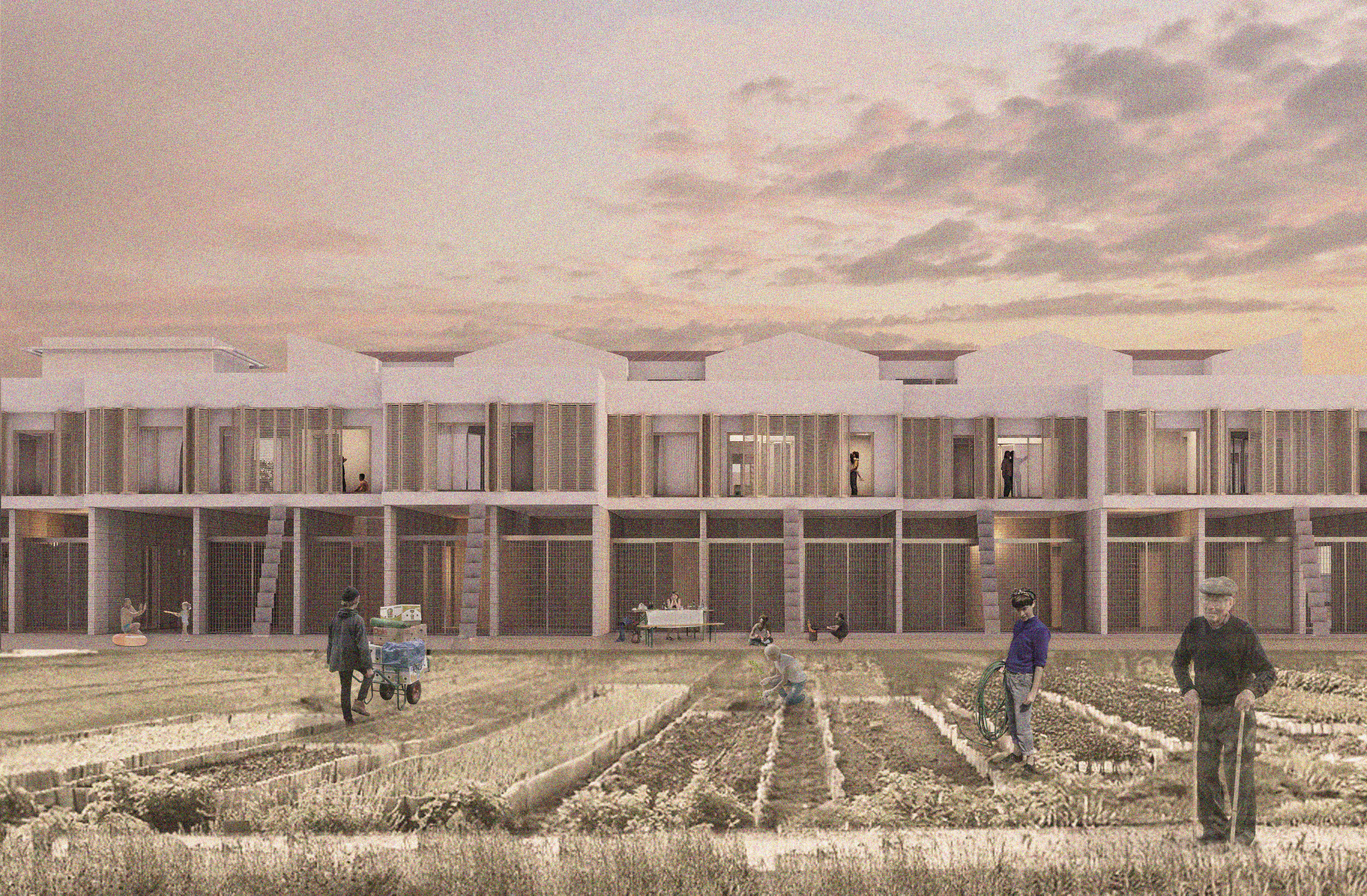
The project proposes the transformation of the "Ciutat Esportiva Dani Jarque" into an equipped park, redifining this environment through the implementation of urban orchards and the construction of 147 social housing units. Initially intended as temporary accommodation for the residents of the La Pau neighbourhood during the renovation of their homes, these will evolve into an emergency social housing offer. It restores the Besòs river agriculture and educates on a sustainable lifestyle.
Spain
Local
Barcelona, Catalonia, Spain
Sant Adrià del Besós, Catalonia, Spain
Sant Adrià del Besós, Catalonia, Spain
It addresses urban-rural linkages
It involves a physical transformation of the built environment (hard investment)
Early concept
No
No
Yes
Individual
Urbanism and architecture are sciences capable to transform the territory and the way people live. For a long time, sustainability (in its broadest spectrum: reintroduction to nature, emissions, proximity, removal, resilience, etc...) has not been an essential element in the definition of our cities. However, in the current climate energetic context, disciplines become vital tools for guiding societies toward ways of living and interacting with nature, with neighbors, with food,... that are more resilient, sustainable and enriching. Thus, the project's architecture not only achieves what is expected of it but is also capable of generating a learning experience that convinces the user of the advantages for them and for nature of this new model.
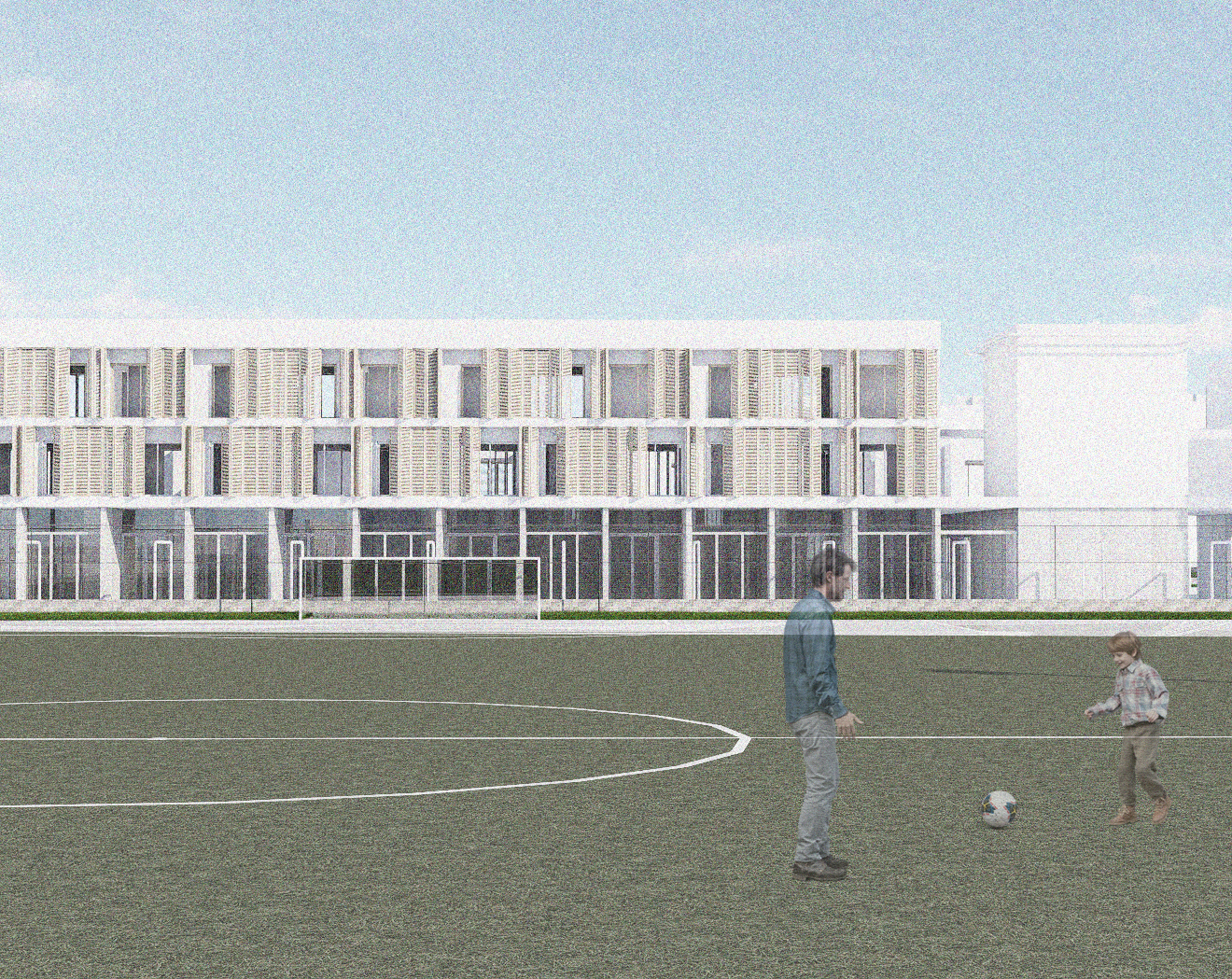
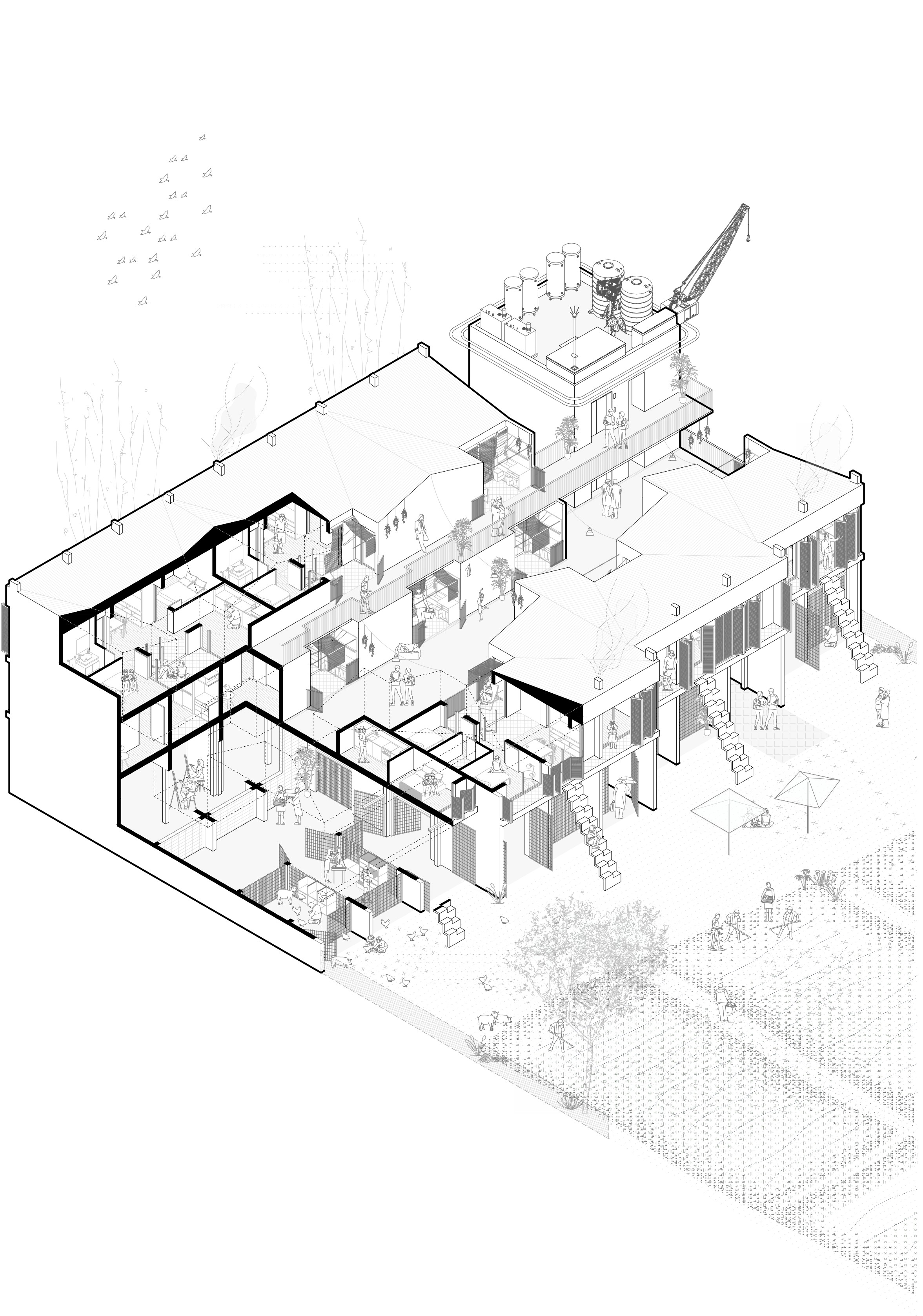
For this reason, the proposal transforms an enclosed and mono-functional space—the Dani Jarque Sports City—into an Equipped Park that hybridizes elite sports with social housing and local agriculture. The proposal projects 147 modular housing units on a rammed earth plinth that redefines the boundary between the city of Barcelona and the Besòs river park. The project works in two phases: first, as temporary accommodation for the residents of the La Pau neighborhood while their degraded buildings are rehabilitated; then, as a permanent social housing resource linked to a productive public space.
The main objective is to dilute the current infrastructural barrier to create a transitional environment where the city merges with the river. The expected results include the recovery of 66,000 m² of permeable soil, the creation of 20 m² of garden per inhabitant, and the implementation of a water and food sovereignty system. The project not only solves a housing urgency but also acts as a prototype of resilient urban regeneration that demonstrates that the coexistence of apparently opposing uses (professional football, residence, and agriculture) is the key to the cohesion of metropolitan peripheries
For this reason, the proposal transforms an enclosed and mono-functional space—the Dani Jarque Sports City—into an Equipped Park that hybridizes elite sports with social housing and local agriculture. The proposal projects 147 modular housing units on a rammed earth plinth that redefines the boundary between the city of Barcelona and the Besòs river park. The project works in two phases: first, as temporary accommodation for the residents of the La Pau neighborhood while their degraded buildings are rehabilitated; then, as a permanent social housing resource linked to a productive public space.
The main objective is to dilute the current infrastructural barrier to create a transitional environment where the city merges with the river. The expected results include the recovery of 66,000 m² of permeable soil, the creation of 20 m² of garden per inhabitant, and the implementation of a water and food sovereignty system. The project not only solves a housing urgency but also acts as a prototype of resilient urban regeneration that demonstrates that the coexistence of apparently opposing uses (professional football, residence, and agriculture) is the key to the cohesion of metropolitan peripheries
The idea was born from a dual critical diagnosis at Barcelona’s eastern edge. On one hand, the dire situation of the La Pau neighborhood was identified: residential estates characteristic of the "desarrollismo" era with structural pathologies, energy inefficiency, and a strong stigma of degradation and poverty that demand urgent rehabilitation. This process implies a temporary relocation of residents during the works, which is often traumatic and uprooting, as it fragments communities and weakens their social bonds. On the other hand, the RCDE Sports City was analyzed—a private and opaque "pocket" that blocks the citizen's connection with the Besòs Delta and its river environment, both in terms of pedestrian access and biodiversity connectivity. Faced with this, the project commits to the premise of "not moving the problem elsewhere" Instead of expelling the sports activity or sending residents to provisional housing far from their surroundings, the proposal suggests a negotiated permeability.
The ideological background of the proposal argues that urban regeneration should not merely be a building rehabilitation policy, but a mechanism for the re-appropriation of resources and a vector for social redistribution. The project arises from the desire to break the dichotomy between nature and humanity, recovering the lost metabolic link with the land. The central idea is that architecture must serve to empower communities to exercise real sovereignty over their energy, water, and food.
Therefore, the project creates a passage, understood as a political space for encounter that combats the isolation of the bedroom city model. Following these same premises, a plinth is generated as a versatile support infrastructure that adapts to human needs at any given moment: from storing belongings and memories during the transition to productive spaces for food sovereignty. The ultimate goal is for the temporary to function as a catalyst to heal self-esteem, eliminating stigmas.
The ideological background of the proposal argues that urban regeneration should not merely be a building rehabilitation policy, but a mechanism for the re-appropriation of resources and a vector for social redistribution. The project arises from the desire to break the dichotomy between nature and humanity, recovering the lost metabolic link with the land. The central idea is that architecture must serve to empower communities to exercise real sovereignty over their energy, water, and food.
Therefore, the project creates a passage, understood as a political space for encounter that combats the isolation of the bedroom city model. Following these same premises, a plinth is generated as a versatile support infrastructure that adapts to human needs at any given moment: from storing belongings and memories during the transition to productive spaces for food sovereignty. The ultimate goal is for the temporary to function as a catalyst to heal self-esteem, eliminating stigmas.
Reterritorialization
Metabolic Circularity
Adaptive Transitional Housing
Agro-Sporting Hybridization
Pedagogical Living Infrastructure
The project approaches sustainability as a challenge of closing metabolic cycles, recovering the historical symbiosis between housing and the fields that once defined the Besòs delta. The concept's exemplarity lies in transforming architecture into a living organism capable of managing its own resources autonomously and circularly, minimizing dependence on external infrastructures.
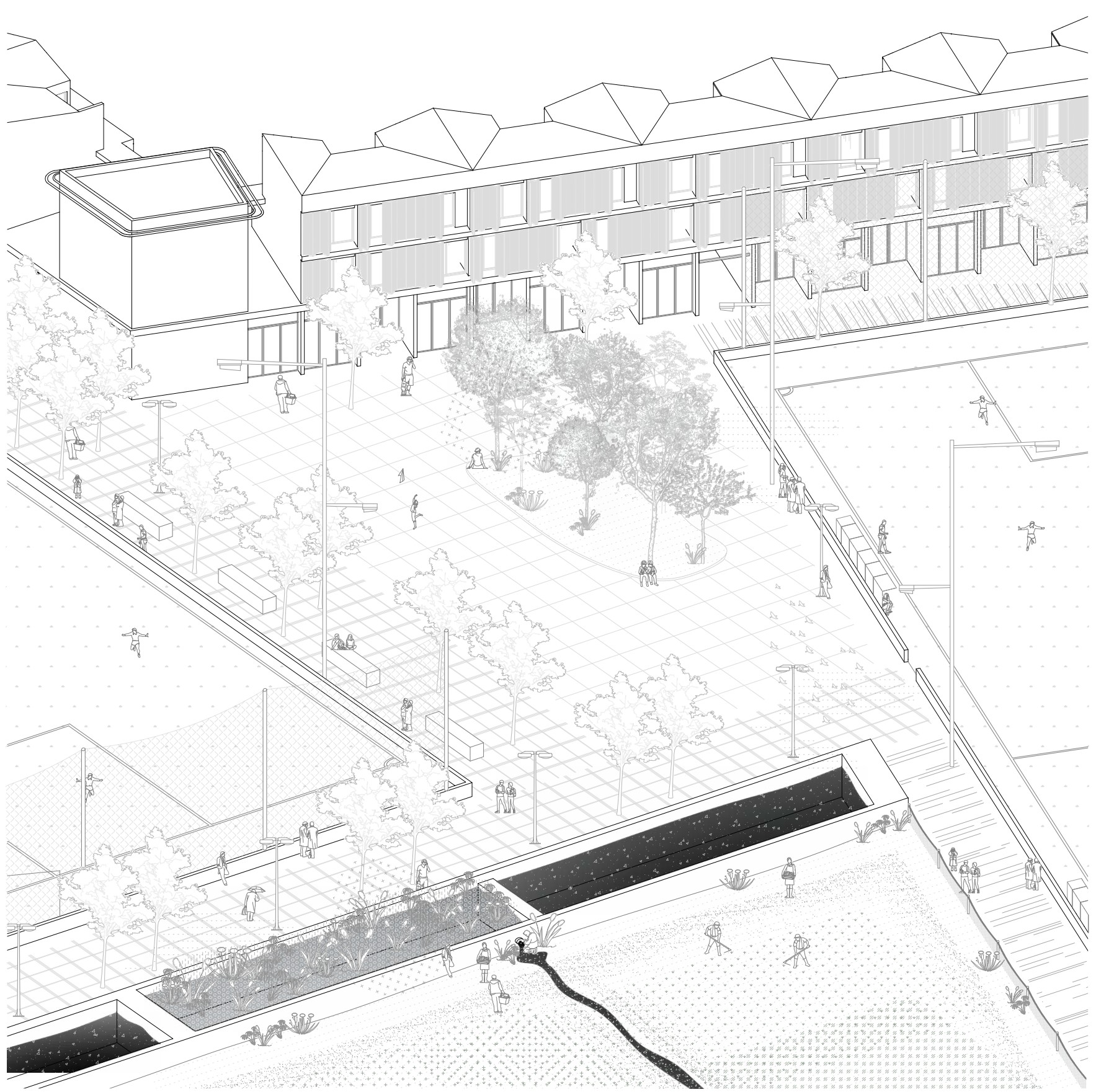
Specifically, the design implements a comprehensive water sovereignty system. Rainwater and greywater from the homes are channeled into collection ponds strategically distributed throughout the park. Treatment is carried out through a multi-stage natural filtration process (gravel and aquatic algae biofilters) that purifies the water, making it suitable for irrigating the 20 m² of urban garden per inhabitant. This cycle is completed with organic matter management: waste from residents and animals living in the plinth (such as chickens or sheep) is transformed into nutrients to nourish the land. This eliminates the need for chemical fertilizers and drastically reduces CO2 emissions linked to waste transport and long-distance food distribution.
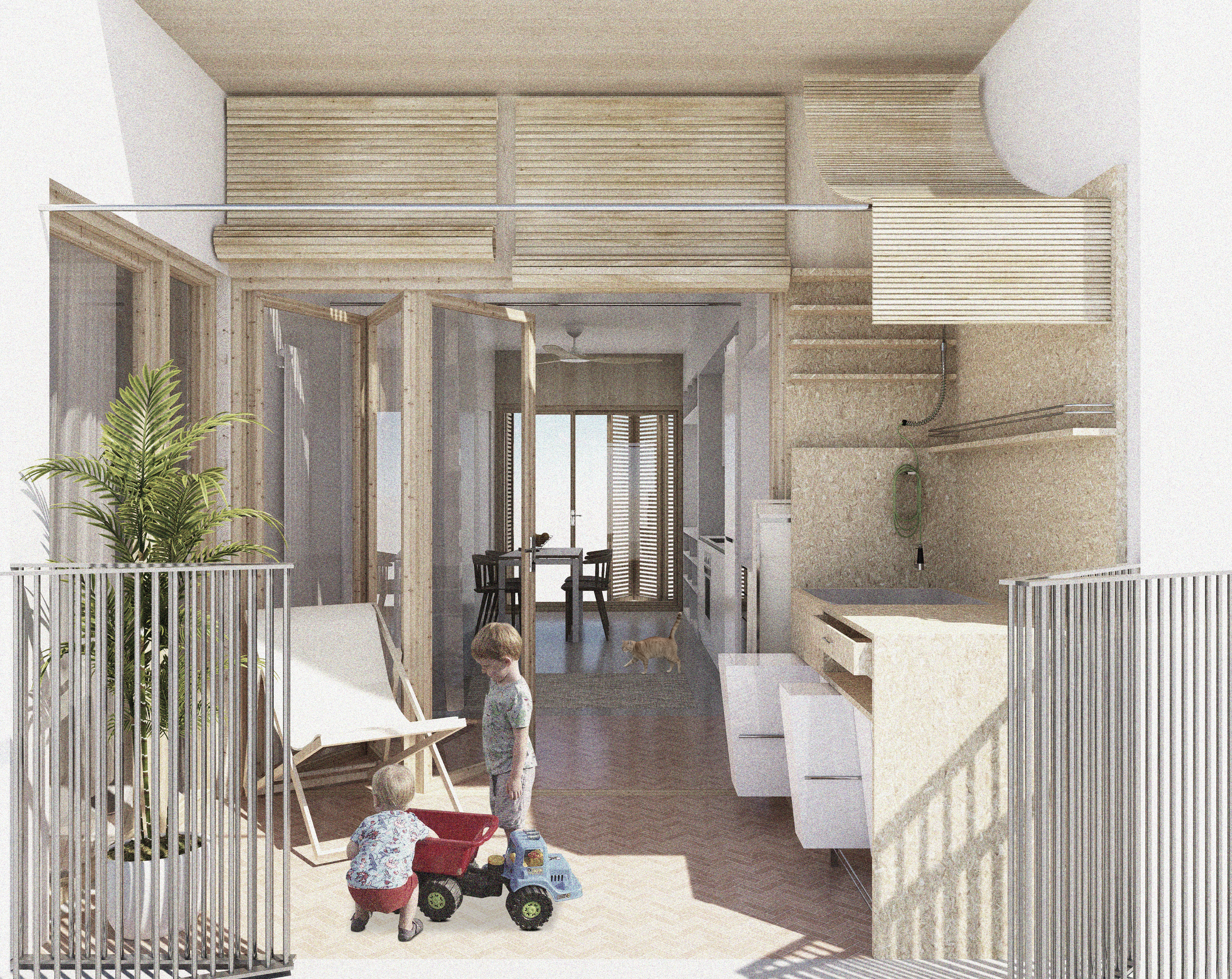
In terms of construction, the rammed earth plinth becomes a pillar of economic and environmental sustainability. It uses soil from the excavation as a zero-kilometer material, providing exceptional thermal inertia that, combined with the upper CLT timber volumes, reduces the carbon footprint of the building's life cycle. This inertia, along with passive systems such as wooden shutters and cross-ventilation, allows for climate comfort without active energy consumption. The project demonstrates that true sustainability arises from reconciling with the biological rhythms of the territory, empowering users through self-production and the careful management of shared resources.
Specifically, the design implements a comprehensive water sovereignty system. Rainwater and greywater from the homes are channeled into collection ponds strategically distributed throughout the park. Treatment is carried out through a multi-stage natural filtration process (gravel and aquatic algae biofilters) that purifies the water, making it suitable for irrigating the 20 m² of urban garden per inhabitant. This cycle is completed with organic matter management: waste from residents and animals living in the plinth (such as chickens or sheep) is transformed into nutrients to nourish the land. This eliminates the need for chemical fertilizers and drastically reduces CO2 emissions linked to waste transport and long-distance food distribution.
In terms of construction, the rammed earth plinth becomes a pillar of economic and environmental sustainability. It uses soil from the excavation as a zero-kilometer material, providing exceptional thermal inertia that, combined with the upper CLT timber volumes, reduces the carbon footprint of the building's life cycle. This inertia, along with passive systems such as wooden shutters and cross-ventilation, allows for climate comfort without active energy consumption. The project demonstrates that true sustainability arises from reconciling with the biological rhythms of the territory, empowering users through self-production and the careful management of shared resources.
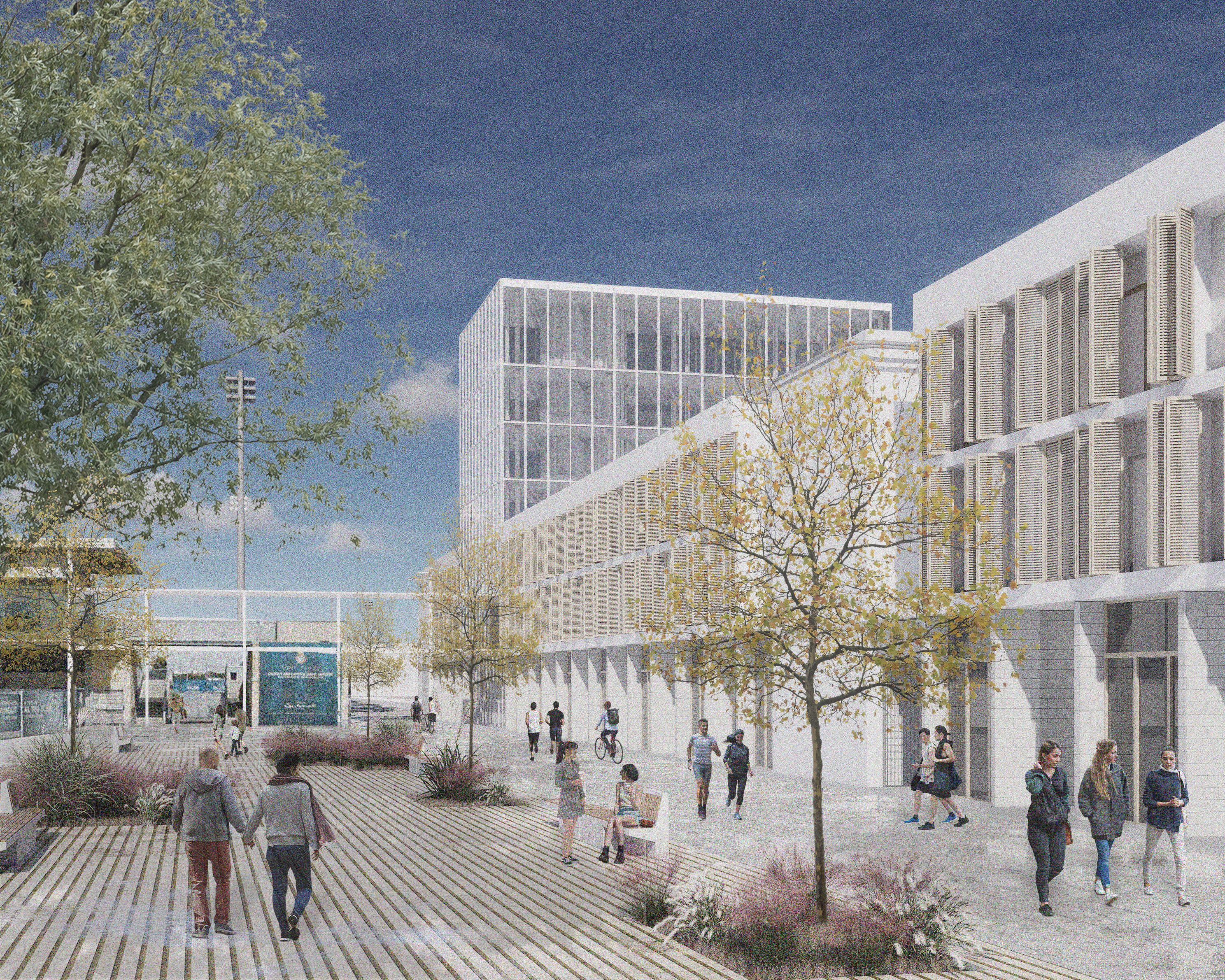
The aesthetics of the project do not reside in the architectural object, but in the poetics of transition. The concept contributes to making life more beautiful by transforming an aggressive concrete barrier into a porous space where the consolidated city gradually blurs toward the Besòs River Park. The exemplarity of this approach lies in exploiting a formerly hermetic private facility to make it permeable and compatible with agriculture and residency; the building disappears to become a landscape where gardens, football fields, and squares intertwine. This integration is achieved through a strategic placement of elements: directional LED lighting minimizes light pollution, and green buffer zones ensure silence and climatic comfort.
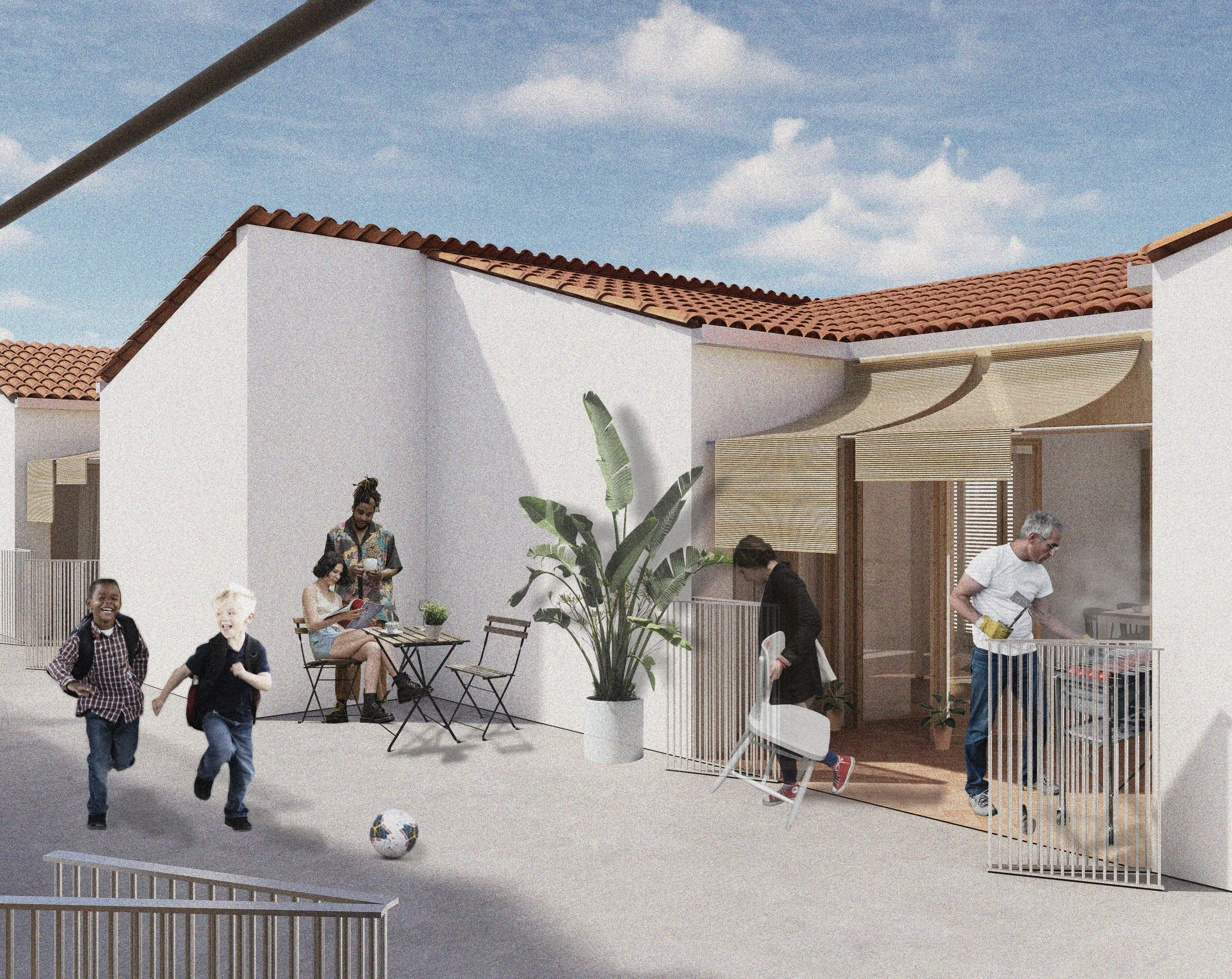
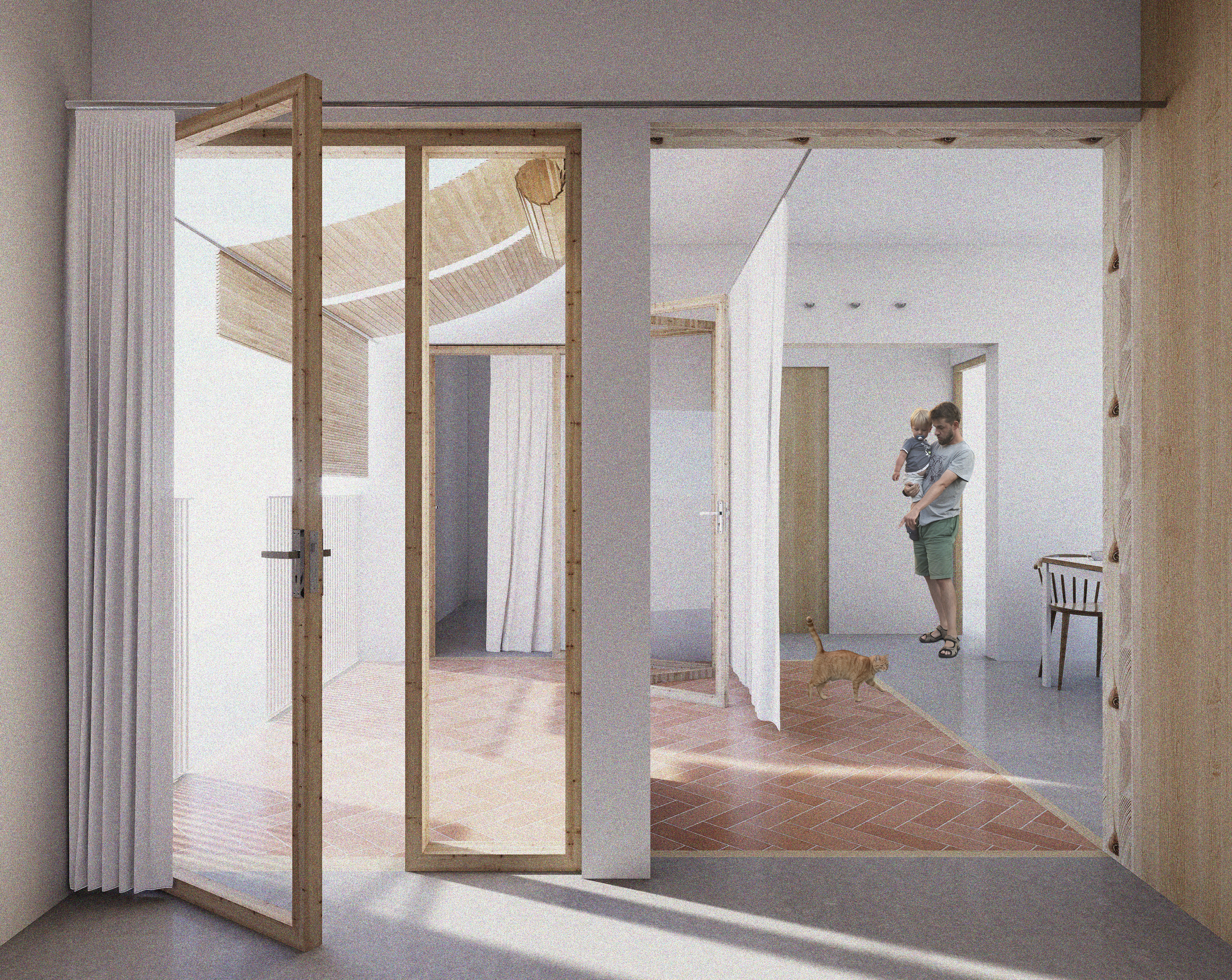
The beauty of the project is its ability to heal the territory beyond the site itself. The rehabilitation of La Pau eliminates the stigma of degradation and restores pride to the residents, while the improvement of river biodiversity benefits all adjacent neighborhoods. This aesthetics of care is materialized through the use of rammed earth and CLT timber, materials that generate a sensory experience of belonging and warmth. On a human scale, the entry patios with modular filters allow each resident to personalize their relationship with the community, granting identity and dignity to the temporary housing.
Finally, the project commits to visual honesty through its utility towers. In contrast to the calm character of the housing, these industrial-aesthetic pieces centralize the water and energy cycles, topped by gravity-fed tanks and a crane that facilitates the logistical moves of temporality. They are landmarks that narrate the productive functioning of the site, demonstrating that beauty is the coherence between utility and the will to create a shared space where nature is no longer a border, but an essential part of daily life.
The beauty of the project is its ability to heal the territory beyond the site itself. The rehabilitation of La Pau eliminates the stigma of degradation and restores pride to the residents, while the improvement of river biodiversity benefits all adjacent neighborhoods. This aesthetics of care is materialized through the use of rammed earth and CLT timber, materials that generate a sensory experience of belonging and warmth. On a human scale, the entry patios with modular filters allow each resident to personalize their relationship with the community, granting identity and dignity to the temporary housing.
Finally, the project commits to visual honesty through its utility towers. In contrast to the calm character of the housing, these industrial-aesthetic pieces centralize the water and energy cycles, topped by gravity-fed tanks and a crane that facilitates the logistical moves of temporality. They are landmarks that narrate the productive functioning of the site, demonstrating that beauty is the coherence between utility and the will to create a shared space where nature is no longer a border, but an essential part of daily life.
Inclusion is addressed through empowerment and self-esteem, eliminating the social stigma often associated with social housing. The project does not merely offer "shelter," but a learning device where vulnerable residents transform into active producers. The model’s exemplarity lies in shifting the narrative from welfare dependence to sovereignty and territorial belonging, demonstrating that true inclusion involves providing the highest quality of space and tools to those who need them most, turning the citizen into a sovereign over their basic needs.
The key element of this transition is the flexible plinth and its cage-like storage spaces. This adaptable social infrastructure responds to human needs at any given moment. Initially, the cages serve as secure storage where La Pau residents can keep their belongings and personal memories during the rehabilitation process of their neighborhood. Having this personal space within the temporary housing reduces the anxiety of relocation and maintains the thread of their identity and memory. Over time, the plinth evolves according to community demands: the storage spaces become workshops or productive units where it is possible to keep chicken coops and farm animals such as sheep or pigs.
This system promotes a new model of coexistence where the resident is an active producer integrated into the metabolism of their neighborhood. Direct learning from the land generates a renewed sense of self-esteem and a deep-rooted connection to the territory. Bringing food closer to home not only drastically reduces CO2 emissions but also empowers people through shared production. Ultimately, the project ensures that dignity and the sense of belonging do not depend on economic status, but on the capacity to inhabit the territory with care, cooperation, and autonomy.
The key element of this transition is the flexible plinth and its cage-like storage spaces. This adaptable social infrastructure responds to human needs at any given moment. Initially, the cages serve as secure storage where La Pau residents can keep their belongings and personal memories during the rehabilitation process of their neighborhood. Having this personal space within the temporary housing reduces the anxiety of relocation and maintains the thread of their identity and memory. Over time, the plinth evolves according to community demands: the storage spaces become workshops or productive units where it is possible to keep chicken coops and farm animals such as sheep or pigs.
This system promotes a new model of coexistence where the resident is an active producer integrated into the metabolism of their neighborhood. Direct learning from the land generates a renewed sense of self-esteem and a deep-rooted connection to the territory. Bringing food closer to home not only drastically reduces CO2 emissions but also empowers people through shared production. Ultimately, the project ensures that dignity and the sense of belonging do not depend on economic status, but on the capacity to inhabit the territory with care, cooperation, and autonomy.
“Comunitat de Proximitat” redefines participation as a lived and collective process embedded in space. The project engages residents of La Pau, local associations, NGOs and everyday users as active co-producers of their environment.
Participation begins with direct interviews, identifying daily routines, spatial deficiencies and social dynamics (which lead to a Master’s Thesis). These insights shape the proposal, ensuring it responds to real needs.
During implementation, around 550 residents per cycle are temporarily relocated, forming small communities that collectively manage shared spaces. Participation extends beyond them to include users of the public park, football facilities and ground-floor economic activities.
The core innovation lies in productive landscapes. Residents can join a community organization to manage urban agriculture, maintain the park and produce food. This system evolves into a shared food infrastructure, where contributions grant access to a collective kitchen and dining space, based on reciprocity rather than aid.
Architecture reinforces this process: the elevated street fosters daily interaction, while the ground floor enables social and economic exchange. The temporary housing becomes an immersive learning environment where sustainable practices are experienced through daily life.
This approach strengthens social cohesion, builds knowledge and fosters agency. Participation improves adaptability and long-term resilience, transforming relocation into an opportunity for collective growth and lasting urban transformation.
Participation begins with direct interviews, identifying daily routines, spatial deficiencies and social dynamics (which lead to a Master’s Thesis). These insights shape the proposal, ensuring it responds to real needs.
During implementation, around 550 residents per cycle are temporarily relocated, forming small communities that collectively manage shared spaces. Participation extends beyond them to include users of the public park, football facilities and ground-floor economic activities.
The core innovation lies in productive landscapes. Residents can join a community organization to manage urban agriculture, maintain the park and produce food. This system evolves into a shared food infrastructure, where contributions grant access to a collective kitchen and dining space, based on reciprocity rather than aid.
Architecture reinforces this process: the elevated street fosters daily interaction, while the ground floor enables social and economic exchange. The temporary housing becomes an immersive learning environment where sustainable practices are experienced through daily life.
This approach strengthens social cohesion, builds knowledge and fosters agency. Participation improves adaptability and long-term resilience, transforming relocation into an opportunity for collective growth and lasting urban transformation.
The project operates through a multi-layered governance model connecting community actors, institutions and private stakeholders into a shared urban system.
At the local level, it builds on existing neighbourhood associations, cultural centres and NGOs already active in La Pau. These actors support social programs, facilitate inclusion and act as mediators between residents and the project.
At the community scale, residents are encouraged to self-organize around shared responsibilities such as managing productive landscapes, maintaining collective spaces and coordinating food systems. This enables a bottom-up governance model based on shared ownership.
At the institutional level, the project aligns with metropolitan planning strategies that identify the area as a key site for regeneration, housing and green infrastructure. Public entities ensure land transformation, accessibility and long-term continuity.
Private stakeholders, such as the football club, are integrated into this system. Their facilities shift from isolated infrastructure to shared urban assets, contributing to public life and local identity. Other private entities can rent the ground floor for social and private economic purposes.
Institutional frameworks provide stability, while community structures ensure adaptability and long-term care. This layered governance enables a resilient model where spatial, social and economic systems are co-managed across scales.
At the local level, it builds on existing neighbourhood associations, cultural centres and NGOs already active in La Pau. These actors support social programs, facilitate inclusion and act as mediators between residents and the project.
At the community scale, residents are encouraged to self-organize around shared responsibilities such as managing productive landscapes, maintaining collective spaces and coordinating food systems. This enables a bottom-up governance model based on shared ownership.
At the institutional level, the project aligns with metropolitan planning strategies that identify the area as a key site for regeneration, housing and green infrastructure. Public entities ensure land transformation, accessibility and long-term continuity.
Private stakeholders, such as the football club, are integrated into this system. Their facilities shift from isolated infrastructure to shared urban assets, contributing to public life and local identity. Other private entities can rent the ground floor for social and private economic purposes.
Institutional frameworks provide stability, while community structures ensure adaptability and long-term care. This layered governance enables a resilient model where spatial, social and economic systems are co-managed across scales.
“Comunitat de Proximitat” integrates architecture, urbanism, environmental systems, social sciences and food networks into a unified approach to urban regeneration.
Architecture provides flexible housing systems that adapt to changing social structures, while redefining the relationship between private and collective life. Urban design reconnects fragmented territories and transforms mono-functional infrastructures into active, mixed-use environments.
Environmental strategies include water reuse, passive climate systems and circular resource flows, making ecological processes visible and integrated into everyday life.
The project focuses on community cohesion, vulnerability and displacement. Temporary relocation is reframed as a social opportunity to build new forms of collective living.
Food systems act as a key connector between disciplines. Urban agriculture links environmental performance, social interaction and local economies, reintroducing production into the city.
Rather than operating separately, these fields are spatially and functionally intertwined. Architecture becomes the framework through which environmental, social and economic systems interact.
This transdisciplinary approach enables a holistic model where urban regeneration is not only physical, but also ecological and social, creating a more resilient and interconnected way of living.
Architecture provides flexible housing systems that adapt to changing social structures, while redefining the relationship between private and collective life. Urban design reconnects fragmented territories and transforms mono-functional infrastructures into active, mixed-use environments.
Environmental strategies include water reuse, passive climate systems and circular resource flows, making ecological processes visible and integrated into everyday life.
The project focuses on community cohesion, vulnerability and displacement. Temporary relocation is reframed as a social opportunity to build new forms of collective living.
Food systems act as a key connector between disciplines. Urban agriculture links environmental performance, social interaction and local economies, reintroducing production into the city.
Rather than operating separately, these fields are spatially and functionally intertwined. Architecture becomes the framework through which environmental, social and economic systems interact.
This transdisciplinary approach enables a holistic model where urban regeneration is not only physical, but also ecological and social, creating a more resilient and interconnected way of living.
The project proposes a hybrid economic model combining public investment, local economic activity and shared infrastructures that generate both direct and indirect value.
Public funding supports the initial transformation, particularly housing, infrastructure and environmental systems, aligned with urban regeneration and social housing policies.
At ground level, commercial spaces generate continuous revenue through local businesses, activating the area economically while supporting employment and small-scale entrepreneurship.
A key innovation is the redefinition of the sports facility as shared infrastructure. The project envisions a “sports city of the future” that maintains the technical requirements of a high-performance private facility—privacy, security and operational efficiency—while opening selectively to the neighbourhood. Spaces are made accessible when not in use, allowing residents to engage with them and fostering a sense of belonging.
This shared use generates positive synergies: the local community becomes part of the ecosystem surrounding the club, strengthening identity and engagement, which in turn benefits the private activity through increased visibility, social value and potential audience growth.
Urban agriculture adds another economic layer. While not profit-driven, it reduces living costs, supports local exchange systems and feeds into a collective kitchen model based on contribution rather than donation, reinforcing dignity and reciprocity.
Operational costs are reduced through passive design, shared systems and collective resource management. Over time, temporary housing is reused as social or emergency housing, ensuring long-term value.
This model combines revenue, cost reduction and social value creation, resulting in a financially resilient and socially integrated system.
Public funding supports the initial transformation, particularly housing, infrastructure and environmental systems, aligned with urban regeneration and social housing policies.
At ground level, commercial spaces generate continuous revenue through local businesses, activating the area economically while supporting employment and small-scale entrepreneurship.
A key innovation is the redefinition of the sports facility as shared infrastructure. The project envisions a “sports city of the future” that maintains the technical requirements of a high-performance private facility—privacy, security and operational efficiency—while opening selectively to the neighbourhood. Spaces are made accessible when not in use, allowing residents to engage with them and fostering a sense of belonging.
This shared use generates positive synergies: the local community becomes part of the ecosystem surrounding the club, strengthening identity and engagement, which in turn benefits the private activity through increased visibility, social value and potential audience growth.
Urban agriculture adds another economic layer. While not profit-driven, it reduces living costs, supports local exchange systems and feeds into a collective kitchen model based on contribution rather than donation, reinforcing dignity and reciprocity.
Operational costs are reduced through passive design, shared systems and collective resource management. Over time, temporary housing is reused as social or emergency housing, ensuring long-term value.
This model combines revenue, cost reduction and social value creation, resulting in a financially resilient and socially integrated system.
The project is designed as a transferable framework rather than a fixed solution. Its key principles can be adapted to different contexts facing similar challenges of urban fragmentation, housing vulnerability and ecological disconnection.
At the core is a methodology based on three elements: temporary housing as a transition tool, integration of productive landscapes and community-based resource management. These can be applied independently or combined depending on local needs.
The spatial system, low-rise modular housing, active ground floors and shared circulation spaces, can be replicated in different urban conditions, particularly in areas with underused infrastructure or transitional land and allows disassembly.
The integration of urban agriculture as both ecological and social infrastructure is highly adaptable, allowing cities to reconnect production, consumption and community life regardless of scale.
Equally transferable is the governance model, which combines institutional support with community self-organization. This structure enables adaptation to different regulatory, cultural and economic contexts.
The project’s main value lies in its ability to transform temporary processes into long-term opportunities. By reframing relocation, infrastructure reuse and public space activation, it offers a replicable strategy for cities seeking inclusive and sustainable regeneration models.
At the core is a methodology based on three elements: temporary housing as a transition tool, integration of productive landscapes and community-based resource management. These can be applied independently or combined depending on local needs.
The spatial system, low-rise modular housing, active ground floors and shared circulation spaces, can be replicated in different urban conditions, particularly in areas with underused infrastructure or transitional land and allows disassembly.
The integration of urban agriculture as both ecological and social infrastructure is highly adaptable, allowing cities to reconnect production, consumption and community life regardless of scale.
Equally transferable is the governance model, which combines institutional support with community self-organization. This structure enables adaptation to different regulatory, cultural and economic contexts.
The project’s main value lies in its ability to transform temporary processes into long-term opportunities. By reframing relocation, infrastructure reuse and public space activation, it offers a replicable strategy for cities seeking inclusive and sustainable regeneration models.
In the year following the application, the project focuses on transitioning from a conceptual proposal to an actionable framework.
The first step is to consolidate partnerships with local stakeholders, including neighbourhood associations, NGOs and institutional actors. This phase will define governance structures, roles and potential pilot groups.
Simultaneously, the project will be developed into a more detailed implementation strategy, including phasing, technical development and regulatory alignment with existing urban plans.
A key objective is to initiate a pilot phase at a smaller scale. This could involve testing specific components such as community-managed urban agriculture, shared food systems or temporary housing prototypes. These pilots will allow evaluation and adjustment before larger implementation.
Communication and dissemination will also play a central role. The project will be presented through exhibitions, publications and collaborations with academic and professional platforms to build visibility and attract support.
Finally, efforts will focus on identifying funding opportunities, combining public programs, research grants and potential partnerships to enable initial execution.
This phased approach ensures feasibility while maintaining flexibility, allowing the project to evolve through real conditions and stakeholder engagement, moving progressively from vision to implementation.
The first step is to consolidate partnerships with local stakeholders, including neighbourhood associations, NGOs and institutional actors. This phase will define governance structures, roles and potential pilot groups.
Simultaneously, the project will be developed into a more detailed implementation strategy, including phasing, technical development and regulatory alignment with existing urban plans.
A key objective is to initiate a pilot phase at a smaller scale. This could involve testing specific components such as community-managed urban agriculture, shared food systems or temporary housing prototypes. These pilots will allow evaluation and adjustment before larger implementation.
Communication and dissemination will also play a central role. The project will be presented through exhibitions, publications and collaborations with academic and professional platforms to build visibility and attract support.
Finally, efforts will focus on identifying funding opportunities, combining public programs, research grants and potential partnerships to enable initial execution.
This phased approach ensures feasibility while maintaining flexibility, allowing the project to evolve through real conditions and stakeholder engagement, moving progressively from vision to implementation.