Arts, Culture, and Heritage as Drivers of Change
Mapping heritage and its perception
Using digital insight to reconnect communities with heritage, fostering beauty and inclusion.
The project explores how digital survey, community questionnaires, and spatial perception come together to reveal a fuller understanding of historic places. By integrating tangible and intangible data into a flexible geometric model, it creates a comprehensive map that supports new ways of interpreting and engaging with heritage.
Italy
Local
Piazzola sul Brenta
Mainly urban
It refers to other types of transformations (soft investment)
Early concept
Yes
The doctoral research project is carried out within the framework of the Italian Piano Nazionale di Ripresa e Resilienza (PNRR), under Mission 4 – Education and Research, Component 2 – From Research to Business, Investment 1.5 – Creation and Strengthening of Innovation Ecosystems. It is funded through RFF – Next Generation EU resources, under grant number ECS00000043, CUP C43C22000340006. The research is part of the broader activities promoted by the Interconnected Nord-Est Innovation Ecosystem (iNEST), a large-scale initiative aimed at fostering innovation, knowledge transfer, and digital transformation across strategic sectors in North-East Italy.
No
No
Individual
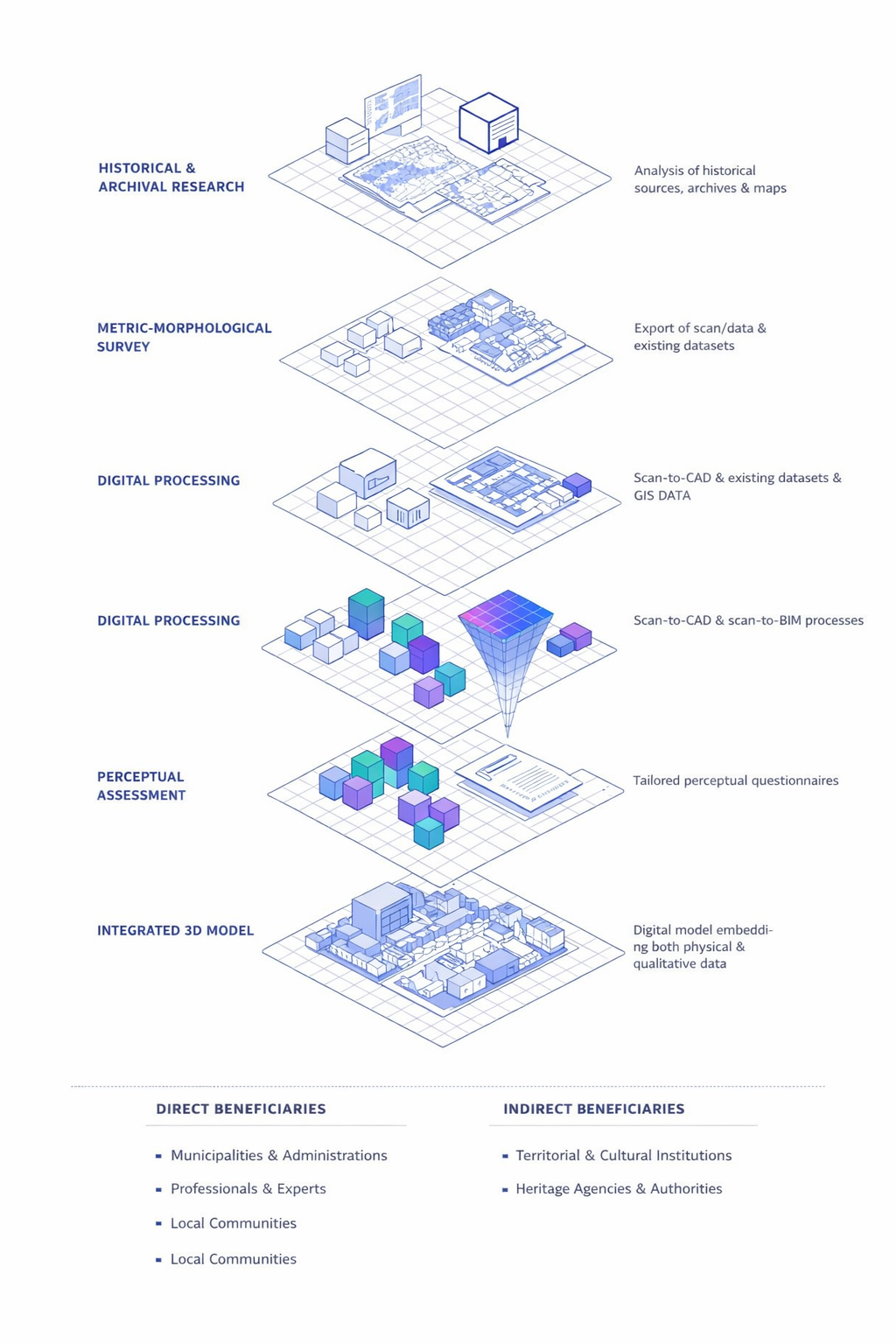
My project develops an integrated guideline for analysing small and medium-sized historic centres, understood as stratified cultural landscapes where natural, built and social dimensions are deeply interwoven. These contexts, often overlooked yet highly fragile, reveal subtle balances between tangible heritage, everyday practices and environmental dynamics—balances increasingly threatened by rapid transformations. The project combines architectural survey, landscape interpretation and community-based inquiry to capture both the geometric memory and the lived experience of historic places. Starting from high-precision morphological and metric surveys, the methodology expands beyond quantitative data to include qualitative dimensions: perceptual questionnaires, analysis of urban patterns, study of architectural types, and investigation of landscape evolution. This interdisciplinary approach acknowledges the complexity of smaller historic centres, where historical stratification, environmental relationships and socio-cultural identities coexist. The main achieved result is the development of a replicable workflow that integrates heterogeneous data into a single three-dimensional virtual environment. This model becomes a shared space where quantitative measurements and qualitative perceptions converge, enabling a more holistic understanding of heritage values and vulnerabilities. The protocol has already demonstrated its capacity to reveal hidden dynamics, support informed decision-making, and foster dialogue between experts, institutions and local communities. Expected results include the refinement of the digital platform (a platform able to collect and visualise tangible and intangible data), broader testing in comparable contexts, and the creation of a transferable methodology that promotes sustainable, culturally aware strategies for the future of historic centres.
The concept emerged from a reflection on the inherent complexity of small historic centres—an attribute often perceived as a challenge, but here embraced as a positive and generative quality. The research began with a simple question: could this very complexity become the lens through which future strategies for regeneration and heritage enhancement should be conceived? This intuition shaped the foundation of the doctoral project. Developed within the Department of Civil, Environmental and Architectural Engineering at the University of Padua, the research is embedded in the iNEST – Interconnected Nord-Est Innovation Ecosystem, a large-scale programme funded through the Italian PNRR. This context placed the project at the intersection of multiple disciplines from the outset. Although rooted in the scientific area of Drawing (CEAR-10/A), the work evolved through continuous collaboration with architectural history, archaeology, cultural heritage studies, digital humanities, information technologies and environmental psychology. This interdisciplinary environment profoundly influenced both the theoretical framework and the operational methodology.
The development of the concept required designing a workflow capable of integrating diverse data sources, technologies and disciplinary languages. The landscape was approached as a temporal palimpsest, readable through vertical stratifications. Tools such as historical documentation, integrated surveys, advanced 3D modelling, perceptual and psychological questionnaires, direct observation and drawing were progressively combined. Each step contributed to constructing a multi-layered understanding of the historic urban space, seen as a living and complex entity. Implementation unfolded through iterative cycles of fieldwork, data integration and dialogue with local communities and researchers.
The development of the concept required designing a workflow capable of integrating diverse data sources, technologies and disciplinary languages. The landscape was approached as a temporal palimpsest, readable through vertical stratifications. Tools such as historical documentation, integrated surveys, advanced 3D modelling, perceptual and psychological questionnaires, direct observation and drawing were progressively combined. Each step contributed to constructing a multi-layered understanding of the historic urban space, seen as a living and complex entity. Implementation unfolded through iterative cycles of fieldwork, data integration and dialogue with local communities and researchers.
Heritage‑Driven Regeneration
Cultural Landscape Identity
Community‑Centred Participation
Transdisciplinary Co‑Creation
Digital Humanities for Inclusion
The concept promotes sustainability by addressing historic centres as complex cultural ecosystems where environmental, social, and cultural dimensions are inseparable. Rather than focusing solely on the physical conservation of heritage, the project develops a methodology that reveals how communities inhabit, perceive, and transform their urban landscapes over time. This integrated understanding supports more informed, long‑term strategies for regeneration, reducing the risk of interventions that overlook local identity, environmental fragility, or community needs. From an environmental perspective, the protocol analyses the relationship between built fabric, natural landscape, and historical transformations, helping identify vulnerabilities, adaptive capacities, and sustainable pathways for future development. On a social and cultural level, the methodology strengthens community awareness and participation. Perceptual questionnaires and direct engagement activities capture the emotional and experiential dimensions of place, reinforcing the sense of belonging that is essential for sustainable stewardship of heritage. This contributes to social cohesion and empowers local actors to take part in decision‑making processes. Economically, the project offers a replicable and scalable workflow that can guide municipalities, professionals, and cultural institutions in designing context‑sensitive strategies, reducing costs associated with inappropriate interventions and promoting heritage as a driver of local development.
The concept is centered in sustainability because it integrates scientific analysis, digital innovation, and community knowledge into a single framework. By combining tangible and intangible heritage, it promotes a holistic vision of sustainability rooted in cultural identity, environmental awareness, and long term resilience.
The concept is centered in sustainability because it integrates scientific analysis, digital innovation, and community knowledge into a single framework. By combining tangible and intangible heritage, it promotes a holistic vision of sustainability rooted in cultural identity, environmental awareness, and long term resilience.
The concept enhances aesthetics by reframing beauty as a lived, shared and culturally rooted experience. Rather than treating historic centres as static artefacts, the project reveals the subtle relationships between people, spaces and memories that shape the everyday beauty of small urban landscapes. By integrating perceptual data, historical layers and spatial analysis, the methodology uncovers the qualities that make these places meaningful—proportions, rhythms, views, material textures, and the emotional resonance they generate within communities. Beauty is approached not as decoration, but as a form of knowledge and care. Through community questionnaires, direct observation and drawing, the project captures how inhabitants perceive their environment, and which elements contribute to their sense of comfort, identity and attachment. This process strengthens the emotional bond between people and place, fostering a renewed awareness of the aesthetic and cultural richness embedded in ordinary streets, open spaces and architectural details. The creation of a three dimensional virtual environment further contributes to aesthetic appreciation by making the invisible visible: historical transformations, spatial hierarchies, and intangible qualities become accessible and understandable. A shared visual platform supports inclusive dialogue and encourages communities to imagine future scenarios that respect the character and beauty of their heritage. The project is exemplary in terms of aesthetics because it promotes a holistic, culturally grounded vision of beauty, rooted in authenticity, memory and environmental harmony. It demonstrates that aesthetic quality emerges from the integration of tangible and intangible heritage, from the care invested in understanding a place, and from the collective capacity to recognise and preserve what makes it unique.
The concept promotes inclusion by placing communities at the centre of the analysis of historic environments. Unlike traditional survey procedures—typically limited to geometric or material data—the project integrates perceptual questionnaires and direct engagement with inhabitants. This approach makes the lived experience of citizens an essential component of heritage interpretation, ensuring that the voices of those who inhabit historic centres daily are acknowledged and valued. By understanding how people perceive safety, comfort, beauty, and identity within their urban landscape, the methodology supports more inclusive and human centred regeneration strategies. This focus on perception and emotional connection enhances accessibility in a broader sense: it allows even small and often marginalised historic centres to maintain and communicate their cultural, social, and economic identity. The project demonstrates that accessibility is not only physical but also cognitive and cultural—ensuring that communities can recognise, understand, and care for the places they inhabit. Digital documentation plays a key role in widening access. The creation of an integrated 3D environment makes heritage information available to diverse audiences: researchers, local administrations, citizens, and future generations. This shared digital space supports transparent decision making, fosters inclusive governance models, and reduces barriers to participation by offering clear, comprehensible representations of complex heritage data. It empowers inhabitants by recognising their experiential knowledge as a legitimate and necessary component of sustainable preservation. By strengthening awareness and fostering a sense of belonging, the concept contributes to long term care for the place and to more equitable, culturally grounded urban futures.
Participation is a foundational element of the concept, shaping both its methodology and its outcomes. The project actively involves citizens, local communities and institutional stakeholders through perceptual questionnaires, interviews, and direct observation sessions conducted within the historic centres under study. These tools allow inhabitants to express how they perceive, use and emotionally relate to their urban environment. Their experiential knowledge becomes a crucial layer of interpretation, complementing technical and historical data. This engagement has had a significant impact on the development of the concept. Citizens’ responses revealed patterns of attachment, discomfort, memory and identity that would not emerge through conventional architectural or morphological analysis alone. These insights guided the refinement of the digital and analog documentation, highlighting which spatial qualities matter most to the community and which areas require attention in future regeneration strategies. The participatory process therefore transforms residents from passive subjects into active contributors to the understanding of their own heritage.
Stakeholders such as municipal administrations, cultural institutions and interdisciplinary research groups are also involved through iterative discussions and shared digital outputs. This fosters transparent decision making and supports governance models that value inclusivity and collective responsibility. By integrating community perception into scientific analysis, the project strengthens local agency, enhances awareness, and lays the foundation for long term, community driven care of historic centres, focusing on participation of citizens because it demonstrates that heritage knowledge is not solely technical: it is co constructed with the people who inhabit the place.
Stakeholders such as municipal administrations, cultural institutions and interdisciplinary research groups are also involved through iterative discussions and shared digital outputs. This fosters transparent decision making and supports governance models that value inclusivity and collective responsibility. By integrating community perception into scientific analysis, the project strengthens local agency, enhances awareness, and lays the foundation for long term, community driven care of historic centres, focusing on participation of citizens because it demonstrates that heritage knowledge is not solely technical: it is co constructed with the people who inhabit the place.
The concept is grounded in a multilevel governance structure that connects local communities, academic institutions, regional networks and national–European innovation frameworks. At the local level, the project engages directly with citizens, municipal administrations and cultural associations within the historic centres under study, especially in dialogue with the municipality of Piazzola sul Brenta. Their experiential knowledge, daily practices and perceptions of place provide essential insights that guide the refinement of the methodology and ensure that the outcomes respond to real community needs. At the regional level, the research is embedded in the iNEST – Interconnected Nord Est Innovation Ecosystem, which brings together universities, research centres, public authorities and private partners across the Veneto and North East Italy. At the national level, the project is part of the Italian PNRR framework, which promotes digital transformation, sustainable development and innovation in cultural heritage. This positioning strengthens the project’s capacity to contribute to national strategies for heritage documentation, community engagement and territorial regeneration. At the European level, the concept aligns with the broader objectives of the Next Generation EU initiative. Its integrated approach—combining digital tools, cultural heritage, community participation and interdisciplinary research—positions it as a replicable model for other European historic centres facing similar challenges. The added value of this multilevel engagement lies in the creation of a shared governance ecosystem where knowledge flows across scales: local perceptions inform regional strategies; academic research supports municipal decision making; national and European frameworks provide resources, standards and long-term vision. This structure ensures that the project is not only scientifically robust but also socially grounded.
The concept is inherently transdisciplinary, emerging from the intersection of multiple fields that together contribute to a holistic understanding of small historic centres. While rooted in architectural drawing and representation, the project integrates knowledge from architecture, urban studies, landscape interpretation, archaeology, and architectural history, which provide the historical and spatial foundations for analysing the built environment. The research also incorporates digital technologies, including integrated surveying, 3D modelling, and digital humanities approaches, enabling the creation of a shared virtual environment where heterogeneous data can be visualised and interpreted. These tools support interoperability and open new possibilities for documenting and communicating heritage. Contributions from the social sciences and environmental psychology are essential for capturing the perceptual and emotional dimensions of place. Through questionnaires and community based inquiry, the project explores how inhabitants experience their environment, how they attribute meaning to spaces, and how these perceptions influence identity and belonging. The involvement of environmental sciences enriches the analysis of landscape dynamics, ecological relationships and long term transformations, ensuring that heritage is understood within its broader environmental context. Collaboration with information technologies supports data integration, processing and accessibility, reinforcing the project’s commitment to digital inclusion.
The long term sustainability of the proposed workflowrelies on its progressive validation and adoption as a standard methodology for the analysis and documentation of minor historic centres. To achieve this, the model must be tested in multiple contexts, allowing comparative assessment across different, social, environmental and community conditions. Each new case study would both refine the protocol and demonstrate its transferability, strengthening its value for public administrations, cultural institutions and territorial agencies. The business model therefore combines research driven development with scalable implementation. Revenues may derive from commissioned applications of the protocol in other historic centres, consultancy services for municipalities and heritage bodies, and training activities for professionals and local authorities. Additional funding streams may include competitive research grants, public programmes supporting digital transition in cultural heritage, and collaborations with regional or national agencies interested in harmonised documentation standards. Over time, the protocol’s adaptability and demonstrated effectiveness would position it as a reference framework, enabling a sustainable cycle of applied projects, capacity building initiatives and institutional partnerships.
The proposed protocol is inherently designed for transferability and scalability. Its core elements—integrated survey workflows, multi layered documentation strategies, and a structured decision making framework—can be replicated across minor historic centres with different morphological, social and environmental conditions. The methodology is modular: each phase (data acquisition, processing, interpretation, community engagement, and output generation) can be adapted to local resources, heritage typologies and governance structures. The approach is also sector agnostic. Beyond historic centres, it can support landscape analysis, rural settlements, industrial heritage sites, and cultural routes, offering a coherent framework for documenting complex built environments. The technological components—interoperable data models, open standard formats, and scalable digital tools—facilitate adoption by municipalities, regional agencies, cultural institutions and research bodies. Key learnings from each implementation feed back into the protocol, strengthening its robustness and adaptability. By combining methodological clarity, flexible tools and a replicable workflow, the concept can be deployed in diverse geographies and beneficiary groups, enabling a shared European standard for the documentation and understanding of fragile heritage contexts.
The next phase of development focuses on applying and refining the protocol through ongoing academic and research driven activities. Several case studies already scheduled within university programmes and externally funded research projects will serve as immediate testing grounds. These contexts, where metric–morphological surveys are planned, offer an ideal opportunity to integrate the perceptual questionnaires and the detailed qualitative–quantitative cataloguing system first developed in the pilot study of Piazzola sul Brenta.
During the year following the application, the concept will be implemented through three coordinated actions:
1. Methodological integration, embedding the workflow into upcoming survey campaigns to validate its applicability in diverse historic centres.
2. Comparative analysis, using the new case studies to assess variations in community perception, spatial morphology and environmental conditions, strengthening the protocol’s adaptability.
3. Dissemination and capacity building, promoting the approach through academic courses, workshops with local administrations, and presentations within research networks.
This structured roadmap ensures that the concept evolves through real world application, progressively consolidating its robustness and readiness for broader adoption.