Verbas ao Miño
Verbas ao Miño: reconnecting the village of As Eiras with the Miño river landscape
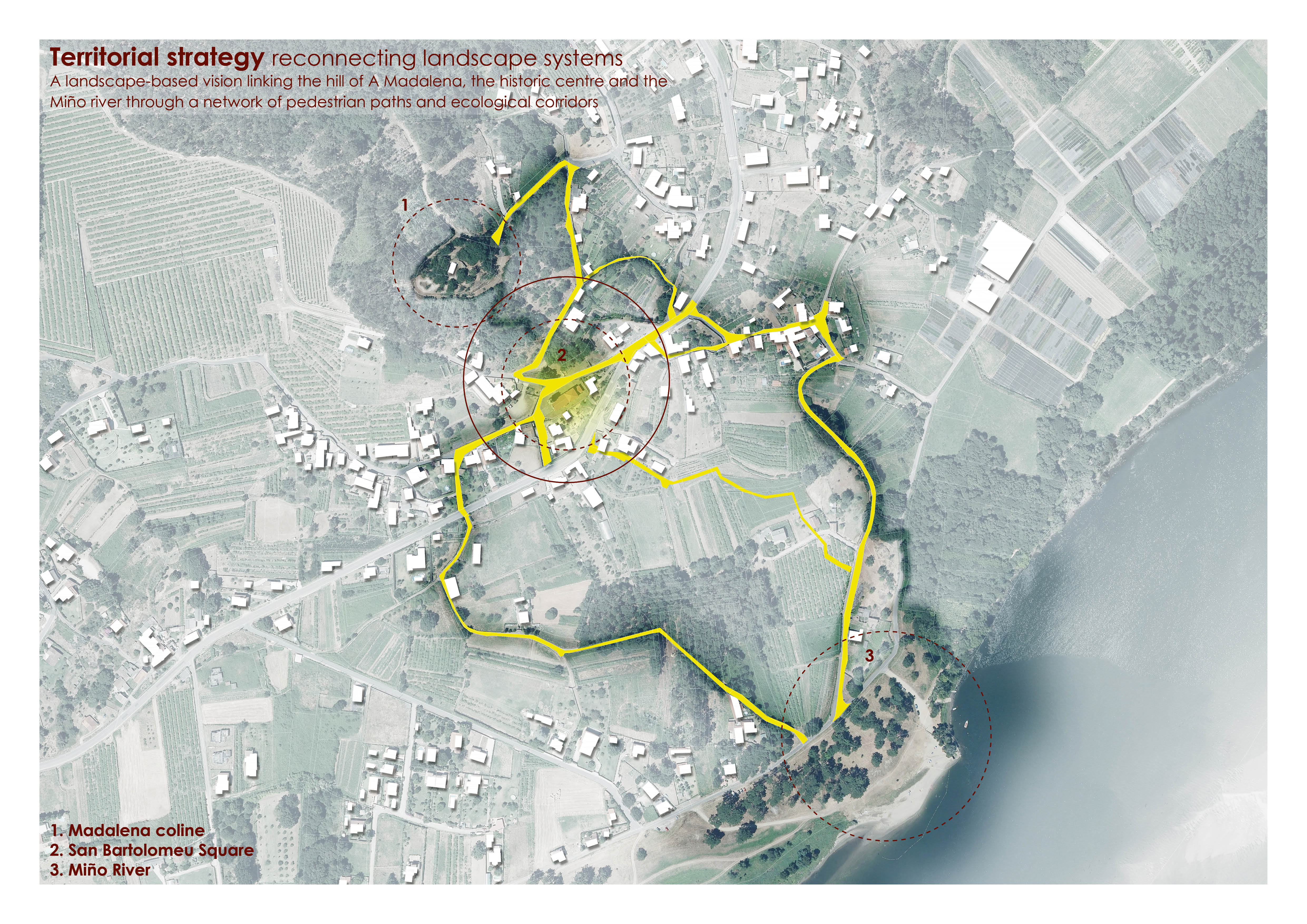
Verbas ao Miño is a territorial strategy developed in the rural parish of As Eiras (O Rosal, Galicia) that reconnects the village with the Miño river landscape. Through the recovery of historic paths, the transformation of San Bartolomeu square and a network of small public space interventions, the project strengthens community life while restoring the ecological and cultural relationship between settlement and territory.
Spain
{Empty}
Prototype level
Yes
Yes
Yes
No
No
36048: Rosal, O (ES)
Verbas ao Miño is a territorial strategy developed in the rural parish of As Eiras, in the municipality of O Rosal (Galicia, Spain), aimed at reconnecting the village with the Miño river landscape while strengthening community life and local identity.
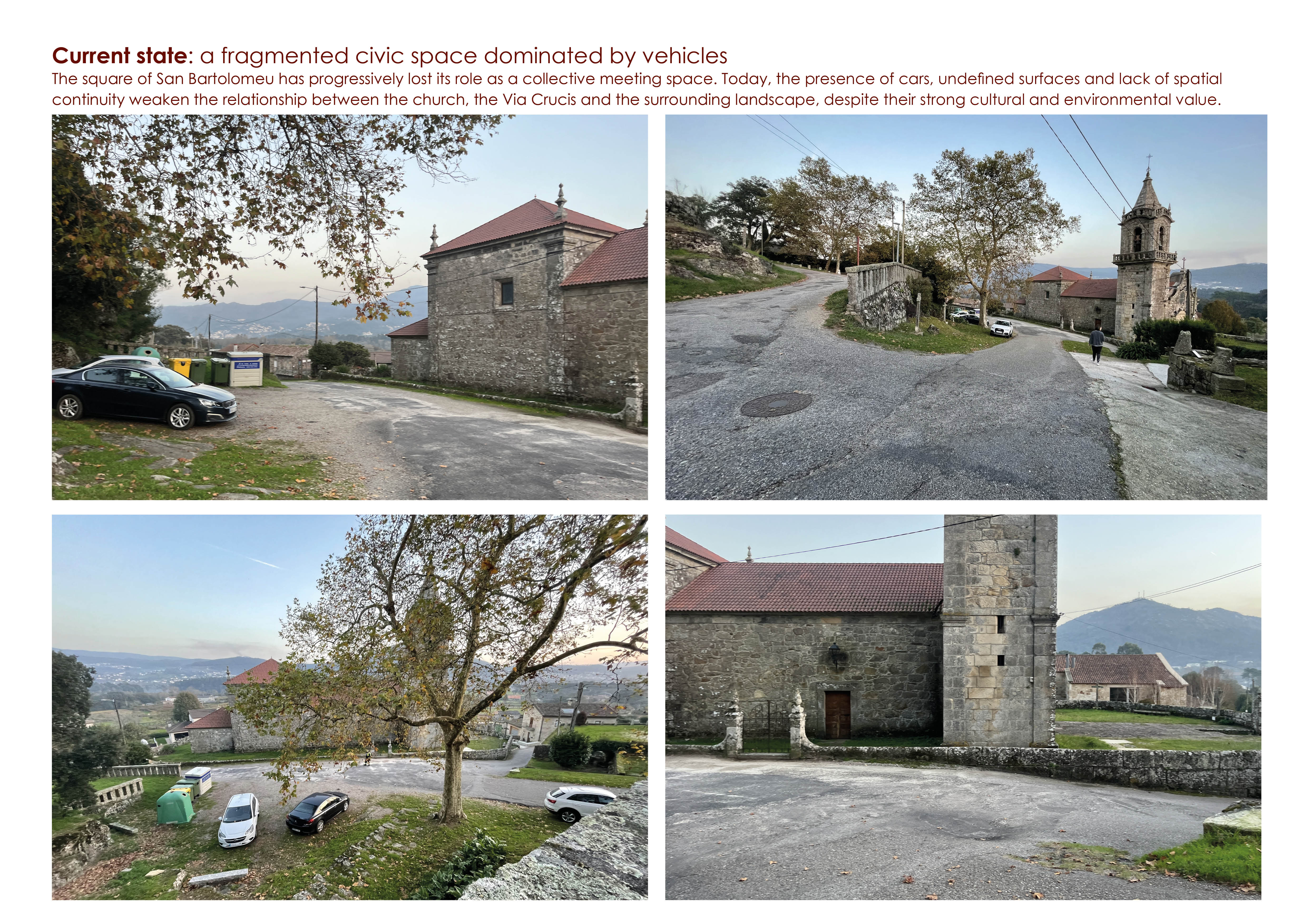
Over the past decades, the relationship between the settlement and the surrounding landscape progressively weakened. Historic paths, washing places, fountains and communal meeting spaces lost their role as everyday infrastructures connecting the village with the river territory.
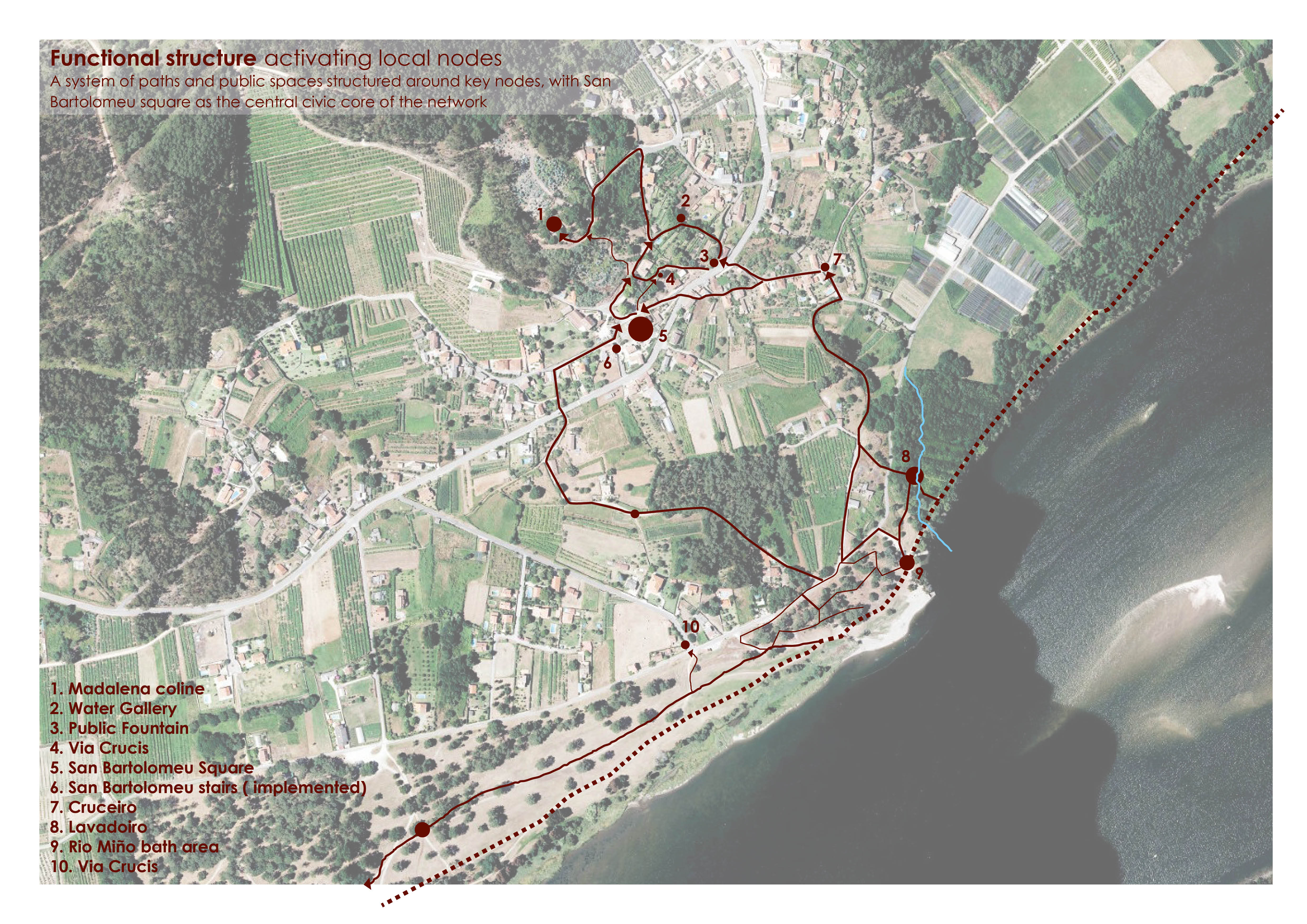
The initiative proposes a gradual regeneration of this landscape through a network of small-scale public space interventions. The strategy combines the recovery of historic paths, the enhancement of ethnographic heritage and the transformation of key civic spaces.
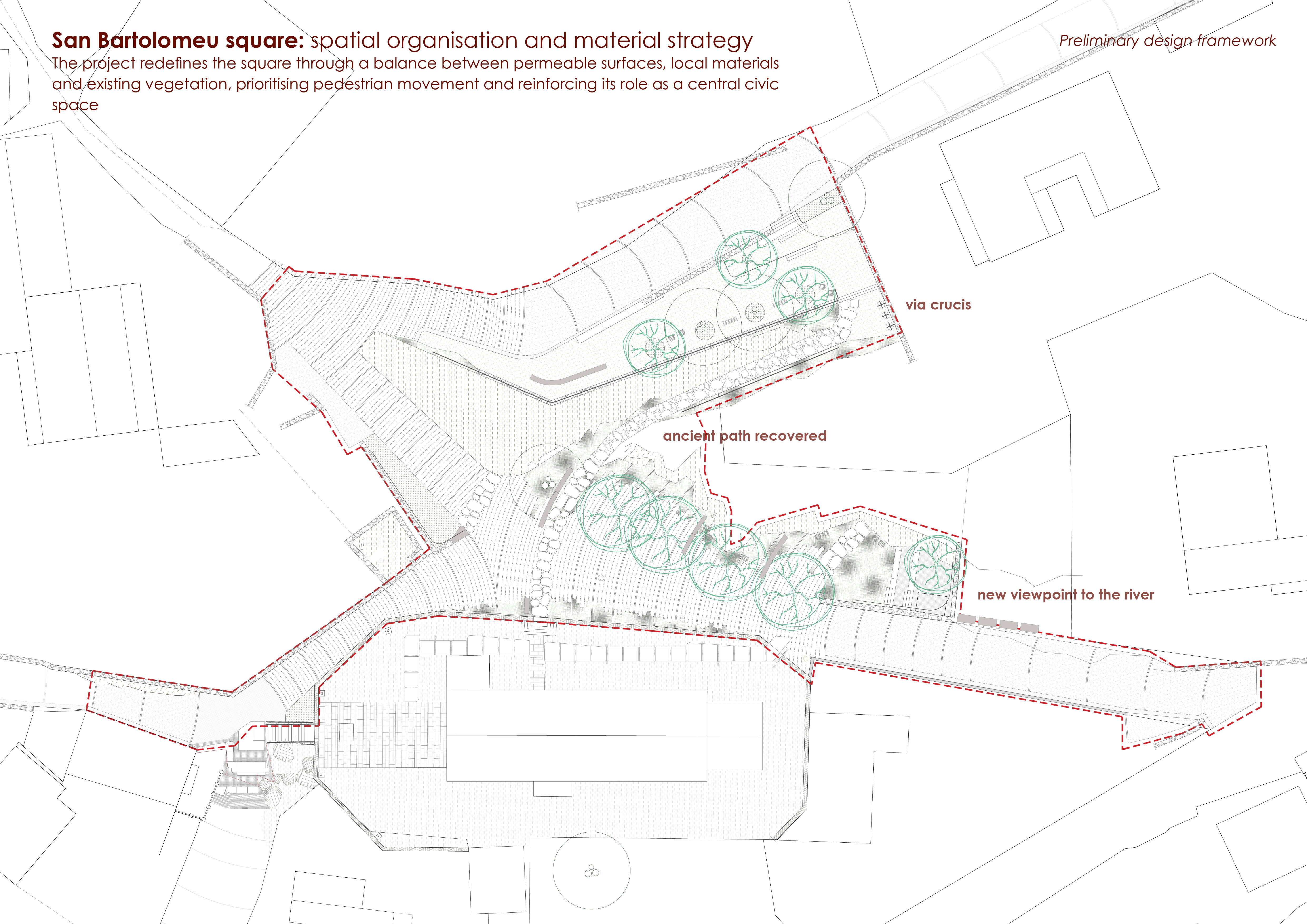
One of the first actions is the transformation of San Bartolomeu square, located next to the church and the traditional centre of the village. Once dominated by car traffic, this space is being reimagined as a pedestrian meeting place that reconnects the settlement with the surrounding paths and landscape.
The initiative is developed through a participatory process involving residents and local stakeholders, supported by strong political commitment from the municipality. Through local materials, nature-based solutions and community engagement, Verbas ao Miño demonstrates how small rural municipalities can regenerate their landscapes while strengthening social cohesion, ecological resilience and cultural heritage.
Territorial regeneration
Rural public space
Landscape connectivity
Community participation
Nature-based solutions
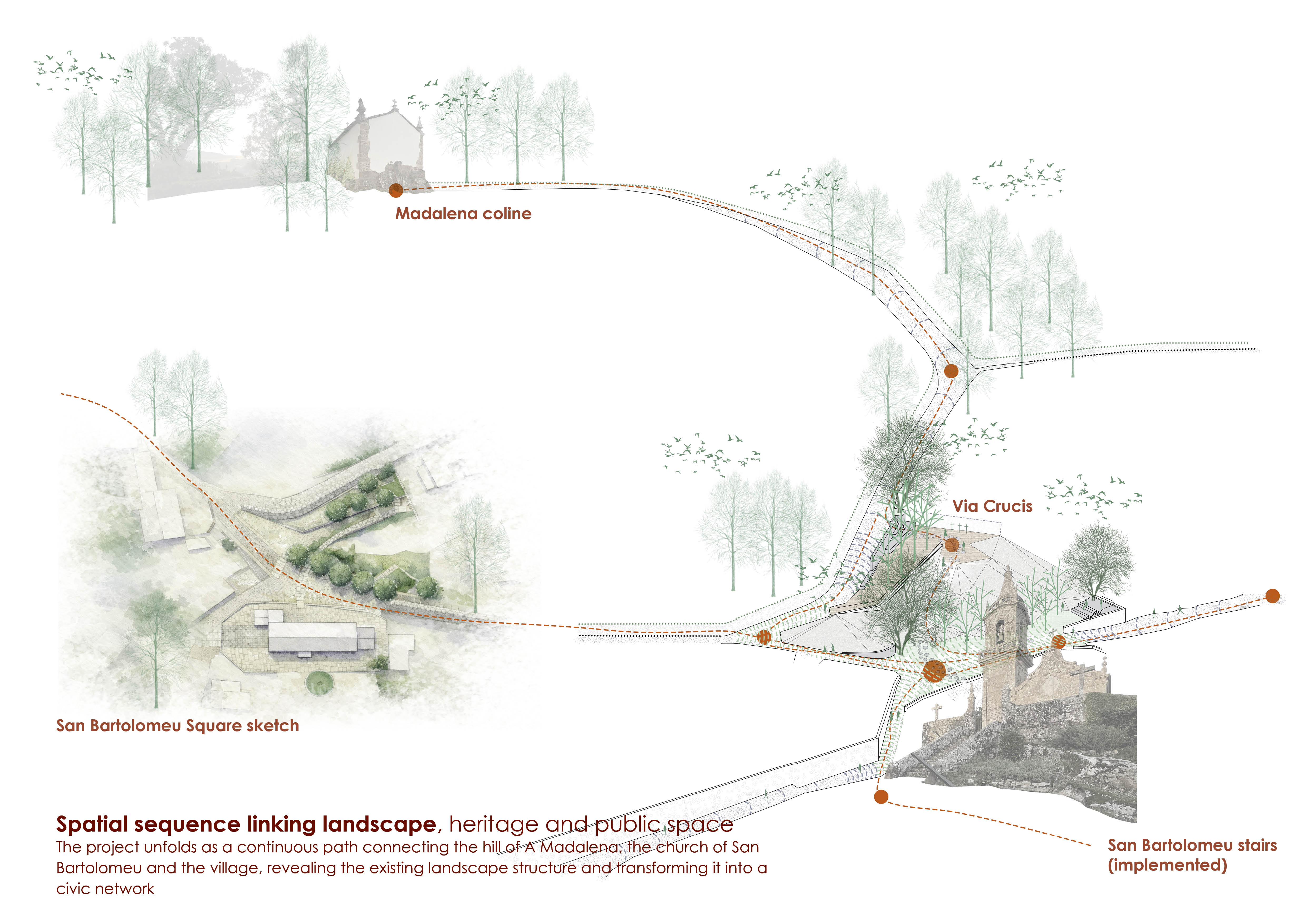
The intervention is conceived as part of a broader landscape strategy that reconnects the village of As Eiras with the Miño river territory through a network of pedestrian paths, ecological corridors and small public spaces. Rather than focusing on a single intervention, the project operates as a territorial system that restores the historic relationship between settlement, landscape and water.
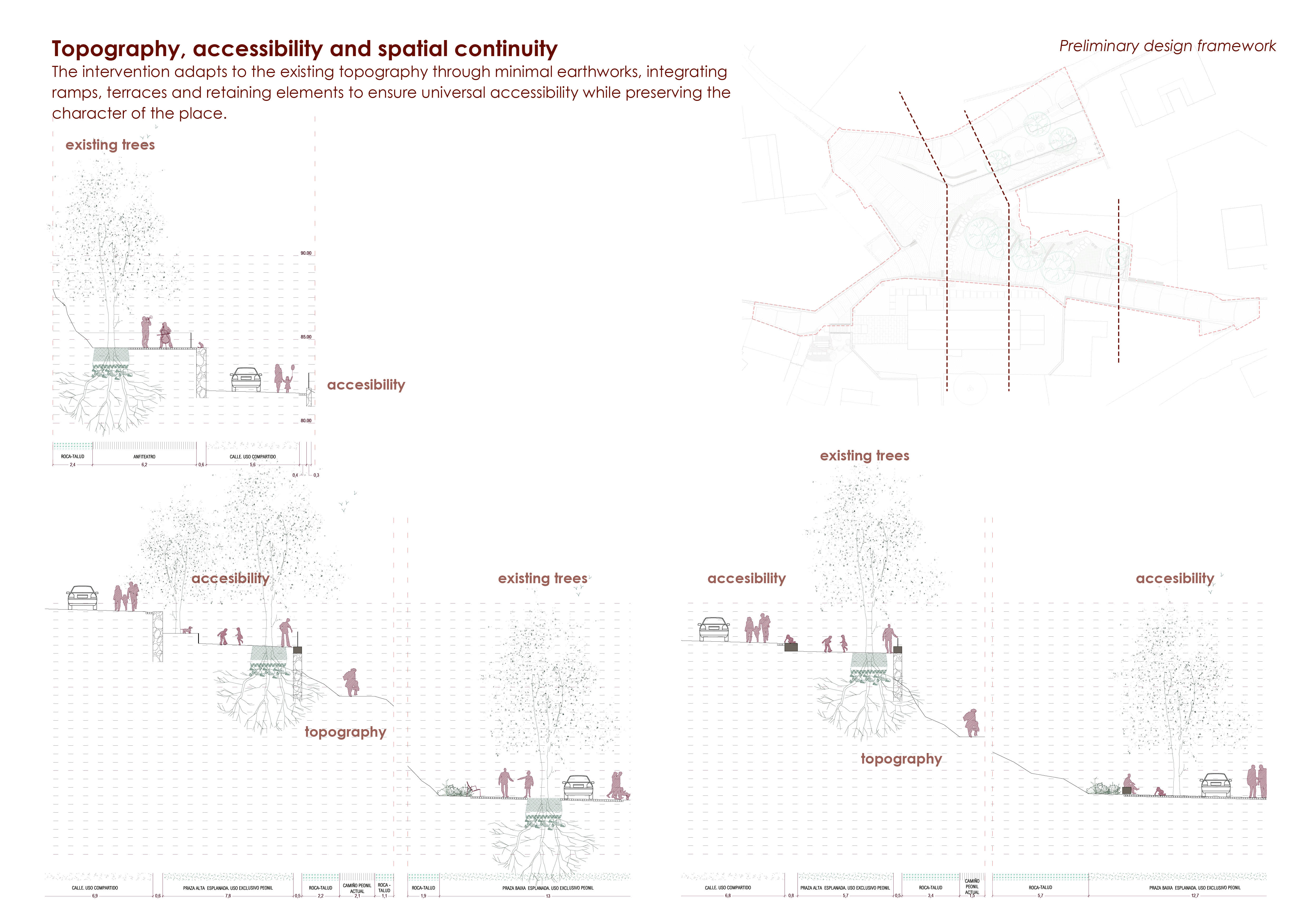
The design prioritises nature-based solutions and locally sourced materials, reinforcing the ecological and cultural continuity of the place. Permeable surfaces, native vegetation and minimal earthworks improve water infiltration, reduce surface runoff and increase resilience to changing climate conditions while preserving the existing topography and soil structure.
The project also promotes a low-impact construction approach based on local granite stone, compacted gravel and simple constructive techniques that minimise the environmental footprint of the intervention. By reducing the dominance of cars and strengthening walkable connections between the village, the surrounding agricultural landscape and the Miño riverfront, the initiative encourages more sustainable mobility patterns and a renewed relationship between inhabitants and their territory.
Through this integrated landscape approach, Verbas ao Miño demonstrates how small rural municipalities can address climate resilience, ecological restoration and public space regeneration simultaneously.
The project restores the spatial and cultural identity of the traditional civic centre of As Eiras. The square of San Bartolomeu, once fragmented by road infrastructure and dominated by cars, is reconfigured as a calm and accessible public space where the landscape, the church and the historic Via Crucis regain their central role in everyday village life.
Rather than introducing new architectural objects, the design works through subtle transformations that reveal the latent qualities of the place. The intervention reorganises movement, reduces traffic and creates a continuous pedestrian surface that allows the square to function once again as a shared meeting space at the heart of the village.
The material palette draws inspiration from the geomorphology and vernacular architecture of the territory. Granite stone, compacted gravel and native vegetation create a simple and durable landscape language rooted in local traditions. These elements reinforce the continuity between built space, agricultural landscape and natural surroundings.
Through this approach, the project enhances the sensory and cultural experience of the place, allowing heritage, landscape and everyday life to coexist in a renewed civic space that reflects the identity of the rural territory.
Community participation has been central to the development of the Verbas ao Miño territorial strategy. From the early stages of the project, the vision for reconnecting the village with the Miño landscape has been shared with residents through public meetings, presentations and locally distributed information materials. These encounters have created opportunities for dialogue, allowing inhabitants to understand the long-term objectives of the strategy and contribute their perspectives on the future of their village.
Equally important has been the political commitment of the municipality to approach the transformation of the area through a comprehensive territorial strategy rather than through isolated interventions. This decision has made it possible to address the village, its paths and the river landscape as a coherent system, ensuring that future actions respond to shared community priorities.
At the spatial level, the redesign of San Bartolomeu square prioritises universal accessibility and safe pedestrian movement. The elimination of traffic barriers and the creation of continuous surfaces make the space usable for elderly residents, children and visitors alike.
By recovering a collective meeting place at the centre of the village, the project strengthens social interaction, intergenerational use and a renewed sense of belonging to the territory.
Citizens have played an active role in shaping the vision and development of the Verbas ao Miño initiative. The strategy has been developed progressively over several years, beginning with the preparation of a territorial masterplan and followed by the gradual design and implementation of small public space interventions within the village.
Public meetings, presentations and locally distributed communication materials have allowed residents to understand the long-term vision of reconnecting the village with the Miño river landscape and to share their knowledge and expectations regarding the transformation of the territory.
The municipality has also promoted activities involving younger generations, including initiatives with local children that encourage awareness of the landscape, heritage and future of the village. These actions help reinforce the connection between the community and its territory.
In parallel, the local cultural agenda has played an important role in activating the spaces of the strategy. Cultural events and concerts have been organised in meaningful locations such as the surroundings of the church of As Eiras, even before the spatial transformation of the square. These initiatives contribute to strengthening the social life of the village and allow residents to rediscover the value of their public spaces.
Through this long-term participatory process, the community has been able to see how the territorial vision of Verbas ao Miño progressively becomes reality. The redesign of San Bartolomeu square, currently under development, represents the central civic node of this shared strategy.
The Verbas ao Miño initiative is supported by collaboration between actors at different institutional and territorial levels. The municipality of O Rosal acts as the main promoter of the strategy, providing political leadership and coordinating the long-term transformation of the village of As Eiras through a coherent territorial vision.
At the regional level, the transformation of the provincial road crossing the village—promoted by the Provincial Council—has played an important role in improving the spatial structure of the settlement and enabling the progressive reconfiguration of public space. These infrastructural improvements have already been implemented in two phases and today form part of the everyday life of the village.
At the local level, residents of the parish of As Eiras are key stakeholders in the process. Through public meetings, presentations and cultural initiatives organised by the municipality, the community has been able to follow and understand the evolution of the strategy.
This multilevel collaboration allows the initiative to combine institutional capacity, territorial planning and local knowledge. The redesign of San Bartolomeu square—currently under development—will become the civic node that consolidates these transformations and strengthens the connection between the village and the Miño river landscape.
The initiative integrates knowledge from several disciplines in order to address the transformation of the village from a territorial and landscape perspective. Landscape architecture and urban design play a central role in redefining public space and strengthening the relationship between the built environment and the surrounding landscape.
Territorial planning has been fundamental in structuring the Verbas ao Miño strategy, identifying the network of paths, public spaces and landscape connections that link the village of As Eiras with the Miño river. This strategic framework allows individual interventions—such as the redesign of San Bartolomeu square—to be understood as part of a broader territorial system.
Environmental knowledge and ecological principles also inform the design approach, through the use of nature-based solutions, permeable surfaces, native vegetation and minimal earthworks that respect the natural topography of the site.
The collaboration between planners, landscape architects, municipal technicians and local stakeholders has made it possible to integrate technical expertise with local knowledge and cultural values. This interdisciplinary process strengthens the quality, resilience and long-term vision of the initiative.
The innovative character of the initiative lies in addressing the transformation of a small rural settlement through a long-term territorial strategy rather than through isolated public space interventions. While mainstream practices often focus on punctual urban upgrades—such as repaving streets or redesigning squares—the Verbas ao Miño initiative proposes a systemic approach that reconnects landscape, mobility, heritage and public life.
The redesign of San Bartolomeu square is therefore not conceived as a standalone architectural project but as the central civic node within a broader territorial structure that links the village of As Eiras with the Miño river landscape. This strategy identifies and strengthens a network of paths, cultural landmarks and ecological spaces that structure the territory.
Another innovative aspect lies in the integration of landscape and cultural activation as part of the transformation process. Cultural activities and community events have been organised in meaningful locations of the village even before the physical interventions were completed, allowing residents to rediscover the value of their public spaces and landscape.
By combining territorial planning, landscape design and community engagement, the initiative proposes a replicable model for small rural municipalities facing similar challenges of spatial fragmentation, car dominance and loss of collective public spaces.
The initiative is based on a progressive and multi-scalar design methodology that combines territorial planning, landscape architecture and community engagement.
The process began with the preparation of a territorial masterplan that analysed the spatial structure of the village of As Eiras and its relationship with the surrounding landscape and the Miño river. This strategic framework identified the key elements of the territory—paths, public spaces, ecological corridors and cultural landmarks—and defined a long-term vision for their reconnection.
Based on this framework, the transformation of the village is being implemented progressively through a series of small but strategic interventions. Some of these actions have already been completed, including the transformation of the provincial road crossing the village and the improvement of accessibility around the church of San Bartolomeu. These first steps allow residents to experience the benefits of the strategy while the central intervention—the redesign of San Bartolomeu square—is currently being developed.
Throughout the process, the municipality has promoted public meetings, presentations and cultural activities that help communicate the vision and involve the local community. This incremental and participatory methodology ensures that the transformation of the territory is both socially shared and spatially coherent.
The Verbas ao Miño initiative demonstrates how small rural municipalities can address spatial fragmentation and the loss of public space through a coherent territorial strategy. Rather than relying on large-scale infrastructure or isolated urban projects, the initiative proposes a scalable methodology based on identifying existing landscape structures and reinforcing them through small but strategic interventions.
This approach can be replicated in many rural contexts across Europe where villages face similar challenges: ageing populations, car-dominated public spaces, fragmented mobility networks and the gradual loss of shared civic places.
Several elements of the initiative are transferable, including the use of a territorial masterplan to guide incremental public space interventions, the prioritisation of pedestrian connections between settlements and surrounding landscapes, and the integration of nature-based solutions and locally sourced materials.
Equally important is the participatory methodology that places citizens at the centre of the transformation process. The initiative demonstrates how community engagement, cultural activation and local knowledge can shape spatial strategies and strengthen collective ownership of public space.
What is replicated is therefore not a fixed architectural form but a way of working. In a globalised context where many landscapes have become increasingly homogenised, this approach proposes a design practice rooted in the “genetic code” of each place—its landscape, cultural memory and social practices. By starting from these specific conditions, the methodology allows each intervention to produce site-specific architecture while remaining transferable as a process.
The Verbas ao Miño initiative reflects a long-term commitment by the municipality of O Rosal to transform the spatial and social structure of the village of As Eiras through a coherent territorial strategy. Rather than being conceived as an isolated project, the redesign of San Bartolomeu square forms part of a broader process aimed at reconnecting the village with its surrounding landscape and with the Miño river.
This commitment is already demonstrated through several actions implemented in recent years. The transformation of the provincial road crossing the village, carried out in two phases by the Provincial Council of Pontevedra, has significantly improved pedestrian mobility and reduced the dominance of vehicular traffic in the historic core. In addition, accessibility improvements around the church of San Bartolomeu have reinforced the role of this historic space as the civic and cultural centre of the parish.
Building on these initial transformations, the municipality is currently advancing the design of San Bartolomeu square as the central public space of the strategy. The project is being developed through a participatory process that allows residents to contribute to the refinement of the proposal before the executive design phase.
The municipality has formally committed to continuing the implementation of the Verbas ao Miño strategy through planning instruments, public investment and community engagement. By progressing through incremental and achievable interventions, the initiative ensures that the long-term vision for reconnecting the village with the Miño landscape can be realistically implemented over time.