Strengthening Local Democracy and Inclusion
LIBERE - Human Routes
Libere Human Routes – Weaving a relational tapestry for safe, beautiful and community-led journeys.
Libere Human Routes is a community-driven process that activates local territories to rediscover and valorise their hidden cultural, social and environmental treasures. Through participatory workshops, community mapping and collaboration with local actors, citizens co-design sustainable travel routes rooted in local knowledge and identity. A digital platform supports the process by connecting travellers with trusted local ecosystems and making these networks visible and replicable.
Italy
Local
Comune di Bracciano
It addresses urban-rural linkages
It refers to other types of transformations (soft investment)
Prototype level
No
No
No
Organisation
Human Routes is a community-driven initiative that activates local territories through participatory tourism, cultural discovery and human networks of trust. The project starts from a simple premise: people who live in a place best understand its identity, hidden treasures and the values worth sharing. Instead of designing tourism from the top down, Human Routes builds a bottom-up process engaging citizens, associations and small local operators in identifying and valorising places, traditions and practices that represent their territory.
The process begins with territorial activation and community mapping. Through participatory workshops and collaborative mapping, citizens identify meaningful places, traditions and experiences, highlighting local strengths and lesser-known cultural and environmental assets. Based on this knowledge, the project scouts and validates local operators such as guides, artisans, cultural organisations and small entrepreneurs. Actors are selected using ethical, inclusive and sustainability criteria and invited to join the ecosystem.
A capacity-building phase then supports them through training in inclusive tourism, communication and storytelling. A self-assessment framework helps validate their practices according to social and environmental standards.
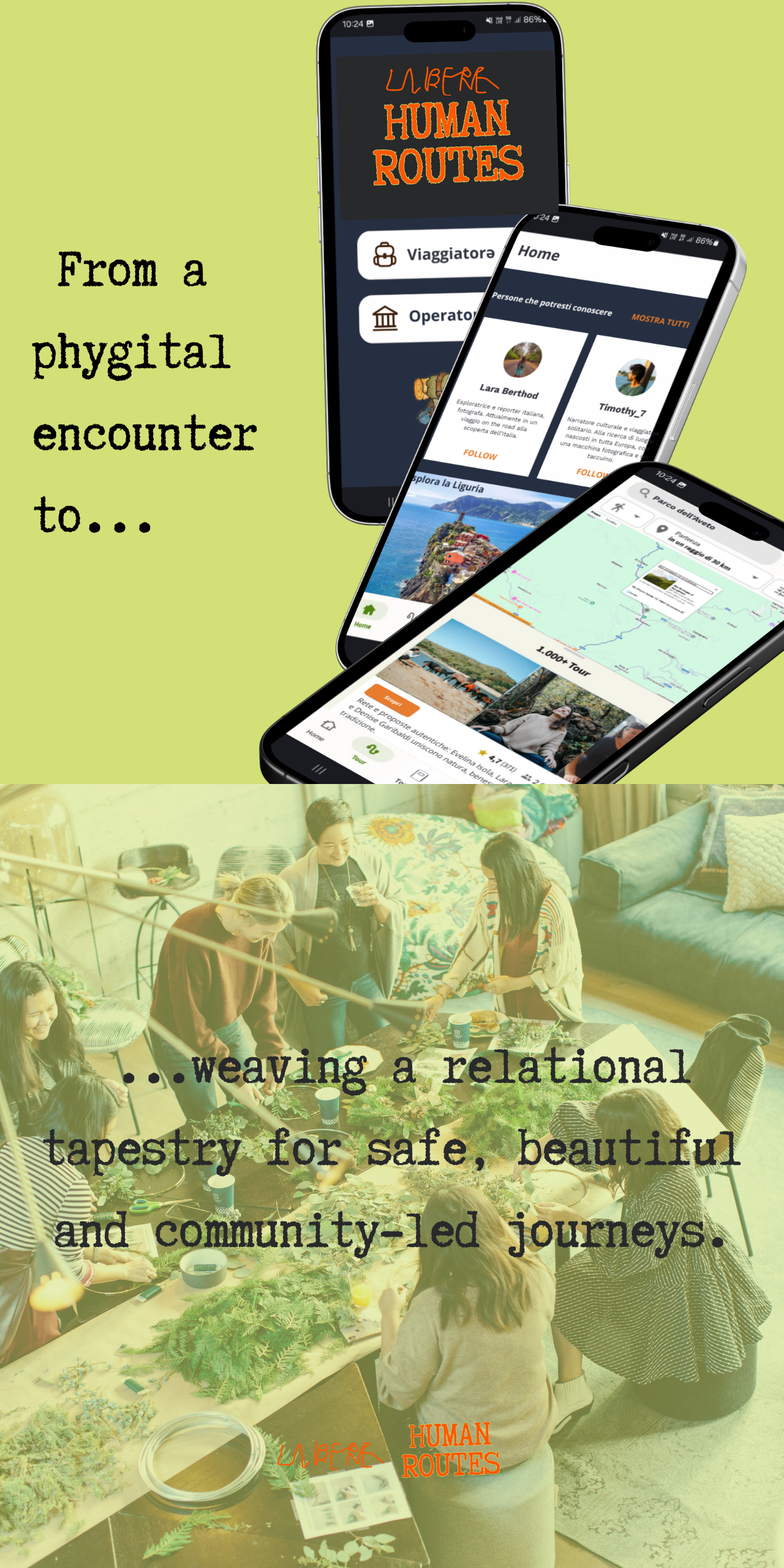
A digital platform (MVP) serves as a relational support infrastructure: mapping the network, connecting travellers with a network of ethically vetted local operators, with a particular focus on women-led micro-enterprises and those committed to preserving cultural traditions, craftsmanship and historic sites, whilst looking after the communities in those areas. This phygital platform makes it possible to showcase itineraries co-created by the community.
The model will be tested through a pilot living-lab where travellers and local actors explore the territory together. Particular attention is given to safety through human networks, especially for women and independent travellers.
The idea for Human Roads was born from a clear need observed among solo women travelers: safety, trust, and authentic human connection are often missing, while women-led micro enterprises rooted in local traditions remain largely invisible. Data highlights the urgency: 16-18% of international travelers are solo, 84% of them women, with Italy representing 22% of national solo women travelers. Women influence 82% of travel decisions and will control 75% of disposable travel income by 2028. Today, AI, social media, and digital tools affect over 50% of travel choices, yet relational trust and meaningful, local experiences cannot be replaced by technology.
Over three years, through Libere di Viaggiare, we engaged with over 13,000 community members and partnered with local stakeholders and University. Surveys, workshops, and training programs on empowerment, inclusive tourism, and storytelling confirmed structural gaps: travelers seek human connection and trustworthy guidance, while local women-led operators struggle for visibility and access to markets.
From these insights, we developed Human Roads: a participatory, bottom-up process where travelers and communities co-create itineraries based on trust, shared values, and local knowledge. Work packages include coordination, community activation, operator scouting and validation, capacity building, digital platform development, pilot testing, impact assessment, and replication strategy.
A digital platform will support this process, enabling travelers to explore maps, plan itineraries, and discover verified operators. Technology acts as a facilitator, making the process scalable and autonomous, while human relationships remain at the core.
By combining human-centered processes, ethical standards, storytelling, and strategic digital facilitation, Human Roads addresses gaps in safety, trust, and visibility, creating a replicable and sustainable model for relational, responsible tourism.
Human-centered co-creation: participatory design of itineraries and experiences with travelers, local operators, and communities.
Women-led empowerment: economic inclusion, visibility, and capacity building for women in tourism
Cultural and territorial activation: promotion of local traditions, crafts, and authentic experiences rooted in place
Safe, inclusive, and relational Travel: enhancing safety, autonomy, and meaningful human connections for solo and small-group travelers
Digital facilitation for relational tourism: technology as a tool to support matching, visibility, and network building, without replacing human interaction
Human Roads promotes sustainability by redefining tourism through responsible, human-centered models that redistribute flows, support local economies, and encourage environmentally conscious practices. The concept addresses environmental pressures caused by mass tourism, which often concentrates visitors in a few destinations while leaving culturally rich territories underexplored and undervalued.
By connecting travelers with women-led micro enterprises, artisans, guides, and community initiatives, Human Roads encourages the discovery of lesser-known places and rural areas. This approach diversifies tourism flows, reduces overcrowding, and strengthens the resilience of local communities. Operators are supported in preserving traditional crafts, food culture, and place-based experiences, ensuring cultural and economic sustainability while valuing slow, meaningful, and authentic travel.
Sustainability is embedded socially as well. Participatory workshops, co-creation of itineraries, and capacity-building programs empower local operators and municipalities to integrate responsible practices, from sustainable mobility and local sourcing to environmental awareness in visitor experiences. At the same time, travelers engage in a learning process that deepens cultural understanding and ethical awareness, fostering a tourism culture rooted in respect for people, heritage, and the environment.
The platform functions as a digital facilitator, supporting ethical matching, visibility, and network building, without replacing human connection. By combining relational processes, participatory governance, storytelling, and technology, Human Roads demonstrates how tourism can be environmentally responsible, socially equitable, culturally enriching, and economically sustainable, creating a model that balances visitor experience with community well-being and environmental stewardship.
Human Roads makes life beautiful by placing human connection, cultural engagement, and community identity at the center of travel. Research shows that solo travelers often cite lack of support networks as a key barrier to autonomous travel, and 85% say that having trusted points of reference would significantly improve their experience. Travel is not only about places but about the people who live there - their knowledge, stories, and everyday practices - which give meaning and depth to the journey.
Through participatory workshops, co‑creation of itineraries, and storytelling activities with local communities and operators, Human Roads enables travelers to engage directly with residents, preserving and sharing local crafts, gastronomy, traditions, and natural landscapes. This creates emotional connections, strengthens local pride, and fosters care for the territory. Visitors become part of a living cultural exchange, breaking stereotypes and cultivating empathy, while communities see their heritage valued and shared.
The project promotes slow, attentive, and meaningful travel, where aesthetic value arises from authenticity, relational richness, and cultural depth. A digital platform facilitates safe, validated discovery of operators and experiences and connects travelers to peers, but human relationships remain central. Technology amplifies visibility and access without replacing real encounters.
By integrating participatory design, ethical storytelling, and relational infrastructure, Human Roads demonstrates that tourism can be both beautiful and responsible: it enriches everyday life, nurtures a sense of belonging, and makes places and communities more vibrant, resilient, and cared-for - creating experiences that are aesthetically, socially, and culturally meaningful for both travelers and residents.
Human Roads fosters inclusion by addressing structural gaps that affect both travelers and local operators, creating a tourism ecosystem open and accessible to all. Solo travel is growing, with 84% of solo travelers being women, who influence 82% of travel decisions and often face greater safety concerns, lack of trusted networks, and stereotypes about independent travel. Young travelers, women traveling alone, families, and groups seeking culturally rich experiences are key target groups who benefit from reliable information, safety tools, and supportive peer networks.
The project provides verified operator profiles, curated safety guidance, practical tips, peer support, and mentorship from experienced travel designers to ensure journeys are secure, relational, and culturally meaningful. Travelers can discover authentic local experiences while connecting with communities in a trusted and guided way.
On the supply side, local operators are supported through self-assessment tools, ethical and inclusive KPIs, capacity-building, and communication support, enhancing visibility, economic participation, and sustainable practices.
Participation and co-creation are central: surveys, workshops, and collaborative design activities engage both travelers and operators in shaping itineraries, platform tools, and standards. This bottom-up approach fosters trust, equity, and shared responsibility, ensuring the system responds to real needs and strengthens community ties.
By combining community-driven processes, relational infrastructure, ethical standards, and digital facilitation, Human Roads fills structural gaps while promoting inclusion, safety, and cultural respect. The platform acts as a scalable tool connecting people and places, creating a tourism model where mobility becomes a space of empowerment, shared meaningful human connection, with particular attention to women traveling independently and other travelers seeking safe, inclusive, and enriching experiences.
Human Roads is designed as a wholly participatory, community-driven process, engaging travelers, local stakeholders, and small tourism operators in shaping every aspect of the ecosystem. The process begins with territorial activation and community mapping: participatory workshops and surveys involve citizens, cultural associations, guides, and public stakeholders in identifying local strengths, traditions, and under-recognized cultural practices. This bottom-up engagement highlights small initiatives, women-led enterprises, and operators often invisible in mainstream tourism.
Next, in scouting and validation, selected operators are invited to join the pilot, guided through a self-assessment on ethics, sustainability, and community engagement. Capacity-building programs further support operators in enhancing inclusive practices, storytelling, and territorial promotion, ensuring they are ready to engage with travelers in meaningful ways.
The digital platform acts as a relational tool, connecting travelers with verified operators and curated experiences, while supporting safety, inclusion, and peer-to-peer networking. This infrastructure is tested in the pilot experience and living lab: a three-day experimental retreat in the pilot territory gathers around 30 participants from the community, 10 local operators, and 2 travel designers. Together they co-create itineraries, evaluate usability, test relational tools, and provide direct feedback on safety, accessibility, and overall experience quality.
Finally, insights from the retreat inform evaluation and impact assessment, refining the model, and guide the replication and scaling strategy, ensuring the process can be adapted to new territories nationally and across Europe.
Through this structured, participatory approach, Human Roads evolves directly from the needs, knowledge, and perspectives of both travelers and communities, embedding inclusion, trust, and relational richness at the core of the tourism experience.
Human Roads is designed as a multi-level governance initiative connecting public institutions, local communities, civil society and small tourism economies. The concept builds on previous experience in participatory tourism strategies, where collaboration between public administrations, communities and local operators proved essential to create inclusive and resilient territorial ecosystems.
At the local level, the pilot will be implemented within a territorial radius of approximately 50 km, typically involving one provincial area and multiple municipalities, including both medium-sized towns and smaller villages. Local administrations will be engaged across departments such as tourism, culture, equal opportunities and local development. This horizontal coordination within municipalities helps integrate tourism policies with cultural heritage, social inclusion and community wellbeing.
The project also promotes vertical governance, encouraging collaboration between municipalities and territorial institutions such as Chambers of Commerce, tourism associations, and artisan networks. These actors support local SMEs, strengthen visibility for micro-enterprises and facilitate connections between cultural heritage, craftsmanship and sustainable tourism economies.
An important dimension of the project is the dialogue between municipalities within the same territorial ecosystem, helping overcome the fragmentation that often characterises tourism strategies.
The participatory activities allow citizens and local actors to express both strengths and criticalities of their territories, strengthening institutional awareness and reinforcing trust between communities and public administrations.
Starting from this local experimentation, Human Roads aims to develop a replicable model always respectful and adapted to local identities while strengthening territorial uniqueness, community belonging and sustainable tourism development.
The concept is built on a holistic and transdisciplinary framework that brings together social sciences, arts, education and digital technologies to activate a process of territorial rediscovery and cultural valorisation.
At its core, Human Roads explores the relationship between people and places. Through participatory methodologies inspired by the social sciences, the project engages citizens, local actors and travellers in collective mapping processes that reveal local knowledge, traditions and under-recognised cultural practices. Workshops, surveys and community dialogues allow territories to rediscover their cultural and social resources while strengthening local awareness and sense of belonging.
Arts and storytelling play a central role in this process. Narratives increasingly shape the imaginaries through which people perceive places - from cinema and television to social media - and strongly influence travel choices. Human Roads seeks to redirect this narrative power towards authentic cultural landscapes, traditions and community stories, giving visibility to places and practices often absent from mainstream tourism narratives.
The project encourages learning processes for both travellers and local actors, supporting responsible travel cultures, intergenerational knowledge exchange and new forms of cultural mediation. Particular attention is given to young entrepreneurs and small initiatives that actively preserve and reinterpret local traditions.
Digital technologies support this ecosystem through a mapping and relational platform that makes these experiences visible and accessible. In a time increasingly characterised by standardised travel experiences, the concept aims to reconnect mobility with authenticity, cultural diversity and human relationships, supporting those who continue to invest in the identity and living traditions of their territories.
The Human Routes concept is based on a hybrid and scalable model that combines community engagement, public–private collaboration and digital services.
In the early phase, the initiative is supported by the activities and organisational structure of Libere di Viaggiare APS, which provides the social infrastructure and community network behind the project. Initial implementation is developed in collaborazione with local administrations and territorial institutions supporting participatory tourism through public programmes and development initiatives. Additional support comes from chambers of commerce, artisan associations, foundations and local financial institutions interested in strengthening local SMEs and cultural economies. These early investments allow the project to activate community workshops, surveys, territorial mapping and the development of the digital platform infrastructure.
Once the ecosystem is established, the platform activates B2B services for local operators. Tourism professionals, artisans and SMEs can join the network through a participation fee that provides visibility, communication support, storytelling development and ethical self-assessment tools focused on sustainability. For travellers, the platform remains freely accessible to ensure broad participation, while premium services - including personalised travel design and curated experience - ensure additional revenue.
Strategically, our long-term sustainability is rooted in its alignment with core European values. As travel is inherently a medium for multicultural discovery and meeting the other, we will leverage European cooperation programs to transition from a local to a "glocal" dimension. Human Routes aims to sustain its social mission through a model that is both economically viable and capable of large-scale impact.
By building on the principles of mobility, cultural exchange and community discovery, the model naturally lends itself to being replicated across different territories while encouraging people to explore places beyond mainstream travel routes.
Its scalability lies first in the community-driven methodology used to activate territories. Each pilot begins with listening processes – workshops, surveys and collaborative mapping - that involve citizens, local actors and institutions in identifying the cultural, social and economic strengths of their territory. This approach ensures that the model is not imposed from above but co-designed with local communities, allowing it to adapt to different cultural, geographic and social contexts.
A second transferable element is the ethical validation framework for local operators. Through a structured self-assessment focused on sustainability, inclusion and responsible practices, the project creates a transparent system that helps small enterprises improve their positioning while strengthening trust among travellers and communities. The framework is flexible and can be adapted to the specific characteristics of different territories.
By offering visibility and networking opportunities to local initiatives, the platform encourages operators themselves to join the network, generating a progressively self-sustaining growth model.
Human Roads also promotes a balanced relationship between tourism flows and local communities, prioritising the perspectives and wellbeing of residents while valorising the unique identity of each territory.
Thanks to the combination of participatory methodologies, adaptable tools and a borderless digital ecosystem, the concept can progressively scale from local pilots to regional, national and European networks, contributing to the creation of a distributed community of territories connected through shared values and responsible mobility.
Following the pilot phase planned for September 2026, the Human Routes initiative will focus on fostering and scaling its participatory methodology for community-based tourism development.
The first pilot will involve approximately 100 participants, including citizens, travellers, local operators, cultural associations, guides, artisans and representatives of local institutions. Through workshops, participatory mapping and experiential activities, the pilot will allow the project team to validate the first network of trusted local actors and test the collaborative model in a real territorial context.
After this phase, a structured evaluation process will be carried out through surveys, interviews and participatory feedback sessions. The insights collected will support the refinement of the methodology and inform the preparation of European project proposals and strategic partnerships.
During this phase, the project will also initiate collaborations with local administrations, Chambers of Commerce, tourism organisations, cultural associations and community groups, strengthening a multi-stakeholder ecosystem committed to responsible and inclusive tourism.
In 2027 the initiative aims to expand the model to three pilot territories within the region, activating new community workshops and participatory mapping processes. This phase is expected to involve almost 300 participants.
By 2028 the project aims to extend the network at national level, reaching at least 5,000 community members engaged through on the ground co-designed activities and events.
Through European partnerships and cooperation projects, the methodology will also be tested in two to three additional European territories, contributing to the development of a broader network of community-driven and sustainable tourism ecosystems