Enhancing Circularity, Sustainability, and Innovation
International Summer School 2026
Green Building Council International Summer School 2026-Sustainable & Natural Building Materials
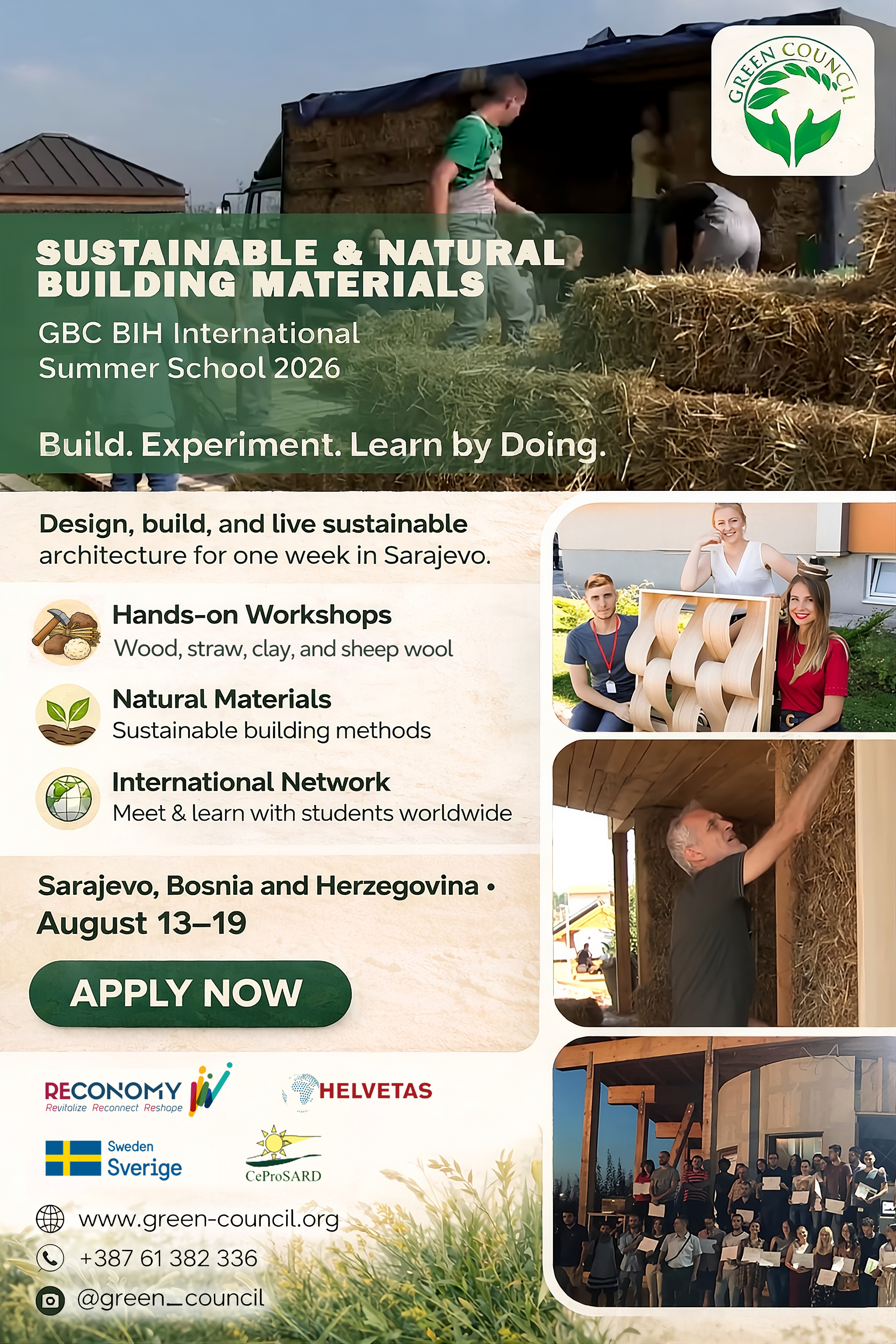
GBC International Summer School 2026 - Sustainable & Natural Building Materials is an international educational program taking place in Sarajevo from 13-19 August 2026. It brings together students and young professionals to explore sustainable architecture through hands-on workshops with wood, straw, clay, and sheep’s wool, combined with expert lectures, site visits, and discussions that connect traditional building knowledge with contemporary sustainable construction practices.
Bosnia and Herzegovina
Local
Visoko and Sarajevo, Bosnia and Herzegovina
It addresses urban-rural linkages
It refers to other types of transformations (soft investment)
Prototype level
No
No
No
Organisation
The Green Building Council International Summer School 2026 – Sustainable & Natural Building Materials is an international educational program that brings together students and young professionals interested in sustainable architecture and natural building materials. The program will take place from 13 to 19 August 2026 in Visoko and Sarajevo, Bosnia and Herzegovina, and focuses on exploring environmentally responsible construction methods that combine traditional knowledge with contemporary architectural practice.
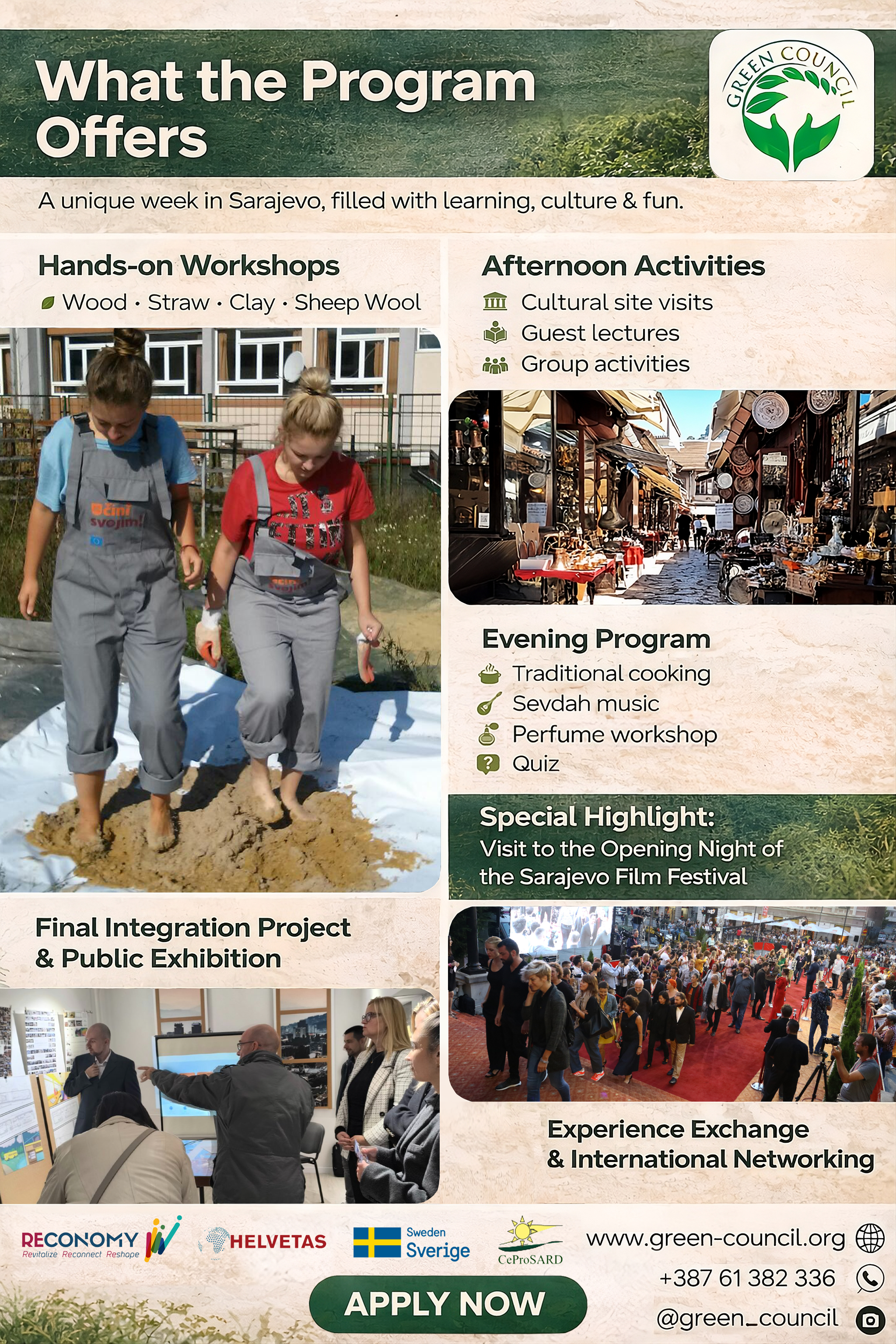
The core of the program consists of hands-on workshops using natural materials such as wood, straw, clay, and sheep’s wool, where participants will learn traditional techniques and explore their application in modern sustainable architecture. In addition to practical workshops, the program includes expert lectures, discussions, and visits to important architectural and cultural sites, creating a platform for interdisciplinary learning and international knowledge exchange.
The core of the program consists of hands-on workshops using natural materials such as wood, straw, clay, and sheep’s wool, where participants will learn traditional techniques and explore their application in modern sustainable architecture. In addition to practical workshops, the program includes expert lectures, discussions, and visits to important architectural and cultural sites, creating a platform for interdisciplinary learning and international knowledge exchange.
The idea came from the work of Professor Sanela Klarić and her colleagues through the Green Building Council. In their efforts to promote green and sustainable living and construction in BiH, they repeatedly encountered the same problem. No matter which project they tried to undertake, the main barrier was always the same: the lack of necessary materials, and even more often, the lack of knowledge needed to actually implement sustainable practices. This was particularly concerning because BiH has a strong tradition of vernacular architecture, based on local materials, climate responsiveness, and a close relationship between people and their environment. These traditional concepts are fundamentally sustainable, aesthetically valuable, and healthy. However, over time, this knowledge has started to disappear. What was once everyday knowledge, something that functioned almost as an unwritten rule within communities, is now no longer widely understood or applied. Recognizing this issue, the Green Building Council, in cooperation with different universities depending on the year, began organizing summer schools. The goal of these summer schools was to reintroduce this knowledge to younger generations, as well as to anyone interested in learning and applying it in practice. The idea was not only to talk about sustainability, but to actively teach it through direct experience.
The concept was developed through a combination of lectures, hands-on workshops, and collaborative work with natural materials such as wood, clay, straw, and wool. Participants are guided through the process of understanding these materials, learning traditional techniques, and exploring how they can be applied in a contemporary context. One of the key steps in this process was the realization of a student pavilion in Sarajevo built entirely using vernacular principles and locally sourced materials. https://www.youtube.com/watch?v=zWszqOPilvA&t=15s
The concept was developed through a combination of lectures, hands-on workshops, and collaborative work with natural materials such as wood, clay, straw, and wool. Participants are guided through the process of understanding these materials, learning traditional techniques, and exploring how they can be applied in a contemporary context. One of the key steps in this process was the realization of a student pavilion in Sarajevo built entirely using vernacular principles and locally sourced materials. https://www.youtube.com/watch?v=zWszqOPilvA&t=15s
Vernacular
Sustainability
Responsibility
Education
Regeneration
Our concept addresses sustainability by promoting environmentally responsible construction practices and the use of natural, locally available building materials. The construction sector is one of the largest contributors to global carbon emissions and resource consumption. By introducing participants to materials such as wood, straw, clay, and sheep’s wool, the programme highlights practical alternatives to energy-intensive industrial materials and demonstrates the potential of low-carbon, renewable resources in contemporary architecture.
The concept contributes to environmental sustainability by encouraging the use of materials with low embodied energy, minimal environmental impact, and the ability to return to natural cycles. Through hands-on workshops, participants learn how natural materials can improve building performance, support healthier indoor environments and reduce the environmental footprint of construction. The program also promotes resource efficiency by emphasizing local sourcing and traditional techniques that rely on renewable materials and climate-responsive design.
Beyond environmental aspects, the concept also addresses social and cultural sustainability. Many traditional building practices adapted to local climates and resources are gradually disappearing. The summer school helps preserve and reinterpret this knowledge by connecting traditional craftsmanship with contemporary architectural practice, demonstrating how heritage can inspire innovative and sustainable solutions.
The program also supports social sustainability by empowering young people through education and practical skill development. Participants gain hands-on experience in sustainable construction while engaging in international knowledge exchange and collaboration. By equipping young professionals with practical competencies and encouraging environmentally responsible thinking, the project contributes to the development of a new generation of entrepreneur and professionals.
Our concept addresses sustainability by promoting environmentally responsible construction practices and the use of natural, locally available building materials. The construction sector is one of the largest contributors to global carbon emissions and resource consumption. By introducing participants to materials such as wood, straw, clay, and sheep’s wool, the program highlights practical alternatives to energy-intensive industrial materials and demonstrates the potential of low-carbon, renewable resources in contemporary architecture.
The concept contributes to environmental sustainability by encouraging the use of materials with low embodied energy, minimal environmental impact, and the ability to return to natural cycles. Through hands-on workshops, participants learn how natural materials can improve building performance, support healthier indoor environments, and reduce the environmental footprint of construction. The program also promotes resource efficiency by emphasizing local sourcing and traditional techniques that rely on renewable materials and climate-responsive design. Local natural materials makes life more beautiful by engaging all human senses.
Beyond environmental aspects, the concept also addresses social and cultural sustainability. Many traditional building practices adapted to local climates and resources are gradually disappearing. The summer school helps preserve and reinterpret this knowledge by connecting traditional craftsmanship with contemporary architectural practice, demonstrating how heritage can inspire innovative and sustainable solutions. By recognizing the local traditional recopies with local natural materials participants will create sense of belongings and care for the place.
The program also supports social sustainability by empowering young people through education and practical skill development. Participants gain hands-on experience in sustainable construction while engaging in international knowledge exchange.
Our concept promotes inclusion by creating an open and accessible educational environment that brings together students, young professionals, and participants from diverse backgrounds who share an interest in sustainable architecture and environmental responsibility. The program is designed to encourage participation from young people who may not otherwise have access to specialized training in sustainable construction, particularly in regions where opportunities for hands-on learning and international exchange are limited.
Accessibility is addressed by focusing on practical, collaborative learning methods that do not require advanced technical resources or expensive equipment. By working with natural and locally available materials such as wood, straw, clay, and sheep’s wool, the program demonstrates that sustainable construction approaches can be affordable, accessible, and adaptable to different contexts. This helps participants understand that environmentally responsible architecture does not necessarily depend on costly technologies, but can also emerge from locally available resources and traditional knowledge.
The project also promotes inclusion through knowledge sharing and participatory learning. Participants actively engage in workshops, discussions, and collaborative activities where they exchange experiences and perspectives from different cultural and professional contexts. This approach encourages dialogue and equal participation, allowing all participants to contribute ideas and learn from one another.
In addition, the program strengthens connections between young professionals, local experts, and community actors. By involving practitioners and organizations working with natural materials and traditional building techniques, the project supports the exchange of practical knowledge that is often held outside formal academic institutions. All natural materials are user-friendly, pleasant to work with, and safe, posing no harm during use.
The Green Building Council is made up of a wide range of companies, institutions and individuals, not all of whom come from architecture or construction backgrounds. Many of our members are coming from different fields, including areas such as building, nutrition, economy, environmental sciences, and other disciplines. This diversity plays an important role in how the concept is developed. From the beginning, we have aimed to cooperate with anyone who shows interest in our projects. We actively listen to feedback from participants, collaborators, and stakeholders, and we do our best to adapt and tailor the experience accordingly. Participation is always open, and we encourage people to become involved at different levels, whether as participants, contributors, or long-term collaborators. A strong example of this approach is the current summer school. This year’s project is being coordinated by a former participant who initially joined as a student, became inspired by the goals of the initiative, and later chose to become actively involved in the work of the Green Building Council. Through continued participation, collaboration, and experience, they reached the point where they are now able to take on a leading role in coordinating the program. This reflects the long-term impact that participation can have.
Our goal is not only to create a network of like-minded individuals who support each other, but also to extend that support outward. We aim to create an open platform for anyone interested in sustainability, vernacular construction, and environmentally responsible practices. Knowledge sharing is a key part of this process. We share our knowledge openly, while also learning from others through these interactions.
The impact of this participatory approach is visible in the growth of the network, the increasing number of returning participants, and the gradual transfer of knowledge from one generation of participants to the next.
At the local level, the project involves local experts, practitioners working with natural building materials, and community actors in Visoko and Sarajevo. Their engagement is essential for providing practical knowledge about traditional building techniques, access to local materials, and an understanding of the cultural and environmental context in which the workshops will take place. Local partners also contribute to the organization of activities and help strengthen the connection between the program and the local community.
At the regional and national level, the initiative benefits from collaboration with universities, educational institutions, and professional networks related to architecture, engineering, and sustainable construction. These actors contribute academic expertise, promote the program among students and young professionals, and support the exchange of knowledge between educational institutions and practitioners.
At the European and international level, the program engages experts, lecturers, and participants from different countries who bring diverse perspectives on sustainable architecture and natural building materials. This international dimension strengthens the exchange of ideas, experiences, and innovative practices related to sustainable construction and climate-responsible design.
The involvement of stakeholders across these different levels creates added value by combining local knowledge with international expertise. This multilevel collaboration allows the project to connect traditional practices with contemporary research and innovation while building networks that support the long-term development of sustainable architecture and education.
The concept reflects a transdisciplinary approach by bringing together knowledge and expertise from several fields that contribute to sustainable architecture and the built environment. The program primarily integrates architecture, engineering, environmental sciences, education, and traditional craftsmanship, creating a learning environment where different perspectives and skills complement each other.
Architecture plays a central role in the design of the program, as participants explore how natural building materials can be applied in contemporary architectural practice. Engineering knowledge contributes to understanding the technical performance of materials, energy efficiency, and the environmental impact of construction methods. Environmental sciences are also reflected in the program through discussions about sustainability, climate responsibility, resource efficiency, and the ecological benefits of natural materials.
Education is another important component of the concept, as the summer school is designed as a non-formal learning environment that combines theoretical knowledge with practical experience. Through workshops, lectures, and collaborative activities, participants gain practical skills while engaging in interdisciplinary dialogue with experts and peers.
Traditional craftsmanship and local building knowledge are also key elements of the program. Experts and practitioners working with natural materials such as wood, straw, clay, and sheep’s wool contribute practical expertise that complements academic knowledge. This combination of traditional techniques and contemporary design thinking encourages participants to explore innovative and culturally grounded approaches to sustainable construction. By connecting these different disciplines and knowledge fields, the concept creates a collaborative platform where participants can explore sustainable architecture from multiple perspectives. This approach helps bridge the gap between theory and practice.
The concept is based on a mixed and scalable financial model that combines participation fees, partnerships, and project-based funding to ensure long-term sustainability. The Green Building Council International Summer School 2026 – Sustainable & Natural Building Materials is primarily organized as an educational program that can generate revenue through participation fees paid by students and young professionals attending the summer school. These fees help cover a portion of operational costs such as workshops, materials, and organizational expenses.
In addition to participant contributions, the program is designed to attract support from public grants and project-based funding at local, national, and European levels. Funding opportunities related to sustainability, education, youth engagement, and climate action can support the development and expansion of the program. Such funding can help ensure that participation remains accessible to a diverse group of participants, including those who may require scholarships or financial support.
Partnerships with universities, professional networks, and organizations working in sustainable architecture and construction represent another important component of the model. These partners may contribute through financial support, in-kind contributions such as expertise, materials, or venues, and promotion of the program within their networks.
The concept also allows for collaboration with companies and producers working with natural building materials, who may provide sponsorship, materials, or logistical support for workshops. This creates mutual value by promoting sustainable materials while providing participants with direct experience in working with them.
Over time, the program can grow into a recurring educational initiative, with future editions expanding partnerships, attracting international participants, and strengthening its reputation as a platform for sustainable architecture education.
Several elements of the concept have strong potential to be replicated and adapted in other places and contexts. The educational format of an international summer school combining lectures, workshops, and collaborative learning can be easily transferred to other regions interested in promoting sustainable architecture and environmental responsibility. This format allows different institutions, organizations, or communities to adapt the program to their own local conditions while maintaining the core structure of hands-on learning and knowledge exchange.
Another replicable element is the methodology of practical workshops focused on natural and locally available building materials. While the program in Bosnia and Herzegovina focuses on materials such as wood, straw, clay, and sheep’s wool, the same approach can be adapted to other regions using materials that are locally available and culturally relevant. This flexibility makes the concept applicable in diverse geographic and environmental contexts.
The concept of connecting traditional building knowledge with contemporary sustainable architecture is also highly transferable. Many regions possess local construction traditions and materials that are increasingly being rediscovered as sustainable alternatives to conventional building practices. The project demonstrates how traditional craftsmanship can be integrated into modern architectural education and innovation.
In addition, the program’s emphasis on international collaboration, interdisciplinary learning, and youth engagement can be replicated in other educational and professional contexts. By bringing together students, experts, and practitioners from different backgrounds, the initiative creates a collaborative environment that encourages knowledge exchange and the development of new networks focused on sustainable construction.
Finally, the project generates practical knowledge, educational materials, and experiences that can be shared through publications
This year represents an important step for the development of the concept, as it is the first time that the summer school is being organized independently by the Green Building Council, under the official name Green Building Council International Summer School. This marks the transition from earlier collaborative formats into a more structured and self-sustained initiative.
The immediate goal for the year following the application is to successfully implement and further refine this format. This includes strengthening the organizational framework, improving the structure of workshops and activities, and expanding the network of collaborators, experts, and participants. Particular focus will be placed on documenting the process and outcomes of the summer school, in order to create a stronger foundation for future editions.
In the longer term, it is our intention for the summer school to become a recurring, annual event. Through continuity, we aim to build a stable platform for education, collaboration, and exchange of knowledge related to vernacular and sustainable construction practices.
An important part of this development is the establishment of stronger connections with international partners and initiatives, including entities such as the New European Bauhaus. Through such cooperation, we hope to create long-term relationships that will support the growth of the project, both in terms of visibility and impact.
Ultimately, the aim is to further develop the summer school into a recognized platform that raises awareness of the value, relevance, and potential of vernacular and sustainable building practices. By doing so, the project seeks not only to preserve this knowledge, but to actively promote its application in contemporary contexts.