Enhancing Circularity, Sustainability, and Innovation
Caffemino
Caffemino - Ritual Aesthetics
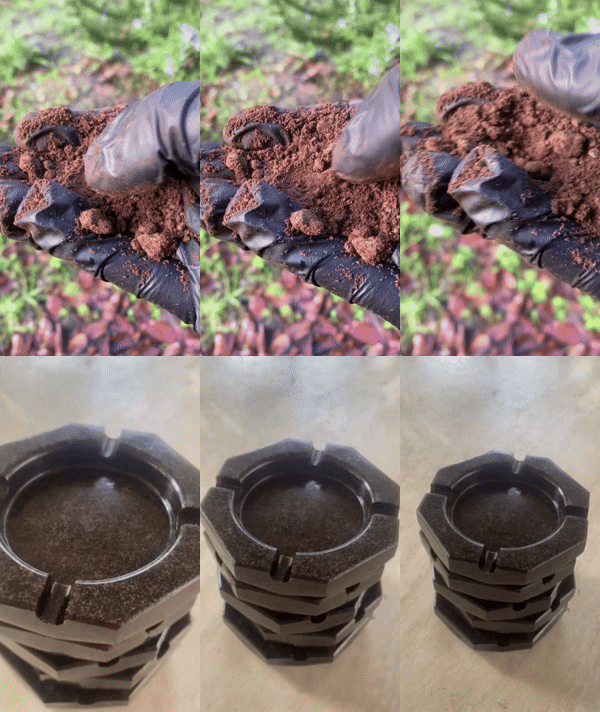
Coffee consumption represents a key cultural practice in our community. An invitation for coffee is an invitation to socialize, converse, and connect. This very fact lies at the heart of our concept, through which we aim to bring the issue of recycling to the forefront in Montenegro. Caffemino transforms the remnants of this daily routine into authentic, designer objects using an innovative blend of 3D technology and bio-composite materials.
Montenegro
National
Mainly urban
It refers to other types of transformations (soft investment)
Completed
No
Yes
RIS Scholarship
No
Individual
The Caffemino concept represents an innovative response to Montenegro's environmental challenges, utilizing the community's most widespread cultural practice—the coffee-drinking ritual—as a platform for introducing circular economy principles. Instead of millions of kilograms of coffee grounds and waste paper ending up in landfills and releasing harmful gases such as methane, our model transforms these resources into authentic designer objects of high aesthetic value. Through the application of digital fabrication and 3D technology, we have developed a specific bio-composite material that retains the sensory properties of coffee, making ecology tangible and visually appealing.
Current results confirm the operational sustainability and strength of this model. We have successfully recycled and processed 5 tons of coffee and 10 tons of paper through vermicomposting, preventing their decomposition in open landfills. We have developed a functional value chain that includes collecting raw materials from local bars and accounting agencies, and processing them into solid objects such as planters and souvenirs using precise 3D-printed molds. Financial validation through early development has shown that the market recognizes the value of these products, with the value of produced goods reaching nearly 20,000 euros, while cooperation with reforestation agencies has allowed our by-product—high-potency compost—to contribute directly to the regeneration of local ecosystems.
In the upcoming period, we are focusing on radically scaling our capacities with the goal of increasing the volume of recycled coffee tenfold by expanding our network to a minimum of 20 permanent partner locations. Expected results also include a digital system upgrade via blockchain technology, which will enable precise tracking of the saved carbon footprint and reward user loyalty.
The idea was born from the direct experience of our team members, most of whom worked seasonal jobs as bartenders. We noticed that in the majority of these establishments, coffee grounds are separated naturally from other waste, yet they still ended up in landfills. Our vision was to transform this raw material into a durable, solid substance that could be molded into authentic items tailored for local bars and souvenir shops. We took our first step by applying to a local Climathon, where we secured the initial funding to develop the concept and advance our recycling efforts.
However, the path to innovation was filled with challenges. We faced two primary obstacles: the rapid decomposition of the raw organic material and the lack of a scalable binding agent that could turn coffee grounds into a hardened, high-quality object. Since no instructions or blueprints existed online for such a process, we spent months independently testing various binders. During this experimental phase, we utilized the surplus material by combining it with waste paper sourced from local accounting firms within vermicomposters. By producing high-potency compost and donating it to local reforestation agencies, we achieved the first real-world application of our circular vision.
As the influx of raw material soon exceeded our initial operational capacities, we joined the regional RISE program. Through this support, we secured the resources to procure our first specialized resins. After nearly a year and a half of rigorous research and development, we successfully finalized the recipe for our production material. The combined grants from both competitions allowed us to equip our workshop with essential technology, including laser engravers and 3D printers.
Using 3D printers, we designed precise models which were then cast in silicone to create custom production molds. In these molds, we blend the resin with processed coffee grounds to achieve our unique designs.
Circular Economy
Ritual Aesthetics
Digital Fabrication
Social Inclusion
Regenerative Design
Our project stands as an exemplary model because it leverages the community's primary cultural practice --the coffee-drinking ritual--to promote ecological values and recycling in a society that currently recycles less than 5% of its waste (EUROSTAT, 2022). By transforming coffee grounds into a strategic resource rather than waste, we directly prevent the anaerobic decomposition of biomass in landfills, which releases methane, carbon dioxide, and nitrous oxide—gases recognized by international conventions as the main catalysts of climate change.
The concept achieves economic valorization by producing high-quality objects of significant aesthetic value, replacing expensive imported raw materials with affordable, local bio-waste. This addresses one of Montenegro's greatest economic challenges: seasonal employment. Our model provides stable, year-round "green" jobs, directly combating labor migration. In terms of sustainability, our concept is exemplary through its holistic "Zero Waste" system: organic remnants not used in designer products are diverted to vermicomposting to produce high-potency fertilizer for local reforestation initiatives. By merging modern 3D technology with local traditions and natural regeneration, we have created a unique, sustainable ecosystem that is both scalable and replicable.
The concept achieves economic valorization by producing high-quality objects of significant aesthetic value, replacing expensive imported raw materials with affordable, local bio-waste. This addresses one of Montenegro's greatest economic challenges: seasonal employment. Our model provides stable, year-round "green" jobs, directly combating labor migration. In terms of sustainability, our concept is exemplary through its holistic "Zero Waste" system: organic remnants not used in designer products are diverted to vermicomposting to produce high-potency fertilizer for local reforestation initiatives. By merging modern 3D technology with local traditions and natural regeneration, we have created a unique, sustainable ecosystem that is both scalable and replicable.
Our project redefines aesthetics by bridging the gap between sensory experience and social responsibility, turning a mundane waste product into a source of beauty and pride. By retaining the natural texture, deep earthy tones, and subtle aroma of coffee, our products offer a unique "digital craftsmanship" aesthetic that distinguishes them from industrial materials like plastic or glass. This creates a more human, warm, and organic environment in the everyday spaces where people live and socialize.
The concept excels in creating a profound sense of belonging and care for the place through its "participatory aesthetics." For instance, a regular guest at a local café realizes that the ashtray or planter on their table was partially made from the very coffee they drank that morning. This realization transforms a simple object into a symbol of their own contribution to the community. Similarly, for business owners, displaying these items is a silent yet powerful statement of their commitment to the neighborhood. This invisible thread connects guests, bartenders, owners, and us as producers into a unified regenerative cycle.
The exemplary nature of our aesthetic approach lies in its ability to inspire spontaneous civic action. We receive numerous calls from citizens offering their raw materials without any direct solicitation, proving that the project’s visual and symbolic language resonates deeply with the community’s desire to care for their surroundings. In the long term, this project serves as a tool for branding our community within regional and European frameworks, showing that sustainability can be beautiful, culturally rooted, and emotionally engaging. By humanizing environmental action through design, we make the transition to a circular economy not just a necessity, but a desirable and beautiful lifestyle choice.
Products and raw materials originating from recycling processes often face lower profitability compared to traditional extractivist production, posing a significant challenge to scalability and affordability. We address this through two strategic approaches. First, we provide discounts and direct bartering systems for individuals and partners who collect raw materials for us. Second, we are developing a technological solution involving NFT tokens that represent the monetary value of the carbon footprint locked through our production. These tokens will be offered to customers as discounts on our online shop, allowing them to realize the value of the offset carbon with each subsequent purchase.
We consider our project an exemplary model of inclusion, as our production predominantly engages hard-to-employ individuals. Furthermore, our suppliers of raw materials and services are often members of minority communities or businesses founded by migrants from Ukraine and the Middle East. The project is rooted in the 'Design for All' principle, utilizing micro-production that eliminates the need for centralized factories. By relying on 3D technology, we champion a decentralized and shareable manufacturing model, promoting the idea that anyone can be a creator. This approach democratizes production and ensures that the transition to a circular economy is socially just and accessible to all.
We consider our project an exemplary model of inclusion, as our production predominantly engages hard-to-employ individuals. Furthermore, our suppliers of raw materials and services are often members of minority communities or businesses founded by migrants from Ukraine and the Middle East. The project is rooted in the 'Design for All' principle, utilizing micro-production that eliminates the need for centralized factories. By relying on 3D technology, we champion a decentralized and shareable manufacturing model, promoting the idea that anyone can be a creator. This approach democratizes production and ensures that the transition to a circular economy is socially just and accessible to all.
The participatory nature of our project is reflected in the fact that our early users were the actual engine of its development. The first 'testers' of our products and processes were the people working directly with the raw material—bartenders—a role we held ourselves. Through shared observations, we identified potential problems early and resolved them rapidly. For instance, without direct feedback from the industry, we would not have established the precise timing of decomposition or the emergence of the small 'coffee specks' that give our products their unique texture and color. Without this timing, the items would appear entirely black, indistinguishable from ordinary resin, and the coffee grounds would have been wasted.
Furthermore, this participation allowed us to establish partnerships with other entities, such as reforestation and accounting agencies, connecting them to solve each other's specific problems. We consider our project a case study of a 'problem-solving chain' where addressing one issue resolves a series of problems for other stakeholders. While the entire country struggles with waste recycling due to a lack of source separation, our experience highlighted one specific waste stream that is already being separated. By identifying the technical challenge of decomposition, we integrated a second waste stream—paper from accounting firms—to create a new product that solves the problem of a third actor: reforestation agencies in need of high-potency compost. This collaborative feedback loop has transformed a linear waste problem into a multi-sectoral circular solution.
Furthermore, this participation allowed us to establish partnerships with other entities, such as reforestation and accounting agencies, connecting them to solve each other's specific problems. We consider our project a case study of a 'problem-solving chain' where addressing one issue resolves a series of problems for other stakeholders. While the entire country struggles with waste recycling due to a lack of source separation, our experience highlighted one specific waste stream that is already being separated. By identifying the technical challenge of decomposition, we integrated a second waste stream—paper from accounting firms—to create a new product that solves the problem of a third actor: reforestation agencies in need of high-potency compost. This collaborative feedback loop has transformed a linear waste problem into a multi-sectoral circular solution.
Our project operates through a robust multi-level governance structure, involving stakeholders from local to European scales to ensure systemic impact.
Local Level: We have engaged the HoReCa sector and accounting agencies as primary suppliers of raw materials (coffee grounds and paper) and as the first link in our distribution chain. The added value here lies in the direct transformation of waste into high-value resources, fostering the circular economy and affirming 'green' values within the immediate community.
Regional Level: We are active members of young entrepreneur networks and programs focused on circular and social entrepreneurship across the Western Balkans. This engagement provides vital administrative, financial, and mentorship support, helping us scale our solution, navigate regional regulations, and access financial benefits tailored for eco-innovators.
National Level: We contribute to branding Montenegro as a constitutional ecological state. A key added value is our production of high-potency vermicompost, essential for growing saplings used in reforesting fire-damaged areas. This directly addresses national environmental crises, such as frequent wildfires and the challenges of reforestation in karst terrain.
European Level: Our early development was powered by European Union funds; notably, as EIT Jumpstarter finalists, we secured the resources to formally establish our company. We act as a bridge for European environmental standards in a region with the continent's lowest recycling rates. By scaling our circular production, we contribute to the shared goal of making Europe the first climate-neutral continent.
Our project harmonizes environmental science, digital technologies, engineering, chemistry, psychology, and tourism, all unified under the umbrella of the creative industries. The growth of these industries is intrinsically linked to the branding of Montenegro, which is constitutionally defined as an ecological state. Given that tourism constitutes a significant portion of the national GDP, we utilize raw materials derived from the community's primary cultural practice—coffee consumption—to create products specifically designed for this lead economic sector.
Our goal is to foster an emotional connection between the visitor and the destination, rooted in green values and national culture. In this context, applied psychology is a key discipline; it encourages the local population to embrace circular production while simultaneously prompting the end-user to develop a lasting emotional bond with the location. This emotional experience is rationalized through environmental science, which provides meaning by offering concrete insights into the reduction of methane, carbon dioxide, and nitrous oxide emissions.
Furthermore, digital technologies, engineering, and chemistry serve as our essential tools for materializing the concept. We utilize 3D software and printing for precision design and digital fabrication, while chemistry allows us to develop the exact material formula necessary to produce high-quality, aesthetically pleasing, and durable products.
The core of our long-term financial sustainability is direct market sales. Over the past 18 months, we have demonstrated market viability by investing €15,000 and generating nearly €20,000 in goods. Our growth strategy is data-driven: with a Customer Acquisition Cost (CAC) of approximately €2.50, we have identified a clear path to scaling. We aim to quintuple our capacities over the next two years by aggressively investing in digital marketing to build a robust sales funnel, targeting a 100% quarterly growth rate in sales and production.
Cost Structure and Funding Strategy: We categorize our costs into capital expenditures (CAPEX), working capital, marketing, and operational expenses.
CAPEX: Most of our primary equipment was secured through competitive grants (RISE and Climathon). Future large-scale machinery required for expansion is planned through upcoming grant schemes.
Working Capital: For the current year, raw materials and production supplies are covered by a national grant for creative industries.
Operational Expenses: While we previously relied on private funds—necessitating strict lean management—we are transitioning to a model where market revenues will exclusively cover rent, salaries, taxes, and third-party services.
Financial Instruments for Scalability: To bridge the gap between micro-production and industrial scaling, we utilize a hybrid financing model. We are applying for international grants and favorable credit lines specifically to fund the high-impact digital marketing needed to clear current inventory and stimulate demand.
The Caffemino concept is designed for high replicability and cross-border transferability, as it relies on accessible technology and a raw material that is globally ubiquitous.
Technological Transferability: Our core production methodology utilizes open-source 3D modeling and printing technologies. These tools require minimal formal education, allowing individuals or small collectives anywhere to design their own models and rapidly produce the silicone molds necessary for scaling production. This decentralization of manufacturing—shifting from heavy factories to micro-studios—is a key element that can be transferred to any urban or rural context.
Resource Accessibility: Coffee grounds are naturally separated from other waste streams in cafes and restaurants across the continent, more often for practical than ecological reasons. This existing habit provides a 'ready-to-use' infrastructure for raw material collection in almost any community. When combined with affordable and widely available binding agents sourced through global online marketplaces, the barriers to entry for new producers are exceptionally low.
Methodological Scaling: The 'bottleneck' of scaling is addressed through digital literacy. The abundance of accessible education in digital marketing, coupled with free AI-driven tools (such as various LLMs and marketing automation agents), significantly lowers the cost of customer acquisition and brand building.
Key Learnings for Transfer: Our project serves as a blueprint for transforming local cultural rituals into circular business models. The methodology of connecting diverse stakeholders (e.g., hospitality, accounting, and reforestation sectors) is a process that can be replicated to solve specific local waste challenges in other regions. By proving that high-end design can emerge from low-cost waste through digital fabrication, we offer a scalable solution for the European transition toward a localized, climate-neutral economy.
In the year following the application, our roadmap is focused on two primary pillars: aggressive production scaling and strategic market promotion.
Digital Growth and E-commerce: Our immediate priority is to optimize our social media presence to reach a consistent monthly sales baseline of at least €2,000. Achieving this milestone will provide the necessary capital to launch a high-end web shop. A core innovation of this platform will be the implementation of the ERC30 token system, which will allow returning customers to redeem discounts equivalent to the carbon footprint saved through their previous purchases of our circular products. This Web3 integration aims to gamify sustainability and ensure long-term customer loyalty.
Operational Scaling and Supply Chain: To support our sales targets, we aim to expand our raw material collection network to at least 20 permanent partner venues. This expansion is projected to increase the volume of recycled coffee grounds tenfold and grow our total production value by 2.5 times within the next twelve months.
Financial Sustainability and Infrastructure: To accommodate this rapid growth in both financial and spatial terms, we are actively pursuing grants from both domestic and international donors. As a secondary strategy, we are in active negotiations with local banks to secure favorable financing lines should additional capital be required for scaling our facilities.