Enablers for New European Bauhaus Transformation
Sustain.ALL
Sustain.ALL Transformation Hub – Co-Creating Sustainable Change
Sustain.ALL Transformation Hub turns universities into living labs for climate-neutral and inclusive transformation. Using a human-centered methodology, it maps local stakeholders, activates open calls, and brings institutions, students, and communities together in co-creation processes. Through concrete formats like workshops, challenge-based projects, and climate coaching, it develops and implements real solutions for sustainable neighborhoods.
Germany
National
Mainly urban
It refers to other types of transformations (soft investment)
Prototype level
No
No
No
Individual
The Sustain.ALL Transformation Hub is a transdisciplinary platform I developed to accelerate climate-neutral, inclusive, and regenerative urban transformation by connecting science, public institutions, communities, industry, and creative practices.
Through my work, I identified a key implementation gap: while technical solutions for decarbonization exist, transformation often fails due to limited participation and lack of ownership. To address this, I developed a human-centered methodology that maps stakeholders across institutions and neighborhoods, activates open calls, and enables co-creation processes to translate strategies into real implementation.This concept builds on over six years of applied experience. Since 2021, I have been developing Sustain.ALL at TU Berlin as a platform connecting students with NGOs, startups, and international partners to work on real sustainability challenges. This has resulted in over 20 SDG impact projects across Berlin, Nepal, Burkina Faso, Sierra Leone, and Istanbul, in collaboration with more than 30 partners.In parallel, I developed and implemented a climate coaching approach through my master’s thesis in Berlin’s public sector, supporting transformation in seven schools, three government buildings, and urban quarters. This contributed to Berlin’s first climate guideline (Klimaleitfaden) with 47 measures, co-created with over 500 stakeholders, and reached more than 7,000 participants through workshops and participatory formats.
I also founded RHEA Kollektiv (2022), a FLINTA-focused art collective organizing exhibitions, pop-ups, and creative workshops, and SHIFT Z (2025), a public dialogue and podcast series with over 8 events, 35 speakers, and more than 2,000 participants.At TU Berlin, I developed a project-based module where around 50 students per semester work on real challenges through open calls and co-creation. Within the hub, 5–10 challenge-based projects are completed every six months, engaging over 200 participant
The idea for the Sustain.ALL Transformation Hub emerged during the COVID-19 lockdown, when I was working on a plastic recycling initiative in Burkina Faso with over 200 women. After six months of preparation, we were unable to travel and implement the project. This moment revealed a critical gap: sustainable projects often depend on physical presence and lack structures for continuous, inclusive collaboration across borders.
In response, I founded Sustain.ALL as a platform without borders—enabling collaboration beyond physical and language barriers. I built a team, joined hackathons, and developed the concept further, winning first prize at TU Berlin. I then translated the idea into a project-based module, where students collaborate with NGOs, startups, and international partners on real SDG challenges.
Through this work, I developed a methodology combining stakeholder mapping, open calls, and challenge-based co-creation. Multiple projects could run in parallel, connecting local and global actors.In parallel, I worked in the public sector on decarbonizing buildings and developed a climate coaching methodology focused on energy monitoring, audits, and renovation strategies. This experience showed me that technical solutions alone are not sufficient—holistic transformation requires social, cultural, and behavioral change.This led me to expand my work by integrating artistic and participatory formats. Through RHEA Kollektiv and SHIFT Z, I activated public spaces, creating platforms for dialogue, creativity, and belonging, and bringing diverse voices into transformation processes.The Sustain.ALL Transformation Hub brings these experiences together into a structured model. It integrates engineering, human-centered design, and cultural practices, organized through innovation clusters and challenge-based projects. Now implemented at TU Berlin, the hub serves as a living lab that connects science, society, and culture, creating scalable pathways for NEB Bauhaus.
community co-design
participatory governance
sustainability education
human centered innovation
climate-neutral transformation
The Sustain.ALL Transformation Hub addresses sustainability as a systemic challenge, integrating environmental, social, cultural, and economic dimensions, with a primary focus on reducing environmental impact in the built environment and urban systems.Environmentally, the concept accelerates climate-neutral transformation by translating decarbonisation strategies into real-world implementation. This includes energy monitoring, audits, and renovation pathways in schools, government buildings, and urban quarters in Berlin, contributing to the city’s Klimaleitfaden with 47 concrete measures to reduce emissions and improve building performance. Within the hub, projects further address energy efficiency, circular construction, resource use, and lifecycle-based design, including nature-based and regenerative approaches where applicable.Socially and culturally, these environmental solutions are enabled through human-centered processes that strengthen ownership and long-term behavioural change. By integrating participatory formats and cultural practices, sustainability becomes actionable and embedded in everyday life, increasing the effectiveness of environmental measures.Economically, the concept supports the development of scalable solutions and new value chains through collaboration between universities, public institutions, startups, and civil society. Projects are designed to evolve into implementation-ready models and ventures that contribute to a resource-efficient and climate-neutral economy.The concept promotes lifecycle thinking by considering environmental impacts across entire systems, from material sourcing to long-term operation.
What makes this approach exemplary is its focus on implementation: it bridges the gap between strategy and execution by integrating environmental, social, and economic dimensions into one operational model. This enables measurable environmental impact while ensuring long-term viability and scalability.
What makes this approach exemplary is its focus on implementation: it bridges the gap between strategy and execution by integrating environmental, social, and economic dimensions into one operational model. This enables measurable environmental impact while ensuring long-term viability and scalability.
The Sustain.ALL Transformation Hub contributes to aesthetics by redefining sustainability as a lived, shared, and emotionally engaging experience.
Its objective is to move beyond purely technical approaches and create spaces where sustainability becomes visible, tangible, and meaningful in everyday life. This is achieved by integrating artistic, cultural, and sensory practices into transformation processes.
Through formats developed in RHEA Kollektiv and SHIFT Z, I create environments that combine dialogue, sound, movement, and visual expression. These take place in galleries, clubs, studios, and public spaces, transforming them into inclusive spaces for exchange and co-creation. Across more than 8 curated events with over 35 speakers and 2,000 participants, these formats have activated diverse audiences and made sustainability accessible and engaging.
The quality of experience is central: participants are not only informed but actively involved, fostering emotional connection, inspiration, and a sense of belonging. By engaging multiple senses and creating collective experiences, the concept supports well-being and strengthens people’s relationship to their environment and to each other.
In addition, the hub enables the co-creation of solutions and spaces that reflect local identity, cultural diversity, and ecological awareness. This ensures that sustainability is not perceived as abstract or imposed, but as something people can relate to and shape.
The concept is exemplary because it bridges sustainability with culture and creativity, transforming it into a shared social experience. It demonstrates how aesthetic practices can foster participation, strengthen community, and make sustainable transformation desirable and inclusive, in line with the New European Bauhaus.
The Sustain.ALL Transformation Hub addresses inclusion by creating accessible, participatory, and equitable pathways for diverse groups to engage in sustainability transformation.Its objective is to reduce barriers toparticipation across social, disciplinary, and institutional boundaries. The concept promotes inclusion in social, cultural, spatial, and governance dimensions by enabling people from different backgrounds to actively contribute to transformation processes.Implementation is based on open and low-threshold access formats. Through open calls, challenge-based projects, and public engagement activities, individuals and organisations can participate regardless of their professional background. The Sustain.ALL module at TU Berlin is open to students across disciplines and institutions, including the Berlin University Alliance, enabling interdisciplinary and cross-institutional collaboration.The concept also promotes inclusive governance by shifting from top-down approaches to co-creation. Stakeholders—including public institutions, civil society, students, and creative actors—are actively involved in defining challenges, shaping solutions, and contributing to implementation processes.In addition, dedicated formats such as RHEA Kollektiv create spaces for underrepresented groups, particularly FLINTA communities, to engage in sustainability through accessible and creative approaches. Public formats such as SHIFT Z further expand access by combining physical and digital participation, enabling broader reach and interaction.
Results include the engagement of over 7,000participants across formats, increased collaboration between sectors, and the creation of shared ownership in transformation processes.What makes the concept exemplary is its shift from participation to co-creation and shared governance. It establishes inclusive structures that empower diverse actors to become active contributors, fostering new forms of collaboration, social cohesion, and equitable
Results include the engagement of over 7,000participants across formats, increased collaboration between sectors, and the creation of shared ownership in transformation processes.What makes the concept exemplary is its shift from participation to co-creation and shared governance. It establishes inclusive structures that empower diverse actors to become active contributors, fostering new forms of collaboration, social cohesion, and equitable
Participation is at the core of the Sustain.ALL Transformation Hub and evolves from consultation to co-creation and shared ownership, in line with the NEB ambition of empowering communities to actively shape transformation processes.
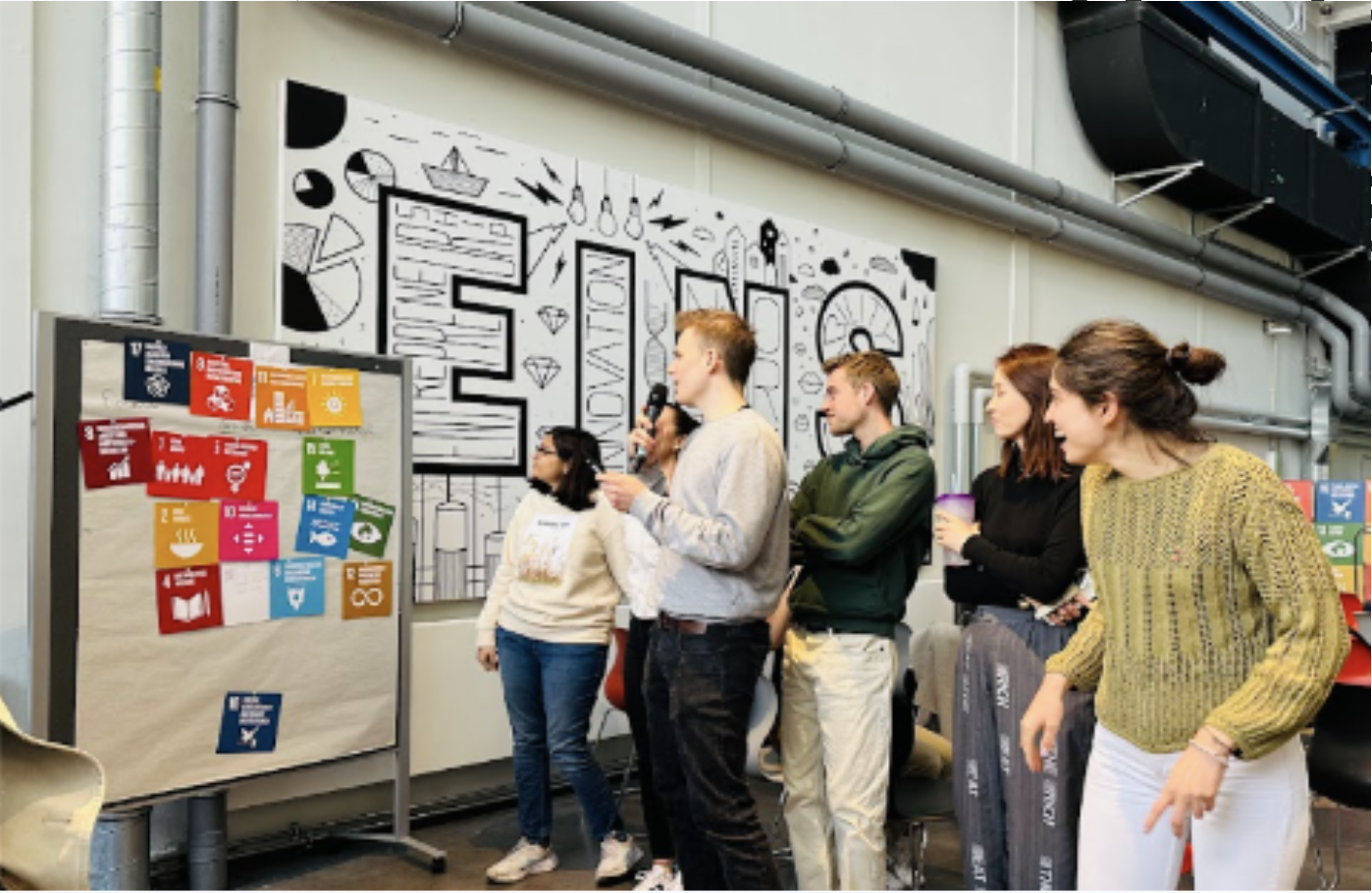
I developed a human-centered methodology that begins with stakeholder mapping across institutions, neighborhoods, and sectors, followed by open calls inviting diverse actors to contribute challenges and ideas. Participants—including students, public institutions, NGOs, startups, and citizens—are actively involved in defining challenges, co-developing solutions, and implementing outcomes.
This approach has been applied through climate workshops, talks, and co-creation labs. In Berlin’s public sector, more than 500 stakeholders co-created the city’s Klimaleitfaden, directly influencing implementation pathways. Overall, more than 7,000 participants have engaged in these processes.
Within the Transformation Hub, participation is institutionalised through challenge-based learning: around 50 students per semester collaborate with external partners on real-world challenges, creating continuous feedback loops between users, decision-makers, and implementers.
Participation is further expanded through public-facing formats such as SHIFT Z and RHEA Kollektiv. SHIFT Z combines physical events with podcast and video formats that are designed to be streamed and shared digitally, enabling wider access to climate dialogue and engagement beyond local contexts. This hybrid approach allows diverse audiences to participate, learn, and contribute regardless of location.
The impact of this approach is a shift from passive involvement to active co-creation. Participants become co-authors of solutions, increasing ownership, accelerating implementation, and strengthening long-term engagement. At the same time, digital formats extend participation across borders, supporting a scalable and inclusive model of collective climate action.
Participation is at the core of the Sustain.ALL Transformation Hub and evolves from consultation to co-creation and shared ownership, in line with the NEB ambition of empowering communities to actively shape transformation processes. I developed a human-centered methodology that begins with stakeholder mapping across institutions, neighborhoods, and sectors, followed by open calls inviting diverse actors to contribute challenges and ideas. Participants—including students, public institutions, NGOs, startups, and citizens—are actively involved in defining challenges, co-developing solutions, and implementing outcomes. This approach has been applied through climate workshops, talks, and co-creation labs. In Berlin’s public sector, more than 500 stakeholders co-created the city’s Klimaleitfaden, directly influencing implementation pathways. Overall, more than 7,000 participants have engaged in these processes. Within the Transformation Hub, participation is institutionalised through challenge-based learning: around 50 students per semester collaborate with external partners on real-world challenges, creating continuous feedback loops between users, decision-makers, and implementers. Participation is further expanded through public-facing formats such as SHIFT Z and RHEA Kollektiv. SHIFT Z combines physical events with podcast and video formats that are designed to be streamed and shared digitally, enabling wider access to climate dialogue and engagement beyond local contexts. This hybrid approach allows diverse audiences to participate, learn, and contribute regardless of location. The impact of this approach is a shift from passive involvement to active co-creation. Participants become co-authors of solutions, increasing ownership, accelerating implementation, and strengthening long-term engagement. At the same time, digital formats extend participation across borders, supporting a scalable and inclusive model of collective climate action.
The Sustain.ALL Transformation Hub is inherently transdisciplinary, integrating knowledge from engineering, environmental sciences, social sciences, arts, education, and digital technologies, while actively incorporating perspectives from non-academic stakeholders and the public.The concept combines my background in environmental engineering and climate strategy—focused on decarbonisation of buildings and urban systems—with human-centered approaches developed through climate coaching and participatory facilitation. These are complemented by artistic and cultural practices through initiatives such as RHEA Kollektiv and SHIFT Z, which introduce perspectives from art, performance, storytelling, and collective experience.Transdisciplinary collaboration is organised through challenge-based learning and co-creation formats. The Sustain.ALL module is open to students from all faculties and disciplinary backgrounds, enabling diverse perspectives to come together in transdisciplinary teams. These teams collaborate with external stakeholders, including public institutions, NGOs, startups, community actors, and creatives.
Collaboration takes place in structured formats such as workshops, co-creation labs, and iterative project cycles, where participants jointly define challenges, develop solutions, and test them in real-world contexts. This enables continuous exchange and integration of perspectives.A key aspect is the equal value given to different types of knowledge. Scientific expertise is combined with practical experience, cultural expression, and community-based insights, allowing solutions to be grounded, innovative, and context-specific.The added value of this approach lies in its ability to address complex sustainability challenges holistically. By integrating technical, social, and cultural dimensions, the concept generates solutions that are not only effective, but also implementable, inclusive, and meaningful.
Collaboration takes place in structured formats such as workshops, co-creation labs, and iterative project cycles, where participants jointly define challenges, develop solutions, and test them in real-world contexts. This enables continuous exchange and integration of perspectives.A key aspect is the equal value given to different types of knowledge. Scientific expertise is combined with practical experience, cultural expression, and community-based insights, allowing solutions to be grounded, innovative, and context-specific.The added value of this approach lies in its ability to address complex sustainability challenges holistically. By integrating technical, social, and cultural dimensions, the concept generates solutions that are not only effective, but also implementable, inclusive, and meaningful.
The Sustain.ALL Transformation Hub follows a hybrid and scalable business model that integrates education, innovation, and entrepreneurship into one operational system.
At its core, the hub functions as a venture and innovation pipeline. Within each innovation cluster, real-world challenges are developed into prototypes, frameworks, and business concepts over a structured 14-week cycle. These projects are designed to evolve into startups or implementation-ready solutions. The hub is directly connected to the entrepreneurship ecosystem at TU Berlin, including the Entrepreneurship Hub and startup support structures, enabling selected projects to be incubated, funded, and scaled as independent ventures.
In parallel, the concept is embedded within higher education through the Sustain.ALL module, which provides institutional stability through teaching formats, academic integration, and long-term partnerships.
Revenue will be generated through multiple channels. These include educational formats, paid workshops and consulting services for public institutions and companies, and co-creation programs with external partners who engage with the hub to develop sustainability solutions. In addition, the development of a digital platform will create new revenue streams by offering structured learning journeys, coaching formats, and collaboration tools through service-based packages for students, professionals, and organisations.
The financial structure is based on a diversified model. Core costs include facilitation, coordination, teaching, and platform development, which are shared across institutional partners, project collaborators, and funding sources. Public and European funding support the initial development and scaling phases, while partnerships and service-based revenues ensure long-term financial sustainability.What makes this model innovative is its ability to transform sustainability challenges into entrepreneurial opportunities.
The Sustain.ALL Transformation Hub is designed as a modular and transferable model that can be replicated across universities, cities, and organisations.At its core, the concept is based on a structured methodology that includes stakeholder mapping, open calls, challenge-based learning, and co-creation processes. These elements are adaptable to different contexts and can be applied to a wide range of sustainability challenges, making the model highly transferable.A key scalable component is the project-based module implemented at TU Berlin. This format can be integrated into other higher education institutions, enabling students from diverse disciplines to work on real-world challenges in collaboration with external partners. The model is already designed to expand across networks such as the Berlin University Alliance, TU9, and European university alliances.The innovation cluster structure further enhances transferability by allowing thematic adaptation to regional priorities, such as climate, circular economy, mobility, or social innovation.To support replication, the concept includes the development of an open-source toolkit and a digital platform. These will provide guidelines, facilitation methods, and frameworks that enable institutions, cities, and organisations to implement similar co-creation processes independently.The concept has already demonstrated transferability through projects in Europe, Africa, and Asia, showing its adaptability across cultural and socio-economic contexts.Replication requires local partnerships and facilitation capacities, particularly with universities, public institutions, and community actors, to ensure contextual relevance and stakeholder engagement. While the core methodology remains consistent, specific challenges, cultural practices, and governance structures are adapted to local needs.By combining education, co-creation, and implementation into a unified system, the Sustain.ALL Transformation Hub provides a scalable model.
The Sustain.ALL Transformation Hub is entering its implementation phase with a clear roadmap for the next 12 months, focused on activation, scaling, and consolidation.In the first phase, the hub will be launched at TU Berlin as a project-based module starting in April 2026. Around 50 students per semester, from different faculties and disciplinary backgrounds as well as from partner institutions such as the Berlin University Alliance, will work on real-world sustainability challenges defined through open calls. In each cycle, 5–10 challenge-based projects will be developed in collaboration with public institutions, NGOs, and industry partners.In parallel, partnerships will be expanded across local, national, and European levels, including universities, public sector actors, and innovation networks. These collaborations will support implementation, increase visibility, and enable integration into broader ecosystems.A second focus is the development of an open-source toolkit documenting the methodology, processes, and learnings of the hub. This will allow other institutions and cities to adopt and implement the model. At the same time, a digital platform will be developed to expand access, offering structured learning journeys, coaching formats, and collaboration tools.Public engagement will be strengthened through formats such as SHIFT Z and RHEA Kollektiv, combining physical events with digital formats to activate broader audiences and foster participation.In the final phase, outcomes will be evaluated, impact will be assessed, and a replication strategy will be defined to scale the model to other universities and cities.Through these steps, the Sustain.ALL Transformation Hub will be established as an operational and scalable model for sustainable, inclusive, and culturally embedded transformation aligned with the New European Bauhaus.