Enhancing Circularity, Sustainability, and Innovation
TrashTrek App
TrashTrek App
TrashTrek is a community-powered platform that helps people identify and clean litter in their surroundings. Through gamification and sponsored rewards, users are motivated to collect and report waste using geolocated photos. The platform transforms these contributions into environmental insights and is evolving to combine community data with satellite imagery and computer vision to better understand and tackle pollution hotspots
Slovenia
National
It addresses urban-rural linkages
It refers to other types of transformations (soft investment)
Prototype level
No
Yes
India–EU Ideathon on Combating Marine Plastic Pollution - https://research-and-innovation.ec.europa.eu/news/all-research-and-innovation-news/india-eu-ideathon-marine-plastic-pollution-concludes-final-ceremony-and-three-winners-2025-12-10_en#:~:text=Trash
Yes
Organisation
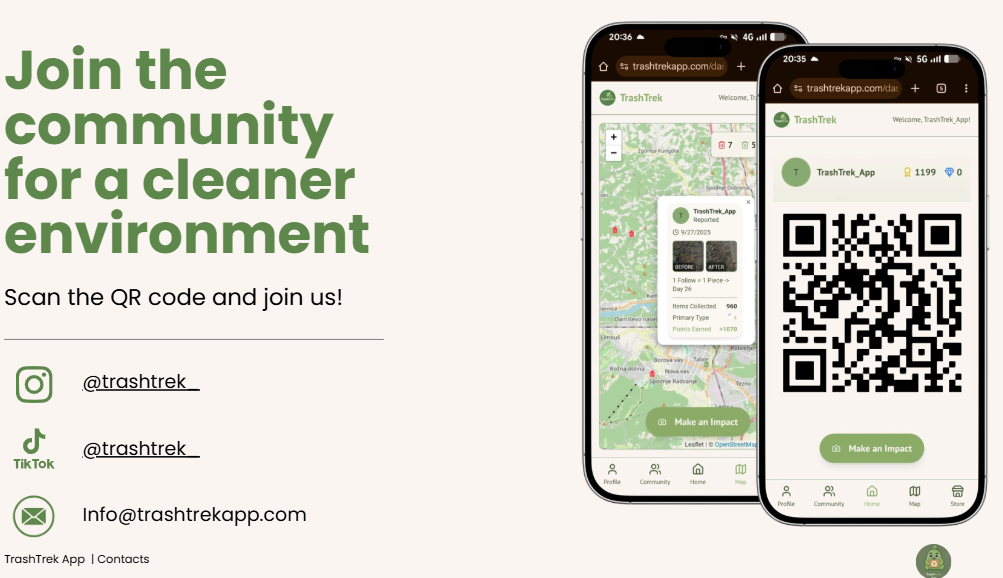
TrashTrek App is a digital platform that enables communities to identify, document, and remove litter while generating environmental data. Users record litter and cleanups with geolocated photos, creating a growing dataset on pollution locations and types of waste. The platform connects citizens, environmental NGOs, and corporations, using gamification and sponsored rewards to motivate participation and support environmental campaigns.
The concept has already demonstrated early traction. The TrashTrek community has grown to more than 90,000 followers on social media and over 2 million video views. An early prototype of the platform has attracted more than 250 early users who have documented over 2,500 pieces of litter during initial testing.
TrashTrek App is also being tested with environmental organisations such as YouSea and Universal Greening Organization (UGO), which use the platform for documenting cleanups and validating environmental data. A pilot collaboration has also been carried out with McDonald’s Slovenia to test corporate-supported cleanup campaigns.
The concept has received international recognition, including first place at the EU–India Ideathon on Marine Plastic Pollution and the Rector’s Award for social innovation at the University of Ljubljana.
The next development stage focuses on improving environmental data collection. TrashTrek App is developing computer vision models to automatically classify waste from photos and integrating satellite indicators to detect environmental changes and identify potential pollution hotspots for community verification.
TrashTrek App started during a walk, when co-founder Rene Pavokovič threw a cigarette butt into nature and began questioning why such behaviour is widely accepted. This moment led to a simple social media challenge: for every new follower, he would collect one piece of litter.
The challenge quickly grew to more than 90,000 followers and over 2 million views on Instagram and TikTok. The response showed that many people were willing to help protect their local environment, but there was no system to record these actions or turn them into useful environmental data.
To test the idea, we built the first prototype of TrashTrek App and shared it on social media together with a waiting list for early testing. The announcements generated more than 15,000 interactions, leading to the first sign-ups. After launching the test version, more than 50 users registered in the first month, and today over 250 early users are testing the platform.
Environmental organisations such as YouSea and IZRIIS in Slovenia, Universal Greening Organization in South Africa, and Amaan Africa in Cameroon showed interest in the concept and its potential to support community cleanups and environmental monitoring.
These discussions also highlighted that 70–80% of marine litter originates from land, meaning protecting rivers and oceans requires engaging local communities directly where litter appears.
A pilot collaboration with McDonald’s Slovenia helped test how corporate-supported cleanup campaigns can promote responsible waste behaviour among consumers.
Today, the MVP of TrashTrek App allows users to document litter locations and cleanups with geolocated photos, creating the first dataset that will support computer vision models and satellite-based monitoring of pollution hotspots.
Community engagement
Marine litter prevention
Water ecosystem protection
Gamified citizen science
Environmental monitoring
Plastic pollution is one of the most pressing environmental challenges today. The world produces around 430 million tonnes of plastic annually, most of it used for single-use products, while less than 10% is recycled. As a result, large quantities accumulate in nature and eventually reach rivers and oceans. Research shows that 70–80% of marine litter originates from land, where waste is improperly disposed of and transported by wind, rainfall, and waterways into aquatic ecosystems.
TrashTrek App addresses this challenge through early detection and removal of litter directly where it appears. The platform allows users to document polluted locations or cleanup activities using geolocated photos. Through community engagement, gamification, and partner-supported rewards, individuals are encouraged to collect litter during everyday activities such as walking or recreation. This preventive approach removes waste before it reaches rivers and oceans or breaks down into microplastics.
To date, the community has documented and removed more than 2,500 pieces of litter, with around 5,000 expected by the end of the year. Based on conservative weight estimates, this represents approximately 150–500 kg of waste removed, with projections of 3.7–12.5 tonnes by 2030. In addition to smaller items, the platform enables reporting of illegal dumping sites such as construction waste, tires, appliances, and electronic waste, allowing communities and local partners to organise their removal.
TrashTrek App also supports corporate-supported cleanup campaigns, encouraging responsible waste behaviour and strengthening collaboration between citizens, organisations, and companies. By combining community participation, environmental monitoring, and digital technology, the platform helps prevent litter from reaching waterways while supporting circular economy practices and more sustainable waste management.
TrashTrek App contributes to cleaner, healthier, and more enjoyable environments for communities. Littered public spaces negatively affect how people experience neighbourhoods, parks, and natural areas. By enabling individuals to identify and clean polluted locations, the platform helps restore the visual quality and usability of these places.
The concept focuses on everyday engagement with local environments. Instead of relying only on large organised cleanup events, TrashTrek App encourages people to improve their surroundings during daily activities such as walking, hiking, or recreation. Many small individual actions accumulate into visible improvements in neighbourhoods, parks, riversides, and public spaces.
The platform also strengthens a sense of care and belonging. By documenting cleanups with geolocated photos and visible results, users can see the direct impact of their actions. This creates a stronger connection between people and their surroundings and motivates continued participation in caring for shared spaces.
In the longer term, the collected environmental data helps identify litter hotspots and recurring pollution problems. These insights can support communities, NGOs, and municipalities in organising targeted cleanup activities and improving waste management strategies. Cleaner environments improve not only ecological conditions but also the everyday experience of living in neighbourhoods and public spaces.
Through community participation, visible environmental improvements, and shared responsibility for public spaces, TrashTrek App helps transform polluted areas into cleaner and more welcoming environments that people can enjoy and take pride in.
TrashTrek App is designed to make environmental action accessible and inclusive for everyone. Participation requires only a smartphone and everyday activities such as walking, cycling, or spending time outdoors. This allows people from different age groups, backgrounds, and locations to contribute to environmental protection without specialised knowledge or equipment.
The platform promotes citizen participation and shared responsibility for local environments. Individuals can report littered areas, document cleanup activities, and contribute environmental observations that become part of a shared dataset. This approach empowers communities to actively participate in solving environmental challenges rather than relying only on institutional actors.
TrashTrek App also supports collaboration between citizens, environmental organisations, municipalities, and companies. Environmental NGOs can use the platform to document cleanups and collect environmental data, while companies can support environmental initiatives and encourage responsible waste behaviour among consumers.
The concept also demonstrates strong global accessibility potential. Early testing has already involved organisations and users from different regions, including Slovenia, South Africa, and Cameroon. Because the platform relies on simple digital tools and community participation, it can be adapted to diverse social and economic contexts, including areas with limited environmental infrastructure.
By lowering barriers to participation and enabling cooperation between different actors, TrashTrek App promotes inclusive environmental governance and community-driven sustainability, ensuring that environmental protection becomes a shared effort accessible to everyone.
Participation has been central to the development of TrashTrek App from the very beginning. The concept originated as a social media experiment in which community members were encouraged to participate in litter collection. This early engagement helped build a community of more than 90,000 followers and over 2 million video views, demonstrating strong public interest in environmental action.
The first prototype of TrashTrek App was also developed through direct interaction with users. Early feedback was collected through social media discussions, a waiting list for prototype testing, and ongoing dialogue with early adopters. Initial announcements generated more than 15,000 interactions, which led to the first sign-ups and the creation of a testing community. Today, over 250 early users are actively testing the platform and providing feedback on functionality, usability, and environmental impact.
Participation also extends to environmental organisations and stakeholders working on environmental protection. Discussions with organisations such as YouSea and IZRIIS in Slovenia, Universal Greening Organization in South Africa, and Amaan Africa in Cameroon helped shape the concept beyond simple litter collection. These organisations highlighted the importance of reliable environmental data and contributed insights into how the platform could support environmental monitoring and cleanup activities.
Through this continuous feedback process, citizens, volunteers, and environmental organisations have directly influenced the development of the concept. Their participation helped refine the platform’s features, including geolocated photo documentation, cleanup verification, and the identification of pollution hotspots.
By combining citizen participation, community feedback, and collaboration with environmental organisations, TrashTrek App ensures that the concept evolves in response to real community needs and environmental challenges.
TrashTrek App is designed to operate within a multi-level governance ecosystem, connecting stakeholders at local, national, and international levels.
At the local level, citizens play a central role by documenting littered areas and participating in cleanup activities. Environmental organisations such as YouSea and IZRIIS in Slovenia contribute expertise in environmental protection and support the validation of environmental observations. Local communities and volunteers help identify polluted locations and participate in cleanup initiatives.
At the regional and national level, collaboration with municipalities and waste management organisations can support the removal of larger illegal dumping sites and improve waste management strategies. Data collected through the platform can help local authorities identify litter hotspots, prioritise cleanup actions, and better understand patterns of environmental pollution.
At the international level, TrashTrek App has already engaged with organisations such as Universal Greening Organization in South Africa and Amaan Africa in Cameroon, demonstrating the potential of the concept to operate across different regions and environmental contexts. Because the platform relies on community participation and simple digital tools, it can be adapted to different governance systems and environmental infrastructures.
Corporate stakeholders also play an important role. A pilot collaboration with McDonald’s Slovenia explored how companies can support environmental initiatives while encouraging responsible waste behaviour among consumers.
By connecting citizens, NGOs, companies, and public institutions across multiple governance levels, TrashTrek App creates a collaborative framework that supports coordinated environmental action and more effective management of environmental challenges.
TrashTrek App is developed through a transdisciplinary approach, combining knowledge from multiple fields including environmental science, digital technology, data analysis, and community engagement.
Environmental science plays a central role in understanding the dynamics of litter pollution and its impact on ecosystems. Research showing that 70–80% of marine litter originates from land informs the preventive approach of the platform, focusing on early detection and removal of waste before it reaches rivers and oceans.
Digital technologies are another key component. The platform uses geolocation, digital mapping, and photo documentation to record environmental observations. Future development includes the integration of computer vision models for automatic waste classification and the use of satellite data to identify potential pollution hotspots.
Social sciences and behavioural insights are also reflected in the design of the platform. Through gamification, community engagement, and reward mechanisms, TrashTrek App encourages behavioural change and motivates individuals to participate in environmental action during everyday activities.
The concept also integrates knowledge from the fields of environmental governance and community participation, enabling collaboration between citizens, NGOs, municipalities, and companies. This approach allows the platform to function not only as a cleanup tool but also as a system for collecting environmental data and supporting better environmental decision-making.
By combining environmental knowledge, digital innovation, and community participation, TrashTrek App demonstrates how transdisciplinary collaboration can create practical solutions for complex environmental challenges.
TrashTrek App operates as a multi-sided platform connecting environmental organisations, citizens, and companies to document, monitor, and reduce litter in the environment. Financial sustainability is based on three revenue streams: organisational subscriptions, voluntary user memberships, and corporate-supported campaigns.
Environmental organisations access the platform through a Software-as-a-Service (SaaS) subscription of 73 € per month (876 € annually). The platform enables automated environmental data collection through geolocated photos, access to community-generated observations, and tools for monitoring pollution hotspots and coordinating cleanup activities.
For individuals, the platform remains free to use to maximise participation and environmental data collection. Users who wish to support the project can subscribe to optional membership tiers: Supporter (3.99 €), Super Supporter (14.99 €), and Hero Supporter (34.99 €) per month.
The main revenue stream comes from corporate-supported environmental campaigns, structured as three-month partnerships priced at 2,990 €. The pricing is based on research showing that loyalty programs increase customer engagement and spending. Large brands such as McDonald’s, Starbucks, Nike, and Sephora use digital loyalty ecosystems to attract and retain users through rewards and gamified incentives.
For example, McDonald’s reported around 30 billion USD in sales linked to its loyalty program, with 175 million active users globally, representing roughly 148 € annual revenue per user. Assuming a conservative 10% value capture, a company would need around 200 engaged users to justify the cost of a three-month campaign.
Pilot testing suggests this scale is realistic. A campaign with McDonald’s Slovenia generated 13,000 views and 149 clicks with a 5 € promotional budget, which expanded to over 30,000 organic views, resulting in 89 new users in one day, with 66% participating in the promotion.
TrashTrek App is designed as a scalable digital platform that can be replicated across different countries, communities, and environmental contexts. Because the platform relies on community participation and simple digital tools such as geolocated photos, it can be implemented in diverse regions without requiring complex infrastructure.
The core elements that make the concept scalable include the digital platform architecture, the community engagement model, and the campaign partnership framework. The same methodology for documenting litter, verifying cleanup activities, and identifying pollution hotspots can be applied in different locations while adapting to local environmental conditions.
Early development already demonstrates this potential. TrashTrek App has engaged users and partner organisations in multiple countries, including Slovenia, South Africa, Cameroon, and India. Collaborations with organisations such as Universal Greening Organization in South Africa and Amaan Africa in Cameroon show that the concept can operate in different social and environmental contexts.
Scaling internationally will be supported through partnerships with large environmental NGOs and international organisations, which can help introduce the platform to local communities and coordinate environmental activities. These partners can act as local anchors that support adoption and ensure the platform aligns with local environmental priorities.
In addition, the concept can be expanded through local franchise or licensing models, allowing regional partners to operate the platform in specific countries while maintaining the shared digital infrastructure and data system.
Participation in international initiatives such as the EU-India Ideathon, where the project received first place, further confirmed the relevance of the concept for addressing global environmental challenges.
he next phase of TrashTrek App focuses on transitioning from early testing to a fully operational platform and expanding real-world implementation. During the year following this application, development will concentrate on three main areas: technology development, community growth, and partnership expansion.
On the technology side, the platform will continue to evolve from the current MVP into a more advanced system for environmental monitoring. Planned improvements include the development of computer vision models to automatically classify waste from user-submitted photos, as well as the integration of satellite-based environmental indicators to help identify potential pollution hotspots that can then be verified by the community.
At the same time, the project will focus on expanding the user community through social media, local environmental initiatives, and collaboration with environmental organisations. The existing community of more than 90,000 followers and early users will serve as the foundation for scaling participation and testing new platform features.
Another key priority will be building partnerships with environmental NGOs and corporate partners. Collaboration with environmental organisations will support the use of the platform in cleanup activities and environmental monitoring, while partnerships with companies will enable the launch of corporate-supported environmental campaigns.
The project will also focus on testing and refining the business model, particularly the campaign-based partnerships with companies and the SaaS model for environmental organisations.
Through these activities, the goal for the next year is to establish TrashTrek App as a functioning platform that combines community participation, environmental data collection, and cross-sector collaboration to address litter pollution in practice.