Enhancing Circularity, Sustainability, and Innovation
REBOXD
REBOXD: Transforming university consumption into a circular campus system
64% of Gen Z search second-hand before buying new, yet universities are not capturing the benefits of this behaviour. Most resale happens through platforms like Vinted or Facebook Marketplace, involving postage, packaging, or uncertain meet-ups with strangers. REBOXD is a secure, hyperlocal platform integrated into university portals that enables students to share and reuse everyday items at no cost, while universities gain verified data on waste reduction, cost savings, and carbon impact.
Ireland
National
Mainly urban
It refers to other types of transformations (soft investment)
Early concept
No
No
No
Individual
REBOXD is a B2B university portal extension designed to transform universities into circular ecosystems. It enables students to safely exchange everyday items within their campus community while helping universities measure their sustainability impact.
The platform is licensed by universities as a digital service & integrated into existing university portals through single sign-on (SSO). Students access REBOXD through the same portal they already use for lecture materials, submissions & campus services.
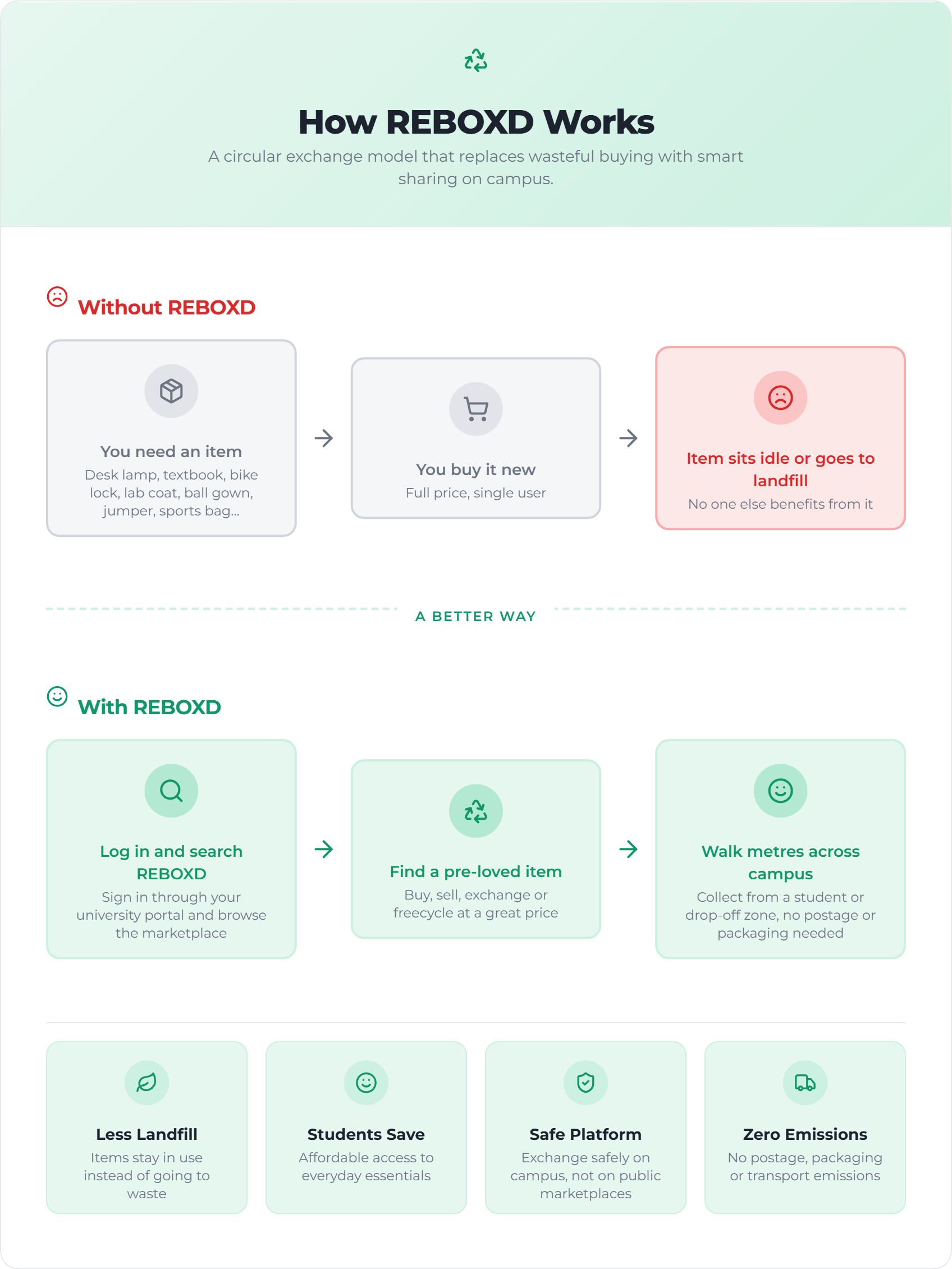
Through REBOXD, students can list,buy,sell,or free cycle items used during ones uni journey. Because exchanges happen within the same campus community, items can be collected locally, often just metres away, eliminating unnecessary postage, packaging & transport emissions.
For example, a student who no longer needs a lab coat could log into their university portal & create a listing. Another student searching for a lab coat can request the item through the platform. The exchange can take place safely on campus or through a designated drop-off location such as a student union. Once both users confirm the transaction, the system records the exchange & generates verified data on waste reduction, cost savings & carbon impact for the university dashboard.
The idea originated from my final-year thesis, which received the highest grade in a cohort of over 450 students & led to me being named Ireland’s Undergraduate of the Year. The project has since received recognition including a Trinity College Dublin award, Irish Times Newspaper features,& finalist positions for Startup &Trailblazerof the Year.Circular economy founder Kevin Murphy, CEO of reusable cup system 2GoCup, has also joined the project as a mentor.
Currently I am gathering Letters of Intent from universities. The University of Cambridge and Trinity Colelge Dublin has recently supported me and will intend to use the concept when fully developed along with support from Irish universities too.
The idea for REBOXD emerged from both my personal student experience and my involvement in sustainability leadership.
During university, I held a leadership role in a biodiversity project. The initiative gained national attention and even received personal correspondence from Sir David Attenborough expressing his support, a real pinch-me moment! That moment was incredibly inspiring and reinforced my belief that meaningful change can begin with student-led ideas.
Following this sustainability leadership experience, I became increasingly interested in how to embed sustainability more deeply in my everyday university life. As part of my degree in education, I decided to dedicate my final-year thesis to exploring sustainability & behaviour change in education. My research involved over 450 students & many educational institutions. I examined how educational spaces could better support sustainable practices within their communities. I received the highest grade awarded in my programme that year (another pinch me moment!) & it encouraged me to explore the idea beyond academia.
Alongside my research, my own experience as a student revealed a clear opportunity.For example, I frequently used circular platforms such as Facebook Marketplace and Vinted to buy second-hand items during my time at university. However, Facebook Marketplace often felt unsafe when meeting strangers to exchange items, while platforms like Vinted required unnecessary shipping, packaging, and additional costs.
The defining moment came when I purchased a jumper on Vinted and later realised the seller lived in the same accommodation building on my university campus! We had both paid for shipping & packaging when we could have simply met on campus to exchange the item!
That experience highlighted a missed opportunity for universities. Students are already participating in circular consumption, but existing platforms are not designed for the hyperlocal nature of university communities.
Circular Systemic transformation
Hyperlocal Environmental impact
Social & Economic benefit
Welfare & Safety promotion
AI-enabled insights
REBOXD can be considered exemplary in terms of sustainability because it can transform every campus into circular ecosytems.
Many pre-loved platforms require postage,packaging,& transport emissions. By keeping exchanges within campus environments, REBOXD eliminates postage & packaging waste & costs, & carbon emissions while extending the lifecycle of everyday items.i.e. course materials & uni lifestyle goods. This approach supports SDG 12 Responsible Consumption & Production & contributes to SDG 13 Climate Action by reducing material waste & emissions associated with new production & transport. REBOXD also addresses social & economic sustainability challenges within higher education. Rising living costs continue to place financial pressure on students worldwide. By enabling safe peer to peer exchange within verified university communities, the platform helps reduce costs while improving access to necessary resources whilst haveing a positive environmental benefit too. The closed digital infrastructure, accessed through university authentication systems, also improves safety & trust compared to open publicmarketplaces. These outcomes support SDG 3 Good Health & Wellbeing & SDG 10 Reduced Inequalities by improving student wellbeing & access. Students are already engaging in circular consumption, with 64 percent of Gen Z searching second hand before buying new. However, universities rarely capture the sustainability impact of this behaviour! REBOXD embeds circular exchange within university digital infrastructure, allowing students to see what items are available within their campus community, often just metres away. This removes the friction associated with packaging, postage, & transport while generating real time data on waste reduction, cost savings, & carbon impact. As a very scalable digital model, REBOXD provides a replicable framework for embedding circular behaviour across campuses worldwide too - SDG 11 Sustainable Cities & Communities & SDG 17 Partnerships.
Many pre-loved platforms require postage,packaging,& transport emissions. By keeping exchanges within campus environments, REBOXD eliminates postage & packaging waste & costs, & carbon emissions while extending the lifecycle of everyday items.i.e. course materials & uni lifestyle goods. This approach supports SDG 12 Responsible Consumption & Production & contributes to SDG 13 Climate Action by reducing material waste & emissions associated with new production & transport. REBOXD also addresses social & economic sustainability challenges within higher education. Rising living costs continue to place financial pressure on students worldwide. By enabling safe peer to peer exchange within verified university communities, the platform helps reduce costs while improving access to necessary resources whilst haveing a positive environmental benefit too. The closed digital infrastructure, accessed through university authentication systems, also improves safety & trust compared to open publicmarketplaces. These outcomes support SDG 3 Good Health & Wellbeing & SDG 10 Reduced Inequalities by improving student wellbeing & access. Students are already engaging in circular consumption, with 64 percent of Gen Z searching second hand before buying new. However, universities rarely capture the sustainability impact of this behaviour! REBOXD embeds circular exchange within university digital infrastructure, allowing students to see what items are available within their campus community, often just metres away. This removes the friction associated with packaging, postage, & transport while generating real time data on waste reduction, cost savings, & carbon impact. As a very scalable digital model, REBOXD provides a replicable framework for embedding circular behaviour across campuses worldwide too - SDG 11 Sustainable Cities & Communities & SDG 17 Partnerships.
REBOXD contributes to aesthetics by improving the quality of everyday life within university communities while fostering a stronger sense of belonging, care for place & positive shared experiences.
University campuses are one of the few environments where thousands of people live, learn & interact within the same shared space. REBOXD strengthens the social & cultural experience of these environments by encouraging students to connect locally, share resources & engage with members of their own campus community. Exchanges happen within familiar campus spaces, transforming everyday resource sharing into a social interaction rather than a transactional exchange.
This approach also improves the visual & experiential quality of campus environments. At the end of academic terms many universities face large volumes of discarded items left behind in accommodation blocks, often filling skips & waste areas. By enabling items to circulate within the campus community instead of being discarded, REBOXD reduces the volume of waste generated on site. Fewer items end up in skips, fewer usable goods are thrown away & campus environments feel more cared for & valued.
The platform also enhances the everyday user experience by making circular behaviour simple, visible & rewarding. Instead of travelling across cities, posting parcels or meeting strangers in unfamiliar locations, students can see what items are available within metres of where they live or study. This creates a more positive experience where sustainable choices feel convenient, social & even exciting.
In this way REBOXD helps transform campuses into environments where circular living becomes visible, desirable & part of everyday culture, demonstrating how sustainable behaviour can improve the beauty, quality & experience of shared spaces.
REBOXD can be considered exemplary in terms of inclusion because it improves accessibility, affordability & safety within university communities.
Firstly, REBOXD improves accessibility to essential items required for university life. By enabling hyperlocal peer to peer exchange within a verified campus network, REBOXD ensures these items remain accessible within the student community rather than requiring new purchases year after year. This supports a more inclusive student experience where resources circulate to those who need them, contributing to SDG 10 Reduced Inequalities.
Secondly, the concept directly addresses affordability challenges faced by students. Across Europe, student living costs are rising rapidly, with accommodation often accounting for over 50 percent of a student’s monthly expenses. REBOXD helps reduce financial pressure by enabling students to access preloved items within their campus community, often metres away. By keeping exchanges hyperlocal, the system eliminates postage, packaging & additional costs associated with traditional resale platforms, supporting SDG 3 Good Health & Wellbeing by reducing financial stress.
Finally, REBOXD promotes safety & trust through its closed digital infrastructure. Unlike open public marketplaces where users often meet strangers in unfamiliar locations, REBOXD operates entirely within the campus environment. Exchanges take place in spaces students already know & navigate daily, adding an additional layer of safety & familiarity. Access is restricted through university authentication systems such as SSO, ensuring exchanges occur only between verified members of the same campus community. A secondary benefit of this trusted environment is that it enables students to connect & network with peers they may not otherwise meet, strengthening social ties within campus communities.
The development of REBOXD has been strongly informed by participatory engagement with students, university stakeholders & sustainability leaders.
During the initial research phase, I involved over 500 students as part of my university dissertation research to understand their experiences with sustainability, second-hand consumption & resource sharing during university life. Every single student said they would use the platform! This feedback demonstrated both the demand for the concept & the potential scale of participation within university communities.
This early user engagement directly informed the design of REBOXD. Students highlighted the importance of safety, affordability & convenience when exchanging items, particularly compared to open public marketplaces. As a result, the platform was designed to operate within existing university systems using secure authentication through single sign-on (SSO), ensuring that exchanges take place only between verified members of the same campus community.
Beyond student input, the concept has also been shaped through engagement with a range of university stakeholders. Sustainability teams, student unions & innovation leaders across multiple universities have been consulted throughout the development process. These conversations have provided valuable insight into institutional sustainability priorities, operational considerations & the potential integration of circular systems within university environments.
The response from these stakeholders has been overwhelmingly positive, with many institutions expressing strong interest in the concept & its potential to support both student wellbeing & institutional sustainability goals. This collaborative engagement has helped ensure that REBOXD is not only a student-driven idea but a solution developed with input from the communities it will serve.
At a local level, students are the primary users of the platform. Their feedback has been central to shaping the concept through research conducted with over 500 students during the initial development phase. Students highlighted the importance of affordability, safety & convenience when accessing everyday items during university life. Their input helped shape the design of a hyperlocal circular system.
At an institutional level, universities play a key role in implementing the concept. REBOXD is designed to integrate into existing university digital infrastructure through authentication systems such as SSO very seamlessly. Engagement with sustainability teams, student unions & innovation leaders across several universities has helped align the concept with institutional sustainability strategies, student welfare priorities & operational systems already in place within higher education environments.
At a national & regional level, the concept aligns with broader sustainability goals related to waste prevention, circular economy development & climate action. Universities increasingly act as living laboratories for sustainability innovation, making them ideal environments to pilot scalable circular solutions such as REBOXD.
At a European level, the concept contributes to shared policy priorities including the EU Green Deal,Horizon Europe, circular economy strategies & resource efficiency initiatives. By enabling measurable data on circular behaviour within large campus communities, REBOXD has the potential to support universities across Europe in demonstrating sustainability impact while accelerating the transition toward more circular consumption systems.
Through engagement across these levels, REBOXD creates a collaborative framework where students, institutions & wider sustainability initiatives work together to embed circular behaviour within everyday life.
The concept first emerged through academic research conducted as part of my final-year university dissertation. Insights gathered helped shape the concept & highlighted the importance of affordability, safety, accessibility & wellbeing when designing solutions for student communities.
Digital technology forms the foundation of the platform. REBOXD is designed as a digital infrastructure integrated into university portals through authentication systems such as single sign-on. This allows the system to operate securely within existing campus ecosystems.
Environmental science & circular economy principles guide the sustainability model of the platform. By extending the lifecycle of everyday products & preventing items from being discarded, the concept promotes resource efficiency, waste reduction & lower emissions associated with new production.
The project also integrates behavioural science & wellbeing perspectives. Participating in circular exchange allows students to feel actively involved in climate solutions rather than overwhelmed by environmental challenges. By enabling students to save money while contributing to sustainability, REBOXD supports both financial wellbeing & a stronger sense of environmental agency.
Artificial intelligence also supports the system through environmental impact tracking. Each exchange generates data on material reuse, waste reduction & carbon impact. AI-supported analysis allows the platform to estimate the environmental benefit of items kept in circulation, helping universities understand how much material has been diverted from landfill & the broader sustainability impact of their campus communities.
By combining insights from education, digital technology, environmental science, behavioural research & innovation, REBOXD demonstrates how transdisciplinary collaboration can create practical solutions that support both people & the planet!
The business model is designed as a B2B digital service licensed to higher-education institutions. Universities subscribe to the platform via a recurring contract to provide their campus community with access to the circular exchange system.
Under this model, universities pay a recurring subscription fee which grants their students, staff & campus communities access to the REBOXD platform through their existing university portal. This ensures the platform remains a free service for students, while universities benefit from improved sustainability outcomes, student welfare support & measurable data on circular activity.
The subscription model creates predictable recurring revenue, enabling the continued development, maintenance & scaling of the platform. Universities already operate similar subscription models for core digital infrastructure such as learning management systems, making this approach familiar within the higher-education sector.
Operationally, universities will have access to a service interface that allows their internal IT teams to manage integration within their digital ecosystem, while the wider platform infrastructure, system updates, data analytics & user support will be managed centrally by the REBOXD company. This ensures institutions receive a reliable service without needing to develop or maintain their own circular marketplace systems.
As the platform scales, additional value will be generated through sustainability analytics dashboards, providing universities with verified insights on waste reduction, cost savings & carbon impact. These insights can support sustainability reporting, climate action commitments & applications for further sustainability funding.
Because universities operate globally with similar digital systems, this B2B subscription model allows REBOXD to scale efficiently across institutions internationally while maintaining a stable recurring revenue structure.
REBOXD demonstrates strong transferability & scalability because it aligns with 3 widely shared conditions across universities globally: common sustainability goals, similar digital infrastructure & universal student needs.
Firstly, sustainability priorities are increasingly aligned across countries. Because environmental challenges are shared globally, the solution offered by REBOXD can be easily applied across universities internationally.
Secondly, universities already operate using similar digital ecosystems. Most institutions use centralised portals, student authentication systems such as SSO & integrated campus software environments. REBOXD is designed to integrate into this existing digital infrastructure, meaning the concept can be replicated without requiring any major physical investment or new behavioural systems. This allows universities to quickly adopt the model within their own campus environments.
Thirdly, student needs are remarkably consistent across universities worldwide. Students require similar items throughout their studies(course materials, clothing, kitchenware & accommodation essentials etc.) REBOXD enables these items to circulate within campus communities rather than requiring new purchases or reliance on distant resale platforms.
Finally, the model generates real time data on circular behaviour, including waste reduction, cost savings & carbon impact. This allows all universities to demonstrate measurable sustainability progress while strengthening reporting & supporting applications for additional sustainability funding - which all universities desire!
Because the concept is digital, adaptable & aligned with global sustainability priorities, REBOXD provides a scalable framework that can be replicated across universities internationally & extended to other educational communities very easily too!
The immediate focus is securing partnerships with universities that are interested in piloting the platform. Initial engagement with institutions including the University of Cambridge & associated colleges such as King’s College & Lucy Cavendish College has already shown encouraging support for the concept.
Over the coming weeks, the priority is to secure a number of Letters of Intent from universities confirming their interest in participating in early pilot programmes. These partnerships will allow the development of an MVP that can be tested within real campus environments.
Following this stage, the next step will involve raising funding to support the technical development of the platform. This will include building the digital infrastructure, integrating the system into university portals through single sign-on authentication, & developing the sustainability data dashboard that measures waste reduction, cost savings & environmental impact generated through circular exchanges.
Once the MVP is completed, pilot programmes will be launched with a small group of partner universities. These pilots will allow the platform to be tested in real-world conditions, gathering feedback from students, sustainability teams & university administrators. Insights from these pilots will be used to refine the platform design, improve user experience & ensure seamless integration within university digital ecosystems.
By late 2026 the aim is to begin wider rollout across participating institutions. The target is to onboard at least 10 universities by early 2027, providing access to more than 350,000 students. As the platform scales, the goal is to expand across universities in Ireland/UK & then the EU.
Through this phased approach of partnership building, pilot testing & scaling, REBOXD aims to establish a robust digital infrastructure that embeds circular exchange into everyday campus life while supporting universities in achieving their sustainability goals.