Enablers for New European Bauhaus Transformation
Formform
Formform: A participatory design intelligence platform for human-centred architecture
Formform helps architects turn vague client conversations into clear design input before key decisions are made.
Through an adaptive, research-informed digital process, it captures routines, priorities, emotional needs, and household dynamics, then translates them into design input architects can use directly.
By improving the brief, Formform supports more inclusive, meaningful, and better-fitting homes.
Through an adaptive, research-informed digital process, it captures routines, priorities, emotional needs, and household dynamics, then translates them into design input architects can use directly.
By improving the brief, Formform supports more inclusive, meaningful, and better-fitting homes.
Romania
National
Mainly urban
It refers to other types of transformations (soft investment)
Completed
No
No
No
Individual
Formform is a participatory design intelligence platform that improves how architectural projects begin.
In many projects, the design brief is vague, incomplete, or dominated by technical requirements. This often leads to homes that do not fully reflect how people actually live.
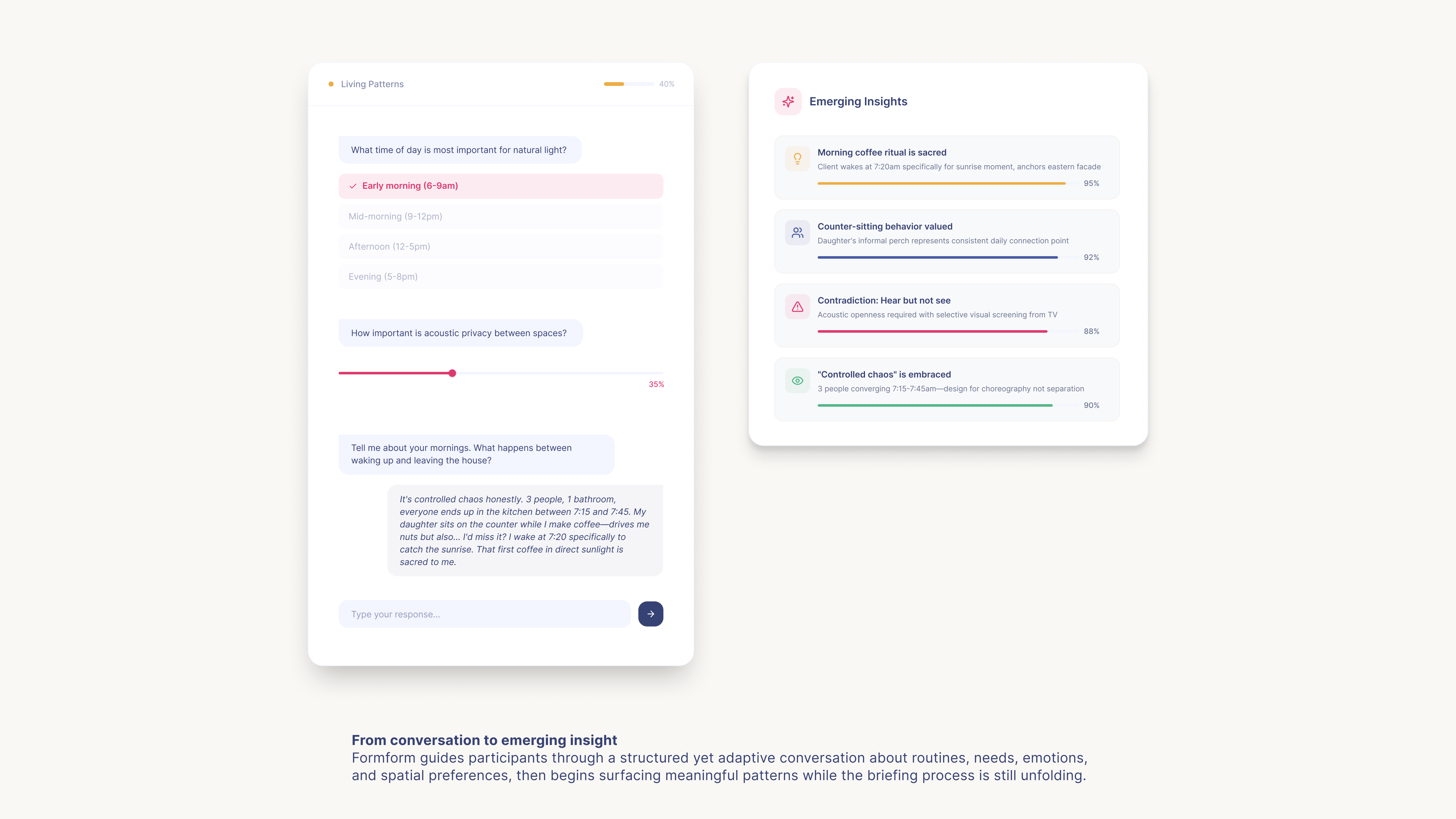
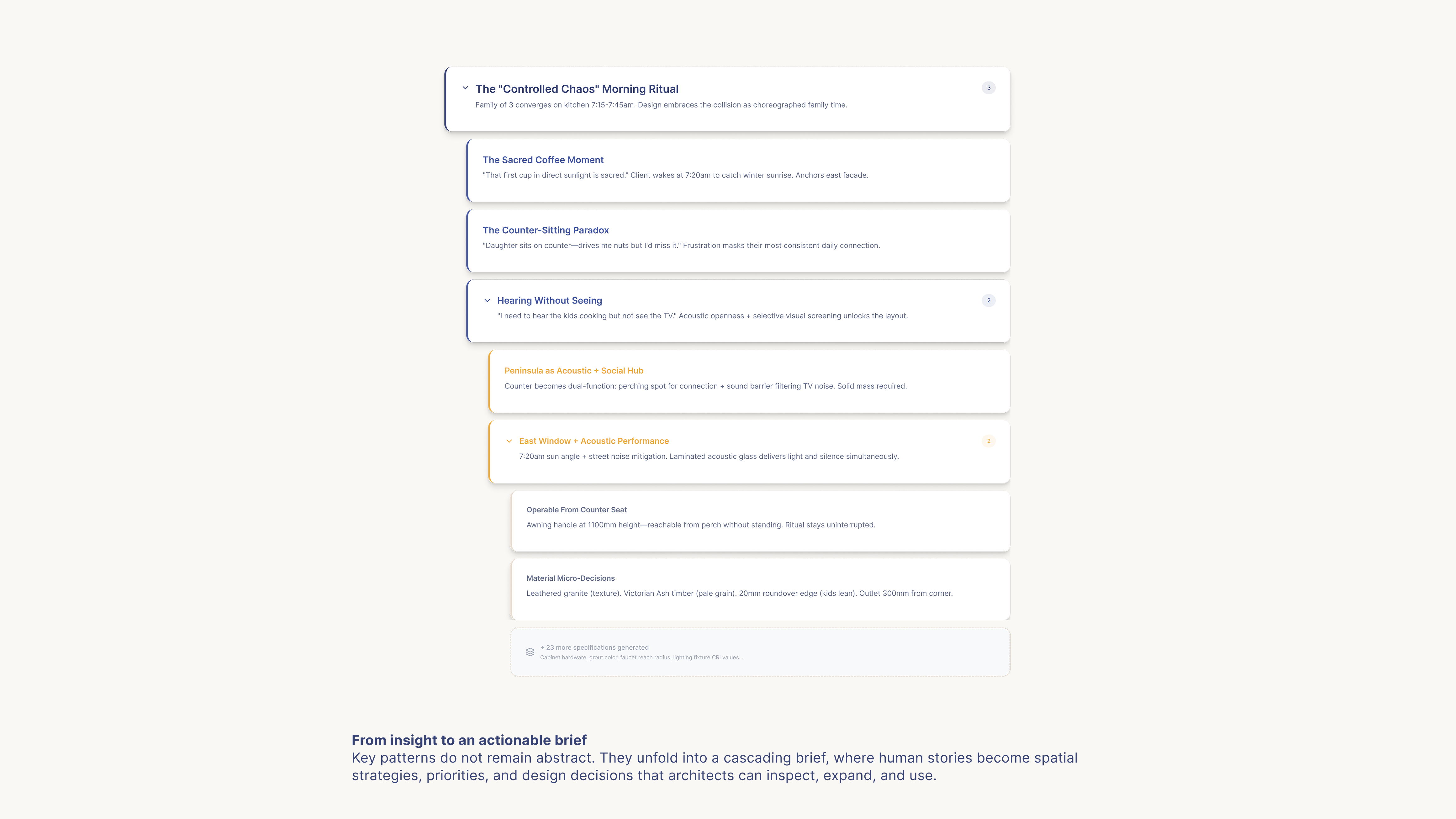
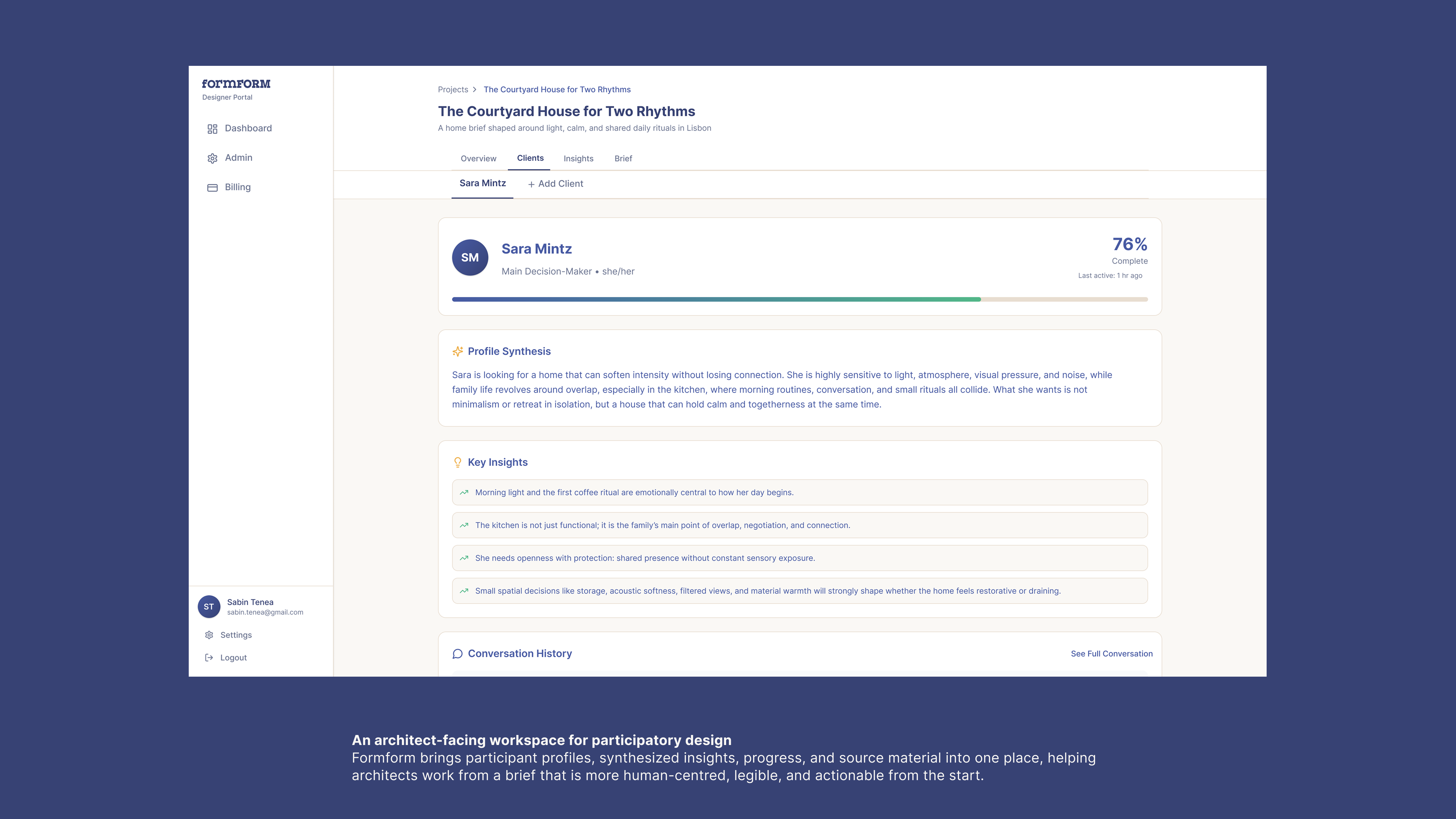
Formform transforms the briefing stage into a structured participatory process. Through an interactive digital interface, clients are guided through an adaptive conversation about routines, spatial preferences, emotional atmospheres, social relationships, and environmental expectations. Instead of receiving only a room list and a moodboard, architects receive structured insight into household dynamics, priorities, tensions, and spatial needs that can inform design from the outset.
The platform is based on an interdisciplinary framework combining architecture, environmental psychology, and human-centred design research. Insights are organised across 21 domains covering behavioural, perceptual, social, technological, and environmental aspects of living environments. This allows complex human experiences to be translated into actionable spatial strategies.
Formform is already a fully functioning digital platform and is now being launched for architects and design clients. In early use, the platform has produced highly detailed, research-informed briefs in under one hour. One architect described the result as “the most complete brief I’ve ever received”, while internal benchmarking showed around three times more detail than conventional briefing methods.
By improving the earliest stage of design, Formform helps create environments that are more inclusive, meaningful, and sustainable. In the coming years, it aims to scale across Europe as a tool that strengthens participation in architecture and supports built environments aligned with the human-centred values of the New European Bauhaus.
In many projects, the design brief is vague, incomplete, or dominated by technical requirements. This often leads to homes that do not fully reflect how people actually live.
Formform transforms the briefing stage into a structured participatory process. Through an interactive digital interface, clients are guided through an adaptive conversation about routines, spatial preferences, emotional atmospheres, social relationships, and environmental expectations. Instead of receiving only a room list and a moodboard, architects receive structured insight into household dynamics, priorities, tensions, and spatial needs that can inform design from the outset.
The platform is based on an interdisciplinary framework combining architecture, environmental psychology, and human-centred design research. Insights are organised across 21 domains covering behavioural, perceptual, social, technological, and environmental aspects of living environments. This allows complex human experiences to be translated into actionable spatial strategies.
Formform is already a fully functioning digital platform and is now being launched for architects and design clients. In early use, the platform has produced highly detailed, research-informed briefs in under one hour. One architect described the result as “the most complete brief I’ve ever received”, while internal benchmarking showed around three times more detail than conventional briefing methods.
By improving the earliest stage of design, Formform helps create environments that are more inclusive, meaningful, and sustainable. In the coming years, it aims to scale across Europe as a tool that strengthens participation in architecture and supports built environments aligned with the human-centred values of the New European Bauhaus.
Formform emerged from a repeated frustration in residential architecture: some of the most consequential design decisions are often made from briefs that are too vague, too late, and too thin. In many projects, clients struggle to express what matters to them beyond room lists, style references, or isolated preferences. Important aspects of daily life, comfort, and routine are often discovered only after the design direction is already taking shape.
Formform was created to address that gap by transforming briefing from a fragmented conversation into a structured, participatory, and architect-ready process. The concept was developed through an iterative research-to-practice process that combines architectural knowledge, environmental psychology, and human-centred design into an adaptive digital platform.
Its development followed four main steps. First, defining the knowledge framework behind the briefing process. Second, building an adaptive conversational flow that adjusts to each participant. Third, designing outputs that architects can inspect and use directly. Fourth, testing whether the system could generate clearer and richer insights than traditional briefing methods.
Several strategies shaped the implementation. Formform was designed to support architects rather than replace them, by making client priorities more explicit, discussable, and actionable. It was built as an adaptive system rather than a fixed questionnaire, so each answer shapes the next question. It was also developed for real workflows, with outputs intended to reduce elicitation time, improve alignment early in the project, and lower the risk of misunderstandings and revision-driven changes later on.
Today, Formform is a fully functioning digital platform for residential architects.
Formform was created to address that gap by transforming briefing from a fragmented conversation into a structured, participatory, and architect-ready process. The concept was developed through an iterative research-to-practice process that combines architectural knowledge, environmental psychology, and human-centred design into an adaptive digital platform.
Its development followed four main steps. First, defining the knowledge framework behind the briefing process. Second, building an adaptive conversational flow that adjusts to each participant. Third, designing outputs that architects can inspect and use directly. Fourth, testing whether the system could generate clearer and richer insights than traditional briefing methods.
Several strategies shaped the implementation. Formform was designed to support architects rather than replace them, by making client priorities more explicit, discussable, and actionable. It was built as an adaptive system rather than a fixed questionnaire, so each answer shapes the next question. It was also developed for real workflows, with outputs intended to reduce elicitation time, improve alignment early in the project, and lower the risk of misunderstandings and revision-driven changes later on.
Today, Formform is a fully functioning digital platform for residential architects.
participatory design
human-centred architecture
design intelligence
inclusive living environments
evidence-informed design
The biggest sustainability gains in architecture often depend on decisions made before anything is built. If the brief is too generic, projects can drift toward unnecessary space, avoidable revisions, or solutions that do not match how people actually live. This is where Formform contributes.
By structuring the early briefing process, the platform helps architects identify real routines, comfort expectations, household dynamics, and long-term priorities before key decisions are fixed. This supports better-fit homes, more efficient use of space, and fewer costly misunderstandings later in the process. It can also help avoid overprogramming and reduce revision pressure by clarifying what is actually needed from the start.
Its sustainability is therefore environmental, social, and economic at once: better alignment, less waste, and more durable outcomes. Formform is exemplary because it acts upstream, improving the quality of decisions before material commitments are locked in.
By structuring the early briefing process, the platform helps architects identify real routines, comfort expectations, household dynamics, and long-term priorities before key decisions are fixed. This supports better-fit homes, more efficient use of space, and fewer costly misunderstandings later in the process. It can also help avoid overprogramming and reduce revision pressure by clarifying what is actually needed from the start.
Its sustainability is therefore environmental, social, and economic at once: better alignment, less waste, and more durable outcomes. Formform is exemplary because it acts upstream, improving the quality of decisions before material commitments are locked in.
Beauty in everyday life is not only a matter of style. It also comes from whether a space feels calm, intimate, open, warm, dignified, or truly one’s own. One of the strengths of Formform is that it brings these qualities into the design conversation much earlier than usual.
Instead of relying only on reference images or vague adjectives such as "cozy", "minimal", or "warm", users are guided to express the atmospheres, moods, sensory qualities, and spatial conditions they value.
This gives architects a stronger basis for shaping homes that are not just functional, but emotionally resonant and culturally meaningful.
In that sense, the concept supports aesthetics as a lived quality, rooted in belonging, recognition, and care for place. It is exemplary because it helps turn aesthetic preference from something vague and late-stage into something discussable and useful in design.
Instead of relying only on reference images or vague adjectives such as "cozy", "minimal", or "warm", users are guided to express the atmospheres, moods, sensory qualities, and spatial conditions they value.
This gives architects a stronger basis for shaping homes that are not just functional, but emotionally resonant and culturally meaningful.
In that sense, the concept supports aesthetics as a lived quality, rooted in belonging, recognition, and care for place. It is exemplary because it helps turn aesthetic preference from something vague and late-stage into something discussable and useful in design.
A conventional design brief often rewards people who already know how to speak the language of architecture. Many others struggle to explain what they need, especially when those needs are emotional, relational, or tied to everyday routines. The result is that important voices can remain partial or unheard.
This concept addresses that barrier by making participation more structured and legible. It helps people translate habits, preferences, tensions, and values into clearer design input, giving them a more active role at the very beginning of the project. That matters not only between architect and client, but also within households, where different needs may otherwise be overshadowed.
Its inclusive value lies in lowering the threshold for expression and making the briefing process more accessible, representative, and usable for non-experts. By improving clarity early, it can also help reduce costly misunderstandings and revision loops, which is especially relevant for smaller practices and clients with tighter budgets. In this way, it supports a fairer and more participatory model of design.
This concept addresses that barrier by making participation more structured and legible. It helps people translate habits, preferences, tensions, and values into clearer design input, giving them a more active role at the very beginning of the project. That matters not only between architect and client, but also within households, where different needs may otherwise be overshadowed.
Its inclusive value lies in lowering the threshold for expression and making the briefing process more accessible, representative, and usable for non-experts. By improving clarity early, it can also help reduce costly misunderstandings and revision loops, which is especially relevant for smaller practices and clients with tighter budgets. In this way, it supports a fairer and more participatory model of design.
The concept was shaped through direct engagement with the people it is meant to support: design clients and architects navigating the early stages of residential projects. A recurring insight was that many people know very well how they want to live, but struggle to express that knowledge in the language of architecture. That gap became one of the starting points for Formform.
User participation influenced both the structure and the tone of the platform. It led to a process that is more guided, adaptive, and reflective than a standard questionnaire, and to outputs that are not just data summaries, but usable design inputs. In other words, participation did not happen only at the level of feedback. It changed the concept itself.
Its impact is visible both in the product and in the participant experience. The platform helps people articulate priorities more clearly, recognise tensions and trade-offs within everyday life, and feel more confident in expressing what matters to them in space. Early use also showed that participants often opened up more than they would in a standard briefing conversation, surfacing needs and future priorities that might otherwise remain unspoken.
Instead of reacting to proposals later, they can shape the direction of the project much earlier. That makes the process more legible, more empowering, and more grounded in real life.
User participation influenced both the structure and the tone of the platform. It led to a process that is more guided, adaptive, and reflective than a standard questionnaire, and to outputs that are not just data summaries, but usable design inputs. In other words, participation did not happen only at the level of feedback. It changed the concept itself.
Its impact is visible both in the product and in the participant experience. The platform helps people articulate priorities more clearly, recognise tensions and trade-offs within everyday life, and feel more confident in expressing what matters to them in space. Early use also showed that participants often opened up more than they would in a standard briefing conversation, surfacing needs and future priorities that might otherwise remain unspoken.
Instead of reacting to proposals later, they can shape the direction of the project much earlier. That makes the process more legible, more empowering, and more grounded in real life.
Formform currently operates most directly at the level of the household and the architectural practice, but its value increases when multiple levels are connected. At household level, it helps participants express needs, routines, and priorities more clearly. At practice level, it helps architects work with richer and more structured design input at the very beginning of a project.
At local and national level, the concept has relevance for design studios, housing actors, and research communities interested in more participatory and evidence-informed ways of shaping domestic environments. Looking ahead, it is also designed to support collaboration with institutions, pilot partners, and wider European networks working on housing quality, inclusion, and wellbeing.
The added value of this multilevel approach lies in making lived experience legible across scales, from the household to the wider built environment ecosystem. What begins as a better conversation between people and architects can scale into a transferable framework for more inclusive and informed design practices across contexts.
At local and national level, the concept has relevance for design studios, housing actors, and research communities interested in more participatory and evidence-informed ways of shaping domestic environments. Looking ahead, it is also designed to support collaboration with institutions, pilot partners, and wider European networks working on housing quality, inclusion, and wellbeing.
The added value of this multilevel approach lies in making lived experience legible across scales, from the household to the wider built environment ecosystem. What begins as a better conversation between people and architects can scale into a transferable framework for more inclusive and informed design practices across contexts.
This concept is inherently transdisciplinary. It brings together architecture, environmental psychology, design research, digital product design, and adaptive technologies in order to address a problem that none of these fields could solve alone.
Architecture provides the spatial and professional framework. Environmental psychology contributes methods for understanding comfort, perception, behaviour, and the relationship between people and their environments. Human-centred design shapes the way questions are structured and how participant input is translated into usable insights. Digital technology makes the process scalable, adaptive, and practical in real workflows.
This combination matters because the design brief is not only a technical document. It is also a behavioural, cultural, emotional, and relational one. Formform reflects that complexity by treating lived experience as something that can be elicited, interpreted, and turned into architectural knowledge. Its transdisciplinary character is not an added layer. It is the basis of how the concept works.
Architecture provides the spatial and professional framework. Environmental psychology contributes methods for understanding comfort, perception, behaviour, and the relationship between people and their environments. Human-centred design shapes the way questions are structured and how participant input is translated into usable insights. Digital technology makes the process scalable, adaptive, and practical in real workflows.
This combination matters because the design brief is not only a technical document. It is also a behavioural, cultural, emotional, and relational one. Formform reflects that complexity by treating lived experience as something that can be elicited, interpreted, and turned into architectural knowledge. Its transdisciplinary character is not an added layer. It is the basis of how the concept works.
Formform’s business model combines software subscriptions with research and innovation partnerships. The concept began as research and development around a recurring problem in architectural practice, and is now evolving into a revenue-generating digital product. The current platform is offered to residential architects through tiered pricing in EUR: a Practice plan for solo practitioners at 49 EUR/month, a Studio plan for growing teams at 149 EUR/month, and an Enterprise offer for larger practices with custom pricing.
Financial sustainability comes from addressing a real bottleneck in practice: the early briefing stage. The platform helps reduce elicitation time, improve alignment, and lower revision-driven inefficiencies. Because clearer briefing reduces ambiguity before design begins, it can also lower unnecessary revision pressure later in the project, saving time and cost for both architect and client.
Formform is also more than a software product. The team operates as a design research practice working across architecture, environmental psychology, phenomenology, cultural familiarity, and technology. A second pillar of the model is therefore dedicated partnerships with universities, research labs, public-interest design programmes, and innovation consortia. These can support funded research, pilot projects, and new applications where briefing quality has strong social impact.
The current market focus is single-family residential architecture, but the model is designed to expand into communal living, shared housing, and public-space projects. Over time, financial sustainability will come from a mix of recurring SaaS income, enterprise integration, and research collaborations. This links commercial viability with public value: a scalable, research-grounded tool that helps create more inclusive, meaningful, and sustainable environments from the start.
Financial sustainability comes from addressing a real bottleneck in practice: the early briefing stage. The platform helps reduce elicitation time, improve alignment, and lower revision-driven inefficiencies. Because clearer briefing reduces ambiguity before design begins, it can also lower unnecessary revision pressure later in the project, saving time and cost for both architect and client.
Formform is also more than a software product. The team operates as a design research practice working across architecture, environmental psychology, phenomenology, cultural familiarity, and technology. A second pillar of the model is therefore dedicated partnerships with universities, research labs, public-interest design programmes, and innovation consortia. These can support funded research, pilot projects, and new applications where briefing quality has strong social impact.
The current market focus is single-family residential architecture, but the model is designed to expand into communal living, shared housing, and public-space projects. Over time, financial sustainability will come from a mix of recurring SaaS income, enterprise integration, and research collaborations. This links commercial viability with public value: a scalable, research-grounded tool that helps create more inclusive, meaningful, and sustainable environments from the start.
Formform has high transferability because its core value does not depend on one site, one country, or one building type. What can be replicated is the underlying method: a structured way of translating lived experience into actionable design input at the very beginning of a project.
Several elements are especially transferable. First, the participatory briefing logic itself can be applied across different geographies, since people everywhere need better ways to express routines, preferences, values, and spatial expectations. Second, the digital platform can be adapted to different housing cultures, languages, and professional contexts without changing its core purpose. Third, the knowledge framework behind the platform can be extended to new sectors by adjusting the question flows, priorities, and outputs.
The concept is currently focused on single-family residential projects, but it is designed to expand into communal living, shared housing, and public-space projects. These contexts often involve even more complex stakeholder relationships, making structured participation and early alignment even more valuable. The same logic could also support municipalities, housing providers, research teams, or public-interest design programmes that need clearer ways of understanding user needs before design decisions are fixed.
Its replicability also comes from format. Formform is not tied to a single model; it exists as a digital product supported by a research-driven methodology. That makes it easier to deploy across practices of different sizes, from solo architects to larger teams, and to combine commercial use with research partnerships, pilots, and institutional collaborations.
In this sense, what is scalable is not only the software, but a wider approach to design: one that is participatory, evidence-informed, and able to adapt across sectors and European contexts while keeping the same core goal of creating environments that fit people better.
Several elements are especially transferable. First, the participatory briefing logic itself can be applied across different geographies, since people everywhere need better ways to express routines, preferences, values, and spatial expectations. Second, the digital platform can be adapted to different housing cultures, languages, and professional contexts without changing its core purpose. Third, the knowledge framework behind the platform can be extended to new sectors by adjusting the question flows, priorities, and outputs.
The concept is currently focused on single-family residential projects, but it is designed to expand into communal living, shared housing, and public-space projects. These contexts often involve even more complex stakeholder relationships, making structured participation and early alignment even more valuable. The same logic could also support municipalities, housing providers, research teams, or public-interest design programmes that need clearer ways of understanding user needs before design decisions are fixed.
Its replicability also comes from format. Formform is not tied to a single model; it exists as a digital product supported by a research-driven methodology. That makes it easier to deploy across practices of different sizes, from solo architects to larger teams, and to combine commercial use with research partnerships, pilots, and institutional collaborations.
In this sense, what is scalable is not only the software, but a wider approach to design: one that is participatory, evidence-informed, and able to adapt across sectors and European contexts while keeping the same core goal of creating environments that fit people better.
The next year is focused on implementation, validation, and selective expansion. Formform is already a functioning product, so the priority is not to prove the concept in theory, but to strengthen its use in practice and extend its relevance.
The first step is to grow adoption among residential architects and small to mid-sized design practices, using the current platform in real projects and learning from repeated use. This includes refining onboarding, improving the clarity of outputs for architects, and strengthening the connection between user input and design decision-making.
A second priority is structured evaluation. Over the coming year, we will document how the platform performs across real workflows: how it improves briefing quality, helps clients express needs more clearly, reduces misunderstandings, and supports more coherent project outcomes.
A third step is research-led development. Formform is being built as a design research platform. We plan to expand collaborations with researchers and institutions working in environmental psychology, phenomenology, cultural familiarity, and technology, so that we can continue evolving on a strong interdisciplinary basis.
The coming year will also be used to prepare sectoral extensions beyond single-family housing. The most immediate areas of exploration are communal living, shared housing, and public-space contexts, where participation and stakeholder complexity are especially important. This means adapting the framework, testing new use cases, and developing pilot partnerships.
In parallel, we will continue promotion through architectural networks, public-facing communication, and research dissemination. The aim is to move from launch to repeatable adoption, while building the evidence, partnerships, and sector pathways needed for long-term European scale.
The first step is to grow adoption among residential architects and small to mid-sized design practices, using the current platform in real projects and learning from repeated use. This includes refining onboarding, improving the clarity of outputs for architects, and strengthening the connection between user input and design decision-making.
A second priority is structured evaluation. Over the coming year, we will document how the platform performs across real workflows: how it improves briefing quality, helps clients express needs more clearly, reduces misunderstandings, and supports more coherent project outcomes.
A third step is research-led development. Formform is being built as a design research platform. We plan to expand collaborations with researchers and institutions working in environmental psychology, phenomenology, cultural familiarity, and technology, so that we can continue evolving on a strong interdisciplinary basis.
The coming year will also be used to prepare sectoral extensions beyond single-family housing. The most immediate areas of exploration are communal living, shared housing, and public-space contexts, where participation and stakeholder complexity are especially important. This means adapting the framework, testing new use cases, and developing pilot partnerships.
In parallel, we will continue promotion through architectural networks, public-facing communication, and research dissemination. The aim is to move from launch to repeatable adoption, while building the evidence, partnerships, and sector pathways needed for long-term European scale.