Enhancing Circularity, Sustainability, and Innovation
Sponge Cities Albania
Sponge City Pilot: Nature-Based and Circular Solutions for Urban Flood Resilience in Albania.
“Sponge Cities Albania” transforms urban spaces into green, permeable areas that manage floods naturally. Using recycled materials and nature-based solutions, it turns sidewalks, parks, and public areas into multifunctional zones that reduce surface runoff, enhance biodiversity, and improve microclimates. Sensors and a web dashboard monitor rainfall, soil moisture, and temperature, helping communities, researchers, and decision-makers. It makes cities greener, safer, and more resilient.
Albania
Local
The project will be implemented at the city level, starting with a pilot public area such as a sidewalk, park, parking area or other public area in Albania. While the approach can be adapted to several cities affected by flooding, including Tirana, Durres, Shkoder, and Vlora, the implementation will focus on a high-visibility urban site which will be selected through a stakeholder consultation process to effectively demonstrate the benefits and scalability of the sponge city approach.
Mainly urban
It involves a physical transformation of the built environment (hard investment)
Early concept
No
No
Yes
Individual
The main objective of the project is to enhance flood risk management and urban water resilience in Albania by implementing the sponge city approach as a sustainable and circular urban solution. The project demonstrates how nature-based solutions and recycled materials can help cities adapt to climate change while creating greener, more livable and resilient public spaces.
The specific goal is to transform a pilot public area- such as a sidewalk, parking area, park or other accessible urban space into a multifunctional green and permeable zone. While the concept can be adapted to several Albanian cities affected by flooding, such as Tirana, Durres, Shkoder and Vlora, the implementation will focus on a high-visibility area to demonstrate the benefits.
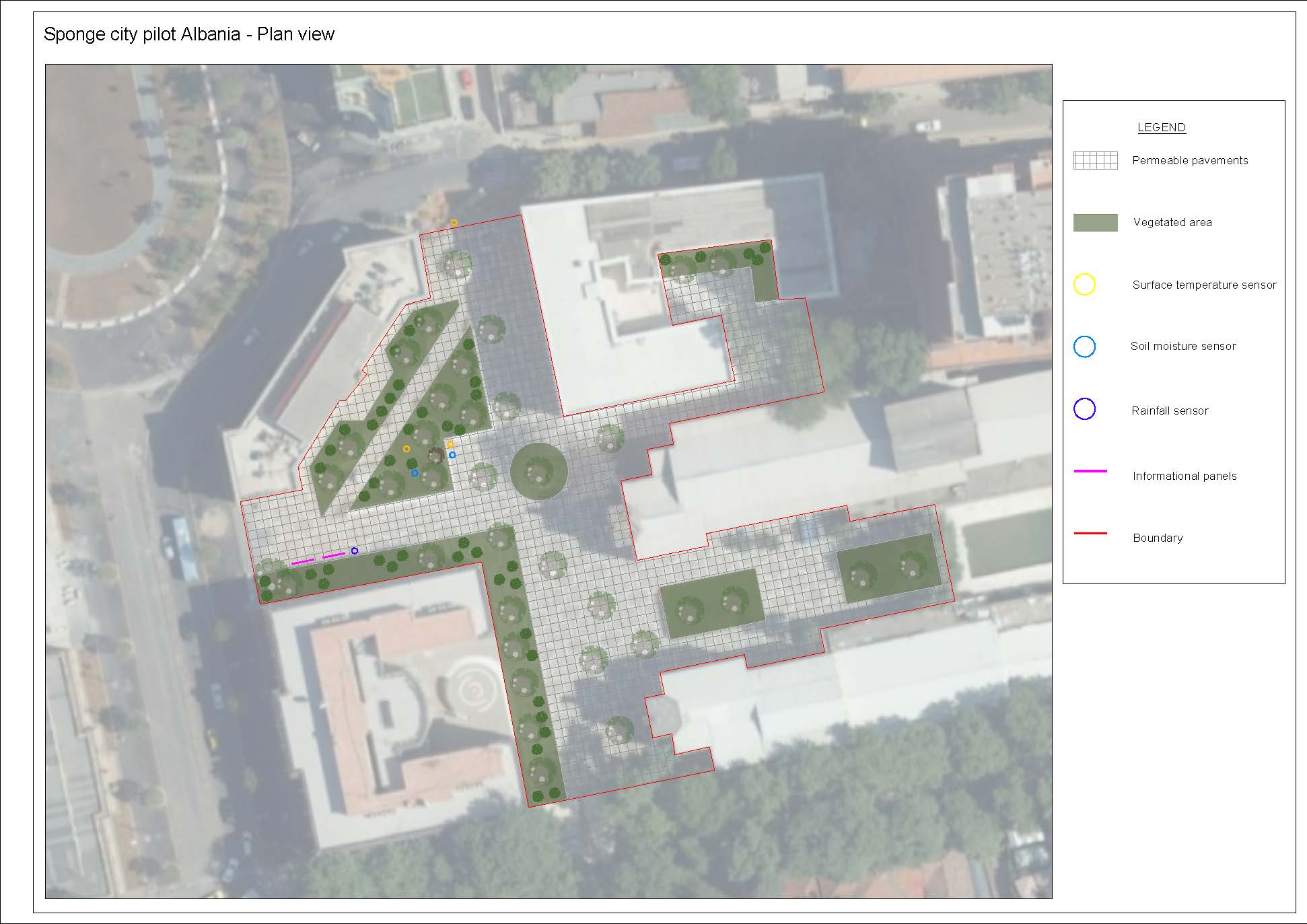
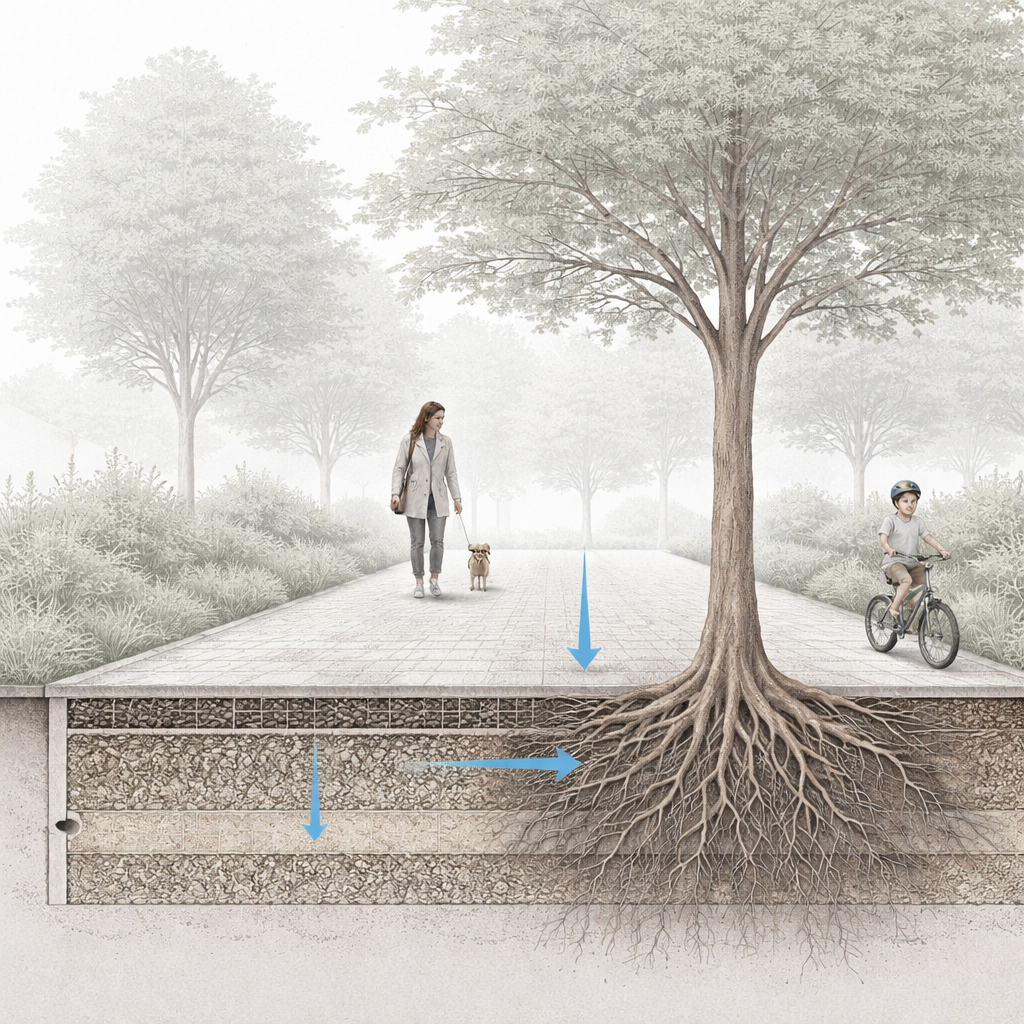
The project includes the installation of permeable pavements made from recycled materials, supporting circular economy and improving water resilience. It is expected to reduce surface runoff, increase water retention and improve flood management. Urban greening will be integrated to enhance water infiltration, biodiversity and microclimate.
Informational panels will raise citizens awareness of the solution and the circular economy. Sensors will be installed to monitor rainfall, surface temperature and soil moisture, and a web dashboard will collect, visualize and analyze the data in real time, supporting decision-makers, universities and researchers.
The beneficiary municipality will benefit from reduced flooding and lower drainage costs, national institutions from improved flood management, reduced surface water pollution and stronger climate resilience. Local communities will gain greener public spaces, a better microclimate, reduced flood risks.
Although still new in Albania, this solution has strong potential for wider application and aligns with national policies. Unlike conventional infrastructure, it integrates sustainability, circular materials and participatory approaches to urban water resilience.
I developed this idea in response to the recurring flooding in Albania, drawing also on my professional experience with projects in the water sector. Recent major floods have impacted cities such as Tirana, Shkoder, Durres, and Vlora. Rapid urban development, particularly in Tirana, has led to extensive urban concreting and a reduction of natural infiltration areas, increasing flood risks.
The main steps of the project include:
1. Preparation and Planning
• Stakeholder consultations and pilot site selection
• Conceptual and technical design of the sponge city intervention
• Permitting and procurement preparations
2. Implementation
• Rehabilitation of the pilot site
• Installation of permeable pavements, infiltration systems, and urban greening
• Community engagement activities and educational panels
3. Monitoring, Evaluation, and Knowledge Sharing
• Deployment of environmental sensors and web dashboard
• Data collection, analysis, and visualization
• Dissemination of results, workshops, and lessons learned.
The project combines permeable infrastructure, urban greening, and community participation, demonstrating an innovative solution to urban flooding.
Looking forward, the pilot can be replicated in the country, integrated into private sector projects and inspire the wider adoption of circular, resilient, and nature-based urban infrastructure.
Circular economy
Nature-based solutions
Water Resilience
Community co-design and awareness
Innovative and scalable solution
The concept addresses environmental, social, and economic challenges by combining nature-based solutions, recycled materials, and community engagement to enhance urban flood resilience. Albania faces increasing flood risks due to climate change and rapid urbanization particularly in Tirana, which reduces natural water infiltration.
The project is expected to restore infiltration capacity, reduce surface runoff, enhance biodiversity, and engage communities in co-creating resilient public spaces. Sustainability objectives include improved stormwater management, enhanced urban microclimate and greenery, strengthened community awareness and participation, and promotion of circular, climate-resilient infrastructure.
Implementation targets urban public areas with high visibility, such as sidewalks, parking spaces, and communal spaces, in consultation with local authorities and residents. Key actions include:
• Implementing permeable pavements made from recycled materials.
• Planting vegetation selected with community input.
• Organizing community planting activities to foster ownership.
• Deploying sensors to monitor soil moisture, rainfall, and surface temperature.
• Installing informational panels and a web dashboard to share real-time data with citizens, scientists, and decision-makers.
Results will be evaluated using indicators including water retention, vegetation growth, and community participation. Early monitoring is expected to shows improved infiltration, increased urban greenery, and strong engagement of residents.
The approach integrates technical, ecological, and social dimensions. Unlike standard flood mitigation measures, it combines recycled materials, nature-based solutions, and active community involvement, creating a replicable model. Durability is strengthened by citizen ownership and continuous monitoring, making it an innovative, practical, and sustainable solution for climate-resilient urban development in Albania and beyond.
This project transforms urban spaces into multifunctional, green, and permeable zones, enhancing flood resilience while creating beautiful and livable environments for communities. By implementing the sponge city approach, permeable pavements and integrated greenery turn sidewalks, parking areas, parks, or other communal spaces into visually appealing and functional public areas. The careful selection of plant species ensures that greenery reflects community preferences, fostering a strong sense of ownership and connection to the place.
Aesthetic quality is central to the design. Pavements, planting patterns, and vegetation textures will be thoughtfully arranged to create harmony, visual interest, and seasonal variation, making everyday experience in public spaces more enjoyable. Community planting activities further will enrich the sensory experience, allowing residents to see and feel the transformation, while promoting creativity, care, and pride in their surroundings. Informational panels and the web dashboard will provide real-time data, connecting people with the natural processes shaping their neighborhood.
The project positively stimulates multiple senses: the permeable pavements, the diversity of plants and microclimate improvements create comfort and well-being. Social interactions in the revitalized spaces strengthen a sense of belonging and community identity. By merging technical, ecological, and social dimensions, the project sets an exemplary standard for urban aesthetics.
Unlike conventional infrastructure, this solution integrates sustainability, circular materials, and participatory into a cohesive urban landscape. Its beauty lies not only in appearance but in its function and inclusivity. By creating resilient, engaging, and visually pleasing spaces, the project demonstrates how sustainable urban design can enhance quality of life, inspire communities, and can serve as a model for climate-resilient development in Albania and beyond.
The project promotes inclusion by ensuring that urban flood resilience and sustainable water management benefit all residents, regardless of age, socioeconomic status, or mobility. Public area selected for intervention will be redesigned to be accessible and welcoming, applying universal design principles that facilitate movement for everyone. By transforming high-visibility urban spaces into multifunctional, green, and permeable areas, the project makes environmental and aesthetic improvements available to everyone, creating equitable access to safe, comfortable, and resilient public spaces.
Inclusion is further strengthened through community engagement. Residents will be consulted in selecting plant species and take part in planting activities, ensuring that local voices shape the project. Informational panels and a dedicated web dashboard will provide transparent data for environmental performance, enabling citizens, authorities and scientists to monitor results and learn from the intervention. This digital inclusion ensures that scientific knowledge and sustainable practices are shared widely. The project also addresses economic inclusion by using permeable pavements from recycled materials, promoting circular economy principles.
Expected results will demonstrate strengthened inclusion through community participation, increased awareness and equitable access to green and resilient public spaces, and engagement of diverse stakeholders- from local residents to scientists and policymakers.
The exemplary character of this project lies in its integration of social, spatial, and digital inclusion with technical and ecological innovation. Unlike conventional infrastructure projects, it actively engages communities in co-creation, ensures accessibility for all, and provides open access to environmental data. By making resilience, sustainability, and aesthetics universally accessible, the project serves as a replicable model for inclusive urban development in Albania.
This project is built around active participation of national and local authorities and citizens to ensure that flood resilience and urban sustainability solutions respond to the real needs. Project beneficiaries include residents, families, children, elderly people, and people with limited mobility, who will gain safer and greener public spaces. Other beneficiaries are municipalities and national institutions such as the Ministry of Environment, Ministry of Infrastructure and Energy and Water Resources Management Agency. They will benefit from improved stormwater management, reduced flooding, and data for planning and decision-making.
National and local authorities and experts will be involved since in the earliest stages, in planning, selection of the pilot area, project design and permitting ensuring regulatory compliance and alignment with national policies and plans. Residents will be engaged from the earliest stages through consultations for the selection of planting species and define priorities for accessibility, aesthetics, and usability.
The level of influence of all stakeholders is considered significant. The national and local authorities will have big influence in decision-making in selection of the pilot area and compliance with legal and policy framework.
Citizen and stakeholder involvement will also support the quality of the concept by ensuring it is socially relevant and user-friendly. By integrating local knowledge and experience, the project can achieve greater environmental performance, stronger community attachment, and higher levels of participation in long-term maintenance. Residents’ feedback will design the informational panels for education ensuring that communication tools are relevant, accessible, and understandable from the community. This participatory approach exemplifies the NEB principle by creating a co-owned, inclusive, and adaptive model for urban flood resilience that is replicable across Albania and beyond.
The project will be implemented through cooperation among stakeholders at different levels to ensure effective implementation, policy alignment, and long-term scalability. At the national level, institutions responsible for environmental and water management, and infrastructure- such as the Ministry of Environment, the Ministry of Infrastructure and Energy and the Water Resources Management Agency- can provide technical opinions, regulatory alignment and strategic support.
At the local level, the beneficiary municipality will play a central role in site selection, permitting, and integration of the solutions into public space planning. Local communities will be involved through consultations and participatory activities reflecting the local needs.
The project can create synergy with EU initiatives and organizations working on sustainable urban development. Universities and research institutions can use the data generated to support scientific studies and innovation.
The engagement of stakeholders across multiple governance levels brings significant added value. Local actors contribute with expertise and ensure community acceptance; national institutions provide policy coherence, expertise and institutional legitimacy. European networks and NGOs can support knowledge exchange and replication potential in the future. This multilevel governance approach strengthens the project’s credibility, mobilizes resources and expertise and inspire similar climate-resilient solutions.
The engagement of authorities ensures that the project is aligned with laws, policies and plans, such as Law No. 155/2020 on Climate Change, National Strategy on Integrated Water Resources Management and the new National Adaptation Plan for Climate Change 2026-2036 (NAP).
This project supports the implementation of the measures proposed in the NAP, specifically: Enhancing urban regenerative capacity and Sustainable urban design: preservation and restoration of permeable and infiltration areas.
The project integrates knowledge and expertise from multiple disciplines to create a holistic and resilient urban solution. Environmental sciences and hydrology including engineering guide the design of permeable pavements and green infrastructure to enhance water infiltration, reduce surface runoff, and improve biodiversity. It will contribute to the technical design, installation of permeable pavements and monitoring system. Architecture and urban design shape the spatial layout and aesthetic integration of green elements, ensuring that public spaces remain functional, attractive, and accessible. Social sciences support participatory processes and community engagement, while digitalization enable the deployment of sensors and the development of the web dashboard. Education and communication disciplines contribute to the development of informational panels and public education.
Collaboration among these disciplines will be organized through coordination between technical experts, national and local authorities, researchers, and community representatives. Joint meetings will allow engineers, designers, environmental experts, and social practitioners to combine their perspectives when defining the pilot area and designing the intervention. Community will also contribute with local knowledge through participatory meetings.
This transdisciplinary approach creates significant added value. By combining scientific knowledge, technical expertise, community input, and digital innovation, the project ensures that the solution is environmentally effective, socially accepted, and visually integrated into the urban environment. The collaboration between disciplines improves the quality and practicality of the concept while strengthening its educational and innovation potential. As a result, the project demonstrates how integrated knowledge and cross-sector collaboration can produce sustainable, resilient, and replicable urban solutions for climate adaptation.
The project can be financed through EU and other donors, national public funding and/or municipal investments. Financial support may come from partnerships with universities, NGOs, and private companies. A strong point in the funding aspect is that this project supports the implementation of the measures in the National Adaptation Plan on Climate Change 2026-2036. This increases the possibility to get support from national authorities and municipalities, responsible for its implementation.
At the pilot stage, the project does not generate direct revenues. Instead, it provides economic value by reducing long-term public costs related to stormwater management, flood damage, and drainage infrastructure. Municipalities can benefit financially through lower maintenance and infrastructure costs, while national institutions benefit from improved water management and reduced risks.
In the future, the concept has the potential to generate indirect revenues and economic opportunities. The use of permeable pavements made from recycled materials can stimulate local businesses and circular economy supply chains. The environmental monitoring and web dashboard may create opportunities for research partnerships, innovation services, and digital environmental monitoring tools that can be replicated in other cities.
The main costs of the project include the contracting of experts, purchase and installation of permeable pavements, urban greening measures, sensor technology, development of the web dashboard, community engagement activities, workshops and technical meetings.
By demonstrating an effective and replicable sponge city solution, the project can support wider implementation in other municipalities. The approach also has disruptive potential in urban development by introducing innovative combinations of circular materials, nature-based solutions and real-time data to transform traditional stormwater management into a more sustainable, climate-resilient urban system.
The concept has strong potential for transferability and replication in other cities in Albania and beyond, particularly in urban areas facing flood risks and limited green infrastructure. By demonstrating the sponge city approach through a visible pilot intervention in a public space, the project can serve as a practical model for municipalities seeking effective and nature-based solutions for water management and climate adaptation.
Several elements of the concept are easily transferable. These include the use of permeable pavements made from recycled materials, the integration of urban greening measures to improve water infiltration and biodiversity, and the use of sensors to monitor rainfall, temperature, and soil moisture. The methodology of combining nature-based solutions, circular economy materials, community participation, and digital monitoring tools can be replicated in sidewalks, parking areas, parks, pedestrian streets, school yards, and other public spaces.
The project can also generate valuable learning through monitoring data, community engagement processes, and technical experience. These lessons can be documented and shared with other municipalities, urban planners and policy makers interested in applying similar approaches.
Replication may require collaboration between municipalities, national authorities, urban planners, universities, and private companies specialized in permeable pavements, green infrastructure, and monitoring. Technical expertise in urban design, stormwater management, and data monitoring would support successful implementation.
While the core concept is highly transferable, certain elements may need to be adapted to local conditions, such as climate patterns, soil permeability, urban density, available materials, and community needs. Site selection, plant species, and design details can therefore be adjusted to reflect the environmental and social context of each location while maintaining the overall sponge city approach.
The foreseen steps envisaged to further develop, promote, and potentially implement the concept focus on a collaborative and flexible approach in the year following the application. Initial efforts include mapping relevant stakeholders, identifying potential partners, and refining the sponge city concept in line with funding requirements. The resulting concept and stakeholder mapping may then be shared with municipalities, public institutions, and other actors, providing a foundation for voluntary implementation, pilot initiatives, or co-creative projects. Supporting materials and recommendations could be circulated to encourage collaboration, community engagement, and potential replication in other urban areas. While the applicant focuses on concept development and stakeholder engagement, further implementation could be realized by municipalities, public institutions, or local partners interested in piloting or scaling the project. Overall, the project is conceived as an open, evolving, and co-creative initiative, where initial development is led by the applicant, while long-term implementation and scaling remain open to collaboration with relevant stakeholders.