Enhancing Circularity, Sustainability, and Innovation
BioReactor
Bioreactor (FTW) for restoring water quality and biodiversity in the water bodies of Chisinau
BioReactor transforms polluted urban waters into living ecosystems. The floating wetland mimics natural water purification, using microorganisms and plant absorption to remove pollutants and improve water quality. By restoring biodiversity and creating green landscapes on the water, the project reconnects people with nature. Starting with a pilot in heart of Chisinau it demonstrates how cities can regenerate waterways through innovative, nature-based design.
Moldova
Local
Chișinău Municipality
It addresses urban-rural linkages
It involves a physical transformation of the built environment (hard investment)
Prototype level
No
No
Yes
Organisation
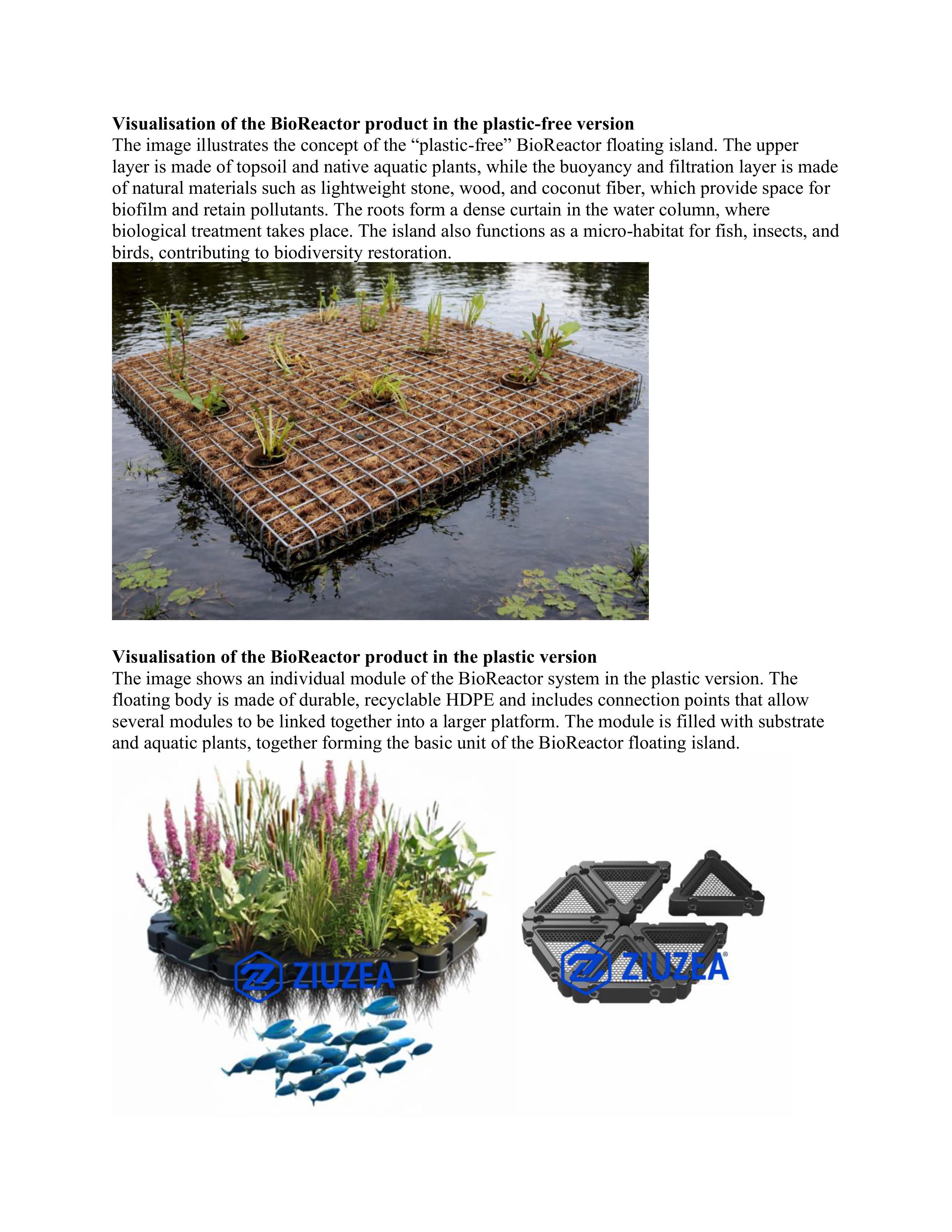
BioReactor FTW is the product created by our team to transform degraded water bodies into living, biodiverse and attractive spaces for people. It was designed as part of the circular economy and is being developed in 2 versions. One version is made without plastic, using only sustainable and nature friendly materials that are harmless and can be reused at the end of the life cycle. The plastic version is a new approach to FTW technology, using manufacturing HDPE lego like modules, which are harmless in water and widely used in household water systems. The product is modular, allowing easy logistics and installation without qualified staff or heavy equipment.
In both versions, we use preselected native and non-invasive plants based on the needs of each site, including contamination, climate, location, and visual aspect. The selected aquatic species reduce multiple types of contamination, suppress algae, improve water clarity and restore ecological balance. The system is low-maintenance, with no need for electricity, chemicals or permanent infrastructure. Permits are easier to obtain because we do not use land, the modules need only anchoring, they are mobile and they do not require work on the bank.
Currently, the product is in the pilot phase (premiere in R.M) and we have finished a circular production model. We obtained permits for 4 pilot locations, including the Bic and Raut rivers and we plan the first pilot in April or May. Our team is part of the UNIDO(GCIP) and UNDP(BOOST) networks and is also supported by local authorities.
The expected impact is both ecological and social. Our goal is to reduce water pollutants with low operational costs and support the restoration of land and aquatic biodiversity. In urban settings, installations can help turn a degraded ponds into a healthier and more beautiful public spaces. BioReactor is also a scalable piece of green infrastructure for climate resilience, biodiversity recoveryand better everyday environments
The idea to develop water treatment solutions started during a simple walk in a park in Chisinau in 2024. We stopped near a lake and saw how polluted and lifeless it had become. The water was unhealthy, unattractive, and had a strong odor. That moment made us ask simple questions: what can we do, how can we change something and how can we restore water bodies in a way that works with nature not against it?
From that point, we began research and tried different solutions based on natural water purification processes. First, we studied the main problems affecting water ways, such as nutrients, metals, drugs, algae blooms, bad smell and biodiversity loss. Then we worked on the product design, choosing a modular structure that is easy to transport, easy to install and simple to scale. We also selected safe materials and native, non-invasive plants according to the needs of each site, including pollution type, climate, location, and visual quality.
In the summer of 2025, we began our journey to showcase our first prototype to the public. At this time, we were selected in the BOOST (UNDP) acceleration program, followed by the deeptech accelerator GCIP (UNIDO). In December 2025, our first commercial-ready concept was selected as the best Water Efficiency Solution of 2025 in the GCIP Moldova program. In parallel, we established contact with the Ministry of Environment and the Municipality of Chisinau administration and now we have 4 site permits to pilot our solution. Each site has different problems to showcase our solution in different conditions and adapt it to national water management documents.
The next steps are pilot installations, which we will proceed with in April May 2026. In parallel, we are creating the first national map and information portal about water quality. We collect information from public and private sources about water quality indicators and lab reports. Our goal is to harmonize humans and nature in a simple and cost efficient way.
nature based solutions
water resilience
urban biodiversity
ecosystem restoration
resilient and inclusive cities
BioReactor from the start was designed to be sustainable and part of the circular economy, from the materials used to its working process without electricity, chemicals and with low maintenance. It mimics natural processes of water treatment, and the core of the concept goes from natural wetlands, which are one of nature’s self treatment components. Product addresses environmental challenges by using nature-based floating systems to reduce nutrient pollution, limit algae blooms, improve water clarity and support the return of biodiversity in and around water. It also address social challenges by helping communities recover their waterways, studies confirm that human health benefits from clear waters, both physically and mentally.
The World Bank, in its reports, confirms that wetlands are one of the most efficient and economical ways to treat water in the long term. Municipalities, farmers and local communities need affordable ways to improve water quality but cannot invest in large traditional infrastructure. Our product is a modular, low-maintenance with lower long-term water treatment costs, and it is easier to transport, install and scale. Our product fits perfectly into existing infrastructure, we do not aim to replace it, but to complement it.
Moldova’s path toward the European Union makes water quality a strategic issue, as the country is aligning its water policies with the EU. This is also an EU challenge, more than 60% of EU surface waters still fail to reach good ecological status. In Moldova, poor water quality is not only an environmental issue but also a circularity and public health issue, because contaminated water used for irrigation can pass pollution through the food chain and reach the final consumer.
Cleaner water means better conditions not only for ecosystems and public spaces, but also for agriculture and local food systems. In this way, the concept shows that sustainability can be visible and close to people’s everyday lives
BioReactor contributes to aesthetics by transforming polluted and neglected water bodies into living, green and attractive places that people can enjoy. Our product aims to turn degraded water bodies into healthy landscapes with visible vegetation, cleaner water and restored biodiversity. In everyday life, this means a better visual environment, a calmer atmosphere and a stronger connection between people and nature. It makes nature visible again in places where it has been damaged or lost by bringing life and seasonal change back to the water,
In long term cleaner and greener water bodies can improve the identity of a place, make public spaces more pleasant, and encourage people to spend more time outdoors. A restored pond or river is not only an environmental improvement, but also a social and emotional one, it can become a place that people are proud of, care for and want to protect.
Bioreactor can be considered exemplary in terms of aesthetics because it combines ecological function with visual and spatial improvement. It does not hide infrastructure or separate beauty from sustainability.We use plants that are not only technical, but also decorative, so the system restores water quality while also improving the visual and emotional quality of the place.
BioReactor is inclusive because, due to its modular structure and easy installation, it makes water restoration more open to communities. The process is simple enough to involve school children, families and local people in planting events, turning installation into an educational and social activity. Our goal is also to create an interactive map and platform for sharing knowledge about water quality, pollution, and ways to treat water and reduce it. In this way, BioReactor promotes participation, awareness and shared responsibility for local water bodies.
BioReactor is participatory because its development is linked to real local water problems and to the people and institutions connected to them. We involved local authorities, environmental institutions and other stakeholders in identifying pilot locations and understanding the needs of each site. Their participation helped us shape a concept that is more practical, more adaptableand easier to implement in real conditions.
The modular structure of BioReactor also makes participation easier. Our goal is to involve schools, families and local communities in planting and launch events, so that restoration becomes a shared educational and social activity, not only a technical process. This participation helps create stronger local ownership, better awareness of water problems and a greater sense of shared responsibility for the place.
The modular structure of BioReactor also makes participation easier. Our goal is to involve schools, families and local communities in planting and launch events, so that restoration becomes a shared educational and social activity, not only a technical process. This participation helps create stronger local ownership, better awareness of water problems and a greater sense of shared responsibility for the place.
BioReactor needs multilevel governance because restoring water bodies requires cooperation at local, national and international level. At local level, municipalities, communities, schools and land users help identify needs, support implementation and build care for the place. At national level, the project is already in direct communication with environmental institutions and the Ministry of Environment, which provide permits, oversight, and connection to public water priorities. At international level, support from UNIDO(GCIP), UNDP(BOOST) brings knowledge, credibility and scaling opportunities. The product is also based on a strong scientific background, drawing on natural treatment processes and existing knowledge in water restoration and floating treatment wetlands. This multilevel approach makes BioReactor more practical, more trusted and easier to implement and scale.
BioReactor is transdisciplinary because it connects environmental science, ecology, engineering, design, IT software development, education and public cooperation. Environmental knowledge shapes the logic of water treatment and biodiversity restoration. Engineering and design shape the modular structure, material choices and easy installation. Landscape designers and florists contribute to planting rules and to the visual quality of installations on sites proposed for beautification. Ecology and botany guide the selection of native plants according to the needs of each site. Digital technologies are reflected in the development of an interactive map, a web knowledge hub and a planned monitoring platform with sensors. Education and community involvement are part of the concept through planting events and knowledge sharing. In this way, BioReactor shows that restoring water bodies requires different fields of knowledge working together.
BioReactor is built on a hybrid business model that combines direct product sales with recurring service revenues. The core revenue stream comes from the sale of modular floating treatment wetland units to municipalities, businesses and private clients. An additional revenue stream comes from the sale of aquatic plants used for installation and replacement, based on the needs of each site. This is supported by recurring income from subscription-based maintenance and subscription-based water monitoring, as well as project-based revenues from design and installation services for larger sites.
The business model is designed to become financially sustainable over time because clients do not only buy a product once. They can also need aquatic plants, long-term support, monitoring, maintenance and future expansion of the system. This creates value and recurring revenues while keeping operating costs low. In the early phase, grants, pilot funding and institutional support help finance prototyping, first production and demonstration projects. The model scales through direct sales, partnerships and service contracts.
BioReactor’s modular structure makes the model flexible and scalable. Smaller clients can start with limited installations, while larger municipalities and agricultural users can develop larger projects with long-term service support. The plastic version is especially designed for easy logistics and international sales, because its lightweight and modular structure allows efficient transport, simple installation and wider market distribution. In this way, the concept combines environmental value with a business structure that can remain viable and grow over time.
BioReactor is scalable because its main elements can be replicated in many places and contexts. The modular product can be adapted to different water bodies, including municipal ponds, rivers, agricultural basins, private lakes, lagoons and other artificial or natural water surfaces. The implementation process can also be transferred, because site assessment, plant selection, installation, and monitoring follow the same logic in different locations.
The plastic version is especially designed for wider production and sale because it is lightweight, modular, easy to transport and easy to install without heavy equipment or complex works. These qualities make it suitable not only for local use, but also for production and distribution in other countries and regions. Its structure allows faster logistics, easier handling and flexible adaptation to different project sizes, which supports growth at larger scale.
The planned digital platform, sensors, interactive map and web knowledge hub are also scalable tools for data collection, learning, and community involvement. In addition, the business model can be replicated through product sales, aquatic plant supply, maintenance, monitoring and installation services. This makes product a concept that can grow across different users, sites and regions while keeping the same core value: simple installation, natural treatment and measurable impact.
Our team is clearly committed to putting this into practice, as the concept has already moved beyond the idea stage and is now heading into the pilot testing and real-world validation phase. We have developed the product concept, finalized the circular production model, obtained the necessary permits for four pilot sites, and purchased two molds for the production of plastic components. We are also part of innovation networks, including UNIDO (GCIP), UNDP (BOOST), and local cooperation networks, which help us develop and promote the concept. At the same time, we are in the process of obtaining patent protection in Moldova.
In 2026, our main objective is practical implementation. We are ready to install the first pilot project in April or May, depending on the import of the selected plants, and then begin on-site monitoring of water quality, plant adaptation, and system performance. Based on the initial results, we will improve the project and prepare the next pilot sites.
At the same time, we develop the digital aspect of product, including the monitoring platform, sensors, interactive map and online knowledge center. Another important step is preparing the product for wider market entry, especially the plastic modular version, which is designed for easy logistics, easier scaling and future international sales.
Our goal for 2026 is to validate BioReactor in real conditions, improve it through field results and prepare it for wider implementation and market entry.