Enhancing Circularity, Sustainability, and Innovation
Plastic2Plant
A circular economy approach that transforms polluting plastic into nourishing plants.
When hearing the expression back to our roots people always think of their home town. In this case I am using it to refer to the actual roots of the plants that nourish us ,rare sights in metropolitan cities. Going a step further to the root small settlements with greenery and clean air. This project aims to bring a glimpse of that natural, nourishing environment into the heart of the city.
Albania
National
Mainly urban
It involves a physical transformation of the built environment (hard investment)
Early concept
No
No
No
Individual
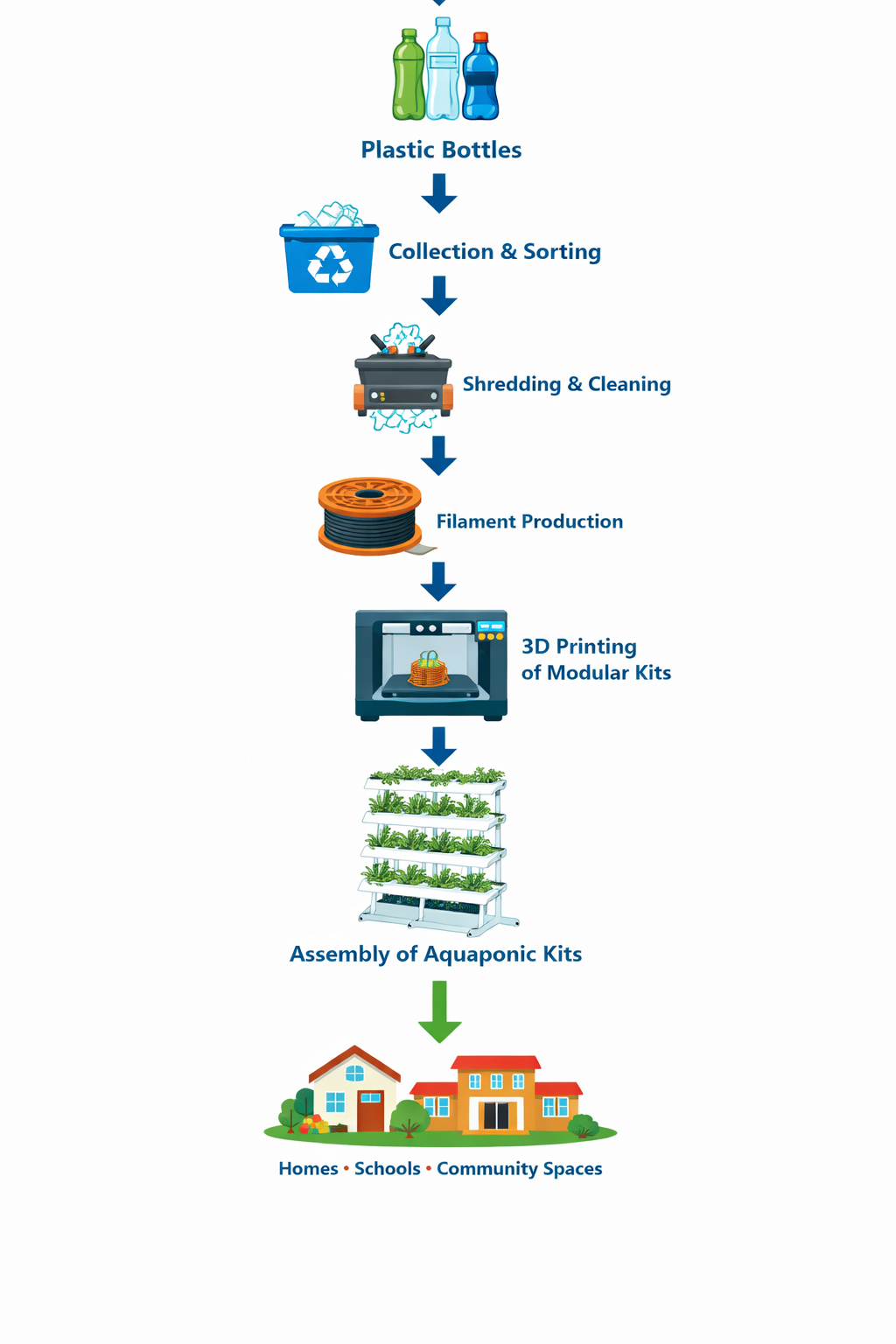
So, Plastic2Plant is a sustainable urban farming project that converts the recycled plastic bottles into compnents for modular hydroponic systems. By doing that it addresses two issues that are now faced in metropolitan cities, plastic waste and the lack of vegetation. It is quite interdisciplinary combining recycling, additive manufacturing and aquaponics. We create a environmentally friendly solution that can be used in urban communities, schools and even small businesses.
So far we have achieved a concept design for the modular aquaponic components using PET plastic. We have 3D printed the grow cups, pipe connectors and housings. And finally a preliminary workflow has been established from collecting to shredding to processing the PET plastic bottles into maaterial that can be 3D printed.
The expected result is the production of fully functional modular aquaponic kits that can be assembled by any given individual simply by following an assembly instruction. This would decrease the amount of plastic sent to landfills and allow for urban food production.
The idea has roots in my upbringing. Being brought up in a small city everyone had a cultivated garden. My parents took great pride in having a colorful garden, filled with different vegetables. It was appeasing to the eye, healthy and economic. Furthermore it was a chance for each kid to learn the basics of agriculture or even test what we learned in biology class.
That same concept I would very much like to see implemented for the families that live in metropolitan cities. The logic path was to find a replacement for the garden which is offered in aquaponics. A sustainabe farming method that doesn't require a garden.
The next step was to find a way to make it affordable and get the community-driven. That I strongly believe can be achieved by using recycled material. Cittizens already try to clean plastic from their communities by organizing cleanup campaigns that reach involve businesses, schools and municipalities, thus creating a pool of collected plastic bottles.
So that would be our first step, common people collecting the plastic bottles. To further engage citizens, a points reward system could incentivize recycling with participants earning modular aquapnic kits based on the volume of plastic collected.
Once collected, the plastic is shredded, cleaned and processed into usable filament. That filament can now be used to 3D print the components.
Cirular economy
Community engagement
Recycling
Urban farming
Youth recycling education
Plastic2Plant addresses a plethora of environmental, social and cultural challenges.
First off, it reduces the plastic waste by recycling a portion of the used plastic bottles to produce the modular aquaoponic kits. Secondly aquaponic farming uses less water than traditional farming. It has been recorded to use ninety percent less water due to the water being recirculated.
Socially it engages the community in a recycling effort which in turn also creates a sense of participation and ownership. The quality of life is improved by gaining access to fresh vegetables in an urban area where green spaces are limited. Lastly one of the key byproducts of the concept is youth education on environmental responsibility.
On the economic aspect the cost of urban farming infrastructure is reduced and new opportunities are created. Furthermore it cuts down on the logistic costs which have proved to be the main factor on food price increase.
Plastic2Plant is exemplary in terms of sustainability because it combines waste reduction, resource efficiency and community education in a single integrated solution. It demonstrates that sustainable food production can be achieved in urban settings through cooperation and circular practices.
Plastic2Plant contributes to making urban life colorful and engaging by transforming otherwise discarded plastic into modular aquaponic systems that bring greenery and life into the heart of metropolitan spaces. As I have learned since a young age the presence of thriving plants not only enhances the scenery but also connects people to a serene natural environment.
By involving the community in collecting plastic, assembling the aquaponic kits, taking care of the plants, people develop ownership over their lcoal environment. They are less prone to polluting and more accostumed to protecting it. It is also a good oportunity to strengthen the connections between neighbors and a chance to be creative in assembling those kits, choosing different plants and designing layouts.
The concept is exemplary in terms o aesthetics because it combines form and function. 3D printed components are not only functional and sustainable but can be designed to be visually appealing and harmonius with the urban settings. Over the long term it demonstrates that environmental solutions can also enhance the beauty and livability of the city.
Plastic2Plant is designed to be accessible and affordable to all urban residents. By using recycled plastic bottles as raw material, the cost of production drops significally. Thus urban farming becomes affordable for all, including families who might otherwise not afford traditionally expensive infrastructure.
The project facilitates inclusive participation. Everyone is invited to collect plastic and assembling the kits can become a family matter. As well as maintaining the plants gives everybody a hands on role in what is also an educational venture.
Through family involvement the project fosters intergenerational collaboration. Thanks to the flexibility of 3D printing the modular kits can be adapted to fit different spaces and accomodate preerences. Thus encouraging creativity and experimentation.
The concept is exemplary in terms of inclusion because it manages to demonstrate a new model within our society where environmental responsibility, education and urban food production are co-created by the entire community. Mass accessibility is ensured which in turn can provide mass engagement.
Plastic2Plant has been designed with active community participation as its core. From the starting point, the concept considers the role of the citizens in the collection of the plastics and the assembly of the aquaponic kits. Continuous feedback from the users will guide the modular design, ensuring that the kits are easy to assemble and ever adapting to the real needs of the environment while being visually appealing.
Potential users and stakeholders have been involved primarily through interviews and opinion gathering. Feedback was collected from the urban residents to understand their needs and expectation regarding recycling, urban farming and aquaponics.
The input has guided some key design aspects such as the modularity of the kits, ease of assembly and adaptability to different urban spaces. It highlighted also the need for youth involvement in order to help bridge the generational gap.
At this early stage the participatory process ensures we are putting our resources to good use.
Plastic2Plant aims to engage stakeholders mainly across local and regional levels to ensure support and secure help with efective implementation.
On a local level level the residents and community organizations will be involved in plastic collection, kit assembly and the deployment of the urban aquaponics infrastructure. Their engagement provides real time feedback ensuring our solutions fit the urban needs.
On a regional level the municipal authorities and local NGOs can help coordinate recycling campaigns and promote awereness which in turn increases scale and impact.
Lastly on a national Europian level environmental agencies and EU funded programs can provide technical guidance and policy alignment. Replicating the project in other urban areas can only be achieved after settings foothold on regional level.
The added value of of this engagement on multiple levels is synergy between citizens, local authorities and European standards. This can ensure that the project remains practical and aligned with broader environmental goals.
Plastic2Plant reflects a transdisciplinary approach by combining knowledge from several fields to achieve a easy to use final product.
Engineering and design through digital technologies play a central role in the development of the project. Mechanical design and 3D printing are used to create the modular aquaponic kits. The material processing chain from recycled plastic all the way to finished product also represents an important technical aspect.
Environmental sciences are encompassed in achieving a sustainable product and pollution reduction through the circular economy theme.
A fair amount of agricultural knowledge also contributes to the design. In many ways, agricultural knowledge has been a hallmark of Albanian communities over the last century.
Social sciences and education are reflected in the comunity driven aspect of the project. Youth engagement and education promotes recycling and food production awareness.
Finally design and aesthetics are considered in the creation of the modular systems which are functional and visually appealing.
Plastic2Plant is built around a circular economy and community driven business model. It combines material porcessing, modular aquaponic systems production and educational initiatives.
The primary source of revenue will be the sale of the modular aquaponic kits along with spare parts. These kits can be sold to households, schools, different businesses like restaurants and even community organizations that with to grow their own plants. Since the concept targets metropolitan areas the market is substantial.
Additional revenue could be generated through workshops and educational programs focused on recycling and urban farming. These activities could involve schools and community organizations, promoting environmental awareness while supporting the financial sustainability of the project.
The project could also benefit from public funding and sustainability grants, particularly those focused on envirnmental education and circular economy.
In addition, community recycling campaigns could be supported through sponsorships from local businesses that wish to improve their environmental footprint.
Through this combination of sales, educational activities and partnerships we aim to establish a financially stable model.
Plastic2Plant has been designed with replication and scalabiltiy in mind. Several key elements can be easily transfered to other cities and communities.
The modular aquaponic kits which will represent the biggest source of income are also the the most scalable aspect of the project. Because they are designed through digital technology and 3D printed the designs can be easily shared and adapted through parametric dimensioning, which is a fundamental part of the mechanical design.
The community recycling model is also another transferable component. The approach of encouraging citizens to collect the plastic bottles through organized campaigns and utilizing the reward system can be replicated in almost every urban environment.
The educational component is also scalable. Workshops in recycling, aquaponics and circular economy can be implemented in schools and community centers. It will help spread knowledge and encourage behavioral change.
Finally the work methodology from plastic bottle to the modular aquaponic systems can be documented. From there it can be shared with other communities, allowing to replicate or even improve the process.
Based on these elements the concept demonstrates capacity to expand beyond a single city.
In the year following the application the project will focus on technical development, community engagement and pilot implementation.
The first step will be the development and refinement of the modular aquaponic kits though testing and prototyping. Our belief is that faster prototyping and iterative testing leads to a much higher success rate than purely theoretic development.This approach will allow us to collect more data which will support informed decisions.
The second step wil be community outreach and strengthening awareness. Local sidents, schools and organizations will be informed about the project and invited to participate in plastic collection initiatives. This phase will also include interviews and feedback sessions to refine the concept based on real user need.
A pilot aquaponic installation will be implemented in a local institution, preferably a school which would also serve the educational aspect of the project. This pilot system will also serve as a demonstration model, helping promote the concept and encourage broader community participation.
During the same period, efforts will be made to establish connections with municipalities and buid a strong relationship with environmental organizations. This will help expand the reach of the project and lay solid foundations.
By the end of this particular year the goal is to have a functional pilot system, validated modular designs on sale and an engaged local community. This will serve as the foundation for scaling, imporvement and implementation in other urban areas.