When the snow melts away
A regenerated sport infrastructure for climate-resilient Alpine Communities
In anticipation of the day when the last snow melts, Antey-Saint-André is regenerating its sports field, transforming it into a multifunctional, open, green, inclusive space accessible all year round. The stream’s water becomes an ally in protecting the area from climate risks, offering new outdoor activities and strengthening the connections between residents, young people, visitors and the natural environment to explore sustainable alternatives to winter-dependent tourism.
Italy
Frazione Filey 1, 11020 Antey Saint André, Aosta Valley, Italy
Prototype level
Yes
Yes
Yes
No
No
7002: Antey-Saint-André (IT)
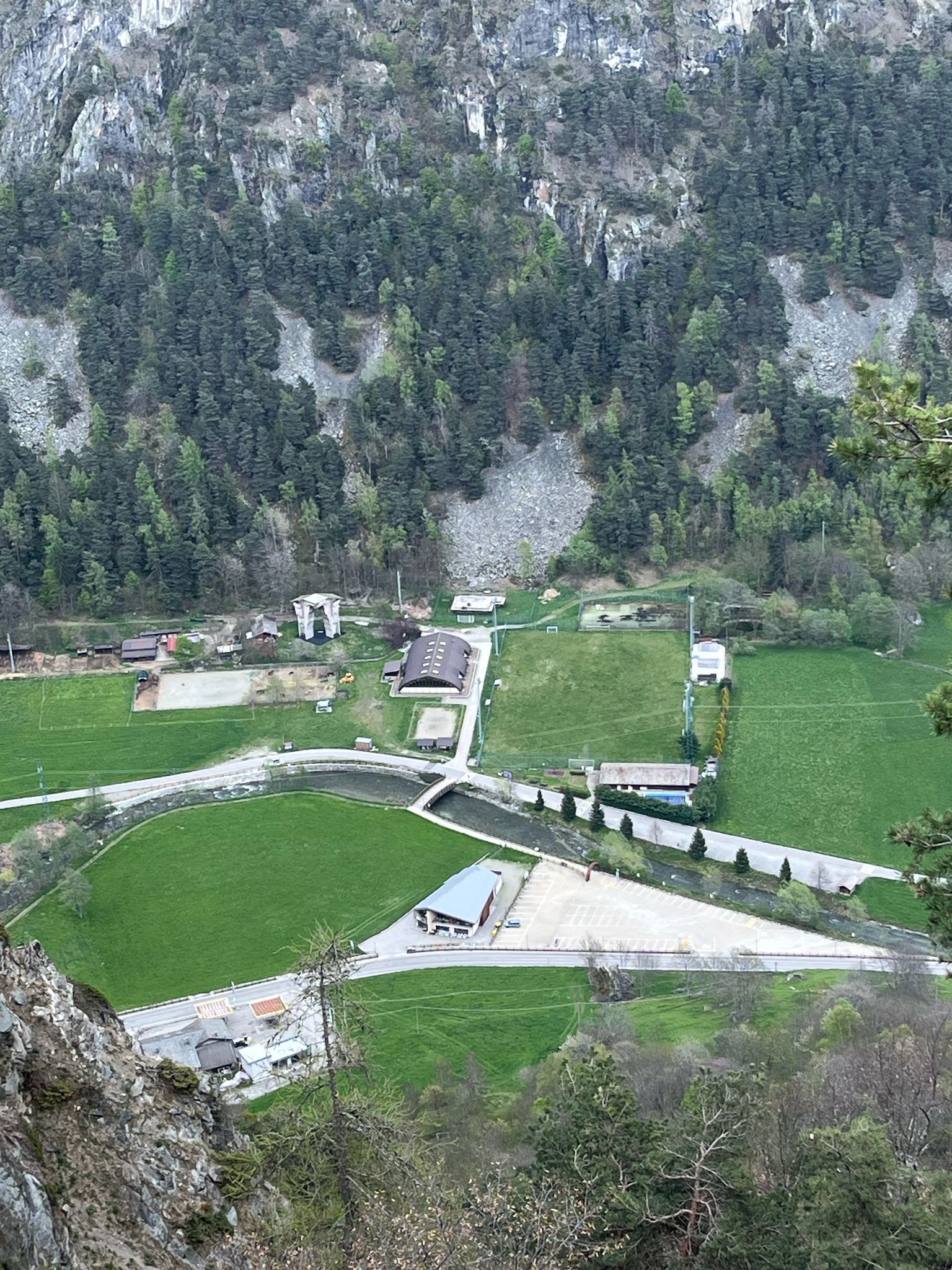
The initiative aims to regenerate an obsolete sport field subject to specific climatic vulnerabilities, transforming it into an outdoor infrastructure that brings together wellbeing, nature and local development in response to the impacts of climate change on Alpine winter tourism.
The objectives are to: i) increase the availability of outdoor sports and social activities in all seasons, in order to improve quality of life and reduce depopulation; ii) enhance the safety of the area with respect to landslides, floods and heat waves; iii) create new economic opportunities linked to slow tourism, cultural valorisation, new educational services, in order to counteract the long-term effects of the lack of snow.
The expected outcome is to ensure the regeneration of an inclusive and usable public space that represents a place of attractiveness and provides a replicable model for other small municipalities.
The project therefore embodies beauty, through a field that actively interacts with the Alpine landscape and restores quality to everyday spaces by returning them to the shared sense of community; sustainability, thanks to nature-based solutions, energy efficiency systems, and the intelligent use of the stream’s water to drain, cool and protect the area; and inclusion, through accessible spaces and multiple uses for different ages and needs.
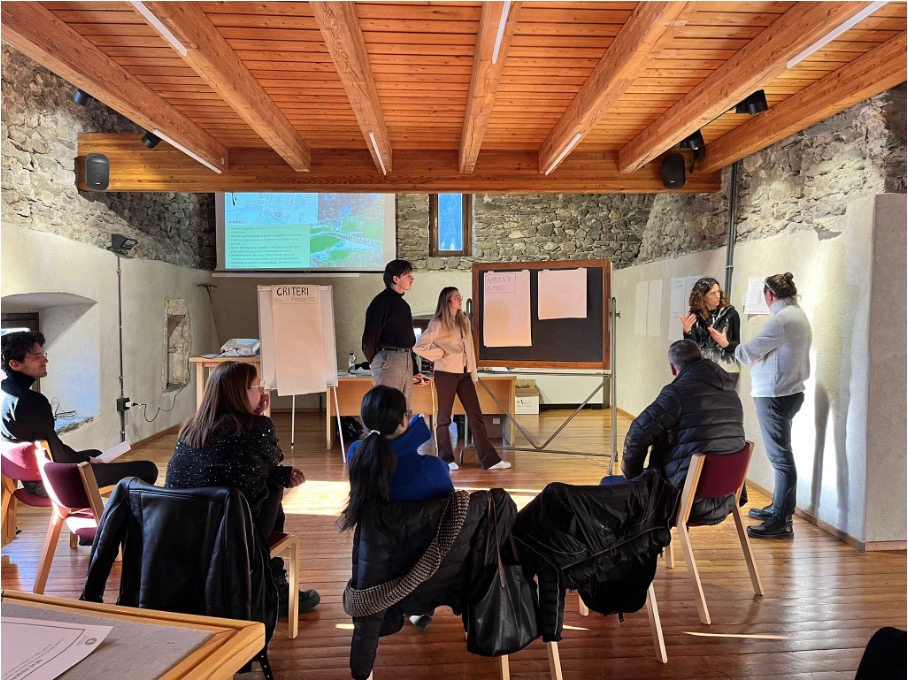
This design stems from a co-creation process activated through a participatory action research led by the University and orchestrated by the Municipality, which involved all stakeholders including young people, resident families and elderly people, second-home owners, regular tourists, sports and cultural associations, and tourism operators. The administration of a questionnaire and the organization of 2 workshops enabled a phase of collective design developed through cycles of systemic design and inspired by the Quintuple Helix model, which recognises the active role of the environment in the decision-making process.
The objectives are to: i) increase the availability of outdoor sports and social activities in all seasons, in order to improve quality of life and reduce depopulation; ii) enhance the safety of the area with respect to landslides, floods and heat waves; iii) create new economic opportunities linked to slow tourism, cultural valorisation, new educational services, in order to counteract the long-term effects of the lack of snow.
The expected outcome is to ensure the regeneration of an inclusive and usable public space that represents a place of attractiveness and provides a replicable model for other small municipalities.
The project therefore embodies beauty, through a field that actively interacts with the Alpine landscape and restores quality to everyday spaces by returning them to the shared sense of community; sustainability, thanks to nature-based solutions, energy efficiency systems, and the intelligent use of the stream’s water to drain, cool and protect the area; and inclusion, through accessible spaces and multiple uses for different ages and needs.
This design stems from a co-creation process activated through a participatory action research led by the University and orchestrated by the Municipality, which involved all stakeholders including young people, resident families and elderly people, second-home owners, regular tourists, sports and cultural associations, and tourism operators. The administration of a questionnaire and the organization of 2 workshops enabled a phase of collective design developed through cycles of systemic design and inspired by the Quintuple Helix model, which recognises the active role of the environment in the decision-making process.
Tourism Diversification
Sustainable Transitions in Alpine Regions
Rural Regeneration
Inclusive Sport
Alpine Environmental Valorization
“When the Snow Melts Away” pursues sustainability across three integrated dimensions—environmental, social and economic. From an environmental perspective, the project transforms an underused sports field that is vulnerable to extreme events into a resilient infrastructure that uses the stream and nature-based elements as allies to improve drainage, microclimate and the ecological quality of the space, contributing to climate-resilient adaptation and strengthening users’ connection with the Alpine environment.
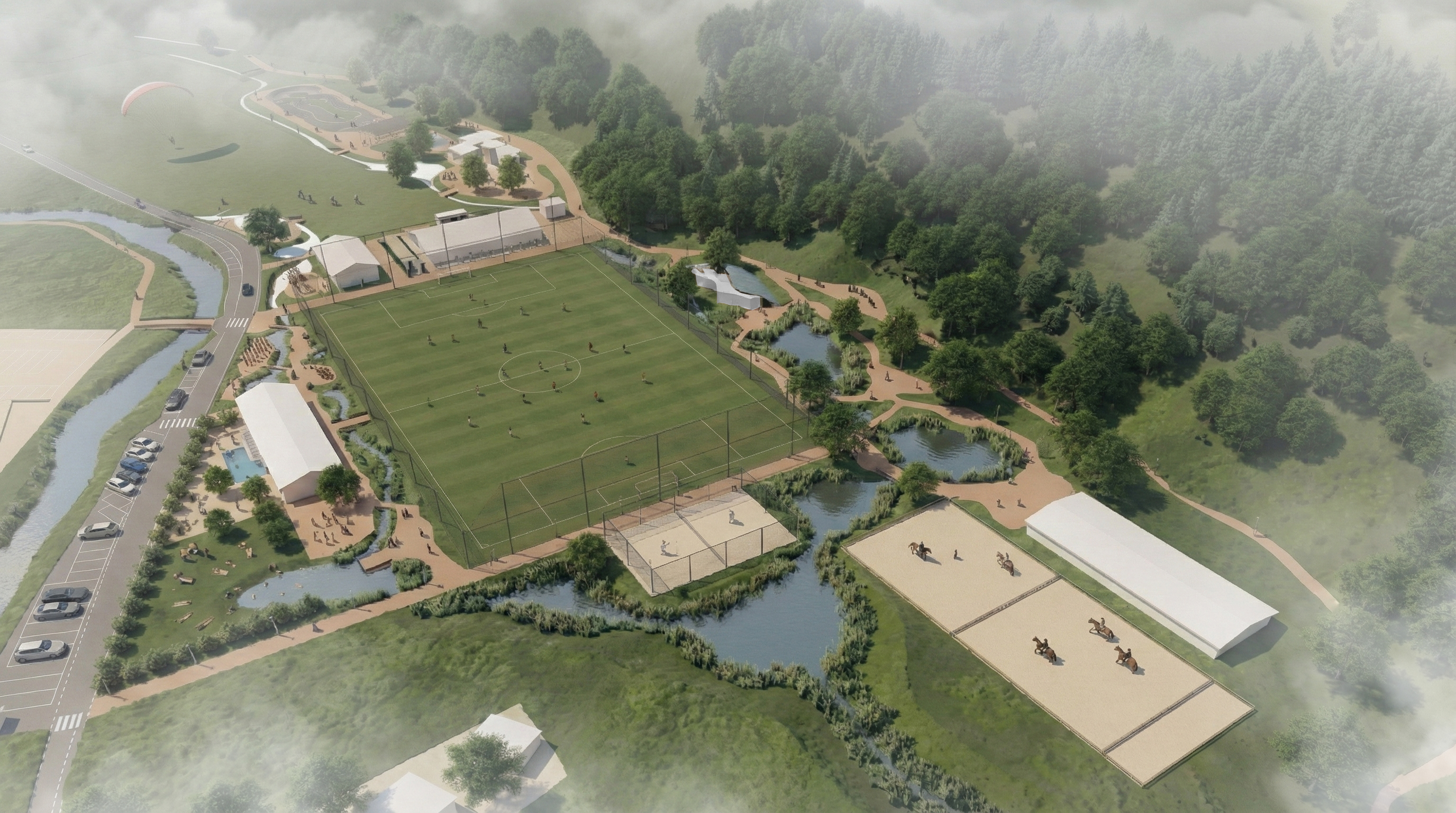
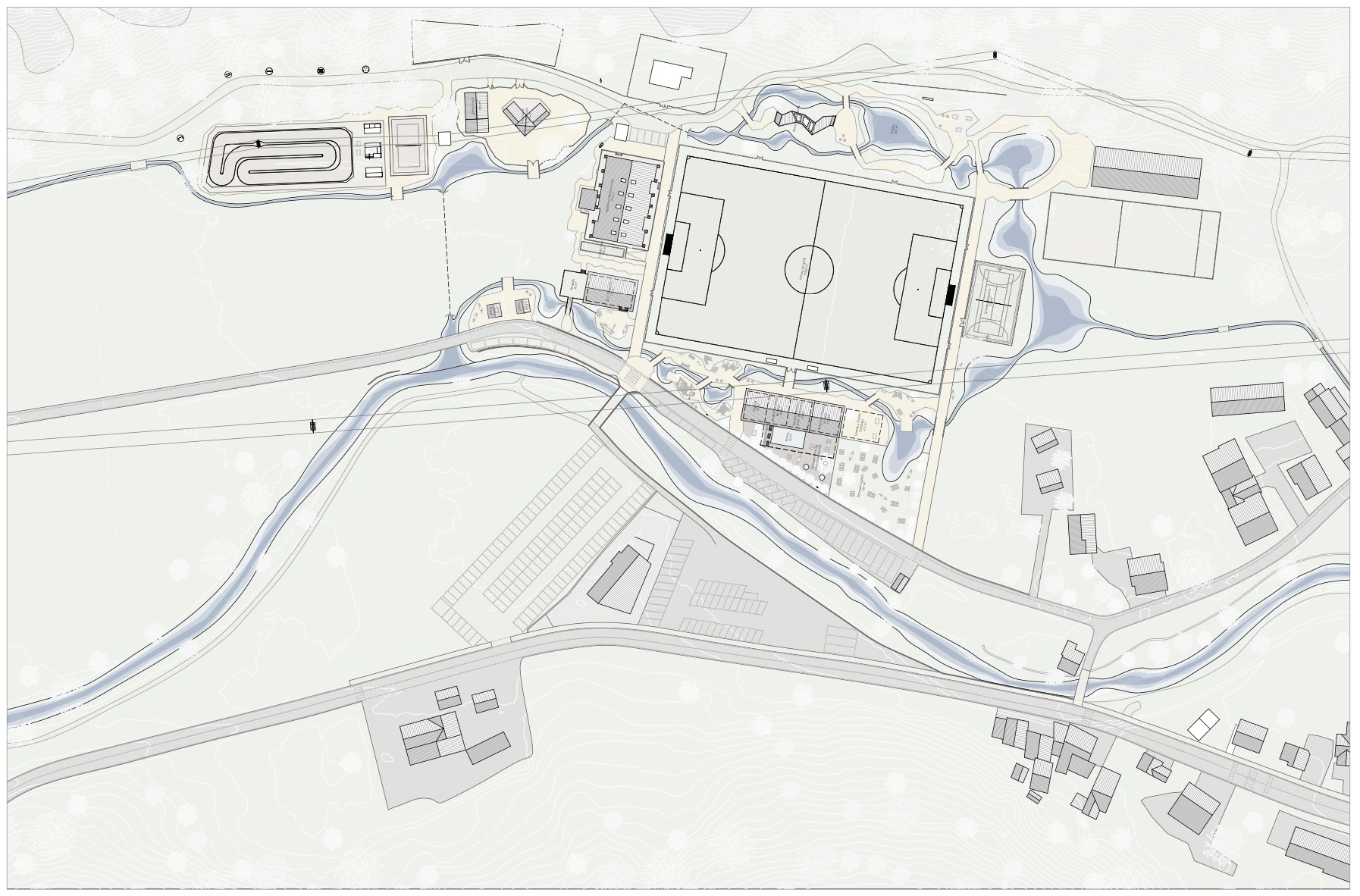
From a social perspective, the regeneration creates a public space accessible in all seasons, designed for different age groups and needs, where people can practice mountain sports, both traditional and national (football, tennis, climbing, mountain biking, palet, skateboarding, paragliding, beach volleyball, horse riding, etc.), meet, participate in environmental education and cultural activities, counteracting depopulation and strengthening the sense of belonging.
From an economic perspective, the regenerated field becomes a lever to diversify the tourism offer beyond skiing, attracting low-impact outdoor practices, events and services that generate new opportunities for local businesses and associations.
These objectives are pursued through a co-design process led by academic researchers, which involved the local administration, technicians, operators, citizens and tourists, in line with the Quintuple Helix model and systemic design, thereby restoring a key role to the environment in public decision-making processes oriented toward sustainable local development.
The initiative may represent a virtuous example for other small Alpine municipalities, as it shows how even small local administrations can rethink existing infrastructure through an ecosystemic and social approach—reducing environmental impact while generating shared value for the community, businesses and the planet.
From a social perspective, the regeneration creates a public space accessible in all seasons, designed for different age groups and needs, where people can practice mountain sports, both traditional and national (football, tennis, climbing, mountain biking, palet, skateboarding, paragliding, beach volleyball, horse riding, etc.), meet, participate in environmental education and cultural activities, counteracting depopulation and strengthening the sense of belonging.
From an economic perspective, the regenerated field becomes a lever to diversify the tourism offer beyond skiing, attracting low-impact outdoor practices, events and services that generate new opportunities for local businesses and associations.
These objectives are pursued through a co-design process led by academic researchers, which involved the local administration, technicians, operators, citizens and tourists, in line with the Quintuple Helix model and systemic design, thereby restoring a key role to the environment in public decision-making processes oriented toward sustainable local development.
The initiative may represent a virtuous example for other small Alpine municipalities, as it shows how even small local administrations can rethink existing infrastructure through an ecosystemic and social approach—reducing environmental impact while generating shared value for the community, businesses and the planet.
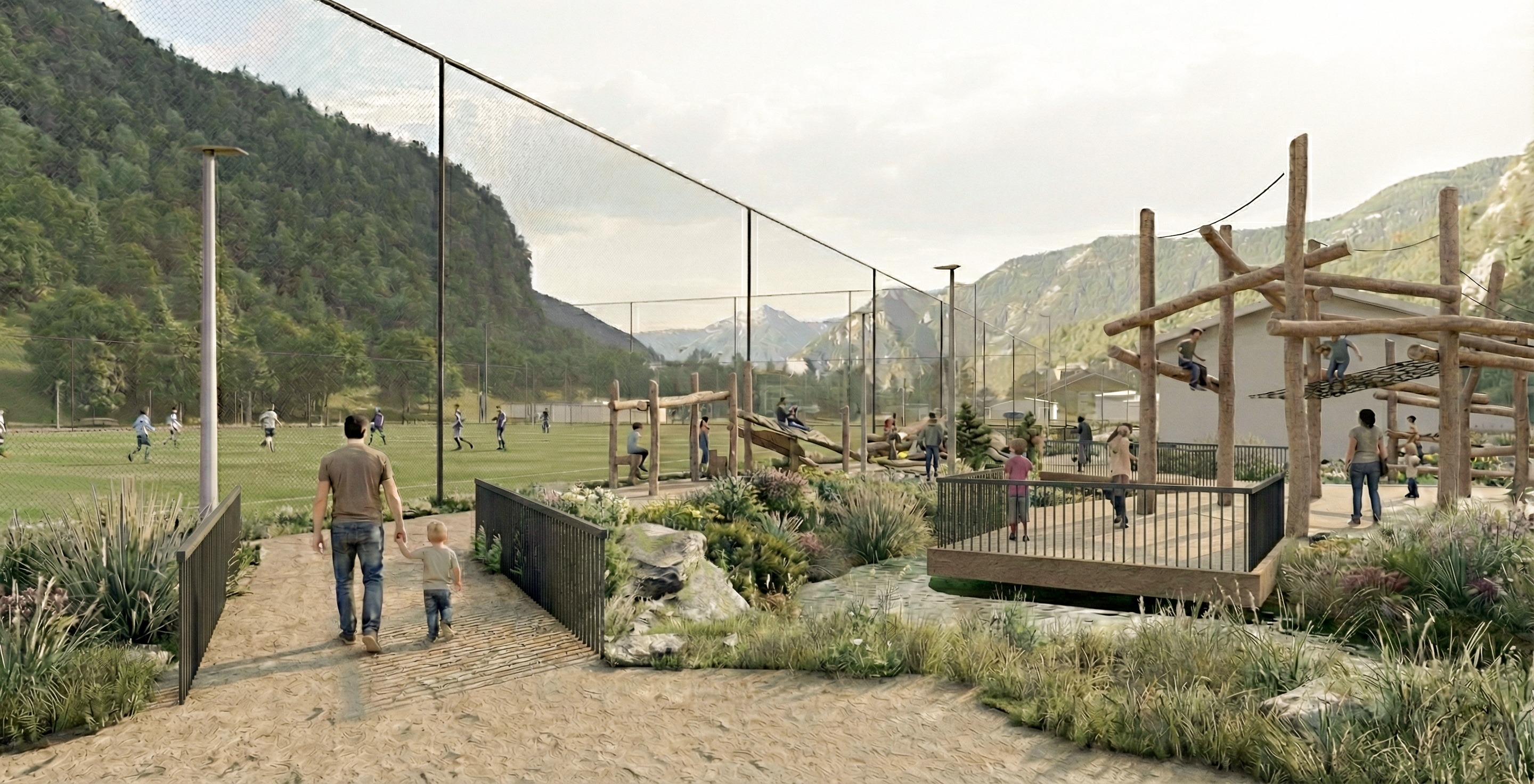
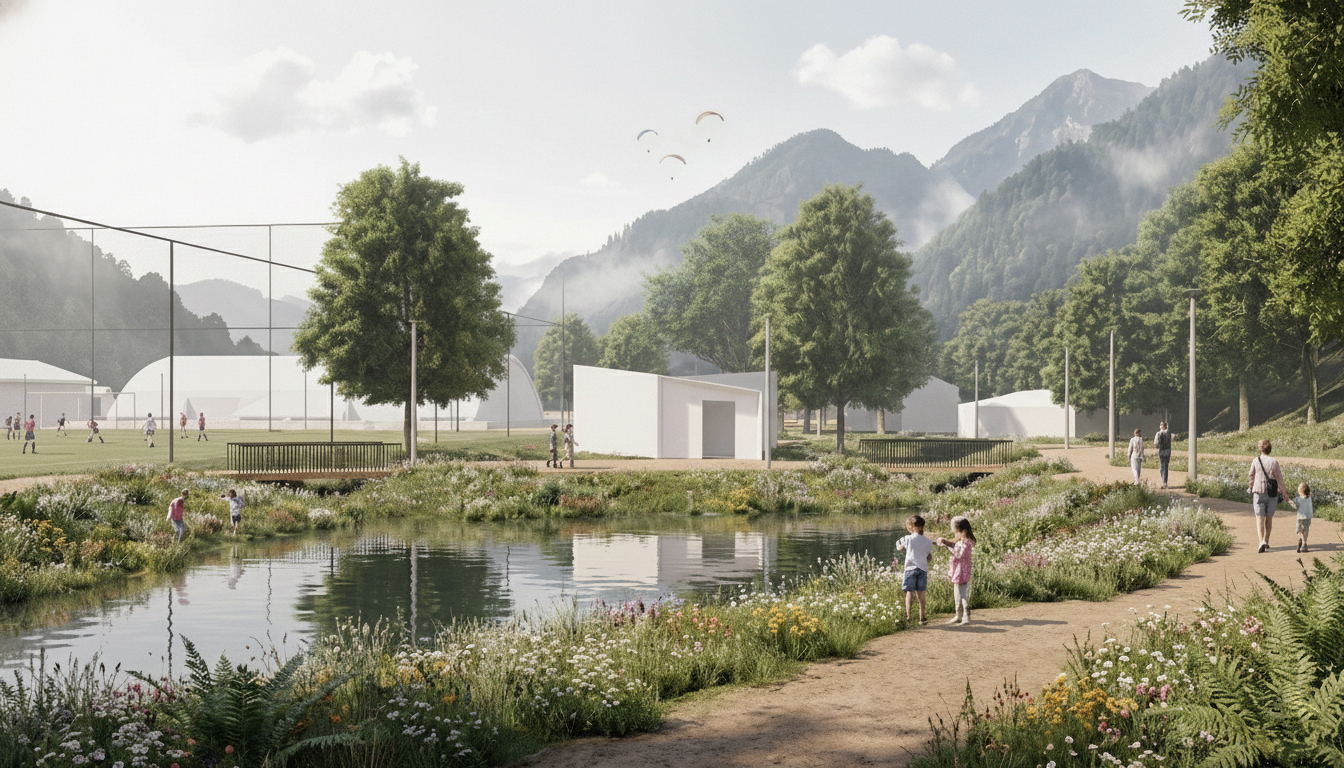
The project aims to transform a simple disused sports field into a public landscape in dialogue with the Alps, offering a high-quality everyday aesthetic experience for both residents and visitors. The design integrates water—channeling the stream into flows and basins that frame and cross the site according to the “sponge city” model - native vegetation and natural materials to create pathways, resting areas and play zones that enhance views of the landscape, improve microclimatic comfort and make the space enjoyable in every season.
In line with the results of the systemic co-design process, which called for fewer infrastructures and greater integration with nature, the quality of the experience is created through flexible, minimal, modular and accessible spaces where sports, cultural events, school workshops, slow tourism activities and relaxation can coexist, transforming the field into a kind of “green square” for the community. The project includes lighting, furnishings and signage solutions that narrate the history of the place, the role of water and the challenges of climate change, generating awareness and a sense of belonging.
This approach makes Antey-Saint-André a virtuous example, demonstrating how even in a small mountain municipality a sports infrastructure can become a cultural and landscape device, where functionality is combined with emotion, education and cultural identity.
In line with the results of the systemic co-design process, which called for fewer infrastructures and greater integration with nature, the quality of the experience is created through flexible, minimal, modular and accessible spaces where sports, cultural events, school workshops, slow tourism activities and relaxation can coexist, transforming the field into a kind of “green square” for the community. The project includes lighting, furnishings and signage solutions that narrate the history of the place, the role of water and the challenges of climate change, generating awareness and a sense of belonging.
This approach makes Antey-Saint-André a virtuous example, demonstrating how even in a small mountain municipality a sports infrastructure can become a cultural and landscape device, where functionality is combined with emotion, education and cultural identity.
The initiative places inclusion at its core, both in terms of physical accessibility and economic and governance accessibility. The municipality has already secured dedicated funding for the removal of barriers and for improving the usability of the area for people with disabilities, integrating accessible pathways, sports infrastructure adapted for disabilities, and specific experiential services such as sensory paths.
The action research also clearly highlighted the need to build a balance between sometimes conflicting interests: keeping costs low to guarantee equal access, while ensuring the economic sustainability of maintenance and distributing benefits fairly among residents, second-home owners, tourists, associations and local operators. In this regard, the participatory process revealed the need to share the burden of maintenance among the economic actor that will manage the complex, the Municipality and the community, which has proposed organising collective “corvée” days to contribute to cleaning and maintenance of the area. The project is based on an interconnected design of the different spaces (e.g., children’s playgrounds located next to shaded areas for grandparents and accompanying adults, sports areas close to spaces for social interaction and relaxation, etc.), in order to create mixed and intergenerational uses.
The co-design process therefore became itself an instrument of inclusion, in which different actors—including the Alpine environment, considered as a critical agent—negotiated priorities and solutions, building a model of open governance that values all voices, including those less often heard. In this sense, Antey-Saint-André offers a virtuous example of how an infrastructure regeneration project can be leveraged to generate experimental regeneration towards new, more equitable and shared social and decision-making models.
The action research also clearly highlighted the need to build a balance between sometimes conflicting interests: keeping costs low to guarantee equal access, while ensuring the economic sustainability of maintenance and distributing benefits fairly among residents, second-home owners, tourists, associations and local operators. In this regard, the participatory process revealed the need to share the burden of maintenance among the economic actor that will manage the complex, the Municipality and the community, which has proposed organising collective “corvée” days to contribute to cleaning and maintenance of the area. The project is based on an interconnected design of the different spaces (e.g., children’s playgrounds located next to shaded areas for grandparents and accompanying adults, sports areas close to spaces for social interaction and relaxation, etc.), in order to create mixed and intergenerational uses.
The co-design process therefore became itself an instrument of inclusion, in which different actors—including the Alpine environment, considered as a critical agent—negotiated priorities and solutions, building a model of open governance that values all voices, including those less often heard. In this sense, Antey-Saint-André offers a virtuous example of how an infrastructure regeneration project can be leveraged to generate experimental regeneration towards new, more equitable and shared social and decision-making models.
All final users and beneficiaries of the intervention - namely residents, second-home owners, associations, economic operators and regular tourists - were involved from the earliest phases as co-designers of the new sports field through a structured process of listening and iterative, self-informed dialogue. Following an ecosystemic analysis of the current state of the art, an initial questionnaire was administered during a highly attended local festival and disseminated through the municipality’s institutional channels, collecting 338 responses from approximately 600 residents. This represents an extraordinary participation rate (> 50%), which made it possible to map priorities and preferences regarding sustainability, usability, expected benefits, governance of the area and open suggestions for the redevelopment. The questionnaire emphasized the community value, highlighting the primarily social rather than economic nature of the regeneration process.
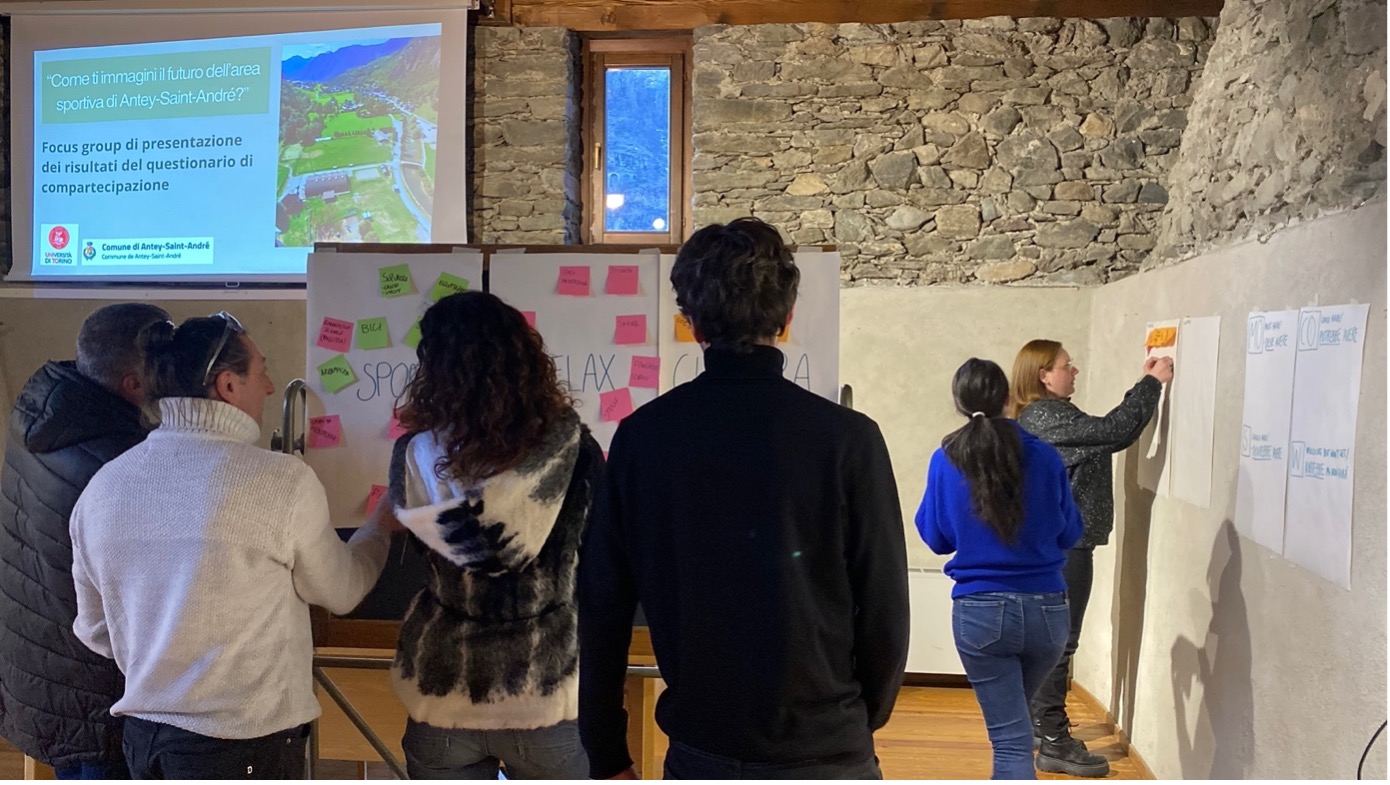
The results were analyzed by researchers and discussed in a first focus group with the municipal council and technical designers, with the aim of guiding operational decisions towards an evidence-based design and exploring the fundamental role of the environment as an active actor within the project. A second focus group then involved representatives of residents, tourists and second-home owners, associations and local entrepreneurs, ensuring a diversity of ages and interests to discuss and potentially validate the solutions emerging at the functional levels.
The final scientific report supported the designers in defining the technical project, which was subsequently presented and shared with the community and regional stakeholders, strengthening transparency and the legitimacy of the decisions taken. This process, combining participatory research methods and local governance, makes the initiative a replicable example of deep and structured citizen engagement in decisions concerning a strategic public asset.
The results were analyzed by researchers and discussed in a first focus group with the municipal council and technical designers, with the aim of guiding operational decisions towards an evidence-based design and exploring the fundamental role of the environment as an active actor within the project. A second focus group then involved representatives of residents, tourists and second-home owners, associations and local entrepreneurs, ensuring a diversity of ages and interests to discuss and potentially validate the solutions emerging at the functional levels.
The final scientific report supported the designers in defining the technical project, which was subsequently presented and shared with the community and regional stakeholders, strengthening transparency and the legitimacy of the decisions taken. This process, combining participatory research methods and local governance, makes the initiative a replicable example of deep and structured citizen engagement in decisions concerning a strategic public asset.
The initiative is based on a multi-level collaboration strategy that starts at the municipal level and extends to the European dimension. At the local level, the Municipality of Antey-Saint-André leads the regeneration process and coordinates the involvement of citizens, associations, businesses and schools, assuming the role of director and guarantor of the public interest.
At the regional level, discussions are underway with the Autonomous Region of Aosta Valley to define a program agreement recognizing the area as an intervention of regional interest, facilitating co-financing, integration with territorial policies and technical-administrative support. This step strengthens the project’s scalability and its integration into the valley’s climate adaptation and tourism development strategies. The implementation works, divided into phases, are intended to rely on public–private partnership agreements with local, regional and national companies and associations aimed at providing economic sponsorship for the area and supporting its long-term financial management.
At the national and Eu level, the Municipality, together with public and private partners, intends to use the project as leverage to apply for funding calls from the regional LAG, the Italian Ministry for Sport, and programmes such as Interreg ALCOTRA, Alpine Space and LIFE, building consortia with other Alpine territories and research actors. The value of this multi-level engagement strategy is twofold: on the one hand, to increase the financial resources and expertise available for the implementation and management of the area; on the other, to transform Antey-Saint-André into a pilot laboratory of territorial innovation capable of generating transferable knowledge and inspiring other small mountain municipalities across Europe.
Participation in the NEB competition aims to strengthen the legitimacy of the process and generate important visibility, reinforcing the credibility of the project.
At the regional level, discussions are underway with the Autonomous Region of Aosta Valley to define a program agreement recognizing the area as an intervention of regional interest, facilitating co-financing, integration with territorial policies and technical-administrative support. This step strengthens the project’s scalability and its integration into the valley’s climate adaptation and tourism development strategies. The implementation works, divided into phases, are intended to rely on public–private partnership agreements with local, regional and national companies and associations aimed at providing economic sponsorship for the area and supporting its long-term financial management.
At the national and Eu level, the Municipality, together with public and private partners, intends to use the project as leverage to apply for funding calls from the regional LAG, the Italian Ministry for Sport, and programmes such as Interreg ALCOTRA, Alpine Space and LIFE, building consortia with other Alpine territories and research actors. The value of this multi-level engagement strategy is twofold: on the one hand, to increase the financial resources and expertise available for the implementation and management of the area; on the other, to transform Antey-Saint-André into a pilot laboratory of territorial innovation capable of generating transferable knowledge and inspiring other small mountain municipalities across Europe.
Participation in the NEB competition aims to strengthen the legitimacy of the process and generate important visibility, reinforcing the credibility of the project.
The initiative emerges from the intersection of several disciplines: public management and sustainable transition studies, landscape architecture and infrastructure design, environmental engineering and geology, as well as social sciences and participatory methodologies. The Quintuple Helix theory (Carayannis & Campbell, 2010) has been innovatively operationalised in the context of rural regeneration, recognising the environment, citizens, businesses, institutions and academia as interdependent and relational helices within the decision-making process.
Systemic design (Meadows, 2008) provided the interpretative and project-oriented lens through which the territory was understood as a system of interdependent relationships, mapping local actors, environmental flows (such as water systems), social uses of space, climate vulnerabilities and economic opportunities. This approach made it possible to conceive the sports field not as an isolated object but as an active node within a broader territorial ecosystem, capable of connecting infrastructure, landscape, community and local development strategies.
Through questionnaires, focus groups and co-design sessions, administrators, technicians, researchers and the local community were able to compare perspectives and expertise, transforming conflicts and divergences into design elements - for example in the location of functions and in balancing free public access with long-term management sustainability.
The added value of this transdisciplinary process lies in improving both the technical and landscape quality of the project while simultaneously generating new shared knowledge on innovative ways of regenerating sports infrastructures in small Alpine municipalities. This approach departs from the top-down, high-impact Olympic archetype and instead proposes a theoretical–practical model transferable to other territories facing similar challenges of climate adaptation and tourism diversification.
Systemic design (Meadows, 2008) provided the interpretative and project-oriented lens through which the territory was understood as a system of interdependent relationships, mapping local actors, environmental flows (such as water systems), social uses of space, climate vulnerabilities and economic opportunities. This approach made it possible to conceive the sports field not as an isolated object but as an active node within a broader territorial ecosystem, capable of connecting infrastructure, landscape, community and local development strategies.
Through questionnaires, focus groups and co-design sessions, administrators, technicians, researchers and the local community were able to compare perspectives and expertise, transforming conflicts and divergences into design elements - for example in the location of functions and in balancing free public access with long-term management sustainability.
The added value of this transdisciplinary process lies in improving both the technical and landscape quality of the project while simultaneously generating new shared knowledge on innovative ways of regenerating sports infrastructures in small Alpine municipalities. This approach departs from the top-down, high-impact Olympic archetype and instead proposes a theoretical–practical model transferable to other territories facing similar challenges of climate adaptation and tourism diversification.
Many mid-altitude mountain destinations appear locked into a path dependency that forces them to respond to the climate crisis by continuing to invest in the dominant ski-based model: increasingly costly artificial snowmaking, new ski lifts and highly energy-intensive infrastructures, despite rising temperatures and decreasing snowfall making such investments progressively less sustainable in the medium term. The initiative of Antey-Saint-André breaks with this pattern by redirecting resources and attention toward an inclusive and sustainable multi-season tourism diversification that reduces environmental pressures and improves the quality of everyday living spaces not only for tourists but also—and above all—for the local community.
The innovative character of this investment therefore lies in treating a sports field as a central device for climate adaptation, landscape regeneration and social cohesion, capable of generating benefits for both residents and visitors throughout the year. Instead of pursuing Olympic-style models—“cathedrals in the desert” that are difficult to sustain for small municipalities—the project experiments with a lightweight, resilient and multifunctional infrastructure based on nature, sport and inclusive social interaction.
Investing today in this type of intervention means anticipating a transition that many Alpine destinations will have to face in the coming years: shifting the centre of gravity from a high-impact, single-season tourism model to a more diffuse, accessible and climate-aware use of public spaces. In this sense, Antey-Saint-André can become a leading case for other mid-altitude mountain areas seeking ways out of the traditional ski lock-in, developing a model in which such infrastructures move beyond an ancillary role and become a core driver of attractiveness and internal social cohesion.
The innovative character of this investment therefore lies in treating a sports field as a central device for climate adaptation, landscape regeneration and social cohesion, capable of generating benefits for both residents and visitors throughout the year. Instead of pursuing Olympic-style models—“cathedrals in the desert” that are difficult to sustain for small municipalities—the project experiments with a lightweight, resilient and multifunctional infrastructure based on nature, sport and inclusive social interaction.
Investing today in this type of intervention means anticipating a transition that many Alpine destinations will have to face in the coming years: shifting the centre of gravity from a high-impact, single-season tourism model to a more diffuse, accessible and climate-aware use of public spaces. In this sense, Antey-Saint-André can become a leading case for other mid-altitude mountain areas seeking ways out of the traditional ski lock-in, developing a model in which such infrastructures move beyond an ancillary role and become a core driver of attractiveness and internal social cohesion.
The methodology is based on a participatory action research process led by the University of Turin in collaboration with the University of Geneva, that intertwines civic participation, technical design and the production of scientific knowledge. The process was structured into 4 complementary and iterative phases: analysis of the context and climate risks; extensive engagement with the population through a questionnaire; presentation and discussion of the results with administrators and designers; co-design and validation with local stakeholders; and the definition of the project foundations for public feedback and sharing with subsequent governance levels.
The Quintuple Helix theory guided the governance framework, recognizing the active role of the environment, the community, institutions, businesses and the research sector in regeneration decisions. Systemic design was used as a tool for interpreting and designing the territory, enabling the mapping of involved actors, environmental flows, sports and recreational functions, relationships with the landscape and socio-economic impacts. This approach made it possible to develop integrated design scenarios capable of connecting infrastructure, environment and community within a coherent long-term territorial vision.
The Universities and the Municipality worked in synergy to create a territorial laboratory in which researchers developed the analytical tools and processes, while administrators, technicians and citizens contributed local knowledge and operational expertise. This iterative approach, alternating phases of investigation, co-design and verification with end users, helps reduce decision-making errors, increase social ownership of the project and generate a replicable model - particularly in small contexts with limited resources but shared ambitions. The results contributed to the development of participatory and shared governance strategies that will be implemented in the management of the regenerated area
The Quintuple Helix theory guided the governance framework, recognizing the active role of the environment, the community, institutions, businesses and the research sector in regeneration decisions. Systemic design was used as a tool for interpreting and designing the territory, enabling the mapping of involved actors, environmental flows, sports and recreational functions, relationships with the landscape and socio-economic impacts. This approach made it possible to develop integrated design scenarios capable of connecting infrastructure, environment and community within a coherent long-term territorial vision.
The Universities and the Municipality worked in synergy to create a territorial laboratory in which researchers developed the analytical tools and processes, while administrators, technicians and citizens contributed local knowledge and operational expertise. This iterative approach, alternating phases of investigation, co-design and verification with end users, helps reduce decision-making errors, increase social ownership of the project and generate a replicable model - particularly in small contexts with limited resources but shared ambitions. The results contributed to the development of participatory and shared governance strategies that will be implemented in the management of the regenerated area
The initiative of Antey-Saint-André is conceived as a replicable model for other small rural municipalities whose everyday context develops within a natural landscape and that aspire to regenerate infrastructure and public spaces in terms of climate adaptation and social inclusion. From a methodological perspective, the transferable elements include the action research approach, the combination of community questionnaires and multi-actor focus groups, the use of the Quintuple Helix to structure governance, and systemic design to analyse relationships, flows and uses of the area.
From a design perspective, the lightweight and nature-based solutions used to manage water, create shade, improve microclimatic comfort and make sports fields and open spaces usable throughout the year can be replicated, adapting them to different contexts (other Alpine municipalities, inner areas or urban peripheries). The “hybrid” sports field model—which integrates sport, social interaction, environmental education and small cultural events—can also be applied to other existing facilities, transforming them into central places for everyday community life.
Finally, the lessons learned regarding the management of conflicts between different interests (economic accessibility, long-term management sustainability, tourism-related and generational needs) and the importance of involving citizens, associations and economic actors early and in a structured way are also transferable. This broadens the scope of the project from a simple local intervention to a laboratory of practices and tools that can inspire policies and projects in other contexts, demonstrating that, despite limited local resources, even the smallest and most vulnerable and peripheral communities can successfully respond to contemporary wicked problems such as climate change.
From a design perspective, the lightweight and nature-based solutions used to manage water, create shade, improve microclimatic comfort and make sports fields and open spaces usable throughout the year can be replicated, adapting them to different contexts (other Alpine municipalities, inner areas or urban peripheries). The “hybrid” sports field model—which integrates sport, social interaction, environmental education and small cultural events—can also be applied to other existing facilities, transforming them into central places for everyday community life.
Finally, the lessons learned regarding the management of conflicts between different interests (economic accessibility, long-term management sustainability, tourism-related and generational needs) and the importance of involving citizens, associations and economic actors early and in a structured way are also transferable. This broadens the scope of the project from a simple local intervention to a laboratory of practices and tools that can inspire policies and projects in other contexts, demonstrating that, despite limited local resources, even the smallest and most vulnerable and peripheral communities can successfully respond to contemporary wicked problems such as climate change.
Based on the preliminary design co-developed with citizens, technicians and researchers, the Municipality of Antey-Saint-André is now launching the implementation phase by negotiating programme agreements, entrepreneurial collaborations and potential co-financing with the Autonomous Region of Valle d’Aosta and other institutional and private partners. The planned activities concern the redevelopment of the obsolete infrastructures of the sports field and its surrounding areas according to principles of innovation, environmental sustainability, inclusiveness, economic manageability and preventive resilience to climate risks.
The NEB values have so far been integrated through strong community involvement (inclusion), the adoption of consumption-reduction strategies, the application of nature-based solutions and the intelligent management of water (sustainability), and careful attention to landscape quality and everyday spaces, thoughtfully integrated into the surrounding environment (beauty). The action research methodology and the reference to the Quintuple Helix ensured that both design and governance choices were discussed with all relevant actors, including the environment itself.
The next steps include the formalisation of multi-level partnerships; applications to regional, national and European funding programmes to support the different phases of the intervention; the preparation of final executive designs incorporating additional moments of public feedback; and the definition of a participatory management model for the regenerated field that will maintain alignment with NEB values over time and ensure fair and high-quality access for residents and visitors. This pathway aims to consolidate Antey-Saint-André as an NEB demonstrator for small Alpine municipalities.
The NEB values have so far been integrated through strong community involvement (inclusion), the adoption of consumption-reduction strategies, the application of nature-based solutions and the intelligent management of water (sustainability), and careful attention to landscape quality and everyday spaces, thoughtfully integrated into the surrounding environment (beauty). The action research methodology and the reference to the Quintuple Helix ensured that both design and governance choices were discussed with all relevant actors, including the environment itself.
The next steps include the formalisation of multi-level partnerships; applications to regional, national and European funding programmes to support the different phases of the intervention; the preparation of final executive designs incorporating additional moments of public feedback; and the definition of a participatory management model for the regenerated field that will maintain alignment with NEB values over time and ensure fair and high-quality access for residents and visitors. This pathway aims to consolidate Antey-Saint-André as an NEB demonstrator for small Alpine municipalities.