Enhancing Circularity, Sustainability, and Innovation
Greatest Outdoor Adventure Toolkit
Greatest Outdoor Adventure Toolkit - Collective outdoor system reconnecting youth with nature.
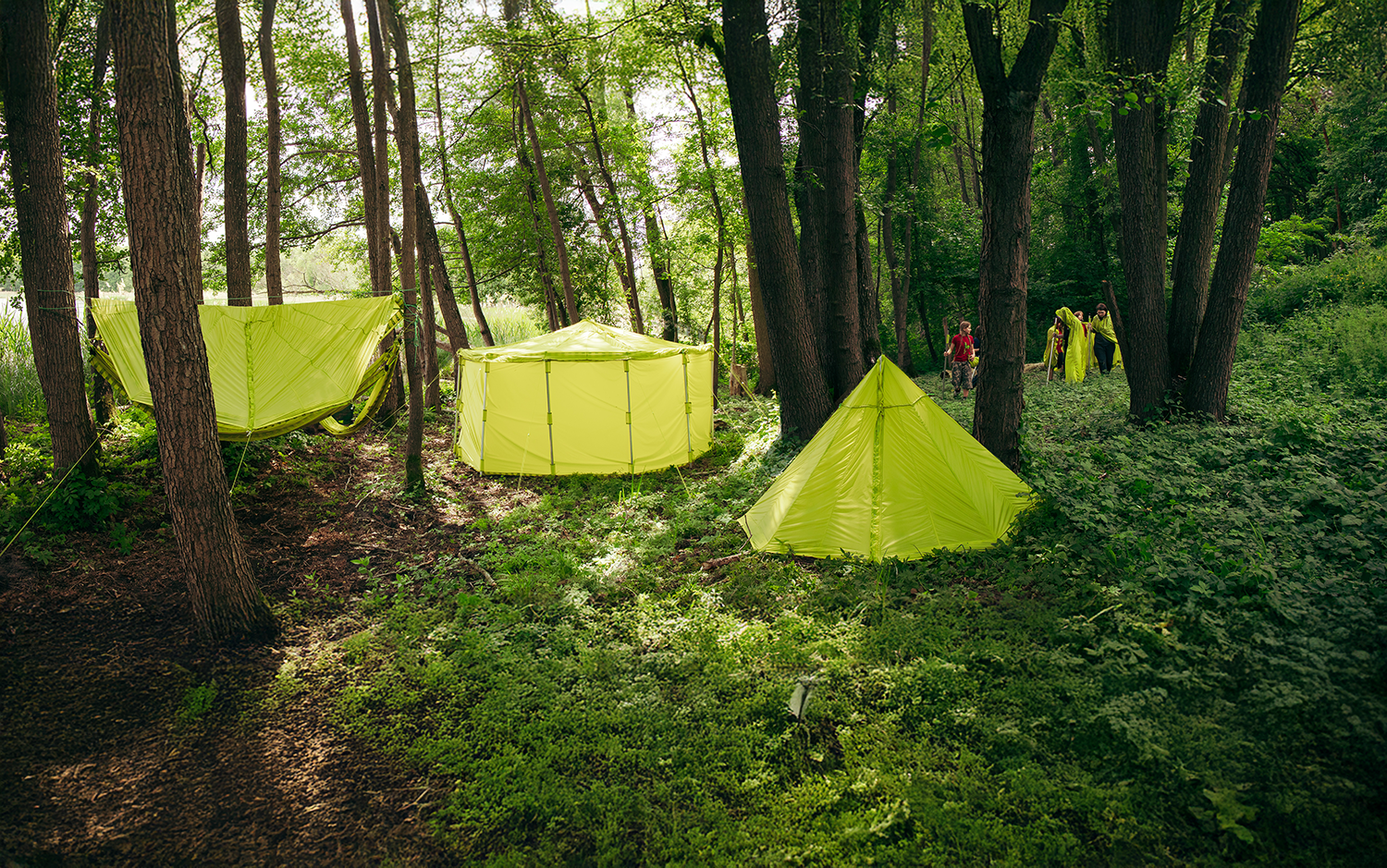
G.O.A.T. Greatest Outdoor Adventure Toolkit reimagines outdoor space as a place for collective discovery, where young people build, explore and reconnect with nature and each other. The project introduces a modular system that enables users to create shared spaces in natural environments, encouraging collaboration, creativity and active engagement. By promoting access over ownership, G.O.A.T. supports circular use and fosters meaningful outdoor experiences.
Poland
Regional
Kuyavia–Pomerania
It addresses urban-rural linkages
It refers to other types of transformations (soft investment)
Prototype level
No
No
No
Individual
G.O.A.T. Greatest Outdoor Adventure Toolkit is a product and service design concept addressing the growing disconnection of young people from nature and peer interaction. The project responds to declining time spent outdoors and increasing reliance on technology. Its main aim is to support meaningful engagement with nature through shared experiences that strengthen wellbeing.
The project is designed for teenagers aged 14-18, as well as schools, youth organisations and community groups. It creates an accessible entry point outdoors, regardless of prior experience and skills.
The core objective is to increase the frequency and quality of youth outdoor group activities, while fostering collaboration, creativity and a sense of agency. Additionally, the project aims to promote sustainable behaviours by encouraging shared use of resources and reducing the need for individual ownership of outdoor equipment.
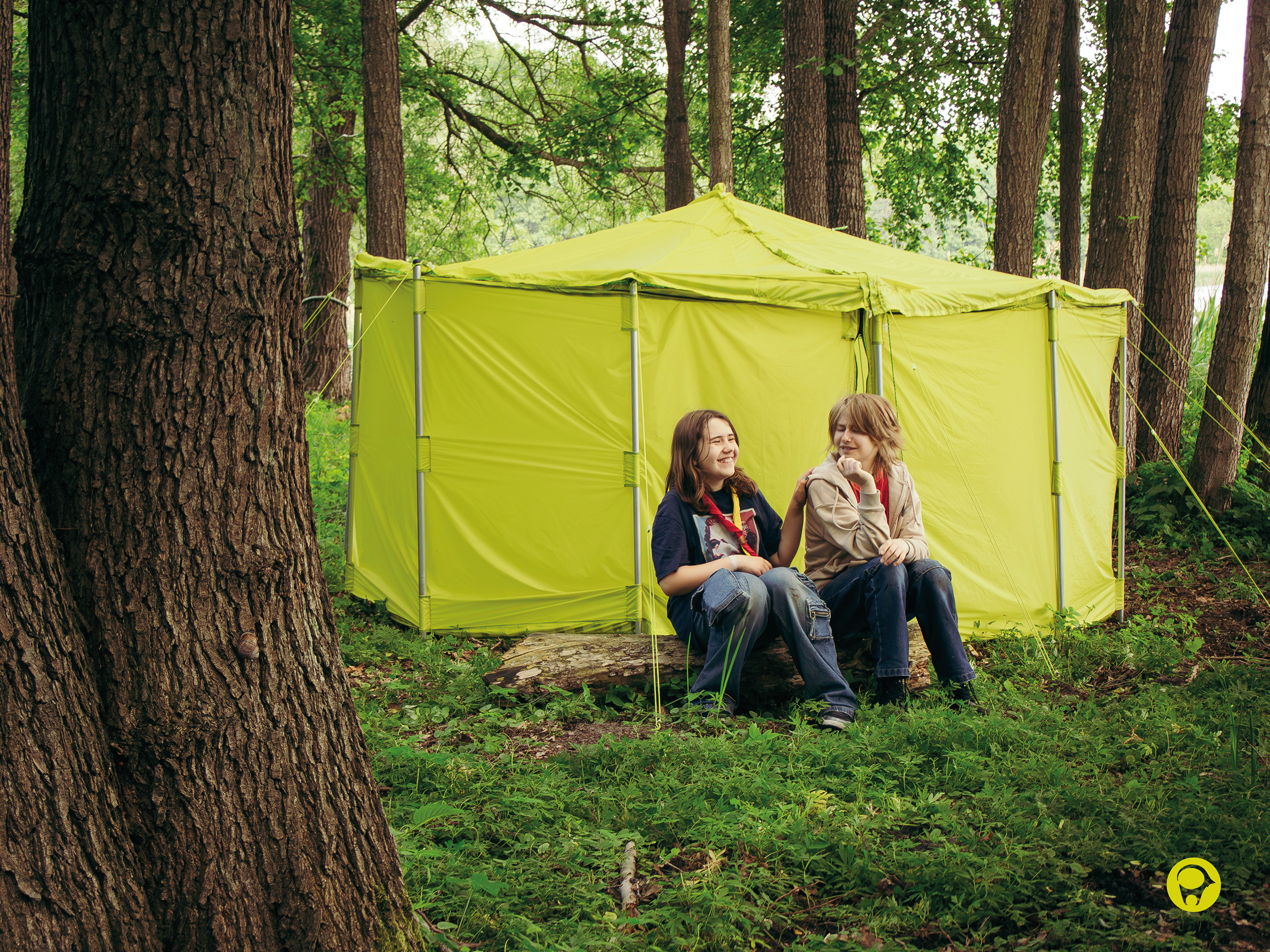
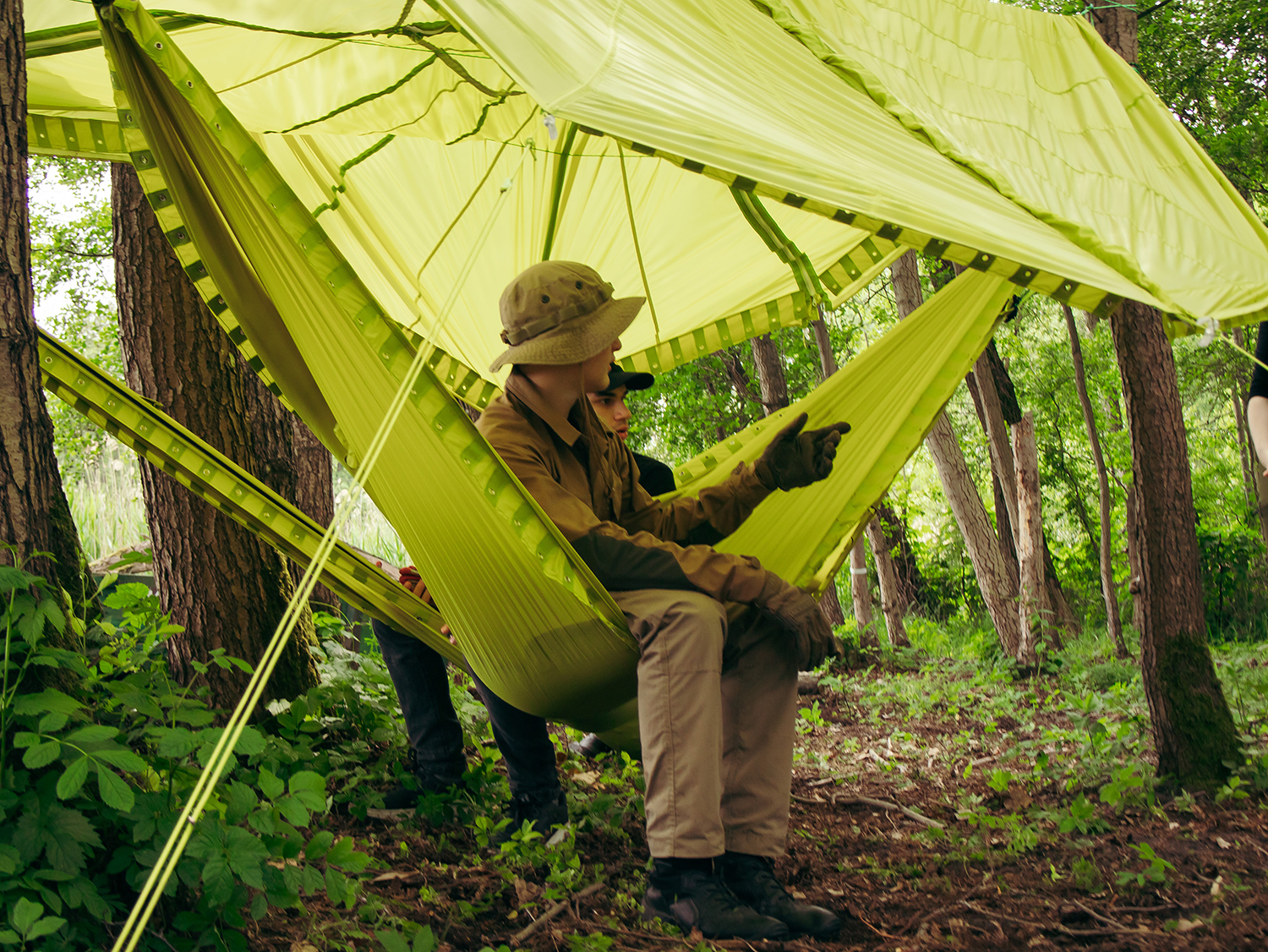
G.O.A.T. is based on a modular system of lightweight and durable elements that can be combined to create a variety of structures in natural settings. Users can build temporary shelters, gathering spaces and resting areas, adapting to different contexts. The system is intuitive and designed for collective use. It is supported by a rental access model, extending product lifecycle in line with circular economy principles.
Developed as a functional prototype, the project has been tested through initial user interactions, prototyping sessions and research on youth behaviour. Observations indicate increased engagement, cooperation and willingness to spend time outdoors. Users showed a strong preference for open-ended, collaborative activities, confirming the relevance of the concept.
G.O.A.T. demonstrates a shift from product design to experience-based systems. Its transformative potential lies in combining physical design with social activation and circular access models, offering a scalable framework that reconnects young people with nature and each other.
G.O.A.T. was developed as a master’s diploma project focused on exploring how design can support social interaction and reconnect young people with nature. The idea emerged from my personal experience as a scout leader, where I observed how outdoor activities, shared challenges and simple tools can naturally build relationships, confidence and engagement among young people. At the same time, I noticed that such experiences are often limited to specific environments and not easily accessible to a wider group of teenagers. This led to the intention of translating scouting, outdoor education methods into a design solution that could function beyond structured organisations.
The development process was based on research into youth behaviour, including analysis of how teenagers spend their free time and how their outdoor activity changes with age. The project followed a design thinking approach, combining research, ideation, prototyping and testing. Early concepts were explored through sketches and simple physical models, focusing on modularity, ease of use and group interaction.
Prototyping played a key role in the process. Successive iterations of the toolkit were developed and tested in outdoor conditions, allowing evaluation of usability, assembly logic and user engagement. Informal testing with young participants and observations from group activities helped refine the system and its functions.
The project integrates knowledge from product design, outdoor education and social research, aiming to create a holistic response to the identified problem. Decisions were guided by the goal of creating a system that is intuitive and encouraging collaboration.
If further developed, the project would focus on expanding testing in collaboration with schools and youth organisations, refining the borrowing model and strengthening its role as a tool for building accessible, shared outdoor experiences for young people.
nature-based experiential design
outdoor education
circular economy
youth wellbeing
sustainable design
G.O.A.T. addresses sustainability by promoting responsible resource use and fostering a more conscious relationship between youth and nature. The project responds to environmental and social challenges such as overconsumption of outdoor equipment, short product lifecycles and the decreasing presence of young people outside. Its main objective is to reduce material demand while increasing meaningful, long-term engagement with outdoor spaces.
This is achieved through a circular product-service system based on shared access rather than ownership. The rental model reduces the need for individual consumption and allows multiple users to benefit from same resources. The toolkit is designed using durable, water-resistant materials and modular components that can be repaired, replaced and reconfigured, extending product lifespan and helping to close the loop in its lifecycle. Lightweight construction and efficient packing further reduce transport impact and support ease of use.
Project has been developed as a functional prototype and tested in real outdoor conditions. Initial observations and user interactions indicate increased engagement in group activities, longer time spent outdoors and a reduced need for multiple individual products. The shared use model also encourages a sense of responsibility and care for the equipment and the environment.
Beyond the physical system, G.O.A.T. promotes sustainable behaviours by encouraging collective use and awareness of natural surroundings. It supports a shift from consumption-based outdoor activity to experience-based engagement.
What makes the project exemplary is its approach, combining environmental, social and behavioural sustainability. Rather than focusing solely on materials or production, G.O.A.T. redefines how outdoor products are accessed and used. It offers a scalable model that links circular design with social activation, creating a durable and forward-looking framework for sustainable interaction with nature.
G.O.A.T. contributes to aesthetics by shaping meaningful, engaging experiences in natural environments and redefining how young people perceive and use outdoor space. Its main objective is to transform nature into a place of collective discovery, where exploring and interacting become part of everyday life, enhancing both individual wellbeing and social connection.
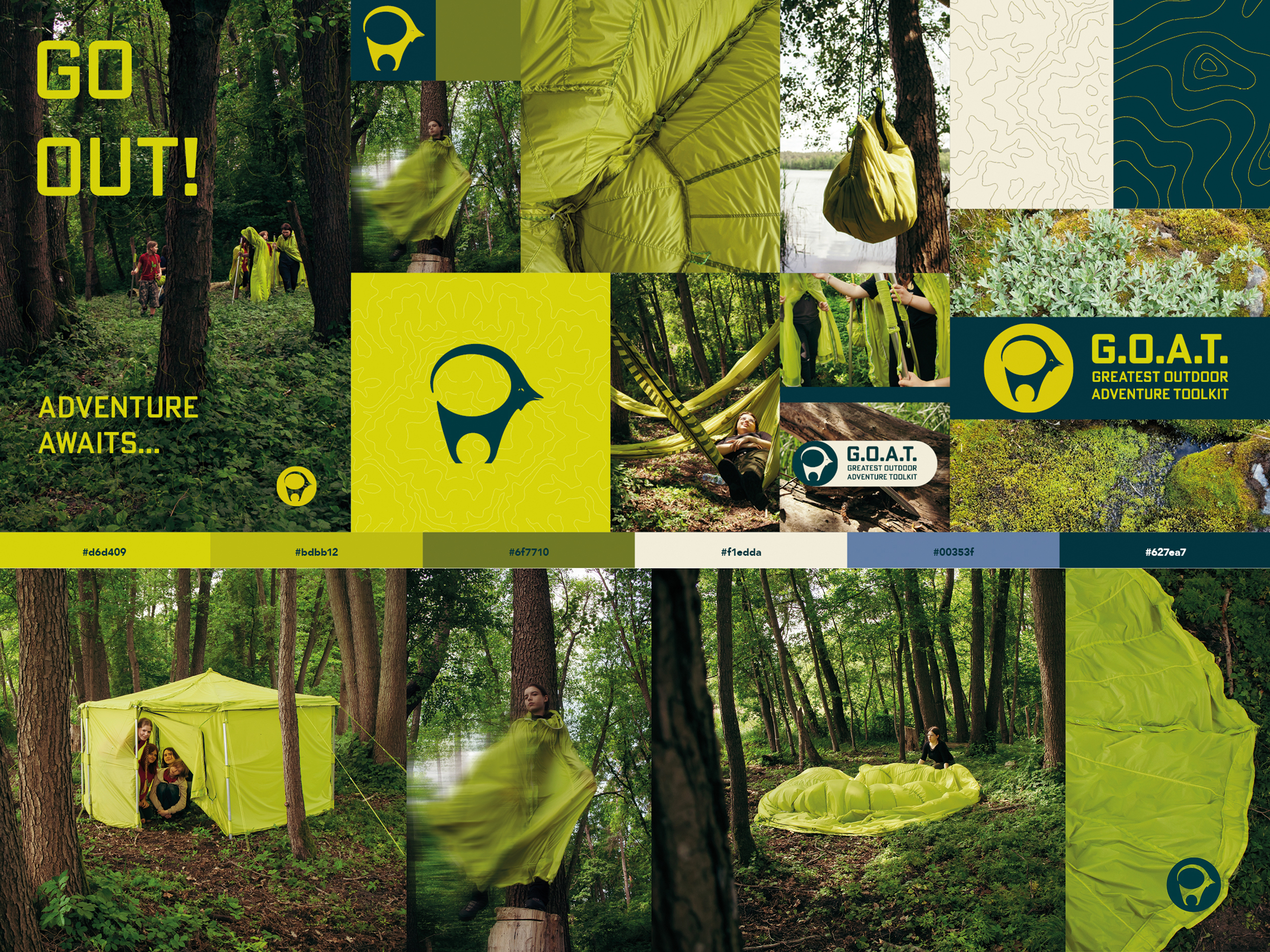
Project draws from contemporary cultural trends, particularly the growing interest in outdoor lifestyles and nature-based activities. Its visual language is inspired by gorpcore aesthetics, combining technical outdoor functionality with youth-oriented identity. This is reflected in the choice of colours and forms, creating a system that feels both accessible and culturally relevant, bridging urban and natural environments.
G.O.A.T. integrates design, culture and craftsmanship through its modular system, which allows users to actively shape space. The simplicity of the elements enable intuitive use, while their adaptability supports creative expression. Users are not only interacting with a designed object, but co-creating space, which strengthens their sense of belonging.
The quality of experience is central to the project. Building temporary structures engages the body, movement, spatial perception—while direct contact with natural surroundings enhances emotional wellbeing. The act of collective creation fosters connection, not only between users but also with the environment itself.
Culturally, the project reflects and amplifies a shift towards outdoor living as a form of identity and expression among younger generations. It supports creativity, shared rituals and new forms of social interaction rooted in nature.
What makes G.O.A.T. exemplary is its shift from object-based aesthetics to experience-based design. Beauty is not defined by a product, but emerges through collaboration and the relationship between designed elements and the natural environment, creating a lasting aesthetic experience.
Greatest Outdoor Adventure Toolkit – Collective outdoor system reconnecting youth with nature promotes social and economic inclusion by making outdoor experiences accessible to a wider and more diverse group of young people. It addresses key barriers such as lack of experience, limited access to equipment and reduced opportunities for meaningful peer interaction. Its main objective is to create an inclusive system that enables participation regardless of background, skills or financial resources.
The project applies design for all principles through simplicity and adaptability. The modular system is intuitive and does not require prior knowledge, allowing users to engage at their own pace and according to their abilities. Its open-ended structure encourages collaboration, where each participant can contribute in different ways, supporting equal participation within the group.
Affordability is addressed through rental-based access model. This significantly lowers financial barriers and enables access through schools, youth organisations and community institutions.
Initial testing with youth groups shows increased engagement, openness and willingness to collaborate. Participants reported a stronger sense of belonging when working together in a shared, non-competitive environment. The system supports the development of social skills, confidence and peer relationships, particularly for those who may be less active or excluded from traditional forms of outdoor activity.
Beyond access, G.O.A.T. promotes a new societal model based on sharing, cooperation and collective responsibility. It shifts outdoor engagement from individual consumption to community-based experience.
Its exemplary character lies in combining accessibility, affordability and social activation within one coherent system. Inclusion is not treated as an additional feature, but as a core design principle, embedded in both the structure of the product and the model of its use.
G.O.A.T. is designed as a participatory system in which users are not passive recipients but active co-creators of the experience. The main beneficiaries are young people aged 14-18, as well as schools, youth organisations and community groups facilitating collective outdoor activities. These stakeholders are both users and contributors, shaping the system through their engagement.
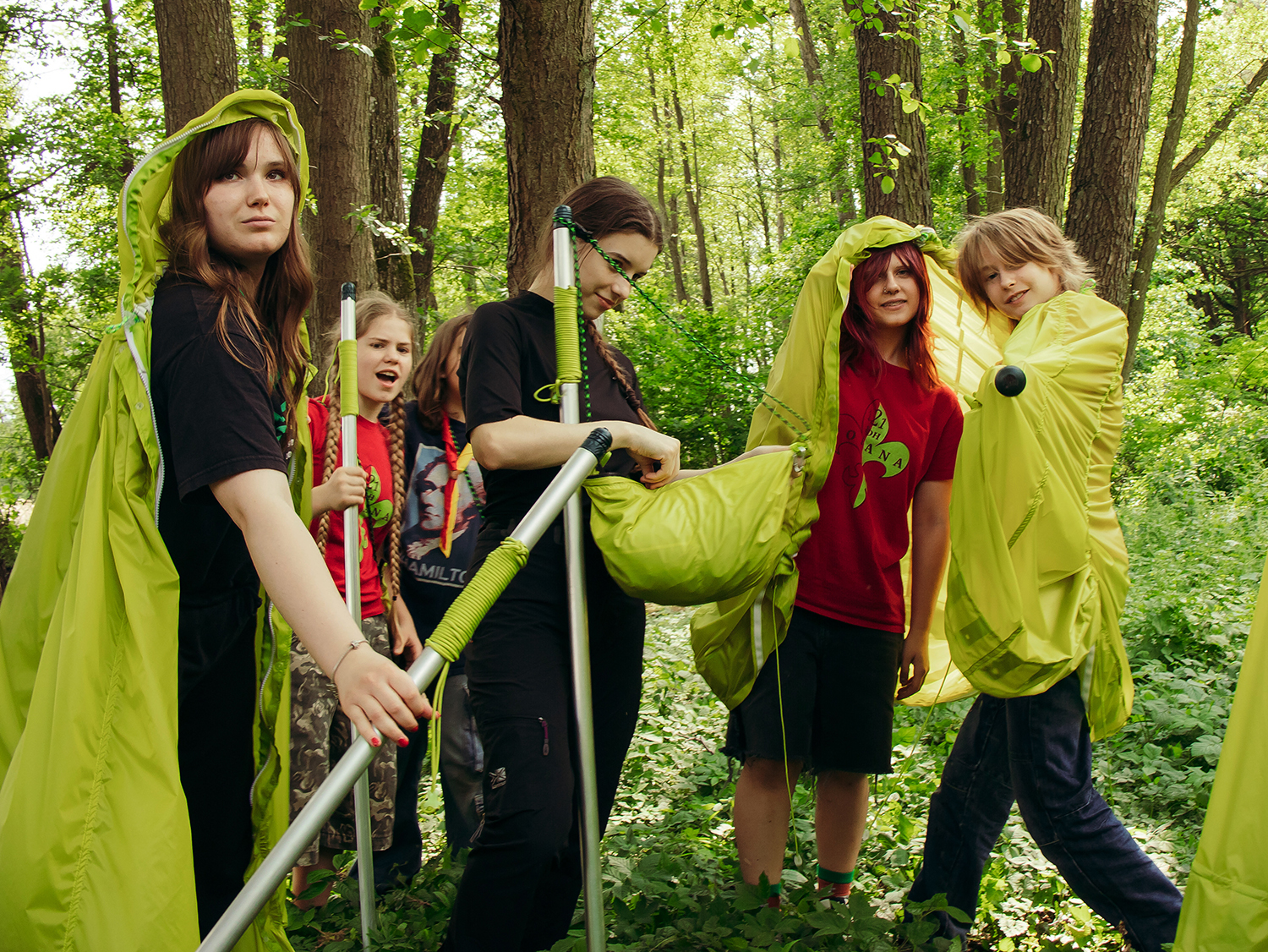
Participation was embedded throughout the development process. Early stages involved research and observation of youth behaviour, followed by iterative prototyping and testing in outdoor conditions. Scout groups from the region were involved in hands-on testing of the prototype, interacting with the system in real-life group scenarios. Informal consultations, feedback sessions and direct observation of group dynamics provided qualitative insights into user needs and behaviours.
Users participated by experimenting with different configurations, testing usability and engaging in collaborative building processes. Their level of influence was significant: feedback directly informed key design decisions, including the simplification of connections, improvement of assembly logic and the open-ended nature of the system. The importance of intuitive use and collective engagement emerged clearly from these interactions.
This participatory process improved the quality and accessibility of the concept. It ensured that the system responds to real behaviours rather than assumed needs, and that it supports cooperation instead of individual use.
Participation continues beyond development. Each use of the toolkit becomes a form of co-creation, where users shape both the physical structures and the social experience. In this way, G.O.A.T. functions as an evolving platform, where engagement, feedback and interaction remain integral to its long-term development and impact.
G.O.A.T. operates across multiple levels, connecting grassroots experiences with institutional frameworks. At the current stage, the project has involved local stakeholders, including scout groups from the region, who participated in early testing of the prototype. Their involvement provided valuable insights into usability, group dynamics and real-life outdoor scenarios, directly informing the development of the system.
At the local level, future implementation is expected to involve schools, youth organisations and community centres, which can facilitate access to the toolkit and organise group activities. These institutions play a key role in embedding the system in everyday practices and ensuring accessibility for young users.
At regional and national levels, the project aligns with educational, health and environmental agendas promoting youth wellbeing, physical activity and connection with nature. Potential stakeholders include educational networks, NGOs focused on youth development and organisations supporting outdoor education.
At the European level, G.O.A.T. resonates with priorities related to sustainability, inclusion and active lifestyles, creating opportunities for alignment with EU-funded programmes and cross-border collaboration.
The added value of multi-level engagement lies in combining local knowledge with institutional support. Stakeholders contribute access to users, infrastructure, expertise and funding opportunities, while the project provides them with a practical tool to achieve their social and educational objectives.
By bridging individual experience with systemic implementation, G.O.A.T. creates a scalable model that links community-based action with broader policy goals, increasing its long-term impact and adaptability across different contexts.
G.O.A.T. is developed through a transdisciplinary approach combining product design, social research, outdoor education and sustainability. The project integrates formal design methodologies with experiential knowledge gained through working directly with young people in outdoor contexts.
The development process was structured as an iterative design cycle, where insights from research, observation and testing informed successive stages of the project. Knowledge from different fields was combined through a design thinking approach, linking analysis, ideation, prototyping and evaluation. This process enabled continuous exchange between theory and practice.
Collaboration across disciplines was supported through consultations and feedback loops involving professionals from different fields. The project was discussed with industrial product designers, contributing to decisions regarding modularity, usability and material solutions. At the same time, educators, pedagogues and outdoor practitioners provided input on group dynamics, learning processes and engagement in natural environments. These perspectives helped shape both the physical toolkit and the user experience.
Practical experience as a scout leader played a key role in bridging formal and non-formal knowledge, offering insights into collaboration, learning through action and the role of nature in youth development. These inputs were not treated separately but integrated throughout the design process, influencing decisions at every stage.
The added value of this approach lies in its holistic character. By combining technical, social and educational perspectives, the project goes beyond a purely functional solution and addresses behavioural and environmental challenges. This enables G.O.A.T. to operate not only as a product, but as a framework for experience, learning and social interaction, adaptable to different contexts and users.
G.O.A.T. is based on a hybrid business model combining a circular product-service system with an organisational structure responsible for implementation. The concept can be operated by a non-profit organisation focused on outdoor education, youth wellbeing and sustainable practices. This entity would manage the toolkit circulation, including rentals, logistics, maintenance and repairs, as well as coordinate educational activities.
Implementation could be financed through public funding (education, youth and environmental programmes), municipalities, NGOs and partnerships with schools and outdoor education providers. At its current stage, the project has been self-funded as part of an academic diploma, but it is designed for further development within institutional and public frameworks.
The concept has strong potential to generate revenue in the future. Income streams include subscription or leasing models for institutions accessing the toolkits, service packages and paid workshops or training programmes for educators and youth leaders.
Key costs include production of durable modular elements, logistics, storage, maintenance, and the development of educational programmes. These costs would be carried by the operating organisation, supported by public funding and revenue from services.
The business model supports long-term sustainability by combining shared access with educational services, reducing individual ownership and extending product lifecycle. Its scalability lies in its adaptability to existing infrastructures such as schools, allowing replication in different regions.
G.O.A.T. also introduces a potentially disruptive approach to urban and social development by shifting outdoor engagement from individual consumption to shared, service-based systems. It creates a bridge between design, education and community infrastructure, offering a new model for activating underused natural spaces and strengthening social cohesion among young people.
G.O.A.T. has strong potential for transferability and scalability due to its modular design, simple use principles and adaptable organisational model. It can serve as a model for combining product design, outdoor education and circular access systems, making it relevant across different geographies and social contexts.
The most transferable elements include the modular toolkit itself, the rental-based access model and the methodology of activating group interaction through building and shared outdoor experiences. The system is designed to be intuitive and low-threshold, allowing easy implementation without the need for advanced technical skills. Its product-service structure enables integration into existing institutions such as schools, youth organisations and community centres.
Replication does not require highly specialised infrastructure but benefits from partnerships with local stakeholders, including educational institutions, NGOs and municipalities. A key role is played by an operating entity (e.g. social enterprise or non-profit organisation) responsible for managing toolkit circulation, maintenance and educational programmes. This organisational layer can be replicated or adapted locally.
Certain aspects may require contextual adaptation, such as material choices depending on climate, cultural approaches to outdoor activity, and local organisational frameworks for distribution and funding. The system is intentionally flexible, allowing it to respond to different environmental and social conditions.
The concept’s strength lies in its ability to function as both a physical toolkit and a scalable service model. By combining tangible elements with a replicable structure of use and management, G.O.A.T. can be implemented across sectors such as education, community development and public space activation. It offers a transferable framework for reconnecting people with nature while promoting shared use, social interaction and sustainable practices.
The development plan for G.O.A.T. focuses on transitioning from a functional prototype to a scalable, real-world system within one year. The first phase centres on establishing partnerships with schools, scout groups and youth organisations, creating a network that enables testing and implementation. Early-stage activities include structured field testing with diverse user groups, allowing the project to gather qualitative and quantitative feedback on usability, accessibility and group dynamics.
Based on these insights, the toolkit will be refined through iterative design processes, improving modularity, durability and ease of use. In parallel, pilot workshops will be conducted to validate the educational and social potential of the system, while also developing a replicable format for outdoor learning experiences.
The next stage focuses on building the infrastructure for access and distribution. A dedicated website and pilot rental system will be launched to enable shared use of the toolkits, reducing barriers to entry and supporting a circular model. Communication activities, including social media and outreach, will increase visibility and engagement among the target group.
Small-scale production of toolkits will allow the transition from testing to real-life implementation. The system will be introduced into selected partner institutions, where it will be used in regular activities. Further testing in varied conditions will ensure adaptability and robustness.
The final phase includes evaluation and optimisation based on collected data, followed by the development of a scaling strategy. This will define pathways for expansion through institutional partnerships and funding opportunities. Overall, the plan aims to create a sustainable, accessible and replicable system that connects young people with nature through shared experience and active participation.