Enhancing Circularity, Sustainability, and Innovation
Re-Life
Re-Pollenisation : Humanity needs flowers, bees, and butterfly
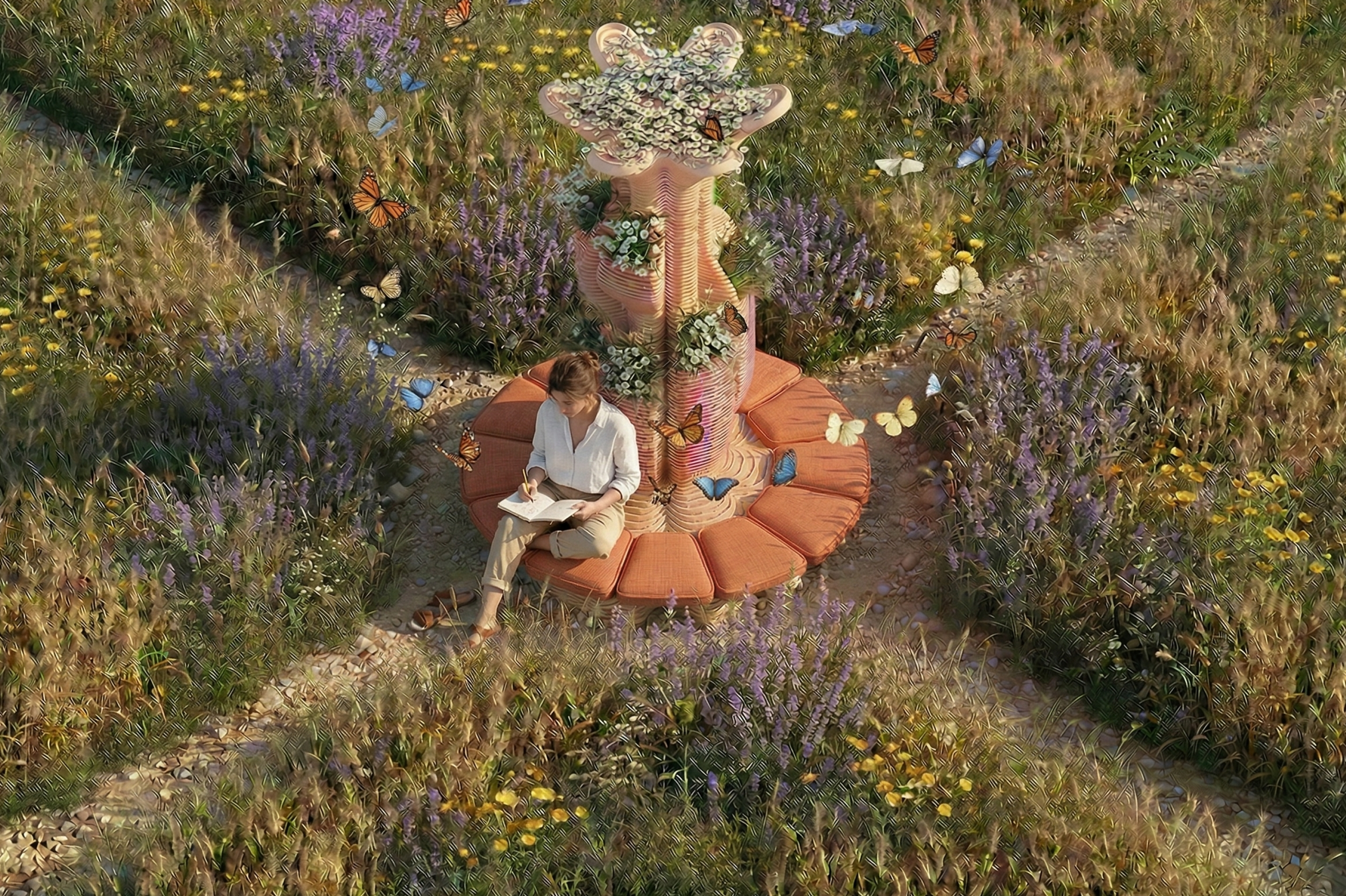
ReLife: A modular, robotic-fabricated column designed to restore biodiversity. Merging computational design with robotic precision, it provides vital micro-habitats for local species. Beyond a structure, it is a living ecosystem deployable in any environment, turning static infrastructure into beautiful, functional architecture. ReLife bridges the gap between technology and the non-human world, creating a sustainable future where all forms of life can thrive together.
France
Local
Ecole Supérieure d'Art et de Design (ESAD) - 28 Av. de Paderborn, 72000 Le Mans, France
It addresses urban-rural linkages
It involves a physical transformation of the built environment (hard investment)
Prototype level
No
No
Yes
Organisation
Pollen Totem is a regenerative 3D-printed clay infrastructure designed to restore urban biodiversity. It directly addresses the "invisible apocalypse" where Europe has lost 75% of its flying insect biomass in 30 years.
By merging computational design with robotic precision, we provide functional ecosystems tailored to native pollinators where traditional mineral architecture has failed.
The concept is a modular "Safe-box" composed of specialized habitats: precision-engineered nesting cavities for solitary bees, floral pockets for endemic flora, and avian strata .
Achieved Results:
International Recognition: Winner of the "Big Six" Award in Sustainability at SOCB Vienna, followed by a public awareness exhibition at Karlsplatz Metro Station.
Technical Validation: Ongoing residency at TALM-Le Mans (Les Affluentes) using ABB industrial robotics to print modular structural domes and columns.
Prototyping: Successful validation of the "slit-and-slide" assembly system and topology-optimized clay/bio-cement material mixes.
Expected Results:
Ecological Recovery: Mending broken urban links to restore the full pollinator web.
Scalability: Establishing a decentralized micro-factory model to scale ReLife across European municipalities.
Social Resilience: Acting as a "social anchor" that fosters inclusion, equity, and environmental stewardship through high-quality design.
The idea was born from the urgent need to transform cities from biological deserts into blueprints for coexistence. ReLife engineers recovery by reimagining urban "barriers" as bridges for life.
Development & Implementation:
The concept was developed through a multidisciplinary partnership. Majuriya provided the ecological expertise to ensure every module serves a precise purpose. Cyber Club developed the technological core, focusing on decentralized software for participatory co-design and mechatronic production systems. Implementation is currently accelerated through an art residency at TALM-Le Mans, bridging artistic research and industrial mechatronics.
Tools, Processes & Strategies:
Parametric Design: We use topology optimization to generate load-responsive forms adapted to the properties of local soil materials.
Robotic Fabrication: Utilizing industrial robotics for zero-waste, high-performance LDM (Liquid Deposition Modeling) 3D-printing.
Circular Lifecycle: Our 6-step infinite loop (Build, Deliver, Assemble, Monitor, Extend, Recycle) ensures total circularity. At end-of-life, modules are crushed and reintegrated as raw material .
Participatory Strategy: A crowdbuilding model where citizens and communities co-design and invest in their local infrastructure via our digital platform.
Institutional Alliances: Leveraging partnerships with FRAC Orléans and Piacé Festival to demonstrate architectural versatility in both urban and rural contexts.
Nature-based solutions: This highlights your core mission of using biological sanctuaries to restore urban ecosystems.
Circular economy: This directly reflects your "Infinite Growth Loop" and the use of local, recyclable materials like raw clay.
Community co-design: This emphasizes the participatory aspect of your "Cyber Club" software, allowing citizens to shape their local infrastructure.
Digital craftsmanship: A sophisticated term used in your dossier to describe the marriage of industrial robotics with the artistic heritage of clay.
Urban biodiversity: This clearly identifies the primary impact of the project—transforming mineral "deserts" into living habitats.
ReLife addresses the "invisible apocalypse" of biodiversity loss—75% decline in insect biomass —by transforming inert urban surfaces into high-performance biological sanctuaries. Our concept is exemplary in its Environmental and Circular approach:
Low-Carbon Infrastructure: By utilizing raw, local clay (90% of mass sourced within a 50km radius) and low-energy robotic fabrication (<500W), we achieve an 85% reduction in CO2 footprint compared to traditional concrete furniture.
Water Resilience: The parametric design optimizes the clay’s natural porosity, creating a capillary network for passive water retention. This ensures plant survival and cooling through evapotranspiration (-4°C local effect) without manual irrigation.
Infinite Growth Loop: Our lifecycle is strictly "Cradle-to-Cradle". At end-of-life, the modular clay components are crushed and reintegrated as raw material for new units, ensuring zero waste.
Economic Viability: The decentralized "Micro-Factory" model in a standard container reduces logistics costs by 60%. With a break-even point at only 12 units, ReLife offers an efficient, scalable solution for European green transitions.
ReLife contributes to the beauty of our neighborhoods by merging Digital Craftsmanship with the raw wisdom of the earth. It is exemplary in its ability to foster a new biophilic urban ritual:
Biophilic Design: Unlike standard mineral architecture, the Pollen Totem is a "symbiotic organism". Its complex, topology-optimized curves create a visual and sensory dialogue between high-tech precision and organic growth.
Quality of Experience: The project makes life beautiful by reintroducing the "missing link" of nature into the concrete desert. The presence of butterflies, birds, and flowers transforms a functional object into a poetic event.
Sense of Belonging and Care: By acting as a Social Anchor, the Totem creates a destination where citizens sit, observe, and re-engage with their environment . This "human-nature entanglement" heals the cultural rift between society and the living world, turning residents into active stewards of their local sanctuary.
Aesthetic Honesty: The 3D-printing layers reflect the "mathematical honesty" of the fabrication process, creating a unique texture that ages naturally with the growth of moss and lichens.
ReLife promotes Democratic Technology and Equity by ensuring that high-quality ecological restoration is accessible and affordable for all communities:
Design for All: The structure integrates ergonomic, universal seating and shading, providing free and inclusive resting areas in public spaces . It serves as a meeting point for all generations, regardless of socio-economic status.
Participatory Governance (Cyber Club): Our decentralized software platform transitions the public from passive observers to active co-designers. Communities can collaboratively choose target species and design their local Totem, ensuring the infrastructure reflects specific local needs.
Affordability & Scaling: The "Micro-Factory" model allows for local production using excavation soil, drastically reducing costs and making the solution affordable for small rural villages and marginalized urban districts alike.
Educational Empowerment: Through the Harvest Economy, ReLife generates local maintenance funds while providing school workshops and professional training in robotic fabrication . This model empowers citizens to own and manage their biological common.
ReLife transitions the public from passive observers to active co-owners of urban infrastructure through a "Crowdbuilding" model. We have involved citizens and stakeholders through two primary channels:
Participatory Co-Design: Using our decentralized "Cyber Club" web software, communities directly engage in the design process. Users can select specific sites and target local species to generate a site-specific parametric architecture. This ensures the "Pollen Totem" reflects the specific ecological and social needs of the neighborhood.
Participatory Investment: Through our crowdfunding platform, citizens can invest in modules. In exchange, they receive digital certificates of their impact and a share of the "biological harvest," such as seeds or honey.
Impact of Participation:
This approach transforms a technical object into a Social Anchor. By involving residents early, the Totem becomes a shared sanctuary that fosters a sense of "care" and collective stewardship. It has turned ecological restoration into a community-building event, where the installation serves as a physical destination for neighborhood meetings, school trips, and workshops. The participation ensures that the technology serves the collective good rather than imposing a top-down aesthetic.
ReLife is designed to operate through a collaborative network spanning from local workshops to continental standards:
Local Level: We work with the École Supérieure d'Art et de Design (TALM) for technical materialization and the Piacé le Radieux festival as a rural laboratory. These partnerships provide immediate technical validation and site-specific testing.
Regional/National Level: Collaboration with FRAC Orléans positions the project within the history of experimental and digital architecture. We also engage with ecological startups like Majuriya to ensure scientific rigor in biodiversity restoration.
European Level: Joining the NEB Rising Stars community is our most critical future partnership. It acts as a continental accelerator, providing the institutional credibility needed to scale ReLife across European municipalities.
Added Value:
This multilevel engagement bridges the gap between artistic research and industrial deployment. Local involvement ensures cultural relevance, while the European framework allows our "Pollen Totems" to become a certified standard for the EU's green transition. By involving stakeholders at all scales, we create a decentralized "Micro-Factory" model that can be replicated across diverse European territories.
The design and implementation of ReLife reflect a deep integration of diverse knowledge fields:Architecture & Design: We utilize parametric design and topology optimization to create load-responsive forms. The design focuses on "mathematical honesty" to merge biological necessity with aesthetic beauty.
Engineering & Digital Technologies: Our process leverages industrial robotics (ABB) and mechatronics for Liquid Deposition Modeling (LDM). We integrate IoT monitoring via sensors to track biodiversity health and thermal performance in real-time.
Environmental Sciences: Every module is engineered based on ecological data—such as the Hallmann et al. study on insect biomass decline—to provide tailored habitats for solitary bees (Apis mellifera), butterflies, and hoverflies.
Arts & Humanities: As a research-in-residence project, ReLife bridges the gap between sculptural research and urban infrastructure. It addresses the cultural rift between society and nature by re-entangling humans with their environment.
Education: The project facilitates knowledge sharing through school workshops and professional training in robotic fabrication, turning technical infrastructure into a tool for environmental education.
The ReLife business model is designed as a scalable, high-margin ecosystem that transitions from "Product-as-an-Infrastructure" to "Service-as-a-Monitoring" platform.
Financial sustainability is ensured through a multi-layered revenue strategy:
1. B2G & B2B Sales (Primary Revenue): Our core revenue comes from selling modular Totems to municipalities and private developers for "Climate Action Plans" or "Biodiversity Net Gain" compliance . By positioning the totem as an "Environmental Artwork," we leverage fiscal advantages (e.g., 5.5% VAT in France), accelerating public procurement. With a high gross margin and a break-even point reached at only 12 units, the model is financially resilient from the early stages.
2. SaaS & Monitoring Services (Recurring Revenue): We generate long-term value through a subscription model for urban planners. Our "Cyber Club" interface provides live IoT data on biodiversity health, thermal regulation, and environmental metrics. This data-driven approach allows for high-value contracts in the "Smart City" market.
3. Participatory "Crowdbuilding" Model: To ensure social inclusion and funding diversification, we utilize crowdfunding. Citizens can directly invest in local modules, receiving digital impact certificates and a share of the "biological harvest" (seeds, honey).
4. The Harvest Economy (Micro-Revenue): Each Totem acts as a production unit. Small-scale harvesting of seeds and bio-products generates local revenue that self-funds the structure's maintenance, ensuring long-term autonomy .
5. Scalability & EU Competitiveness: Sustainability is reinforced by our low-overhead "Micro-Factory" strategy. Utilizing local raw clay reduces material costs and eliminates heavy logistics. This decentralized approach allows ReLife to scale rapidly across European territories, reducing carbon taxes and dependency on imported materials.
he ReLife project is engineered for high transferability and replicability across the European Union through its modular architecture and decentralized production model.
Technology & Material Transferability:
The core technology—robotic additive manufacturing using local raw clay—is geographically neutral. By adapting the material mix to specific local soil properties, the "Pollen Totem" can be manufactured in any European region, from Mediterranean landscapes to Northern urban centers. This "Digital Craftsmanship" replaces heavy global logistics with local material intelligence.
Process Replicability:
Our "Robotic Micro-factory" strategy is a highly replicable operational model. These portable units can be deployed in any municipality to produce site-specific totems on demand, reducing transport-related CO2 and supporting local circular economies. This "plug-and-play" process is a blueprint for the future of localized, low-carbon industrial production.
Methodological Scalability:
The "Cyber Club" co-design software provides a scalable digital framework for participatory governance. It allows diverse communities to co-design their local infrastructure while maintaining technical and structural standards. The open-source documentation ensures that ecological monitoring data can be transferred to environmental scientists and urban planners globally.
Sectoral Transferability:
While currently focused on biodiversity, the "slit-and-slide" assembly methodology is transferable to other sectors, such as public furniture, landscape design, and architectural cladding. The parametric principles and bio-material research we have developed can be applied to create climate-resilient seating, shading structures, or acoustic barriers in dense urban environments.
ReLife offers a transferable methodology for "Cradle-to-Cradle" urbanism, providing a scalable solution to meet the European Nature Restoration Law targets.
To demonstrate a concrete commitment to implementing ReLife in practice, we have established a clear, phased roadmap that transitions from laboratory validation to European-scale deployment. The year following the NEB 2026 application is designed as the critical "pivot" from artistic research to functional urban infrastructure.
2026: From Lab to Pilot
Q2–Q3 | Engineering Validation (TALM Residency): We are currently finalizing the structural proof of concept for the modular core and nesting bricks at the ESAD TALM Le Mans. This phase involves rigorous testing of the "slit-and-slide" assembly system and the durability of our local clay bio-materials.
September | NEB Catalyst: The announcement of the NEB Rising Stars results will act as our continental accelerator. We will leverage this institutional credibility to launch the first functional "Pollen Totem" in a public space, officially pivoting from a research prototype to a certified urban sanctuary.
2027: Cultural Valorization & Scaling
Q4 2026–Q1 2027 | Site Expansion: We will demonstrate architectural versatility through two major exhibitions. At Piacé le Radieux, we will deploy a rural laboratory prototype, while at FRAC Orléans, we will showcase the digital craftsmanship and computational design aspects to a global audience.
Q2–Q4 | Digital Common & Monitoring: We will deploy our decentralized co-design software, enabling communities and urban planners to duplicate the totems across diverse geographies. Simultaneously, we will establish a bio-monitoring feedback loop to track insect colonization and ecological performance in real-time.
By the end of 2027, ReLife will have transformed from a localized residency into a scalable, data-driven network of urban sanctuaries, providing a tangible standard for the EU's green transition.