Enhancing Circularity, Sustainability, and Innovation
Democratising Europe’s Seaweed Industry
Democratising European Seaweed Production with Accessible Digital Knowledge Tools
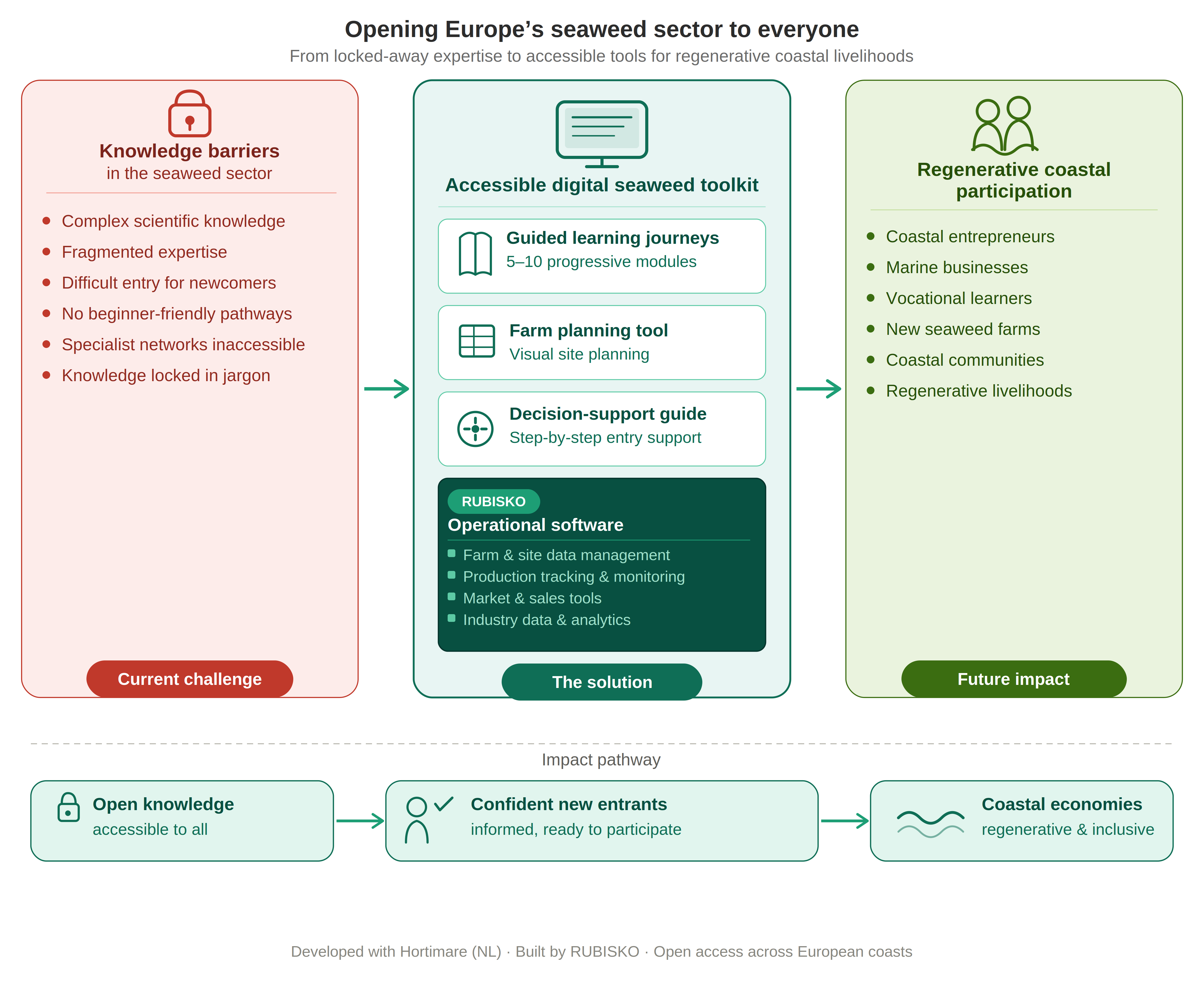
Seaweed cultivation could support sustainable food systems and new coastal livelihoods across Europe, yet entering the sector remains difficult due to complex, fragmented knowledge. This project creates a personalised digital toolkit that transforms expert knowledge into clear, visual guidance - helping people like a fisherman in coastal regions in Europe such as the Atlantic coastline and Mediterranean explore, plan, and build a viable seaweed operation using existing skills and infrastructure.
Netherlands
Regional
North Holland (Noord-Holland), Netherlands - pilot region; additional European coastal regions to be engaged during the project.
Mainly rural
It refers to other types of transformations (soft investment)
Prototype level
No
No
No
Individual
Seaweed cultivation is widely recognised as one of Europe’s most promising regenerative marine industries, with potential to support sustainable food systems, biomaterials, and more resilient coastal economies. Yet for many people, entering the sector remains difficult. Knowledge is highly specialised, fragmented across sources, and often only accessible through expert networks.
Seaweed cultivation is widely recognised as one of Europe’s most promising regenerative marine industries, yet entering the sector remains difficult. Knowledge is highly specialised, fragmented across sources, and often only accessible through expert networks.
This project creates a personalised digital toolkit that guides users from initial curiosity through to running a seaweed production operation.
Users begin by answering a short set of questions about their goals, location, time horizon, and level of knowledge. Based on this, the system generates a tailored pathway combining:
- guided learning modules
- structured setup roadmaps
- decision-support tools
- and operational tools such as production management software
Instead of navigating disconnected resources, users move through a single journey from understanding to planning to operation. Currently, new entrants rely on fragmented resources and expert networks. No integrated system connects learning, planning, and operation in one personalised pathway.
The concept builds on RUBISKO’s existing production management software, already used by seaweed producers globally across hatchery, cultivation, and processing stages. This foundation will be expanded to include accessible learning and entry-level planning tools.
The prototype will be developed with Hortimare in the Netherlands and tested with prospective producers across European coastal regions.
Within the first year, the project will deliver a working prototype, 5-10 structured modules, and pilot testing with ~100 users across European coastal regions.
This concept emerged from direct experience working within the global seaweed sector and observing a gap between its recognised potential and its accessibility in practice.
Across Europe, seaweed is increasingly seen as part of the future of sustainable food systems and the blue economy, which already contributes over €260 billion and supports nearly 5 million jobs. At the same time, many coastal regions are seeking new livelihoods as traditional industries decline. Yet for those interested in entering the sector, the pathway remains unclear.
Demand for seaweed in Europe is projected to reach €9 billion by 2030, with the potential to create over 100,000 jobs. Despite this growth, the number of active producers remains relatively small, highlighting a significant gap.
Today, knowledge is dispersed across scientific literature, technical documents, and informal expert networks. Understanding how to start typically requires navigating fragmented resources or direct access to specialists, creating a structural barrier for new entrants.
Through work with over 15 seaweed producers globally - including Ocean Rainforest, Nordic Seafarm, Hortimare, and The Seaweed Company - RUBISKO has developed production management software used in real operations. This experience has highlighted a key gap: while advanced operators have specialised tools, there is no integrated system that connects learning, planning, and operational execution for new entrants.
The concept is based on this premise: access to knowledge is a form of infrastructure.
The project translates complex production knowledge into a guided, personalised journey that connects learning, planning, and operation. For example, a coastal worker exploring seaweed cultivation can understand whether it is viable, how it would work in their context, and what steps are required to begin.
The prototype will be developed with Hortimare in the Netherlands and refined with users across European coastal regions.
Seaweed cultivation
Blue economy
Coastal resilience
Knowledge accessibility
Participatory digital infrastructure
Seaweed cultivation is widely recognised as a promising regenerative form of aquaculture. In suitable ecological conditions, seaweed production can avoid many of the pressures associated with land-based agriculture, while contributing to low-impact value chains for food, biomaterials, and other products. Seaweed farming can also support healthier marine ecosystems by absorbing nutrients and creating habitat. Despite this potential, the European seaweed sector still faces significant barriers to responsible growth, including fragmented knowledge, limited access to practical guidance, and uncertainty for new entrants.
This concept addresses these challenges by improving the quality of knowledge and decision-making before production begins. Rather than encouraging uninformed expansion, the digital toolkit helps new entrants understand ecological conditions, cultivation systems, seasonal cycles, and operational risks before investing resources. By making this knowledge accessible, the project supports more responsible, place-sensitive participation in seaweed cultivation and reduces the likelihood of inefficient or environmentally harmful trial-and-error approaches. EU targets 8M tonnes by 2030, yet production remains low due to knowledge gaps. This toolkit helps close that gap.
The concept is also resource-efficient. Instead of relying on large physical infrastructure, it creates a shared digital knowledge resource that can be used repeatedly by learners, businesses, and coastal communities across multiple regions. This allows knowledge to circulate widely while minimising material and environmental costs.
In doing so, the project contributes to the sustainable development of regenerative marine industries while strengthening the resilience of coastal economies. By lowering knowledge barriers and supporting informed participation, it helps ensure that the growth of the European seaweed sector is both environmentally responsible and socially beneficial.
Aesthetics in this concept is expressed through the design of a clear, calm, and intuitive user experience that transforms complexity into something people can see, navigate, and act on.
The toolkit is built as a minimalist digital environment using a restrained palette of greens, whites, yellows, and greys, reflecting both RUBISKO’s visual identity and the natural tones of natural environments. The interface prioritises clarity over density, using icons, diagrams, and visual flows in place of text-heavy explanations.
Users move through a guided, step-by-step journey that adapts to their goals and context. Complex processes such as farm setup, seasonal cycles, and production workflows are presented through visual sequences, interactive diagrams, and map-based views. For example, users can explore a bird’s-eye view of a farm, understand how it evolves over time, and see how decisions affect operations through simple animations and structured pathways.
The experience is designed to shift users from confusion to clarity and from feeling like outsiders to becoming active participants. Rather than confronting technical barriers, users gradually build understanding through visual learning and intuitive progression.
The interface also reflects place. Visual content adapts depending on species, environment, and cultivation method, whether offshore or land-based. Marine imagery, spatial layouts, and environmental context connect the learning experience to real coastal conditions, helping users relate the tools to their own landscapes and opportunities.
Beauty in this concept lies in making a complex system legible, navigable, and meaningful. By turning abstract knowledge into tangible, visual experiences, the project creates a sense of confidence, belonging, and possibility for people exploring regenerative coastal futures.
Inclusion is a central objective of this project. Today, access to the seaweed sector often depends on specialist education, technical training, or direct connections within industry networks. This creates barriers for many people who may have practical marine knowledge, entrepreneurial interest, or strong local motivation but lack the technical background or professional networks typically required to enter the field.
The project addresses these barriers by designing accessibility into the concept from the beginning. The digital toolkit will follow design-for-all principles to ensure that people with different educational backgrounds and levels of technical familiarity can understand and use the tools. This includes plain-language explanations, visual-first learning pathways, intuitive navigation, and beginner-friendly guidance that reduces reliance on specialist terminology.
Affordability is also a key component. Core learning resources and entry-level planning tools will be openly accessible or low-cost, ensuring that financial barriers do not prevent individuals, small businesses, or community organisations from exploring seaweed cultivation opportunities.
Inclusion is also reflected in the development process. The concept begins with a co-design phase between RUBISKO and Hortimare to identify the main barriers faced by new entrants and to translate complex industry knowledge into accessible formats. As the project develops, this participatory approach can expand to include learners, practitioners, and coastal stakeholders who help refine the tools and shape future iterations.
By lowering knowledge and access barriers, the concept promotes a more inclusive model for emerging marine industries. It enables a wider range of people - including coastal entrepreneurs, vocational learners, and small marine businesses - to explore regenerative economic opportunities that were previously difficult to access.
Participation is embedded as a core design principle and will take place across multiple stages of development, involving both industry experts and prospective users across European coastal regions.
The initial phase focuses on co-design and knowledge mapping between RUBISKO and Hortimare, combining digital product design with operational hatchery expertise to identify key barriers to entry in seaweed cultivation. This establishes a strong technical and practical foundation for the toolkit.
Building on this, the project expands participation to include prospective producers, vocational learners, and coastal stakeholders across Europe. During the prototype phase, users will be engaged through structured feedback processes, including user interviews, testing sessions, and small group workshops with individuals exploring seaweed cultivation in different regional contexts.
These participants will directly influence the development of the toolkit by shaping:
- the structure of learning pathways
- the clarity and usability of interface design
- the relevance of planning tools to real-world conditions
- and the accessibility of content for different knowledge levels
This ensures that the platform reflects the needs of people who are not yet part of the sector, rather than only established operators.
Participation continues beyond initial testing through iterative refinement. Feedback from users in different coastal regions is used to adapt content to local ecological conditions, regulatory environments, and user needs.
As a result, participation is not a one-off consultation but an ongoing process through which users actively shape how the toolkit evolves. This approach helps ensure that the platform remains relevant, accessible, and grounded in the lived realities of the communities it is designed to support.
The concept connects stakeholders across multiple levels of the emerging European seaweed ecosystem.
At the local level, the project focuses on prospective entrants, learners, and small marine businesses exploring seaweed cultivation as a potential activity. These users represent the communities the toolkit is designed to support, particularly in coastal regions seeking new regenerative economic opportunities.
At the industry level, the pilot is grounded in collaboration with Hortimare in the Netherlands, one of Europe’s leading seaweed hatcheries. Hortimare contributes operational expertise in seaweed seed production, cultivation systems, and industry practices. This ensures that the knowledge translated into the toolkit reflects real production conditions and credible industry experience.
At the territorial and regional level, the concept responds to broader challenges faced by coastal regions where traditional marine industries are under pressure and communities are exploring new blue-economy opportunities. By making knowledge about seaweed cultivation more accessible, the project supports regional economic diversification and skills development.
At the European level, the concept is designed to be transferable across coastal regions where seaweed cultivation and marine bioeconomy activities are emerging. Through the wider networks of RUBISKO and Hortimare within the European seaweed sector, the project can connect with practitioners, training organisations, and regional initiatives working to develop sustainable marine industries.
The engagement of stakeholders at these different levels ensures that the concept combines practical industry knowledge, regional development needs, and broader European collaboration. This multi-level approach strengthens both the relevance and scalability of the project.
The concept combines multiple disciplines to translate complex marine production knowledge into accessible and usable tools.
Marine biology and aquaculture science provide the foundation for understanding seaweed species, growth conditions, and cultivation systems. This is combined with operational expertise from industry partners such as Hortimare, contributing practical knowledge from hatchery operations and commercial production.
Digital technologies and software development are used to structure this knowledge into a modular toolkit, while user experience (UX) and interaction design ensure it is accessible to people without specialist backgrounds.
Crucially, these disciplines are not applied in isolation but integrated to create new forms of understanding. For example, biological growth cycles and cultivation processes are translated into visual, step-by-step planning tools and seasonal timelines, replacing complex technical documentation with intuitive, map-based and diagram-led interfaces. This allows users to understand and act on information that would otherwise require specialist training.
The concept also draws on social sciences and regional development perspectives to ensure that tools reflect the realities of coastal economic transitions and emerging blue economy opportunities.
In addition, non-academic knowledge is treated as equally important. Insights from marine businesses, coastal practitioners, and prospective new entrants are integrated through testing and feedback, shaping how the toolkit is structured and used.
By combining scientific, technological, design, and practical knowledge in this way, the project creates a transdisciplinary approach that bridges the gap between expert knowledge and accessible participation in regenerative marine industries.
The business model is designed as a tiered access system that balances open accessibility with paid professional tools and services.
At the entry level, core learning resources and early-stage planning tools will remain free or low-cost. This ensures that individuals, small businesses, and coastal communities can explore seaweed cultivation without financial barriers.
Revenue is generated through three primary streams.
First, advanced planning and operational tools are offered through subscription. These build directly on RUBISKO’s existing production management software, already used by seaweed producers globally across hatchery, cultivation, and processing operations. Users progressing from exploration to implementation can transition into paid tiers with access to more detailed planning, data integration, and operational functionality.
Second, institutional training and licensing will be provided to hatcheries, vocational education providers, and regional development organisations. These partners use the toolkit to support training programmes, workforce development, and sector entry initiatives within coastal regions.
Third, partnership-based projects with blue economy programmes, research initiatives, and regional authorities will support deployment in specific territories. These collaborations focus on enabling new entrants, supporting regional diversification, and strengthening local marine economies.
Because the platform is digital and modular, it can scale across regions with low marginal cost. This allows the project to maintain open access at the entry level while generating sustainable revenue from professional users and institutional partners.
This model builds directly on RUBISKO’s existing commercial activities while extending them into a broader, more accessible entry pathway for the sector.
Although the prototype will initially be developed in collaboration with Hortimare in the Netherlands, the concept is designed from the outset to operate across the wider European seaweed ecosystem. Hortimare provides scientific and hatchery expertise to support early development, while the project itself engages stakeholders across multiple European coastal regions during testing and refinement.
Several core elements are inherently transferable.
First, the digital toolkit architecture enables complex production knowledge to be translated into structured learning pathways, planning tools, and decision-support guidance. Because the platform is modular and digital, it can be adapted to different regions without fundamental changes to the system.
Second, the project develops a repeatable methodology for translating specialist knowledge into accessible, personalised tools. By combining scientific expertise, operational industry experience, and user-centred design, the concept creates a model that can be applied wherever knowledge barriers limit entry into complex sectors.
Third, the concept includes a participatory co-design process involving prospective producers, practitioners, and coastal stakeholders across Europe. This ensures that the toolkit is tested and refined in different territorial contexts, allowing content to reflect local ecological conditions, regulatory environments, and user needs.
Rather than being transferred after development, scalability is embedded through this multi-region approach. The toolkit is designed to adapt to variations in species, cultivation methods, and governance frameworks while maintaining a consistent user experience.
Beyond seaweed, the same knowledge-translation approach could be applied to other emerging regenerative sectors where access to specialist knowledge currently limits wider participation.
The concept will be developed through a structured one-year process focused on co-design, prototype development, and early testing across the European seaweed ecosystem.
Phase 1 – Knowledge Mapping and Co-Design (Months 1–3).
The project will begin with a co-design and knowledge-mapping phase between RUBISKO and Hortimare. This stage will identify the key barriers preventing wider participation in seaweed cultivation and define the needs of prospective users. The outcome will be a clear structure for the toolkit, including prioritised content areas and the design of the first learning journeys.
Phase 2 – Prototype Development (Months 4–6).
Using insights from the co-design phase, the first version of the digital toolkit will be developed. This prototype will include approximately 5–10 learning modules explaining the seaweed cultivation lifecycle, early visual planning tools, and initial decision-support guidance to help users understand key production considerations.
Phase 3 – Early Pilot Testing (Months 7–9).
The prototype will be tested with pilot users across the seaweed ecosystem. This stage will generate practical feedback on usability, clarity, and relevance, allowing the project team to identify improvements and refine the design of the tools.
Phase 4 – Refinement and Preparation for Wider Use (Months 10–12).
In the final phase, the toolkit will be improved based on user feedback and the lessons learned during pilot testing. The project will produce an enhanced prototype and document a transferable methodology for translating specialised industry knowledge into accessible digital tools.
These steps will demonstrate the feasibility of the concept and create the foundation for broader implementation with coastal stakeholders across Europe.