Strengthening Local Democracy and Inclusion
CIVIC-PULSE: Tangible Democracy Nodes
CIVIC-PULSE: A Physical Interface for Inclusive Participation and Local Budgeting
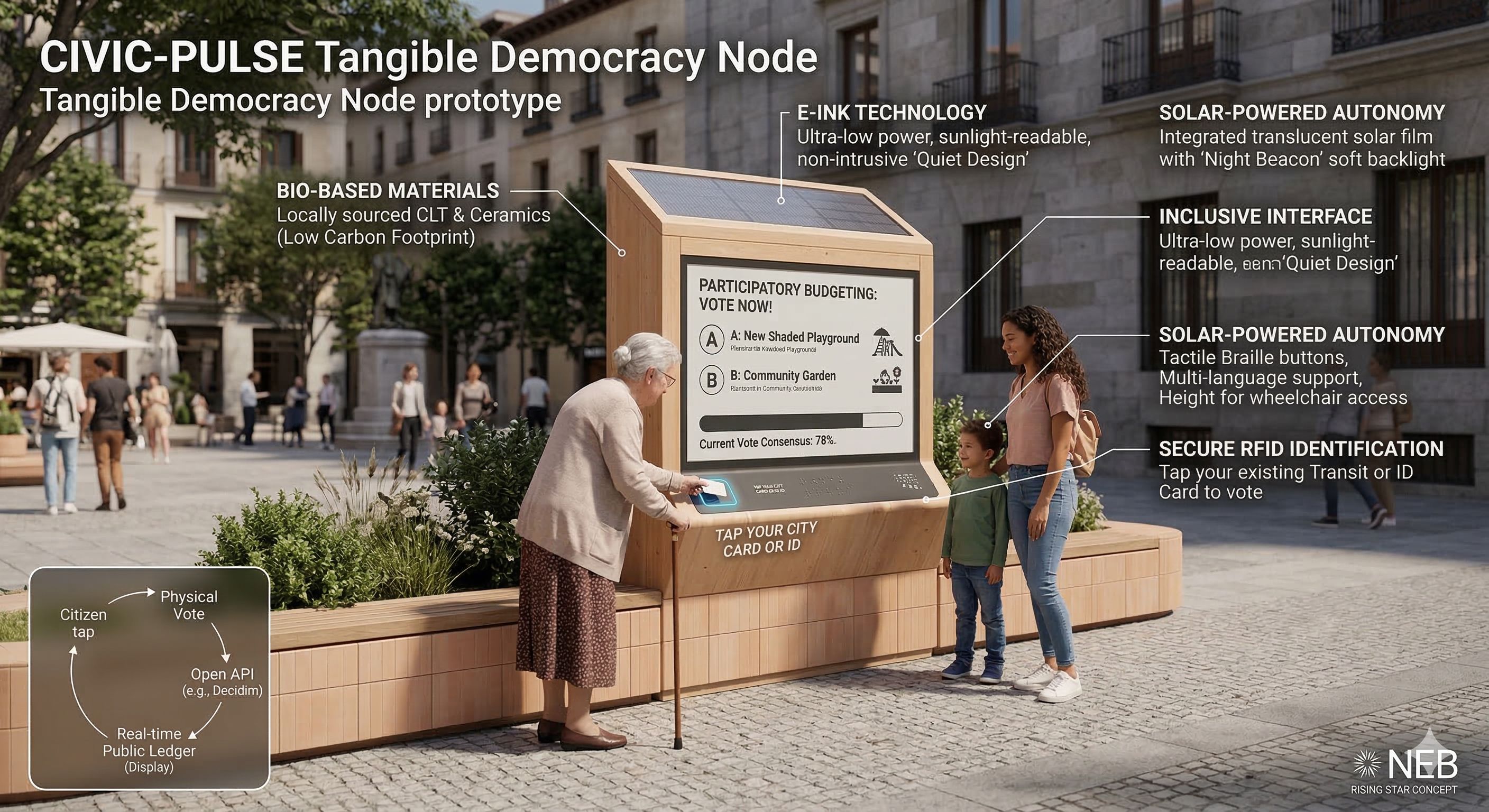
CIVIC-PULSE is a sustainable urban terminal that bridges the digital divide in local governance. While online platforms often exclude the elderly and vulnerable groups, our E-ink nodes bring participatory budgeting back to the town square. Using secure RFID cards, citizens can vote on local projects and monitor public spending in real-time. Built with bio-based materials and solar-powered, it transforms public spaces into inclusive arenas for transparent, democratic decision-making.
Spain
National
Mainly urban
It involves a physical transformation of the built environment (hard investment)
Early concept
No
No
No
Individual
CIVIC-PULSE is a sustainable, physical infrastructure designed to materialize local democracy in the public square. In an era where "Digital-First" administration is inadvertently creating a "Digital-Divide," our project bridges the gap by providing a tangible interface for participatory budgeting and urban co-design.
The Concept:
The core of CIVIC-PULSE is a network of Urban Democracy Nodes. These are not just screens; they are high-durability, low-energy terminals built from bio-based materials (local timber and stone) and powered by integrated solar films. They serve as physical access points for citizens who are often excluded from online-only governance platforms—such as the elderly, people with low digital literacy, or those without stable internet access.
Expected Results & Impact:
Democratic Inclusion: By placing voting terminals in markets, plazas, and health centers, we expect to increase participation rates in local budgeting by 300% compared to web-only models. Using secure RFID identification (such as existing transit or identity cards), citizens can vote on community projects with a single touch.
Technological Innovation: We implement high-contrast E-ink technology, ensuring 100% legibility under direct sunlight with near-zero energy consumption. Unlike intrusive LED screens, CIVIC-PULSE respects the aesthetic and light-pollution standards of historic European centers.
Transparency & Trust: The nodes function as a real-time "Public Ledger," displaying the status of ongoing municipal works and how funds are being allocated. This transparency rebuilds trust between citizens and local institutions.
Social Cohesion: The physical nature of the node encourages intergenerational dialogue. We envision the terminal as a "social anchor" where neighbors discuss projects in person, transforming the individual act of voting into a collective experience of community-building.
The seed for CIVIC-PULSE was planted during a public assembly in a small Mediterranean town. While local authorities proudly presented a new digital app for participatory budgeting, I observed a significant portion of the audience—mostly elderly residents and local shopkeepers—looking on with a sense of disconnection. They were the heart of the community, yet they were being "designed out" of their own democracy by a digital-only barrier.
As a professional focused on sustainable systems, I realized that democracy needs a physical home. The idea was to take the efficiency of digital platforms like Decidim and wrap them in a physical, inclusive, and beautiful "skin" that belongs to the street, not just the cloud.
Development & Implementation Strategy:
The Ethnographic Phase: We started by interviewing neighborhood associations to identify why they didn't participate in online voting. The answers were consistent: lack of trust in "invisible" systems and the complexity of digital authentication. This led us to the "One-Touch" physical voting concept using existing RFID cards.
The "Non-Intrusive" Tech Strategy: We rejected standard LED screens because they create light pollution and feel like "advertising." Instead, we applied E-ink technology—the same used in e-readers—to ensure the device felt like a natural part of the urban furniture, readable in the sun and respectful of the architectural heritage.
Prototyping for Inclusion: We used 3D-modeling and mock-ups to test ergonomics. We worked on the height for wheelchair accessibility and developed a tactile interface for the visually impaired. We moved from a "gadget" to a "monument to participation."
Circular Design: The final step was selecting materials. We chose local timber and stone to ensure the node had a low carbon footprint and felt warm to the touch, contrasting with the coldness of typical metal street kiosks.
Digital Inclusion
Participatory Budgeting
Tactile Democracy
E-ink Governance
Urban Commons
CIVIC-PULSE exemplifies sustainability by integrating high-tech efficiency with low-impact materials, addressing the environmental and economic challenges of traditional urban digitalization. Our approach is based on three pillars of sustainability:
1. Energy Efficiency & Non-Intrusive Tech:
Most urban screens (LED/LCD) are energy-intensive and contribute to light pollution. CIVIC-PULSE utilizes ultra-low-power E-ink technology, which only consumes energy when the image changes. This allows the nodes to be 100% energy-autonomous, powered by a small, integrated solar film. By avoiding light emission at night, we protect urban biodiversity (nocturnal insects and birds) and preserve the "dark sky" of our neighborhoods, meeting the highest environmental standards for smart city infrastructure.
2. Circular Materiality & Longevity:
The physical structure is designed following circular economy principles. We use locally sourced, certified timber (CLT) or stone and recycled metals for the chassis, ensuring a low embodied carbon footprint. Unlike plastic-heavy electronics, our nodes are modular: every component is designed to be easily repaired, upgraded, or recycled. This "Right to Repair" approach extends the product’s lifecycle, reducing electronic waste and promoting local craftsmanship in maintenance.
3. Economic & Social Sustainability:
Sustainability is also about efficient resource management. By facilitating Participatory Budgeting, CIVIC-PULSE ensures that municipal investments are directed toward projects truly needed by the community. This "evidence-based" spending reduces the waste of public funds on unwanted infrastructure. Economically, the project promotes the local bio-economy by using regional materials and labor for the assembly of the nodes, creating a sustainable value chain that stays within the community.
CIVIC-PULSE redefines urban aesthetics by moving away from the cold, intrusive "gadget" and toward a poetic and sensory civic landmark. We believe that democracy should not only be transparent but also beautiful to the touch and the eye. Our aesthetic contribution is built on three levels:
1. Materiality and Tactile Warmth:
Unlike the sterile plastic and glass of standard digital kiosks, CIVIC-PULSE is crafted from warm, organic materials like certified timber, local stone, or artisanal ceramics. This choice is intentional: we want citizens to feel a physical connection to the device. By using materials that age gracefully and reflect the local architectural heritage, the node stops being an "alien object" and becomes a natural extension of the neighborhood’s identity. The beauty lies in the grain of the wood and the texture of the stone, inviting people to approach and touch.
2. Visual Harmony and "Quiet" Technology:
We employ a "Quiet Design" philosophy. By using high-resolution E-ink displays, the terminal mimics the visual quality of paper or engraved stone. It emits no glare and no flickering blue light, ensuring it does not compete with the historical beauty of European plazas. At night, instead of a bright screen, a soft, warm backlight provides a subtle glow, transforming the node into a poetic beacon of participation that enhances the nighttime atmosphere of the street rather than disrupting it.
3. Belonging and Collective Pride:
Aesthetics is a powerful tool for social care. When a community sees a beautifully designed object in their square, it signals that their voice is valued. CIVIC-PULSE becomes a "Social Anchor," a place where people meet to discuss the future. By displaying the community’s collective decisions in an elegant, clear visual language, we turn public data into a source of local pride.
CIVIC-PULSE is an intervention against democratic exclusion. In an increasingly "app-centric" world, we address the paradox where digital governance, intended to be efficient, inadvertently disenfranchises the 40% of European citizens who lack advanced digital skills or access. Our project is exemplary in inclusion through three transformative layers:
1. Eradicating the Digital Divide:
By relocating the voting process from a private smartphone to a shared urban node, we remove the barriers of device ownership and data costs. Using the "Design for All" principles, we have simplified the authentication process: citizens use existing physical assets (RFID transit cards or ID cards) to identify themselves. A simple, one-touch tactile interface replaces complex menu navigation, ensuring that a 90-year-old resident has the same agency as a digital native to decide the future of their street.
2. Physical and Sensory Accessibility:
The node is an inclusive landmark by design. Its height is optimized for wheelchair users, and the interface features high-relief buttons (Braille) and high-contrast E-ink displays for those with visual impairments. Furthermore, we integrate an audio-guided mode and multi-language support (including local dialects and simplified visual icons), ensuring that immigrants and people with low literacy levels can exercise their right to participate without feeling overwhelmed by bureaucratic jargon.
3. Inclusive Governance & New Societal Models:
CIVIC-PULSE promotes a "proximity democracy" model. By bringing the "ballot box" to the market or the plaza, we reach people where they naturally gather, particularly women, caregivers, and the elderly whose voices are often missing in online forums. This creates a new societal model of collective stewardship: the node becomes a site for intergenerational encounter, where the act of deciding on public funds becomes a visible, communal, and dignified ritual for all members of society.
CIVIC-PULSE is a product of radical co-design, moving beyond simple "user feedback" to active citizen involvement in the technological and physical architecture of the node. The development followed a bottom-up strategy structured in three impactful stages:
1. The "Exclusion Audit" Workshops:
We began by conducting "Active Listening" sessions in neighborhood centers, specifically targeting groups traditionally absent from digital platforms: elderly residents, migrants, and low-income families. The impact of their participation was immediate: we discovered that the primary barrier was not "disinterest," but a lack of trust in invisible digital processes. This feedback shifted our concept from a mobile app to a permanent physical landmark, providing a sense of security and institutional presence that a smartphone cannot offer.
2. Iterative Prototyping with "Super-Users":
We placed low-fidelity mock-ups in local markets to observe how citizens naturally interacted with the interface. Feedback from people with visual impairments led us to replace touch-only screens with hybrid tactile buttons and high-contrast E-ink displays. Their participation ensured the node followed "Design for All" principles, transforming a technical requirement into a core aesthetic feature of the device.
3. Co-Defining the Governance Rules:
Through "Town Hall" simulations, citizens helped define what they wanted to vote on. They expressed a desire for granular participation—not just voting on massive infrastructure, but on daily micro-improvements (lighting, benches, playground equipment). This led to the development of our "Dynamic Agenda" software, which prioritizes hyper-local issues based on the specific needs of each street or plaza.
This participatory journey ensures that CIVIC-PULSE is not an external imposition, but a tool born from the community, reflecting the real needs and trust-levels of the people it serves.
CIVIC-PULSE is designed to function as a vertical bridge, ensuring that local citizen input effectively informs decision-making at higher institutional scales. Our governance model integrates four distinct levels:
1. Local Level (The Engine): We involve Municipal Councils and Neighborhood Associations. Their engagement is critical for the physical placement of the nodes and the integration with local "Participatory Budgeting" rules. The added value is immediate accountability: the city council gets high-quality, inclusive data, and citizens see their decisions implemented in their own streets, restoring trust in local institutions.
2. Regional Level (The Framework): We expect to collaborate with Regional Governments (e.g., Provincial Deputations or Regional Innovation Agencies). Their role is to standardize the data protocols. The added value here is territorial cohesion: ensuring that a small rural village and a large capital city use the same transparent governance "language," allowing regional authorities to allocate resources based on real, aggregated territorial needs.
3. National Level (The Policy): We align with national "Digital Agenda" and "Citizen Participation" ministries. Their involvement provides the legal and technical framework for secure identification (RFID/e-ID). The added value is the transformation of CIVIC-PULSE into a validated pilot for national open-government laws, proving that digital transition can be physically inclusive.
4. European Level (The Vision): Our concept is built to support the EU Mission on Climate-Neutral and Smart Cities and the European Declaration on Digital Rights. By involving European NEB networks and research clusters, we ensure the concept is replicable across the Union. The added value is creating a "European Governance Standard": a scalable, modular model that helps the EU meet its 2030 targets for social inclusion and democratic resilience through "Democracy-as-a-Service."
IVIC-PULSE is not merely a technical tool; it is a transdisciplinary synthesis designed to solve a complex social problem: the erosion of democratic participation in the digital age. The concept is born from the convergence of four distinct fields of knowledge:
1. Hardware Engineering & Digital Technologies:
We apply high-level engineering to ensure urban resilience. This includes the integration of low-power IoT architecture, E-ink display drivers, and secure RFID/NFC authentication systems. The challenge was making sophisticated technology "invisible" and robust enough for the public space, ensuring 24/7 autonomous operation via solar energy harvesting.
2. Social Sciences & Environmental Psychology:
To ensure inclusion, we draw on sociological research regarding the "Digital Divide" and behavioral economics. We apply "Nudge Theory" to the physical design—placing the nodes in natural social pathways to lower the psychological barrier to participation. This discipline was key in shifting the project from a "voting machine" to a "community anchor" that fosters collective trust.
3. Architecture & Industrial Design:
The node is designed as a piece of "Responsive Furniture." We collaborate with industrial designers and architects to ensure the terminal respects the "Design for All" principles (ergonomics for wheelchair users, tactile haptics). The aesthetic choice of bio-based materials (timber, stone) reflects a deep understanding of urban heritage and the need for biophilic elements that improve the visual and emotional quality of the town square.
4. Political Science & Data Ethics:
The software logic is rooted in Open Governance and "Liquid Democracy" theories. We work with experts in data ethics to ensure that the participation process is anonymous, secure, and tamper-proof (using blockchain or encrypted ledgers), translating complex democratic ideals into a simple, transparent interface that any citizen can understand.
CIVIC-PULSE operates on a hybrid "Hardware-as-a-Service" (HaaS) model, ensuring long-term financial sustainability by aligning municipal investment with social impact and operational efficiency. The model is structured into three revenue and sustainability streams:
1. Public Procurement & Implementation (B2G):
The primary revenue comes from direct contracts with Municipalities and Regional Governments. Instead of a one-time purchase, we offer a "Decentralized Governance Subscription." This includes the installation of the bio-based nodes, software integration with existing citizen-lab platforms (like Decidim), and continuous maintenance. This model lowers the initial financial barrier for small towns, allowing them to scale the number of nodes as citizen engagement grows.
2. Operational Cost Savings (The Efficiency Value):
CIVIC-PULSE makes democracy financially sustainable for cities. Traditional "Town Hall" consultations and postal voting are expensive and often result in low participation. By providing a 24/7 autonomous physical channel, the city reduces the administrative overhead of organizing public meetings. Furthermore, "Evidence-Based Budgeting" ensures that public funds are allocated to projects with high community consensus, preventing "white elephant" investments and significantly reducing the waste of public resources.
3. Data Insights & Institutional ESG:
While we prioritize data privacy, the nodes generate aggregated, anonymous social analytics. These insights are invaluable for urban planning and public service optimization. Additionally, the nodes can be funded through "Social Innovation" and "Green Transition" grants (NextGenerationEU, ERDF). For the private sector, we offer a Sponsorship Model for CSR (Corporate Social Responsibility), where local companies can fund a node's maintenance in exchange for recognition as a "Supporter of Local Democracy," reinforcing the local economic fabric.
CIVIC-PULSE is conceived as a modular and "borderless" framework, designed to be replicated across diverse European social and urban landscapes. Its transferability is built on three scalable layers:
1. Modular Hardware & Local Materiality:
The physical design of the nodes follows a "Global Logic, Local Material" approach. While the internal electronic core (E-ink and RFID module) is standardized for mass production and cost-efficiency, the external chassis is designed to be manufactured using local bio-based materials. This allows the concept to scale from a Mediterranean plaza using local stone to a Scandinavian park using certified timber, ensuring that the project always feels native to its context while maintaining a unified technological backbone.
2. Software Interoperability (Open-Source API):
Our digital architecture is built on an Open API that integrates seamlessly with existing democratic software used globally, such as Decidim, Consul, or CitizenLab. This makes CIVIC-PULSE a "Plug-and-Play" solution for any city that already has a digital participation portal but lacks a physical interface. This sector-agnostic approach allows the tool to be transferred beyond municipal governance to other sectors, such as university campuses, large housing cooperatives, or hospital complexes.
3. Methodological Toolkit for Inclusion:
Beyond the hardware, we have developed a "Participation Playbook" that can be transferred to any community leader. This includes standardized iconographies (visual language) and inclusive voting protocols that eliminate language barriers. This methodology is highly replicable in multicultural urban districts or rural areas with high aging populations across Europe, where the need to bridge the digital divide is a shared systemic challenge.
Phase 1: Technical Refinement & Stakeholder Mapping (Months 1-3)
The first quarter will focus on finalizing the hardware-software integration. We will establish a partnership with a pilot municipality and conduct "Focus Groups" with neighborhood associations to refine the icon-based interface. We will also perform a technical audit of the local RFID/NFC cards (transit/library cards) to ensure 100% compatibility with our secure authentication module.
Hito: Final technical dossier and pilot site selection.
Phase 2: Prototyping & "Hardware-in-the-Loop" Testing (Months 4-6)
We will use the prize funds to manufacture two high-fidelity prototypes using local bio-based materials (CLT and stone). This phase includes "Weather & Stress Testing" to ensure the E-ink displays and solar films withstand urban conditions. Simultaneously, we will finalize the API integration with open-source platforms like Decidim.
Hito: Fully functional "Node 0" prototype.
Phase 3: Pilot Deployment & Community Launch (Months 7-9)
The first CIVIC-PULSE node will be installed in a strategic public square. We will conduct a 3-month "Live Test" during a real municipal participatory budgeting cycle. A "Democracy Concierge" (community mediator) will be present during the first weeks to assist elderly users and gather real-time ethnographic data on usability.
Hito: Launch of the first physical voting cycle.
Phase 4: Impact Analysis & Scaling Strategy (Months 10-12)
The final quarter will be dedicated to data analysis: comparing participation rates of the physical node vs. the digital-only platform. We will publish a "White Paper on Tangible Democracy" to be presented at NEB networking events, seeking to expand the network to 5 additional municipalities by the following year.
Hito: Verified Impact Report and scalability roadmap.