Enhancing Circularity, Sustainability, and Innovation
TERRA-VIVA: Regenerative Farm
TERRA-VIVA: A Circular Platform for Landscape Regeneration and Community-Driven Agriculture
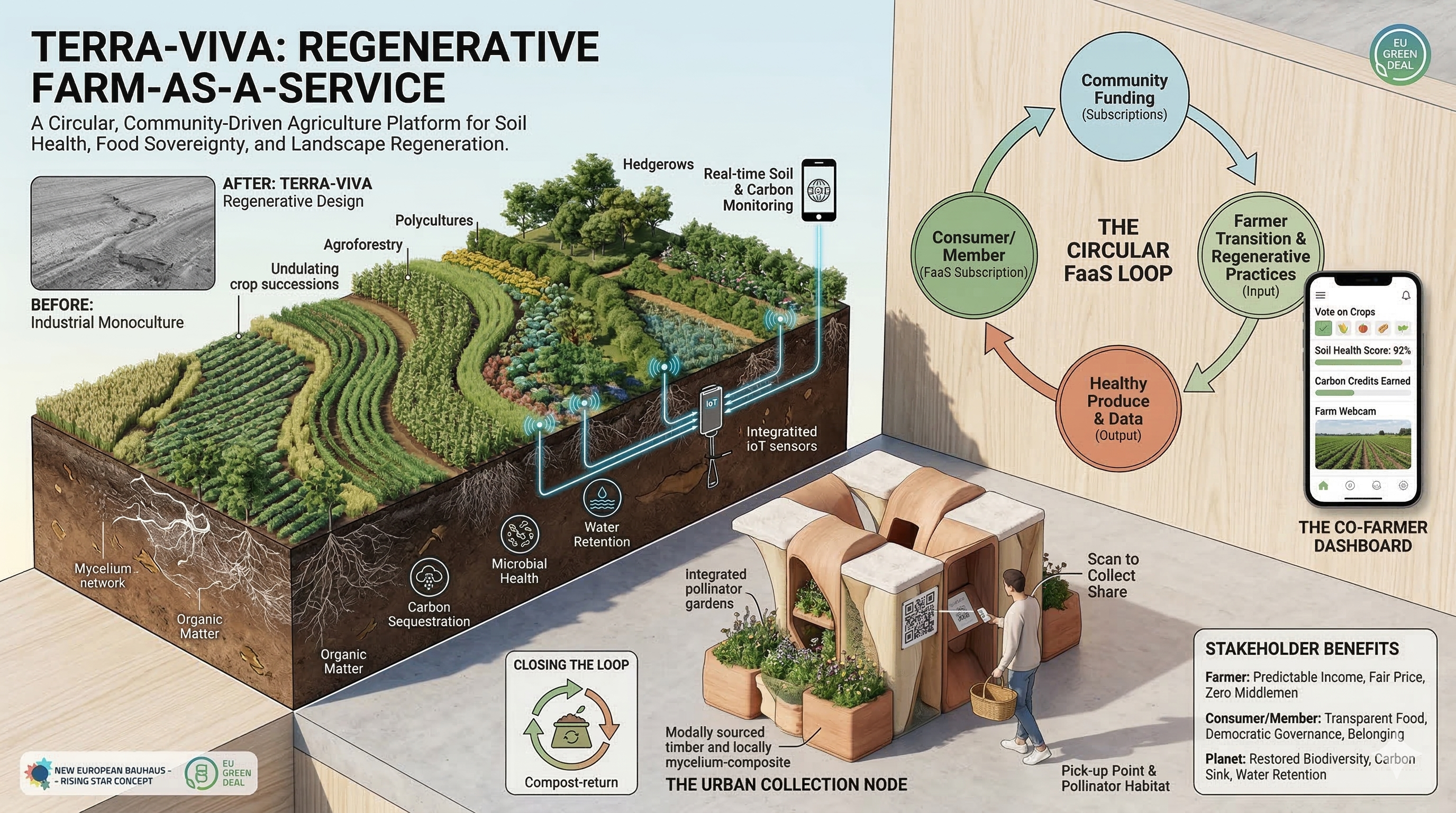
TERRA-VIVA transforms citizens from passive consumers into active landscape stewards. Through our "Farm-as-a-Service" platform, members subscribe to fund the transition to regenerative agriculture. As an agronomist, I merge IoT precision with soil health, offering shares of the harvest, carbon credits, and voting rights on crops. By creating aesthetic urban-collection nodes and rural events, we bridge the gap between city and soil, ensuring fair pay, circularity, and food sovereignty.
Spain
National
It addresses urban-rural linkages
It involves a physical transformation of the built environment (hard investment)
Early concept
No
No
No
Individual
TERRA-VIVA is a regenerative "Farm-as-a-Service" (FaaS) platform that transforms the traditional agricultural model into a circular, community-driven ecosystem. As an agronomist, I have designed this concept to address the systemic vulnerability of small-scale farmers and the environmental degradation caused by industrial monocultures.
The Concept:
Unlike traditional food subscriptions, TERRA-VIVA members do not just buy produce; they invest in the transition of a specific farm toward regenerative practices. Through a digital governance interface, subscribers pay a monthly fee (FaaS) that covers the operational costs of the land in exchange for a guaranteed share of the harvest, carbon credits, and participation in the farm’s strategic planning.
Expected Results & Impact:
Agronomic Innovation: We implement "precision regeneration." By using IoT soil sensors, we monitor carbon sequestration and microbial health in real-time. We expect to increase soil organic matter by 1.5% in the first three years, turning the farm into a certified carbon sink.
Economic Resilience: The model eliminates market price volatility. For the farmer, it ensures 100% of the harvest is pre-sold at a fair price, increasing net profitability by an estimated 40% compared to traditional distribution.
Urban-Rural Circularity: The concept includes the design of "Aesthetic Collection Nodes" in the city—modular, bio-based architectural structures that serve as pick-up points and micro-habitats for urban pollinators, bringing the NEB beauty and nature to the neighborhood level.
Social Governance: Members vote on crop diversity based on an "Agronomic Menu" I design, which balances community desires with scientific crop rotation needs. This fosters food sovereignty and cultural reconnection with the land, transforming "consumers" into "landscape stewards."
The idea for TERRA-VIVA was born in the fields, not in an office. As an agronomist, I witnessed a painful paradox: while urban citizens were increasingly desperate for high-quality, sustainable food and a connection to nature, the small-scale farmers providing it were struggling to survive due to price volatility and the crushing pressure of large-scale distribution. I saw fertile land being abandoned because the "business of farming" was no longer human-centric.
I realized that the problem wasn't a lack of productivity, but a lack of relationship. The concept emerged from the desire to "de-commoditize" food. I started asking: What if we treated a farm like a vital public service, like Netflix or a gym, where the community shares the risk and the reward?
Development & Steps Applied:
To transform this vision into a "Rising Star" concept, I applied a three-step engineering strategy:
The Agronomic Prototype: I spent months mapping soil health and biodiversity in a pilot plot. I applied Regenerative Design principles (minimum tillage, diverse cover crops) to prove that we could restore the ecosystem while remaining productive. This gave me the scientific "proof of concept" needed for the platform.
The Digital Bridge (FaaS): I developed the framework for the "Farm-as-a-Service" interface. Using my technical knowledge, I translated complex crop rotations and soil data into a user-friendly "Agronomic Menu." This allowed non-experts to understand the impact of their choices, moving from simple buyers to active "co-farmers."
Strategic NEB Integration: I sought to merge agriculture with architecture and art. I collaborated with designers to conceptualize the "Collection Nodes"—urban pick-up points that use biomimetic design to bring a piece of the farm’s beauty back to the city. This step was crucial to ensure the project wasn't just "rural," but a truly integrated New European Bauhaus solution that bridges the urban-rural divide.
Regenerative Agriculture
Food Sovereignty
Farm-as-a-Service (FaaS)
Urban-Rural Circularity
Landscape Stewardship
TERRA-VIVA redefines sustainability by moving beyond "conservation" toward active ecosystem regeneration. As an agronomist, I have designed this concept to address the environmental and economic fragility of our food systems through a holistic, circular approach:
1. Environmental (Regenerative Agronomy): The core of the project is the transition from industrial to regenerative agriculture. We implement Nature-based Solutions (NbS) such as minimum tillage, diverse cover cropping, and hedgerow restoration. These practices transform the farm into a high-capacity carbon sink. By using IoT soil sensors to monitor organic matter increase and microbial activity, we provide scientific proof of carbon sequestration, actively mitigating climate change and restoring local biodiversity.
2. Economic (Financial Resilience): Sustainability is impossible without profitability. TERRA-VIVA’s "Farm-as-a-Service" model eliminates the economic vulnerability of the farmer. By securing 100% of the production’s value through upfront subscriptions, we bypass the volatility of global markets and the waste inherent in traditional retail chains. This creates a stable, circular economy where the urban investment directly finances the health of the rural landscape.
3. Social & Cultural (Food Sovereignty): We address the cultural "extinction of experience" regarding nature. By involving citizens in crop planning and soil health monitoring, we restore the lost bond between the city and the land. Sustainability becomes a shared cultural value, not a distant policy.
4. Circularity: Our model minimizes food waste by aligning production exactly with demand (subscription-based planting). Furthermore, the "Urban Collection Nodes" serve as compost-return points, closing the nutrient loop by bringing urban organic matter back to the farm’s soil, embodying the exemplary circular character required by the New European Bauhaus.
TERRA-VIVA redefines aesthetics by moving beyond "decoration" toward the beauty of a living, functional landscape. We believe that a resilient ecosystem is inherently beautiful, and we bring this "productive aesthetics" into the daily lives of people through two scales:
1. The Rural Scale (The Living Canvas):
As an agronomist, I replace the monotonous and "grey" industrial monoculture with a vibrant, fractal landscape based on Agroforestry and Permaculture principles. We design crop successions that create a tapestry of textures, colors, and seasonal changes. The beauty here is sensory: the scent of diverse aromatic borders, the sight of blooming hedgerows, and the return of wildlife. This is not a static garden; it is a dynamic, evolving masterpiece that restores the emotional connection between the community and the rhythm of the Earth.
2. The Urban Scale (The Collection Nodes):
In the city, we replace mundane plastic crates with "Aesthetic Collection Nodes." These are modular, sculptural structures made from bio-based materials (like timber or mycelium-composites) that serve as local pick-up points. They are designed using biomimetic patterns, functioning as both public art and micro-habitats for urban pollinators. For a neighborhood, these nodes become a "piece of the farm," a beautiful landmark that signals a commitment to life and health in the middle of the asphalt.
3. Belonging and Care:
Life becomes beautiful when we feel a sense of Landscape Stewardship. By allowing members to vote on crops and visit the farm, we transform the land into a "shared place." When people participate in the design of their food system, they develop a profound "care for the place." The exemplary aesthetic of TERRA-VIVA lies in this fusion: the elegance of agronomic science meeting the human need for sensory beauty and ancestral belonging, proving that sustainability can—and must—be breathtaking.
TERRA-VIVA promotes inclusion by transforming the "consumer" into a "co-farmer," breaking the elitist barriers often associated with organic and local food. We address accessibility and social equity through three fundamental pillars:
1. Affordability through Social Cross-Subsidization: We acknowledge that high-quality, regenerative food can be a financial challenge for some. Our "Farm-as-a-Service" model includes a "Solidarity Tier": for every ten standard subscriptions, the community-fund finances one subsidized subscription for low-income families or local food banks. This ensures that the benefits of soil health and nutrition are a universal right, not a privilege, creating a truly inclusive societal model where the community looks after its most vulnerable members.
2. Inclusive Governance & Digital Democracy: The concept is exemplary in its governance. Through our digital platform, we implement a "One Member, One Vote" system for crop planning. This democratizes the decision-making process, allowing citizens to have a direct say in how their local landscape is managed. We use "Design for All" principles in our interface to ensure that elderly residents or people with low digital literacy can easily participate in the "Agronomic Menu" selection, fostering a deep sense of agency and empowerment.
3. Physical Accessibility & Spatial Justice: By placing our "Aesthetic Collection Nodes" in diverse urban neighborhoods—not just wealthy city centers—we bring healthy food and nature to "food deserts." These nodes are designed to be 100% accessible, serving as inclusive meeting points where diverse social groups interact during pick-up events. Furthermore, the farm itself is designed as an accessible educational space, providing "therapeutic landscapes" for people with disabilities or mental health challenges, proving that the agricultural transition can be a powerful engine for social cohesion and spatial justice.
The development of TERRA-VIVA follows a radical co-design methodology, moving from "consumer feedback" to "citizen-led governance." As a Rising Star concept, the participation of stakeholders has been the primary driver in shaping the platform’s architecture through three distinct levels of engagement:
1. Community Co-Diagnosis: Early conceptualization involved "Design Thinking" sessions with diverse urban neighbors and local agricultural associations. The impact was transformative: citizens expressed that they didn't just want a food box; they wanted agency. This feedback led to the creation of the "Agronomic Menu," shifting the project from a simple delivery service to a democratic crop-planning platform where users actually decide what is grown on the land.
2. Farmer-Centric Iteration: We conducted "Field Workshops" with small-scale producers. Their participation was crucial in defining the financial model. They emphasized the stress caused by retail payment delays and "ugly produce" rejection. Consequently, we implemented the "Farm-as-a-Service" subscription—ensuring 100% upfront payment and a "zero-waste" commitment from subscribers to accept the entire harvest, regardless of aesthetic standards.
3. Urban Integration Design: For the "Aesthetic Collection Nodes," we involved local neighborhood associations to identify "food deserts" and underused public spaces. Their input ensures that these nodes aren't just pick-up points but serve as community hubs. The impact of this participation has been the integration of seating areas and pollinator gardens into the nodes, turning a logistical necessity into a social asset.
This participatory process ensures that TERRA-VIVA is not an external imposition but a socially-rooted infrastructure that reflects the real needs, fears, and aspirations of both those who cultivate the land and those who are nourished by it.
TERRA-VIVA operates as a bridge between hyper-local actions and European strategic goals, creating a governance structure that involves stakeholders across four critical scales:
1. Local Level (Neighborhoods & Municipalities): We engage with local Neighborhood Associations and City Councils. Their involvement is essential for the strategic placement of the "Aesthetic Collection Nodes" in public spaces. The added value is the creation of "Food Policy Councils" at the neighborhood level, turning urban planning into a tool for food security and social cohesion.
2. Regional Level (Agricultural Chambers & River Basin Authorities): We collaborate with regional agricultural bodies to identify farms in transition. As an agronomist, I involve these stakeholders to ensure our regenerative practices align with regional soil and water conservation plans. Their engagement adds value by providing technical validation and helping scale the model to different bio-regions within the territory.
3. National Level (Innovation Agencies & Rural Development Networks): We aim to engage with national entities focused on the "Digitalization of the Primary Sector." The added value here is the integration of our "Farm-as-a-Service" data into national statistics on carbon sequestration and biodiversity recovery, positioning TERRA-VIVA as a pilot case for national rural-urban revitalization strategies.
4. European Level (EU Mission: Soil Deal for Europe & Farm to Fork): Our concept is designed to be a "living lab" for the European Green Deal. We expect to involve European NEB networks and research clusters to standardize our "Regenerative Subscription" model. The engagement at this level adds immense value by providing a replicable framework that helps the EU meet its 2030 targets for organic farming and soil health, proving that small-scale local governance can drive continental transformation.
TERRA-VIVA is built on the conviction that the urban-rural divide can only be bridged through a radical fusion of diverse knowledge fields. Our concept moves beyond simple multidisciplinary cooperation toward a transdisciplinary synergy where four core areas intersect:
1. Agronomy & Environmental Sciences (The Scientific Foundation): As the lead agricultural engineer, I provide the technical backbone. We apply soil science, plant physiology, and agroecology to design regenerative systems that restore microbial life and sequester carbon. This is not "traditional farming"; it is applied environmental engineering that uses the soil as a living technology to mitigate climate change.
2. Architecture & Parametric Design (The Spatial Interface): We translate biological data into urban form. By collaborating with architects, we use parametric design to create our "Aesthetic Collection Nodes." These are not just functional kiosks; they are biomimetic structures that respect "Design for All" principles, transforming logistical points into sculptural landmarks that enhance the urban fabric.
3. Digital Technologies & IoT (The Transparency Layer): We bridge the physical and digital worlds through "Smart Farming." Integrating IoT sensors with blockchain-based governance allows us to translate complex agronomic data into a transparent "Farm-as-a-Service" dashboard. This requires a fusion of software engineering and data science to empower citizens with real-time evidence of their ecological impact.
4. Social Sciences & Arts (The Cultural Connector): To foster a true "sense of belonging," we incorporate environmental psychology and the arts. We use storytelling and sensory design to turn a harvest into a cultural event. By applying social innovation methodologies, we ensure the project addresses food justice and inclusive governance, proving that the agricultural transition is, at its heart, a cultural transformation.
TERRA-VIVA disrupts the precarious financial model of traditional agriculture by implementing a diversified "Farm-as-a-Service" (FaaS) ecosystem. Our financial sustainability is built on three complementary revenue streams that ensure long-term viability:
1. Tiered Subscription Model (B2C/B2B):
The primary revenue comes from monthly memberships. Unlike a simple "veg box," subscribers pay for a share of the farm’s productive capacity. This provides the farmer with a predictable, upfront cash flow, eliminating market price volatility and "middleman" fees. We include a "Professional Tier" for local restaurants and schools, ensuring a stable, high-volume base. This model reduces food waste to near zero, as production is precisely aligned with subscription demand.
2. Ecosystem Service Credits & Data (Data Monetization):
As an agronomist, I integrate IoT monitoring to quantify the farm’s environmental impact. TERRA-VIVA generates verified data on carbon sequestration and biodiversity recovery. We envision monetizing this through "Green Credits" purchased by local SMEs seeking to meet CSR (Corporate Social Responsibility) targets or ESG regulations. This transforms "sustainability" from a cost into a measurable, sellable asset.
3. Agronomic Cultural Tourism & Education (High-Value Services):
The farm doubles as a cultural venue. Revenue is generated through "Field Experience Days," technical agroecology workshops, and farm-to-table events. This diversifies income beyond physical produce, utilizing the land as a platform for education and community building, which is highly resilient to agricultural yield fluctuations.
4. Public-Private Partnerships (PPP):
In the implementation phase, we seek to leverage EU Green Deal innovation funds (such as LIFE or EAFRD) to finance the initial setup of the "Aesthetic Collection Nodes."
TERRA-VIVA is designed as a modular and "exportable" system, ensuring high potential for transferability across different European bioclimatic and social contexts. Its scalability is based on three replicable layers:
1. The Agronomic Protocol (Technical Scalability):
The core "Regenerative Recipe" is climate-agnostic. While the specific plant species change, the methodology of soil restoration, carbon monitoring, and IoT integration remains constant. As an agronomist, I have developed a standardized "Regeneration Toolkit" that can be adapted to a vineyard in Spain, an apple orchard in Poland, or a dairy farm in the Netherlands. This allows the concept to scale across any geography by simply swapping the local "Phyto-Palette."
2. The FaaS Digital Framework (Methodological Scalability):
Our "Farm-as-a-Service" software and governance model are highly transferable. The digital interface, including the "One Member, One Vote" system and the transparent impact dashboard, functions as a white-label platform. It can be utilized by various groups of beneficiaries: from small farmers' cooperatives seeking digital transformation to municipal governments looking to manage peri-urban agricultural belts more efficiently.
3. The Modular Urban Interface (Spatial Scalability):
The "Aesthetic Collection Nodes" are designed as prefabricated, modular kits. These structures can be 3D-printed or CNC-milled using local bio-based materials (timber, hemp, or recycled plastics), allowing for rapid deployment in any European neighborhood. This "Plug-and-Play" urbanism ensures that the project can bridge the rural-urban divide in any city, regardless of size or existing infrastructure.
4. Key Learnings & Policy Transfer:
The project generates a replicable blueprint for Public-Private Partnerships. The data collected on carbon sequestration and local food resilience can be transferred to regional authorities to help them design new agri-environmental payment scheme.
Winning the New European Bauhaus Prize will act as the decisive catalyst to transition TERRA-VIVA from a high-fidelity concept to a functional, community-driven pilot. My commitment as an agronomist is backed by a structured 12-month implementation plan:
Phase 1: Technical Foundation & Site Selection (Months 1-3)
The first quarter will focus on finalizing the pilot farm agreement and the baseline agronomic study. Using the prize funds, I will conduct exhaustive soil testing (SOC, microbial diversity) to establish the "Year 0" environmental baseline. Simultaneously, we will refine the "Regenerative Recipe" for the specific Mediterranean climate of the pilot site, selecting the initial biodiversity-led crop succession.
Phase 2: Digital MVP & Collection Node Design (Months 4-6)
We will develop the Minimum Viable Product (MVP) of the "Farm-as-a-Service" platform, focusing on the voting interface and the IoT data dashboard. Concurrently, I will collaborate with local architects to prototype the first "Aesthetic Collection Node" using bio-based materials. This phase ensures the technical bridge between the field’s data and the citizen’s experience is seamless.
Phase 3: Community Onboarding & Pilot Launch (Months 7-9)
We will launch our first "Founder Subscription" campaign to onboard the initial 100 members. This phase includes "Open Field Days" where future co-farmers participate in the first planting events. By month 9, the first Urban Collection Node will be installed in a strategic neighborhood, making the concept a visible reality in the urban fabric.
Phase 4: Impact Analysis & Scaling Strategy (Months 10-12)
The final quarter will focus on monitoring. We will gather data on soil recovery and member satisfaction to produce our first "Regeneration Report." This data will be used to pitch the "SaaS" model to regional agricultural authorities and local SMEs for carbon offsetting.