Arts, Culture, and Heritage as Drivers of Change
transhuman Ring
transhumanist Ring: Therapeutic Tech
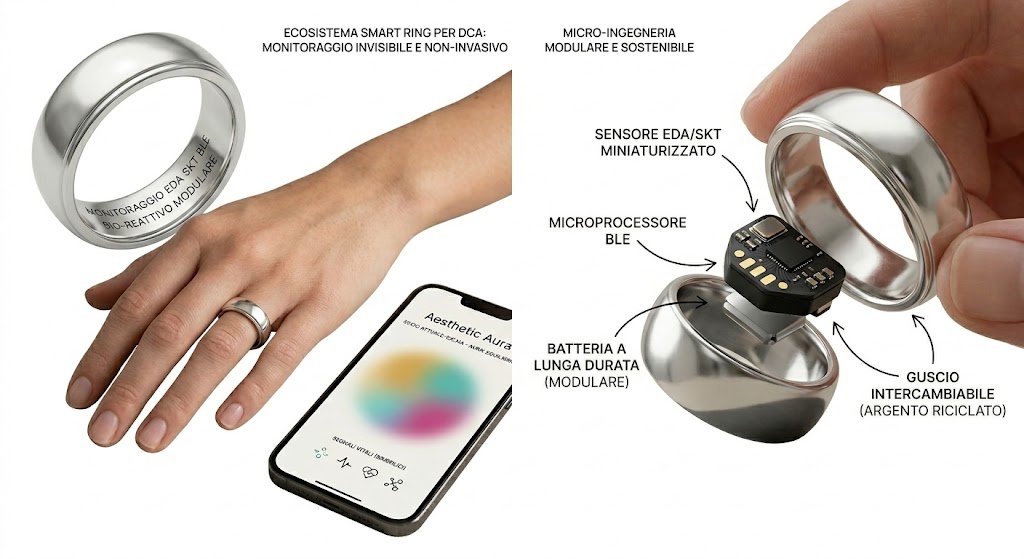
An elegant Smart Ring designed to transform the invisible struggle of Eating Disorders into a poetic visual journey. By merging Italian jewelry tradition with neuroscience, the device translates vital signals (EDA, HRV, Temperature) into an ever-changing "digital aurora" on your smartphone. It’s not a medical monitor, but a tool for aesthetic self-awareness: a modular, sustainable piece of Art-Tech that restores agency and beauty to the process of healing.
Italy
National
Mainly urban
It refers to other types of transformations (soft investment)
Early concept
No
No
No
Individual
The project addresses the invisible mental health crisis, specifically focusing on Eating Disorders—a pathology where the body becomes the battlefield for a silent identity conflict. The initiative aims to dismantle the traditional clinical monitoring paradigm, which is often perceived as punitive, cold, and invasive, by replacing it with a wearable bio-responsive ecosystem: a Smart Ring. The intent is to transform biometric data collection into an experience of aesthetic self-awareness and "visual interoception," allowing the user to reconnect with their vital signals without the filter of clinical judgment.
Target Groups: The primary beneficiaries are patients in recovery from ED and young adults exhibiting psychophysical vulnerability. The project also targets mental health professionals (psychologists, nutritionists, psychiatrists) as a relational support tool, as well as educational institutions and academies interested in the intersection of digital craftsmanship and well-being.
Specific Objectives: The project seeks to translate complex physiological parameters (EDA, HR, HRV, SKT) in real-time into chromatic and formal variables projected onto a dedicated mobile application. This process facilitates the early recognition of emotional triggers and acute stress states before they escalate into symptomatic manifestations or crises.
Results Obtained and Transformative Potential: To date, the algorithmic mapping logic has been prototyped (e.g., the correlation between peripheral thermal drops and EDA peaks as markers of paralyzing anxiety). Acceptability tests conducted within patient communities have confirmed the effectiveness of visual language over numerical data. The approach is disruptive: it shifts the focus from an imposed external diagnosis to a shared internal narrative. It is not the chip that defines the emotion, but the user who learns to interpret their own "digital matter,"restoring dignity, voice, and agency to the suffering body.
Genesis and Participation: The idea emerged from the necessary collision between my background in Fashion Design (Made in Italy) and my artistic research in Decoration at the Academy of Fine Arts, deeply marked by a personal journey of overcoming Eating Disorders (ED). The primary necessity was to transmute pain and identity fragmentation into a poetic tool for healing. The project is led by me as an artist-researcher, drawing upon a transdisciplinary network that includes bioengineering experts for sensor technology and, most importantly, the active participation of ED patients. These individuals were involved in co-creation workshops at dedicated facilities, where their feedback guided the aesthetic and functional choices of the device.
Phases and Tools: The process is structured into four crucial phases: 1. Theoretical research on the phenomenology of the body and the physiology of emotions. 2. Textile experimentation with reactive knitwear to map body movements. 3. Technological miniaturization toward the Smart Ring to ensure discretion and continuity of use. 4. Development of a generative shader in Unity capable of reacting to biometric data. The tools used range from advanced 3D modeling to precision GSR/EDA sensing, utilizing BLE (Bluetooth Low Energy) protocols to ensure portability.
Future: The project's horizon envisions the evolution of the ring into an artistic self-care device. The goal is to establish a new standard of "ethical health jewelry," where Italian manufacturing excellence meets narrative health, transforming the wearable object into a life companion and a symbol of contemporary healing.
Interoception
Emotion
Care
Art-Tech
Aesthetics
bjectives and Implementation: The project aims to minimize the environmental impact of consumer electronics and promote radical social sustainability in mental health care. The ring breaks away from the "disposable" logic through a strictly modular and disassemblable design. The outer shell, crafted from biocompatible resin or recycled precious metals, is physically separated from the electronic "core." This architecture allows for precise repairs, hardware upgrades, or efficient differentiated recycling, countering the planned obsolescence typical of mass-market commercial wearables.
Exemplarity: The project serves as a model of "Slow-Tech." Sustainability is understood here as an ecology of the mind: by reducing informational "noise" and performance anxiety linked to numerical data, it fosters long-lasting and resilient health, reducing—where possible—dependency on purely pharmacological solutions. Furthermore, the affective value of the jewelry, personalized and co-designed, prevents mindless disposal: the object is not an anonymous sensor, but a piece of personal heritage that evolves alongside the clinical and artistic history of the wearer.
Exemplarity: The project serves as a model of "Slow-Tech." Sustainability is understood here as an ecology of the mind: by reducing informational "noise" and performance anxiety linked to numerical data, it fosters long-lasting and resilient health, reducing—where possible—dependency on purely pharmacological solutions. Furthermore, the affective value of the jewelry, personalized and co-designed, prevents mindless disposal: the object is not an anonymous sensor, but a piece of personal heritage that evolves alongside the clinical and artistic history of the wearer.
My concept redefines beauty not as a superficial quality, but as a state of harmony between the internal self and the external world. It makes life beautiful by transforming the "invisible" burden of mental distress into a visible, aesthetic narrative, fostering self-care and community belonging.
1. Beauty in the Everyday and Long-Term In the everyday, the project removes the clinical coldness from health monitoring. Instead of an anxiety-inducing medical device, the user wears a piece of Italian-designed jewelry. Life becomes more beautiful because body data is no longer a number to be feared (e.g., calories, heart rate), but a generative aurora to be observed. In the long term, it promotes a "narrative of recovery." By tracking emotional changes through an artistic diary, patients share "visual signatures," turning a solitary struggle into a shared, beautiful language of resilience.
2. Belonging and Care for the "Place" The project interprets the body as the primary "place" we inhabit. Through "visual interoception," it helps individuals regain a sense of belonging to their own physical and emotional space, often lost during Eating Disorders. On a community level, co-creation workshops in libraries and cultural hubs turn these venues into "sanctuaries of care." The project encourages people to inhabit public spaces not just as consumers, but as creative individuals who care for one another through the shared language of art and technology.
3. Exemplarity in Aesthetics (Beyond Functionality) The project applies Synesthesia as a design principle, moving beyond functional monitoring toward poetic self-expression:
Tactile and Visual Quality: It combines the haptic richness of recycled precious metals or biocompatible resins with the ethereal beauty of real-time digital art.
The "Slow-Tech" Aesthetic, Dignity and Resonance.
To address the Inclusion value of the New European Bauhaus, the concept focuses on democratizing mental health support by breaking down physical, social, and economic barriers. The project shifts the user's perception from a "medical patient" to a "creative agent."
1. Accessibility and Economic Sustainability
Design for All: The mobile interface utilizes a universal language of colors and shapes. This makes the tool accessible regardless of language, education level, or digital literacy, ensuring that the "story" told by the body is understandable to everyone.
Economic Sustainability: By adopting a modular hardware approach, the project ensures long-term affordability. Users do not need to replace the entire device; they can simply update the internal sensor or repair the outer shell.
2. Inclusive Governance and New Societal Models
The concept promotes a collaborative care model that flattens the traditional hierarchy between doctor and patient.
Shared Agency: Instead of the doctor being the sole "interpreter" of data, the user becomes a co-interpreter. This promotes a care governance system where the patient’s subjective experience holds the same value as clinical data.
Public Sanctuaries: By hosting workshops in libraries and community centers, the project moves mental health care into the civic heart of the neighborhood. This creates a new societal model where "healing" is not hidden away in clinics but is a collective, visible, and supported part of urban life.
3.Inclusion
The project treats discretion as a form of dignity. Many inclusive designs fail by making the "assistive" nature of the object too obvious, which can lead to social exclusion.
Community Co-creation: The project’s development is rooted in the lived experiences of those suffering from Eating Disorders. Their direct influence on he "no-numbers" policy (avoiding the tracking of calories or weight) proves that the project is not just for them, but made by them.
Co-design is the heart of this project. The concept has been validated through iterative feedback cycles with both patients and experts. These exchanges led to crucial decisions: the elimination of charts and numbers (such as calories, steps, or precise BPM) to prevent the device from becoming a new tool for obsession for those suffering from ED. The users are true "influencers," determining the abstract and reassuring aesthetics of the interface.
Stakeholder Involvement across Levels:
The project is built upon a multi-level governance framework, engaging diverse stakeholders to ensure the concept is socially grounded, scientifically sound, and scalable:
Local Level: The project originated within the Academy of Fine Arts (Accademia di Belle Arti), involving students and academic researchers in the fields of Decoration and Fashion Design. Locally, we engage community libraries and cultural hubs as decentralized spaces for co-creation workshops, transforming these venues into "urban sanctuaries" for mental health dialogue.
Regional Level: We collaborate with regional healthcare facilities and specialized Eating Disorder (ED) centers. These stakeholders provide the clinical expertise necessary to validate the bio-reactive mapping and ensure the device meets the real needs of patients and therapists within the local healthcare ecosystem.
National Level: We expect to involve national design and jewelry consortia to integrate traditional Italian craftsmanship with emerging technologies. Engaging national mental health associations will also be crucial for advocating for "narrative health" tools within national welfare systems.
European Level: The project is designed to align with the European Commission’s digital health programs and the New European Bauhaus network. By participating in EU-wide research initiatives, we aim to scale the methodology "Physiology → Art" as a standard for human-centric technology across the Union.
The Added Value of Engagement:
The strength of this engagement lies in its radical transdisciplinarity, fusing expertise from tailoring, goldsmithing, neuroscience, performance art, and computer science.
The added value of this "collision of knowledge" is transformative:
From Technology to Poetry: Through the involvement of neuroscientists and bioengineers, technology loses its aseptic neutrality. It ceases to be a cold monitoring tool and becomes a poetic medium for self-expression.
From Ornament to Function: Through the lens of art and fashion design, the object is no longer merely ornamental. It becomes a functional tool for survival and collective well-being, restoring dignity to the wearer.
Holistic Validation: By engaging both the "lived experience" of patients and the "technical rigor" of clinicians, the project ensures that the final device is not just a commercial product, but a socially responsible intervention that counters stigma and fosters a new culture of care.
A hybrid financial structure is planned to ensure long-term sustainability and impact:
B2C Sales: The ring will be positioned as a high-end "Art-Tech" accessory, targeting users interested in the intersection of well-being, personal growth, and contemporary design.
B2B/B2G Model: Establishing partnerships with private rehabilitation clinics and National Health Systems. The ring will be offered as part of a specialized telemedicine kit, providing a less invasive and more human-centric method for remote patient monitoring.
Crowdfunding: A campaign will be launched to finance the production of the initial "capsule collection." Additionally, software development costs will be amortized through licensing the visualization platform for professional use in therapeutic contexts.
The "Physiology → Color" mapping methodology is inherently scalable and adaptable:
Clinical Transferability: The framework can be recalibrated to address other conditions beyond ED, such as Generalized Anxiety Disorder (GAD), PTSD, or to support emotional regulation for individuals on the autism spectrum.
Formal Versatility: The core technology is transferable to various wearable formats (necklaces, bracelets) or can be integrated into large-scale environmental installations for sensory rooms.
Global Reach: For large-scale scalability, partnerships are envisioned with micro-electronics technology hubs and European mental health networks. This strategy positions the European Union’s digital craftsmanship as a global leader in Human-Centric Technology.
1: Technical Refinement & Miniaturization (Months 1–7)
The primary goal is to finalize the hardware architecture:
Engineering: Collaborating with bioengineering partners to optimize EDA and SKT sensor integration into a wearable format that preserves the ring’s aesthetic integrity.
Prototyping: Ensuring the device is easily disassemblable, aligning with circular economy and sustainability requirements.
Software Beta: Finalizing the Unity-based generative engine to ensure seamless Bluetooth Low Energy (BLE) communication between the ring and the smartphone.
2: Participatory Testing (Months 7–8)
Transitioning from "proof of concept" to real-world validation:
Pilot Study: In collaboration with regional ED centers and mental health professionals.
Feedback Cycles: Conducting qualitative interviews to refine the "visual language," ensuring color mappings remain reassuring and do not trigger obsessive behaviors.
Ethical Review: Finalizing GDPR-compliant data protocols to ensure all biometric data remains encrypted and under the user’s total control.
Phase 3: Promotion & Community Building (Months 8–10)
Developing the narrative and securing a financial foundation:
Capsule Collection Launch: Presenting the first series of rings at international design and technology exhibitions.
Educational Outreach: Continuing workshops in public libraries to promote digital awareness and NEB values, turning the project into a social movement.
4: Market Entry & Institutional Partnerships (Months 11–12)
Setting the stage for long-term scalability:
B2B/B2G Relations: Presenting validated results to private clinics and regional health authorities to establish pilot remote monitoring programs.
Supply Chain Finalization: Securing contracts with Italian goldsmiths and biocompatible resin suppliers to guarantee "Made in Italy" quality and material sustainability.
Foreseen Added Value
By the end of year one, the project will evolve into a community-validated wearable.