Enhancing Circularity, Sustainability, and Innovation
Hydro-Agora: Sponge-as-a-Service
Hydro-Agora: 3D-Printed Bio-filtering Furniture for Urban Water Resilience
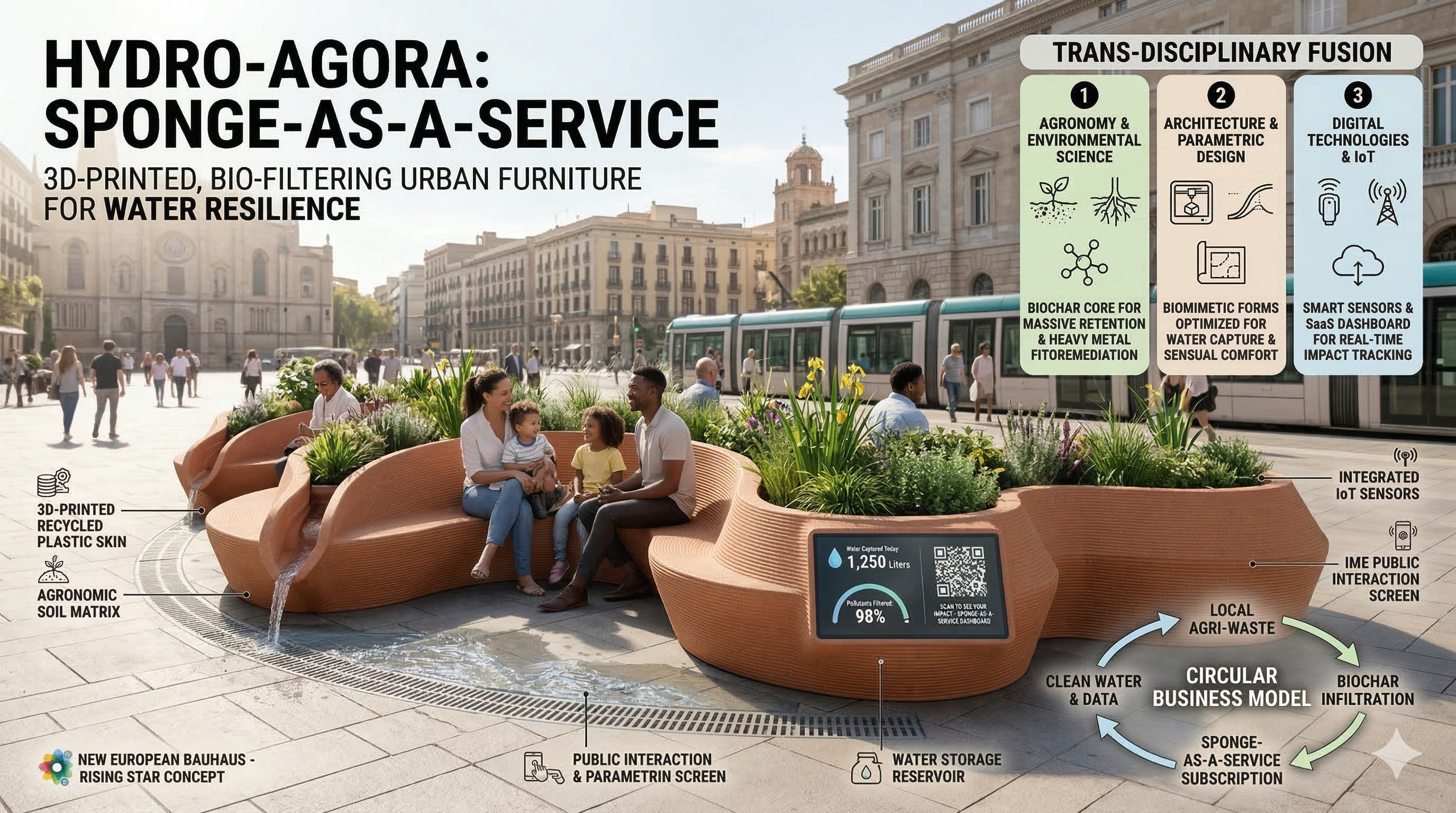
Hydro-Agora transforms city streets into climate-resilient micro-wetlands. We design beautiful, 3D-printed urban furniture from recycled plastics that acts as a smart sponge. Powered by agronomic science, its biochar core and local plants capture, filter, and store stormwater, preventing floods and fighting droughts. Equipped with IoT sensors, it offers "Sponge-as-a-Service" to cities, merging inclusive public spaces with high-tech water management and circular economy.
Spain
National
Mainly urban
It involves a physical transformation of the built environment (hard investment)
Early concept
No
No
Yes
Individual
Hydro-Agora is a modular, 3D-printed urban furniture system functioning as a climate-resilient micro-wetland. It transforms paved urban areas into decentralized stormwater management hubs, directly addressing Europe’s dual threat of extreme droughts and flash floods.
Circularity & Innovation (Category Relevance): We upcycle local agricultural waste into biochar, blending it with recycled urban plastics to 3D-print parametric structures. Inside, a biochar core acts as a massive sponge, retaining 5x its weight in water, while hyper-accumulating Mediterranean flora bio-filters heavy metals from street runoff. Equipped with IoT sensors, it pioneers a financially viable "Sponge-as-a-Service" model for municipalities.
Expected Results & Impact: A single module is projected to intercept and divert up to 500 liters of runoff per rain event, relieving overburdened sewage systems and preventing urban flooding. During droughts, the biochar sustains the vegetation passively without external municipal irrigation. This process actively cools the surrounding air, mitigates the urban heat island effect, and restores hyper-local biodiversity at the street level.
NEB Values & Working Principles:
Sustainability: Combines carbon-negative materials, circular economy loops, and nature-based water resilience.
Beauty: Biomimetic, flowing designs inspired by riverbed erosion replace mundane concrete planters, creating visually striking, iconic, and welcoming civic spaces.
Inclusion & Participation: Driven by a transdisciplinary approach (agronomy, hydrology, 3D-design), we prioritize installations in vulnerable, heat-island-prone neighborhoods to ensure spatial justice. A built-in QR interface engages citizens with real-time water purification data, turning infrastructure into an educational community tool.
The story of Hydro-Agora began at the intersection of agricultural engineering and urban climate anxiety. Witnessing the devastating flash floods (such as the extreme 'DANAs' in the Mediterranean) followed by severe seasonal droughts, a stark contrast became clear to me. While modern agronomy treats every drop of rainwater as a precious resource to be captured and stored in the soil, our concrete-paved cities treat stormwater as a hazard to be quickly flushed into overburdened sewers.
I realized the solution wasn't building massive, expensive gray infrastructure, but shrinking green infrastructure into scalable, street-level modules. The core question emerged: what if we brought the science of agricultural water retention and phytoremediation directly into our everyday urban furniture?
Development & Methodology:
As a "Rising Star" concept, the development followed a highly transdisciplinary strategy, merging agronomic science, digital fabrication, and circular economics through three main steps:
1. Agronomic R&D: The first step was developing the "biological engine." Leveraging my engineering background, I formulated a specialized substrate relying heavily on biochar—produced from local agricultural waste (like olive pits)—which acts as a high-capacity sponge. I then curated a palette of endemic, hyper-accumulating riparian plants capable of surviving the dual stress of heavy inundation and prolonged drought.
2. Parametric Design: To make this infrastructure beautiful, we used parametric design tools (Rhino/Grasshopper) to model biomimetic, fluid shapes that naturally guide and capture water runoff, far removed from traditional, rigid concrete planters.
3. Fabrication & Tech Strategy: We strategized the 3D-printing process using biocomposites (recycled urban plastics mixed with organic fibers). Finally, we integrated IoT moisture sensors to track water retention in real-time.
Nature-based Solutions
Water Resilience
Circular Bioeconomy
Parametric Design
Climate Adaptation
Hydro-Agora addresses the sustainability challenge by shifting from "extract-consume-waste" to a "regenerative-circular" urban model. Its exemplary character lies in how it integrates four key dimensions of sustainability:
1. Environmental (Climate Adaptation & Water Cycle): The concept creates a decentralized network of nature-based solutions. By capturing and bio-filtering stormwater at the source, it reduces the hydraulic load on municipal sewage systems by an estimated 30% per street, mitigating flood risks. Simultaneously, it uses phytoremediation to remove heavy metals (Pb, Zn, Cu) from runoff, preventing pollutants from reaching natural water bodies. The use of biochar ensures a "Net Zero" approach, passively sequestering carbon within the urban fabric for decades.
2. Circular Economy (Resource Optimization): The sustainability is rooted in industrial symbiosis. We transform agricultural liabilities (biomass waste) into high-value assets (biochar filtration cores). By combining this with 3D-printing using recycled polyolefins from urban waste, we close the loop between the rural agricultural sector and urban infrastructure, drastically reducing the embodied carbon of public furniture.
3. Economic (Viability & Scalability): Sustainability requires financial durability. Our "Sponge-as-a-Service" (SaaS) model replaces the traditional "one-off" purchase with a maintenance-based subscription. This ensures the long-term health of the biological systems (plants and filters) while providing municipalities with a predictable, cost-effective alternative to multi-million-euro grey infrastructure upgrades.
4. Social & Cultural: We foster a new "water culture" (Cultura del Agua). By transforming invisible, underground drainage into a visible, aesthetic, and functional landscape element, we educate citizens on the value of water in an era of scarcity, turning sustainability into a tangible and shared urban experience.
Hydro-Agora redefines urban aesthetics by moving beyond "cosmetic" greenery toward performative beauty. It challenges the traditional, gray, and utilitarian appearance of water infrastructure, replacing invisible concrete pipes with visible, iconic, and biomimetic art.
1. Biomimetic & Sensory Design: Using parametric 3D-printing, we create fluid, organic forms inspired by the movement of water and natural riverbeds. These shapes are not just visual; they invite touch and interaction. The aesthetic experience is multisensory: the cooling scent of damp earth during a rain event, the vibrant textures of riparian flora, and the ergonomic curves that offer comfort. By bringing the "wild" aesthetics of a wetland into the paved city, we provide a daily "nature-fix" that reduces urban stress and improves mental well-being.
2. Cultivating a Sense of Belonging: Beauty inspires care. When a neighborhood receives a Hydro-Agora module, it isn't just receiving a bench; it is receiving a "living landmark." By transforming a neglected "hard" plaza into a lush, sculptural oasis, we foster a sense of pride. Citizens are no longer passive users of a street; they become observers of a micro-ecosystem that changes with the seasons. This visibility of the water cycle creates a deeper emotional connection to the local environment and a shared responsibility for its upkeep.
3. Exemplary Character – "The Beauty of Function": Our concept is exemplary because it embodies the "Bauhaus" spirit of fusing form and function. The aesthetic of the module is dictated by its purpose: the curves are designed to channel runoff, and the porous textures are optimized for bio-filtration. It proves that sustainability doesn't have to be "invisible" or "boring." Instead, it can be the primary driver of a new, contemporary urban identity that celebrates water as life, making the long-term resilience of the neighborhood a source of collective joy and architectural pride.
Hydro-Agora promotes inclusion by treating climate resilience not as a luxury, but as a universal right. It concretely addresses social equity through three inclusive pillars:
1. Spatial Justice & Accessibility: Unlike large-scale green infrastructure that often triggers "green gentrification" in wealthy areas, our modular system is designed for "acupuncture urbanism." We prioritize installation in vulnerable, high-density neighborhoods—often characterized by "hard" plazas and a lack of natural shade. By transforming these neglected spaces into high-quality, cooling rest areas, we provide elderly citizens, children, and low-income residents with free access to thermal comfort and restorative environments, adhering to "Design for All" principles in its ergonomic, barrier-free seating.
2. Economic Affordability & Scalability: High-tech sustainability is often unaffordable for small municipalities. Our "Sponge-as-a-Service" model democratizes access to innovation. By removing the high upfront cost of infrastructure and replacing it with a manageable maintenance subscription, we enable resource-constrained local governments to implement cutting-edge water management. This new societal model shifts the burden of technical maintenance from the city to the provider, ensuring that even the most modest neighborhoods can benefit from state-of-the-art circular technology.
3. Inclusive Governance & Transparency: Hydro-Agora acts as an open-air classroom. Through the integrated QR-code interface and IoT dashboard, complex environmental data (water purity, liters saved) is translated into simple, visual storytelling. This promotes "inclusive governance" by empowering residents with information about their local environment. It fosters a sense of collective ownership and care, turning a passive piece of furniture into a hub for community engagement and environmental education, ensuring that the ecological transition is transparent and culturally grounded for everyone.
The development of Hydro-Agora follows a "Bottom-Up Meets High-Tech" approach. As a Rising Star concept, participation has been integrated as a core design tool rather than a final formality, involving three levels of stakeholders:
1. Community Co-Diagnosis: The initial conceptualization was driven by informal "field walks" and interviews with residents in "hard" urban areas. Their input was crucial: they didn't just ask for "more trees," but for "cool places to sit" and "solutions for the puddles that make streets impassable after rain." This directly shifted our focus from simple planters to multifunctional, ergonomic seating systems that prioritize thermal comfort and accessibility.
2. Transdisciplinary Stakeholder Mapping: We have engaged with municipal water technicians and urban maintenance workers to understand the "pain points" of current infrastructure. Their participation led to a major pivot in the concept: the modular, "plug-and-play" nature of the furniture. They emphasized the need for systems that don't require complex underground construction, leading to our surface-level, modular design that simplifies adoption for local councils.
3. Impact of Participation - The "Human-Centric" Prototype: The feedback from these groups resulted in the integration of the IoT transparency layer. Citizens expressed a desire to "see" the impact of their local sustainability efforts. Consequently, the concept evolved to include the digital dashboard and QR interfaces, transforming a static object into a conversational piece of infrastructure. This participatory process ensures that Hydro-Agora is not an alien technological imposition, but a culturally grounded response to the specific needs, fears, and aspirations of the people who will share their daily lives with it.
Hydro-Agora is designed to operate as a catalyst across different scales of governance, bridging the gap between hyper-local urban needs and European strategic goals. Our multilevel engagement strategy includes:
1. Local Level (Municipalities & Citizens): We involve local Water Management Authorities and Urban Planning departments. Their engagement is vital to ensure the modules align with specific local runoff challenges. The added value is the creation of a "Sponge City" micro-grid that provides immediate, tangible data on flood mitigation, helping mayors meet local climate targets while enhancing the daily well-being of residents.
2. Regional Level (River Basin Authorities & Regional Governments): In the Mediterranean and beyond, Water Confederations (River Basin Authorities) are key stakeholders. We expect to involve them to validate how decentralized urban capture can reduce the pressure on regional water bodies during storm events. Their engagement adds value by integrating urban design into broader Integrated Water Resources Management (IWRM) plans, turning city streets into an extension of the regional ecological corridor.
3. National & European Level (EU Policy Alignment): Our concept aligns directly with the EU Strategy on Adaptation to Climate Change and the EU Mission: Climate-Neutral and Smart Cities. We aim to engage with national innovation agencies and European NEB networks to standardize the "Sponge-as-a-Service" model. The added value here is the potential for Hydro-Agora to become a replicable European "Best Practice." By gathering data through our IoT network, we contribute to a cross-border knowledge base on Nature-based Solutions, helping the EU transition from theoretical policy to ground-level implementation.
This multilevel approach ensures that a single bench in a neighborhood street is technically, legally, and strategically connected to the European-wide effort to build a water-resilient and climate-neutral continent.
Hydro-Agora is inherently transdisciplinary, moving beyond simple "collaboration" toward a true fusion of knowledge fields to solve the complex challenge of urban water resilience. The concept is built upon four intersecting pillars:
1. Agronomy & Environmental Sciences (The Biological Engine): My background in agricultural engineering provides the scientific foundation. We apply advanced soil science to formulate biochar-based substrates and plant physiology to select hyper-accumulating species for phytoremediation. This "living technology" is what makes the furniture functional, turning a static object into a biological filter and a carbon-sequestering unit.
2. Architecture & Parametric Design (The Aesthetic Skin): We bridge the gap between engineering and beauty through computational design. Using parametric tools typically reserved for high-end architecture, we translate hydraulic flow data into biomimetic forms. This ensures that the furniture’s geometry is not just decorative, but optimized for water capture while meeting the aesthetic and ergonomic standards of the New European Bauhaus.
3. Digital Technologies & IoT (The Smart Infrastructure): The implementation reflects the cutting edge of "Smart Cities." By integrating sensors and data analytics, we transform the agronomic process into a digital service (Sponge-as-a-Service). This requires a synergy between hardware engineering and software development, allowing the infrastructure to "communicate" its environmental impact to both technicians and citizens.
4. Social Sciences & Urban Ecology (The Human Context): We incorporate principles from environmental psychology and urban sociology to ensure the modules foster community well-being and spatial justice. This transdisciplinary lens ensures that the final design respects "Design for All" principles, making high-tech ecological restoration an inclusive, educational, and culturally resonant experience for diverse urban populations.
Hydro-Agora disrupts the traditional public procurement model by shifting from a "one-off product sale" to a Sponge-as-a-Service (SaaS) recurring revenue model. This ensures both financial sustainability and the long-term biological health of the infrastructure. Our envisioned business model comprises three primary revenue streams:
1. Service-Based Subscription (B2G/B2B): Instead of municipalities making a large upfront capital expenditure (CAPEX) for drainage, they pay an annual "Resilience Fee." This subscription covers the installation, biological maintenance (agronomic pruning, substrate health), and IoT data monitoring. This provides the municipality with predictable costs and shifts the technical risk to us, ensuring the "living technology" never becomes a neglected asset.
2. Environmental Performance Credits: Leveraging the IoT sensors, Hydro-Agora generates verified data on water retention (liters diverted from sewers) and carbon sequestration (via the biochar core). We envision monetizing this data through "Water Credits" or "Green Certificates" that private developers can purchase to offset the environmental impact of new constructions or to meet mandatory ESG (Environmental, Social, and Governance) targets required by EU regulations.
3. Circular Bio-product Sales (B2B): As an agronomic engineer, I have designed the system to be productive. The periodic maintenance involves harvesting the phytoremediation biomass and saturated biochar. This "waste" is a nutrient-rich byproduct that can be processed and resold as high-quality compost or technical substrate for urban gardening, creating a secondary circular revenue loop.
Competitiveness & Funding:
The concept is highly competitive because it reduces the need for multi-million-euro "grey" infrastructure upgrades.
Hydro-Agora is designed as a highly scalable "Open-Plug-in" system, ensuring its methodology and technology can be replicated across diverse European geographies and sectors:
1. Geographic Replicability (The Agronomic Engine): The core technology is climate-agnostic. While our current focus is on Mediterranean drought/flood cycles, the biological filtration core is customizable. By simply swapping the plant palette and adjusting the biochar-to-substrate ratio, the system can be calibrated for Northern European rain patterns or Central European urban heat islands. This "Agronomic Recipe" approach makes the product transferable to any city in the EU, from Stockholm to Athens.
2. Sectoral Transferability: Beyond public furniture, the modular bio-filtration technology is directly transferable to other sectors:
Infrastructure: Integration into bus shelters, bike parking, or highway sound barriers to manage runoff.
Industrial: "Bio-filter skins" for logistics centers or retail parks that need to meet strict environmental drainage regulations.
Residential: Scaled-down versions for private housing developments seeking "Green Building" certifications (BREEAM/LEED).
3. Methodological Scalability (Sponge-as-a-Service): The "SaaS" business model is perhaps the most replicable element. It provides a blueprint for how small-to-medium enterprises (SMEs) can partner with municipalities to manage Nature-based Solutions. This methodology can be adopted by other "Rising Stars" focusing on urban forestry, waste management, or renewable energy, creating a new market of performance-based urban services.
4. Technological Tools: The IoT data architecture and the parametric 3D-printing files are digital assets that can be shared or licensed. This allows for local production (printing the modules near the installation site using local recycled materials), drastically reducing transport emissions and supporting local circular economies across Europe.
Phase 1: Technical Prototyping & Lab Testing (Months 1-3):
The immediate focus will be the physical production of a 1:1 scale modular unit. We will utilize the prize funds to secure high-quality 3D printing using recycled biocomposites and to finalize the "Agronomic Recipe." This involves laboratory stress-tests of our biochar-substrate to calibrate its filtration capacity against specific urban pollutants (oils, microplastics, and heavy metals).
Phase 2: IoT Integration & Digital Dashboard (Months 4-5):
We will develop the minimum viable product (MVP) of our IoT sensor network. This includes calibrating the humidity and water-quality sensors and building the first iteration of the "Sponge-as-a-Service" dashboard. This digital tool is essential to demonstrate the real-time environmental value to our first municipal partners.
Phase 3: Real-World Pilot Installation (Months 6-9):
We aim to install the first "Hydro-Agora" module in a "hard" plaza in a Mediterranean city (as a test-bed for extreme drought/flood resilience). During this phase, we will monitor the biological health of the phytoremediation plants and the actual runoff capture during autumn rain events. We will open this pilot to the community, using the QR interface to gather user feedback on aesthetics and comfort.
Phase 4: Promotion & Scalability Strategy (Months 10-12):
Using the data gathered from the pilot, we will develop a "Replicability Toolkit." We will present the results at European urban resilience forums and NEB events to secure our first "Sponge-as-a-Service" contracts with public and private stakeholders. Our goal is to end the year with a validated business model ready to be scaled to three other European cities, fulfilling the NEB’s mission of making sustainable innovation tangible, beautiful, and inclusive.