Enhancing Circularity, Sustainability, and Innovation
Terra-Mosaic: Rural Revival
Terra-Mosaic: Fractional Ownership for Regenerative Rural Landscapes
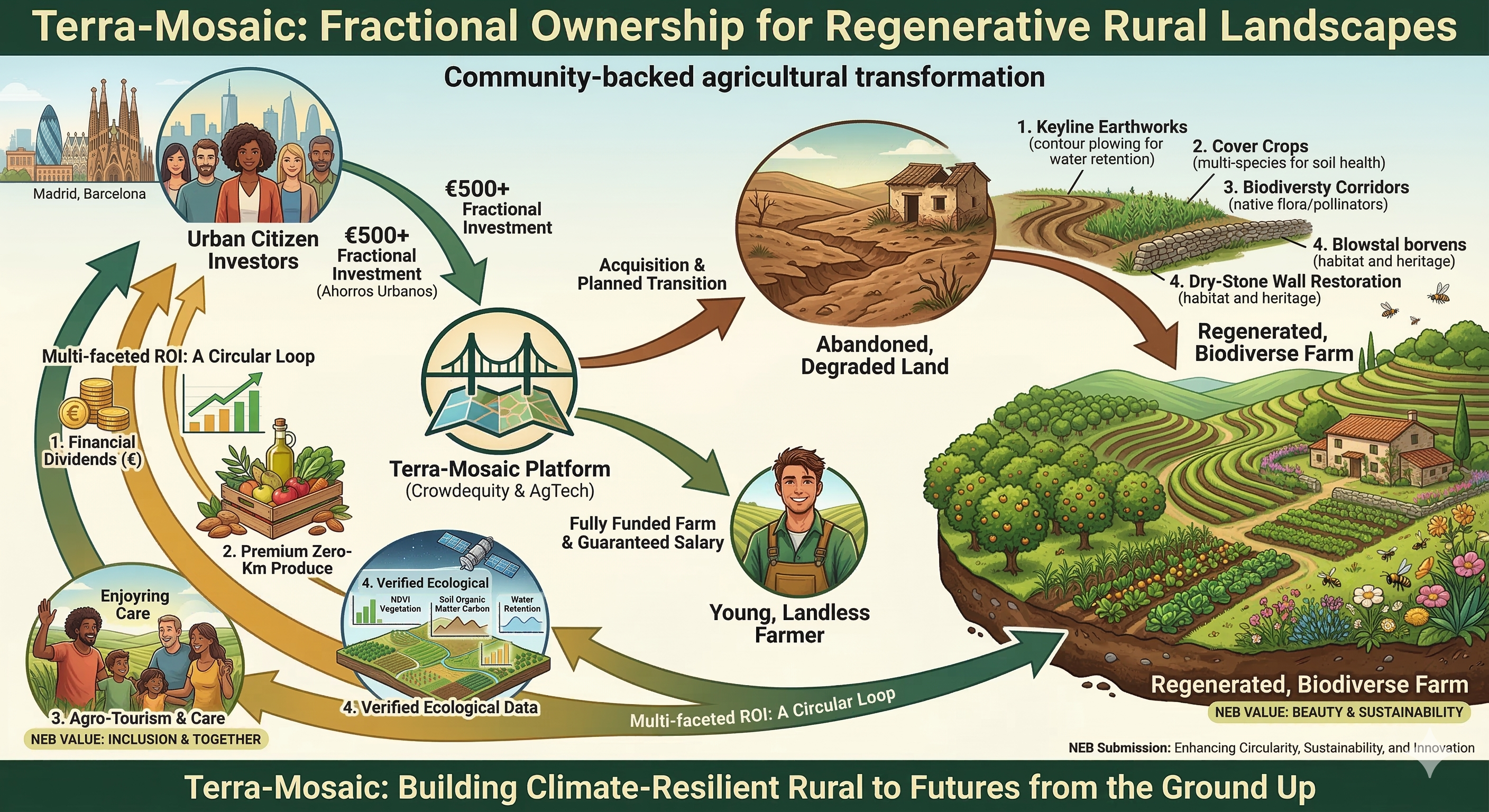
Terra-Mosaic is an innovative AgTech platform allowing urban citizens to invest in the ecological restoration of abandoned farmland. By fractionalizing land ownership, we empower young, landless farmers to implement regenerative agriculture and revive dying rural communities. Investors get a financial return, premium local produce, and the joy of watching their landscape bloom. We bridge city savings and rural revival to create beautiful, climate-resilient ecosystems.
Spain
National
Mainly rural
It involves a physical transformation of the built environment (hard investment)
Early concept
No
No
No
Individual
Spain faces a dual crisis: severe soil desertification and the socio-economic collapse of the "España Vaciada" (Empty Spain), where millions of hectares are abandoned. Concurrently, young farmers cannot afford land, while urban citizens seek meaningful climate investments. Terra-Mosaic is an AgTech crowdequity platform solving this by fractionalizing the ownership and ecological restoration of degraded farmland.
As an agricultural engineer, I designed Terra-Mosaic to tokenize a "Regenerative Masterplan". Urban citizens invest (starting at €500) to fund the purchase of abandoned estates. This capital places the land in a trust and employs landless young farmers to execute regenerative agriculture, Keyline water-retention design, and soil microbiome restoration. Investors receive financial dividends, premium zero-km produce, and eco-tourism access to "their" farm.
Achieved Results (Concept Phase):
We have finalized the core agronomic framework, establishing the technical protocols required to transition arid Mediterranean soils into resilient ecosystems. We have also designed the scalable PropTech/AgTech business model, defined the legal cooperative structure, and identified the first target pilot regions in Spain for our MVP launch.
Expected Results:
Ecological (Sustainability): Transitioning hectares of fire-prone, barren land into active carbon sinks, drastically improving water retention, stopping erosion, and boosting biodiversity.
Socio-Economic (Inclusion): Democratizing land ownership and removing the financial barrier for young agricultural entrepreneurs. It creates fair rural jobs and bridges the emotional and economic gap between urban savings and rural needs.
Aesthetic (Beauty): Replacing abandoned plots with vibrant "Living Landscapes", restoring traditional architecture and native flora, allowing investors to watch their landscape heal.
As an agricultural engineer, I designed Terra-Mosaic to tokenize a "Regenerative Masterplan". Urban citizens invest (starting at €500) to fund the purchase of abandoned estates. This capital places the land in a trust and employs landless young farmers to execute regenerative agriculture, Keyline water-retention design, and soil microbiome restoration. Investors receive financial dividends, premium zero-km produce, and eco-tourism access to "their" farm.
Achieved Results (Concept Phase):
We have finalized the core agronomic framework, establishing the technical protocols required to transition arid Mediterranean soils into resilient ecosystems. We have also designed the scalable PropTech/AgTech business model, defined the legal cooperative structure, and identified the first target pilot regions in Spain for our MVP launch.
Expected Results:
Ecological (Sustainability): Transitioning hectares of fire-prone, barren land into active carbon sinks, drastically improving water retention, stopping erosion, and boosting biodiversity.
Socio-Economic (Inclusion): Democratizing land ownership and removing the financial barrier for young agricultural entrepreneurs. It creates fair rural jobs and bridges the emotional and economic gap between urban savings and rural needs.
Aesthetic (Beauty): Replacing abandoned plots with vibrant "Living Landscapes", restoring traditional architecture and native flora, allowing investors to watch their landscape heal.
The seed for Terra-Mosaic was planted through my direct experience on the ground as an Agricultural Engineer in Spain. I spent years walking through the "España Vaciada" (Empty Spain), witnessing a heartbreaking paradox: millions of hectares of historically rich, terraced farmland were being abandoned as the older generation retired. At the same time, I met brilliant, highly trained young agronomists and farmers who were desperate to apply regenerative agriculture to fight desertification, but were completely locked out by the prohibitive cost of land.
The turning point was realizing that the capital needed to save our soil wasn't in the countryside—it was sitting in urban savings accounts in cities like Madrid or Barcelona. City dwellers wanted to fight climate change and access real, sustainable food, but lacked a transparent mechanism to do so beyond donating to NGOs.
Development & Strategy:
With zero initial capital, I approached the problem not by buying land, but by designing a bridge. The concept developed through three main phases:
1. Agronomic Feasibility (The Core): I first mapped the specific technical protocols required to transition degraded Mediterranean plots into profitable, water-retaining ecosystems using Keyline design, cover crops, and native flora integration. I had to ensure the biological model was sound.
2. The Financial Model (The Innovation): I researched successful fractional ownership (PropTech) models in the US and adapted them to the Spanish legal framework for agricultural cooperatives and trusts. The strategy was to "tokenize" the regenerative transition, allowing micro-investments starting at €500.
3. The MVP Architecture: I outlined the digital platform's UX/UI strategy, focusing on transparency. The tool allows urban investors to track soil health, biodiversity metrics, and visual landscape improvements via satellite data, connecting them emotionally to their land.
The turning point was realizing that the capital needed to save our soil wasn't in the countryside—it was sitting in urban savings accounts in cities like Madrid or Barcelona. City dwellers wanted to fight climate change and access real, sustainable food, but lacked a transparent mechanism to do so beyond donating to NGOs.
Development & Strategy:
With zero initial capital, I approached the problem not by buying land, but by designing a bridge. The concept developed through three main phases:
1. Agronomic Feasibility (The Core): I first mapped the specific technical protocols required to transition degraded Mediterranean plots into profitable, water-retaining ecosystems using Keyline design, cover crops, and native flora integration. I had to ensure the biological model was sound.
2. The Financial Model (The Innovation): I researched successful fractional ownership (PropTech) models in the US and adapted them to the Spanish legal framework for agricultural cooperatives and trusts. The strategy was to "tokenize" the regenerative transition, allowing micro-investments starting at €500.
3. The MVP Architecture: I outlined the digital platform's UX/UI strategy, focusing on transparency. The tool allows urban investors to track soil health, biodiversity metrics, and visual landscape improvements via satellite data, connecting them emotionally to their land.
Regenerative Agriculture
Rural Revitalization
Fractional Ownership
Nature-based Solutions
Landscape Restoration
Terra-Mosaic redefines sustainability by shifting agriculture from an extractive model to a regenerative, community-backed ecosystem. Spain faces severe desertification and rural abandonment; our concept tackles these intertwined environmental, economic, and cultural challenges simultaneously.
Environmental Regeneration:
As an agronomist, I designed the platform’s core metric around soil health. We do not just “farm”; we restore. By applying Keyline water-retention design, cover cropping, and zero-tillage, we plan to transform degraded, fire-prone land into active carbon sinks. This system drastically improves water infiltration—crucial for drought-stricken Mediterranean regions—and fosters biodiversity by replacing chemical-heavy monocultures with vibrant, native flora corridors.
Economic & Social Viability:
The current agricultural system is financially unsustainable for young farmers. Terra-Mosaic provides a circular economic solution. By fractionalizing land acquisition costs, we remove the massive barrier to entry, ensuring young farmers manage the land without crippling debt while earning a fair income. Furthermore, it creates a zero-kilometer supply chain: urban investors receive premium, locally grown produce, drastically reducing food transportation emissions.
Cultural Preservation:
We rescue the heritage of the "España Vaciada" (Empty Spain). Our Regenerative Masterplans include the preservation of traditional dry-stone walls and the cultivation of historic, climate-resilient crop varieties, ensuring the rural landscape is not lost to neglect.
Exemplary Character:
Terra-Mosaic is exemplary because it proves ecological restoration can be financially self-sustaining and democratic. It shows that healing the soil does not rely solely on macro-subsidies, but can be driven by collective, grassroots citizen investment.
Environmental Regeneration:
As an agronomist, I designed the platform’s core metric around soil health. We do not just “farm”; we restore. By applying Keyline water-retention design, cover cropping, and zero-tillage, we plan to transform degraded, fire-prone land into active carbon sinks. This system drastically improves water infiltration—crucial for drought-stricken Mediterranean regions—and fosters biodiversity by replacing chemical-heavy monocultures with vibrant, native flora corridors.
Economic & Social Viability:
The current agricultural system is financially unsustainable for young farmers. Terra-Mosaic provides a circular economic solution. By fractionalizing land acquisition costs, we remove the massive barrier to entry, ensuring young farmers manage the land without crippling debt while earning a fair income. Furthermore, it creates a zero-kilometer supply chain: urban investors receive premium, locally grown produce, drastically reducing food transportation emissions.
Cultural Preservation:
We rescue the heritage of the "España Vaciada" (Empty Spain). Our Regenerative Masterplans include the preservation of traditional dry-stone walls and the cultivation of historic, climate-resilient crop varieties, ensuring the rural landscape is not lost to neglect.
Exemplary Character:
Terra-Mosaic is exemplary because it proves ecological restoration can be financially self-sustaining and democratic. It shows that healing the soil does not rely solely on macro-subsidies, but can be driven by collective, grassroots citizen investment.
Terra-Mosaic redefines aesthetics by treating the rural landscape itself as a living canvas. In the context of the "España Vaciada" (Empty Spain), rural abandonment has left behind visually desolate, barren fields. Our concept brings beauty back to these territories, not through concrete, but through regenerative agronomy.
Everyday and Long-Term Beauty:
Everyday beauty is delivered both digitally and physically: urban investors experience the joy of tracking their farm's ecological revival via satellite imagery on our app, and by receiving beautifully curated boxes of the premium, colorful produce they helped grow. In the long term, we replace the visual monotony of degraded land with a vibrant, biodiverse mosaic of blooming cover crops, lush orchards, and restored ecosystems.
Sense of Belonging and Care:
Terra-Mosaic cures the emotional urban-rural divide. By allowing city dwellers to own a fraction of a farm, we transform them from passive consumers into active stewards. This link creates a profound emotional bond. When investors visit "their" land for eco-tourism weekends, walk alongside the young farmer they empowered, and sit under the shade of trees they helped plant, they develop a deep sense of belonging to a territory they previously ignored.
Exemplary Character in Aesthetics:
As an agronomist, I design our Regenerative Masterplans for both ecological function and visual harmony. We utilize Keyline water-retention design, which creates mesmerizing, organic topographical curves across the hillsides instead of harsh straight lines. We plant native pollinator borders (lavender, rosemary) that paint the landscape with seasonal colors, and we restore heritage dry-stone walls. Terra-Mosaic is exemplary because it proves that healing the earth is the ultimate form of monumental land art.
Everyday and Long-Term Beauty:
Everyday beauty is delivered both digitally and physically: urban investors experience the joy of tracking their farm's ecological revival via satellite imagery on our app, and by receiving beautifully curated boxes of the premium, colorful produce they helped grow. In the long term, we replace the visual monotony of degraded land with a vibrant, biodiverse mosaic of blooming cover crops, lush orchards, and restored ecosystems.
Sense of Belonging and Care:
Terra-Mosaic cures the emotional urban-rural divide. By allowing city dwellers to own a fraction of a farm, we transform them from passive consumers into active stewards. This link creates a profound emotional bond. When investors visit "their" land for eco-tourism weekends, walk alongside the young farmer they empowered, and sit under the shade of trees they helped plant, they develop a deep sense of belonging to a territory they previously ignored.
Exemplary Character in Aesthetics:
As an agronomist, I design our Regenerative Masterplans for both ecological function and visual harmony. We utilize Keyline water-retention design, which creates mesmerizing, organic topographical curves across the hillsides instead of harsh straight lines. We plant native pollinator borders (lavender, rosemary) that paint the landscape with seasonal colors, and we restore heritage dry-stone walls. Terra-Mosaic is exemplary because it proves that healing the earth is the ultimate form of monumental land art.
Terra-Mosaic is fundamentally an engine for socio-economic inclusion. The current agricultural system is deeply exclusionary: land prices in Spain are prohibitive for young farmers, while urban citizens without immense wealth cannot participate in rural land ownership or directly impact how their food is grown.
Affordability and Accessibility for All:
We break the financial barrier to entry on both sides. For the young farmer, Terra-Mosaic provides a fully funded, designed farm to manage without the crushing burden of a bank loan, guaranteeing them a fair, livable salary and profit-sharing. For the urban citizen, we lower the threshold of land ownership from hundreds of thousands of euros to micro-investments starting at just €500. This makes climate-positive investment accessible to the middle and working classes, not just institutional funds.
Inclusive Governance and New Societal Models:
Terra-Mosaic promotes a radical shift from the traditional "landlord-tenant" dynamic to a cooperative, community-backed model. We establish a digital, inclusive governance system where "Agro-Partners" (urban investors) and the local farmer form a decentralized cooperative. Through the platform, investors have voting rights on non-agronomic, community-focused decisions—such as organizing harvest festivals, deciding the aesthetic layout of communal areas, or directing a percentage of the harvest to local food banks.
Exemplary Character in Inclusion:
Our concept is exemplary because it bridges the deepest demographic divide in Spain: the disconnect between the aging, abandoned "España Vaciada" and the dense, wealthy urban centers. By financially linking the urbanite to the rural youth, we foster intergenerational and geographic solidarity. We don't just share land; we share risk, reward, and the responsibility of caring for our shared territory.
Affordability and Accessibility for All:
We break the financial barrier to entry on both sides. For the young farmer, Terra-Mosaic provides a fully funded, designed farm to manage without the crushing burden of a bank loan, guaranteeing them a fair, livable salary and profit-sharing. For the urban citizen, we lower the threshold of land ownership from hundreds of thousands of euros to micro-investments starting at just €500. This makes climate-positive investment accessible to the middle and working classes, not just institutional funds.
Inclusive Governance and New Societal Models:
Terra-Mosaic promotes a radical shift from the traditional "landlord-tenant" dynamic to a cooperative, community-backed model. We establish a digital, inclusive governance system where "Agro-Partners" (urban investors) and the local farmer form a decentralized cooperative. Through the platform, investors have voting rights on non-agronomic, community-focused decisions—such as organizing harvest festivals, deciding the aesthetic layout of communal areas, or directing a percentage of the harvest to local food banks.
Exemplary Character in Inclusion:
Our concept is exemplary because it bridges the deepest demographic divide in Spain: the disconnect between the aging, abandoned "España Vaciada" and the dense, wealthy urban centers. By financially linking the urbanite to the rural youth, we foster intergenerational and geographic solidarity. We don't just share land; we share risk, reward, and the responsibility of caring for our shared territory.
Terra-Mosaic is built on the premise that rural regeneration cannot be dictated from a city office; it must be co-created with the people who live on the land and those who fund it.
Involvement in Concept Development:
During the conceptualization phase, I did not rely solely on agronomic data. I conducted informal, grassroots interviews with two critical stakeholder groups:
Local aging farmers and young agronomists in the "España Vaciada": Their feedback was clear. The older generation feared their legacy would be lost to industrial macro-farms, while the youth expressed frustration at the impossibility of securing bank loans for regenerative projects.
Urban professionals in Madrid and Barcelona: I surveyed potential investors to understand their motivations. They revealed a strong desire to invest their savings in tangible, climate-positive assets rather than abstract financial products, provided the platform offered transparency and a connection to the food source.
Impact of Participation on the Concept:
This dual feedback fundamentally shaped Terra-Mosaic. Initially, I envisioned a purely B2B agricultural fund. However, stakeholder input pivoted the concept into a B2C Crowdequity platform that emphasizes the emotional and experiential return on investment (eco-tourism, produce boxes, digital tracking) alongside the financial return.
Future Participatory Architecture:
Moving forward, participation is hardcoded into the platform's governance. Urban "Agro-Partners" and the local farmer will form a digital cooperative. While the farmer retains full autonomy over technical agronomic decisions, the community will have voting rights on social and aesthetic initiatives, such as selecting native tree species for biodiversity borders, organizing harvest events, or deciding whether to donate a portion of the yield to local food banks.
Involvement in Concept Development:
During the conceptualization phase, I did not rely solely on agronomic data. I conducted informal, grassroots interviews with two critical stakeholder groups:
Local aging farmers and young agronomists in the "España Vaciada": Their feedback was clear. The older generation feared their legacy would be lost to industrial macro-farms, while the youth expressed frustration at the impossibility of securing bank loans for regenerative projects.
Urban professionals in Madrid and Barcelona: I surveyed potential investors to understand their motivations. They revealed a strong desire to invest their savings in tangible, climate-positive assets rather than abstract financial products, provided the platform offered transparency and a connection to the food source.
Impact of Participation on the Concept:
This dual feedback fundamentally shaped Terra-Mosaic. Initially, I envisioned a purely B2B agricultural fund. However, stakeholder input pivoted the concept into a B2C Crowdequity platform that emphasizes the emotional and experiential return on investment (eco-tourism, produce boxes, digital tracking) alongside the financial return.
Future Participatory Architecture:
Moving forward, participation is hardcoded into the platform's governance. Urban "Agro-Partners" and the local farmer will form a digital cooperative. While the farmer retains full autonomy over technical agronomic decisions, the community will have voting rights on social and aesthetic initiatives, such as selecting native tree species for biodiversity borders, organizing harvest events, or deciding whether to donate a portion of the yield to local food banks.
Terra-Mosaic is designed as a vertical bridge, translating macro-level European climate policies into micro-level, actionable investments for local rural communities. As an agronomist, I recognize that solving rural abandonment and desertification requires aligned action across all administrative levels.
Local Level (Municipalities & Agrarian Cooperatives):
I engage directly with local councils in the depopulating "España Vaciada" and grassroots farmers' cooperatives.
Added Value: Municipalities are crucial for identifying abandoned cadastral plots and fast-tracking land-use permits. Cooperatives provide the essential grassroots trust needed to onboard older, retiring farmers and match them seamlessly with young agronomic talent.
Regional & National Level (Spain):
Implementation involves engaging Regional Agricultural Departments (Autonomous Communities) and national bodies, including the Ministry for the Ecological Transition and financial regulators (for crowdequity compliance).
Added Value: Their engagement ensures our Regenerative Masterplans align directly with Spain's National Action Program Against Desertification. Furthermore, regional governments can provide tax incentives or matching funds for urban citizens investing in rural revitalization, multiplying the platform's financial impact.
European Level (EU Green Deal & NEB Community):
We expect to align the platform with European frameworks such as the Farm to Fork Strategy, EIT Food, and the Common Agricultural Policy (CAP) networks.
Added Value: European engagement provides the scientific standardization required for our soil health and carbon sequestration metrics. More importantly, it ensures scalability. The desertification crisis affects the entire Mediterranean basin; EU-level engagement will allow Terra-Mosaic to be replicated in countries like Italy, Greece, or Portugal facing identical socio-ecological threats.
Local Level (Municipalities & Agrarian Cooperatives):
I engage directly with local councils in the depopulating "España Vaciada" and grassroots farmers' cooperatives.
Added Value: Municipalities are crucial for identifying abandoned cadastral plots and fast-tracking land-use permits. Cooperatives provide the essential grassroots trust needed to onboard older, retiring farmers and match them seamlessly with young agronomic talent.
Regional & National Level (Spain):
Implementation involves engaging Regional Agricultural Departments (Autonomous Communities) and national bodies, including the Ministry for the Ecological Transition and financial regulators (for crowdequity compliance).
Added Value: Their engagement ensures our Regenerative Masterplans align directly with Spain's National Action Program Against Desertification. Furthermore, regional governments can provide tax incentives or matching funds for urban citizens investing in rural revitalization, multiplying the platform's financial impact.
European Level (EU Green Deal & NEB Community):
We expect to align the platform with European frameworks such as the Farm to Fork Strategy, EIT Food, and the Common Agricultural Policy (CAP) networks.
Added Value: European engagement provides the scientific standardization required for our soil health and carbon sequestration metrics. More importantly, it ensures scalability. The desertification crisis affects the entire Mediterranean basin; EU-level engagement will allow Terra-Mosaic to be replicated in countries like Italy, Greece, or Portugal facing identical socio-ecological threats.
Terra-Mosaic breaks down the silos that have traditionally isolated agriculture from urban capital and design. As an Agronomic Engineer, I realized early on that solving the desertification of the "España Vaciada" (Empty Spain) could not be achieved through agronomy alone. It required a radical fusion of fields to create a holistic, investable, and beautiful solution.
1. Agronomic Engineering & Environmental Sciences (The Foundation):
This is the core of the project. We apply advanced soil science, microbiology (microbiome restoration), and hydrology (Keyline design) to design the "Regenerative Masterplans." This ensures the ecological transition of the degraded land is scientifically rigorous, verifiable, and capable of sequestering carbon.
2. Financial Technology (Fintech & PropTech) (The Engine):
To fund the agronomic transition, we integrate digital financial technologies. By applying the principles of fractional ownership (Crowdequity) and smart contracts, we tokenize rural land. This discipline shifts the project from a traditional agricultural grant model into a scalable, decentralized financial platform accessible to any urban citizen with €500.
3. Landscape Architecture & Spatial Design (The Aesthetics):
We do not just plant crops; we design landscapes. We integrate principles of landscape architecture to ensure the restored farms are visually stunning and culturally appropriate. This involves designing native biodiversity corridors, preserving heritage dry-stone walls, and mapping the visual transformation of the territory using GIS (Geographic Information Systems).
4. Rural Sociology & Behavioral Economics (The Community):
To ensure adoption, we draw on sociology to understand the emotional barriers of the aging rural population and the motivations of the urban investor.
1. Agronomic Engineering & Environmental Sciences (The Foundation):
This is the core of the project. We apply advanced soil science, microbiology (microbiome restoration), and hydrology (Keyline design) to design the "Regenerative Masterplans." This ensures the ecological transition of the degraded land is scientifically rigorous, verifiable, and capable of sequestering carbon.
2. Financial Technology (Fintech & PropTech) (The Engine):
To fund the agronomic transition, we integrate digital financial technologies. By applying the principles of fractional ownership (Crowdequity) and smart contracts, we tokenize rural land. This discipline shifts the project from a traditional agricultural grant model into a scalable, decentralized financial platform accessible to any urban citizen with €500.
3. Landscape Architecture & Spatial Design (The Aesthetics):
We do not just plant crops; we design landscapes. We integrate principles of landscape architecture to ensure the restored farms are visually stunning and culturally appropriate. This involves designing native biodiversity corridors, preserving heritage dry-stone walls, and mapping the visual transformation of the territory using GIS (Geographic Information Systems).
4. Rural Sociology & Behavioral Economics (The Community):
To ensure adoption, we draw on sociology to understand the emotional barriers of the aging rural population and the motivations of the urban investor.
Terra-Mosaic operates as a financially self-sustaining AgTech and Crowdequity platform. While many ecological restoration projects rely indefinitely on public subsidies, our business model is designed to be profitable, scalable, and market-driven, ensuring long-term EU competitiveness in the AgTech sector.
The envisioned business model generates revenue through three primary streams, ensuring viability beyond initial seed funding:
1. Structuring & Origination Fee (CapEx Phase):
When an abandoned farm's "Regenerative Masterplan" is published on the platform, urban citizens invest to fund the land acquisition and transition costs. Terra-Mosaic charges a one-time structuring fee (e.g., 5-8%) on the total capital raised. This covers the legal framework creation, agronomic auditing, and platform onboarding.
2. Management & Agronomic Success Fee (OpEx Phase):
To secure recurring revenue, the platform charges a small annual management fee deducted from the farm's yearly agricultural profits before dividends are distributed to investors. Because we design the agronomic system, we also take a minor percentage of the premium "zero-kilometer" harvest sales (B2C/B2B). This aligns our financial success directly with the productive success of the local young farmer.
3. B2B ESG & Biodiversity Credits (Scaling Phase):
As the soil health improves, our platform's digital twin will verify the carbon sequestered and water retained. We will aggregate this data and sell certified biodiversity/carbon credits to European corporations needing to meet ESG targets, creating a high-margin B2B revenue stream.
Financial Sustainability:
Public funding (such as the NEB Prize) is strictly envisioned to build the software MVP and execute the first pilot farm. Once operational, transaction fees and B2B monetization will make Terra-Mosaic 100% financially independent and highly scalable across Europe.
The envisioned business model generates revenue through three primary streams, ensuring viability beyond initial seed funding:
1. Structuring & Origination Fee (CapEx Phase):
When an abandoned farm's "Regenerative Masterplan" is published on the platform, urban citizens invest to fund the land acquisition and transition costs. Terra-Mosaic charges a one-time structuring fee (e.g., 5-8%) on the total capital raised. This covers the legal framework creation, agronomic auditing, and platform onboarding.
2. Management & Agronomic Success Fee (OpEx Phase):
To secure recurring revenue, the platform charges a small annual management fee deducted from the farm's yearly agricultural profits before dividends are distributed to investors. Because we design the agronomic system, we also take a minor percentage of the premium "zero-kilometer" harvest sales (B2C/B2B). This aligns our financial success directly with the productive success of the local young farmer.
3. B2B ESG & Biodiversity Credits (Scaling Phase):
As the soil health improves, our platform's digital twin will verify the carbon sequestered and water retained. We will aggregate this data and sell certified biodiversity/carbon credits to European corporations needing to meet ESG targets, creating a high-margin B2B revenue stream.
Financial Sustainability:
Public funding (such as the NEB Prize) is strictly envisioned to build the software MVP and execute the first pilot farm. Once operational, transaction fees and B2B monetization will make Terra-Mosaic 100% financially independent and highly scalable across Europe.
Terra-Mosaic is fundamentally designed not as a localized physical intervention, but as a highly scalable digital and legal framework. Because our solution relies on software and standardized agronomic methodologies rather than heavy physical infrastructure, its transferability across Europe is immense.
Geographic Replicability (The Mediterranean Context):
The dual crisis of rural aging/abandonment and soil desertification is not exclusive to the "España Vaciada." It is a systemic threat across Southern Europe, including Italy’s Mezzogiorno, inland Portugal, and rural Greece. The agronomic protocols we are developing for Mediterranean climates (Keyline design, drought-resistant cover crops) and the financial framework for fractional land ownership can be directly exported to these neighboring countries to save their rural heritage.
Technological Transferability:
The core AgTech/PropTech architecture—the user interface for urban micro-investors, the integration of satellite imagery for tracking soil health, and the dividend distribution algorithm—is entirely borderless. The software code can be localized and deployed in any EU member state, adapting only the specific national trust or cooperative laws.
Methodological Replicability:
Our "Regenerative Masterplan" process is a replicable blueprint. The methodology of (1) identifying abandoned land, (2) calculating the ecological transition cost, and (3) matching it with a landless young farmer, can be applied to vastly different agricultural sectors—from olive groves in Spain to vineyards in France or degraded forestry in Romania.
Cross-Sectoral Expansion:
Beyond agriculture, the core concept of "crowdfunding landscape regeneration" can be transferred to other urgent sectors, such as the ecological restoration of abandoned industrial sites (brownfields) or the protection of coastal wetlands.
Geographic Replicability (The Mediterranean Context):
The dual crisis of rural aging/abandonment and soil desertification is not exclusive to the "España Vaciada." It is a systemic threat across Southern Europe, including Italy’s Mezzogiorno, inland Portugal, and rural Greece. The agronomic protocols we are developing for Mediterranean climates (Keyline design, drought-resistant cover crops) and the financial framework for fractional land ownership can be directly exported to these neighboring countries to save their rural heritage.
Technological Transferability:
The core AgTech/PropTech architecture—the user interface for urban micro-investors, the integration of satellite imagery for tracking soil health, and the dividend distribution algorithm—is entirely borderless. The software code can be localized and deployed in any EU member state, adapting only the specific national trust or cooperative laws.
Methodological Replicability:
Our "Regenerative Masterplan" process is a replicable blueprint. The methodology of (1) identifying abandoned land, (2) calculating the ecological transition cost, and (3) matching it with a landless young farmer, can be applied to vastly different agricultural sectors—from olive groves in Spain to vineyards in France or degraded forestry in Romania.
Cross-Sectoral Expansion:
Beyond agriculture, the core concept of "crowdfunding landscape regeneration" can be transferred to other urgent sectors, such as the ecological restoration of abandoned industrial sites (brownfields) or the protection of coastal wetlands.
Phase 1: Legal Structuring & Site Selection (Months 1-3)
The immediate first step is resolving the regulatory framework. We will use the initial funds to hire specialized legal counsel to establish the trust or cooperative structure required for fractional land ownership under Spanish law. Concurrently, I will secure the first pilot plot in the 'España Vaciada', finalize its specific 'Regenerative Masterplan' (soil baseline metrics, Keyline topography mapping), and pre-select a local landless young farmer.
Phase 2: MVP Development & Tech Integration (Months 4-7)
We will develop the Minimum Viable Product (MVP) of the Terra-Mosaic digital platform. This involves building the core UX/UI, integrating secure payment gateways for micro-investments (€500+), and linking basic satellite APIs (e.g., Copernicus open data) to create the visual dashboard where future investors will track soil moisture and vegetation indexes.
Phase 3: Launching the First Campaign (Months 8-10)
With the legal framework and MVP ready, we will launch our first crowdfunding campaign. We will execute a targeted digital marketing strategy aimed at environmentally conscious urban professionals in cities like Madrid and Barcelona, validating our B2C traction and raising the capital to purchase the pilot farm.
Phase 4: Physical Execution & Onboarding (Months 11-12)
Upon successful funding, the land will be officially acquired by the trust. The young farmer will be onboarded, and the physical regeneration (earthworks, dry-stone wall restoration, and cover cropping) will begin, proving our model works on the ground.
The immediate first step is resolving the regulatory framework. We will use the initial funds to hire specialized legal counsel to establish the trust or cooperative structure required for fractional land ownership under Spanish law. Concurrently, I will secure the first pilot plot in the 'España Vaciada', finalize its specific 'Regenerative Masterplan' (soil baseline metrics, Keyline topography mapping), and pre-select a local landless young farmer.
Phase 2: MVP Development & Tech Integration (Months 4-7)
We will develop the Minimum Viable Product (MVP) of the Terra-Mosaic digital platform. This involves building the core UX/UI, integrating secure payment gateways for micro-investments (€500+), and linking basic satellite APIs (e.g., Copernicus open data) to create the visual dashboard where future investors will track soil moisture and vegetation indexes.
Phase 3: Launching the First Campaign (Months 8-10)
With the legal framework and MVP ready, we will launch our first crowdfunding campaign. We will execute a targeted digital marketing strategy aimed at environmentally conscious urban professionals in cities like Madrid and Barcelona, validating our B2C traction and raising the capital to purchase the pilot farm.
Phase 4: Physical Execution & Onboarding (Months 11-12)
Upon successful funding, the land will be officially acquired by the trust. The young farmer will be onboarded, and the physical regeneration (earthworks, dry-stone wall restoration, and cover cropping) will begin, proving our model works on the ground.