Enablers for New European Bauhaus Transformation
Defensive Pedal
Defensive Pedal
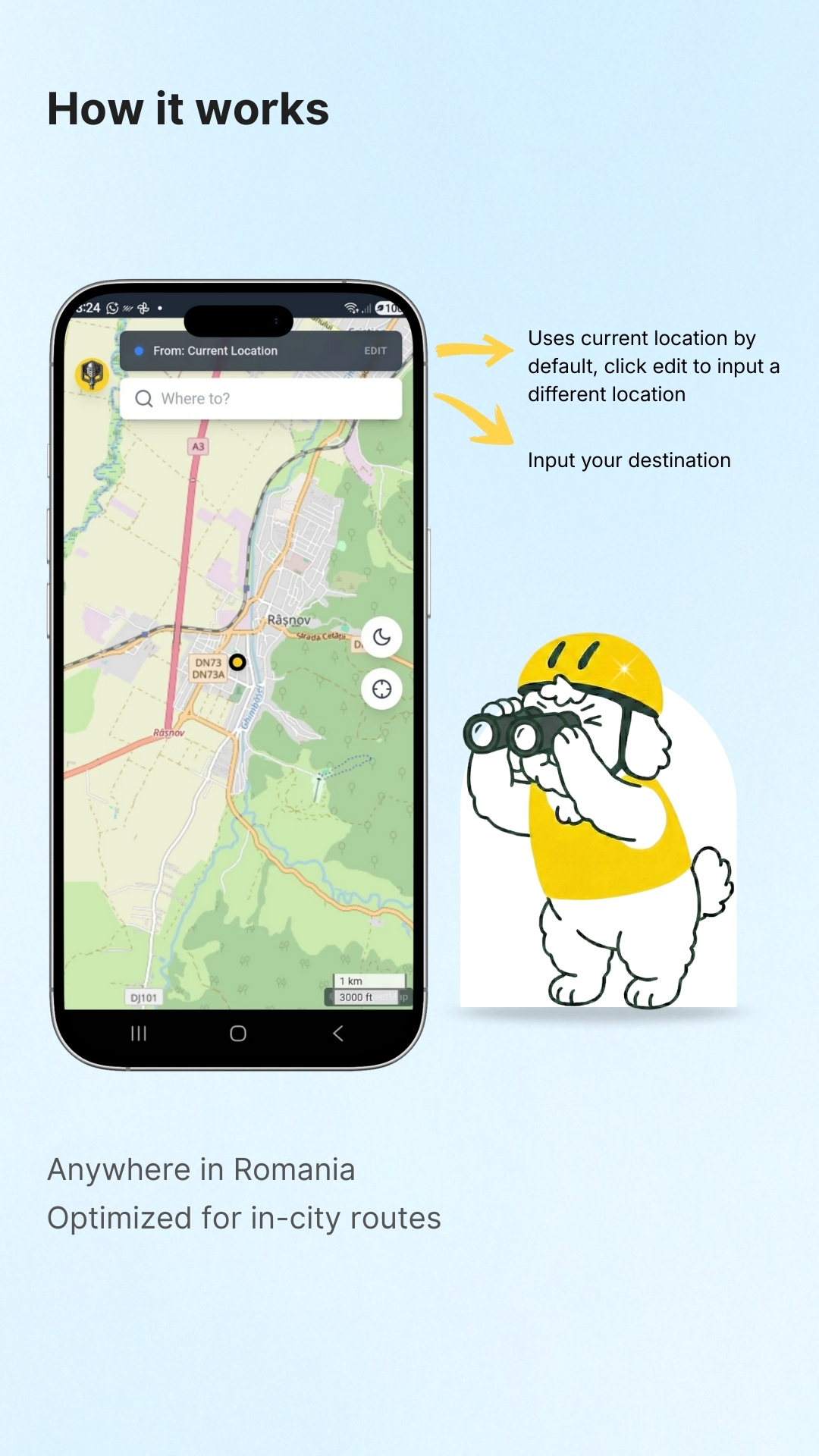
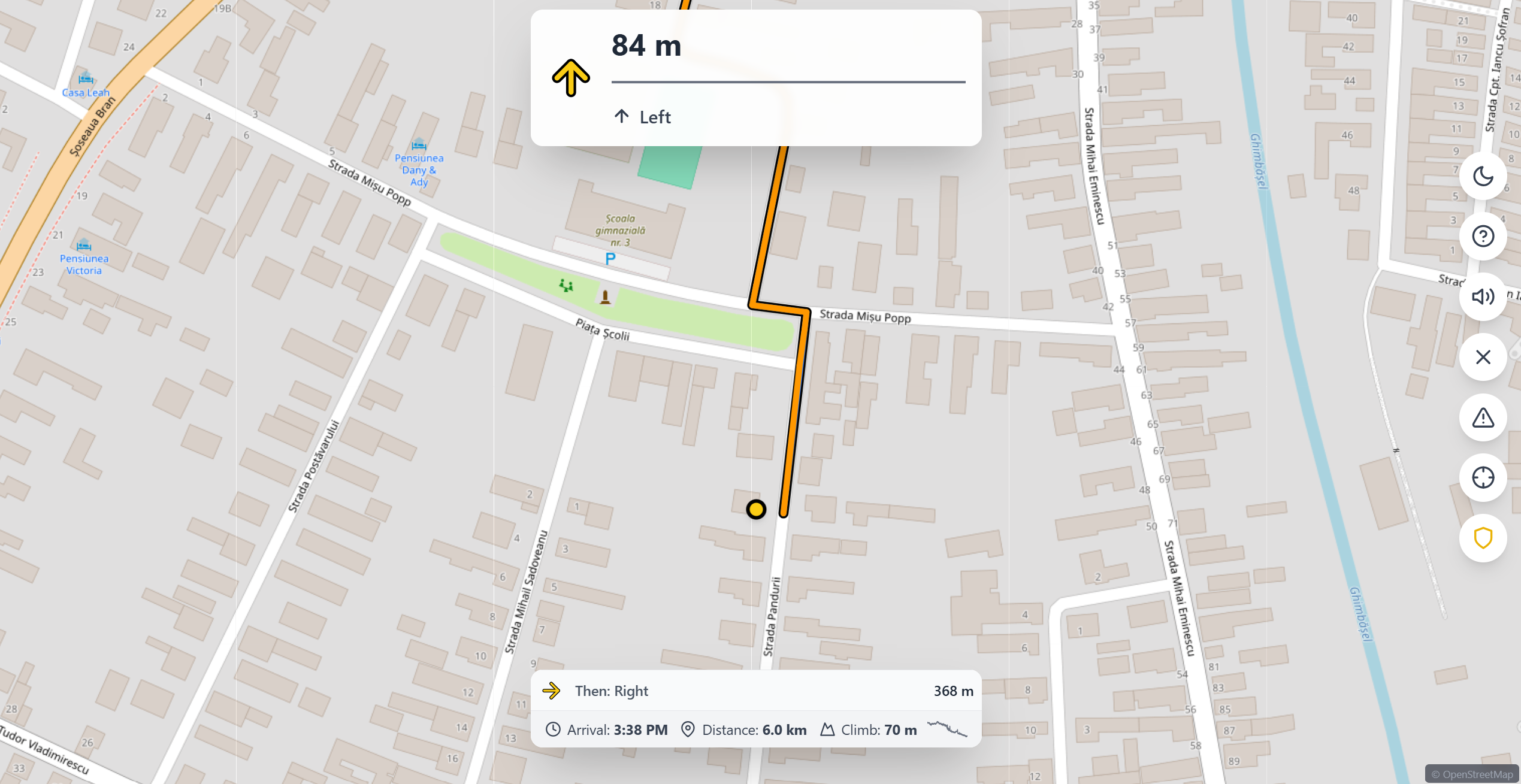
Defensive Pedal turns fear into confidence for everyday cycling. Using our cyclist risk map and safer route guidance, we help people choose calmer, lower-risk streets and help cities understand where cycling feels unsafe. Already piloted and applied with World Bank collaboration in Romanian cities, the project supports healthier, lower-carbon, more human urban mobility.
Romania
National
Mainly urban
It involves other types of transformations (soft investment)
Yes
2026-03-04
No
No
No
Individual
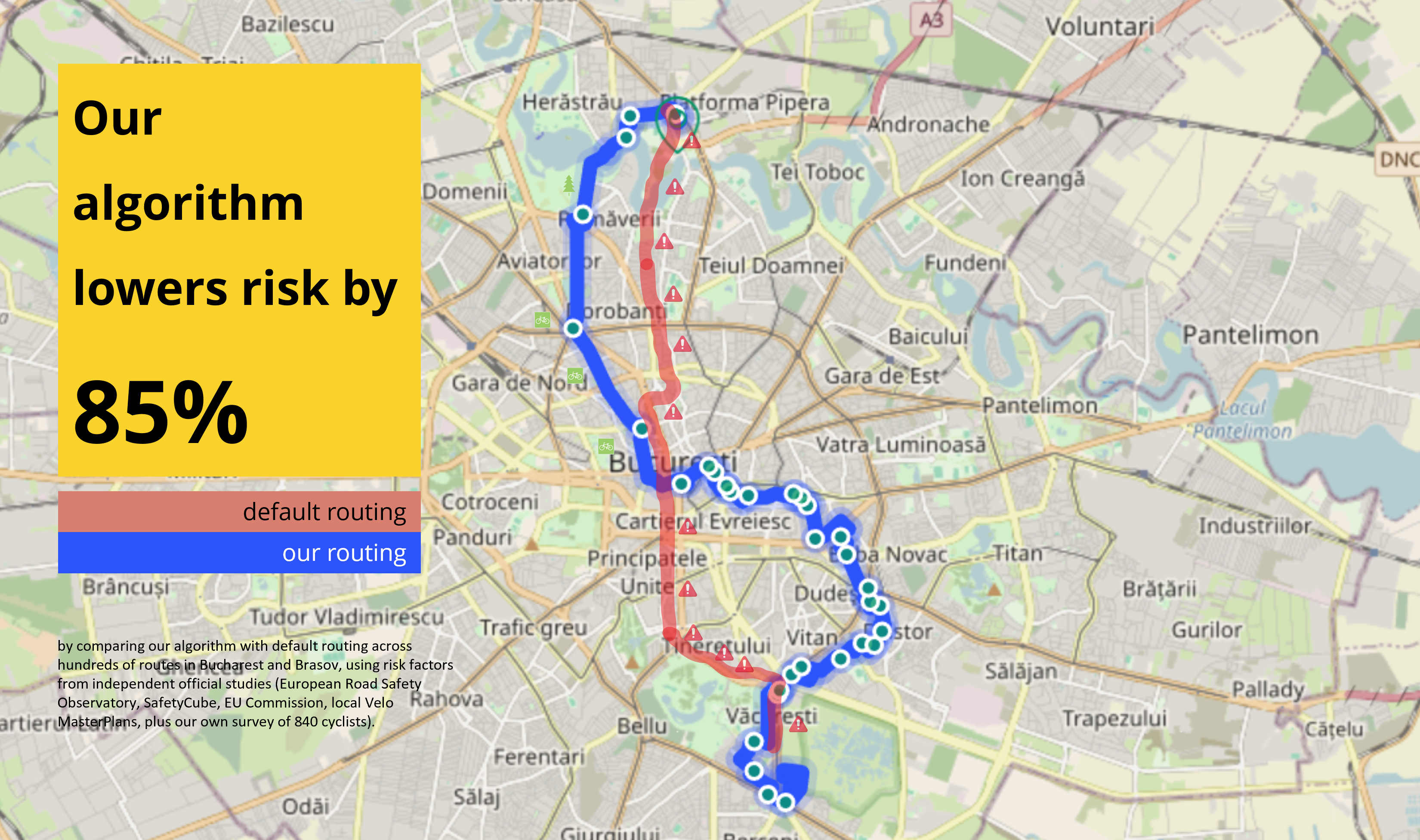
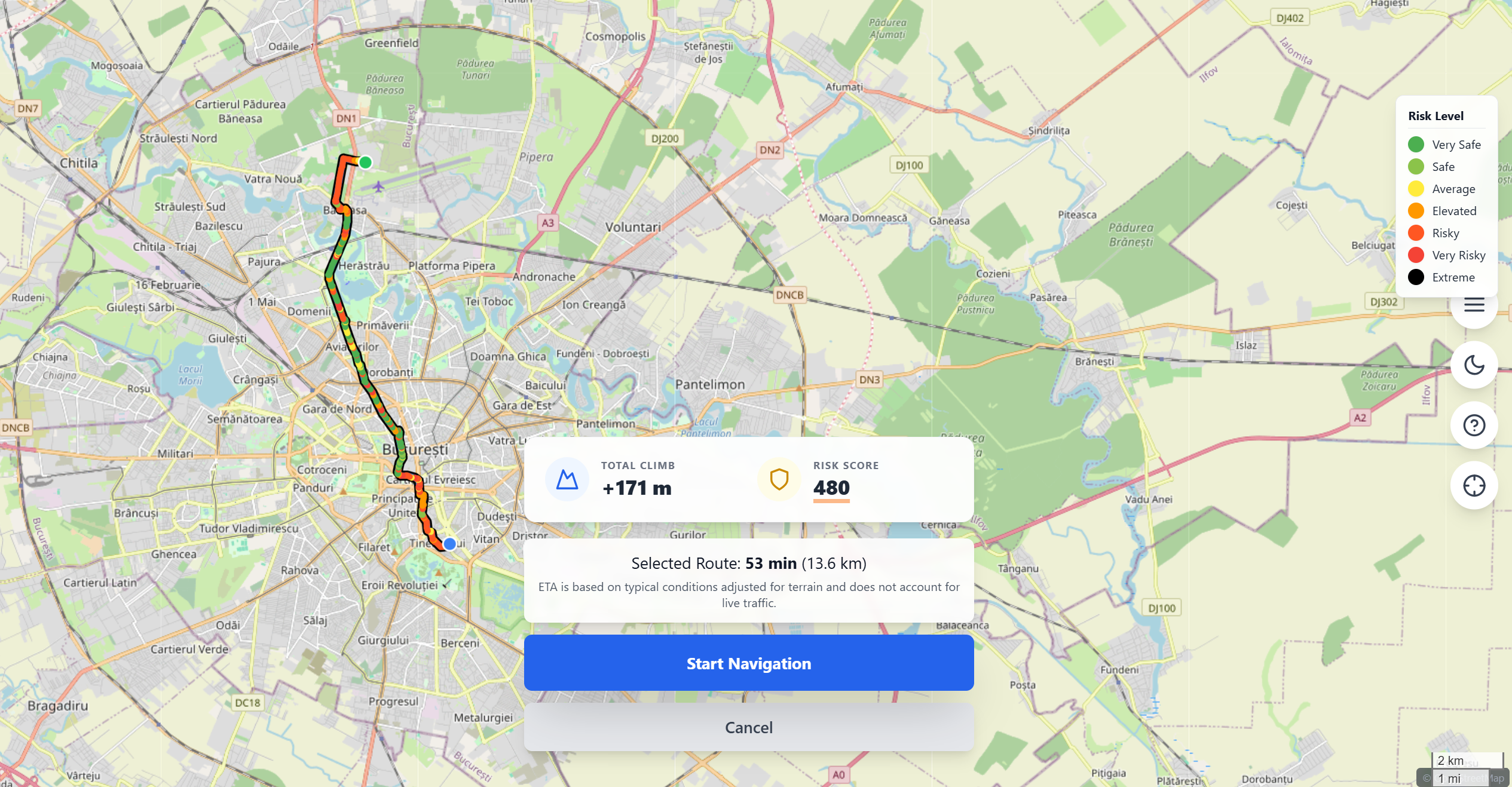
Defensive Pedal is a cyclist-safety project that helps people choose calmer, lower-risk urban routes and helps cities understand where cycling feels unsafe. We developed a safety-routing method that evaluates each street segment using 25+ proven risk factors and compares route options based on total risk, not only distance or speed. Our approach has already been validated across hundreds of routes in Romania, where our routing showed an average risk reduction of about 85% compared with default routing.
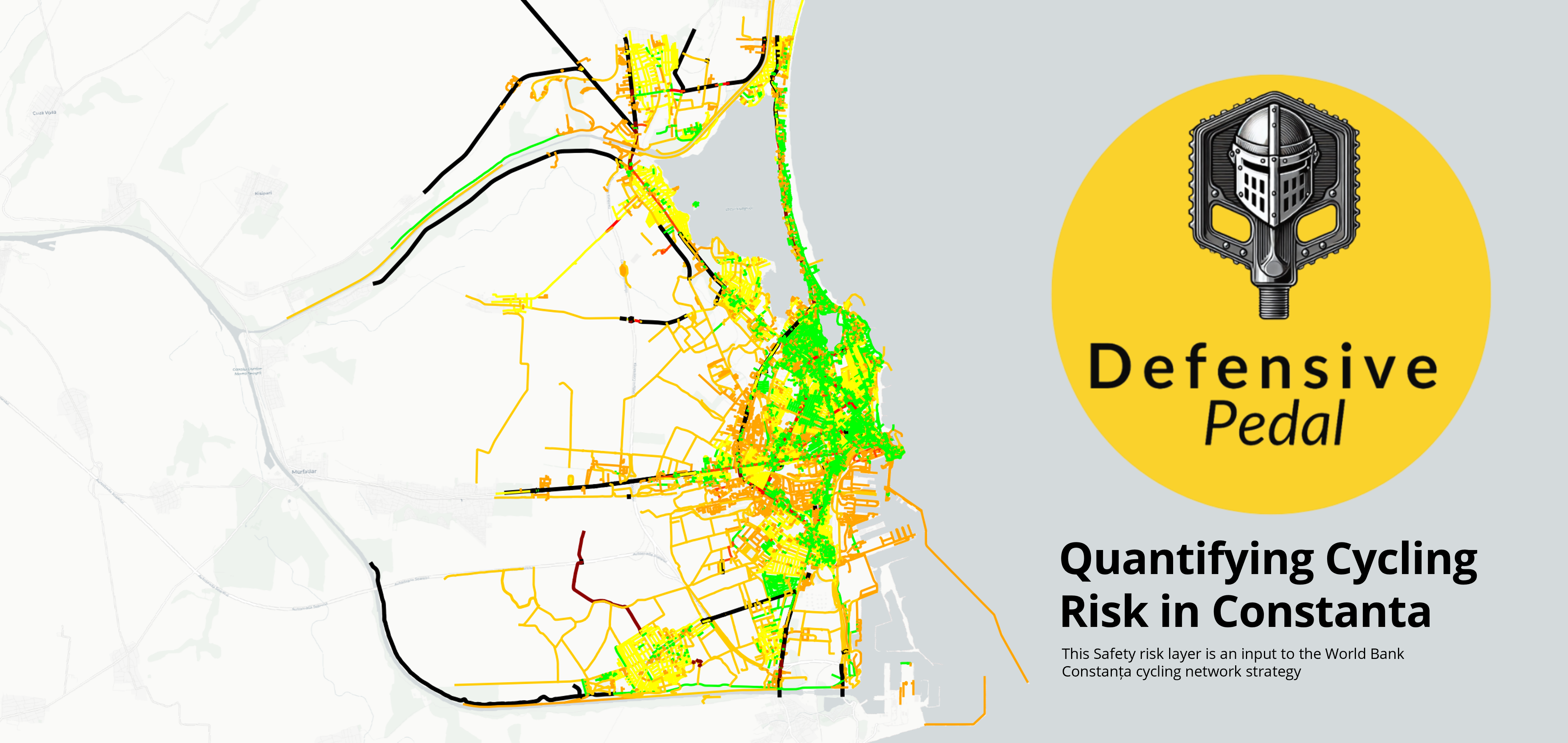
Already achieved results include strong demand validation through a survey of around 840 cyclists, more than 900 early-access sign-ups, testing with 200+ people, a pilot with Alba Iulia municipality, and the creation of an interactive cyclist risk map for all of Romania. This map is already helping local actors understand safer and less safe urban areas for cycling, and we are collaborating with the World Bank to apply our risk map and risk knowledge in Iași, Constanța, and soon other cities.
The project’s long-term impact is both social and spatial. For citizens, Defensive Pedal can turn fear into confidence and make everyday cycling accessible to many “near-cyclists” who would otherwise drive. For cities, it provides granular safety intelligence that can support evidence-based street design, cycling planning, and velo masterplans. Over time, this can contribute to healthier lifestyles, lower transport emissions, safer streets, and more inclusive urban mobility. By combining safer route guidance with city-scale safety intelligence, Defensive Pedal is designed not only as a digital tool for individual trips, but as an enabler of broader urban transformation toward healthier, lower-carbon, more human-centred cities
Defensive Pedal grew out of a simple observation: many people would like to cycle in cities, but do not, because the journey does not feel safe from start to finish. Bike lanes help, but they are often fragmented, and the level of danger can vary greatly from one street to the next. We started by studying official road-safety research and local velo masterplans to identify the factors that make a street segment feel and be more or less risky for cyclists. We then translated this into a safety-routing method that evaluates each street segment and prioritises lower-risk routes rather than simply the shortest path.
The project was implemented step by step on the ground. We tested the concept with cyclists and near-cyclists through surveys, real-route comparisons, and live interactions at public events, then refined the model using feedback and trip data from more than 1,300 people. This process also helped us understand not only where danger exists objectively, but where fear prevents people from choosing the bicycle in everyday life.
From there, the project moved from methodology to real local application. We built an interactive cyclist risk map for the whole of Romania, allowing cities and other stakeholders to understand where cycling feels safer or less safe and where improvements are most needed. We are piloting the application with Alba Iulia municipality as part of its programme to encourage the use of bike lanes. In parallel, we are collaborating with the World Bank to use our risk map and our safety knowledge for cities including Iași and Constanța.
In this way, Defensive Pedal was implemented not only as a digital tool for individual users, but also as a practical support instrument for local authorities and urban mobility planning. It grew from experience and public need in a concrete, place-based project that helps residents choose calmer routes, helps cities make better decisions, and supports the transition toward safer, healthier and human cities
cyclist safety
low-carbon mobility
human cities
urban transformation
vision zero
Defensive Pedal addresses sustainability by making low-carbon urban mobility realistically usable for the many people who would like to cycle but do not because they feel unsafe. Instead of requiring new construction, we help people use existing streets and bike infrastructure more confidently by guiding them along calmer, lower-risk routes. In this way, the project can unlock higher cycling uptake with limited material resources, while also helping cities get more value from infrastructure they already have.
Our sustainability impact is environmental, social and economic at the same time. Environmentally, the project supports a shift from car trips to bicycle trips, reducing transport emissions and air pollution. Socially, it makes active mobility more accessible to “near-cyclists” — people who would cycle if they felt safer — and therefore supports healthier daily habits, safer streets and better quality of life. Economically, it helps households reduce transport costs and helps municipalities identify where safety improvements would have the greatest effect, making future investments more evidence-based and efficient.
What makes Defensive Pedal exemplary is that it combines individual behaviour change with city-scale transformation. We have already developed an interactive cyclist risk map for the whole of Romania, are piloting the application with Alba Iulia municipality, and are collaborating with the World Bank to use our risk map and safety knowledge for cities including Iași and Constanța. This means the project does not only help one user choose one safer trip; it also helps local authorities understand where cycling feels unsafe and how to improve urban mobility systems over time.
Our approach is lightweight, scalable and replicable. It is based on open data, city-calibrated safety analysis, and practical application in real urban contexts. By eliminating fea, Defensive Pedal helps cities move toward lower-carbon, healthier and more human mobility
Defensive Pedal contributes to aesthetics by changing how the city is felt in everyday life. For many people, cycling is not absent from their lives because they do not value it, but because the city feels tense, fragmented and intimidating when experienced by bike. By helping people move through calmer, lower-risk streets and connect fragmented cycling infrastructure into routes that feel coherent and reassuring, Defensive Pedal transforms daily mobility from an experience of stress and vigilance into one of confidence, clarity and comfort.
This is a concrete form of beauty. A beautiful city is not only one that looks good, but one that feels welcoming, legible and humane in everyday use. When people can move through their neighbourhood with less fear and more ease, the city becomes more liveable and caring. Defensive Pedal helps residents experience streets not as barriers, but as part of a continuous and dignified journey. It allows people to rediscover familiar places from a calmer perspective and makes active mobility feel more natural and enjoyable.
The project also strengthens belonging and care for place. Our cyclist risk map makes visible where the urban environment feels safe and where it feels threatening, giving communities and local authorities a shared language for understanding the lived experience of the city. This supports more caring decisions and a stronger relationship between people and place. In this way, Defensive Pedal shows that beauty is also about feeling safe, oriented and at ease in everyday life, and about creating cities that are more human, inclusive and inviting.
Defensive Pedal is inclusive because it is designed for the many people who would like to cycle but do not because they feel unsafe. We focus especially on “near-cyclists” — people excluded from active mobility not by lack of interest, but by fear, fragmented infrastructure, cost of car dependence, and lack of trustworthy guidance. By helping people find calmer, lower-risk routes, we make cycling more accessible for everyday users, not only for confident or experienced riders.
The project also supports affordability. Cycling is one of the most accessible low-cost forms of urban mobility, but many people still feel forced to use a car because it seems safer. Defensive Pedal helps reduce that barrier, enabling more people to choose a healthier and less expensive way of moving through the city.
Our approach promotes inclusive governance by making cyclists’ lived experience visible to decision-makers. Through our city-scale and national risk maps, municipalities and other actors can understand where people feel safe, where they do not, and where improvements are most needed. This creates a stronger basis for evidence-based, people-centred planning. We are already applying this through a pilot with Alba Iulia municipality, our interactive risk map for all of Romania, and collaboration with the World Bank for cities including Iași and Constanța.
The project can be considered exemplary in terms of inclusion because it expands who the city works for. It does not assume that only fast, fit, confident cyclists matter. Instead, it is built around those currently left out of urban cycling and helps create conditions in which safer, low-carbon mobility becomes realistic for a much wider public. In this way, Defensive Pedal supports design for all not through one-size-fits-all infrastructure, but through safer everyday access, better public decisions, and a more human-centred mobility model.
Defensive Pedal has been shaped through continuous involvement of the people and communities it is meant to serve. We began by engaging cyclists and “near-cyclists” through a voluntary survey of around 840 people, which helped us understand not only route preferences, but also the fear, barriers and safety concerns that stop many people from cycling in everyday life. We then tested the concept in real-world settings, including public community events such as Street Delivery in Brașov and Bucharest, where more than 200 people interacted with and tested the project before launch.
Citizens did not play a passive role. Their input helped refine the selection and weighting of the safety factors behind our routing model, and feedback from more than 1,300 people has been used to improve how the algorithm understands perceived and real risk. This means the project was not designed only from technical or institutional assumptions, but also from lived experience.
Civil society and community actors have also been important in implementation. Our outreach and testing have been supported through cycling communities, NGOs, bike shops and public events, which helped us reach users in trusted local spaces rather than only through digital channels. This community-based process increased both credibility and relevance.
The impact of this participation has been substantial. It validated strong demand, improved the quality of our safety model, and ensured that the project responds to the needs of people who are often excluded from cycling by fear rather than by lack of interest. It also helped create the basis for implementation with public actors, including our pilot with Alba Iulia municipality and the broader use of our cyclist risk map in collaboration with the World Bank for Romanian cities. In this way, participation has not been an accessory to the project, but one of the main reasons it became both usable and relevant in real urban contexts.
Defensive Pedal has involved stakeholders at several levels, with the strongest engagement so far at local and national level. Locally, citizens, cyclists, near-cyclists, cycling communities, NGOs, bike shops and community events helped shape the project through surveys, real-world testing and direct feedback. Their involvement ensured that the project responds to lived experience, not only technical assumptions, and helped us refine the safety model around the real barriers people face in everyday urban cycling.
At local institutional level, Alba Iulia municipality is involved through our pilot, supporting implementation in a real city context and creating a direct link between citizen use and public decision-making.
At national level, we expanded from individual routing to a cyclist risk map covering all of Romania. This helps local administrations and other actors understand where cycling feels safer or less safe and where improvements are most needed, creating a shared evidence base beyond one city.
At multi-city level, we are collaborating with the World Bank to apply our risk map and safety knowledge in cities including Iași and Constanța. This adds strategic value by connecting citizen experience with broader planning processes such as velo masterplans and safety-oriented urban mobility decisions.
At European level, the project draws on European road-safety knowledge and mobility networks, strengthening its transferability. The added value of this multilevel engagement is that Defensive Pedal works both bottom-up and top-down: it starts from citizens’ lived experience, is tested with local authorities, and can scale into a shared planning tool for safer, more inclusive urban mobility.
Defensive Pedal is transdisciplinary by design. It brings together urban mobility, road-safety research, digital technology, data science, behavioural insight, urban planning and community knowledge. The project began from a mobility and public-health problem — that many people do not cycle because cities feel unsafe — and translated that problem into a practical tool for both citizens and local authorities.
In technical terms, the project combines geospatial analysis, routing engineering and AI-supported optimisation. Our safety-routing method uses 25+ proven risk factors for each street segment and applies them through a custom routing engine, while also integrating open data, infrastructure data, user feedback and additional external data such as traffic, weather and street-level information.
At the same time, the project reflects knowledge from social sciences and behavioural research. We built it not only on official studies, but also on surveys, user testing and feedback from more than 1,300 people, which helped us understand perceived safety, fear and the barriers that prevent “near-cyclists” from choosing the bicycle in everyday life.
Urban planning is also central to the project. Our work draws on local velo masterplans and is now applied not only as safer route guidance for individuals, but also as a city-scale risk map that can support municipalities, public institutions and planning processes. This is visible in our pilot with Alba Iulia municipality and in our collaboration with the World Bank for cities including Iași and Constanța.
Because of this combination, Defensive Pedal is not only a digital product. It is a project at the intersection of engineering, civic mobility, planning, public health and lived urban experience, which is exactly what allows it to create both immediate user value and longer-term urban transformation.
Defensive Pedal is designed to become financially sustainable through a mixed revenue model that combines user subscriptions with mission-aligned B2B and impact-based revenues. The core model is freemium: the app is free to access, while premium features such as safer route optimisation, hazard alerts and enhanced functionality are offered through low monthly subscriptions of €3 and €5. This creates an accessible entry point for users while generating recurring income as adoption grows.
Over time, this is complemented by additional revenue streams that are closely linked to the project’s public value. These include affiliate commissions from safety gear sales, the sale of aggregated and anonymised cycling-mobility data to municipalities, urban planning consultants and other organisations, and, in the longer term, carbon credits linked to modal shift from cars to bicycles. This diversified structure reduces dependence on a single source of income and strengthens long-term resilience.
The model is financially sustainable because the project has strong operational leverage: once the digital infrastructure and safety model are in place, the cost of serving additional users is relatively low. Our plan also relies on cost-efficient growth channels such as cycling communities, NGOs, bike shops, public events and municipal partnerships, which help build trust while keeping acquisition costs low.
The project’s sustainability is also reinforced by its dual value proposition. Defensive Pedal creates value for individual users, who gain safer and more confident daily mobility, and for public and professional stakeholders, who gain safety intelligence for planning and better investment decisions. This makes the model both socially useful and economically credible over time.
First, the core methodology is highly portable: our safety-routing model evaluates each street segment using 25+ risk factors, combines open data with local knowledge and community feedback, and recalibrates the result for each city. This means we will easily adapt to expand in the whole of Europe in a couple of years.
Second, the technology is scalable. Our routing engine, city-calibrated safety layer, hazard reporting logic and feedback loops can be applied in other cities and countries wherever basic map and infrastructure data exist. Because the model is built on widely available data and is strengthened through local calibration, it can transfer to places with different levels of cycling infrastructure maturity.
Third, the project is transferable not only as a user tool, but also as a planning instrument. We have already built an interactive cyclist risk map for all of Romania, which helps administrations and other actors understand how safe or unsafe their city feels for cycling and is especially useful for velo masterplans. We are also collaborating with the World Bank to use this risk map and our risk knowledge for cities including Iași and Constanța.
Fourth, the implementation model is replicable. Our pilot logic in Alba Iulia shows how a municipality can use the project with light coordination, local GIS input and communication support, while we provide the calibrated model and digital tool. This makes transfer feasible even for cities with limited resources.
Finally, our key learning is that safer cycling can be scaled not only through new infrastructure, but also through better use, understanding and connection of what already exists. In this sense, Defensive Pedal can be replicated across cities, beneficiary groups and institutional contexts: as a safer-routing tool for citizens, as a confidence-building tool for near-cyclists, and as a decision-support tool for municipalities and mobility planners.
- https://da.zf.ro/info/tech-catalyst-si-a-desemnat-castigatorii-solutii-digitale-pentru-22850095?utm_source=chatgpt.com
- https://hotnews.ro/video-am-fost-ciclist-15-ani-in-bucuresti-dar-n-am-convins-pe-nimeni-sa-mearga-cu-bicicleta-victor-incearca-sa-reduca-riscurile-pentru-biciclisti-cu-aplicatia-defensive-pedal-2121169?utm_source=chatgpt.com